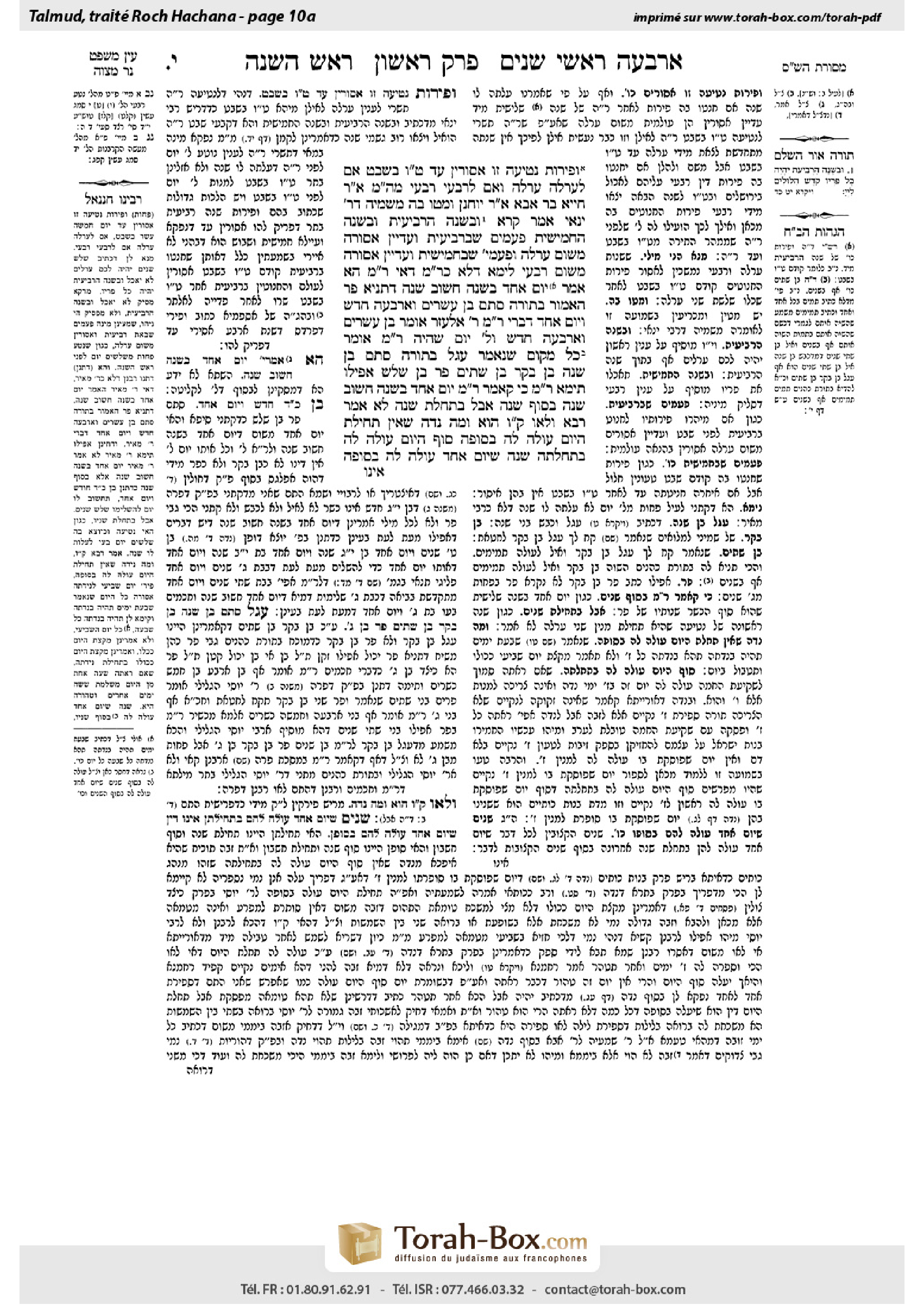
Rosh Hashanah 10a: Talmud study for Daf Yomi
Daf Yomi is the daily study of one Talmud folio. Explore 37 tractates with scans, Hebrew text, Sefaria English and AI-generated French translations where annotated.
Passage selection and English or AI-generated French translation are available where the scan has annotations. Daf Study is independent of Torah-Box and Sefaria.
Browse Rosh Hashanah · ראש השנה · All tractatesRosh Hashanah 10a text and translations
This page of Rosh Hashanah includes the Aramaic text, an English translation and an AI-generated French translation, alongside the scan above.
ראש השנה י׳ א · Aramaic and Hebrew text
וּפֵירוֹת נְטִיעָה זוֹ אֲסוּרִין עַד חֲמִשָּׁה עָשָׂר בִּשְׁבָט, אִם לְעׇרְלָה — עׇרְלָה, וְאִם לִרְבָעִי — רְבָעִי.
מְנָא הָנֵי מִילֵּי? אָמַר רַבִּי חִיָּיא בַּר אַבָּא אָמַר רַבִּי יוֹחָנָן, וּמָטוּ בָּהּ מִשְּׁמֵיהּ דְּרַבִּי יַנַּאי, אָמַר קְרָא: ״וּבַשָּׁנָה הָרְבִיעִית וּבַשָּׁנָה הַחֲמִישִׁית״.
פְּעָמִים שֶׁבָּרְבִיעִית וַעֲדַיִין אֲסוּרָה מִשּׁוּם עׇרְלָה, וּפְעָמִים שֶׁבַּחֲמִישִׁית וַעֲדַיִין אֲסוּרָה מִשּׁוּם רְבָעִי.
לֵימָא דְּלָא כְּרַבִּי מֵאִיר, דְּאִי רַבִּי מֵאִיר — הָא אָמַר: יוֹם אֶחָד בַּשָּׁנָה חָשׁוּב שָׁנָה. דְּתַנְיָא: פַּר הָאָמוּר בַּתּוֹרָה סְתָם — בֶּן עֶשְׂרִים וְאַרְבָּעָה חֹדֶשׁ וְיוֹם אֶחָד. דִּבְרֵי רַבִּי מֵאִיר.
רַבִּי אֶלְעָזָר אוֹמֵר: בֶּן עֶשְׂרִים וְאַרְבָּעָה חֹדֶשׁ וּשְׁלֹשִׁים יוֹם. שֶׁהָיָה רַבִּי מֵאִיר אוֹמֵר: כׇּל מָקוֹם שֶׁנֶּאֱמַר עֵגֶל בַּתּוֹרָה סְתָם — בֶּן שָׁנָה, ״בֶּן בָּקָר״ — בֶּן שְׁתַּיִם, ״פַּר״ — בֶּן שָׁלֹשׁ.
אֲפִילּוּ תֵּימָא רַבִּי מֵאִיר, כִּי קָאָמַר רַבִּי מֵאִיר יוֹם אֶחָד בַּשָּׁנָה חָשׁוּב שָׁנָה — בְּסוֹף שָׁנָה, אֲבָל בִּתְחִלַּת שָׁנָה — לָא.
אָמַר רָבָא: וְלָאו קַל וָחוֹמֶר הוּא? וּמָה נִדָּה, שֶׁאֵין תְּחִילַּת הַיּוֹם עוֹלָה לָהּ בְּסוֹפָהּ — סוֹף הַיּוֹם עוֹלֶה לָהּ בִּתְחִלָּתָהּ. שָׁנָה, שֶׁיּוֹם אֶחָד עוֹלֶה לָהּ בְּסוֹפָהּ —
Rosh Hashanah 10a · English translation
And if the planting, layering, or grafting took place more than thirty days before Rosh HaShana, the fruit of this planting is prohibited until the fifteenth of Shevat of the fourth year since the tree’s planting, even though the three years were already completed the previous Rosh HaShana. This principle applies both for orla during the year of orla, when it is prohibited to eat the fruit, and for fourth-year produce during the year of fourth-year produce, which must be eaten in Jerusalem or redeemed before it is eaten outside Jerusalem.
The Gemara asks: From where are these matters derived, that the prohibitions of orla and fourth-year produce extend past Tishrei until the fifteenth of Shevat? Rabbi Ḥiyya bar Abba said that Rabbi Yoḥanan said, and some determined that it was stated in the name of Rabbi Yannai: The verse states: “Three years shall it be as prohibited to you; it shall not be eaten. And in the fourth year all its fruit shall be sacred for praise-giving to the Lord. And in the fifth year shall you eat of its fruit, that it may yield to you its increase; I am the Lord your God” (Leviticus 19:23–25).
The baraita explains: The repetition of the word “and,” indicated by the conjunctive vav that joins these verses, teaches that there are times that the tree is already in its fourth year and yet the fruit is forbidden as orla, from the verses “three years…and in the fourth year”; and there are times that the tree is already in its fifth year and yet the fruit is forbidden as fourth-year produce, from the verses “in the fourth year…and in the fifth year.”
The Gemara suggests: Let us say that this baraita is not in accordance with the opinion of Rabbi Meir, as, if it were in accordance with the opinion of Rabbi Meir, didn’t Rabbi Meir say that even one day in a year is considered a year? As it is taught in a baraita: The term bullock [par] mentioned in the Torah without specification is referring to a bullock that is twenty-four months and one day old, as although it is known by tradition that a bullock is three years old, once it is one day into its third year, it is already considered three years old; this is the statement of Rabbi Meir.
The baraita continues: Rabbi Elazar says: The term bullock is referring to an animal that is twenty-four months and thirty days old. As Rabbi Meir would say: Wherever a calf [egel] is stated in the Torah without specification, the reference is to a calf that is one year old; a young ox [ben bakar] is referring to a cow that is two years old; and a bullock is referring to a cow that is three years old. Since the baraita dealing with planting requires that the tree be planted thirty days before Rosh HaShana, rather than one day, it would seem that it is not in accordance with the opinion of Rabbi Meir.
The Gemara rejects this argument: Even if you say that the baraita is in accordance with the opinion of Rabbi Meir, it can be explained as follows. When Rabbi Meir said that one day in a year is considered a full year, this is only when the day is at the end of the year; since the count of a new year is about to begin, the day is considered like a whole year. But if the day is at the beginning of the year, that one day is not considered like a whole year.
Against this claim Rava said: But can we not invoke an a fortiori argument to prove just the opposite? Whereas in the case of a menstruating woman, where the beginning of the day is not counted as a full day at the end of her seven-day period of ritual impurity and instead she must wait until the end of the seventh day and immerse in a ritual bath only in the evening, yet nevertheless the end of the day is counted as a full day at the beginning of her ritually impure period, since if she experienced bleeding shortly before sunset that day is considered as the first day of her seven-day period of impurity; if so, in the case of a year, where one day is counted as a full year at the end of the year,
Rosh Hashanah 10a · Traduction française (IA)
Si la plantation, le marcottage ou le greffage a eu lieu plus de trente jours avant Roch Hachana, les fruits issus de cet arbre sont interdits jusqu’au quinze Chevat de sa quatrième année, même si les trois années étaient déjà achevées au Roch Hachana précédent. Ce principe s’applique aussi bien à l’orla, dont les fruits sont interdits à la consommation pendant l’année d’orla, qu’aux produits de la quatrième année, qui doivent être consommés à Jérusalem ou rachetés avant d’être consommés hors de Jérusalem.
La Guemara demande : D’où tire-t-on que les interdictions relatives à l’orla et aux produits de la quatrième année se prolongent au-delà de Tichri, jusqu’au quinze Chevat ? Rabbi Ḥiyya bar Abba a dit au nom de Rabbi Yoḥanan, et certains ont établi que cela avait été enseigné au nom de Rabbi Yannai : le verset dit : « Pendant trois ans, il vous sera interdit ; vous n’en mangerez pas. La quatrième année, tous ses fruits seront consacrés pour louer le Seigneur. Et la cinquième année, vous mangerez de ses fruits, afin qu’il vous rapporte son produit ; Je suis le Seigneur votre Dieu » (Lévitique 19, 23-25).
La baraïta explique : La répétition du mot « et », indiquée par le vav conjonctif qui relie ces versets, enseigne qu’il arrive que l’arbre soit déjà dans sa quatrième année et que ses fruits soient pourtant interdits comme orla, comme l’indiquent les versets « trois ans… et la quatrième année » ; et qu’il arrive que l’arbre soit déjà dans sa cinquième année et que ses fruits soient pourtant interdits comme produits de la quatrième année, comme l’indiquent les versets « la quatrième année… et la cinquième année ».
La Guemara suggère : Disons que cette baraïta n’est pas conforme à l’opinion de Rabbi Meïr. En effet, si elle était conforme à son opinion, Rabbi Meïr n’a-t-il pas dit qu’un seul jour d’une année est considéré comme une année entière ? Ainsi qu’il est enseigné dans une baraïta : Le terme « taureau » [par], employé sans précision dans la Torah, désigne un taureau âgé de vingt-quatre mois et un jour. En effet, bien que la tradition enseigne qu’un taureau a trois ans, dès qu’il a entamé sa troisième année depuis un jour, il est déjà considéré comme âgé de trois ans. Telle est l’opinion de Rabbi Meïr.
La baraïta poursuit : Rabbi Elazar dit : Le terme « taureau » désigne un animal âgé de vingt-quatre mois et trente jours. Rabbi Meïr disait en effet : Chaque fois que le terme « veau » [egel] apparaît sans précision dans la Torah, il désigne un veau âgé d’un an ; « jeune bovin » [ben bakar] désigne un bovin âgé de deux ans ; et « taureau » désigne un bovin âgé de trois ans. Puisque la baraïta relative à la plantation exige que l’arbre soit planté trente jours avant Roch Hachana, et non un seul jour, il semblerait qu’elle ne soit pas conforme à l’opinion de Rabbi Meïr.
La Guemara rejette cet argument : Même si l’on dit que la baraïta est conforme à l’opinion de Rabbi Meïr, on peut l’expliquer ainsi : lorsque Rabbi Meïr a dit qu’un jour d’une année est considéré comme une année entière, cela ne vaut que lorsque ce jour se trouve à la fin de l’année. Puisqu’une nouvelle année est sur le point de commencer, ce jour est considéré comme une année entière. Mais si le jour se trouve au début de l’année, il n’est pas considéré comme une année entière.
À l’encontre de cette affirmation, Rava dit : Mais ne pouvons-nous pas invoquer un raisonnement a fortiori pour prouver exactement le contraire ? Dans le cas d’une femme menstruée, le début du jour n’est pas compté comme une journée entière à la fin de sa période de sept jours d’impureté rituelle : elle doit au contraire attendre la fin du septième jour et ne s’immerger dans un mikvé que le soir. Pourtant, la fin du jour est comptée comme une journée entière au début de sa période d’impureté rituelle, car si elle a eu un saignement peu avant le coucher du soleil, ce jour est considéré comme le premier jour de sa période de sept jours d’impureté. Si tel est le cas, à plus forte raison dans le cas d’une année, où un jour est compté comme une année entière à la fin de l’année,
Traduction française générée par IA à partir de l’édition anglaise de Sefaria. Vérifie toujours un passage avec le texte source.
Text from Sefaria: William Davidson Edition - Vocalized Aramaic (CC BY NC); William Davidson Edition - English (CC BY NC).