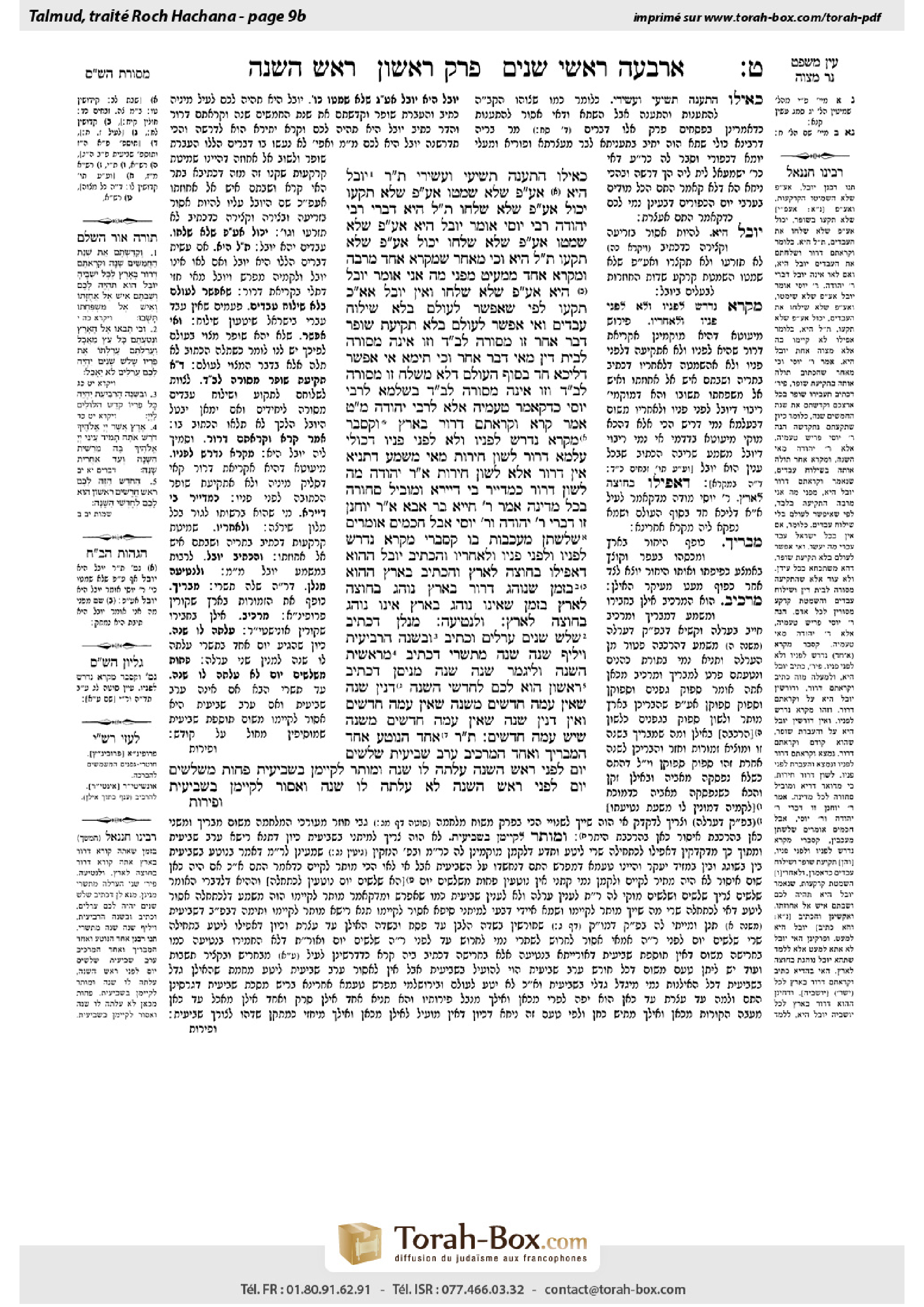
Rosh Hashanah 9b: Talmud study for Daf Yomi
Daf Yomi is the daily study of one Talmud folio. Explore 37 tractates with scans, Hebrew text, Sefaria English and AI-generated French translations where annotated.
Passage selection and English or AI-generated French translation are available where the scan has annotations. Daf Study is independent of Torah-Box and Sefaria.
Browse Rosh Hashanah · ראש השנה · All tractatesRosh Hashanah 9b text and translations
This page of Rosh Hashanah includes the Aramaic text, an English translation and an AI-generated French translation, alongside the scan above.
ראש השנה ט׳ ב · Aramaic and Hebrew text
כְּאִילּוּ הִתְעַנָּה תְּשִׁיעִי וַעֲשִׂירִי.
תָּנוּ רַבָּנַן: ״יוֹבֵל הִיא״ — אַף עַל פִּי שֶׁלֹּא שָׁמְטוּ, אַף עַל פִּי שֶׁלֹּא תָּקְעוּ. יָכוֹל אַף עַל פִּי שֶׁלֹּא שִׁלְּחוּ — תַּלְמוּד לוֹמַר: ״הִיא״, דִּבְרֵי רַבִּי יְהוּדָה.
רַבִּי יוֹסֵי אוֹמֵר: ״יוֹבֵל הִיא״ — אַף עַל פִּי שֶׁלֹּא שָׁמְטוּ, אַף עַל פִּי שֶׁלֹּא שִׁלְּחוּ. יָכוֹל אַף עַל פִּי שֶׁלֹּא תָּקְעוּ — תַּלְמוּד לוֹמַר: ״הִיא״.
וְכִי מֵאַחַר שֶׁמִּקְרָא אֶחָד מְרַבֶּה, וּמִקְרָא אֶחָד מְמַעֵיט, מִפְּנֵי מָה אֲנִי אוֹמֵר: ״יוֹבֵל הִיא״ — אַף עַל פִּי שֶׁלֹּא שִׁלְּחוּ, וְאֵין יוֹבֵל אֶלָּא אִם כֵּן תָּקְעוּ? לְפִי שֶׁאֶפְשָׁר לָעוֹלָם בְּלֹא שִׁילּוּחַ עֲבָדִים, וְאִי אֶפְשָׁר לָעוֹלָם בְּלֹא תְּקִיעַת שׁוֹפָר.
דָּבָר אַחֵר: זוֹ מְסוּרָה לְבֵית דִּין, וְזוֹ אֵינָהּ מְסוּרָה לְבֵית דִּין.
מַאי ״דָּבָר אַחֵר״? וְכִי תֵּימָא: אִי אֶפְשָׁר דְּלֵיכָּא חַד בְּסוֹף הָעוֹלָם דְּלָא מְשַׁלַּח — זוֹ מְסוּרָה לְבֵית דִּין, וְזוֹ אֵינָהּ מְסוּרָה לְבֵית דִּין.
בִּשְׁלָמָא לְרַבִּי יוֹסֵי — כִּדְקָאָמַר טַעְמֵיהּ, אֶלָּא לְרַבִּי יְהוּדָה — מַאי טַעְמָא? אָמַר קְרָא: ״וּקְרָאתֶם דְּרוֹר בָּאָרֶץ״, וְקָסָבַר: מִקְרָא נִדְרָשׁ לְפָנָיו, וְלֹא לִפְנֵי פָנָיו.
דְּכוּלֵּי עָלְמָא — ״דְּרוֹר״ לְשׁוֹן חֵירוּת, מַאי מַשְׁמַע? דְּתַנְיָא: אֵין ״דְּרוֹר״ אֶלָּא לְשׁוֹן חֵירוּת. אָמַר רַבִּי יְהוּדָה: מָה לְשׁוֹן דְּרוֹר — כִּמְדַיַּיר בֵּי דַיָּירָא, וּמוֹבִיל סְחוֹרָה בְּכׇל מְדִינָה.
אָמַר רַבִּי חִיָּיא בַּר אַבָּא אָמַר רַבִּי יוֹחָנָן: זוֹ דִּבְרֵי רַבִּי יְהוּדָה וְרַבִּי יוֹסֵי. אֲבָל חֲכָמִים אוֹמְרִים: שְׁלָשְׁתָּן מְעַכְּבוֹת בּוֹ. קָסָבְרִי: מִקְרָא נִדְרָשׁ לְפָנָיו, וְלִפְנֵי פָנָיו, וּלְאַחֲרָיו.
וְהָכְתִיב: ״יוֹבֵל״! הַהוּא, דַּאֲפִילּוּ בְּחוּצָה לָאָרֶץ. וְהָכְתִיב: ״בָּאָרֶץ״! הָהוּא, בִּזְמַן שֶׁנּוֹהֵג דְּרוֹר בָּאָרֶץ — נוֹהֵג בְּחוּצָה לָאָרֶץ, בִּזְמַן שֶׁאֵינוֹ נוֹהֵג בָּאָרֶץ — אֵינוֹ נוֹהֵג בְּחוּצָה לָאָרֶץ.
וְלִנְטִיעָה. מְנָלַן? דִּכְתִיב: ״שָׁלֹשׁ שָׁנִים עֲרֵלִים״, וּכְתִיב: ״וּבַשָּׁנָה הָרְבִיעִית״, וְיָלֵיף ״שָׁנָה״ ״שָׁנָה״ מִתִּשְׁרִי, דִּכְתִיב: ״מֵרֵאשִׁית הַשָּׁנָה״:
וְלִיגְמַר ״שָׁנָה״ ״שָׁנָה״ מִנִּיסָן, דִּכְתִיב: ״רִאשׁוֹן הוּא לָכֶם לְחׇדְשֵׁי הַשָּׁנָה״?! דָּנִין שָׁנָה שֶׁאֵין עִמָּהּ חֳדָשִׁים מִשָּׁנָה שֶׁאֵין עִמָּהּ חֳדָשִׁים, וְאֵין דָּנִין שָׁנָה שֶׁאֵין עִמָּהּ חֳדָשִׁים מִשָּׁנָה שֶׁיֵּשׁ עִמָּהּ חֳדָשִׁים.
תָּנוּ רַבָּנַן: אֶחָד הַנּוֹטֵעַ אֶחָד הַמַּבְרִיךְ, וְאֶחָד הַמַּרְכִּיב עֶרֶב שְׁבִיעִית, שְׁלֹשִׁים יוֹם לִפְנֵי רֹאשׁ הַשָּׁנָה — עָלְתָה לוֹ שָׁנָה, וּמוּתָּר לְקַיְּימָן בַּשְּׁבִיעִית. פָּחוֹת מִשְּׁלֹשִׁים יוֹם לִפְנֵי רֹאשׁ הַשָּׁנָה — לֹא עָלְתָה לוֹ שָׁנָה, וְאָסוּר לְקַיְּימָן בַּשְּׁבִיעִית.
Rosh Hashanah 9b · English translation
as though he fasted on both the ninth and the tenth.
§ The Gemara continues with the topic of the Jubilee Year. The Sages taught in a baraita: The verse states: “And you shall hallow the fiftieth year, and proclaim liberty throughout all the land to all its inhabitants; it shall be a Jubilee for you” (Leviticus 25:10). The words “it shall be a Jubilee” come to teach that although they did not release property to its original owners, and although they did not sound the shofar, it is nevertheless a Jubilee Year, and the halakhot of the Jubilee year apply. One might have thought that although they did not send free the slaves it is also still a Jubilee Year. Therefore, the verse states: “It shall be,” this being a term of limitation. This teaches that at least one of the essential halakhot of the year must be observed, and if not, it is not a Jubilee Year. This is the statement of Rabbi Yehuda.
Rabbi Yosei says: “It shall be a Jubilee for you”; although they did not release property to its original owners, and although they did not send free the slaves, it is nevertheless a Jubilee Year. One might have thought that although they did not sound the shofar, it is also still a Jubilee Year. Therefore, the verse states: “It shall be.” Some act must be performed. In this case, the shofar must be sounded, otherwise it is not a Jubilee Year.
Rabbi Yosei explains his position: Since one verse includes situations where the Jubilee is in force, and another verse excludes such situations, for what reason do I say that it is a Jubilee Year although they did not send free the slaves, but it is a Jubilee Year only if they sounded the shofar? This is since it is possible that there would be no sending free of slaves, as perhaps no one has any slaves to release, but it is impossible that there would be no sounding of the shofar, as a shofar can always be found. Therefore, it must be that it is the sounding of the shofar that is the indispensable criterion for the Jubilee Year.
Alternatively: This, sounding the shofar, is given over to the court, which is obligated to blow it. But that, setting the slaves free, is not given over to the court but to each individual slave owner. It stands to reason that the indispensable criterion is one that is in the hands of the court and not in the hands of individuals.
The Gemara asks: What is the need for Rabbi Yosei to add: Alternatively? Why is his first explanation insufficient? The Gemara answers: It is necessary, as, if you say that it is impossible that there should not be at least one slave owner at the end of the world, and therefore it is inconceivable that there will ever be a time when there are no slaves that are set free, you can nevertheless say that this, sounding the shofar, is given over to the court, but that, setting the slaves free, is not given over to the court.
The Gemara asks: Granted, this is clear according to Rabbi Yosei, as he has stated his reasoning. But according to Rabbi Yehuda, what is the reason that the indispensable criterion for the Jubilee Year is sending free the slaves? The Gemara explains: The verse states: “And you shall proclaim liberty [deror] throughout all the land to all its inhabitants,” and immediately afterward it says: “It shall be a Jubilee for you.” And Rabbi Yehuda holds that a verse may be expounded in reference to the immediately preceding clause, but not in reference to the clause before that. Therefore, the exclusion implied by the words “it shall be,” is referring to what is stated in the immediately preceding clause: “And you shall proclaim liberty throughout all the land,” i.e., the emancipation of slaves. It is not referring to what is stated in the clause before that: “On Yom Kippur shall you sound the shofar throughout all your land.”
The Gemara asks: It is clear that according to everyone the term “deror” is a word meaning liberty. From where may this be inferred? The Gemara answers: As it is taught in a baraita: The word deror is a term meaning only liberty. Rabbi Yehuda said: What is the meaning of the word deror? It is like a man who dwells [medayyer] in any dwelling [dayyara] and moves merchandise around the entire country, i.e., he can live and do business wherever he wants.
Rabbi Ḥiyya bar Abba said in the name of Rabbi Yoḥanan: This is the statement of Rabbi Yehuda and Rabbi Yosei, but the Rabbis say: All three of them are indispensable for the Jubilee Year: Releasing property, sounding the shofar, and liberating the slaves. They hold that a verse may be interpreted in reference to the immediately preceding clause, in reference to the clause before that, and it may also be interpreted in reference to the clause following it, as all of these halakhot are mentioned in this section, and the exclusion implied by the words “it shall be” applies to all of them.
The Gemara asks: But isn’t it written “Jubilee Year,” which is a term of inclusion that should counter the exclusionary function of the words: “It shall be”? The Gemara answers: That term “Jubilee Year” comes to teach that the mitzva of the Jubilee applies even outside of Eretz Yisrael. The Gemara challenges: But isn’t it written: “Throughout the land,” implying that it applies only in Eretz Yisrael? The Gemara answers: That term, “throughout the land,” comes to teach that when liberation applies in Eretz Yisrael, it applies outside of Eretz Yisrael as well, and when liberation does not apply in Eretz Yisrael, it does not apply outside of Eretz Yisrael either.
§ The mishna teaches: And the first of Tishrei is the New Year for planting. It determines the years of orla, the three-year period from when a tree has been planted during which time its fruit is forbidden. The Gemara asks: From where do we derive this? As it is written: “Three years shall it be prohibited [arelim] to you; it shall not be eaten” (Leviticus 19:23), and it is written in the following verse: “And in the fourth year all its fruit will be sacred for giving praise to the Lord” (Leviticus 19:24). And it is derived by way of a verbal analogy between one instance of the word “year” and another instance of the word “year” that for this purpose the year begins from Tishrei, as it is written with regard to Tishrei: “From the beginning of the year” (Deuteronomy 11:12).
The Gemara asks: But let us derive by way of a verbal analogy between one instance of the word “year” and another instance of the word “year” that for this purpose the year begins from Nisan, as it is written with regard to Nisan: “It shall be the first month of the year to you” (Exodus 12:2). The Gemara answers: The Sages derive the meaning of the word “year” as it appears in the verse about the orla, where months are not mentioned with it, from the word “year” as it appears in the verse in Deuteronomy above, where months are also not mentioned with it. And they do not derive the meaning of the word “year” where months are not mentioned with it from the word “year” as it appears in the verse where months are mentioned with it, i.e., “It shall be the first month of the year for you.”
The Sages taught in a baraita: If one plants a tree, or layers a vine shoot into the ground so that it may take root, or grafts a branch onto a tree on the eve of the Sabbatical Year thirty days before Rosh HaShana, as soon as Rosh HaShana arrives, a year is counted for him. The thirty days count as a full year with regard to the prohibition of orla, and it is permitted to preserve the plant during the Sabbatical Year, as this is not considered new growth. However, if one performed these actions less than thirty days before Rosh HaShana, then when Rosh HaShana arrives, a year is not counted for him for orla, and it is prohibited to preserve the new growth during the Sabbatical Year.
Rosh Hashanah 9b · Traduction française (IA)
comme s’il avait jeûné à la fois le neuvième et le dixième jour.
§ La Guemara poursuit sur le thème de l’année du Jubilé. Les Sages ont enseigné dans une baraïta : le verset dit : « Vous sanctifierez la cinquantième année et proclamerez la liberté dans tout le pays pour tous ses habitants ; ce sera pour vous le Jubilé » (Lévitique 25:10). Les mots « ce sera le Jubilé » viennent enseigner que, même si les biens n’ont pas été rendus à leurs propriétaires d’origine et que le chofar n’a pas été sonné, il s’agit néanmoins d’une année du Jubilé et les halakhot de l’année du Jubilé s’appliquent. On aurait pu penser que, même si les esclaves n’étaient pas libérés, il s’agissait tout de même d’une année du Jubilé. Le verset dit donc : « Ce sera », expression restrictive. Cela enseigne qu’au moins l’une des halakhot essentielles de l’année doit être observée ; sinon, ce n’est pas une année du Jubilé. Telle est l’opinion de Rabbi Yehouda.
Rabbi Yossi dit : « Ce sera pour vous le Jubilé » ; même si les biens n’ont pas été rendus à leurs propriétaires d’origine et que les esclaves n’ont pas été libérés, il s’agit néanmoins d’une année du Jubilé. On aurait pu penser que, même si le chofar n’était pas sonné, il s’agissait tout de même d’une année du Jubilé. Le verset dit donc : « Ce sera ». Un acte doit être accompli. En l’occurrence, le chofar doit être sonné ; sinon, ce n’est pas une année du Jubilé.
Rabbi Yossi explique sa position : puisqu’un verset inclut des situations où le Jubilé est en vigueur et qu’un autre les exclut, pour quelle raison dis-je qu’il s’agit d’une année du Jubilé même si les esclaves n’ont pas été libérés, mais qu’il ne s’agit d’une année du Jubilé que si le chofar a été sonné ? C’est parce qu’il est possible qu’il n’y ait pas de libération d’esclaves, car peut-être personne ne possède d’esclaves à libérer ; en revanche, il est impossible qu’il n’y ait pas de sonnerie du chofar, puisqu’on peut toujours trouver un chofar. Il faut donc conclure que la sonnerie du chofar est le critère indispensable pour qu’il s’agisse d’une année du Jubilé.
Autre explication : la sonnerie du chofar relève du tribunal, qui est tenu de le faire sonner. En revanche, la libération des esclaves ne relève pas du tribunal, mais de chaque propriétaire d’esclaves. Il est logique que le critère indispensable soit celui qui dépend du tribunal et non celui qui dépend de particuliers.
La Guemara demande : pourquoi Rabbi Yossi ajoute-t-il : « Autre explication » ? Pourquoi sa première explication ne suffit-elle pas ? La Guemara répond : c’est nécessaire, car même si l’on disait qu’il est impossible qu’il n’y ait pas au moins un propriétaire d’esclaves à l’autre bout du monde, et qu’il est donc inconcevable qu’il arrive un moment où aucun esclave ne soit libéré, on peut néanmoins dire que la sonnerie du chofar relève du tribunal, tandis que la libération des esclaves ne relève pas du tribunal.
La Guemara demande : cela se comprend pour Rabbi Yossi, puisqu’il a exposé son raisonnement. Mais, selon Rabbi Yehouda, pour quelle raison la libération des esclaves est-elle le critère indispensable de l’année du Jubilé ? La Guemara explique : le verset dit : « Vous proclamerez la liberté [deror] dans tout le pays pour tous ses habitants », puis il est dit immédiatement après : « Ce sera pour vous le Jubilé ». Rabbi Yehouda considère qu’un verset peut être interprété en référence à la proposition qui le précède immédiatement, mais non à celle qui la précède encore. Par conséquent, l’exclusion impliquée par les mots « ce sera » se rapporte à ce qui est dit dans la proposition immédiatement précédente : « Vous proclamerez la liberté dans tout le pays », c’est-à-dire l’affranchissement des esclaves. Elle ne se rapporte pas à ce qui est dit dans la proposition antérieure : « Le jour de Yom Kippour, vous ferez sonner le chofar dans tout votre pays ».
La Guemara demande : il est clair que, selon tous, le terme « deror » signifie liberté. D’où peut-on le déduire ? La Guemara répond : car il est enseigné dans une baraïta que le mot deror ne signifie rien d’autre que liberté. Rabbi Yehouda dit : que signifie le mot deror ? Il désigne un homme qui réside [medayyer] dans n’importe quelle habitation [dayyara] et fait circuler des marchandises dans tout le pays, c’est-à-dire qu’il peut vivre et faire du commerce où bon lui semble.
Rabbi Ḥiyya bar Abba a dit au nom de Rabbi Yoḥanan : telle est l’opinion de Rabbi Yehouda et de Rabbi Yossi, mais les Sages disent que les trois éléments sont indispensables pour l’année du Jubilé : la restitution des biens, la sonnerie du chofar et la libération des esclaves. Ils considèrent qu’un verset peut être interprété en référence à la proposition qui le précède immédiatement, à celle qui la précède encore, et aussi à la proposition qui le suit, car toutes ces halakhot sont mentionnées dans ce passage et l’exclusion impliquée par les mots « ce sera » s’applique à chacune d’elles.
La Guemara demande : mais n’est-il pas écrit « année du Jubilé », expression d’inclusion qui devrait contrecarrer la fonction restrictive des mots « Ce sera » ? La Guemara répond : l’expression « année du Jubilé » vient enseigner que la mitsva du Jubilé s’applique également hors d’Eretz Yisrael. La Guemara objecte : mais n’est-il pas écrit « dans tout le pays », ce qui implique qu’elle ne s’applique qu’en Eretz Yisrael ? La Guemara répond : l’expression « dans tout le pays » vient enseigner que lorsque la libération s’applique en Eretz Yisrael, elle s’applique aussi hors d’Eretz Yisrael ; et lorsque la libération ne s’applique pas en Eretz Yisrael, elle ne s’applique pas non plus hors d’Eretz Yisrael.
§ La Michna enseigne : le premier Tishrei est le Nouvel An des plantations. Il détermine le calcul des années de orla, la période de trois ans à compter de la plantation d’un arbre, durant laquelle ses fruits sont interdits. La Guemara demande : d’où le déduisons-nous ? Car il est écrit : « Pendant trois ans, ils seront pour vous interdits [arelim] ; on n’en mangera pas » (Lévitique 19:23), et il est écrit dans le verset suivant : « La quatrième année, tous ses fruits seront consacrés pour louer le Seigneur » (Lévitique 19:24). On déduit, par une analogie verbale entre une occurrence du mot « année » et une autre, que, dans ce cas, l’année commence à Tishrei, comme il est écrit à propos de Tishrei : « Depuis le commencement de l’année » (Deutéronome 11:12).
La Guemara demande : mais ne pourrait-on pas déduire, par une analogie verbale entre une occurrence du mot « année » et une autre, que, dans ce cas, l’année commence à Nisan, comme il est écrit à propos de Nisan : « Il sera pour vous le premier mois de l’année » (Exode 12:2) ? La Guemara répond : les Sages déduisent le sens du mot « année » dans le verset sur la orla, où les mois ne sont pas mentionnés, du mot « année » dans le verset du Deutéronome cité précédemment, où les mois ne sont pas davantage mentionnés. Ils ne déduisent pas le sens du mot « année » dans un passage où les mois ne sont pas mentionnés à partir du mot « année » dans le verset où les mois sont mentionnés, à savoir : « Il sera pour vous le premier mois de l’année ».
Les Sages ont enseigné dans une baraïta : si quelqu’un plante un arbre, couche en terre une pousse de vigne afin qu’elle prenne racine, ou greffe une branche sur un arbre, trente jours avant Rosh HaChana, à la veille de l’année de la Chemita, dès l’arrivée de Rosh HaChana, une année lui est comptée. Les trente jours comptent comme une année entière pour l’interdiction de orla, et il est permis de préserver la plante pendant l’année de la Chemita, car cela n’est pas considéré comme une nouvelle pousse. En revanche, si quelqu’un a effectué ces opérations moins de trente jours avant Rosh HaChana, à l’arrivée de Rosh HaChana, aucune année ne lui est comptée pour la orla, et il est interdit de préserver la nouvelle pousse pendant l’année de la Chemita.
Traduction française générée par IA à partir de l’édition anglaise de Sefaria. Vérifie toujours un passage avec le texte source.
Text from Sefaria: William Davidson Edition - Vocalized Aramaic (CC BY NC); William Davidson Edition - English (CC BY NC).