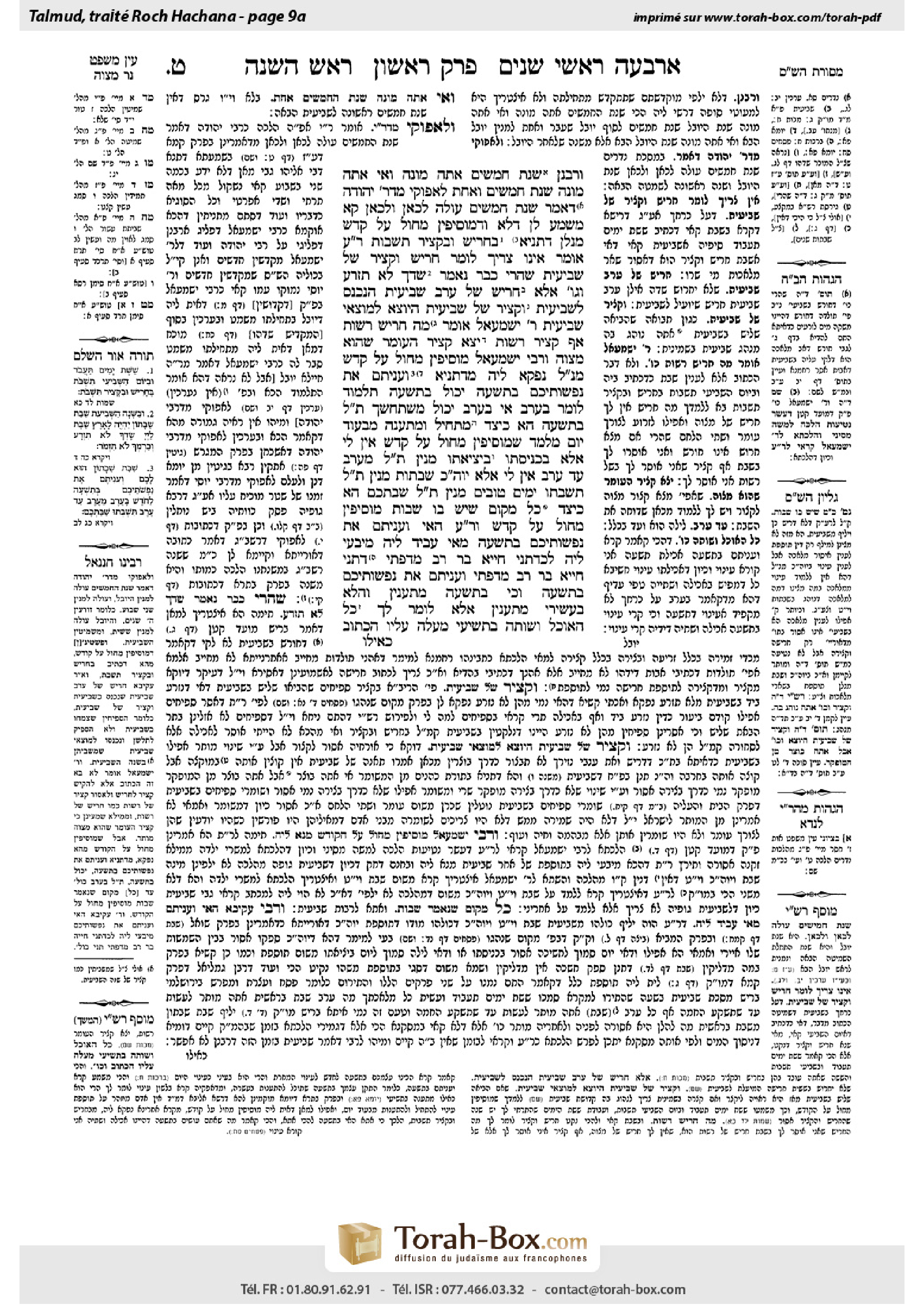
Rosh Hashanah 9a: Talmud study for Daf Yomi
Daf Yomi is the daily study of one Talmud folio. Explore 37 tractates with scans, Hebrew text, Sefaria English and AI-generated French translations where annotated.
Passage selection and English or AI-generated French translation are available where the scan has annotations. Daf Study is independent of Torah-Box and Sefaria.
Browse Rosh Hashanah · ראש השנה · All tractatesRosh Hashanah 9a text and translations
This page of Rosh Hashanah includes the Aramaic text, an English translation and an AI-generated French translation, alongside the scan above.
ראש השנה ט׳ א · Aramaic and Hebrew text
וְרַבָּנַן? שְׁנַת חֲמִשִּׁים אַתָּה מוֹנֶה, וְאִי אַתָּה מוֹנֶה שְׁנַת חֲמִשִּׁים וְאַחַת — לְאַפּוֹקֵי מִדְּרַבִּי יְהוּדָה, דְּאָמַר: שְׁנַת חֲמִשִּׁים עוֹלָה לְכָאן וּלְכָאן, קָא מַשְׁמַע לַן דְּלָא.
וּדְמוֹסִיפִין מֵחוֹל עַל קֹדֶשׁ מְנָלַן?
דְּתַנְיָא: ״בֶּחָרִישׁ וּבַקָּצִיר תִּשְׁבּוֹת״, רַבִּי עֲקִיבָא אוֹמֵר: אֵינוֹ צָרִיךְ לוֹמַר חָרִישׁ וְקָצִיר שֶׁל שְׁבִיעִית, שֶׁהֲרֵי כְּבָר נֶאֱמַר ״שָׂדְךָ לֹא תִזְרָע וְגוֹ׳״. אֶלָּא חָרִישׁ שֶׁל עֶרֶב שְׁבִיעִית הַנִּכְנָס לִשְׁבִיעִית, וְקָצִיר שֶׁל שְׁבִיעִית הַיּוֹצֵא לְמוֹצָאֵי שְׁבִיעִית.
רַבִּי יִשְׁמָעֵאל אוֹמֵר: מָה חָרִישׁ רְשׁוּת — אַף קָצִיר רְשׁוּת, יָצָא קְצִיר הָעוֹמֶר שֶׁהוּא מִצְוָה.
וְרַבִּי יִשְׁמָעֵאל מוֹסִיפִין מֵחוֹל עַל קֹדֶשׁ מְנָא לֵיהּ? נָפְקָא לֵיהּ מִדְּתַנְיָא: ״וְעִנִּיתֶם אֶת נַפְשׁוֹתֵיכֶם בְּתִשְׁעָה״. יָכוֹל בְּתִשְׁעָה? תַּלְמוּד לוֹמַר: ״בָּעֶרֶב״, אִי ״בָּעֶרֶב״ יָכוֹל מִשֶּׁתֶּחְשַׁךְ? תַּלְמוּד לוֹמַר: ״בְּתִשְׁעָה״. הָא כֵּיצַד? מַתְחִיל וּמִתְעַנֶּה מִבְּעוֹד יוֹם — מְלַמֵּד שֶׁמּוֹסִיפִין מֵחוֹל עַל קֹדֶשׁ.
אֵין לִי אֶלָּא בִּכְנִיסָתוֹ, בִּיצִיאָתוֹ מִנַּיִן? תַּלְמוּד לוֹמַר: ״מֵעֶרֶב עַד עֶרֶב״.
אֵין לִי אֶלָּא יוֹם הַכִּפּוּרִים, שַׁבָּתוֹת מִנַּיִן — תַּלְמוּד לוֹמַר: ״תִּשְׁבְּתוּ״. יָמִים טוֹבִים מִנַּיִן? תַּלְמוּד לוֹמַר: ״שַׁבַּתְּכֶם״. הָא כֵּיצַד? כׇּל מָקוֹם שֶׁיֵּשׁ בּוֹ שְׁבוּת — מוֹסִיפִין מֵחוֹל עַל קֹדֶשׁ.
וְרַבִּי עֲקִיבָא, הַאי ״וְעִנִּיתֶם אֶת נַפְשׁוֹתֵיכֶם בְּתִשְׁעָה״ מַאי עָבֵיד לֵיהּ! מִיבְּעֵי לֵיהּ לְכִדְתָנֵי חִיָּיא בַּר רַב מִדִּפְתִּי. דְּתָנֵי חִיָּיא בַּר רַב מִדִּפְתִּי: ״וְעִנִּיתֶם אֶת נַפְשׁוֹתֵיכֶם בְּתִשְׁעָה״ וְכִי בְּתִשְׁעָה מִתְעַנִּין? וַהֲלֹא בַּעֲשִׂירִי מִתְעַנִּין! אֶלָּא לוֹמַר לְךָ: כָּל הָאוֹכֵל וְשׁוֹתֶה בִּתְשִׁיעִי, מַעֲלֶה עָלָיו הַכָּתוּב
Rosh Hashanah 9a · English translation
And the Rabbis, who do not require an additional verse to derive that the Jubilee Year does not extend until Yom Kippur of the fifty-first year, derive this halakha from the verse: You count the fiftieth year as the Jubilee Year alone, but you do not count the fiftieth year as the Jubilee Year and also as the first year of the next Sabbatical cycle. This halakha comes to exclude the opinion of Rabbi Yehuda, who said that the fiftieth year is counted for here and for there, both as the Jubilee Year and also as the first year of the next Sabbatical cycle. Lest someone think that that is the case, therefore, the verse teaches us that this is not so; rather, the fiftieth year is the Jubilee Year, and the following year is the first year of the next Sabbatical cycle.
§ Apropos of the discussion of extending the Jubilee year, the Gemara asks: From where do we derive the principle that one extends a sanctified time period by adding from the profane to the sacred at both ends?
As it is taught in a baraita: The verse states: “In plowing and in harvest you shall rest” (Exodus 34:21). Rabbi Akiva says: It is unnecessary to state this about plowing and harvesting during the Sabbatical Year, as it is already stated: “But in the seventh year shall be a Shabbat of solemn rest for the land, a Shabbat for the Lord; you shall neither sow your field, nor prune your vineyard” (Leviticus 25:4). Rather, the verse: “In plowing and in harvest you shall rest,” is referring to plowing in the year preceding the Sabbatical Year going into the Sabbatical Year, i.e., plowing in the sixth year that will benefit the crops growing in the Sabbatical Year, and about harvesting of the Sabbatical Year going into the year that follows the Sabbatical Year, i.e., harvesting grain that grew in the Sabbatical Year in the eighth year. This teaches that there is a requirement to add extra time to the sanctity of the Sabbatical Year, and not work the land both before and after.
The baraita continues: Rabbi Yishmael says that the verse: “In plowing and in harvest you shall rest,” is not referring to the prohibition against farming the land before and after the Sabbatical Year as Rabbi Akiva explains. He explains that the reason that the verse mentions these two particular forms of labor is to teach that just as the type of plowing that is prohibited during the Sabbatical Year is an otherwise voluntary act, as plowing is never required by the Torah, so too, the harvesting that is prohibited during that year is only voluntary harvesting. This comes to exclude the harvesting of the omer from the prohibition, as it is a mitzva. The barley for the omer must be harvested on the sixteenth of Nisan. Consequently, it is permitted to harvest the omer even during the Sabbatical Year.
The Gemara asks: If so, from where does Rabbi Yishmael derive this principle that one extends a sacred time period by adding from the profane to the sacred both before and after? The Gemara answers: He derives it from that which is taught in a baraita: The verse states, in reference to Yom Kippur: “And you shall afflict your souls on the ninth of the month in the evening” (Leviticus 23:32). One might have thought that one must begin to fast the entire day on the ninth of the month. Therefore, the verse states: “In the evening.” But if it is so that Yom Kippur begins in the evening, one might have thought that one need only begin to fast from when it is dark, after nightfall, when the tenth day of the month begins. Therefore, the verse states: “On the ninth.” How so; how is this to be accomplished? One begins to fast on the ninth of the month while it is still day. This teaches that one extends a sacred time period by adding at the beginning from the profane to the sacred.
From here I have derived only that this addition is made at the beginning of Yom Kippur. But from where do I derive that a similar addition is made at the end of Yom Kippur? The verse states: “From evening to evening shall you rest on your Shabbat” (Leviticus 23:32), which teaches that just as Yom Kippur is extended at the beginning, so too, it is extended at the end.
From here I have derived only that an extension is added to Yom Kippur. From where is it derived that one must also extend Shabbat? The verse states: “You shall rest [tishbetu],” which is referring to Yom Kippur but alludes to Shabbat. From where do I know that the same applies to Festivals? The verse states: “Your Shabbat [shabbatkhem],” your day of rest. How so? Wherever there is a mitzva of resting, be it Shabbat or a Festival, one adds from the profane to the sacred, extending the sacred time at both ends.
The Gemara asks: And Rabbi Akiva, who learns that one adds from the profane to the sacred from the verse dealing with the Sabbatical Year, what does he do with this verse: “And you shall afflict your souls on the ninth of the month in the evening”? The Gemara answers: He requires it for that which was taught by Ḥiyya bar Rav of Difti, as Ḥiyya bar Rav of Difti taught the following baraita: The verse states: “And you shall afflict your souls on the ninth of the month.” Is the fasting on the ninth? But isn’t the fasting on Yom Kippur on the tenth of Tishrei? Rather, this verse comes to teach you: Whoever eats and drinks on the ninth, thereby preparing himself for the fast on the next day, the verse ascribes him credit
Rosh Hashanah 9a · Traduction française (IA)
Et les Sages, qui n’ont pas besoin d’un verset supplémentaire pour déduire que l’année du Jubilé ne se prolonge pas jusqu’à Yom Kippour de la cinquante et unième année, déduisent cette halakha du verset : on compte la cinquantième année comme l’année du Jubilé seulement, mais on ne la compte pas à la fois comme l’année du Jubilé et comme la première année du cycle sabbatique suivant. Cette halakha vient exclure l’opinion de Rabbi Yehouda, qui disait que la cinquantième année est comptée pour les deux, à la fois comme l’année du Jubilé et comme la première année du cycle sabbatique suivant. Pour éviter que l’on ne pense qu’il en est ainsi, le verset nous enseigne que ce n’est pas le cas : la cinquantième année est l’année du Jubilé, et l’année suivante est la première année du cycle sabbatique suivant.
§ À propos de la discussion sur la prolongation de l’année du Jubilé, la Guemara demande : D’où déduit-on le principe selon lequel on prolonge une période sainte en ajoutant du temps profane au temps sacré, à ses deux extrémités ?
Comme il est enseigné dans une baraïta : le verset dit : « Pendant les labours et pendant la moisson, tu te reposeras » (Exode 34,21). Rabbi Akiva dit : Il n’était pas nécessaire de mentionner les labours et les moissons pendant l’année sabbatique, puisque cela est déjà énoncé : « Mais la septième année sera un sabbat de repos complet pour la terre, un sabbat pour le Seigneur ; tu n’ensemenceras pas ton champ et tu ne tailleras pas ta vigne » (Lévitique 25,4). Le verset « Pendant les labours et pendant la moisson, tu te reposeras » se rapporte plutôt aux labours de l’année précédant l’année sabbatique qui empiètent sur celle-ci, c’est-à-dire aux labours de la sixième année qui profiteront aux cultures poussant pendant l’année sabbatique, et à la moisson de l’année sabbatique qui empiète sur l’année suivante, c’est-à-dire à la moisson, durant la huitième année, des céréales qui ont poussé pendant l’année sabbatique. Cela enseigne qu’il faut ajouter du temps à la sainteté de l’année sabbatique et ne pas travailler la terre avant ni après.
La baraïta poursuit : Rabbi Yishmaël dit que le verset « Pendant les labours et pendant la moisson, tu te reposeras » ne se rapporte pas à l’interdiction de cultiver la terre avant et après l’année sabbatique, comme l’explique Rabbi Akiva. Selon lui, si le verset mentionne ces deux formes de travail particulières, c’est pour enseigner que, de même que le labour interdit pendant l’année sabbatique est une activité qui, en temps normal, est facultative, puisque la Torah n’impose jamais de labourer, de même, seule la moisson facultative est interdite pendant cette année. Cela exclut de l’interdiction la moisson de l’omer, qui est une mitsva. L’orge destinée à l’omer doit être moissonnée le seize nissan. Par conséquent, il est permis de moissonner l’omer même pendant l’année sabbatique.
La Guemara demande : Si tel est le cas, d’où Rabbi Yishmaël déduit-il le principe selon lequel on prolonge une période sainte en ajoutant du temps profane au temps sacré, avant comme après ? La Guemara répond : Il le déduit de ce qui est enseigné dans une baraïta : au sujet de Yom Kippour, le verset dit : « Vous vous affligerez le neuvième jour du mois, au soir » (Lévitique 23,32). On aurait pu penser qu’il faut jeûner toute la journée du neuvième jour du mois. Le verset dit donc : « au soir ». Mais, si Yom Kippour commence le soir, on aurait pu penser qu’il suffit de commencer à jeûner à la nuit tombée, après le coucher du soleil, lorsque commence le dixième jour du mois. Le verset dit donc : « le neuvième ». Comment faut-il comprendre cela ? Comment doit-on procéder ? On commence à jeûner le neuvième jour du mois, alors qu’il fait encore jour. Cela enseigne qu’on prolonge une période sainte en ajoutant, au début, du temps profane au temps sacré.
Jusqu’ici, j’ai seulement déduit que cet ajout se fait au début de Yom Kippour. Mais d’où déduit-on qu’un ajout semblable se fait à la fin de Yom Kippour ? Le verset dit : « Du soir au soir, vous vous reposerez pendant votre sabbat » (Lévitique 23,32), ce qui enseigne que, de même que Yom Kippour est prolongé à son début, il l’est aussi à sa fin.
Jusqu’ici, j’ai seulement déduit qu’on ajoute du temps à Yom Kippour. D’où déduit-on qu’il faut aussi prolonger Chabbat ? Le verset dit : « Vous vous reposerez [tishbetu] », ce qui se rapporte à Yom Kippour, mais fait allusion à Chabbat. D’où sait-on qu’il en va de même pour les fêtes ? Le verset dit : « Votre sabbat [shabbatkhem] », c’est-à-dire votre jour de repos. Comment faut-il comprendre cela ? Chaque fois qu’il y a une mitsva de se reposer, que ce soit Chabbat ou une fête, on ajoute du temps profane au temps sacré, prolongeant ainsi la période sainte à ses deux extrémités.
La Guemara demande : Et Rabbi Akiva, qui déduit du verset relatif à l’année sabbatique qu’on ajoute du temps profane au temps sacré, que fait-il de ce verset : « Vous vous affligerez le neuvième jour du mois, au soir » ? La Guemara répond : Il en a besoin pour l’enseignement de Ḥiyya bar Rav de Difti. En effet, Ḥiyya bar Rav de Difti a enseigné la baraïta suivante : le verset dit : « Vous vous affligerez le neuvième jour du mois. » Le jeûne a-t-il lieu le neuvième ? Pourtant, le jeûne de Yom Kippour n’a-t-il pas lieu le dixième jour de tishrei ? Ce verset vient plutôt t’enseigner que celui qui mange et boit le neuvième jour, se préparant ainsi au jeûne du lendemain, se voit crédité de mérite par le verset
Traduction française générée par IA à partir de l’édition anglaise de Sefaria. Vérifie toujours un passage avec le texte source.
Text from Sefaria: William Davidson Edition - Vocalized Aramaic (CC BY NC); William Davidson Edition - English (CC BY NC).