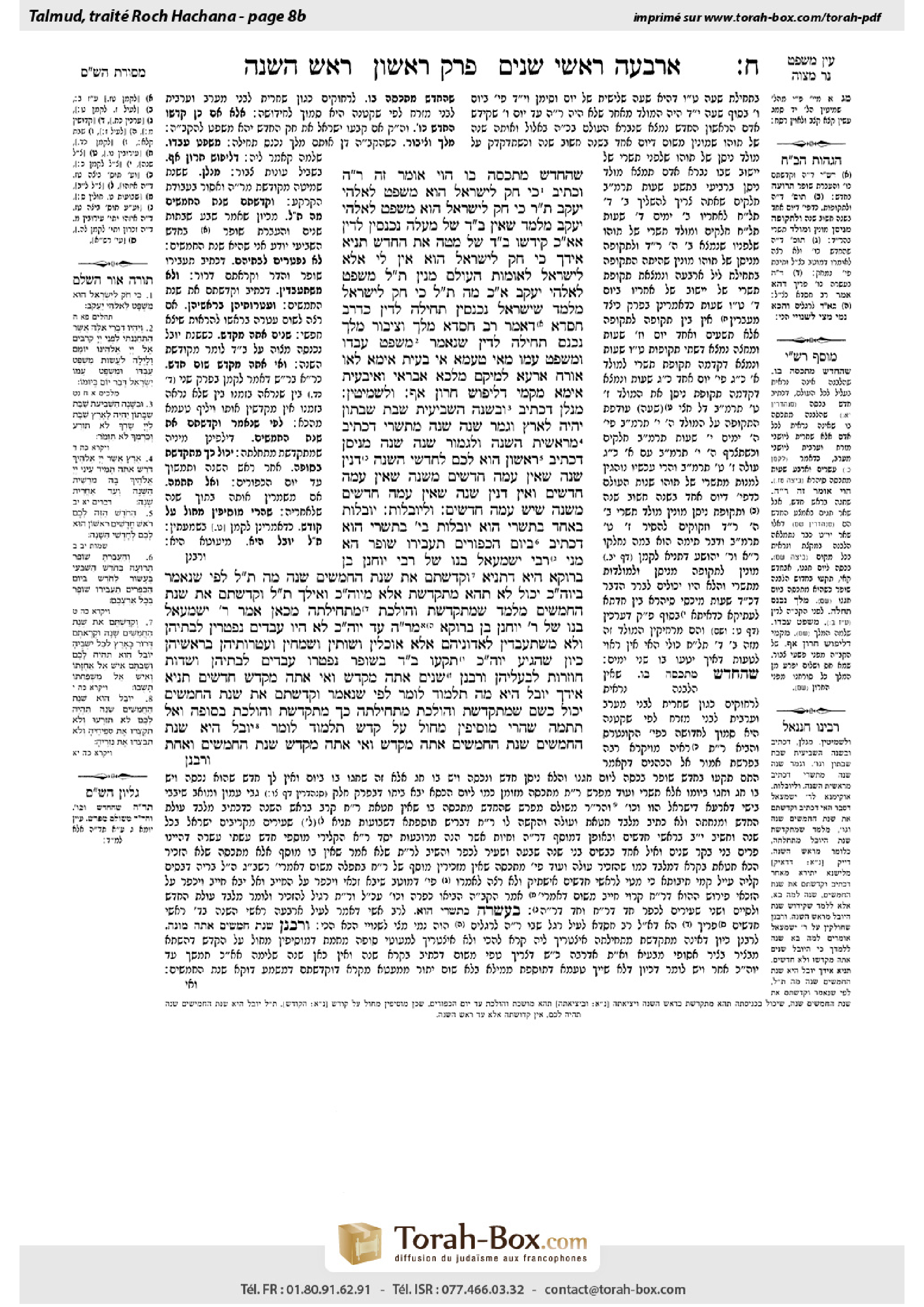
Rosh Hashanah 8b: Talmud study for Daf Yomi
Daf Yomi is the daily study of one Talmud folio. Explore 37 tractates with scans, Hebrew text, Sefaria English and AI-generated French translations where annotated.
Passage selection and English or AI-generated French translation are available where the scan has annotations. Daf Study is independent of Torah-Box and Sefaria.
Browse Rosh Hashanah · ראש השנה · All tractatesRosh Hashanah 8b text and translations
This page of Rosh Hashanah includes the Aramaic text, an English translation and an AI-generated French translation, alongside the scan above.
ראש השנה ח׳ ב · Aramaic and Hebrew text
שֶׁהַחֹדֶשׁ מִתְכַּסֶּה בּוֹ — הֱוֵי אוֹמֵר זֶה רֹאשׁ הַשָּׁנָה. וּכְתִיב: ״כִּי חֹק לְיִשְׂרָאֵל הוּא מִשְׁפָּט לֵאלֹהֵי יַעֲקֹב״.
תָּנוּ רַבָּנַן: ״כִּי חֹק לְיִשְׂרָאֵל הוּא מִשְׁפָּט לֵאלֹהֵי יַעֲקֹב״ — מְלַמֵּד שֶׁאֵין בֵּית דִּין שֶׁל מַעְלָה נִכְנָסִין לַדִּין אֶלָּא אִם כֵּן קִידְּשׁוּ בֵּית דִּין שֶׁל מַטָּה אֶת הַחֹדֶשׁ.
תַּנְיָא אִידַּךְ: ״כִּי חֹק לְיִשְׂרָאֵל הוּא״ — אֵין לִי אֶלָּא לְיִשְׂרָאֵל, לְאוּמּוֹת הָעוֹלָם מִנַּיִן? תַּלְמוּד לוֹמַר: ״מִשְׁפָּט לֵאלֹהֵי יַעֲקֹב״. אִם כֵּן, מָה תַּלְמוּד לוֹמַר: ״כִּי חֹק לְיִשְׂרָאֵל״, מְלַמֵּד שֶׁיִּשְׂרָאֵל נִכְנָסִין תְּחִילָּה לַדִּין.
כִּדְרַב חִסְדָּא. דְּאָמַר רַב חִסְדָּא: מֶלֶךְ וְצִיבּוּר — מֶלֶךְ נִכְנָס תְּחִילָּה לַדִּין, שֶׁנֶּאֱמַר: ״מִשְׁפַּט עַבְדּוֹ וּמִשְׁפַּט עַמּוֹ״.
מַאי טַעְמָא? אִי בָּעֵית אֵימָא: לָאו אוֹרַח אַרְעָא לְמֵיקַם מַלְכָּא אַבָּרַאי, וְאִיבָּעֵית אֵימָא: מִקַּמֵּי דְּלִיפּוֹשׁ חֲרוֹן אַף.
וְלַשְּׁמִיטִּין. מְנָלַן? דִּכְתִיב: ״וּבַשָּׁנָה הַשְּׁבִיעִית שַׁבַּת שַׁבָּתוֹן יִהְיֶה לָאָרֶץ״, וְגָמַר ״שָׁנָה״ ״שָׁנָה״ מִתִּשְׁרִי, דִּכְתִיב: ״מֵרֵאשִׁית הַשָּׁנָה״.
וְלִגְמוֹר ״שָׁנָה״ ״שָׁנָה״ מִנִּיסָן, דִּכְתִיב: ״רִאשׁוֹן הוּא לָכֶם לְחׇדְשֵׁי הַשָּׁנָה״! דָּנִין שָׁנָה שֶׁאֵין עִמָּהּ חֳדָשִׁים מִשָּׁנָה שֶׁאֵין עִמָּהּ חֳדָשִׁים, וְאֵין דָּנִין שָׁנָה שֶׁאֵין עִמָּהּ חֳדָשִׁים מִשָּׁנָה שֶׁיֵּשׁ עִמָּהּ חֳדָשִׁים.
וְלַיּוֹבְלוֹת. יוֹבְלוֹת בְּאֶחָד בְּתִשְׁרִי הוּא? יוֹבְלוֹת בַּעֲשָׂרָה בְּתִשְׁרִי הוּא, דִּכְתִיב: ״בְּיוֹם הַכִּפּוּרִים תַּעֲבִירוּ שׁוֹפָר״!
הָא מַנִּי — רַבִּי יִשְׁמָעֵאל בְּנוֹ שֶׁל רַבִּי יוֹחָנָן בֶּן בְּרוֹקָא הִיא. דְּתַנְיָא: ״וְקִדַּשְׁתֶּם אֵת שְׁנַת הַחֲמִשִּׁים שָׁנָה״, מָה תַּלְמוּד לוֹמַר? לְפִי שֶׁנֶּאֱמַר ״בְּיוֹם הַכִּפּוּרִים״ — יָכוֹל לֹא תְּהֵא מִתְקַדֶּשֶׁת אֶלָּא מִיּוֹם הַכִּפּוּרִים וְאֵילָךְ, תַּלְמוּד לוֹמַר: ״וְקִדַּשְׁתֶּם אֵת שְׁנַת הַחֲמִשִּׁים״, מְלַמֵּד שֶׁמִּתְקַדֶּשֶׁת וְהוֹלֶכֶת מִתְּחִילָּתָהּ.
מִכָּאן אָמַר רַבִּי יִשְׁמָעֵאל בְּנוֹ שֶׁל רַבִּי יוֹחָנָן בֶּן בְּרוֹקָא: מֵרֹאשׁ הַשָּׁנָה עַד יוֹם הַכִּפּוּרִים לֹא הָיוּ עֲבָדִים נִפְטָרִין לְבָתֵּיהֶן, וְלֹא מִשְׁתַּעְבְּדִין לַאֲדוֹנֵיהֶם — אֶלָּא אוֹכְלִין וְשׁוֹתִין וּשְׂמֵחִין, וְעַטְרוֹתֵיהֶן בְּרָאשֵׁיהֶן. כֵּיוָן שֶׁהִגִּיעַ יוֹם הַכִּפּוּרִים, תָּקְעוּ בֵּית דִּין בְּשׁוֹפָר, נִפְטְרוּ עֲבָדִים לְבָתֵּיהֶן וְשָׂדוֹת חוֹזְרוֹת לְבַעְלֵיהֶן.
וְרַבָּנַן — שָׁנִים אַתָּה מְקַדֵּשׁ, וְאִי אַתָּה מְקַדֵּשׁ חֳדָשִׁים.
תַּנְיָא אִידַּךְ: ״יוֹבֵל הִיא״ — מָה תַּלְמוּד לוֹמַר? לְפִי שֶׁנֶּאֱמַר: ״וְקִדַּשְׁתֶּם אֵת שְׁנַת הַחֲמִשִּׁים״, יָכוֹל כְּשֵׁם שֶׁמִּתְקַדֶּשֶׁת וְהוֹלֶכֶת מִתְּחִילָּתָהּ, כָּךְ מִתְקַדֶּשֶׁת וְהוֹלֶכֶת בְּסוֹפָהּ. וְאַל תִּתְמַהּ, שֶׁהֲרֵי מוֹסִיפִין מֵחוֹל עַל קֹדֶשׁ — תַּלְמוּד לוֹמַר: ״יוֹבֵל הִיא שְׁנַת הַחֲמִשִּׁים״ — שְׁנַת הַחֲמִשִּׁים אַתָּה מְקַדֵּשׁ, וְאִי אַתָּה מְקַדֵּשׁ שְׁנַת הַחֲמִשִּׁים וְאַחַת.
Rosh Hashanah 8b · English translation
on which the moon is covered, i.e., hidden? You must say that this is Rosh HaShana, which is the only Festival that occurs at the beginning of a month, when the moon cannot be seen. And it is written in the next verse: “For this is a statute for Israel, a judgment of the God of Jacob” (Psalms 81:5), implying that this is the day of judgment.
With regard to this same verse, the Sages taught in a baraita: “For this is a statute for Israel, a judgment of the God of Jacob”; this teaches that the heavenly court does not assemble for judgment until the earthly court has sanctified the month, once the Sanhedrin has declared that day as Rosh HaShana.
It is taught in another baraita: The verse states: “For this is a statute for Israel.” From here I have derived only that this is the day of judgment for the Jewish people; from where do I derive that it is also the day of judgment for the gentile nations of the world? Therefore, the verse states: “A judgment for the God of Jacob,” Who rules over the entire world. If so, what is the meaning when the verse states: “A statute for Israel”? This teaches that the Jewish people enter for judgment first.
The Gemara notes: This is in accordance with the opinion of Rav Ḥisda, as Rav Ḥisda said: When a king and a community are brought before God for judgment, the king is brought in for judgment first, as it is stated: “And let these my words, with which I have made supplication before the Lord, be near to the Lord our God day and night, that He make the judgment of His servant and the judgment of His people Israel at all times” (I Kings 8:59). This verse is from King Solomon’s prayer at the dedication of the Temple, and he is referring to himself a servant of God.
What is the reason that the king is brought in first? If you wish, say that it is not proper conduct for the king to stand outside and wait for the trial of his subjects to come to an end. And if you wish, say instead that the king is brought in first so that he may be judged before God’s anger intensifies due to the sins of the community, and he may thereby be saved from overly harsh judgment.
§ The mishna teaches: The first of Tishrei is also the New Year for calculating Sabbatical Years. The Gemara asks: From where do we derive this? As it is written: “But in the seventh year shall be a Shabbat of solemn rest for the land” (Leviticus 25:4), and we learn by way of a verbal analogy between one instance of the word “year” and another instance of the word “year” that the year begins for this purpose from Tishrei, as it is written: “From the beginning of the year” (Deuteronomy 11:12). The latter verse is referring to the year that begins at the onset of the rainy season, i.e., Tishrei.
The Gemara raises a difficulty: But let us learn by way of a verbal analogy between one instance of the word “year” and another instance of the word “year” and conclude that for this purpose the year begins from Nisan, as it is written: “It shall be the first month of the year to you” (Exodus 12:2), and there the reference is to Nisan. The Gemara answers: The Sages derive the meaning of the word “year” that appears in the verse about the Sabbatical Year, where months are not mentioned with it, from the word “year” that appears in the verse in Deuteronomy above, where months are also not mentioned with it. And they do not derive the meaning of the word “year” where months are not mentioned with it from the word “year” that appears in the verse where months are mentioned with it, i.e., “It shall be the first month of the year for you.”
§ The mishna teaches: The first of Tishrei is also the New Year for Jubilee Years. The Gemara asks: Is the New Year for Jubilee Years on the first of Tishrei? Isn’t the New Year for Jubilee Years on the tenth of Tishrei, Yom Kippur? As it is written: “Then shall you cause the shofar to sound on the tenth day of the seventh month, on Yom Kippur shall you sound the shofar throughout all your land. And you shall hallow the fiftieth year, and proclaim liberty throughout all the land to all its inhabitants; it shall be a Jubilee for you” (Leviticus 25:9–10).
The Gemara answers: In accordance with whose opinion is this mishna? It is the opinion of Rabbi Yishmael, son of Rabbi Yoḥanan ben Beroka, as it is taught in a baraita: What is the meaning when the verse states: “And you shall hallow the fiftieth year”? Since it is stated that the shofar is blown “on Yom Kippur,” one might have thought that the year is sanctified only from Yom Kippur and onward. Therefore, the verse states: “And you shall hallow the fiftieth year,” which teaches that the year is sanctified from its beginning onward, from the first of Tishrei, when the year begins.
From here, Rabbi Yishmael, son of Rabbi Yoḥanan ben Beroka, said: From Rosh HaShana until Yom Kippur of the Jubilee Year, Hebrew slaves were not released to their homes because the shofar had not yet been sounded. And they were also not enslaved to their masters, as the Jubilee Year had already begun. Rather, they would eat, drink, and rejoice, and they would wear their crowns on their heads like free people. Once Yom Kippur arrived, the court would sound the shofar, slaves would be released to their houses, and fields that were sold would be returned to their original owners.
The Gemara asks: And the Rabbis who disagree with Rabbi Yishmael, son of Rabbi Yoḥanan ben Beroka, how do they interpret the verse: “And you shall hallow the fiftieth year”? The Gemara answers: They derive from here that you sanctify years, but you do not sanctify months. According to this opinion, the court is commanded to sanctify the Jubilee Year with a proclamation: This year is sanctified; but it is not commanded to sanctify the months with a similar proclamation.
It is taught in another baraita: What is the meaning when the verse states: “It shall be a Jubilee Year” (Leviticus 25:11)? Since it is stated: “And you shall hallow the fiftieth year,” one might have thought that just as the Jubilee Year is sanctified from its beginning onward, so too, it is sanctified at its end onward, i.e., it remains sanctified until Yom Kippur of the fifty-first year. And do not wonder why one might think this, as don’t we regularly add from the profane to the sacred, extending a sacred time period by adding to it both before and after from a profane time period? Therefore, the verse states: “It shall be a Jubilee Year, the fiftieth year,” to teach that you sanctify the fiftieth year, but you do not sanctify the fifty-first year, even partially.
Rosh Hashanah 8b · Traduction française (IA)
où la lune est couverte, c’est-à-dire cachée ? Il faut donc dire qu’il s’agit de Roch Hachana, la seule fête qui tombe au début d’un mois, lorsque la lune n’est pas visible. Le verset suivant dit : « Car ceci est une loi pour Israël, un jugement du Dieu de Jacob » (Psaumes 81,5), ce qui implique qu’il s’agit du jour du jugement.
À propos de ce même verset, les Sages enseignent dans une baraïta : « Car ceci est une loi pour Israël, un jugement du Dieu de Jacob » ; cela enseigne que le tribunal céleste ne se réunit pas pour le jugement avant que le tribunal terrestre ait sanctifié le mois, une fois que le Sanhédrin a déclaré ce jour comme étant Roch Hachana.
Une autre baraïta enseigne : Le verset dit : « Car ceci est une loi pour Israël. » J’en ai déduit que ce jour est le jour du jugement pour le peuple juif ; d’où déduis-je qu’il est également le jour du jugement pour les nations non juives du monde ? Le verset dit donc : « Un jugement pour le Dieu de Jacob », qui règne sur le monde entier. Si tel est le cas, que signifie l’expression « une loi pour Israël » dans le verset ? Cela enseigne que le peuple juif comparaît en premier pour le jugement.
La Guemara relève que cela correspond à l’opinion de Rav Ḥisda, car Rav Ḥisda a dit : Lorsqu’un roi et une communauté comparaissent devant Dieu pour être jugés, le roi comparaît en premier, comme il est dit : « Que ces paroles par lesquelles j’ai supplié le Seigneur soient toujours devant le Seigneur notre Dieu, jour et nuit, afin qu’il fasse droit à son serviteur et à son peuple Israël en tout temps » (I Rois 8,59). Ce verset est tiré de la prière du roi Salomon lors de l’inauguration du Temple ; il se désigne lui-même comme un serviteur de Dieu.
Pourquoi le roi comparaît-il en premier ? Si tu veux, dis que le roi ne saurait rester dehors à attendre la fin du procès de ses sujets : cela ne conviendrait pas. Ou bien, si tu veux, dis plutôt que le roi comparaît en premier afin d’être jugé avant que la colère de Dieu ne s’intensifie à cause des péchés de la communauté, et d’être ainsi épargné d’un jugement excessivement sévère.
§ La Michna enseigne : Le premier Tichri est également le nouvel an pour le décompte des années sabbatiques. La Guemara demande : D’où le déduisons-nous ? Il est écrit : « Mais la septième année sera un Chabbat, un repos solennel pour la terre » (Lévitique 25,4), et nous apprenons, au moyen d’une analogie verbale entre deux occurrences du mot « année », que, dans ce contexte, l’année commence à Tichri, comme il est écrit : « Dès le commencement de l’année » (Deutéronome 11,12). Ce dernier verset fait référence à l’année qui commence au début de la saison des pluies, c’est-à-dire à Tichri.
La Guemara soulève une difficulté : Pourquoi ne pas apprendre, au moyen d’une analogie verbale entre deux occurrences du mot « année », que, dans ce contexte, l’année commence à Nissan, comme il est écrit : « Il sera pour vous le premier mois de l’année » (Exode 12,2), verset qui fait référence à Nissan ? La Guemara répond : Les Sages déduisent le sens du mot « année » dans le verset sur l’année sabbatique, où les mois ne sont pas mentionnés, du mot « année » dans le verset du Deutéronome cité plus haut, où les mois ne sont pas non plus mentionnés. Ils ne déduisent pas le sens du mot « année », lorsqu’aucun mois n’est mentionné avec lui, du mot « année » qui apparaît dans le verset où les mois sont mentionnés, à savoir : « Il sera pour vous le premier mois de l’année. »
§ La Michna enseigne : Le premier Tichri est également le nouvel an pour les années jubilaires. La Guemara demande : Le nouvel an des années jubilaires tombe-t-il le premier Tichri ? N’est-il pas le dix Tichri, à Yom Kippour ? Il est écrit : « Alors tu feras retentir le chofar le dixième jour du septième mois ; le jour de Yom Kippour, vous ferez retentir le chofar dans tout votre pays. Vous sanctifierez la cinquantième année et proclamerez la liberté dans tout le pays pour tous ses habitants ; ce sera pour vous une année jubilaire » (Lévitique 25,9-10).
La Guemara répond : De l’opinion de qui cette Michna relève-t-elle ? De celle de Rabbi Yishmael, fils de Rabbi Yoḥanan ben Beroka, comme l’enseigne une baraïta : Que signifie l’expression du verset : « Vous sanctifierez la cinquantième année » ? Puisqu’il est dit que le chofar est sonné « le jour de Yom Kippour », on aurait pu penser que l’année n’est sanctifiée qu’à partir de Yom Kippour. Le verset dit donc : « Vous sanctifierez la cinquantième année », ce qui enseigne que l’année est sanctifiée dès son commencement, c’est-à-dire à partir du premier Tichri, lorsque l’année commence.
À partir de là, Rabbi Yishmael, fils de Rabbi Yoḥanan ben Beroka, a dit : De Roch Hachana jusqu’à Yom Kippour de l’année jubilaire, les esclaves hébreux n’étaient pas renvoyés chez eux, car le chofar n’avait pas encore été sonné. Ils n’étaient pas non plus asservis à leurs maîtres, puisque l’année jubilaire avait déjà commencé. Ils mangeaient, buvaient et se réjouissaient, et portaient des couronnes sur leur tête comme des hommes libres. À l’arrivée de Yom Kippour, le tribunal faisait sonner le chofar, les esclaves étaient libérés et rentraient chez eux, et les champs vendus revenaient à leurs propriétaires d’origine.
La Guemara demande : Comment les Rabbins qui contestent Rabbi Yishmael, fils de Rabbi Yoḥanan ben Beroka, interprètent-ils le verset : « Vous sanctifierez la cinquantième année » ? La Guemara répond : Ils en déduisent que l’on sanctifie les années, mais pas les mois. Selon cette opinion, le tribunal a l’obligation de sanctifier l’année jubilaire par une proclamation : « Cette année est sanctifiée » ; mais il n’a pas l’obligation de sanctifier les mois par une proclamation analogue.
Une autre baraïta enseigne : Que signifie l’expression du verset : « Ce sera une année jubilaire » (Lévitique 25,11) ? Puisqu’il est dit : « Vous sanctifierez la cinquantième année », on aurait pu penser que, tout comme l’année jubilaire est sanctifiée dès son commencement, elle le reste également après sa fin, c’est-à-dire jusqu’à Yom Kippour de la cinquante et unième année. Et il ne faut pas s’étonner que l’on puisse le penser, car n’ajoutons-nous pas régulièrement du profane au sacré, en prolongeant une période sacrée par l’ajout d’un temps profane avant et après ? Le verset dit donc : « Ce sera une année jubilaire, la cinquantième année », pour enseigner que l’on sanctifie la cinquantième année, mais pas la cinquante et unième année, même en partie.
Traduction française générée par IA à partir de l’édition anglaise de Sefaria. Vérifie toujours un passage avec le texte source.
Text from Sefaria: William Davidson Edition - Vocalized Aramaic (CC BY NC); William Davidson Edition - English (CC BY NC).