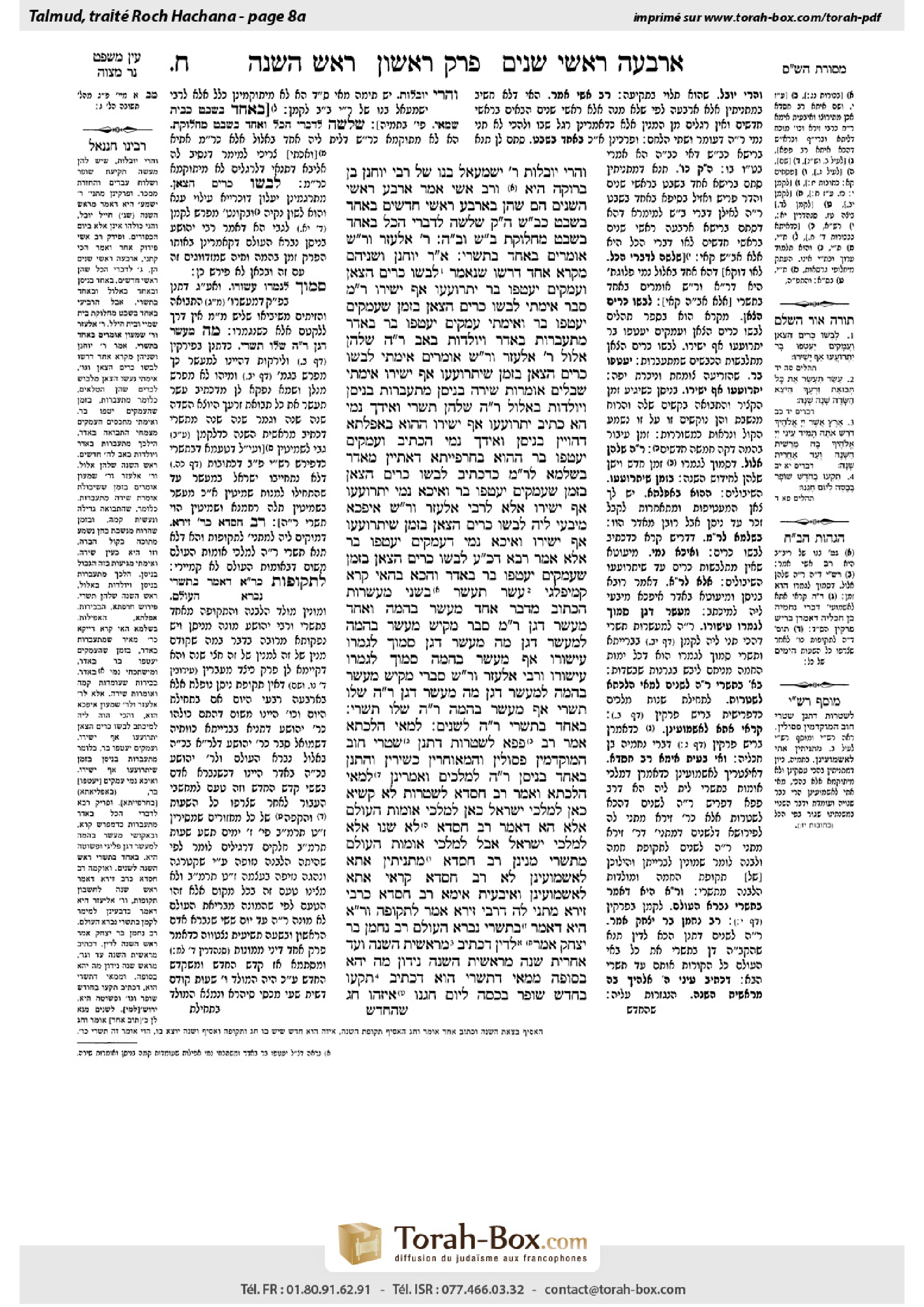
Rosh Hashanah 8a: Talmud study for Daf Yomi
Daf Yomi is the daily study of one Talmud folio. Explore 37 tractates with scans, Hebrew text, Sefaria English and AI-generated French translations where annotated.
Passage selection and English or AI-generated French translation are available where the scan has annotations. Daf Study is independent of Torah-Box and Sefaria.
Browse Rosh Hashanah · ראש השנה · All tractatesRosh Hashanah 8a text and translations
This page of Rosh Hashanah includes the Aramaic text, an English translation and an AI-generated French translation, alongside the scan above.
ראש השנה ח׳ א · Aramaic and Hebrew text
וַהֲרֵי יוֹבְלוֹת! רַבִּי יִשְׁמָעֵאל בְּנוֹ שֶׁל רַבִּי יוֹחָנָן בֶּן בְּרוֹקָה הִיא.
וְרַב אָשֵׁי אָמַר: אַרְבַּע רָאשֵׁי הַשָּׁנִים הֵם שֶׁהֵן בְּאַרְבַּע רָאשֵׁי חֳדָשִׁים.
בְּאֶחָד בִּשְׁבָט — כְּבֵית שַׁמַּאי? הָכִי קָאָמַר: שְׁלֹשָׁה לְדִבְרֵי הַכֹּל, בְּאֶחָד בִּשְׁבָט — מַחְלוֹקֶת בֵּית שַׁמַּאי וּבֵית הִלֵּל.
רַבִּי אֶלְעָזָר וְרַבִּי שִׁמְעוֹן אוֹמְרִים בְּאֶחָד בְּתִשְׁרִי. אָמַר רַבִּי יוֹחָנָן: וּשְׁנֵיהֶם מִקְרָא אֶחָד דָּרְשׁוּ, שֶׁנֶּאֱמַר: ״לָבְשׁוּ כָרִים הַצֹּאן וַעֲמָקִים יַעַטְפוּ בָר יִתְרוֹעֲעוּ אַף יָשִׁירוּ״. רַבִּי מֵאִיר סָבַר: אֵימָתַי לָבְשׁוּ כָרִים הַצֹּאן — בִּזְמַן שֶׁעֲמָקִים יַעַטְפוּ בָר. וְאֵימָתַי עֲמָקִים יַעַטְפוּ בָר — בַּאֲדָר, מִתְעַבְּרוֹת בַּאֲדָר וְיוֹלְדוֹת בְּאָב, רֹאשׁ הַשָּׁנָה שֶׁלָּהֶן אֱלוּל.
רַבִּי אֶלְעָזָר וְרַבִּי שִׁמְעוֹן אוֹמְרִים: אֵימָתַי ״לָבְשׁוּ כָרִים הַצֹּאן״ — בִּזְמַן שֶׁ״יִּתְרוֹעֲעוּ אַף יָשִׁירוּ״, אֵימָתַי שִׁבֳּלִים אוֹמְרוֹת שִׁירָה — בְּנִיסָן, מִתְעַבְּרוֹת בְּנִיסָן וְיוֹלְדוֹת בֶּאֱלוּל, רֹאשׁ הַשָּׁנָה שֶׁלָּהֶן תִּשְׁרֵי.
וְאִידַּךְ נָמֵי, הָא כְּתִיב: ״יִתְרוֹעֲעוּ אַף יָשִׁירוּ״! הָהוּא בְּאַפְלָתָא, דְּהָוְיָין בְּנִיסָן. וְאִידַּךְ נָמֵי, הָכְתִיב: ״וַעֲמָקִים יַעַטְפוּ בָר״! הָהוּא בְּחָרַפְיָיתָא, דְּאָתְיָין מֵאֲדָר.
בִּשְׁלָמָא לְרַבִּי מֵאִיר, כְּדִכְתִיב: ״לָבְשׁוּ כָרִים הַצֹּאן״ — בִּזְמַן שֶׁ״עֲמָקִים יַעַטְפוּ בָר״, וְאִיכָּא נָמֵי ״יִתְרוֹעֲעוּ אַף יָשִׁירוּ״. אֶלָּא לְרַבִּי אֶלְעָזָר וְרַבִּי שִׁמְעוֹן, אִיפְּכָא מִיבְּעֵי לֵיהּ: ״לָבְשׁוּ כָרִים הַצֹּאן״ — בִּזְמַן שֶׁ״יִּתְרוֹעֲעוּ אַף יָשִׁירוּ״, וְאִיכָּא נָמֵי דַּ״עֲמָקִים יַעַטְפוּ בָר״.
אֶלָּא אָמַר רָבָא: דְּכוּלֵּי עָלְמָא ״לָבְשׁוּ כָרִים הַצֹּאן״ — בִּזְמַן שֶׁ״עֲמָקִים יַעַטְפוּ בָר״ בַּאֲדָר, וְהָכָא בְּהַאי קְרָא קָמִיפַּלְגִי: ״עַשֵּׂר תְּעַשֵּׂר״ — בִּשְׁנֵי מַעַשְׂרוֹת הַכָּתוּב מְדַבֵּר: אֶחָד מַעְשַׂר בְּהֵמָה וְאֶחָד מַעֲשֵׂר דָּגָן.
רַבִּי מֵאִיר סָבַר: מַקִּישׁ מַעְשַׂר בְּהֵמָה לְמַעֲשֵׂר דָּגָן: מָה מַעֲשֵׂר דָּגָן — סָמוּךְ לִגְמָרוֹ עִישּׂוּרוֹ, אַף מַעְשַׂר בְּהֵמָה — סָמוּךְ לִגְמָרוֹ עִישּׂוּרוֹ. וְרַבִּי אֶלְעָזָר וְרַבִּי שִׁמְעוֹן סָבְרִי: מַקִּישׁ מַעְשַׂר בְּהֵמָה לְמַעֲשֵׂר דָּגָן: מָה מַעֲשֵׂר דָּגָן רֹאשׁ הַשָּׁנָה שֶׁלּוֹ תִּשְׁרִי — אַף מַעְשַׂר בְּהֵמָה רֹאשׁ הַשָּׁנָה שֶׁלּוֹ תִּשְׁרִי.
בְּאֶחָד בְּתִשְׁרִי רֹאשׁ הַשָּׁנָה לַשָּׁנִים. לְמַאי הִלְכְתָא? אָמַר רַב פָּפָּא: לִשְׁטָרוֹת. דִּתְנַן: שִׁטְרֵי חוֹב הַמּוּקְדָּמִין — פְּסוּלִין, וְהַמְאוּחָרִין — כְּשֵׁירִין.
וְהָתְנַן: בְּאֶחָד בְּנִיסָן רֹאשׁ הַשָּׁנָה לַמְּלָכִים, וְאָמְרִינַן: לְמַאי הִלְכְתָא — וְאָמַר רַב חִסְדָּא לִשְׁטָרוֹת.
לָא קַשְׁיָא: כָּאן לְמַלְכֵי יִשְׂרָאֵל, כָּאן לְמַלְכֵי אוּמּוֹת הָעוֹלָם.
אֶלָּא הָא דְּאָמַר רַב חִסְדָּא: לֹא שָׁנוּ אֶלָּא לְמַלְכֵי יִשְׂרָאֵל, אֲבָל לְמַלְכֵי אוּמּוֹת הָעוֹלָם מִתִּשְׁרִי מָנִינַן — רַב חִסְדָּא מַתְנִיתִין אֲתָא לְאַשְׁמוֹעִינַן?!
לָא, רַב חִסְדָּא קְרָאֵי אֲתָא לְאַשְׁמוֹעִינַן.
וְאִיבָּעֵית אֵימָא: רַב חִסְדָּא כְּרַבִּי זֵירָא מַתְנֵי לַהּ. דְּרַבִּי זֵירָא אָמַר: לַתְּקוּפָה, וְרַבִּי אֱלִיעֶזֶר הִיא, דְּאָמַר בְּתִשְׁרִי נִבְרָא הָעוֹלָם.
רַב נַחְמָן בַּר יִצְחָק אָמַר: לַדִּין, דִּכְתִיב: ״מֵרֵאשִׁית הַשָּׁנָה וְעַד אַחֲרִית שָׁנָה״, מֵרֵאשִׁית הַשָּׁנָה נִידּוֹן מָה יְהֵא בְּסוֹפָהּ.
מִמַּאי דְּתִשְׁרִי הוּא? דִּכְתִיב: ״תִּקְעוּ בַחֹדֶשׁ שׁוֹפָר בַּכֵּסֶה לְיוֹם חַגֵּנוּ״, אֵיזֶהוּ חַג
Rosh Hashanah 8a · English translation
The Gemara asks further: But the New Year for the Jubilee depends upon a certain action, i.e., sounding the shofar, and nevertheless the tanna counts it. The Gemara answers: The mishna is in accordance with the opinion of Rabbi Yishmael, son of Rabbi Yoḥanan ben Beroka, who said that the Jubilee Year begins on Rosh HaShana, even without the shofar blast.
The Gemara presents an alternative answer as to why the tanna did not include all the other New Years. Rav Ashi said: The tanna said that there are four New Years that fall on four New Moons. However, there are also other New Years that do not fall on New Moons.
The Gemara raises a question: Does Rav Ashi count the first of Shevat as one of the New Years; but the first of Shevat is a New Year only according to Beit Shammai, and by the time of Rav Ashi, the halakha was known to be in accordance with the opinion of Beit Hillel? The Gemara answers that this is what Rav Ashi is saying: There are three New Years that all agree occur on the first of the month, and the first of Shevat is subject to a dispute between Beit Shammai and Beit Hillel.
§ The mishna teaches that Rabbi Elazar and Rabbi Shimon say: The New Year for animal tithes is on the first of Tishrei. Rabbi Yoḥanan said: And both of them, Rabbi Meir and Rabbi Elazar, expounded the same verse in different ways. As it is stated in the verse: “The flocks are clothed in the meadows, and the valleys are wrapped in grain; they shout for joy, they also sing” (Psalms 65:14). Rabbi Meir holds: When are the flocks clothed in the meadows, i.e., when do the rams impregnate the ewes and thereby clothe them? It is at the time when the valleys are wrapped in grain, i.e., when they are covered in grain. And when are the valleys wrapped in grain? It is in Adar. Therefore, the sheep conceive in Adar and give birth five months later in Av, and so it is fitting that their New Year is on the first of Elul, as most of the year’s lambs have been born by then.
Rabbi Elazar and Rabbi Shimon say: When are the flocks clothed in the meadows? At the time that the stalks of grain “shout for joy, and also sing.” When do the stalks break out in song, i.e., when are they full, so that they rustle in the wind and create the whispering sounds of song? It is in Nisan. Therefore, the sheep conceive in Nisan and give birth in Elul, and so it is fitting that their New Year is on the first of Tishrei.
The Gemara asks: And according to the other tanna, Rabbi Meir, as well, isn’t it written: “They shout for joy, they also sing”? The Gemara answers: That is referring to late sheep, which were conceived after the usual time, in Nisan. The Gemara asks: According to the other opinion of Rabbi Elazar and Rabbi Shimon as well, isn’t it written: “And the valleys wrapped in grain,” which is in Adar? The Gemara answers: That is referring to early sheep, which were conceived in Adar.
The Gemara asks further: Granted, according to the opinion of Rabbi Meir, the verse can be understood as it is written: “The flocks are clothed in the meadows” at the time when “the valleys are wrapped in grain.” But there are also some that do not conceive until as late as when “they shout for joy, they also sing.” But according to the opinion of Rabbi Elazar and Rabbi Shimon, it should have been written in the reverse order: “The flocks are clothed in the meadows” at the time when “they shout for joy, they also sing,” but there are also some that conceive earlier, when “the valleys are wrapped in grain.” If so, according to them, the words in the verse were not written in their proper order.
Rather, Rava said that the dispute must be explained as follows: Everyone is of the opinion that “the flocks are clothed in the meadows,” i.e., the sheep conceive, primarily at the time when “the valleys are wrapped in grain,” in the month of Adar. But here they disagree about the meaning of the following verse: “You shall tithe a tithe from all the increase of your seed that the field brings forth year by year. And you shall eat before the Lord your God, in the place which He shall choose to place His name there, the tithe of your grain, of your wine, and of your oil, and the firstborn of your herds, and of your flocks; that you may learn to fear the Lord your God always” (Deuteronomy 14:22–23). The verse speaks here about two tithes, one being the animal tithe and the other the grain tithe.
They disagree about the following: Rabbi Meir holds that the verse juxtaposes the animal tithe to the grain tithe. Just as the grain tithe is set aside close to the grain’s completion, after it dries out in the field, so too, the animal tithe is set aside close to its completion, after the animals are born. Just as the grain is completed in Elul and is set aside the following month, which is Tishrei, so too, the animals are born in Av and therefore must be set aside in the following month, which is Elul. On the other hand, Rabbi Elazar and Rabbi Shimon hold: The verse juxtaposes the animal tithe to the grain tithe. Just as in the case of the grain tithe, its New Year is in Tishrei, so too, in the case of the animal tithe, its New Year is in Tishrei.
§ It is taught in the mishna: On the first of Tishrei is the New Year for counting years. The Gemara asks: With regard to which halakha is this stated? Rav Pappa said: It is stated for determining the validity of documents, as we learned in a mishna: Antedated promissory notes, which bear a date that is earlier than the date when the loan actually took place, are invalid. But postdated promissory notes, which bear a date that is later than the date when the loan actually took place, are valid. Therefore, it is essential to know the date on which the new year begins in order to determine whether or not a particular promissory note is valid.
The Gemara asks: But didn’t we already learn in the mishna: On the first of Nisan is the New Year for kings; and we say about this: For what halakha is this stated? And Rav Ḥisda said: It is for determining the validity of documents. Therefore, the new year for documents begins in Nisan and not in Tishrei.
The Gemara answers: This is not difficult; here, where the document is dated according to the reign of the Jewish kings, the year begins in Nisan; and there, where the document is dated to the reign of the gentile kings of the nations of the world, the year begins in Tishrei.
The Gemara asks: But that which Rav Ḥisda said in explanation of the mishna, that they taught that the New Year for kings is in Nisan only with regard to the Jewish kings, but as for the gentile kings of the nations of the world we count from Tishrei, did Rav Ḥisda come to teach us what was already taught in the mishna itself?
The Gemara answers: No, Rav Ḥisda came to teach us the meaning of certain biblical verses, i.e., that they should not be understood as was suggested at the beginning of this chapter but as teaching that the New Year for gentile kings is in Tishrei.
And if you wish, say that Rav Ḥisda teaches the mishna as did Rabbi Zeira, and he maintains that when it says that the first of Tishrei is the New Year for years, it is not referring to documents, as Rabbi Zeira said: The first of Tishrei is the New Year for years with regard to calculating the cycles of the sun and the moon. And this is in accordance with the opinion of Rabbi Eliezer, who said: The world was created in the month of Tishrei, and all the calculations with regard to the sun and the moon are based on when they were created.
§ Rav Naḥman bar Yitzḥak said: When the mishna says that the first of Tishrei is the New Year for years, it is with regard to judgment, as on that day God judges the world for the whole year, as it is written: “A land that the Lord your God cares for; the eyes of the Lord your God are always upon it, from the beginning of the year until the end of the year” (Deuteronomy 11:12); from the beginning of the year judgment is passed as to what will happen at the end of the year.
The Gemara raises a question: From where is it known that the day of judgment is in Tishrei? As it is written: “Blow a shofar at the New Moon, at the covered time for our Festival day” (Psalms 81:4). Which is the Festival day
Rosh Hashanah 8a · Traduction française (IA)
La Guemara demande encore : Mais le nouvel an du Jubilé dépend d’un acte particulier, à savoir la sonnerie du chofar, et pourtant le tanna le compte. La Guemara répond : La Michna suit l’opinion de Rabbi Yishmael, fils de Rabbi Yoḥanan ben Beroka, qui a dit que l’année jubilaire commence à Roch Hachana, même sans sonnerie du chofar.
La Guemara propose une autre réponse à la question de savoir pourquoi le tanna n’a pas inclus tous les autres nouveaux ans. Rav Ashi a dit : Le tanna a dit qu’il y a quatre nouveaux ans qui tombent au début de quatre mois. Mais il existe aussi d’autres nouveaux ans qui ne tombent pas au début d’un mois.
La Guemara soulève une question : Rav Ashi compte-t-il le premier de Chevat parmi les nouveaux ans ? Or, le premier de Chevat n’est un nouvel an que selon Beit Shammaï, et à l’époque de Rav Ashi, on savait que la halakha suivait l’opinion de Beit Hillel. La Guemara répond que voici ce que Rav Ashi veut dire : Il y a trois nouveaux ans dont tous conviennent qu’ils tombent le premier du mois, tandis que le premier de Chevat fait l’objet d’un désaccord entre Beit Shammaï et Beit Hillel.
§ La Michna enseigne que Rabbi Elazar et Rabbi Shimon disent : Le nouvel an de la dîme des animaux tombe le premier de Tichri. Rabbi Yoḥanan a dit : Rabbi Meïr et Rabbi Elazar ont tous deux interprété différemment le même verset. En effet, il est écrit : « Les troupeaux se couvrent de pâturages, et les vallées se revêtent de céréales ; ils poussent des cris de joie, ils chantent aussi » (Psaumes 65:14). Rabbi Meïr considère : Quand les troupeaux se couvrent-ils de pâturages, c’est-à-dire quand les béliers fécondent-ils les brebis et les couvrent-ils ainsi ? C’est au moment où les vallées se revêtent de céréales, c’est-à-dire lorsqu’elles en sont couvertes. Et quand les vallées se revêtent-elles de céréales ? En Adar. Par conséquent, les brebis conçoivent en Adar et mettent bas cinq mois plus tard, en Av. Leur nouvel an tombe donc à juste titre le premier d’Eloul, puisque la plupart des agneaux de l’année sont nés à cette date.
Rabbi Elazar et Rabbi Shimon disent : Quand les troupeaux se couvrent-ils de pâturages ? Au moment où les épis de céréales « poussent des cris de joie et chantent aussi ». Quand les épis se mettent-ils à chanter, c’est-à-dire quand sont-ils pleins, de sorte qu’ils bruissent dans le vent et produisent des sons murmurants semblables à un chant ? En Nissan. Par conséquent, les brebis conçoivent en Nissan et mettent bas en Eloul ; leur nouvel an tombe donc à juste titre le premier de Tichri.
La Guemara demande : Et, selon l’autre tanna, Rabbi Meïr, n’est-il pas également écrit : « Ils poussent des cris de joie, ils chantent aussi » ? La Guemara répond : Cela se rapporte aux brebis tardives, qui ont conçu après la période habituelle, en Nissan. La Guemara demande : Et, selon l’autre opinion, celle de Rabbi Elazar et Rabbi Shimon, n’est-il pas également écrit : « Et les vallées se revêtent de céréales », ce qui se produit en Adar ? La Guemara répond : Cela se rapporte aux brebis précoces, qui ont conçu en Adar.
La Guemara demande encore : On peut comprendre, selon l’opinion de Rabbi Meïr, que le verset soit formulé ainsi : « Les troupeaux se couvrent de pâturages » au moment où « les vallées se revêtent de céréales ». Mais certaines brebis ne conçoivent que plus tard, lorsque « les épis poussent des cris de joie et chantent aussi ». En revanche, selon l’opinion de Rabbi Elazar et Rabbi Shimon, le verset aurait dû être formulé dans l’ordre inverse : « Les troupeaux se couvrent de pâturages » au moment où « les épis poussent des cris de joie et chantent aussi », tandis que certaines brebis conçoivent plus tôt, lorsque « les vallées se revêtent de céréales ». Ainsi, selon eux, les mots du verset ne sont pas dans l’ordre qui leur convient.
Rava a plutôt dit qu’il faut expliquer le désaccord ainsi : Tous sont d’avis que « les troupeaux se couvrent de pâturages », c’est-à-dire que les brebis conçoivent principalement au moment où « les vallées se revêtent de céréales », au mois d’Adar. Mais ils sont en désaccord sur le sens du verset suivant : « Tu prélèveras une dîme de toute la récolte de tes semences que le champ produit année après année. Et tu mangeras devant le Seigneur ton Dieu, au lieu qu’Il choisira pour y faire résider Son nom, la dîme de tes céréales, de ton vin et de ton huile, ainsi que les premiers-nés de tes troupeaux de gros et de petit bétail, afin que tu apprennes à craindre le Seigneur ton Dieu en tout temps » (Deutéronome 14:22–23). Le verset parle ici de deux dîmes : la dîme des animaux et la dîme des céréales.
Le désaccord porte sur ce qui suit : Rabbi Meïr considère que le verset rapproche la dîme des animaux de la dîme des céréales. De même que la dîme des céréales est prélevée près de leur achèvement, après qu’elles ont séché dans le champ, de même la dîme des animaux est prélevée près de leur achèvement, après leur naissance. De même que les céréales arrivent à maturité en Eloul et sont prélevées le mois suivant, en Tichri, de même les animaux naissent en Av et doivent donc être prélevés le mois suivant, en Eloul. Rabbi Elazar et Rabbi Shimon, en revanche, considèrent que le verset rapproche la dîme des animaux de la dîme des céréales : de même que, pour la dîme des céréales, le nouvel an tombe en Tichri, de même, pour la dîme des animaux, le nouvel an tombe en Tichri.
§ La Michna enseigne : Le premier de Tichri est le nouvel an pour le décompte des années. La Guemara demande : À quelle halakha cela se rapporte-t-il ? Rav Pappa a dit : Cela concerne la validité des documents, comme nous l’avons appris dans une Michna : Les billets de dette antidatés, qui portent une date antérieure à celle à laquelle le prêt a réellement été consenti, sont invalides. En revanche, les billets de dette postdatés, qui portent une date postérieure à celle à laquelle le prêt a réellement été consenti, sont valides. Il est donc indispensable de connaître la date à laquelle commence la nouvelle année afin de déterminer si un billet de dette donné est valide ou non.
La Guemara demande : Mais n’avons-nous pas déjà appris dans la Michna : Le premier de Nissan est le nouvel an des rois ? Et ne disons-nous pas à ce propos : À quelle halakha cela se rapporte-t-il ? Rav Ḥisda a répondu : Cela concerne la validité des documents. La nouvelle année utilisée pour dater les documents commence donc en Nissan, et non en Tichri.
La Guemara répond : Il n’y a pas de difficulté : ici, lorsque le document est daté selon le règne des rois juifs, l’année commence en Nissan ; là, lorsque le document est daté selon le règne des rois non juifs des nations du monde, l’année commence en Tichri.
La Guemara demande : Mais lorsque Rav Ḥisda a expliqué la Michna en disant que le nouvel an des rois tombe en Nissan uniquement pour les rois juifs, tandis que, pour les rois non juifs des nations du monde, on compte à partir de Tichri, Rav Ḥisda est-il venu nous enseigner ce qui était déjà enseigné dans la Michna elle-même ?
La Guemara répond : Non. Rav Ḥisda est venu nous enseigner le sens de certains versets bibliques : ils ne doivent pas être compris comme cela a été suggéré au début de ce chapitre, mais comme enseignant que le nouvel an des rois non juifs tombe en Tichri.
Et si tu le souhaites, dis plutôt que Rav Ḥisda enseigne la Michna comme Rabbi Zeira et considère que, lorsqu’il est dit que le premier de Tichri est le nouvel an pour les années, cela ne se rapporte pas aux documents. En effet, Rabbi Zeira a dit : Le premier de Tichri est le nouvel an pour les années en ce qui concerne le calcul des cycles du soleil et de la lune. Cela correspond à l’opinion de Rabbi Eliezer, qui a dit : Le monde a été créé au mois de Tichri, et tous les calculs relatifs au soleil et à la lune sont fondés sur le moment de leur création.
§ Rav Naḥman bar Yitzḥak a dit : Lorsque la Michna enseigne que le premier de Tichri est le nouvel an pour les années, cela se rapporte au jugement, car ce jour-là, Dieu juge le monde pour toute l’année, comme il est écrit : « Un pays dont le Seigneur ton Dieu prend soin ; les yeux du Seigneur ton Dieu sont constamment tournés vers lui, du commencement de l’année jusqu’à la fin de l’année » (Deutéronome 11:12). Dès le commencement de l’année, le jugement est prononcé quant à ce qui arrivera à la fin de l’année.
La Guemara soulève une question : D’où sait-on que le jour du jugement tombe en Tichri ? Car il est écrit : « Sonnez du chofar à la nouvelle lune, au moment fixé pour le jour de notre fête » (Psaumes 81:4). Quel est le jour de fête
Traduction française générée par IA à partir de l’édition anglaise de Sefaria. Vérifie toujours un passage avec le texte source.
Text from Sefaria: William Davidson Edition - Vocalized Aramaic (CC BY NC); William Davidson Edition - English (CC BY NC).