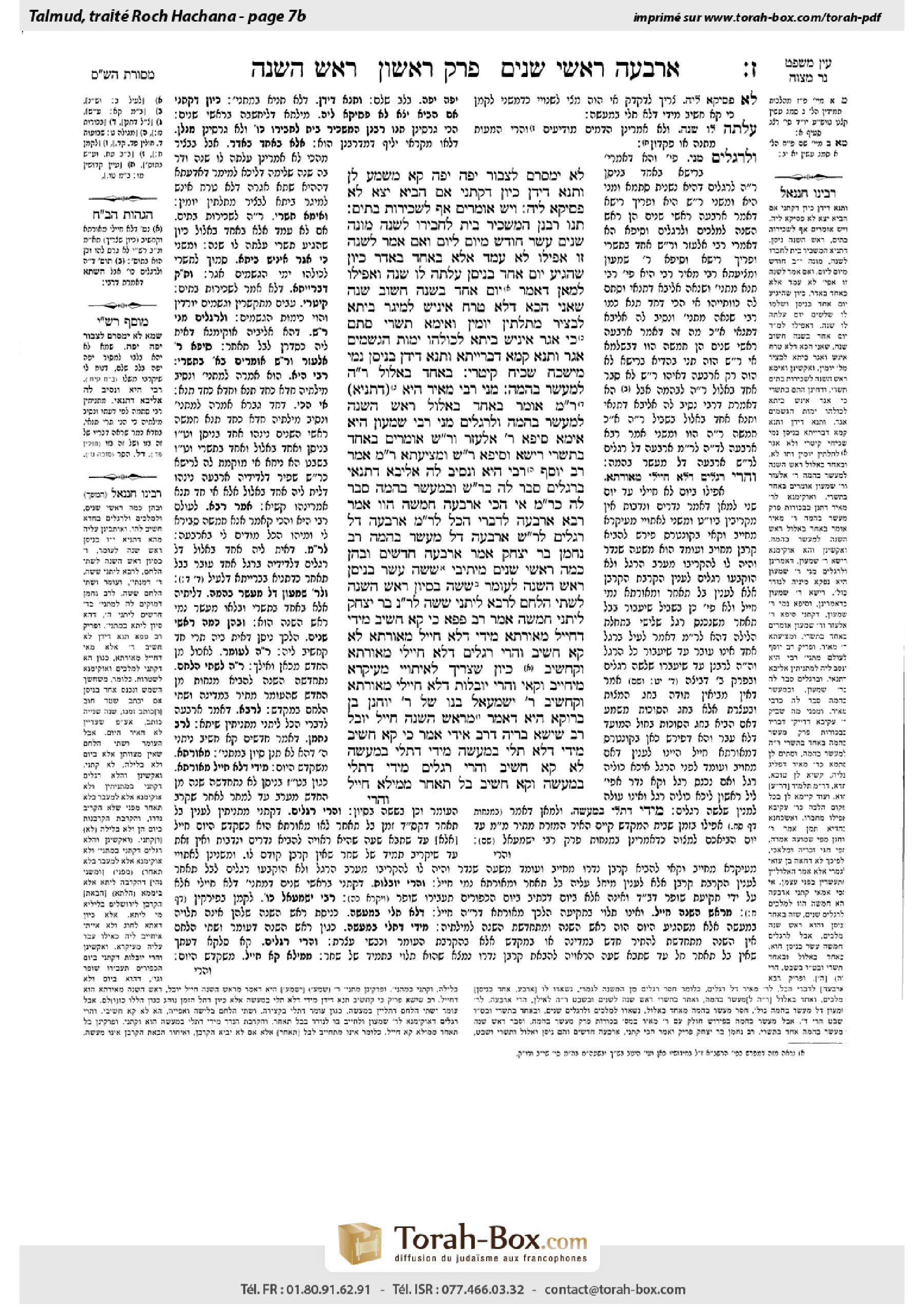
Rosh Hashanah 7b: Talmud study for Daf Yomi
Daf Yomi is the daily study of one Talmud folio. Explore 37 tractates with scans, Hebrew text, Sefaria English and AI-generated French translations where annotated.
Passage selection and English or AI-generated French translation are available where the scan has annotations. Daf Study is independent of Torah-Box and Sefaria.
Browse Rosh Hashanah · ראש השנה · All tractatesRosh Hashanah 7b text and translations
This page of Rosh Hashanah includes the Aramaic text, an English translation and an AI-generated French translation, alongside the scan above.
ראש השנה ז׳ ב · Aramaic and Hebrew text
לֹא יִמְסְרֵם לַצִּבּוּר יָפֶה יָפֶה, קָא מַשְׁמַע לַן.
וְתַנָּא דִּידַן? כֵּיוָן דְּקָתָנֵי: אִם הֵבִיא יָצָא — לָא פְּסִיקָא לֵיהּ.
וְיֵשׁ אוֹמְרִים: אַף לִשְׂכִירוּת בָּתִּים. תָּנוּ רַבָּנַן: הַמַּשְׂכִּיר בַּיִת לַחֲבֵירוֹ לְשָׁנָה — מוֹנֶה שְׁנֵים עָשָׂר חוֹדֶשׁ מִיּוֹם לְיוֹם. וְאִם אָמַר ״לְשָׁנָה זוֹ״, אֲפִילּוּ לֹא עָמַד אֶלָּא בְּאֶחָד בַּאֲדָר, כֵּיוָן שֶׁהִגִּיעַ יוֹם אֶחָד בְּנִיסָן — עָלְתָה לוֹ שָׁנָה.
וַאֲפִילּוּ לְמַאן דְּאָמַר יוֹם אֶחָד בַּשָּׁנָה חָשׁוּב שָׁנָה — שָׁאנֵי הָכָא, דְּלָא טָרַח אִינִישׁ לְמֵיגַר בֵּיתָא לִבְצִיר מִתְּלָתִין יוֹמִין.
וְאֵימָא תִּשְׁרִי? סְתָם כִּי אָגַר אִינִישׁ בֵּיתָא — לְכוּלְּהוּ יְמוֹת הַגְּשָׁמִים אָגַר.
וְתַנָּא קַמָּא דְּבָרַיְיתָא, וְתַנָּא דִּידַן? בְּנִיסָן נָמֵי מִישְׁכָּח שְׁכִיחִי קִיטְרֵי.
בְּאֶחָד בֶּאֱלוּל רֹאשׁ הַשָּׁנָה לְמַעְשַׂר בְּהֵמָה. מַנִּי — רַבִּי מֵאִיר הִיא. דְּתַנְיָא, רַבִּי מֵאִיר אוֹמֵר: בְּאֶחָד בֶּאֱלוּל רֹאשׁ הַשָּׁנָה לְמַעְשַׂר בְּהֵמָה.
וְלָרְגָלִים. מַנִּי — רַבִּי שִׁמְעוֹן הִיא. אֵימָא סֵיפָא, רַבִּי אֶלְעָזָר וְרַבִּי שִׁמְעוֹן אוֹמְרִים: בְּאֶחָד בְּתִשְׁרִי. רֵישָׁא וְסֵיפָא רַבִּי שִׁמְעוֹן, וּמְצִיעֲתָא רַבִּי מֵאִיר!
אָמַר רַב יוֹסֵף: רַבִּי הִיא, וְנָסֵיב לַהּ אַלִּיבָּא דְּתַנָּאֵי. בִּרְגָלִים סָבַר לַהּ כְּרַבִּי שִׁמְעוֹן, וּבְמַעְשַׂר בְּהֵמָה סָבַר לַהּ כְּרַבִּי מֵאִיר.
אִי הָכִי, אַרְבָּעָה? חֲמִשָּׁה הָווּ! אָמַר רָבָא: אַרְבָּעָה לְדִבְרֵי הַכֹּל; לְרַבִּי מֵאִיר אַרְבָּעָה — דַּל רְגָלִים, לְרַבִּי שִׁמְעוֹן אַרְבָּעָה — דַּל מַעְשַׂר בְּהֵמָה.
רַב נַחְמָן בַּר יִצְחָק אָמַר: אַרְבָּעָה חֳדָשִׁים וּבָהֶן כַּמָּה רָאשֵׁי שָׁנִים.
מֵיתִיבִי: שִׁשָּׁה עָשָׂר בְּנִיסָן — רֹאשׁ הַשָּׁנָה לָעוֹמֶר. שִׁשָּׁה בְּסִיוָן — רֹאשׁ הַשָּׁנָה לִשְׁתֵּי הַלֶּחֶם. לְרָבָא לִיתְנֵי שִׁשָּׁה, לְרַב נַחְמָן בַּר יִצְחָק לִיתְנֵי חֲמִשָּׁה?
אָמַר רַב פָּפָּא: כִּי קָא חָשֵׁיב — מִידֵּי דְּחָיֵיל מֵאוּרְתָּא. מִידֵּי דְּלָא חָיֵיל מֵאוּרְתָּא — לָא קָא חָשֵׁיב.
וַהֲרֵי רְגָלִים, דְּלָא חָיְילִי מֵאוּרְתָּא, וְקָחָשֵׁיב! כֵּיוָן שֶׁצָּרִיךְ לְאֵיתוֹיֵי מֵעִיקָּרָא, מִיחַיַּיב וְקָאֵי.
וַהֲרֵי יוֹבְלוֹת, דְּלָא חָיְילִי מֵאוּרְתָּא, וְקָחָשֵׁיב! רַבִּי יִשְׁמָעֵאל בְּנוֹ שֶׁל רַבִּי יוֹחָנָן בֶּן בְּרוֹקָא הִיא, דְּאָמַר: מֵרֹאשׁ הַשָּׁנָה חָיֵיל יוֹבֵל.
רַב שִׁישָׁא בְּרֵיהּ דְּרַב אִידִי אָמַר: כִּי קָא חָשֵׁיב — מִידֵּי דְּלָא תְּלֵי בְּמַעֲשֶׂה, מִידֵּי דִּתְלֵי בְּמַעֲשֶׂה — לָא קָא חָשֵׁיב.
וַהֲרֵי רְגָלִים, מִידֵּי דִּתְלֵי בְּמַעֲשֶׂה, וְקָא חָשֵׁיב! ״בַּל תְּאַחֵר״ מִמֵּילָא חָיֵיל.
Rosh Hashanah 7b · English translation
he will not transfer them over to the public without reservation, and in his heart he will hold on to them as his own, therefore the baraita teaches us that this is not a matter of concern.
The Gemara asks: And why didn’t the tanna of our mishna count the first of Nisan as the New Year for shekels? The Gemara answers: The tanna of the mishna lists only definite New Years. Since it is taught: If one brought them from the old contribution, he has fulfilled his obligation, he could not state this New Year as a definite rule, and so he did not teach it.
§ It was taught in the baraita: And some say that the first of Nisan is also the New Year for the renting of houses. The Sages taught the following baraita: If one rents out a house to another person for a year, he counts twelve months from day to day. But if he said that he was renting it for this year, then even if the agreement was made only on the first of Adar, once the first of Nisan arrived one month later, it is counted as a year, and the rental contract comes to end.
The Gemara comments: Even according to the one who said that one day in a year is considered a year, it is different here, with regard to rental halakhot, as a person does not take the trouble to rent a house for less than thirty days. Therefore, if one rented a house after the first of Adar, the remaining days of Adar are not considered a full year.
The Gemara asks: But why not say that the first of Tishrei is the New Year for the renting of houses, and so if one rents a house for a year in the summer the year would come to an end in Tishrei? The Gemara answers: A person who rents a house without specification intends to rent it for all of the rainy season, until Nisan, when the rainy season comes to a close.
The Gemara asks: And why didn’t the first tanna of the baraita and the tanna of our mishna include the first of Nisan as the New Year for the renting of houses? They hold that even in Nisan it is common that the sky becomes covered with clouds and rain falls. Therefore, one who rents a house does not have in mind to rent it only until the first of Nisan, as presumably he does not want to find himself in a situation where he is homeless when it is still raining.
§ The mishna states: On the first of Elul is the New Year for animal tithes. The Gemara comments: Who is the author of the opinion cited in this mishna? It is Rabbi Meir, as it is taught in a mishna that Rabbi Meir says: On the first of Elul is the New Year for animal tithes.
The Gemara asks: And with regard to the Festivals, i.e., that the first of Nisan is the New Year for Festivals, who is the author of the opinion cited in the mishna? It is Rabbi Shimon, who holds that one transgresses the prohibition against delaying only if the three Festivals have passed in their proper order, with Passover first. Say the last clause of the mishna, which states that Rabbi Elazar and Rabbi Shimon say: The New Year for animal tithes is on the first of Tishrei. Can it be that the first clause and the last clause follow the opinion of Rabbi Shimon, while the middle clause relating to animal tithes follows the opinion of Rabbi Meir?
Rav Yosef said: The entire mishna is in accordance with the opinion of Rabbi Yehuda HaNasi, and he takes the mishna according to the opinions of different tanna’im. With regard to the Festivals, he holds in accordance with the opinion of Rabbi Shimon, while with regard to animal tithes he holds in accordance with the opinion of Rabbi Meir.
The Gemara raises a difficulty: If so, how are there four New Years? If the tanna of the mishna holds that the first of Elul is the New Year for animal tithes, there are five New Years: The first of Nisan, the fifteenth of Nisan, the first of Elul, the first of Tishrei, and the fifteenth of Shevat. Rava said: There are only four New Years according to each opinion: There are four according to Rabbi Meir, who removes the New Year for Festivals, as according to him there is no fixed time from which to begin counting the Festivals. According to Rabbi Shimon’s opinion as well there are four New Years, for he removes the New Year for animal tithes, as according to him it is on the first of Tishrei, which is already listed.
Rav Naḥman bar Yitzḥak said an alternative answer: The mishna is to be understood as follows: There are four months in which there are several New Years, since in Nisan, according to Rabbi Meir, there are two New Years: For kings on the first and for Festivals on the fifteenth.
The Gemara raises an objection from the following baraita: The sixteenth of Nisan is the New Year for the omer offering, as from this date onward it is permitted to eat from the new crop of grain. The sixth of Sivan is the New Year for the two loaves, i.e., the public offering of two loaves from the new wheat brought on Shavuot, as from this day onward it is permitted to sacrifice meal-offerings in the Temple from the new grain. If so, according to Rava, let the mishna teach that there are six New Years, including the sixteenth of Nisan and the sixth of Sivan, and according to Rav Naḥman bar Yitzḥak let it teach that there are five New Years, since Sivan is a month in which there is a New Year.
Rav Pappa said: When the tanna of the mishna counts New Years, he counts only those that begin in the evening; those that do not begin in the evening he does not count. Since the New Years associated with the omer and the two loaves do not begin in the evening but only from the time that they are sacrificed, he does not include them.
The Gemara asks: But there is the New Year for Festivals, which does not begin in the evening, as the prohibition against delaying is not transgressed in the evening, when the Festival begins, but only in the morning, after the daily offering has been brought and one is able to bring the vowed animal to the altar, and nevertheless the tanna counts it. The Gemara answers: Since he had to bring his vow by the Festival, he stands liable from the beginning of the Festival for transgressing the prohibition against delaying.
The Gemara asks further: But there is the New Year for the Jubilee, which does not begin in the evening but from the time of the shofar blast on Yom Kippur during the day, and nevertheless the tanna counts it. The Gemara answers: The mishna is in accordance with the opinion of Rabbi Yishmael, son of Rabbi Yoḥanan ben Beroka, who said that the Jubilee Year begins on Rosh HaShana, and the blowing of the shofar merely completes the release of the slaves. Therefore, the New Year for the Jubilee is included.
Rav Sheisha, son of Rav Idi, said a different explanation for why the New Year for the omer offering and the New Year for the two loaves are not mentioned in the mishna: When the tanna of the mishna counts New Years, he counts only those that do not depend upon an action; those that depend upon an action, e.g., the offering of the omer or the two loaves, he does not count.
The Gemara asks: But there is the New Year for the Festivals, which depends upon an action, i.e., the sacrifice of the daily offering, since no offering may be brought before the daily offering, and nevertheless the tanna counts it. The Gemara answers: This is not so, as the transgression of the prohibition: You shall not delay, does not depend upon anything else; rather, it begins on its own as soon as the Festival begins.
Rosh Hashanah 7b · Traduction française (IA)
Il ne les transférera pas au public sans réserve et, dans son cœur, les gardera pour lui. La baraïta nous enseigne donc que cette éventualité n’est pas à craindre.
La Guemara demande : Pourquoi le tanna de notre Michna n’a-t-il pas compté le premier Nissan comme nouvel an pour les shekels ? La Guemara répond : Le tanna de la Michna ne mentionne que des nouveaux ans établis avec certitude. Puisqu’il est enseigné que celui qui les a apportés sur les fonds de l’ancienne contribution s’est acquitté de son obligation, il ne pouvait énoncer ce nouvel an comme une règle certaine ; il ne l’a donc pas enseigné.
§ Il a été enseigné dans une baraïta : Certains disent que le premier Nissan est également le nouvel an pour la location des maisons. Les Sages ont enseigné la baraïta suivante : Si quelqu’un loue une maison à une autre personne pour un an, il compte douze mois de date à date. Mais s’il a dit qu’il la louait pour cette année, même si l’accord n’a été conclu que le premier Adar, dès que le premier Nissan arrive, un mois plus tard, cela compte comme une année et le contrat de location prend fin.
La Guemara remarque : Même selon celui qui dit qu’un jour dans l’année est considéré comme une année, le cas de la location est différent, car on ne se donne pas la peine de louer une maison pour moins de trente jours. Par conséquent, si quelqu’un a loué une maison après le premier Adar, les jours restants d’Adar ne sont pas considérés comme une année entière.
La Guemara demande : Pourquoi ne pas dire que le premier Tichri est le nouvel an pour la location des maisons, de sorte que si quelqu’un loue une maison pour un an en été, l’année prendrait fin en Tichri ? La Guemara répond : Celui qui loue une maison sans préciser de durée entend la louer pour toute la saison des pluies, jusqu’à Nissan, quand celle-ci s’achève.
La Guemara demande : Pourquoi le premier tanna de la baraïta et le tanna de notre Michna n’ont-ils pas inclus le premier Nissan comme nouvel an pour la location des maisons ? Ils estiment qu’en Nissan aussi, il arrive que le ciel se couvre de nuages et qu’il pleuve. Par conséquent, celui qui loue une maison n’a pas l’intention de la louer seulement jusqu’au premier Nissan, car il ne veut vraisemblablement pas se retrouver sans abri alors qu’il pleut encore.
§ La Michna énonce : Le premier Eloul est le nouvel an pour les dîmes animales. La Guemara remarque : De qui est l’opinion citée dans cette Michna ? De Rabbi Meïr, comme il est enseigné dans une Michna : Rabbi Meïr dit que le premier Eloul est le nouvel an pour les dîmes animales.
La Guemara demande : Et pour ce qui est des fêtes, c’est-à-dire du fait que le premier Nissan est le nouvel an des fêtes, de qui est l’opinion citée dans la Michna ? De Rabbi Chimon, qui estime qu’on transgresse l’interdiction de différer seulement si les trois fêtes sont passées dans leur ordre habituel, Pessa’h en premier. Considérons la dernière clause de la Michna, qui énonce que Rabbi Elazar et Rabbi Chimon disent : Le nouvel an pour les dîmes animales tombe le premier Tichri. Se pourrait-il que la première et la dernière clauses suivent l’opinion de Rabbi Chimon, tandis que la clause médiane, relative aux dîmes animales, suive celle de Rabbi Meïr ?
Rav Yossef dit : Toute la Michna est conforme à l’opinion de Rabbi Yehouda HaNassi, qui présente la Michna selon les opinions de différents tannaïm. Pour les fêtes, il suit l’opinion de Rabbi Chimon, tandis que pour les dîmes animales, il suit celle de Rabbi Meïr.
La Guemara soulève une difficulté : Dans ce cas, comment peut-il y avoir quatre nouveaux ans ? Si le tanna de la Michna estime que le premier Eloul est le nouvel an pour les dîmes animales, il y en a cinq : le premier Nissan, le quinze Nissan, le premier Eloul, le premier Tichri et le quinze Chevat. Rava dit : Selon chaque opinion, il n’y a que quatre nouveaux ans. Il y en a quatre selon Rabbi Meïr, qui écarte le nouvel an des fêtes, puisqu’à son avis, il n’existe pas de date fixe à partir de laquelle commencer à compter les fêtes. Selon l’opinion de Rabbi Chimon aussi, il y a quatre nouveaux ans, car il écarte le nouvel an pour les dîmes animales, puisque, selon lui, celui-ci tombe le premier Tichri, déjà mentionné.
Rav Naḥman bar Yitzḥak donne une autre réponse : Il faut comprendre la Michna ainsi : il y a quatre mois au cours desquels tombent plusieurs nouveaux ans, car, selon Rabbi Meïr, il y a deux nouveaux ans en Nissan : celui des rois, le premier, et celui des fêtes, le quinze.
La Guemara soulève une objection à partir de la baraïta suivante : Le seize Nissan est le nouvel an pour l’offrande du omer, car, à partir de cette date, il est permis de consommer les produits de la nouvelle récolte de céréales. Le six Sivan est le nouvel an pour les deux pains, c’est-à-dire l’offrande publique de deux pains faits avec du blé nouveau, apportée à Chavouot, car, à partir de ce jour, il est permis d’offrir au Temple des oblations faites avec la nouvelle récolte. Dans ce cas, selon Rava, que la Michna enseigne qu’il y a six nouveaux ans, en comptant le seize Nissan et le six Sivan ; et selon Rav Naḥman bar Yitzḥak, qu’elle enseigne qu’il y a cinq nouveaux ans, puisque Sivan est un mois où tombe un nouvel an.
Rav Pappa dit : Lorsque le tanna de la Michna compte les nouveaux ans, il ne compte que ceux qui commencent le soir ; il ne compte pas ceux qui ne commencent pas le soir. Comme les nouveaux ans associés au omer et aux deux pains ne commencent pas le soir, mais seulement au moment où ils sont offerts, il ne les inclut pas.
La Guemara demande : Mais il y a le nouvel an des fêtes, qui ne commence pas le soir, puisque l’interdiction de différer n’est pas transgressée le soir, au début de la fête, mais seulement le matin, après que l’offrande perpétuelle a été apportée et que l’on peut présenter au Temple l’animal voué ; pourtant, le tanna le compte. La Guemara répond : Puisqu’il devait apporter son vœu avant la fête, il est passible de transgresser l’interdiction de différer dès le début de la fête.
La Guemara demande encore : Mais il y a le nouvel an du Jubilé, qui ne commence pas le soir, mais au moment où l’on sonne du chofar pendant la journée de Yom Kippour ; pourtant, le tanna le compte. La Guemara répond : La Michna suit l’opinion de Rabbi Yishmaël, fils de Rabbi Yoḥanan ben Beroka, qui a dit que l’année du Jubilé commence à Roch Hachana et que la sonnerie du chofar ne fait qu’achever la libération des esclaves. Le nouvel an du Jubilé est donc inclus.
Rav Sheisha, fils de Rav Idi, donne une autre explication à l’absence, dans la Michna, du nouvel an pour l’offrande du omer et du nouvel an pour les deux pains : lorsque le tanna de la Michna compte les nouveaux ans, il ne compte que ceux qui ne dépendent pas d’un acte ; il ne compte pas ceux qui en dépendent, comme l’offrande du omer ou des deux pains.
La Guemara demande : Mais il y a le nouvel an des fêtes, qui dépend d’un acte, c’est-à-dire du sacrifice de l’offrande perpétuelle, puisqu’aucune offrande ne peut être apportée avant celle-ci ; pourtant, le tanna le compte. La Guemara répond : Ce n’est pas le cas, car la transgression de l’interdiction « Tu ne différeras pas » ne dépend de rien d’autre ; elle commence d’elle-même dès le début de la fête.
Traduction française générée par IA à partir de l’édition anglaise de Sefaria. Vérifie toujours un passage avec le texte source.
Text from Sefaria: William Davidson Edition - Vocalized Aramaic (CC BY NC); William Davidson Edition - English (CC BY NC).