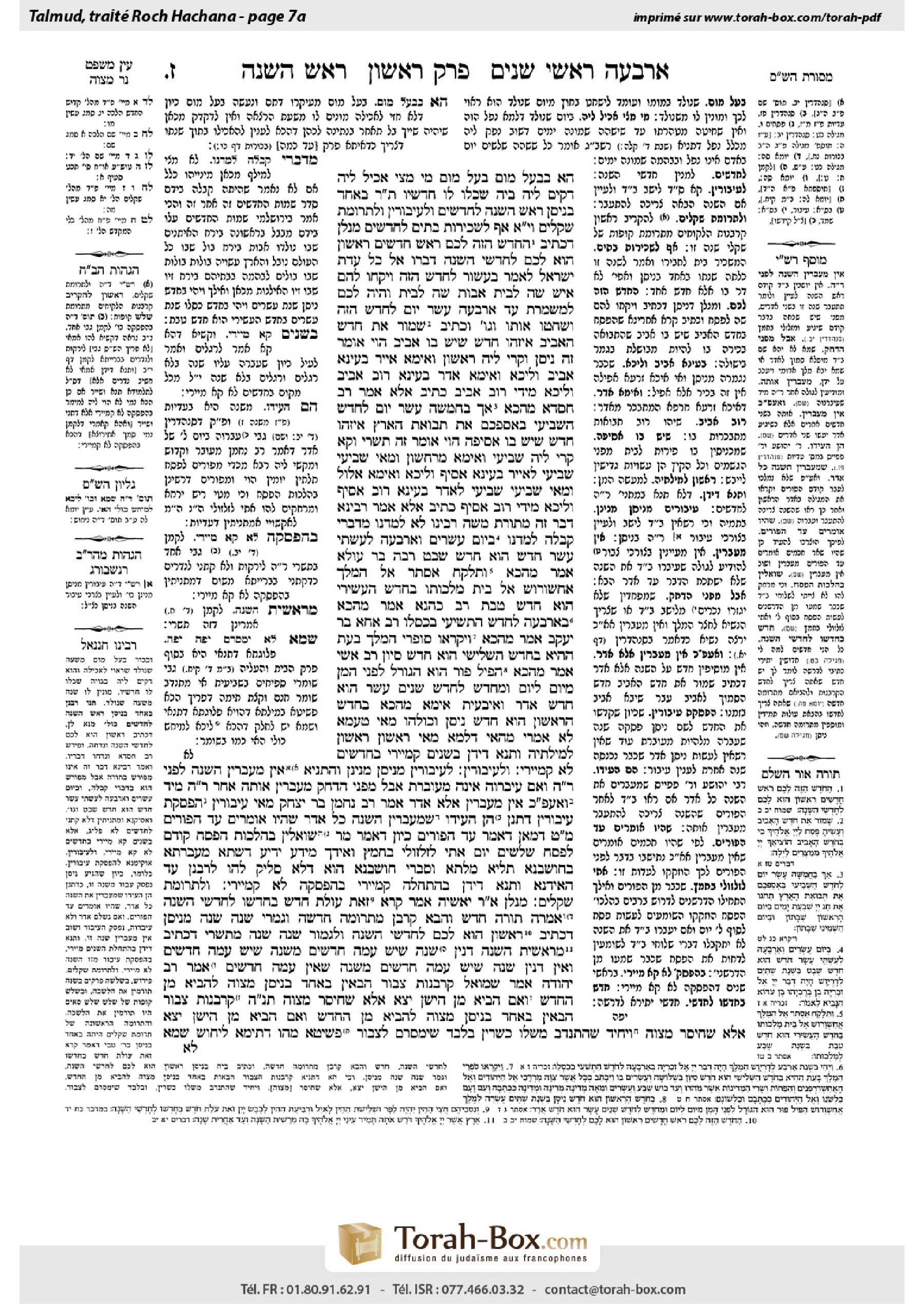
Rosh Hashanah 7a: Talmud study for Daf Yomi
Daf Yomi is the daily study of one Talmud folio. Explore 37 tractates with scans, Hebrew text, Sefaria English and AI-generated French translations where annotated.
Passage selection and English or AI-generated French translation are available where the scan has annotations. Daf Study is independent of Torah-Box and Sefaria.
Browse Rosh Hashanah · ראש השנה · All tractatesRosh Hashanah 7a text and translations
This page of Rosh Hashanah includes the Aramaic text, an English translation and an AI-generated French translation, alongside the scan above.
ראש השנה ז׳ א · Aramaic and Hebrew text
הָא בְּבַעַל מוּם.
בַּעַל מוּם מִי מָצֵי אָכֵיל לֵיהּ? דְּקִים לֵיהּ בֵּיהּ שֶׁכָּלוּ לוֹ חֳדָשָׁיו.
תָּנוּ רַבָּנַן: בְּאֶחָד בְּנִיסָן רֹאשׁ הַשָּׁנָה לָחֳדָשִׁים, וּלְעִיבּוּרִין, וְלִתְרוּמַת שְׁקָלִים. וְיֵשׁ אוֹמְרִים: אַף לִשְׂכִירוּת בָּתִּים.
לָחֳדָשִׁים מְנָלַן — דִּכְתִיב: ״הַחֹדֶשׁ הַזֶּה לָכֶם רֹאשׁ חֳדָשִׁים רִאשׁוֹן הוּא לָכֶם לְחׇדְשֵׁי הַשָּׁנָה. דַּבְּרוּ אֶל כׇּל עֲדַת יִשְׂרָאֵל לֵאמֹר בֶּעָשׂוֹר לַחֹדֶשׁ הַזֶּה וְיִקְחוּ לָהֶם אִישׁ שֶׂה לְבֵית אָבוֹת שֶׂה לַבָּיִת. וְהָיָה לָכֶם לְמִשְׁמֶרֶת עַד אַרְבָּעָה עָשָׂר יוֹם לַחֹדֶשׁ הַזֶּה וְשָׁחֲטוּ אוֹתוֹ וְגוֹ׳״. וּכְתִיב: ״שָׁמוֹר אֶת חֹדֶשׁ הָאָבִיב״, אֵיזֶהוּ חֹדֶשׁ שֶׁיֵּשׁ בּוֹ אָבִיב, הֱוֵי אוֹמֵר — זֶה נִיסָן, וְקָרֵי לֵיהּ רִאשׁוֹן.
וְאֵימָא אִיָּיר? בָּעֵינָא אָבִיב, וְלֵיכָּא. וְאֵימָא אֲדָר? בָּעֵינָא רוֹב אָבִיב, וְלֵיכָּא. מִידֵּי ״רוֹב אָבִיב״ כְּתִיב?
אֶלָּא אָמַר רַב חִסְדָּא, מֵהָכָא: ״אַךְ בַּחֲמִשָּׁה עָשָׂר יוֹם לַחֹדֶשׁ הַשְּׁבִיעִי בְּאׇסְפְּכֶם אֶת תְּבוּאַת הָאָרֶץ״, אֵיזֶהוּ חֹדֶשׁ שֶׁיֵּשׁ בּוֹ אֲסִיפָה, הֱוֵי אוֹמֵר — זֶה תִּשְׁרִי, וְקָא קָרֵי לֵיהּ ״שְׁבִיעִי״.
וְאֵימָא מְרַחְשְׁוָן, וּמַאי ״שְׁבִיעִי״ — שְׁבִיעִי לְאִיָּיר? בָּעֵינָא אָסִיף, וְלֵיכָּא. וְאֵימָא אֱלוּל, וּמַאי ״שְׁבִיעִי״ — שְׁבִיעִי לַאֲדָר? בָּעֵינָא רוֹב אָסִיף, וְלֵיכָּא. מִידֵּי ״רוֹב אָסִיף״ כְּתִיב?
אֶלָּא אָמַר רָבִינָא, דָּבָר זֶה מִתּוֹרַת מֹשֶׁה רַבֵּינוּ לֹא לָמַדְנוּ, מִדִּבְרֵי קַבָּלָה לָמַדְנוּ: ״בְּיוֹם עֶשְׂרִים וְאַרְבָּעָה לְעַשְׁתֵּי עָשָׂר חֹדֶשׁ הוּא חֹדֶשׁ שְׁבָט״. רַבָּה בַּר עוּלָּא אָמַר מֵהָכָא: ״וַתִּלָּקַח אֶסְתֵּר אֶל הַמֶּלֶךְ אֲחַשְׁוֵרוֹשׁ אֶל בֵּית מַלְכוּתוֹ בַּחֹדֶשׁ הָעֲשִׂירִי הוּא חֹדֶשׁ טֵבֵת״.
רַב כָּהֲנָא אָמַר מֵהָכָא: ״בְּאַרְבָּעָה לַחֹדֶשׁ הַתְּשִׁיעִי בְּכִסְלֵו״. רַב אַחָא בַּר יַעֲקֹב אָמַר מֵהָכָא: ״וַיִּקָּרְאוּ סוֹפְרֵי הַמֶּלֶךְ בָּעֵת הַהִיא בַּחֹדֶשׁ הַשְּׁלִישִׁי הוּא חֹדֶשׁ סִיוָן״. רַב אָשֵׁי אָמַר מֵהָכָא: ״הִפִּיל פּוּר הוּא הַגּוֹרָל לִפְנֵי הָמָן מִיּוֹם לְיוֹם וּמֵחֹדֶשׁ לְחֹדֶשׁ שְׁנֵים עָשָׂר הוּא חֹדֶשׁ אֲדָר״. וְאִיבָּעֵית אֵימָא, מֵהָכָא: ״בַּחֹדֶשׁ הָרִאשׁוֹן הוּא חֹדֶשׁ נִיסָן״.
וְכוּלְּהוּ, מַאי טַעְמָא לָא אָמְרִי מֵהַאי? דִּלְמָא מַאי ״רִאשׁוֹן״ — רִאשׁוֹן לְמִילְּתֵיהּ.
וְתַנָּא דִּידַן — בְּשָׁנִים קָמַיְירֵי, בָּחֳדָשִׁים לָא קָמַיְירֵי.
וּלְעִיבּוּרִין לְעִיבּוּרִין מִנִּיסָן מָנִינַן? וְהָתַנְיָא: אֵין מְעַבְּרִין הַשָּׁנָה לִפְנֵי רֹאשׁ הַשָּׁנָה, וְאִם עִיבְּרוּהָ — אֵינָהּ מְעוּבֶּרֶת. אֲבָל מִפְּנֵי הַדְּחָק — מְעַבְּרִין אוֹתָהּ אַחַר רֹאשׁ הַשָּׁנָה מִיָּד. וְאַף עַל פִּי כֵּן, אֵין מְעַבְּרִין אֶלָּא אֲדָר.
אָמַר רַב נַחְמָן בַּר יִצְחָק: מַאי עִיבּוּרִין — הַפְסָקַת עִיבּוּרִין. דִּתְנַן: הֵן הֵעִידוּ שֶׁמְּעַבְּרִין הַשָּׁנָה כׇּל אֲדָר. שֶׁהָיוּ אוֹמְרִים — עַד הַפּוּרִים.
מַאי טַעְמָא דְּמַאן דְּאָמַר עַד הַפּוּרִים? כֵּיוָן דְּאָמַר מָר: שׁוֹאֲלִין בְּהִלְכוֹת הַפֶּסַח קוֹדֶם לַפֶּסַח שְׁלֹשִׁים יוֹם, אָתֵי לְזַלְזוֹלֵי בְּחָמֵץ.
וְאִידַּךְ — מִידָּע יְדִיעַ דְּשַׁתָּא מְעַבַּרְתָּא בְּחוּשְׁבָּנָא תַּלְיָא מִלְּתָא, וְסָבְרִי: חוּשְׁבָּנָא הוּא דְּלָא סְלֵיק לְהוּ לְרַבָּנַן עַד הָאִידָּנָא.
וְתַנָּא דִּידַן? בְּהַתְחָלָה קָמַיְירֵי, בְּהַפְסָקָה לָא קָמַיְירֵי.
וְלִתְרוּמַת שְׁקָלִים. מְנָלַן? אָמַר רַבִּי יֹאשִׁיָּה, אָמַר קְרָא: ״זֹאת עוֹלַת חֹדֶשׁ בְּחׇדְשׁוֹ לְחׇדְשֵׁי הַשָּׁנָה״ — אָמְרָה תּוֹרָה: חַדֵּשׁ וְהָבֵא קׇרְבָּן מִתְּרוּמָה חֲדָשָׁה. וְגָמְרִי ״שָׁנָה״ ״שָׁנָה״ מִנִּיסָן, דִּכְתִיב: ״רִאשׁוֹן הוּא לָכֶם לְחׇדְשֵׁי הַשָּׁנָה״.
וְלִגְמוֹר ״שָׁנָה״ ״שָׁנָה״ מִתִּשְׁרִי, דִּכְתִיב: ״מֵרֵאשִׁית הַשָּׁנָה״! דָּנִין שָׁנָה שֶׁיֵּשׁ עִמָּהּ חֳדָשִׁים מִשָּׁנָה שֶׁיֵּשׁ עִמָּהּ חֳדָשִׁים, וְאֵין דָּנִין שָׁנָה שֶׁיֵּשׁ עִמָּהּ חֳדָשִׁים מִשָּׁנָה שֶׁאֵין עִמָּהּ חֳדָשִׁים.
אָמַר רַב יְהוּדָה אָמַר שְׁמוּאֵל: קׇרְבְּנוֹת צִבּוּר הַבָּאִין בְּאֶחָד בְּנִיסָן — מִצְוָה לְהָבִיא מִן הֶחָדָשׁ. וְאִם הֵבִיא מִן הַיָּשָׁן — יָצָא, אֶלָּא שֶׁחִיסֵּר מִצְוָה.
תַּנְיָא נָמֵי הָכִי: קׇרְבְּנוֹת צִבּוּר הַבָּאִין בְּאֶחָד בְּנִיסָן — מִצְוָה לְהָבִיא מִן הֶחָדָשׁ, וְאִם הֵבִיא מִן הַיָּשָׁן — יָצָא, אֶלָּא שֶׁחִיסֵּר מִצְוָה. וְיָחִיד שֶׁהִתְנַדֵּב מִשֶּׁלּוֹ — כְּשֵׁרִין, בִּלְבַד שֶׁיִּמְסְרֵם לַצִּבּוּר.
פְּשִׁיטָא! מַהוּ דְּתֵימָא: לֵיחוּשׁ שֶׁמָּא
Rosh Hashanah 7a · English translation
That one, Abaye, who said that one counts from the time that the animal is born, is speaking about a blemished animal. Since it was already fit to be slaughtered from the day of its birth, if one does not give it to the priest within a year of that day he transgresses the prohibition against delaying.
The Gemara asks: Can an animal with a blemish really be eaten immediately on the day that it is born? Isn’t there a requirement to wait eight days before slaughtering it, in order to ascertain that the animal is viable and was not born prematurely? The Gemara answers: This is referring to a case where one is certain of when the animal was conceived and that its months of gestation have been completed, so that it may be presumed to be viable.
§ The Sages taught a baraita that expands upon what was taught in the mishna: On the first of Nisan is the New Year for counting the months of the year, and for leap years, and for collection of the shekels that had been collected in Adar and used to purchase animals for communal offerings and other needs of the Temple; and some say that it is also the New Year for the renting of houses.
From where do we derive that the first of Nisan is the New Year for months? As it is written: “This month shall be to you the beginning of months; it shall be the first month of the year to you. Speak to all the congregation of Israel, saying: On the tenth day of this month they shall take to them every man a lamb, according to the house of their fathers, a lamb for a household…And you shall keep it until the fourteenth day of the same month: And the whole assembly of the congregation shall slaughter it toward evening” (Exodus 12:2–6). And elsewhere it is written: “Observe the month of ripening and keep Passover to the Lord your God; for in the month of ripening the Lord your God brought you forth out of Egypt by night” (Deuteronomy 16:1). Which is the month in which there is a ripening of grain? You must say that this is Nisan, and it is called the first month of the year.
The Gemara asks: But one could say that it is the month of Iyyar. The Gemara answers: A month of ripening is required, and in Iyyar there is no ripening, as the grain has already ripened. The Gemara asks further: But one could say that it is the month of Adar, the month in which some of the grain begins to ripen. The Gemara answers: The month in which most of the ripening takes place is required, and this is not the case in Adar, as most of the grain ripens during the next month, the month of Nisan. The Gemara asks: But is most of the ripening written in the verse? The verse merely speaks of the month of ripening, and since there is some ripening in Adar, it is possible that this is the first month.
Rather, Rav Ḥisda said: It is derived that Nisan is the first of the months from here. The verse states: “Also on the fifteenth day of the seventh month, when you have gathered in the fruit of the land” (Leviticus 23:39). Which is the month in which there is a gathering of the grain of the field before the rains begin? You must say that this is Tishrei, and it is called the seventh month. Therefore, Nisan is the first month of the year.
The Gemara asks: But one could say that verse is referring to the month of Marḥeshvan, and what is meant by seventh? It is the seventh month from the month of Iyyar. The Gemara rejects this possibility: A month of gathering is required, and in Marḥeshvan there is no gathering, as the crops have already been gathered in, and the fields have already begun to be plowed to prepare them for the next year’s planting. The Gemara asks further: But one could say that it is the month of Elul, the month in which the gathering of the grain from the fields begins, and what is meant by seventh? It is the seventh month from the month of Adar. The Gemara answers: The month in which most of the gathering takes place is required, and this is not the case in Elul, as most of the gathering is done in Tishrei. The Gemara asks: But is most of the gathering written in the verse?
Rather, Ravina said: This matter we did not learn from the Torah of Moses, our teacher; rather, we learned it from the texts of the tradition, i.e., the Prophets and Writings: “On the twenty-fourth day of the eleventh month, which is the month of Shevat” (Zechariah 1:7). If Shevat is the eleventh month, Nisan must be the first month. Rabba bar Ulla said: It is derived from here, as it is stated: “So Esther was taken to the king Ahasuerus into his royal house in the tenth month, which is the month of Tevet” (Esther 2:16).
Rav Kahana said: It is derived from here: “On the fourth day of the ninth month, in Kislev” (Zechariah 7:1). Rav Aḥa bar Ya’akov said: It is derived from here, as it is stated: “And the scribes of the king were called at that time in the third month, that is the month of Sivan” (Esther 8:9). Rav Ashi said: It is derived from here: “He cast pur, that is, the lot, before Haman from day to day, and from month to month, to the twelfth month, that is, the month of Adar” (Esther 3:7). And if you wish, say that it is derived from here: “In the first month, that is, the month of Nisan” (Esther 3:7).
The Gemara asks: And all of the others, what is the reason that they did not say that it is derived from here, the last verse mentioned, which is explicitly referring to Nisan as the first month? The Gemara answers: It is because one could perhaps have said: What is meant here by first? It means the first in relation to its matter, i.e., the months of the decree, and so it cannot be proven from here that Nisan is the first of the months of the year.
The Gemara asks: And why didn’t the tanna of our mishna list the first of Nisan as the New Year for months, as did the tanna of the baraita? The Gemara answers: He is dealing with matters connected to years, but he is not dealing with matters connected to months.
§ It was taught in the baraita: And on the first of Nisan is the New Year for leap years. The Gemara asks: Do we really count leap years from Nisan? But isn’t it taught in a baraita: The court may not declare a leap year before Rosh HaShana, and if they did declare a leap year before Rosh HaShana, the declaration is not valid and it is not considered a leap year. But due to pressing circumstances, e.g., religious persecution, it may be declared immediately after Rosh HaShana. At that time, the Sages may declare that the coming year will be a leap year in accordance with their calculations. Even so, the additional month added to the leap year can be only a second Adar. In what sense, then, is Nisan the New Year for leap years?
Rav Naḥman bar Yitzḥak said: What is meant here by leap years? It means the end of the leap year. Once the month of Nisan has arrived, the previous year can no longer be declared a leap year, as we learned in a mishna: They, Rabbi Yehoshua and Rabbi Papeyyas, testified that the court may declare a leap year all through the month of Adar, as there were Sages who said: A year may be declared a leap year only until Purim, and if the decision to declare a leap year was not made before Purim, the year can no longer be declared a leap year.
The Gemara explains the dispute: What is the rationale of the one who said that a leap year can be declared only until Purim? It is since the Master said: One asks about the halakhot of Passover thirty days before Passover. Immediately following Purim, on the fifteenth of Adar, people already began to immerse themselves in the halakhot of Passover, which occurs on the fifteenth of Nisan. Were the court to declare a leap year after Purim, the festival of Passover would then be delayed for another month. In that case, there is concern that people will come to demean the prohibition against leavened bread and not observe Passover on its new date in the proper manner.
And the other Sages, Rabbi Yehoshua and Rabbi Papeyyas, who are not concerned about this, what do they say? They say that people know that a leap year is dependent on the calculation, and they will assume that the Sages did not complete the calculation until now, after Purim. Since this is a matter of common knowledge, there is no concern that declaring a leap year at that late time will lead to a disregard of the halakhot of Passover.
The Gemara asks: And why didn’t the tanna of our mishna include the first of Nisan as the New Year for leap years? The Gemara answers: He is dealing with years that begin on the first of Nisan, but he is not dealing with years that end on that date. With regard to leap years, the first of Nisan is the end not a beginning.
§ It was taught in the baraita: And the first of Nisan is the New Year for collection of the shekels that had been collected in Adar and were used to purchase animals for communal offerings and other needs of the Temple. The Gemara asks: From where do we derive this? Rabbi Yoshiya said that the verse states: “This is the burnt-offering of each month in its month throughout the months [leḥodshei] of the year” (Numbers 28:14). The seemingly superfluous term: “Throughout the months [leḥodshei] of the year,” should be understood as follows: The Torah is saying here: Renew [ḥaddesh] the year and bring an offering from the new collection of the shekels. And it is derived by way of a verbal analogy between one instance of the word “year” and another instance of the word “year” that the year begins for this purpose from Nisan, as it is written with regard to Nisan: “It shall be the first month of the year to you” (Exodus 12:2).
The Gemara asks: But let us learn by way of a verbal analogy between one instance of the word “year” and a different instance of the word “year” that the year begins for this purpose from Tishrei, as it is written with regard to Tishrei: “From the beginning of the year” (Deuteronomy 11:12). The Gemara answers: One derives the meaning of the word “year” together with which “months” are mentioned, as the verse states: “Throughout the months of the year,” from another instance of the word “year” together with which months are mentioned, as the verse states: “It shall be the first month of the year to you.” And one does not derive the meaning of the word “year” together with which months are mentioned from an instance of the word “year” together with which “months” are not mentioned, as the verse states: “From the beginning of the year.”
§ Rav Yehuda said that Shmuel said: With regard to communal offerings that are brought on the first of Nisan, there is a mitzva to bring them from the new contribution of shekels collected for that year. However, if one brought them from the old contribution, i.e., from last year’s shekels, he has fulfilled the obligation with regard to the offerings, but he lacks the mitzva of bringing them from the new shekels.
The Gemara comments: This halakha is also taught in a baraita: With regard to communal offerings that are brought on the first of Nisan, there is a mitzva to bring them from the new contribution of shekels. However, if one brought them from the old contribution, he has fulfilled the obligation with regard to the sacrifices, but he lacks the mitzva of bringing them from the new shekels. If a private individual volunteered to bring the communal offerings from his own property, they are fit for the altar, provided that he transfers them over to the community.
The Gemara asks: It is obvious that one may donate of his own property to the community, provided that he transfers it to the community in the proper manner. The Gemara answers: Lest you say that we should be concerned that perhaps
Rosh Hashanah 7a · Traduction française (IA)
Abaye, qui a dit que l’on compte à partir de la naissance de l’animal, parle d’un animal présentant un défaut. Puisqu’il était déjà apte à être abattu dès le jour de sa naissance, si on ne le donne pas au prêtre dans l’année qui suit ce jour, on transgresse l’interdiction de tarder.
La Guemara demande : Un animal présentant un défaut peut-il vraiment être consommé dès le jour de sa naissance ? Ne faut-il pas attendre huit jours avant de l’abattre, afin de s’assurer qu’il est viable et qu’il n’est pas né prématurément ? La Guemara répond : Il s’agit d’un cas où l’on sait avec certitude quand l’animal a été conçu et que sa période de gestation est achevée, de sorte qu’on peut le présumer viable.
§ Les Sages ont enseigné dans une baraïta, qui développe ce qui a été enseigné dans la Michna : Le premier de Nissan est le nouvel an pour le décompte des mois de l’année, pour les années embolismiques et pour la collecte des sicles recueillis en Adar et utilisés pour acheter des animaux destinés aux sacrifices communautaires et aux autres besoins du Temple ; certains disent que c’est aussi le nouvel an pour la location des maisons.
D’où déduisons-nous que le premier de Nissan est le nouvel an pour les mois ? Car il est écrit : « Ce mois-ci sera pour vous le commencement des mois ; il sera pour vous le premier mois de l’année. Parlez à toute l’assemblée d’Israël en ces termes : Le dixième jour de ce mois, que chacun prenne un agneau pour sa famille, un agneau par maison… Vous le garderez jusqu’au quatorzième jour de ce mois, et toute l’assemblée de la communauté l’abattra au crépuscule » (Exode 12, 2-6). Et il est écrit ailleurs : « Observe le mois de la maturation des céréales et célèbre Pessa’h pour le Seigneur ton Dieu, car c’est au mois de la maturation des céréales que le Seigneur ton Dieu t’a fait sortir d’Égypte, de nuit » (Deutéronome 16, 1). Quel est le mois où les céréales mûrissent ? Il faut dire que c’est Nissan, appelé le premier mois de l’année.
La Guemara demande : Mais on pourrait dire qu’il s’agit du mois d’Iyar. La Guemara répond : Il faut un mois de maturation, or en Iyar il n’y a pas de maturation, car les céréales ont déjà mûri. La Guemara demande encore : Mais on pourrait dire qu’il s’agit du mois d’Adar, où certaines céréales commencent à mûrir. La Guemara répond : Il faut le mois où se produit la majeure partie de la maturation, ce qui n’est pas le cas en Adar, car la plupart des céréales mûrissent le mois suivant, celui de Nissan. La Guemara demande : Mais le verset parle-t-il de la majeure partie de la maturation ? Il parle seulement du mois de maturation et, puisqu’il y a une certaine maturation en Adar, il est possible que ce soit le premier mois.
Mais Rav Ḥisda a dit : On déduit d’ici que Nissan est le premier des mois. Le verset dit : « Le quinzième jour du septième mois, lorsque vous aurez recueilli les produits de la terre » (Lévitique 23, 39). Quel est le mois où l’on recueille les céréales des champs avant le début des pluies ? Il faut dire que c’est Tichri, appelé le septième mois. Par conséquent, Nissan est le premier mois de l’année.
La Guemara demande : Mais on pourrait dire que ce verset se rapporte au mois de Marḥeshvan, et que « septième » signifie le septième mois à partir du mois d’Iyar. La Guemara rejette cette possibilité : Il faut un mois de récolte, or en Marḥeshvan il n’y a pas de récolte, car les cultures ont déjà été récoltées et l’on a déjà commencé à labourer les champs pour les préparer aux semailles de l’année suivante. La Guemara demande encore : Mais on pourrait dire qu’il s’agit du mois d’Eloul, où commence la récolte des céréales dans les champs, et que « septième » signifie le septième mois à partir du mois d’Adar. La Guemara répond : Il faut le mois où se déroule la majeure partie de la récolte, ce qui n’est pas le cas en Eloul, car l’essentiel de la récolte a lieu en Tichri. La Guemara demande : Mais le verset parle-t-il de la majeure partie de la récolte ?
Mais Ravina a dit : Nous n’avons pas appris cette question dans la Torah de Moïse, notre maître ; nous l’avons plutôt apprise dans les textes de la tradition, c’est-à-dire les Prophètes et les Écrits : « Le vingt-quatrième jour du onzième mois, qui est le mois de Chevat » (Zacharie 1, 7). Si Chevat est le onzième mois, Nissan doit être le premier mois. Rabba bar Ulla a dit : On le déduit d’ici, comme il est dit : « Esther fut conduite auprès du roi Assuérus, dans sa maison royale, au dixième mois, qui est le mois de Tévèt » (Esther 2, 16).
Rav Kahana a dit : On le déduit d’ici : « Le quatrième jour du neuvième mois, en Kislev » (Zacharie 7, 1). Rav Aḥa bar Ya’akov a dit : On le déduit d’ici, comme il est dit : « Les scribes du roi furent convoqués à cette époque, au troisième mois, c’est-à-dire le mois de Sivan » (Esther 8, 9). Rav Ashi a dit : On le déduit d’ici : « Il fit tirer le pour, c’est-à-dire le sort, devant Haman, de jour en jour et de mois en mois, jusqu’au douzième mois, c’est-à-dire le mois d’Adar » (Esther 3, 7). Et si tu veux, dis que l’on déduit cela d’ici : « Au premier mois, c’est-à-dire le mois de Nissan » (Esther 3, 7).
La Guemara demande : Et tous les autres, pourquoi n’ont-ils pas dit qu’on le déduit d’ici, de ce dernier verset, qui désigne explicitement Nissan comme le premier mois ? La Guemara répond : C’est parce qu’on pourrait peut-être dire que « premier » signifie ici premier par rapport au sujet concerné, c’est-à-dire les mois du décret ; on ne peut donc pas en déduire que Nissan est le premier des mois de l’année.
La Guemara demande : Et pourquoi le tanna de notre Michna n’a-t-il pas énuméré le premier de Nissan comme nouvel an pour les mois, comme l’a fait le tanna de la baraïta ? La Guemara répond : Il traite des questions liées aux années, mais pas de celles qui sont liées aux mois.
§ Il a été enseigné dans une baraïta : Le premier de Nissan est le nouvel an pour les années embolismiques. La Guemara demande : Compte-t-on vraiment les années embolismiques à partir de Nissan ? N’est-il pas enseigné dans une baraïta : Le tribunal ne peut pas déclarer une année embolismique avant Roch Hachana ; s’il en déclare une avant Roch Hachana, sa déclaration est invalide et l’année n’est pas considérée comme embolismique. Toutefois, en raison de circonstances pressantes, par exemple une persécution religieuse, une année embolismique peut être déclarée immédiatement après Roch Hachana. À ce moment-là, les Sages peuvent déclarer, conformément à leurs calculs, que l’année à venir sera embolismique. Même alors, le mois supplémentaire ajouté à l’année embolismique ne peut être qu’un second mois d’Adar. En quel sens, alors, Nissan est-il le nouvel an pour les années embolismiques ?
Rav Naḥman bar Yitzḥak a dit : Que signifie ici « années embolismiques » ? Cela désigne la fin de l’année embolismique. Une fois le mois de Nissan arrivé, l’année précédente ne peut plus être déclarée embolismique, comme nous l’avons appris dans une Michna : Rabbi Yehoshua et Rabbi Papeyyas ont témoigné que le tribunal peut déclarer une année embolismique pendant tout le mois d’Adar, car certains Sages disaient qu’une année ne peut être déclarée embolismique que jusqu’à Pourim ; si la décision de déclarer l’année embolismique n’a pas été prise avant Pourim, elle ne peut plus l’être.
La Guemara explique le désaccord : Quel est le raisonnement de celui qui dit qu’une année ne peut être déclarée embolismique que jusqu’à Pourim ? C’est parce que le Maître a dit : On étudie les halakhot de Pessa’h trente jours avant Pessa’h. Immédiatement après Pourim, le quinze Adar, les gens commençaient déjà à se consacrer aux halakhot de Pessa’h, qui tombe le quinze Nissan. Si le tribunal déclarait une année embolismique après Pourim, la fête de Pessa’h serait alors repoussée d’un mois supplémentaire. On pourrait craindre que les gens en viennent à prendre à la légère l’interdiction du hamets et n’observent pas Pessa’h correctement à sa nouvelle date.
Et que disent les autres Sages, Rabbi Yehoshua et Rabbi Papeyyas, qui ne se soucient pas de cette éventualité ? Ils disent que les gens savent qu’une année embolismique dépend du calcul et supposeront que les Sages n’ont achevé le calcul qu’à ce moment-là, après Pourim. Puisque cela est de notoriété publique, on ne craint pas que la déclaration tardive d’une année embolismique entraîne le mépris des halakhot de Pessa’h.
La Guemara demande : Et pourquoi le tanna de notre Michna n’a-t-il pas inclus le premier de Nissan comme nouvel an pour les années embolismiques ? La Guemara répond : Il traite des années qui commencent le premier de Nissan, mais pas de celles qui s’achèvent à cette date. Pour les années embolismiques, le premier de Nissan marque la fin, et non le commencement.
§ Il a été enseigné dans une baraïta : Le premier de Nissan est le nouvel an pour la collecte des sicles recueillis en Adar et utilisés pour acheter des animaux destinés aux sacrifices communautaires et aux autres besoins du Temple. La Guemara demande : D’où déduisons-nous cela ? Rabbi Yoshiya a dit que le verset affirme : « Tel est l’holocauste de chaque mois, à son mois, pendant les mois [leḥodshei] de l’année » (Nombres 28, 14). L’expression apparemment superflue « pendant les mois [leḥodshei] de l’année » doit être comprise ainsi : la Torah dit ici : « Renouvelez [ḥaddesh] l’année et apportez un sacrifice financé par la nouvelle collecte des sicles. » Et l’on déduit, au moyen d’une analogie verbale entre une occurrence du mot « année » et une autre occurrence de ce mot, que l’année commence à cette fin en Nissan, comme il est écrit au sujet de Nissan : « Il sera pour vous le premier mois de l’année » (Exode 12, 2).
La Guemara demande : Mais déduisons, au moyen d’une analogie verbale entre une occurrence du mot « année » et une autre occurrence de ce mot, que l’année commence à cette fin en Tichri, comme il est écrit au sujet de Tichri : « Depuis le commencement de l’année » (Deutéronome 11, 12). La Guemara répond : On déduit le sens du mot « année » lorsqu’il est accompagné du mot « mois », comme dans le verset « pendant les mois de l’année », d’une autre occurrence du mot « année » accompagnée du mot « mois », comme dans le verset « Il sera pour vous le premier mois de l’année ». On ne déduit pas le sens du mot « année » lorsqu’il est accompagné du mot « mois » d’une occurrence du mot « année » où le mot « mois » n’apparaît pas, comme dans le verset « depuis le commencement de l’année ».
Rav Yehuda a dit au nom de Shmuel : Pour les sacrifices communautaires apportés le premier de Nissan, il y a une mitsva de les apporter avec la nouvelle contribution de sicles recueillie pour cette année. Toutefois, si on les a apportés avec l’ancienne contribution, c’est-à-dire les sicles de l’année précédente, on s’est acquitté de l’obligation concernant les sacrifices, mais on n’a pas accompli la mitsva de les apporter avec les nouveaux sicles.
La Guemara fait remarquer : Cette halakha est également enseignée dans une baraïta : Pour les sacrifices communautaires apportés le premier de Nissan, il y a une mitsva de les apporter avec la nouvelle contribution de sicles. Toutefois, si on les a apportés avec l’ancienne contribution, on s’est acquitté de l’obligation concernant les sacrifices, mais on n’a pas accompli la mitsva de les apporter avec les nouveaux sicles. Si un particulier s’est proposé pour fournir les sacrifices communautaires avec ses propres biens, ceux-ci peuvent être apportés sur l’autel, à condition qu’il les transfère à la communauté.
La Guemara demande : Il va de soi que l’on peut faire don de ses propres biens à la communauté, à condition de les lui transférer de la manière appropriée. La Guemara répond : De peur que tu dises qu’il faut craindre que peut-être
Traduction française générée par IA à partir de l’édition anglaise de Sefaria. Vérifie toujours un passage avec le texte source.
Text from Sefaria: William Davidson Edition - Vocalized Aramaic (CC BY NC); William Davidson Edition - English (CC BY NC).