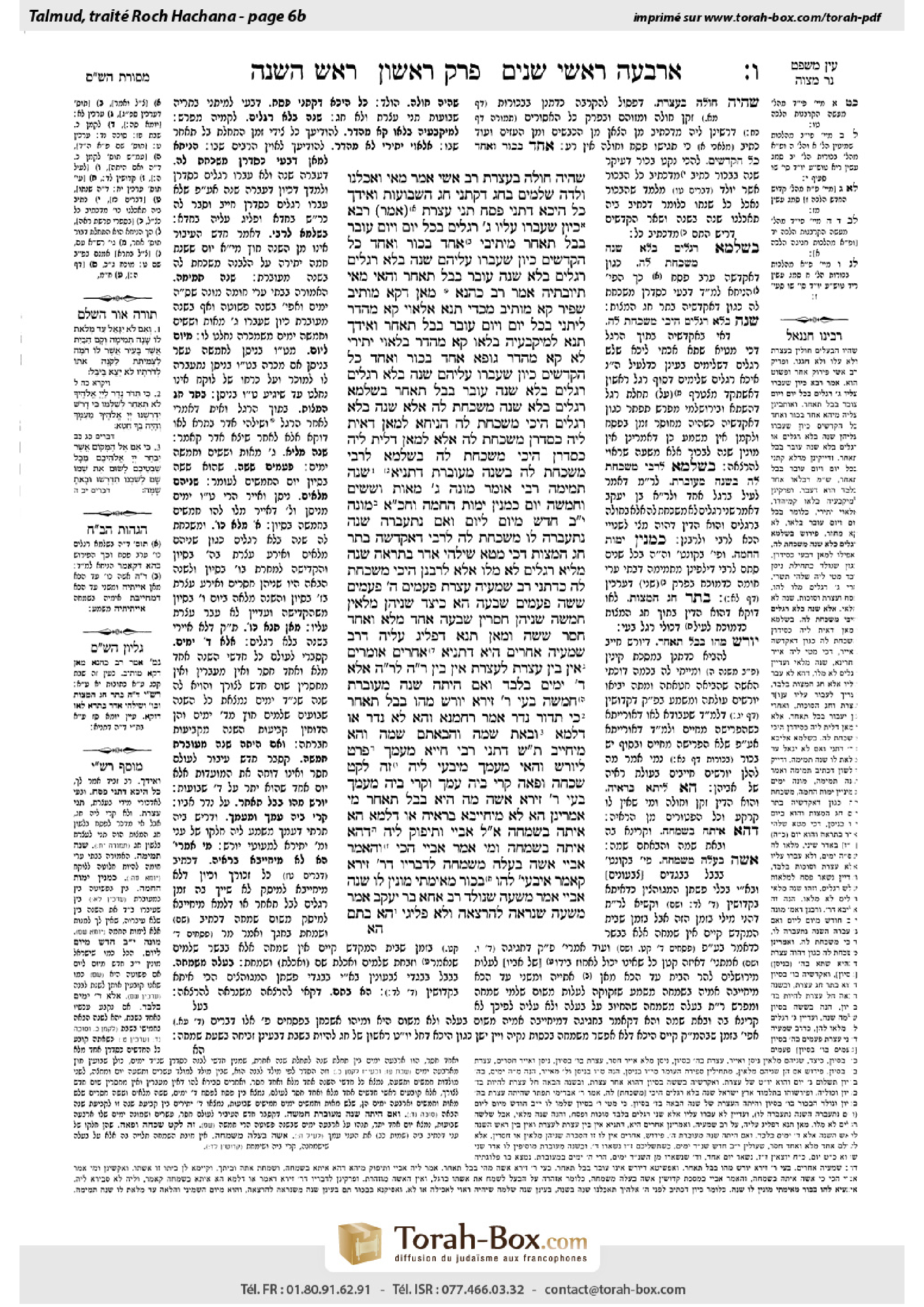
Rosh Hashanah 6b: Talmud study for Daf Yomi
Daf Yomi is the daily study of one Talmud folio. Explore 37 tractates with scans, Hebrew text, Sefaria English and AI-generated French translations where annotated.
Passage selection and English or AI-generated French translation are available where the scan has annotations. Daf Study is independent of Torah-Box and Sefaria.
Browse Rosh Hashanah · ראש השנה · All tractatesRosh Hashanah 6b text and translations
This page of Rosh Hashanah includes the Aramaic text, an English translation and an AI-generated French translation, alongside the scan above.
ראש השנה ו׳ ב · Aramaic and Hebrew text
שֶׁהָיָה חוֹלֶה בָּעֲצֶרֶת. רַב אָשֵׁי אָמַר: מַאי ״וְאָכַלְנוּ וְלָדָהּ שְׁלָמִים בֶּחָג״ דְּקָתָנֵי — חַג הַשָּׁבוּעוֹת.
וְאִידַּךְ: כֹּל הֵיכָא דְּתָנֵי פֶּסַח, תָּנֵי עֲצֶרֶת.
אָמַר רָבָא: כֵּיוָן שֶׁעָבְרוּ עָלָיו שְׁלֹשָׁה רְגָלִים, בְּכׇל יוֹם וָיוֹם עוֹבֵר בְּ״בַל תְּאַחֵר״. מֵיתִיבִי: אֶחָד בְּכוֹר, וְאֶחָד כׇּל הַקֳּדָשִׁים, כֵּיוָן שֶׁעָבְרוּ עֲלֵיהֶם שָׁנָה בְּלֹא רְגָלִים, רְגָלִים בְּלֹא שָׁנָה — עוֹבֵר בְּ״בַל תְּאַחֵר״.
וְהַאי מַאי תְּיוּבְתֵּיהּ? אָמַר רַב כָּהֲנָא: מַאן דְּקָא מוֹתֵיב — שַׁפִּיר קָא מוֹתֵיב: מִכְּדֵי תַּנָּא אַלָּאוֵי קָא מְהַדַּר, לִיתְנֵי: בְּכׇל יוֹם וָיוֹם עוֹבֵר בְּ״בַל תְּאַחֵר״.
וְאִידַּךְ — תַּנָּא לְמִיקְבְּעֵיהּ בְּלָאו קָא מְהַדַּר, בְּלָאוֵי יְתֵירִי לָא קָא מְהַדַּר.
גּוּפָא: אֶחָד בְּכוֹר וְאֶחָד כׇּל הַקֳּדָשִׁים, כֵּיוָן שֶׁעָבְרוּ עֲלֵיהֶם שָׁנָה בְּלֹא רְגָלִים, רְגָלִים בְּלֹא שָׁנָה — עוֹבֵר בְּ״בַל תְּאַחֵר״. בִּשְׁלָמָא רְגָלִים בְּלֹא שָׁנָה מַשְׁכַּחַתְּ לַהּ, אֶלָּא שָׁנָה בְּלֹא רְגָלִים הֵיכִי מַשְׁכַּחַתְּ לַהּ?
הָנִיחָא לְמַאן דְּאִית לֵיהּ כְּסִדְרָן, מַשְׁכַּחַתְּ לַהּ. אֶלָּא לְמַאן דְּלֵית לֵיהּ כְּסִדְרָן, הֵיכִי מַשְׁכַּחַתְּ לַהּ?
בִּשְׁלָמָא לְרַבִּי מַשְׁכַּחַתְּ לַהּ בְּשָׁנָה מְעוּבֶּרֶת. דְּתַנְיָא: ״שָׁנָה תְּמִימָה״, רַבִּי אוֹמֵר: מוֹנֶה שְׁלֹשׁ מֵאוֹת וְשִׁשִּׁים וַחֲמִשָּׁה יוֹם כְּמִנְיָן יְמוֹת הַחַמָּה,
וַחֲכָמִים אוֹמְרִים: מוֹנֶה שְׁנֵים עָשָׂר חֹדֶשׁ מִיּוֹם לְיוֹם, וְאִם נִתְעַבְּרָה שָׁנָה — נִתְעַבְּרָה לוֹ. מַשְׁכַּחַתְּ לַהּ לְרַבִּי דְּאַקְדְּשַׁהּ בָּתַר חַג הַמַּצּוֹת, דְּכִי מְטָא שִׁילְהֵי אֲדָר בָּתְרָאָה — שָׁנָה מַלְיָא, רְגָלִים לָא מְלוּ. אֶלָּא לְרַבָּנַן, הֵיכִי מַשְׁכַּחַתְּ לַהּ?
כִּדְתָנֵי רַב שְׁמַעְיָה: עֲצֶרֶת פְּעָמִים חֲמִשָּׁה, פְּעָמִים שִׁשָּׁה, פְּעָמִים שִׁבְעָה. הָא כֵּיצַד? שְׁנֵיהֶן מְלֵאִין — חֲמִשָּׁה, שְׁנֵיהֶן חֲסֵרִין — שִׁבְעָה, אֶחָד מָלֵא וְאֶחָד חָסֵר — שִׁשָּׁה.
וּמַאן תַּנָּא דִּפְלִיג עֲלֵיהּ דְּרַב שְׁמַעְיָה — אֲחֵרִים הִיא. דְּתַנְיָא, אֲחֵרִים אוֹמְרִים: אֵין בֵּין עֲצֶרֶת לַעֲצֶרֶת, אֵין בֵּין רֹאשׁ הַשָּׁנָה לְרֹאשׁ הַשָּׁנָה, אֶלָּא אַרְבָּעָה יָמִים בִּלְבַד. וְאִם הָיְתָה שָׁנָה מְעוּבֶּרֶת — חֲמִשָּׁה.
בָּעֵי רַבִּי זֵירָא: יוֹרֵשׁ, מַהוּ בְּ״בַל תְּאַחֵר״? ״כִּי תִדּוֹר נֶדֶר״ אָמַר רַחֲמָנָא, וְהָא לָא נְדַר, אוֹ דִלְמָא: ״וּבָאתָ שָּׁמָּה וַהֲבֵאתֶם שָׁמָּה״, וְהָא מִיחַיַּיב.
תָּא שְׁמַע: דְּתָנֵי רַבִּי חִיָּיא — ״מֵעִמָּךְ״, פְּרָט לְיוֹרֵשׁ.
וְהַאי ״מֵעִמָּךְ״ מִיבְּעֵי לֵיהּ, זֶה לֶקֶט שִׁכְחָה וּפֵאָה! קְרִי בֵּיהּ ״עִמָּךְ״, וּקְרִי בֵּיהּ ״מֵעִמָּךְ״.
בָּעֵי רַבִּי זֵירָא: אִשָּׁה, מַה הִיא בְּ״בַל תְּאַחֵר״? מִי אָמְרִינַן: הָא לָא מִיחַיְּיבָא בִּרְאִיָּה, אוֹ דִלְמָא הָא אִיתַהּ בְּשִׂמְחָה?
אֲמַר לֵיהּ אַבָּיֵי: וְתִיפּוֹק לֵיהּ דְּהָא אִיתַהּ בְּשִׂמְחָה. וּמִי אָמַר אַבָּיֵי הָכִי? וְהָאָמַר אַבָּיֵי: אִשָּׁה — בַּעֲלָהּ מְשַׂמְּחָהּ! לִדְבָרָיו דְּרַבִּי זֵירָא קָאָמַר.
אִיבַּעְיָא לְהוּ: בְּכוֹר, מֵאֵימָתַי מוֹנִין לוֹ שָׁנָה? אַבָּיֵי אָמַר: מִשָּׁעָה שֶׁנּוֹלַד, רַב אַחָא בַּר יַעֲקֹב אָמַר: מִשָּׁעָה שֶׁנִּרְאָה לְהַרְצָאָה.
וְלָא פְּלִיגִי: הָא בְּתָם,
Rosh Hashanah 6b · English translation
in a case where the offspring was sick on Shavuot, and therefore it could be brought to the altar only on the next Festival. Rav Ashi said an alternative explanation: What is the statement: And we ate its offspring as a peace-offering on the Festival, coming to teach? This is not referring to the festival of Sukkot, which is the usual meaning of the term the Festival; rather, it is referring to the festival of Shavuot. Therefore, there is no difficulty here whatsoever.
The Gemara asks: And what does the other amora, Rav Zevid, say to this? He argues that anywhere that the tanna teaches a halakha concerning Passover using the term Pesaḥ, he teaches the halakha concerning Shavuot using the term Atzaret, not the term Ḥag. In such a context, the term Ḥag is reserved exclusively for Sukkot.
Rava said: Once three Festivals have passed, every day he transgresses the prohibition: You shall not delay. The Gemara raises an objection from that which is taught in the following baraita: In the case of both a firstborn animal and all consecrated animals, once a year has passed without three Festivals, or three Festivals have passed without a year elapsing, the owner transgresses the prohibition: You shall not delay.
The Gemara first expresses its astonishment at the question itself: What is this objection? What is the comparison between this ruling and the statement of Rava? Rav Kahana said: He who raises an objection here raises a valid objection, and this is the way the question should be understood. Since the tanna of the baraita is looking for prohibitions to add, and he shows that the prohibition applies in additional cases, then if Rava is correct, let the tanna of the baraita teach that once three Festivals have passed he transgresses the prohibition: You shall not delay, every single day.
And how does the other amora, Rava, explain the baraita? He understands that the tanna is trying to establish the action only as subject to a prohibition, i.e., he merely wishes to set the parameters of the prohibition; but once the action is established as prohibited, he is not looking for additional prohibitions.
The Gemara proceeds to discuss the matter itself, i.e., the baraita cited above, which stated: In the case of both a firstborn animal and all consecrated animals, once a year has passed, even if three Festivals have not passed, or once three Festivals have passed, even if a whole year has not passed, the owner transgresses the prohibition: You shall not delay. Granted, it is possible to have three Festivals without a year; you find it because three Festivals can pass in half a year, between Passover and Sukkot. But a year without three Festivals, under what circumstances can you find this case? How can a year pass without three Festivals also passing?
The Gemara clarifies the question: This works out well according to the one who is of the opinion that one transgresses the prohibition against delaying only if the three Festivals have passed in their proper order. You can find a year without three Festivals in their proper order, e.g., if one made his vow shortly before Shavuot, in which case the year will end before Shavuot the following year, but three Festivals in order will not have elapsed until Sukkot of the third year. But according to the one who is not of the opinion that the three Festivals must be in their proper order, under what circumstances can you find this case of a year without three Festivals?
The Gemara clarifies again: Granted, according to Rabbi Yehuda HaNasi, you find a year without three Festivals in a leap year, as it is taught in a baraita: In the case of houses of walled cities, with regard to which an owner is given only one year to redeem his home if he sells it, after which it becomes the permanent possession of the purchaser, the verse states: “And if it be not redeemed within the space of a full year” (Leviticus 25:30). How is the year determined? Rabbi Yehuda HaNasi says: One counts 365 days like the number of the days in a solar year, and not the usual lunar year, which is why it is called a full year.
And the Rabbis disagree and say: One counts twelve months from day to day, from the date of the sale until that same date twelve months later, and if it is a leap year with an added month, the leap month is for the seller’s benefit, i.e., he has thirteen months to redeem his house. You can find a year without three Festivals according to Rabbi Yehuda HaNasi. How so? It is possible in a case where one consecrated the animal after the festival of Passover, so that once he reaches the end of the second month of Adar in a leap year, the year is completed, but the Festivals are not yet completed, as the third Festival is still to come. But according to the Sages, under what circumstances can you find this case of a year without three Festivals?
The Gemara answers: As Rav Shemaya taught in a baraita: Shavuot sometimes occurs on the fifth of Sivan, sometimes on the sixth of Sivan, and sometimes on the seventh. How so? If both the months of Nisan and Iyyar are full months of thirty days each, the festival of Shavuot, which is celebrated fifty days after the second day of Passover, occurs on the fifth of Sivan; if both months are short, with twenty-nine days each, it occurs on the seventh of Sivan; and if one of them is full and the other is short, it occurs on the sixth of Sivan. According to this opinion, if both months were full and the festival of Shavuot occurred on the fifth day of Sivan, and one made his vow on the day after Shavuot, i.e., the sixth of Sivan, and in the following year both months were short, so that the festival of Shavuot occurred on the seventh of Sivan, a whole year would have passed without three Festivals.
The Gemara comments: And who is the tanna who disagrees with Rav Shemaya and says that a year has a fixed number of days? It is Aḥerim, as it is taught in a baraita: Aḥerim say: The difference between Shavuot of one year and Shavuot of the following year, and similarly, between Rosh HaShana of one year and Rosh HaShana of the following year, is only four days of the week. There are 354 days in a lunar year, which are divided into twelve alternating months, six months that are thirty days long and six months that are twenty-nine days long. Therefore, every year is fifty weeks and four days long. And if it were a leap year, in which case the year is comprised of 383 days, or fifty-four weeks and five days, there is a difference of five days between them.
§ Rabbi Zeira asks: In the case of an heir, what is the halakha with regard to the prohibition of: You shall not delay? That is to say, does an heir transgress the prohibition against delaying a vow taken by his father? The Gemara explains the two sides of the question: Is it that the Merciful One states in the Torah: “When you shall vow a vow to the Lord your God, you shall not delay paying it” (Deuteronomy 23:22), and this one, the heir, did not make a vow? Or perhaps the essence of the mitzva is as it says: “And there you shall come; and there you shall bring your burnt-offerings and your sacrifices” (Deuteronomy 12:5–6), and this one, the heir, is obligated to come and bring his father’s offerings.
Come and hear an answer to this, as Rabbi Ḥiyya taught a baraita that says: The verse states: “For the Lord your God will surely require it from you” (Deuteronomy 23:22), which is interpreted to mean: To the exclusion of an heir. This teaches that an heir does not transgress the prohibition against delaying a vow taken by his father.
The Gemara asks: But this phrase “from you” is necessary to teach a different halakha, namely, that one transgresses the prohibition against delaying even for gleanings, forgotten sheaves, and the produce of the corner of his field. The Gemara answers: Rabbi Ḥiyya derived two halakhot from this word. He read into the verse: “You [imakh],” which he expounded as coming to include gleanings, forgotten sheaves and the produce of the corner of the field in the prohibition, and he read into the verse: “From you [me’imakh],” with the extra letter mem coming to exclude an heir.
§ Rabbi Zeira asks another question on this topic: In the case of a woman who made a vow, what is the halakha with regard to the prohibition: You shall not delay? The Gemara explains: Do we say that since she is not obligated to appear in the Temple on the pilgrimage Festivals, as this obligation is a positive, time-bound mitzva, from which women are exempt, she also does not transgress if she is late in bringing her offering? Or perhaps, since she is obligated in the mitzva of rejoicing on a Festival, she should also be obligated in some of the other mitzvot connected to the day?
Abaye said to him: Derive this from the fact that she is also obligated in the mitzva of rejoicing on a Festival. The Gemara asks: And did Abaye actually say this, that a woman is obligated to rejoice on a Festival? But didn’t Abaye say: As for a woman, her husband must make her joyful on a Festival? This means that the obligation falls not on the woman, but upon her husband. The Gemara answers: Abaye stated his opinion in accordance with the statement of Rabbi Zeira. Rabbi Zeira holds that women are bound by a positive mitzva to rejoice on a Festival. Since, according to Rabbi Zeira’s opinion, they are obligated in the mitzva of rejoicing on a Festival, they are also subject to the prohibition: You shall not delay.
§ A dilemma was raised before the Sages: In the case of a firstborn animal, from when does one begin to count a year with regard to the prohibition against delaying? Abaye said: One counts from the time it is born. Rav Aḥa bar Ya’akov said: One counts from the time it is fit for appeasement, i.e., from its eighth day, when it is fit to be brought as an offering, as explicitly stated in the Torah (see Leviticus 22:27).
The Gemara comments: The two Sages do not disagree. This one, Rav Aḥa bar Ya’akov, who said that one counts from the time that the animal is fit for appeasement, is speaking about an unblemished firstborn, which must be brought to the altar for sacrifice.
Rosh Hashanah 6b · Traduction française (IA)
dans le cas où le petit était malade à Chavouot et ne pouvait donc être présenté sur l’autel qu’à la fête suivante. Rav Ashi proposa une autre explication : Que vient enseigner la déclaration : « Nous avons mangé son petit en sacrifice de paix pendant la fête » ? Elle ne fait pas référence à la fête de Souccot, qui est le sens habituel du terme « la fête », mais à la fête de Chavouot. Il n’y a donc là aucune difficulté.
La Guemara demande : Que répond l’autre amora, Rav Zevid ? Il soutient que partout où le tanna enseigne une halakha relative à Pessa’h en employant le terme Pessa’h, il enseigne la halakha relative à Chavouot en employant le terme Atséret, et non le terme ‘Hag. Dans un tel contexte, le terme ‘Hag est réservé exclusivement à Souccot.
Rava dit : Une fois que trois fêtes de pèlerinage sont passées, chaque jour, il transgresse l’interdit : « Tu ne tarderas pas. » La Guemara soulève une objection à partir de ce qui est enseigné dans la baraïta suivante : Pour un animal premier-né comme pour tous les animaux consacrés, si une année s’est écoulée sans que trois fêtes de pèlerinage soient passées, ou si trois fêtes de pèlerinage sont passées sans qu’une année se soit écoulée, le propriétaire transgresse l’interdit : « Tu ne tarderas pas. »
La Guemara commence par exprimer son étonnement devant la question elle-même : En quoi consiste cette objection ? Quel rapport y a-t-il entre cette décision et la déclaration de Rava ? Rav Kahana dit : Celui qui soulève ici une objection en soulève une valable, et voici comment il faut comprendre la question. Puisque le tanna de la baraïta cherche à ajouter des cas où l’interdit s’applique et montre qu’il s’applique dans des cas supplémentaires, si Rava a raison, que le tanna de la baraïta enseigne donc qu’une fois que trois fêtes de pèlerinage sont passées, il transgresse chaque jour l’interdit : « Tu ne tarderas pas. »
Et comment l’autre amora, Rava, explique-t-il la baraïta ? Il comprend que le tanna cherche seulement à établir que l’acte est soumis à un interdit, c’est-à-dire qu’il souhaite simplement en définir les limites ; mais une fois que l’acte est établi comme interdit, il ne cherche pas à ajouter d’autres interdits.
La Guemara examine alors la baraïta elle-même, citée plus haut, qui enseignait : Pour un animal premier-né comme pour tous les animaux consacrés, si une année s’est écoulée, même si trois fêtes de pèlerinage ne sont pas passées, ou si trois fêtes de pèlerinage sont passées, même si une année entière ne s’est pas écoulée, le propriétaire transgresse l’interdit : « Tu ne tarderas pas. » Il est certes possible que trois fêtes de pèlerinage passent sans qu’une année s’écoule : cela se produit, puisque trois fêtes peuvent passer en six mois, entre Pessa’h et Souccot. Mais dans quelles circonstances une année peut-elle s’écouler sans que trois fêtes de pèlerinage passent ? Comment une année peut-elle s’écouler sans que trois fêtes de pèlerinage passent également ?
La Guemara précise la question : Cela se comprend bien selon celui qui estime qu’on ne transgresse l’interdit de tarder que si les trois fêtes de pèlerinage sont passées dans leur ordre habituel. On peut trouver une année sans que trois fêtes soient passées dans leur ordre habituel, par exemple si quelqu’un a fait son vœu peu avant Chavouot : l’année s’achèvera avant Chavouot de l’année suivante, mais les trois fêtes ne se seront pas écoulées dans l’ordre avant Souccot de la troisième année. Mais selon celui qui estime que les trois fêtes n’ont pas à passer dans leur ordre habituel, dans quelles circonstances peut-on trouver le cas d’une année sans trois fêtes de pèlerinage ?
La Guemara précise encore : Il est certes possible, selon Rabbi Yehouda HaNassi, de trouver une année sans trois fêtes de pèlerinage dans le cas d’une année embolismique, comme l’enseigne une baraïta : Pour les maisons des villes fortifiées, dont le propriétaire ne dispose que d’un an pour racheter sa maison s’il la vend, après quoi elle devient la propriété permanente de l’acheteur, le verset dit : « Et si elle n’est pas rachetée dans l’espace d’une année entière » (Lévitique 25:30). Comment détermine-t-on cette année ? Rabbi Yehouda HaNassi dit : On compte 365 jours, soit le nombre de jours d’une année solaire, et non ceux d’une année lunaire habituelle ; c’est pourquoi elle est appelée « année entière ».
Les Sages ne sont pas d’accord et disent : On compte douze mois de date à date, depuis la date de la vente jusqu’à la même date douze mois plus tard ; et si l’année est embolismique, avec un mois supplémentaire, ce mois est à l’avantage du vendeur, c’est-à-dire qu’il dispose de treize mois pour racheter sa maison. Selon Rabbi Yehouda HaNassi, on peut donc trouver une année sans trois fêtes de pèlerinage. Comment cela ? C’est possible si quelqu’un a consacré l’animal après la fête de Pessa’h : lorsqu’il arrive à la fin du deuxième mois d’Adar d’une année embolismique, l’année est achevée, mais les fêtes ne sont pas encore toutes passées, puisque la troisième fête est encore à venir. Mais selon les Sages, dans quelles circonstances peut-on trouver le cas d’une année sans trois fêtes de pèlerinage ?
La Guemara répond : Rav Shemaya l’a enseigné dans une baraïta : Chavouot tombe parfois le cinq Sivan, parfois le six Sivan et parfois le sept Sivan. Comment cela ? Si les mois de Nisan et d’Iyar comptent tous deux trente jours, la fête de Chavouot, célébrée cinquante jours après le deuxième jour de Pessa’h, tombe le cinq Sivan ; si les deux mois sont courts et comptent chacun vingt-neuf jours, elle tombe le sept Sivan ; et si l’un est plein et l’autre court, elle tombe le six Sivan. Selon cette opinion, si les deux mois étaient pleins et que Chavouot tombait le cinq Sivan, puis que quelqu’un faisait son vœu le lendemain de Chavouot, c’est-à-dire le six Sivan, et que l’année suivante les deux mois étaient courts, de sorte que Chavouot tombait le sept Sivan, une année entière se serait écoulée sans que trois fêtes de pèlerinage passent.
La Guemara fait remarquer : Quel est le tanna qui contredit Rav Shemaya et dit qu’une année comporte un nombre fixe de jours ? C’est A’herim, comme l’enseigne une baraïta : A’herim disent que l’écart entre Chavouot d’une année et Chavouot de l’année suivante, et de même entre Roch Hachana d’une année et Roch Hachana de l’année suivante, n’est que de quatre jours de la semaine. Une année lunaire compte 354 jours, répartis en douze mois alternant entre six mois de trente jours et six mois de vingt-neuf jours. Chaque année compte donc cinquante semaines et quatre jours. Et dans une année embolismique, qui compte 383 jours, soit cinquante-quatre semaines et cinq jours, l’écart est de cinq jours.
§ Rabbi Zeira demande : Quelle est la halakha concernant un héritier au regard de l’interdit : « Tu ne tarderas pas » ? Autrement dit, un héritier transgresse-t-il l’interdit de tarder à accomplir un vœu fait par son père ? La Guemara expose les deux possibilités : Le Miséricordieux dit-il dans la Torah : « Lorsque tu feras un vœu au Seigneur ton Dieu, tu ne tarderas pas à l’acquitter » (Deutéronome 23:22), et cet homme, l’héritier, n’a pas fait de vœu ? Ou bien l’essentiel de la mitsva est-il exprimé ainsi : « Là, tu viendras ; et là, tu apporteras tes holocaustes et tes sacrifices » (Deutéronome 12:5–6), de sorte que cet homme, l’héritier, est tenu de venir et d’apporter les sacrifices de son père ?
Viens entendre la réponse à cette question, car Rabbi Ḥiyya a enseigné une baraïta qui dit : Le verset énonce : « Car le Seigneur ton Dieu te le réclamera certainement » (Deutéronome 23:22). On en déduit : à l’exclusion d’un héritier. Cela enseigne qu’un héritier ne transgresse pas l’interdit de tarder à accomplir un vœu fait par son père.
La Guemara demande : Mais l’expression « de toi » est nécessaire pour enseigner une autre halakha, à savoir que l’on transgresse l’interdit de tarder même pour les glanures, les gerbes oubliées et les produits du coin du champ. La Guemara répond : Rabbi Ḥiyya a déduit deux halakhot de ce mot. Il a lu dans le verset : « Toi [imakh] », qu’il a interprété comme incluant les glanures, les gerbes oubliées et les produits du coin du champ dans l’interdit ; et il a lu dans le verset : « De toi [me’imakh] », le mem supplémentaire venant exclure un héritier.
§ Rabbi Zeira pose une autre question à ce sujet : Quelle est la halakha concernant une femme qui a fait un vœu au regard de l’interdit : « Tu ne tarderas pas » ? La Guemara explique : Doit-on dire que, puisqu’elle n’est pas tenue de se présenter au Temple lors des fêtes de pèlerinage — cette obligation étant une mitsva positive liée au temps, dont les femmes sont exemptées — elle ne transgresse pas non plus l’interdit si elle tarde à apporter son offrande ? Ou bien, puisqu’elle est tenue d’accomplir la mitsva de se réjouir lors d’une fête, est-elle également tenue d’accomplir certaines des autres mitsvot liées à ce jour ?
Abayé lui dit : Déduis-le du fait qu’elle est également tenue d’accomplir la mitsva de se réjouir lors d’une fête. La Guemara demande : Abayé a-t-il vraiment dit qu’une femme est tenue de se réjouir lors d’une fête ? Abayé n’a-t-il pas dit : « Quant à la femme, c’est son mari qui doit la réjouir lors d’une fête » ? Cela signifie que l’obligation incombe non à la femme, mais à son mari. La Guemara répond : Abayé a exprimé son opinion conformément à celle de Rabbi Zeira. Rabbi Zeira estime que les femmes sont astreintes à une mitsva positive de se réjouir lors d’une fête. Puisque, selon l’opinion de Rabbi Zeira, elles sont tenues d’accomplir la mitsva de se réjouir lors d’une fête, elles sont également soumises à l’interdit : « Tu ne tarderas pas. »
§ Une question fut posée aux Sages : Dans le cas d’un animal premier-né, à partir de quand commence-t-on à compter une année au regard de l’interdit de tarder ? Abayé dit : On compte à partir de sa naissance. Rav Aḥa bar Ya’akov dit : On compte à partir du moment où il est apte à être agréé, c’est-à-dire à partir de son huitième jour, où il peut être présenté en offrande, comme l’énonce explicitement la Torah (voir Lévitique 22:27).
La Guemara fait remarquer : Les deux Sages ne sont pas en désaccord. Rav Aḥa bar Ya’akov, qui a dit qu’on compte à partir du moment où l’animal est apte à être agréé, parle d’un animal premier-né sans défaut, qui doit être présenté sur l’autel en sacrifice.
Traduction française générée par IA à partir de l’édition anglaise de Sefaria. Vérifie toujours un passage avec le texte source.
Text from Sefaria: William Davidson Edition - Vocalized Aramaic (CC BY NC); William Davidson Edition - English (CC BY NC).