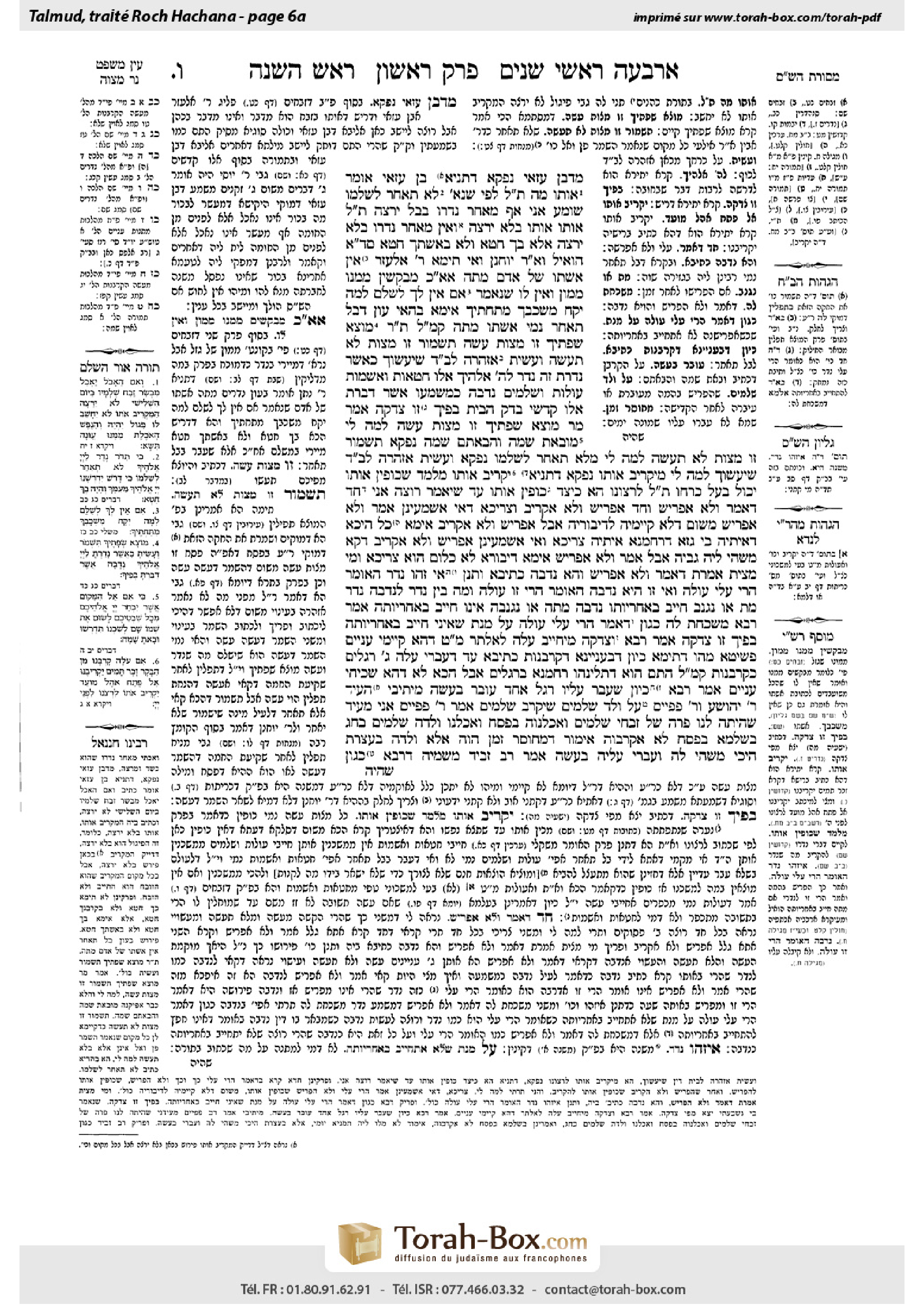
Rosh Hashanah 6a: Talmud study for Daf Yomi
Daf Yomi is the daily study of one Talmud folio. Explore 37 tractates with scans, Hebrew text, Sefaria English and AI-generated French translations where annotated.
Passage selection and English or AI-generated French translation are available where the scan has annotations. Daf Study is independent of Torah-Box and Sefaria.
Browse Rosh Hashanah · ראש השנה · All tractatesRosh Hashanah 6a text and translations
This page of Rosh Hashanah includes the Aramaic text, an English translation and an AI-generated French translation, alongside the scan above.
ראש השנה ו׳ א · Aramaic and Hebrew text
מִדְּבֶן עַזַּאי נָפְקָא, דְּתַנְיָא: בֶּן עַזַּאי אוֹמֵר: ״אוֹתוֹ״
מַה תַּלְמוּד לוֹמַר? לְפִי שֶׁנֶּאֱמַר: ״לֹא תְאַחֵר לְשַׁלְּמוֹ״, שׁוֹמֵעַ אֲנִי אַף מְאַחֵר נִדְרוֹ בְּ״בַל יֵרָצֶה״, תַּלְמוּד לוֹמַר: ״אוֹתוֹ״ — אוֹתוֹ בְּ״לֹא יֵרָצֶה״, וְאֵין מְאַחֵר נִדְרוֹ בְּ״לֹא יֵרָצֶה״,
אֶלָּא: ״בְּךָ חֵטְא״ — וְלֹא בְּאִשְׁתְּךָ חֵטְא.
סָלְקָא דַּעְתָּךְ אָמֵינָא: הוֹאִיל וְאָמַר רַבִּי יוֹחָנָן, וְאִי תֵּימָא רַבִּי אֶלְעָזָר: אֵין אִשְׁתּוֹ שֶׁל אָדָם מֵתָה אֶלָּא אִם כֵּן מְבַקְּשִׁין מִמֶּנּוּ מָמוֹן וְאֵין לוֹ, שֶׁנֶּאֱמַר: ״אִם אֵין לְךָ לְשַׁלֵּם לָמָּה יִקַּח מִשְׁכָּבְךָ מִתַּחְתֶּיךָ״, אֵימָא בְּהַאי עָוֹן דְּ״בַל תְּאַחֵר״ נָמֵי אִשְׁתּוֹ מֵתָה, קָא מַשְׁמַע לַן.
תָּנוּ רַבָּנַן: ״מוֹצָא שְׂפָתֶיךָ״ — זוֹ מִצְוַת עֲשֵׂה, ״תִּשְׁמוֹר״ — זוֹ מִצְוַת לֹא תַעֲשֶׂה, ״וְעָשִׂיתָ״ — אַזְהָרָה לְבֵית דִּין שֶׁיְּעַשּׂוּךְ, ״כַּאֲשֶׁר נָדַרְתָּ״ — זֶה נֶדֶר, ״לַה׳ אֱלֹהֶיךָ״ — אֵלּוּ חַטָּאוֹת וַאֲשָׁמוֹת עוֹלוֹת וּשְׁלָמִים, ״נְדָבָה״ — כְּמַשְׁמָעוֹ, ״אֲשֶׁר דִּבַּרְתָּ״ — אֵלּוּ קׇדְשֵׁי בֶּדֶק הַבַּיִת, ״בְּפִיךְ״ — זוֹ צְדָקָה.
אָמַר מָר: ״מוֹצָא שְׂפָתֶיךָ״ — זוֹ מִצְוַת עֲשֵׂה. לְמָה לִי? מִ״וּבָאתָ שָּׁמָּה ... וַהֲבֵאתֶם שָׁמָּה״ נָפְקָא! ״תִּשְׁמוֹר״ — זוֹ מִצְוַת לֹא תַעֲשֶׂה. לְמָה לִי? מִ״לֹּא תְאַחֵר לְשַׁלְּמוֹ״ נָפְקָא!
״וְעָשִׂיתָ״ — אַזְהָרָה לְבֵית דִּין שֶׁיְּעַשּׂוּךְ. לְמָה לִי? מִ״יַּקְרִיב אוֹתוֹ״ נָפְקָא, דְּתַנְיָא: ״יַקְרִיב אוֹתוֹ״ — מְלַמֵּד שֶׁכּוֹפִין אוֹתוֹ. יָכוֹל בְּעַל כׇּרְחוֹ — תַּלְמוּד לוֹמַר: ״לִרְצוֹנוֹ״, הָא כֵּיצַד? כּוֹפִין אוֹתוֹ עַד שֶׁיֹּאמַר ״רוֹצֶה אֲנִי״.
חַד, דַּאֲמַר וְלָא אַפְרֵישׁ, וְחַד, אַפְרֵישׁ וְלָא אַקְרֵיב.
וּצְרִיכָא, דְּאִי אַשְׁמְעִינַן אֲמַר וְלָא אַפְרֵישׁ, מִשּׁוּם דְּלָא קַיְּימֵיהּ לְדִיבּוּרֵיהּ, אֲבָל אַפְרֵישׁ וְלָא אַקְרֵיב, אֵימָא: כֹּל הֵיכָא דְּאִיתֵיהּ — בֵּי גַזָּא דְּרַחֲמָנָא אִיתֵיהּ. צְרִיכָא.
וְאִי אַשְׁמְעִינַן אַפְרֵישׁ וְלָא אַקְרֵיב, דְּקָא מַשְׁהֵי לֵיהּ גַּבֵּיהּ, אֲבָל אָמַר וְלָא אַפְרֵישׁ, אֵימָא דִּיבּוּרָא לֹא כְּלוּם הוּא. צְרִיכָא.
וּמִי מָצֵית אָמְרַתְּ דְּאָמַר וְלָא אַפְרֵישׁ? וְהָא נְדָבָה כְּתִיבָא, וּתְנַן: אֵי זֶהוּ נֶדֶר — הָאוֹמֵר: הֲרֵי עָלַי עוֹלָה. וְאֵי זוֹ הִיא נְדָבָה — הָאוֹמֵר: הֲרֵי זוֹ עוֹלָה.
וּמָה בֵּין נֶדֶר לִנְדָבָה? נֶדֶר, מֵת אוֹ נִגְנַב — חַיָּיב בְּאַחְרָיוּתוֹ. נְדָבָה, מֵתָה אוֹ נִגְנְבָה — אֵינוֹ חַיָּיב בְּאַחְרָיוּתָהּ.
אָמַר רָבָא: מַשְׁכַּחַתְּ לַהּ, כְּגוֹן דְּאָמַר: הֲרֵי עָלַי עוֹלָה עַל מְנָת שֶׁאֵינִי חַיָּיב בְּאַחְרָיוּתָהּ.
״בְּפִיךְ״ — זוֹ צְדָקָה. אָמַר רָבָא: וּצְדָקָה — מִיחַיַּיב עֲלַהּ לְאַלְתַּר. מַאי טַעְמָא — דְּהָא קָיְימִי עֲנִיִּים.
פְּשִׁיטָא! מַהוּ דְּתֵימָא: כֵּיוָן דִּבְעִנְיָינָא דְּקׇרְבָּנוֹת כְּתִיבָא, עַד דְּעָבְרִי עֲלַהּ שְׁלֹשָׁה רְגָלִים כְּקׇרְבָּנוֹת, קָא מַשְׁמַע לַן: הָתָם הוּא דִּתְלִינְהוּ רַחֲמָנָא בִּרְגָלִים, אֲבָל הָכָא לָא — דְּהָא שְׁכִיחִי עֲנִיִּים.
אָמַר רָבָא: כֵּיוָן שֶׁעָבַר עָלָיו רֶגֶל אֶחָד — עוֹבֵר בַּעֲשֵׂה.
מֵיתִיבִי: הֵעִיד רַבִּי יְהוֹשֻׁעַ וְרַבִּי פַּפְּיָיס עַל וָלָד שְׁלָמִים שֶׁיִּקְרַב שְׁלָמִים. אָמַר רַבִּי פַּפְּיָיס: אֲנִי מֵעִיד שֶׁהָיְתָה לָנוּ פָּרָה שֶׁל זִבְחֵי שְׁלָמִים וַאֲכַלְנוּהָ בַּפֶּסַח, וְאָכַלְנוּ וְלָדָהּ שְׁלָמִים בֶּחָג.
בִּשְׁלָמָא בְּפֶסַח לָא אַקְרְבוּהּ, אֵימוֹר דִּמְחוּסָּר זְמַן הֲוָה. אֶלָּא וַלְדַּהּ בַּעֲצֶרֶת הֵיכִי מַשְׁהִי לֵהּ וְעָבְרִי עֲלֵיהּ בַּעֲשֵׂה!
אָמַר רַב זְבִיד מִשְּׁמֵיהּ דְּרָבָא: כְּגוֹן
Rosh Hashanah 6a · English translation
as this halakha is derived from that which ben Azzai said, as it is taught in a baraita that ben Azzai says: The verse states: “And if any of the flesh of the sacrifice of his peace-offering be eaten at all on the third day, it shall not be accepted, neither shall it be imputed to him who offers it, it shall be piggul” (Leviticus 7:18).
For what purpose does the verse state the word “it”? Since elsewhere it states: “When you shall vow a vow to the Lord your God, you shall not delay paying it; for the Lord your God will surely require it from you, and it would be sin in you” (Deuteronomy 23:22), I might have interpreted from this verse that even one who is late in paying his vow is included in: It shall not be accepted. Therefore, the verse states “it.” It, an offering disqualified by improper intention [piggul], is included in the halakha of: “It shall not be accepted,” but the animal of one who is late in paying his vow is not included in the halakha of: “It shall not be accepted.”
The Gemara rejects what was said above; rather, the explanation of the verse is as follows. The phrase: “And it would be sin in you” comes to teach that there would be a sin in you, but there would not be a sin in your wife.
It was necessary to say that the lateness is not imputed to the other members of one’s household for the following reason: It might enter your mind to say: Since Rabbi Yoḥanan said, and some say that it was Rabbi Elazar who said: A person’s wife dies only because others demand of him money and he does not have means with which to pay, as it is stated about one who commits himself to guarantee a loan: “If you have nothing with which to pay, why should he take away your bed from under you?” (Proverbs 22:27). The verse warns one who takes a loan that incurring debt may result in one losing the very sheets that he sleeps on to his creditor. The Gemara understands this homiletically: Why should you cause God to take away your wife, i.e., she who shares your bed, so that she dies? Consequently, you might say that one’s wife also dies for this transgression of the prohibition: You shall not delay, in that one fails to fulfill his commitment. Therefore, the verse teaches us that this is not so. Rather, this sin is imputed to him alone.
§ The Sages taught in a baraita: The verse states: “That which is gone out of your lips you shall keep and do; as you have vowed as a gift to the Lord your God, which you have promised with your mouth” (Deuteronomy 23:24). “That which is gone out of your lips”; this is a positive mitzva. “You shall keep”; this is a prohibition, as the phrase “you shall keep” is a warning to keep oneself from sinning. “And do”; this is an admonition to the court to make you fulfill your vow. “As you have vowed”; this is referring to a vow-offering. “To the Lord your God”; this is referring to sin-offerings, guilt-offerings, burnt-offerings, and peace-offerings, teaching that one must keep his word and bring them. “As a gift”; this is understood in its literal sense to be referring to a gift-offering. “Which you have promised”; this is referring to objects consecrated for Temple maintenance. “With your mouth”; this is referring to vows of charity, to which one commits himself with his mouth.
The Gemara clarifies the details mentioned in this baraita. The Master said: “That which is gone out of your lips”; this is a positive mitzva. Why do I need this derivation? Isn’t the positive mitzva derived from the verse: “And there you shall come; and there you shall bring your burnt-offerings and your sacrifices, and your tithes, and the offering of your hand, and your vows, and your gift-offerings, and the firstborn of your herd and of your flock” (Deuteronomy 12:5–6)? The baraita continues: “You shall keep”; this is a prohibition. Why do I need this derivation; this is derived from the verse: “You shall not delay paying it” (Deuteronomy 23:22).
“And do”; this is a warning to the court to make you fulfill your vow. Why do I need this derivation? This rule is derived from the verse: “He shall offer it” (Leviticus 1:3), as it is taught in a baraita: The verse states: “He shall offer it,” which teaches that he must be forced to bring his offering. One might have thought that he may be forced to bring his offering even against his will. Therefore, the verse states: “In accordance with his will” (Leviticus 1:3). How so? The court coerces him until he says: I want to bring the offering. Now, since all of these halakhot are already known from other sources, what is the point of this repetition?
The Gemara answers: One set of verses is referring to a case where one said that he vowed to bring an offering but did not yet set aside a specific animal for his vow, and one set of verses is referring to a case where he set aside a specific animal for his vow but did not yet sacrifice it on the altar.
And it is necessary to teach the halakha in both cases, as had the Torah taught us only about the halakha of the case where one said that he vowed to bring an offering but did not yet set aside a specific animal for his vow, one might have said that only in this case has he transgressed because he did not keep his word; however, if he set aside a specific animal for his vow but did not yet sacrifice it on the altar, one might say that anywhere that it is, it is in the treasure house of the Merciful One, as the world and everything in it belongs to God, and therefore it makes no difference if he delays in bringing it to the Temple. Therefore, it is necessary to teach that even when one has set aside a specific animal he transgresses the prohibition.
And had the Torah taught us only about the case where one set aside a specific animal for his vow but did not yet sacrifice it on the altar, one might have said that only in this case has he transgressed because he is keeping the animal for himself. But if he said that he vowed to bring an offering but did not yet set aside a specific animal for his vow, one might say that his mere speech is nothing, and there is no transgression provided he has not actually set aside an animal. Therefore, it is necessary to teach the halakha in both cases.
The Gemara raises a difficulty: How can you say that the Gemara is dealing with a case where one merely said that he vowed to bring an offering but did not yet set aside a specific animal? Isn’t a gift-offering mentioned in the verse, and we learned in a mishna: What is a vow-offering? It is an offering brought by one who says: It is incumbent upon me to bring a burnt-offering. And what is a gift-offering? It is an offering brought by one who says, concerning a particular animal: I undertake to bring this animal as a burnt-offering.
And what is the difference between a vow-offering and a gift-offering? With regard to vow-offerings, if the animal died or was stolen, the one who took the vow is obligated to pay restitution for it. He undertook to bring a burnt-offering without specifying the animal, and therefore until he brings that offering he is not absolved of his obligation. With regard to a gift-offering, however, if the animal died or was stolen, he is not obligated to pay restitution for it because he undertook to bring a specific animal, and that is no longer possible. In the case of a gift-offering, then, a specific animal must have already been set aside as an offering.
Rava said: You can find a case of a gift-offering where a specific animal has not yet been set aside; for example, where one said: It is incumbent upon me to bring a burnt-offering on the condition that after I set an animal aside in fulfillment of my vow, I will not be liable to replace it should the animal die or be stolen.
§ The baraita stated: “With your mouth”; this is referring to vows of charity. Rava said: In the case of vows of charity, one is liable immediately if he is late in distributing the charity that he had promised to give. What is the reason for this halakha? It is that poor people to whom the charity may be given exist in all places, and so the charity can be distributed to them immediately, unlike an offering, which must be brought to the Temple.
The Gemara asks: It is obvious that charity must be given to the poor without delay. The Gemara explains: Lest you say that since the halakha pertaining to vows of charity is written in the passage dealing with offerings, perhaps one does not transgress the prohibition against delaying until three Festivals have passed, as is the halakha with regard to offerings, therefore Rava teaches us that this is not so. Rather, there, with regard to the offerings, the Merciful One made the timing of the transgression dependent upon the time of the Festivals, when one must go on pilgrimage to the Temple. However, here, with regard to charity vows, this is not so because poor people who are ready to accept charity are found in all places.
Rava said: Although, according to most opinions one transgresses the prohibition against delaying only after three Festivals have elapsed, once even one Festival has passed and he has not sacrificed the offerings that he vowed to bring, he immediately violates a positive mitzva.
The Gemara raises an objection from the following mishna: Rabbi Yehoshua and Rabbi Papeyyas testified about the offspring of peace-offerings. They said that if the mother animal was consecrated before it conceived or during its pregnancy, the offspring, too, must be sacrificed as a peace-offering. Rabbi Papeyyas said: I testify that we once had a cow that was sacrificed as a peace-offering, and we ate it on Passover [beFesaḥ], and we ate its offspring as a peace-offering on the Festival [beḤag], i.e., on Sukkot.
The Gemara clarifies the details of this story: Granted, on Passover itself Rabbi Papeyyas and his family did not sacrifice the offspring, as one can say that the animal was lacking the requisite time, i.e., it was less than eight days old, and it is prohibited to sacrifice such a young animal. But how could they delay and not sacrifice the offspring on Shavuot, the first Festival after Passover, if, according to Rava, they would violate a positive mitzva as soon as the first Festival passed?
Rav Zevid said in the name of Rava: For example, this occurs
Rosh Hashanah 6a · Traduction française (IA)
car cette halakha est déduite de ce qu’a dit ben Azzai, comme on l’enseigne dans une baraïta. ben Azzai dit : Le verset énonce : « Si l’on mange de la chair du sacrifice de son offrande de paix le troisième jour, elle ne sera pas agréée et cela ne sera pas imputé à celui qui l’offre ; ce sera du piggul » (Lévitique 7,18).
Pourquoi le verset emploie-t-il le mot « cela » ? Puisqu’il est écrit ailleurs : « Quand tu feras un vœu à l’Éternel, ton Dieu, tu ne tarderas pas à l’acquitter, car l’Éternel, ton Dieu, te le réclamera certainement, et il y aurait une faute en toi » (Deutéronome 23,22), j’aurais pu comprendre de ce verset que même celui qui tarde à acquitter son vœu est inclus dans la règle : « Cela ne sera pas agréé ». C’est pourquoi le verset dit « cela ». L’offrande disqualifiée par une intention irrégulière [piggul] est incluse dans la règle : « Cela ne sera pas agréé », mais l’animal de celui qui tarde à acquitter son vœu n’y est pas inclus.
La Guemara rejette ce qui a été dit plus haut ; l’explication du verset est plutôt la suivante : l’expression « et il y aurait une faute en toi » enseigne qu’il y aurait une faute en toi, mais pas en ta femme.
Il fallait préciser que le retard n’est pas imputé aux autres membres du foyer, pour la raison suivante : tu aurais pu penser que, puisque Rabbi Yoḥanan a dit — et certains disent que c’est Rabbi Elazar qui l’a dit — qu’une femme ne meurt que parce que des créanciers réclament de l’argent à son mari et qu’il n’a pas de quoi payer, comme il est dit à propos de celui qui se porte garant d’un emprunt : « Si tu n’as pas de quoi payer, pourquoi emporterait-il ton lit de dessous toi ? » (Proverbes 22,27). Le verset met en garde celui qui emprunte : s’endetter peut conduire à ce que son créancier lui prenne jusqu’aux draps sur lesquels il dort. La Guemara comprend cela de manière homilétique : pourquoi provoquerais-tu Dieu à t’enlever ta femme, c’est-à-dire celle qui partage ton lit, en la faisant mourir ? Tu aurais donc pu dire que ta femme aussi meurt à cause de cette transgression de l’interdiction de tarder, c’est-à-dire parce que tu ne respectes pas ton engagement. Le verset nous enseigne qu’il n’en est rien : cette faute ne lui est imputée qu’à lui seul.
§ Les Sages enseignent dans une baraïta : Le verset énonce : « Ce qui est sorti de tes lèvres, tu le garderas et le feras ; selon ce que tu as voué comme don à l’Éternel, ton Dieu, ce que tu as promis de ta bouche » (Deutéronome 23,24). « Ce qui est sorti de tes lèvres » : c’est une mitsva positive. « Tu le garderas » : c’est une interdiction, car cette expression avertit de se préserver de la faute. « Et le feras » : c’est un avertissement au tribunal, qui doit te faire accomplir ton vœu. « Selon ce que tu as voué » : cela désigne une offrande votive. « À l’Éternel, ton Dieu » : cela désigne les sacrifices expiatoires, les sacrifices de culpabilité, les holocaustes et les offrandes de paix, et enseigne qu’il faut tenir parole et les apporter. « Comme don » : cette expression est comprise dans son sens littéral et désigne une offrande volontaire. « Ce que tu as promis » : cela désigne les objets consacrés à l’entretien du Temple. « De ta bouche » : cela désigne les vœux de charité, auxquels on s’engage par la parole.
La Guemara précise les détails mentionnés dans cette baraïta. Le maître a dit : « Ce qui est sorti de tes lèvres » : c’est une mitsva positive. Pourquoi cette déduction est-elle nécessaire ? La mitsva positive ne se déduit-elle pas du verset : « Là, vous irez et là, vous apporterez vos holocaustes et vos sacrifices, vos dîmes, les offrandes de vos mains, vos vœux, vos offrandes volontaires et les premiers-nés de votre gros et de votre petit bétail » (Deutéronome 12,5-6) ? La baraïta poursuit : « Tu le garderas » : c’est une interdiction. Pourquoi cette déduction est-elle nécessaire ? Cela se déduit du verset : « Tu ne tarderas pas à l’acquitter » (Deutéronome 23,22).
« Et le feras » : c’est un avertissement au tribunal, qui doit te faire accomplir ton vœu. Pourquoi cette déduction est-elle nécessaire ? Cette règle se déduit du verset : « Il l’offrira » (Lévitique 1,3), comme on l’enseigne dans une baraïta : le verset dit « Il l’offrira », ce qui enseigne qu’on doit le contraindre à apporter son offrande. On aurait pu penser qu’on peut le contraindre à l’apporter même contre sa volonté. C’est pourquoi le verset dit : « Selon sa volonté » (Lévitique 1,3). Comment cela s’applique-t-il ? Le tribunal le contraint jusqu’à ce qu’il dise : « Je veux apporter l’offrande. » Or, puisque toutes ces halakhot sont déjà connues par d’autres sources, à quoi sert cette répétition ?
La Guemara répond : un ensemble de versets concerne le cas où quelqu’un a dit qu’il avait fait vœu d’apporter une offrande, mais n’a pas encore désigné d’animal précis pour l’accomplir ; un autre ensemble de versets concerne le cas où il a désigné un animal précis pour son vœu, mais ne l’a pas encore sacrifié sur l’autel.
Il est nécessaire d’enseigner la halakha dans les deux cas. En effet, si la Torah nous avait enseigné uniquement le cas où quelqu’un a dit qu’il avait fait vœu d’apporter une offrande, sans encore désigner d’animal précis pour l’accomplir, on aurait pu dire qu’il n’a transgressé que dans ce cas, parce qu’il n’a pas tenu parole. En revanche, s’il a désigné un animal précis pour son vœu sans encore le sacrifier sur l’autel, on aurait pu dire que, où qu’il se trouve, l’animal est dans le trésor du Miséricordieux — car le monde et tout ce qu’il contient appartiennent à Dieu — et qu’il importe donc peu qu’on tarde à l’apporter au Temple. Il est donc nécessaire d’enseigner que même celui qui a désigné un animal précis transgresse l’interdiction.
Et si la Torah nous avait enseigné uniquement le cas où quelqu’un a désigné un animal précis pour son vœu sans encore le sacrifier sur l’autel, on aurait pu dire qu’il n’a transgressé que dans ce cas, parce qu’il garde l’animal pour lui. Mais s’il a dit qu’il avait fait vœu d’apporter une offrande sans encore désigner d’animal précis pour l’accomplir, on aurait pu dire que sa simple parole ne compte pas et qu’il n’y a pas de transgression tant qu’il n’a pas effectivement désigné d’animal. Il est donc nécessaire d’enseigner la halakha dans les deux cas.
La Guemara soulève une difficulté : comment peux-tu dire que la Guemara traite du cas où quelqu’un a simplement dit qu’il avait fait vœu d’apporter une offrande sans encore désigner d’animal précis ? Le verset ne mentionne-t-il pas une offrande volontaire ? Or, nous avons appris dans une Michna : Qu’est-ce qu’une offrande votive ? C’est une offrande apportée par celui qui dit : « Je suis tenu d’apporter un holocauste. » Et qu’est-ce qu’une offrande volontaire ? C’est une offrande apportée par celui qui dit, à propos d’un animal particulier : « Je m’engage à apporter cet animal comme holocauste. »
Quelle est la différence entre une offrande votive et une offrande volontaire ? Pour une offrande votive, si l’animal meurt ou est volé, celui qui a prononcé le vœu est tenu de le remplacer. Il s’est engagé à apporter un holocauste sans préciser d’animal ; tant qu’il n’a pas apporté cette offrande, il n’est donc pas libéré de son obligation. En revanche, pour une offrande volontaire, si l’animal meurt ou est volé, il n’est pas tenu de le remplacer, car il s’était engagé à apporter un animal précis, ce qui n’est désormais plus possible. Dans le cas d’une offrande volontaire, un animal précis doit donc déjà avoir été désigné comme offrande.
Rava a dit : On peut trouver un cas d’offrande volontaire où aucun animal précis n’a encore été désigné ; par exemple, quelqu’un a dit : « Je suis tenu d’apporter un holocauste, à condition qu’après avoir désigné un animal pour accomplir mon vœu, je ne sois pas tenu de le remplacer si l’animal meurt ou est volé. »
§ La baraïta a dit : « De ta bouche » désigne les vœux de charité. Rava a dit : Pour les vœux de charité, on est immédiatement passible si l’on tarde à distribuer la charité promise. Quelle est la raison de cette halakha ? Des pauvres à qui donner la charité se trouvent partout ; on peut donc la distribuer immédiatement, contrairement à une offrande, qui doit être apportée au Temple.
La Guemara demande : Il est évident qu’il faut donner la charité aux pauvres sans tarder. La Guemara explique : De peur que tu ne dises que, puisque la halakha relative aux vœux de charité figure dans le passage consacré aux offrandes, on ne transgresse peut-être l’interdiction de tarder qu’après le passage de trois fêtes de pèlerinage, comme c’est le cas pour les offrandes ; Rava nous enseigne qu’il n’en est rien. Pour les offrandes, le Miséricordieux a fait dépendre le moment de la transgression des fêtes, où l’on doit monter en pèlerinage au Temple. Mais il n’en va pas ainsi des vœux de charité, car on trouve partout des pauvres prêts à la recevoir.
Rava a dit : Bien que, selon la plupart des opinions, on ne transgresse l’interdiction de tarder qu’après l’écoulement de trois fêtes de pèlerinage, dès qu’une seule fête est passée sans qu’on ait sacrifié les offrandes qu’on avait promis d’apporter, on transgresse immédiatement une mitsva positive.
La Guemara soulève une objection à partir de la Michna suivante : Rabbi Yehoshua et Rabbi Papeyyas ont témoigné au sujet des petits issus d’offrandes de paix. Ils ont dit que si la mère avait été consacrée avant la conception ou pendant la gestation, son petit devait lui aussi être sacrifié comme offrande de paix. Rabbi Papeyyas a dit : « J’atteste que nous avions une fois une vache qui fut sacrifiée comme offrande de paix ; nous l’avons mangée à Pessaḥ [beFesaḥ], et nous avons mangé son petit comme offrande de paix à la fête [beḤag], c’est-à-dire à Souccot. »
La Guemara précise les détails de cette histoire : il est compréhensible que Rabbi Papeyyas et sa famille n’aient pas sacrifié le petit à Pessaḥ même, car on peut dire qu’il n’avait pas encore atteint l’âge requis, c’est-à-dire qu’il avait moins de huit jours ; il est interdit de sacrifier un animal aussi jeune. Mais comment ont-ils pu attendre et ne pas sacrifier le petit à Chavouot, la première fête après Pessaḥ, si, selon Rava, ils transgressaient une mitsva positive dès que la première fête était passée ?
Rav Zevid a dit au nom de Rava : Cela se produit, par exemple,
Traduction française générée par IA à partir de l’édition anglaise de Sefaria. Vérifie toujours un passage avec le texte source.
Text from Sefaria: William Davidson Edition - Vocalized Aramaic (CC BY NC); William Davidson Edition - English (CC BY NC).