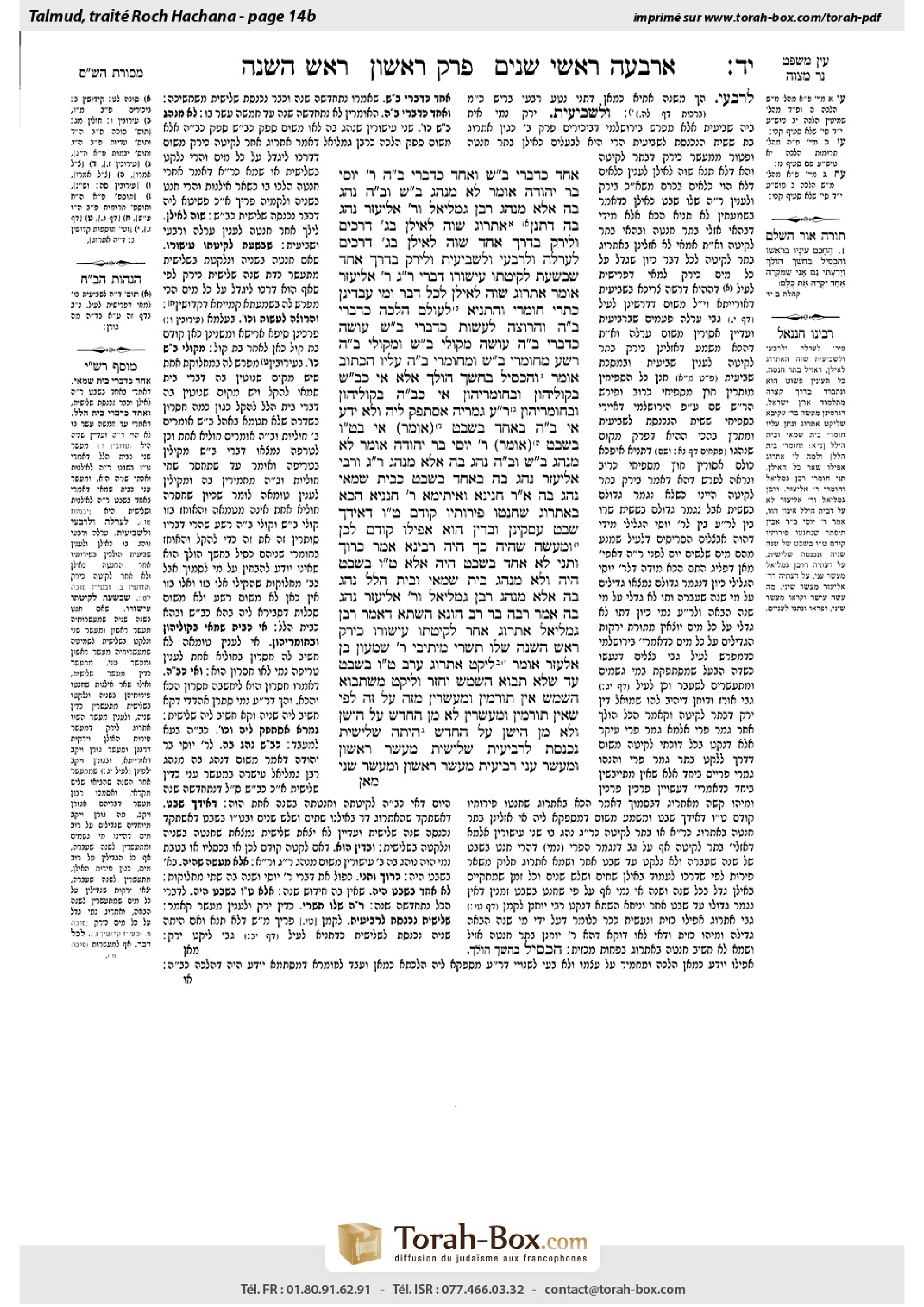
Rosh Hashanah 14b: Talmud study for Daf Yomi
Daf Yomi is the daily study of one Talmud folio. Explore 37 tractates with scans, Hebrew text, Sefaria English and AI-generated French translations where annotated.
Passage selection and English or AI-generated French translation are available where the scan has annotations. Daf Study is independent of Torah-Box and Sefaria.
Browse Rosh Hashanah · ראש השנה · All tractatesRosh Hashanah 14b text and translations
This page of Rosh Hashanah includes the Aramaic text, an English translation and an AI-generated French translation, alongside the scan above.
ראש השנה י״ד ב · Aramaic and Hebrew text
אֶחָד כְּדִבְרֵי בֵּית שַׁמַּאי, וְאֶחָד כְּדִבְרֵי בֵּית הִלֵּל.
רַבִּי יוֹסֵי בַּר יְהוּדָה אוֹמֵר: לֹא מִנְהַג בֵּית שַׁמַּאי וּבֵית הִלֵּל נָהַג בָּהּ, אֶלָּא מִנְהַג רַבָּן גַּמְלִיאֵל וְרַבִּי אֱלִיעֶזֶר נָהַג בָּהּ.
דִּתְנַן: אֶתְרוֹג שָׁוֶה לָאִילָן בִּשְׁלֹשָׁה דְּרָכִים, וְלַיָּרָק בְּדֶרֶךְ אֶחָד. שָׁוֶה לָאִילָן בִּשְׁלֹשָׁה דְּרָכִים: לְעׇרְלָה וְלִרְבָעִי וְלִשְׁבִיעִית וּלְיָרָק בְּדֶרֶךְ אֶחָד — שֶׁבִּשְׁעַת לְקִיטָתוֹ עִישּׂוּרוֹ, דִּבְרֵי רַבָּן גַּמְלִיאֵל.
רַבִּי אֱלִיעֶזֶר אוֹמֵר: אֶתְרוֹג שָׁוֶה לָאִילָן לְכׇל דָּבָר.
וּמִי עָבְדִינַן כִּתְרֵי חוּמְרֵי? וְהָתַנְיָא: לְעוֹלָם הֲלָכָה כְּדִבְרֵי בֵּית הִלֵּל, וְהָרוֹצֶה לַעֲשׂוֹת כְּדִבְרֵי בֵּית שַׁמַּאי — עוֹשֶׂה. כְּדִבְרֵי בֵּית הִלֵּל — עוֹשֶׂה. מִקּוּלֵּי בֵּית שַׁמַּאי וּמִקּוּלֵּי בֵּית הִלֵּל — רָשָׁע. מֵחוּמְרֵי בֵּית שַׁמַּאי וּמֵחוּמְרֵי בֵּית הִלֵּל — עָלָיו הַכָּתוּב אוֹמֵר: ״וְהַכְּסִיל בַּחֹשֶׁךְ הוֹלֵךְ״. אֶלָּא: אִי כְּבֵית שַׁמַּאי — בְּקוּלֵּיהוֹן וּבְחוּמְרֵיהוֹן. אִי כְּבֵית הִלֵּל — בְּקוּלֵּיהוֹן וּבְחוּמְרֵיהוֹן.
רַבִּי עֲקִיבָא גְּמָרֵיהּ אִסְתַּפַּק לֵיהּ, וְלָא יְדַע אִי בֵּית הִלֵּל בְּאֶחָד בִּשְׁבָט אֲמוּר, אִי בַּחֲמִשָּׁה עָשָׂר בִּשְׁבָט אֲמוּר.
רַבִּי יוֹסֵי בַּר יְהוּדָה אוֹמֵר: לֹא מִנְהַג בֵּית שַׁמַּאי וּבֵית הִלֵּל נָהַג בָּהּ, אֶלָּא מִנְהַג רַבָּן גַּמְלִיאֵל וְרַבִּי אֱלִיעֶזֶר נָהַג בָּהּ. בְּאֶחָד בִּשְׁבָט — כְּבֵית שַׁמַּאי נָהַג בָּהּ!
אָמַר רַבִּי חֲנִינָא וְאִיתֵּימָא רַבִּי חֲנַנְיָא: הָכָא בְּאֶתְרוֹג שֶׁחָנְטוּ פֵּירוֹתָיו קוֹדֶם חֲמִשָּׁה עָשָׂר דְּאִידַּךְ שְׁבָט עָסְקִינַן. וּבְדִין הוּא אֲפִילּוּ קוֹדֶם לָכֵן, וּמַעֲשֶׂה שֶׁהָיָה כָּךְ הָיָה.
רָבִינָא אָמַר, כְּרוֹךְ וּתְנִי: לֹא אֶחָד בִּשְׁבָט הָיָה — אֶלָּא חֲמִשָּׁה עָשָׂר בִּשְׁבָט הָיָה, וְלֹא מִנְהַג בֵּית שַׁמַּאי וּבֵית הִלֵּל נָהַג בָּהּ — אֶלָּא מִנְהַג רַבָּן גַּמְלִיאֵל וְרַבִּי אֱלִיעֶזֶר נָהַג בָּהּ.
אָמַר רַבָּה בַּר רַב הוּנָא: הַשְׁתָּא דְּאָמַר רַבָּן גַּמְלִיאֵל אֶתְרוֹג אַחַר לְקִיטָתוֹ עִישּׂוּרוֹ כְּיָרָק, רֹאשׁ הַשָּׁנָה שֶׁלּוֹ תִּשְׁרִי.
מֵיתִיבִי, רַבִּי שִׁמְעוֹן בֶּן אֶלְעָזָר אוֹמֵר: לִיקֵּט אֶתְרוֹג עֶרֶב חֲמִשָּׁה עָשָׂר בִּשְׁבָט עַד שֶׁלֹּא תָּבוֹא הַשֶּׁמֶשׁ, וְחָזַר וְלִיקֵּט מִשֶּׁתָּבוֹא הַשֶּׁמֶשׁ — אֵין תּוֹרְמִין וּמְעַשְּׂרִין מִזֶּה עַל זֶה, לְפִי שֶׁאֵין תּוֹרְמִין וּמְעַשְּׂרִין לֹא מִן הֶחָדָשׁ עַל הַיָּשָׁן וְלֹא מִן הַיָּשָׁן עַל הֶחָדָשׁ. הָיְתָה שְׁלִישִׁית נִכְנֶסֶת לִרְבִיעִית — שְׁלִישִׁית מַעֲשֵׂר רִאשׁוֹן וּמַעְשַׂר עָנִי, רְבִיעִית מַעֲשֵׂר רִאשׁוֹן וּמַעֲשֵׂר שֵׁנִי.
Rosh Hashanah 14b · English translation
One tithe was in accordance with the statement of Beit Shammai that the new year for trees is on the first of Shevat, in which case it was already the third or sixth year, when one must set aside poor man’s tithe; and one tithe was in accordance with the statement of Beit Hillel that the new year for trees is on the fifteenth of Shevat, so it was still the second or fifth year, when one must set aside second tithe.
Rabbi Yosei bar Yehuda says: He did not act as he did in order to conform with the conflicting practices of Beit Shammai and Beit Hillel. Rather, he acted as he did in order to conform with the conflicting practices of Rabban Gamliel and Rabbi Eliezer.
As we learned in a mishna: The etrog tree is like an ordinary tree in three ways and like a vegetable in one way. How so? It is like an ordinary tree in three ways: With regard to orla, that the fruit of the first three years after the tree is planted is forbidden; with regard to fourth-year produce, that the fruit that grows in the fourth year after the tree is planted must be brought to Jerusalem and eaten there or else it must be redeemed; and with regard to the Sabbatical Year, that the year is determined by the time of the formation of its fruit. And the etrog is like a vegetable in one way, which is that its tithe year follows the time of the picking of its fruit; this is the statement of Rabban Gamliel.
Rabbi Eliezer says: The etrog is like fruit of a tree with regard to all matters, and so its tithe year also follows the time of the formation of its fruit. Since Rabbi Akiva was in doubt whether the halakha is ruled in accordance with the opinion of Rabban Gamliel or Rabbi Eliezer, he set aside two tithes in order to follow both of their opinions.
The Gemara questions Rabbi Akiva’s conduct: But do we adopt the respective stringencies of two authorities who disagree on a series of issues? Isn’t it taught in a baraita: The halakha is always in accordance with the statement of Beit Hillel, but one who wishes to act in accordance with the statement of Beit Shammai may do so, and one who wishes to act in accordance with the statement of Beit Hillel may do so. If he adopts both the leniencies of Beit Shammai and also the leniencies of Beit Hillel, he is a wicked person. And if he adopts both the stringencies of Beit Shammai and the stringencies of Beit Hillel, with regard to him the verse states: “The fool walks in darkness” (Ecclesiastes 2:14). Rather, one should act either in accordance with Beit Shammai, following both their leniencies and their stringencies, or in accordance with Beit Hillel, following both their leniencies and their stringencies. If so, why did Rabbi Akiva follow two contradictory stringencies?
The Gemara answers: Rabbi Akiva wished to act in accordance with the opinion of Beit Hillel, but he was in doubt about his tradition and did not know whether Beit Hillel said that the new year for trees is on the first of Shevat or whether they said that it is on the fifteenth of Shevat, and so he set aside two tithes in order to conform with both possibilities.
The Gemara further clarifies the baraita, which states: Rabbi Yosei bar Yehuda says: He did not act as he did in order to conform with the conflicting practices of Beit Shammai and Beit Hillel; rather, he acted as he did in order to conform with the conflicting practices of Rabban Gamliel and Rabbi Eliezer. The Gemara asks: Seeing that he did this on the first of Shevat, it would seem that he acted in accordance with the practice of Beit Shammai. According to Beit Hillel, both the formation of the fruit and its picking took place in the same year, as the new year does not begin until the fifteenth of Shevat, and so there would have been no need to set aside two tithes.
Rabbi Ḥanina said, and some say that it was Rabbi Ḥananya who said: Here we are dealing with an etrog tree whose fruit was formed prior to the fifteenth of the other, previous, Shevat, in the second year, and it was picked on the first of the following Shevat, in the third year. According to the opinion of Rabbi Eliezer that the tithe year of an etrog follows the time of the formation of its fruit, the fruit was obligated in second tithe, whereas according to the opinion of Rabban Gamliel that the tithe year of an etrog follows the time of its picking, it was obligated in poor man’s tithe, and so Rabbi Akiva set aside two tithes. And by right it should have taught that even if the fruit had been picked earlier, any time after the fifteenth of the previous Shevat, but the incident that took place, took place in this way, that the fruit was picked on the first of Shevat.
Ravina said: Combine the two statements and teach the baraita as follows: It was not on the first of Shevat that Rabbi Akiva picked the fruit, but on the fifteenth of Shevat, and he did not act as he did in order to conform with the conflicting practices of Beit Shammai and Beit Hillel, but rather, he acted as he did in order to conform with the conflicting practices of Rabban Gamliel and Rabbi Eliezer, both in accordance with the practice of Beit Hillel.
§ Rabba bar Rav Huna said: Now that Rabban Gamliel has said that the tithe year of an etrog follows the time of the picking of its fruit, like a vegetable, its new year for tithing is Tishrei, like other vegetables.
The Gemara raises an objection from the following baraita: Rabbi Shimon ben Elazar says: If one picked the fruit of an etrog tree on the eve of the fifteenth of Shevat before the sun had set, and then he picked more fruit after sunset, one may not set aside teruma and tithes from the one for the other, as one may not set aside teruma and tithes from the new crop for the old or from the old crop for the new. If he did this when it was the third year of the Sabbatical cycle going into the fourth year, the halakha is as follows: From what he picked in the third year he must set aside first tithe and poor man’s tithe, and from what he picked in the fourth year he must set aside first tithe and second tithe.
Rosh Hashanah 14b · Traduction française (IA)
Une dîme correspondait à l’opinion de Beit Shammaï, selon laquelle le nouvel an des arbres tombe le premier Chevat ; il s’agissait donc déjà de la troisième ou de la sixième année, où l’on doit prélever la dîme du pauvre. L’autre dîme correspondait à l’opinion de Beit Hillel, selon laquelle le nouvel an des arbres tombe le quinze Chevat ; il s’agissait donc encore de la deuxième ou de la cinquième année, où l’on doit prélever la seconde dîme.
Rabbi Yosei bar Yehuda dit : Il n’a pas agi ainsi pour se conformer aux pratiques divergentes de Beit Shammaï et de Beit Hillel. Il a plutôt agi ainsi pour se conformer aux pratiques divergentes de Rabban Gamliel et de Rabbi Eliezer.
Comme nous l’avons appris dans une Michna : Le cédratier ressemble à un arbre ordinaire à trois égards et à un légume à un égard. Comment cela ? Il ressemble à un arbre ordinaire à trois égards : en ce qui concerne la orla, car les fruits des trois premières années suivant la plantation de l’arbre sont interdits ; en ce qui concerne les fruits de la quatrième année, car les fruits qui poussent la quatrième année après la plantation doivent être apportés à Jérusalem et y être consommés, ou bien rachetés ; et en ce qui concerne l’année sabbatique, car l’année est déterminée par le moment où ses fruits se forment. Le cédrat ressemble à un légume à un égard : l’année de dîme est déterminée par le moment où ses fruits sont cueillis. Telle est l’opinion de Rabban Gamliel.
Rabbi Eliezer dit : À tous égards, le cédrat est comme le fruit d’un arbre ; son année de dîme est donc elle aussi déterminée par le moment où ses fruits se forment. Rabbi Akiva, incertain quant à savoir si la halakha suit l’opinion de Rabban Gamliel ou celle de Rabbi Eliezer, préleva deux dîmes afin de suivre les deux opinions.
La Guemara conteste la conduite de Rabbi Akiva : Mais adopte-t-on les rigueurs respectives de deux autorités qui sont en désaccord sur une série de questions ? N’est-il pas enseigné dans une baraïta : La halakha suit toujours l’opinion de Beit Hillel ; mais celui qui souhaite agir conformément à l’opinion de Beit Shammaï peut le faire, et celui qui souhaite agir conformément à l’opinion de Beit Hillel peut le faire. S’il adopte à la fois les indulgences de Beit Shammaï et celles de Beit Hillel, c’est un homme méchant. Et s’il adopte à la fois les rigueurs de Beit Shammaï et celles de Beit Hillel, le verset dit à son sujet : « L’insensé marche dans les ténèbres » (Ecclésiaste 2,14). Il faut plutôt agir soit conformément à Beit Shammaï, en suivant à la fois leurs indulgences et leurs rigueurs, soit conformément à Beit Hillel, en suivant à la fois leurs indulgences et leurs rigueurs. Si tel est le cas, pourquoi Rabbi Akiva a-t-il suivi deux rigueurs contradictoires ?
La Guemara répond : Rabbi Akiva souhaitait agir conformément à l’opinion de Beit Hillel, mais il avait un doute sur sa tradition et ne savait pas si Beit Hillel avait dit que le nouvel an des arbres tombe le premier Chevat ou le quinze Chevat ; il préleva donc deux dîmes afin de tenir compte des deux possibilités.
La Guemara précise encore la baraïta, qui enseigne : Rabbi Yosei bar Yehuda dit : Il n’a pas agi ainsi pour se conformer aux pratiques divergentes de Beit Shammaï et de Beit Hillel ; il a plutôt agi ainsi pour se conformer aux pratiques divergentes de Rabban Gamliel et de Rabbi Eliezer. La Guemara demande : Puisqu’il a fait cela le premier Chevat, il semble qu’il ait suivi la pratique de Beit Shammaï. Selon Beit Hillel, la formation du fruit et sa cueillette ont toutes deux eu lieu la même année, puisque la nouvelle année ne commence que le quinze Chevat ; il n’aurait donc pas été nécessaire de prélever deux dîmes.
Rabbi Ḥanina a dit, et certains disent que c’est Rabbi Ḥananya qui l’a dit : Il s’agit ici d’un cédratier dont les fruits s’étaient formés avant le quinze du Chevat précédent, dans la deuxième année, et avaient été cueillis le premier du Chevat suivant, dans la troisième année. Selon l’opinion de Rabbi Eliezer, pour qui l’année de dîme d’un cédrat suit le moment où ses fruits se forment, ces fruits étaient assujettis à la seconde dîme, tandis que selon l’opinion de Rabban Gamliel, pour qui l’année de dîme d’un cédrat suit le moment où ses fruits sont cueillis, ils étaient assujettis à la dîme du pauvre ; Rabbi Akiva préleva donc deux dîmes. En toute rigueur, il aurait fallu enseigner que même si les fruits avaient été cueillis plus tôt, à n’importe quel moment après le quinze du Chevat précédent, la règle aurait été la même ; mais l’événement qui s’est produit s’est déroulé ainsi : les fruits ont été cueillis le premier Chevat.
Ravina a dit : Réunissons les deux propos et enseignons la baraïta ainsi : Rabbi Akiva n’a pas cueilli les fruits le premier Chevat, mais le quinze Chevat ; et il n’a pas agi ainsi pour se conformer aux pratiques divergentes de Beit Shammaï et de Beit Hillel, mais plutôt pour se conformer aux pratiques divergentes de Rabban Gamliel et de Rabbi Eliezer, les deux suivant la pratique de Beit Hillel.
§ Rabba bar Rav Huna a dit : Puisque Rabban Gamliel a déclaré que l’année de dîme d’un cédrat suit le moment où ses fruits sont cueillis, comme pour un légume, son nouvel an pour la dîme est en Tichri, comme pour les autres légumes.
La Guemara soulève une objection tirée de la baraïta suivante : Rabbi Shimon ben Elazar dit : Si quelqu’un a cueilli les fruits d’un cédratier à la veille du quinze Chevat, avant le coucher du soleil, puis en a cueilli d’autres après le coucher du soleil, il ne peut pas prélever la terouma et les dîmes des uns pour les autres, car on ne peut pas prélever la terouma et les dîmes de la nouvelle récolte pour l’ancienne, ni de l’ancienne pour la nouvelle. S’il a fait cela au moment où l’on passait de la troisième année du cycle sabbatique à la quatrième, la halakha est la suivante : sur ce qu’il a cueilli pendant la troisième année, il doit prélever la première dîme et la dîme du pauvre ; et sur ce qu’il a cueilli pendant la quatrième année, il doit prélever la première dîme et la seconde dîme.
Traduction française générée par IA à partir de l’édition anglaise de Sefaria. Vérifie toujours un passage avec le texte source.
Text from Sefaria: William Davidson Edition - Vocalized Aramaic (CC BY NC); William Davidson Edition - English (CC BY NC).