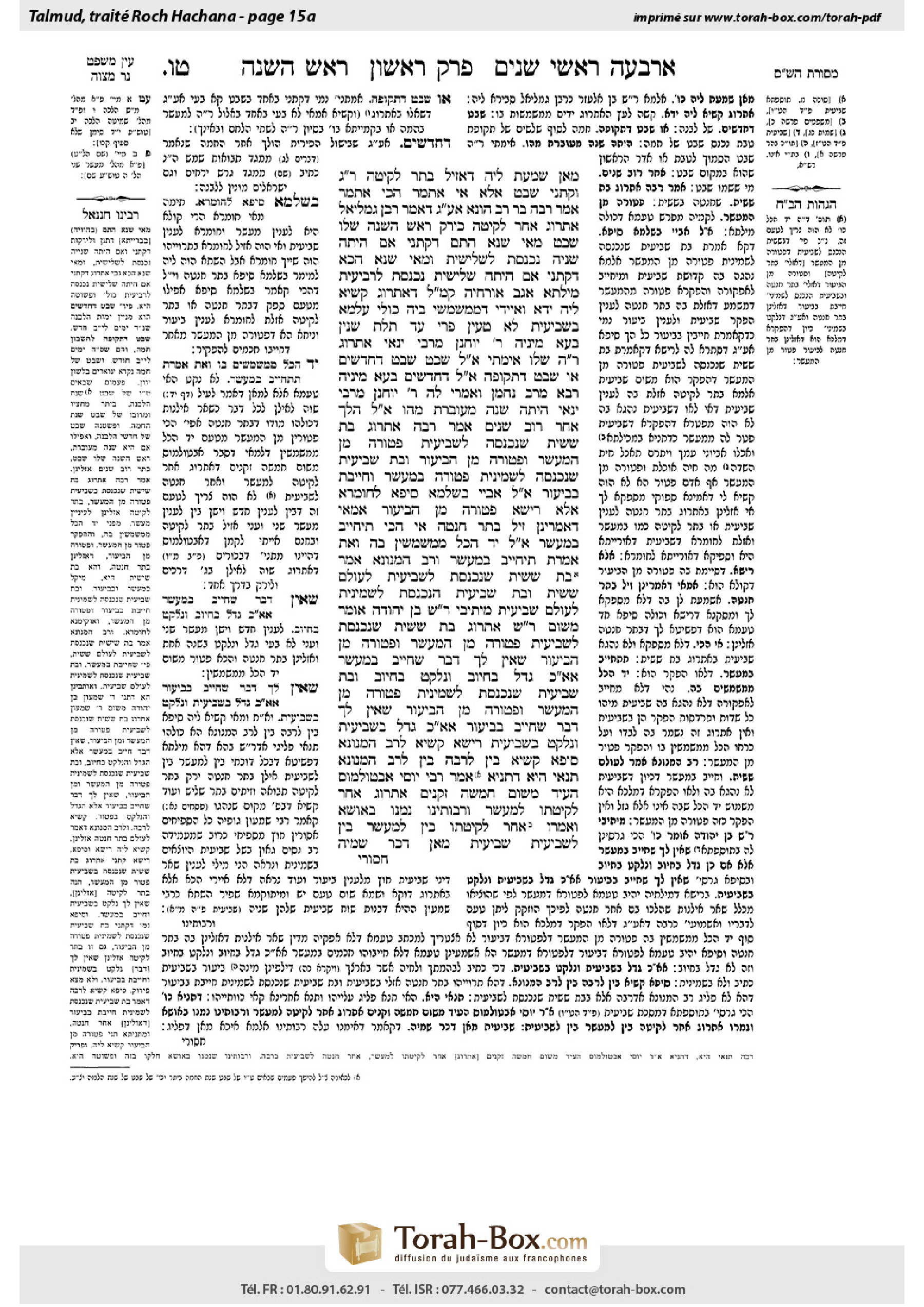
Rosh Hashanah 15a: Talmud study for Daf Yomi
Daf Yomi is the daily study of one Talmud folio. Explore 37 tractates with scans, Hebrew text, Sefaria English and AI-generated French translations where annotated.
Passage selection and English or AI-generated French translation are available where the scan has annotations. Daf Study is independent of Torah-Box and Sefaria.
Browse Rosh Hashanah · ראש השנה · All tractatesRosh Hashanah 15a text and translations
This page of Rosh Hashanah includes the Aramaic text, an English translation and an AI-generated French translation, alongside the scan above.
ראש השנה י״ה א · Aramaic and Hebrew text
מַאן שָׁמְעַתְּ לֵיהּ דְּאָזֵיל בָּתַר לְקִיטָה — רַבָּן גַּמְלִיאֵל, וְקָתָנֵי שְׁבָט!
אֶלָּא, אִי אִתְּמַר הָכִי אִתְּמַר: אָמַר רַבָּה בַּר רַב הוּנָא: אַף עַל גַּב דְּאָמַר רַבָּן גַּמְלִיאֵל אֶתְרוֹג אַחַר לְקִיטָה כְּיָרָק — רֹאשׁ הַשָּׁנָה שֶׁלּוֹ שְׁבָט.
מַאי שְׁנָא הָתָם דְּקָתָנֵי ״אִם הָיְתָה שְׁנִיָּה נִכְנֶסֶת לִשְׁלִישִׁית״ וּמַאי שְׁנָא הָכָא דְּקָתָנֵי ״אִם הָיְתָה שְׁלִישִׁית נִכְנֶסֶת לִרְבִיעִית״?
מִילְּתָא אַגַּב אוֹרְחֵיהּ קָא מַשְׁמַע לַן, דְּאֶתְרוֹג קַשְׁיָא לֵיהּ יְדָא וְאַיְּידֵי דִּמְמַשְׁמְשִׁי בֵּיהּ כּוּלֵּי עָלְמָא בִּשְׁבִיעִית, לָא טָעֵין פֵּרֵי עַד תְּלָת שְׁנִין.
בְּעָא מִינֵּיהּ רַבִּי יוֹחָנָן מֵרַבִּי יַנַּאי: אֶתְרוֹג, רֹאשׁ הַשָּׁנָה שֶׁלּוֹ אֵימָתַי? אֲמַר לֵיהּ: שְׁבָט. שְׁבָט דָּחֳדָשִׁים, אוֹ שְׁבָט דִּתְקוּפָה? אֲמַר לֵיהּ: דָּחֳדָשִׁים.
בְּעָא מִינֵּיהּ רָבָא מֵרַב נַחְמָן, וְאָמְרִי לַהּ רַבִּי יוֹחָנָן מֵרַבִּי יַנַּאי: הָיְתָה שָׁנָה מְעוּבֶּרֶת, מַהוּ? אֲמַר לֵיהּ: הַלֵּךְ אַחַר רוֹב שָׁנִים.
אָמַר רַבָּה: אֶתְרוֹג בַּת שִׁשִּׁית שֶׁנִּכְנְסָה לִשְׁבִיעִית — פְּטוּרָה מִן הַמַּעֲשֵׂר וּפְטוּרָה מִן הַבִּיעוּר. וּבַת שְׁבִיעִית שֶׁנִּכְנְסָה לִשְׁמִינִית — פְּטוּרָה בַּמַּעֲשֵׂר וְחַיֶּיבֶת בַּבִּיעוּר.
אֲמַר לֵיהּ אַבָּיֵי: בִּשְׁלָמָא סֵיפָא — לְחוּמְרָא, אֶלָּא רֵישָׁא פְּטוּרָה מִן הַבִּיעוּר — אַמַּאי? דְּאָמְרִינַן זִיל בָּתַר חֲנָטָה, אִי הָכִי תִּיחַיַּיב בְּמַעֲשֵׂר!
אֲמַר לֵיהּ: יַד הַכֹּל מְמַשְׁמְשִׁין בָּהּ, וְאַתְּ אָמְרַתְּ תִּיחַיַּיב בְּמַעֲשֵׂר?!
וְרַב הַמְנוּנָא אָמַר: בַּת שִׁשִּׁית שֶׁנִּכְנֶסֶת לִשְׁבִיעִית — לְעוֹלָם שִׁשִּׁית, וּבַת שְׁבִיעִית הַנִּכְנֶסֶת לִשְׁמִינִית — לְעוֹלָם שְׁבִיעִית.
מֵיתִיבִי, רַבִּי שִׁמְעוֹן בֶּן יְהוּדָה אוֹמֵר מִשּׁוּם רַבִּי שִׁמְעוֹן: אֶתְרוֹג בַּת שִׁשִּׁית שֶׁנִּכְנֶסֶת לִשְׁבִיעִית — פְּטוּרָה מִן הַמַּעֲשֵׂר וּפְטוּרָה מִן הַבִּיעוּר, שֶׁאֵין לְךָ דָּבָר שֶׁחַיָּיב בְּמַעֲשֵׂר אֶלָּא אִם כֵּן גָּדַל בְּחִיּוּב וְנִלְקַט בְּחִיּוּב. וּבַת שְׁבִיעִית שֶׁנִּכְנֶסֶת לִשְׁמִינִית — פְּטוּרָה מִן הַמַּעֲשֵׂר וּפְטוּרָה מִן הַבִּיעוּר, שֶׁאֵין לְךָ דָּבָר שֶׁחַיָּיב בְּבִיעוּר אֶלָּא אִם כֵּן גָּדַל בִּשְׁבִיעִית וְנִלְקַט בִּשְׁבִיעִית.
רֵישָׁא קַשְׁיָא לְרַב הַמְנוּנָא, סֵיפָא קַשְׁיָא בֵּין לְרַבָּה בֵּין לְרַב הַמְנוּנָא!
תַּנָּאֵי הִיא. דְּתַנְיָא, אָמַר רַבִּי יוֹסֵי, אַבְטוּלְמוֹס הֵעִיד מִשּׁוּם חֲמִשָּׁה זְקֵנִים: אֶתְרוֹג — אַחַר לְקִיטָתוֹ לְמַעֲשֵׂר, וְרַבּוֹתֵינוּ נִמְנוּ בְּאוּשָׁא, וְאָמְרוּ: אַחַר לְקִיטָתוֹ, בֵּין לְמַעֲשֵׂר בֵּין לִשְׁבִיעִית.
שְׁבִיעִית מַאן דְּכַר שְׁמֵיהּ?
Rosh Hashanah 15a · English translation
The Gemara clarifies this ruling: Whom did you hear that said the tithe year of an etrog follows the time of the picking of its fruit? It was Rabban Gamliel. And yet this baraita is teaching that the new year for tithing an etrog is the fifteenth of Shevat, against the opinion of Rabba bar Rav Huna, who says that according to Rabban Gamliel it is the first of Tishrei.
Rather, if this was said, it was said as follows: Rabba bar Rav Huna said: Even though Rabban Gamliel said that the tithe year of an etrog follows the time of the picking of its fruit, like a vegetable, its new year is in Shevat, like a tree.
The Gemara asks: What is different there, in the baraita with regard to one who picked vegetables on the eve of Rosh HaShana, such that it teaches the case when it was the second year of the Sabbatical cycle going into the third year, and what is different here, in the baraita dealing with one who was picking the fruit of an etrog tree on the eve of the fifteenth of Shevat, such that it teaches the case when it was the third year going into the fourth year? Why is the same example not brought in both cases?
The Gemara answers: It teaches us a matter in passing, that it is damaging for an etrog when the tree is handled, and since everyone handles it in the Sabbatical Year, as all the orchards are declared ownerless and everyone is permitted to enter and pick produce, the tree does not bear fruit that is fit for eating for another three years.
Rabbi Yoḥanan inquired of Rabbi Yannai: With regard to an etrog, when is its new year? Rabbi Yannai said to him: It is in Shevat. Rabbi Yoḥanan asked again: Are you referring to the lunar month of Shevat or to the Shevat of the solar season, which begins thirty days after the winter solstice, but on a different date each year? Rabbi Yannai said to him: I am referring to the lunar month of Shevat.
Rava inquired of Rav Naḥman, and some say that it was Rabbi Yoḥanan who inquired of Rabbi Yannai: If it was a leap year, what is the halakha? Does the new year for trees then move to the First Adar, which is the penultimate month in a leap year? He said to him: Follow the majority of years. Even in a leap year the new year for trees is in Shevat.
Rabba said: An etrog from the sixth year of the Sabbatical cycle that entered into, and was picked in, the Sabbatical Year is exempt from tithes, like the produce of the Sabbatical Year, and is also exempt from the mitzva of elimination of Sabbatical Year produce from one’s house after produce of that particular species is no longer found in the field. A Sabbatical Year etrog that entered into, and was picked in, the eighth year is exempt from tithes but is subject to the mitzva of elimination of Sabbatical Year produce from one’s house.
Abaye said to him: Granted, in the latter clause the halakha follows the more stringent approach, as it follows the time of the formation of the fruit, which was in the Sabbatical Year, and therefore the etrog is subject to the mitzva of elimination. But in the first clause, which states that the etrog is exempt from the mitzva of elimination, why is this so? It must be that we say to follow the time of the formation of the fruit, which was in the sixth year. But if so, it should be subject to tithes.
Rabba said to him: Everyone’s hand is touching it, as all are permitted to enter the orchards and touch all the fruit, and so the etrog is regarded as ownerless, and yet you wish to say that it should be subject to tithes? Even if it is not exempt as fruit of the Sabbatical Year, it is exempt from tithes because it is now ownerless.
Rav Hamnuna argued and said: An etrog from the sixth year of the Sabbatical cycle that entered into, and was picked in, the Sabbatical Year is always and for all purposes considered sixth-year produce. And an etrog from the Sabbatical Year that entered into, and was picked in, the eighth year is always and for all purposes considered produce of the Sabbatical Year.
The Gemara raises an objection from the following baraita: Rabbi Shimon ben Yehuda said in the name of Rabbi Shimon: An etrog from the sixth year that entered into, and was picked in, the Sabbatical Year is exempt from tithes, and it is also exempt from the mitzva of elimination of Sabbatical Year produce from one’s house, as there is nothing that is subject to tithes unless it both grew at a time of obligation in tithes and was also picked at a time of obligation. Likewise, an etrog from the Sabbatical Year that entered into, and was picked in, the eighth year is exempt from tithes, and it is also exempt from the mitzva of elimination, as nothing is subject to the mitzva of elimination unless it both grew in the Sabbatical Year and was also picked in the Sabbatical Year.
The Gemara notes: The first clause of this baraita poses a difficulty with regard to the opinion of Rav Hamnuna, who says that a sixth-year etrog that was picked in the Sabbatical Year is subject to tithes. And the latter clause of the baraita poses a difficulty with regard to the opinions of both Rabba and Rav Hamnuna, as they both say that a Sabbatical-Year etrog that was picked in the eighth year is subject to the mitzva of elimination.
The Gemara answers: The matter is a dispute between tanna’im, as it is taught in a baraita: Rabbi Yosei said: Avtolemos testified in the name of five Elders: An etrog follows the time of its picking in the matter of tithes. But our Sages voted in Usha and said that an etrog follows the time of its picking, both in the matter of tithes and in the matter of the Sabbatical Year.
The Gemara raises a question about this baraita: Who mentioned anything about the Sabbatical Year? The subject of the discussion was tithes.
Rosh Hashanah 15a · Traduction française (IA)
La Guemara précise cette décision : qui a-t-on entendu dire que l’année de dîme d’un étrog suit le moment où son fruit est cueilli ? Rabban Gamliel. Pourtant, cette baraïta enseigne que le nouvel an pour la dîme d’un étrog tombe le quinze Chevat, contrairement à l’opinion de Rabba bar Rav Huna, selon laquelle, d’après Rabban Gamliel, il tombe le premier Tichri.
Il faut plutôt comprendre que Rabba bar Rav Huna a dit ceci : même si Rabban Gamliel a dit que l’année de dîme d’un étrog suit le moment où son fruit est cueilli, comme pour un légume, son nouvel an tombe en Chevat, comme celui d’un arbre.
La Guemara demande : En quoi diffère le cas de la baraïta concernant celui qui a cueilli des légumes la veille de Roch Hachana, où elle enseigne le cas du passage de la deuxième à la troisième année du cycle sabbatique, du cas de la baraïta concernant celui qui cueillait les fruits d’un étrog la veille du quinze Chevat, où elle enseigne le cas du passage de la troisième à la quatrième année ? Pourquoi le même exemple n’est-il pas présenté dans les deux cas ?
La Guemara répond : Elle nous enseigne incidemment qu’il est néfaste de manipuler un étrog. Or, pendant l’année sabbatique, tout le monde le manipule, puisque tous les vergers sont déclarés sans propriétaire et que chacun est autorisé à y entrer pour cueillir des fruits. L’arbre ne porte donc pas de fruits propres à la consommation pendant encore trois ans.
Rabbi Yoḥanan demanda à Rabbi Yannai : Pour un étrog, quand tombe le nouvel an ? Rabbi Yannai lui répondit : En Chevat. Rabbi Yoḥanan lui demanda alors : Parlez-vous du mois lunaire de Chevat ou du Chevat de la saison solaire, qui commence trente jours après le solstice d’hiver, mais à une date différente chaque année ? Rabbi Yannai lui répondit : Je parle du mois lunaire de Chevat.
Rava demanda à Rav Naḥman — et certains disent que ce fut Rabbi Yoḥanan qui demanda à Rabbi Yannai : Quelle est la halakha si l’année est embolismique ? Le nouvel an des arbres est-il alors reporté au premier Adar, l’avant-dernier mois d’une année embolismique ? Il lui répondit : On suit la majorité des années. Même lors d’une année embolismique, le nouvel an des arbres tombe en Chevat.
Rabba dit : Un étrog de la sixième année du cycle sabbatique qui est entré dans l’année sabbatique et y a été cueilli est exempt de dîmes, comme les produits de l’année sabbatique, et également exempt de la mitsva consistant à retirer de chez soi les produits de l’année sabbatique lorsque cette espèce n’est plus présente dans les champs. Un étrog de l’année sabbatique qui est entré dans la huitième année et y a été cueilli est exempt de dîmes, mais soumis à la mitsva consistant à retirer de chez soi les produits de l’année sabbatique.
Abaye lui dit : Il est compréhensible que, dans la dernière proposition, la halakha suive l’avis le plus rigoureux : on tient compte du moment où le fruit s’est formé, pendant l’année sabbatique, et l’étrog est donc soumis à la mitsva de retrait. Mais dans la première proposition, qui dit que l’étrog est exempt de cette mitsva, pourquoi en est-il ainsi ? Il faut nécessairement considérer le moment où le fruit s’est formé, qui était pendant la sixième année. Mais dans ce cas, il devrait être soumis aux dîmes.
Rabba lui répondit : Tout le monde le touche, car chacun est autorisé à entrer dans les vergers et à toucher tous les fruits. L’étrog est donc considéré comme sans propriétaire. Et pourtant, tu voudrais dire qu’il devrait être soumis aux dîmes ? Même s’il n’est pas exempt en tant que fruit de l’année sabbatique, il est exempt de dîmes parce qu’il est désormais sans propriétaire.
Rav Hamnuna contesta et dit : Un étrog de la sixième année du cycle sabbatique qui est entré dans l’année sabbatique et y a été cueilli est toujours et à tous égards considéré comme un produit de la sixième année. Et un étrog de l’année sabbatique qui est entré dans la huitième année et y a été cueilli est toujours et à tous égards considéré comme un produit de l’année sabbatique.
La Guemara soulève une objection à partir de la baraïta suivante : Rabbi Shimon ben Yehuda a dit au nom de Rabbi Shimon : Un étrog de la sixième année qui est entré dans l’année sabbatique et y a été cueilli est exempt de dîmes et également exempt de la mitsva consistant à retirer de chez soi les produits de l’année sabbatique, car aucun produit n’est soumis aux dîmes à moins qu’il ait à la fois poussé à une époque où les dîmes sont obligatoires et été cueilli à une telle époque. De même, un étrog de l’année sabbatique qui est entré dans la huitième année et y a été cueilli est exempt de dîmes et également exempt de la mitsva de retrait, car aucun produit n’est soumis à cette mitsva à moins qu’il ait à la fois poussé pendant l’année sabbatique et été cueilli pendant l’année sabbatique.
La Guemara note : La première proposition de cette baraïta pose une difficulté à Rav Hamnuna, qui dit qu’un étrog de la sixième année cueilli pendant l’année sabbatique est soumis aux dîmes. La dernière proposition de la baraïta pose une difficulté aux opinions de Rabba et de Rav Hamnuna, car tous deux disent qu’un étrog de l’année sabbatique cueilli pendant la huitième année est soumis à la mitsva de retrait.
La Guemara répond : Il s’agit d’une controverse entre tannaïm, comme il est enseigné dans une baraïta : Rabbi Yosei a dit : Avtolemos a témoigné au nom de cinq Anciens qu’un étrog suit le moment de sa cueillette en matière de dîmes. Mais nos Sages votèrent à Ousha et décidèrent qu’un étrog suit le moment de sa cueillette aussi bien en matière de dîmes qu’en matière d’année sabbatique.
La Guemara soulève une question à propos de cette baraïta : Qui a mentionné l’année sabbatique ? Le sujet de la discussion était les dîmes.
Traduction française générée par IA à partir de l’édition anglaise de Sefaria. Vérifie toujours un passage avec le texte source.
Text from Sefaria: William Davidson Edition - Vocalized Aramaic (CC BY NC); William Davidson Edition - English (CC BY NC).