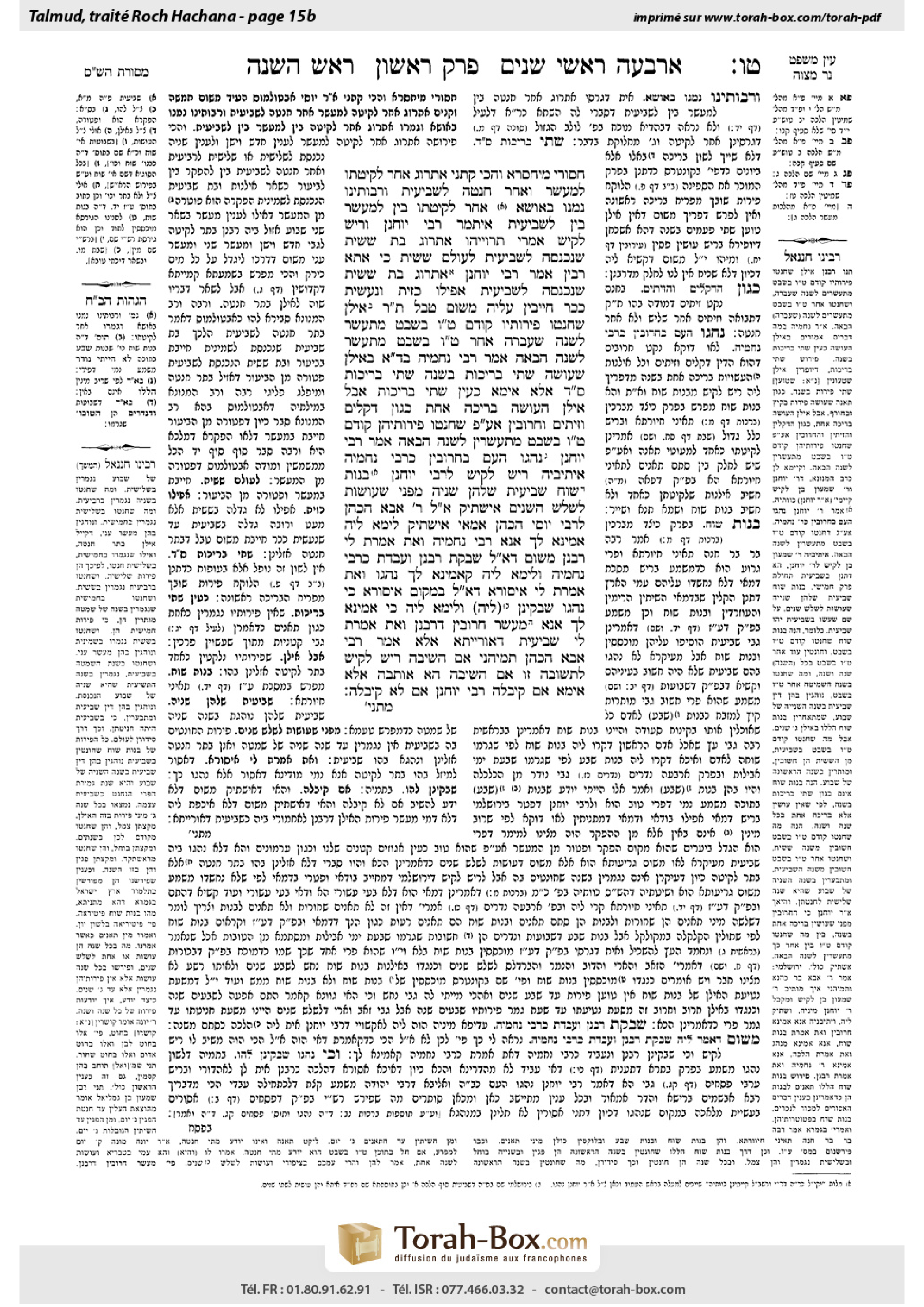
Rosh Hashanah 15b: Talmud study for Daf Yomi
Daf Yomi is the daily study of one Talmud folio. Explore 37 tractates with scans, Hebrew text, Sefaria English and AI-generated French translations where annotated.
Passage selection and English or AI-generated French translation are available where the scan has annotations. Daf Study is independent of Torah-Box and Sefaria.
Browse Rosh Hashanah · ראש השנה · All tractatesRosh Hashanah 15b text and translations
This page of Rosh Hashanah includes the Aramaic text, an English translation and an AI-generated French translation, alongside the scan above.
ראש השנה י״ה ב · Aramaic and Hebrew text
חַסּוֹרֵי מִיחַסְּרָא וְהָכִי קָתָנֵי: אֶתְרוֹג — אַחַר לְקִיטָתוֹ לְמַעֲשֵׂר וְאַחַר חֲנָטָה לִשְׁבִיעִית. וְרַבּוֹתֵינוּ נִמְנוּ בְּאוּשָׁא: אַחַר לְקִיטָתוֹ, בֵּין לְמַעֲשֵׂר בֵּין לִשְׁבִיעִית.
אִיתְּמַר, רַבִּי יוֹחָנָן וְרֵישׁ לָקִישׁ אָמְרִי תַּרְוַיְיהוּ: אֶתְרוֹג בַּת שִׁשִּׁית שֶׁנִּכְנְסָה לִשְׁבִיעִית — לְעוֹלָם שִׁשִּׁית. כִּי אֲתָא רָבִין אָמַר רַבִּי יוֹחָנָן: אֶתְרוֹג בַּת שִׁשִּׁית שֶׁנִּכְנְסָה לִשְׁבִיעִית, אֲפִילּוּ כְּזַיִת וְנַעֲשֵׂית כִּכָּר — חַיָּיבִין עָלֶיהָ מִשּׁוּם טֶבֶל.
תָּנוּ רַבָּנַן: אִילָן שֶׁחָנְטוּ פֵּירוֹתָיו קוֹדֶם חֲמִשָּׁה עָשָׂר בִּשְׁבָט — מִתְעַשֵּׂר לְשָׁנָה שֶׁעָבְרָה, אַחַר חֲמִשָּׁה עָשָׂר בִּשְׁבָט — מִתְעַשֵּׂר לְשָׁנָה הַבָּאָה. אָמַר רַבִּי נְחֶמְיָה: בַּמֶּה דְּבָרִים אֲמוּרִים — בְּאִילָן שֶׁעוֹשֶׂה שְׁתֵּי בְרִיכוֹת בַּשָּׁנָה.
שְׁתֵּי בְרִיכוֹת סָלְקָא דַּעְתָּךְ? אֶלָּא אֵימָא: כְּעֵין שְׁתֵּי בְרִיכוֹת.
אֲבָל אִילָן הָעוֹשֶׂה בְּרִיכָה אַחַת, כְּגוֹן דְּקָלִים וְזֵיתִים וְחָרוּבִין, אַף עַל פִּי שֶׁחָנְטוּ פֵּירוֹתֵיהֶן קוֹדֶם חֲמִשָּׁה עָשָׂר בִּשְׁבָט — מִתְעַשְּׂרִין לְשָׁנָה הַבָּאָה.
אָמַר רַבִּי יוֹחָנָן: נָהֲגוּ הָעָם בֶּחָרוּבִין כְּרַבִּי נְחֶמְיָה.
אֵיתִיבֵיהּ רֵישׁ לָקִישׁ לְרַבִּי יוֹחָנָן: בְּנוֹת שׁוּחַ — שְׁבִיעִית שֶׁלָּהֶן שְׁנִיָּה, מִפְּנֵי שֶׁעוֹשׂוֹת לִשְׁלֹשׁ הַשָּׁנִים!
אִישְׁתִּיק. אֲמַר לֵיהּ רַבִּי אַבָּא הַכֹּהֵן לְרַבִּי יוֹסֵי הַכֹּהֵן: אַמַּאי אִישְׁתִּיק? לֵימָא לֵיהּ: אָמֵינָא לָךְ אֲנָא רַבִּי נְחֶמְיָה, וְאַתְּ אָמְרַתְּ לִי רַבָּנַן?!
מִשּׁוּם דַּאֲמַר לֵיהּ: שָׁבְקַתְּ רַבָּנַן וְעָבְדַתְּ כְּרַבִּי נְחֶמְיָה?!
וְלֵימָא לֵיהּ: קָאָמֵינָא לָךְ ״נָהֲגוּ״, וְאַתְּ אָמְרַתְּ לִי אִיסּוּרָא?! דַּאֲמַר לֵיהּ: בִּמְקוֹם אִיסּוּרָא, כִּי נָהֲגוּ שָׁבְקִינַן לְהוּ?!
וְלֵימָא לֵיהּ: כִּי אָמֵינָא לָךְ אֲנָא — מַעֲשֵׂר חָרוּבִין דְּרַבָּנַן, וְאַתְּ אָמְרַתְּ לִי שְׁבִיעִית דְּאוֹרָיְיתָא?!
אֶלָּא אָמַר רַבִּי אַבָּא הַכֹּהֵן: תְּמֵיהַנִי אִם הֱשִׁיבָהּ רֵישׁ לָקִישׁ לִתְשׁוּבָה זוֹ. אִם הֱשִׁיבָהּ? הָא אוֹתְבַהּ! אֶלָּא אֵימָא: אִם קִיבְּלָהּ רַבִּי יוֹחָנָן, אִם לָא קִיבְּלָהּ.
Rosh Hashanah 15b · English translation
The Gemara answers: The baraita is incomplete and is teaching the following: Avtolemos testified in the name of five Elders: An etrog follows the time of its picking in the matter of tithes and it follows the time of the formation of its fruit in the matter of the Sabbatical Year. But our Sages voted in Usha and decided that an etrog follows the time of its picking, both in the matter of tithes and in the matter of the Sabbatical Year.
It was stated that the amora’im of Eretz Yisrael discussed this issue: Rabbi Yoḥanan and Reish Lakish both say: An etrog from the sixth year of the Sabbatical cycle that entered into, and was picked in, the Sabbatical Year is always and for all purposes considered as sixth-year produce. When Ravin came from Eretz Yisrael to Babylonia, he said that Rabbi Yoḥanan said: A sixth-year etrog that entered into, and was picked in, the Sabbatical Year, although at the beginning of the Sabbatical Year it was only the size of an olive-bulk and during the Sabbatical Year it grew to the size of a loaf of bread, is considered sixth-year produce that is subject to tithing, and if one eats it without tithing, he is liable for eating untithed produce.
The Sages taught in a baraita: A tree whose fruits were formed before the fifteenth of Shevat is tithed in accordance with the previous year, and if the fruits were formed after the fifteenth of Shevat it is tithed in accordance with the coming year. Rabbi Neḥemya said: In what case is this statement said? It is said with regard to a tree that produces two broods, two crops, in a single year.
The Gemara interrupts with a question about the wording of this baraita: Does it enter your mind to say two broods? Animals produce broods, but trees do not. Rather, say: Like two broods, i.e., two seasons’ worth of crops.
The baraita continues: But in the case of trees that produce only one brood of fruit, for example, palm trees, and olive trees, and carob trees, which yield fruit only once a year, although their fruit took form before the fifteenth of Shevat, they are tithed in accordance with the coming year, since they follow the time of their fruit’s picking. According to Rabbi Neḥemya, most fruit will be tithed according to the time that the fruit is picked, since only a minority of fruit trees produce two crops a year.
Rabbi Yoḥanan said: The people were accustomed to act with regard to carobs in accordance with the opinion of Rabbi Neḥemya, that their tithe year follows the time of the fruit’s picking.
Reish Lakish raised an objection to the opinion of Rabbi Yoḥanan from a mishna that teaches: In the case of white fig trees, the Sabbatical Year for them with regard to the halakhot of eating and elimination is in the second year of the Sabbatical cycle, due to the fact that their fruit grows for three years, and so the fruit that ripens in the second year of the Sabbatical cycle had already taken form in the previous Sabbatical Year. This indicates that the tithe follows the time of the formation of the fruit and not the time of picking.
Rabbi Yoḥanan was silent and did not respond, as though he had no answer. Rabbi Abba the priest said to Rabbi Yosei the priest: Why was Rabbi Yoḥanan silent? He should have said to Reish Lakish as follows: I am speaking to you of the opinion of Rabbi Neḥemya, and you say to me the opinion of the Rabbis?
Rabbi Yosei the priest answered: He could not have made this argument, because Reish Lakish would then have said to him: Do you abandon the opinion of the Rabbis, who constitute the majority, and act in accordance with the opinion of Rabbi Neḥemya, who expresses a sole dissenting opinion?
Rabbi Abba the priest asked further: Rabbi Yoḥanan should have said to him: I am speaking to you only about how the people practice and that their custom follows the opinion of Rabbi Neḥemya, and you say to me that it is a prohibition? Rabbi Yosei the priest answered: He could not have said this, because Reish Lakish would then have said to him: Where there is a prohibition, even if they were accustomed to act in a particular manner, would we leave them to continue?
Rabbi Abba the priest asked further: Rabbi Yoḥanan should have said to Reish Lakish as follows: I am speaking to you about the tithe of carobs, which is only by rabbinic decree, as by Torah law all fruits apart from grapes and olives are exempt from tithing, and you speak to me about the Sabbatical Year, which is by Torah law? This being an irrefutable argument, the Gemara once again clarifies this matter.
Rather, Rabbi Abba the priest said: I wonder whether Reish Lakish actually raised this original objection to the opinion of Rabbi Yoḥanan, since it has such a clear refutation. The Gemara asks: Whether he asked it? But he did ask it, as is reported in the story. Rather, say: I wonder if Rabbi Yoḥanan accepted this question and was silent because he had nothing to answer, or he did not accept it but nevertheless remained silent because he thought the question was not worthy of an answer.
Rosh Hashanah 15b · Traduction française (IA)
La Guemara répond : La baraïta est incomplète et enseigne ce qui suit : Avtolemos a témoigné au nom de cinq Anciens : l’étrog suit le moment de sa cueillette pour les dîmes, et le moment de la formation de son fruit pour l’année de Chemita. Mais nos Sages votèrent à Ousha et décidèrent que l’étrog suit le moment de sa cueillette, aussi bien pour les dîmes que pour l’année de Chemita.
Il a été rapporté que les amoraïm d’Eretz Israël ont discuté de cette question : Rabbi Yoḥanan et Reish Lakish disent tous deux qu’un étrog de la sixième année du cycle de Chemita, qui est entré dans l’année de Chemita et y a été cueilli, est toujours et à tous égards considéré comme un produit de la sixième année. Lorsque Ravin vint d’Eretz Israël en Babylonie, il rapporta que Rabbi Yoḥanan avait dit : Un étrog de la sixième année qui est entré dans l’année de Chemita et y a été cueilli est considéré comme un produit de la sixième année, soumis à la dîme, même si, au début de l’année de Chemita, il n’avait que la taille d’une olive et qu’il avait grandi pendant cette année jusqu’à la taille d’un pain. Si quelqu’un le mange sans en avoir prélevé la dîme, il est passible pour avoir consommé un produit non dîmé.
Les Sages enseignèrent dans une baraïta : Un arbre dont les fruits se sont formés avant le quinze Chevat est soumis à la dîme selon l’année précédente ; si ses fruits se sont formés après le quinze Chevat, il est soumis à la dîme selon l’année suivante. Rabbi Neḥemya dit : Dans quel cas cette règle a-t-elle été énoncée ? À propos d’un arbre qui produit deux récoltes au cours d’une même année.
La Guemara interrompt le propos par une question sur la formulation de cette baraïta : Peut-on vraiment parler de deux portées ? Les animaux ont des portées, mais pas les arbres. Il faut plutôt dire : « comme deux portées », c’est-à-dire des récoltes correspondant à deux saisons.
La baraïta poursuit : Mais dans le cas des arbres qui ne produisent qu’une seule récolte de fruits, par exemple les palmiers, les oliviers et les caroubiers, qui ne donnent des fruits qu’une fois par an, même si leurs fruits se sont formés avant le quinze Chevat, ils sont soumis à la dîme selon l’année suivante, puisqu’ils suivent le moment de la cueillette de leurs fruits. Selon Rabbi Neḥemya, la plupart des fruits sont soumis à la dîme selon le moment de leur cueillette, car seule une minorité d’arbres fruitiers produit deux récoltes par an.
Rabbi Yoḥanan dit : Les gens avaient coutume d’agir au sujet des caroubes conformément à l’avis de Rabbi Neḥemya, selon lequel l’année de leur dîme dépend du moment de la cueillette des fruits.
Reish Lakish souleva une objection à l’avis de Rabbi Yoḥanan à partir d’une Michna qui enseigne : Pour les figuiers blancs, l’année de Chemita, en ce qui concerne les règles de consommation et d’élimination, est la deuxième année du cycle de Chemita, parce que leurs fruits mettent trois ans à pousser ; ainsi, les fruits qui mûrissent durant la deuxième année du cycle se sont déjà formés pendant l’année de Chemita précédente. Cela indique que la dîme dépend du moment de la formation du fruit, et non du moment de sa cueillette.
Rabbi Yoḥanan garda le silence et ne répondit pas, comme s’il n’avait aucune réponse. Rabbi Abba le prêtre dit à Rabbi Yosei le prêtre : Pourquoi Rabbi Yoḥanan est-il resté silencieux ? Il aurait dû répondre à Reish Lakish ainsi : « Je te parle de l’avis de Rabbi Neḥemya, et toi, tu me cites l’avis des Rabbins ? »
Rabbi Yosei le prêtre répondit : Il ne pouvait pas avancer cet argument, car Reish Lakish lui aurait alors dit : « Abandonnes-tu l’avis des Rabbins, qui sont majoritaires, pour agir conformément à celui de Rabbi Neḥemya, qui exprime une opinion dissidente isolée ? »
Rabbi Abba le prêtre demanda encore : Rabbi Yoḥanan aurait dû lui dire : « Je te parle seulement de la pratique des gens, dont la coutume suit l’avis de Rabbi Neḥemya, et toi, tu me parles d’une interdiction ? » Rabbi Yosei le prêtre répondit : Il ne pouvait pas dire cela, car Reish Lakish lui aurait alors dit : « Lorsqu’il y a une interdiction, même si les gens ont coutume d’agir d’une certaine manière, les laisserions-nous continuer ? »
Rabbi Abba le prêtre demanda encore : Rabbi Yoḥanan aurait dû répondre à Reish Lakish ainsi : « Je te parle de la dîme des caroubes, qui n’est imposée que par décret rabbinique, car, selon la Torah, tous les fruits, à l’exception du raisin et des olives, sont exemptés de dîme ; et toi, tu me parles de l’année de Chemita, qui relève de la Torah ? » Comme cet argument est irréfutable, la Guemara clarifie à nouveau la question.
Rabbi Abba le prêtre dit alors : Je me demande si Reish Lakish a réellement soulevé cette objection initiale contre l’avis de Rabbi Yoḥanan, puisqu’elle se réfute si clairement. La Guemara demande : « S’il l’a soulevée ? » Mais il l’a bien soulevée, comme le rapporte le récit. Il faut plutôt dire : Je me demande si Rabbi Yoḥanan a accepté cette objection et gardé le silence parce qu’il n’avait rien à répondre, ou s’il ne l’a pas acceptée, mais est tout de même resté silencieux parce qu’il estimait que la question ne méritait pas de réponse.
Traduction française générée par IA à partir de l’édition anglaise de Sefaria. Vérifie toujours un passage avec le texte source.
Text from Sefaria: William Davidson Edition - Vocalized Aramaic (CC BY NC); William Davidson Edition - English (CC BY NC).