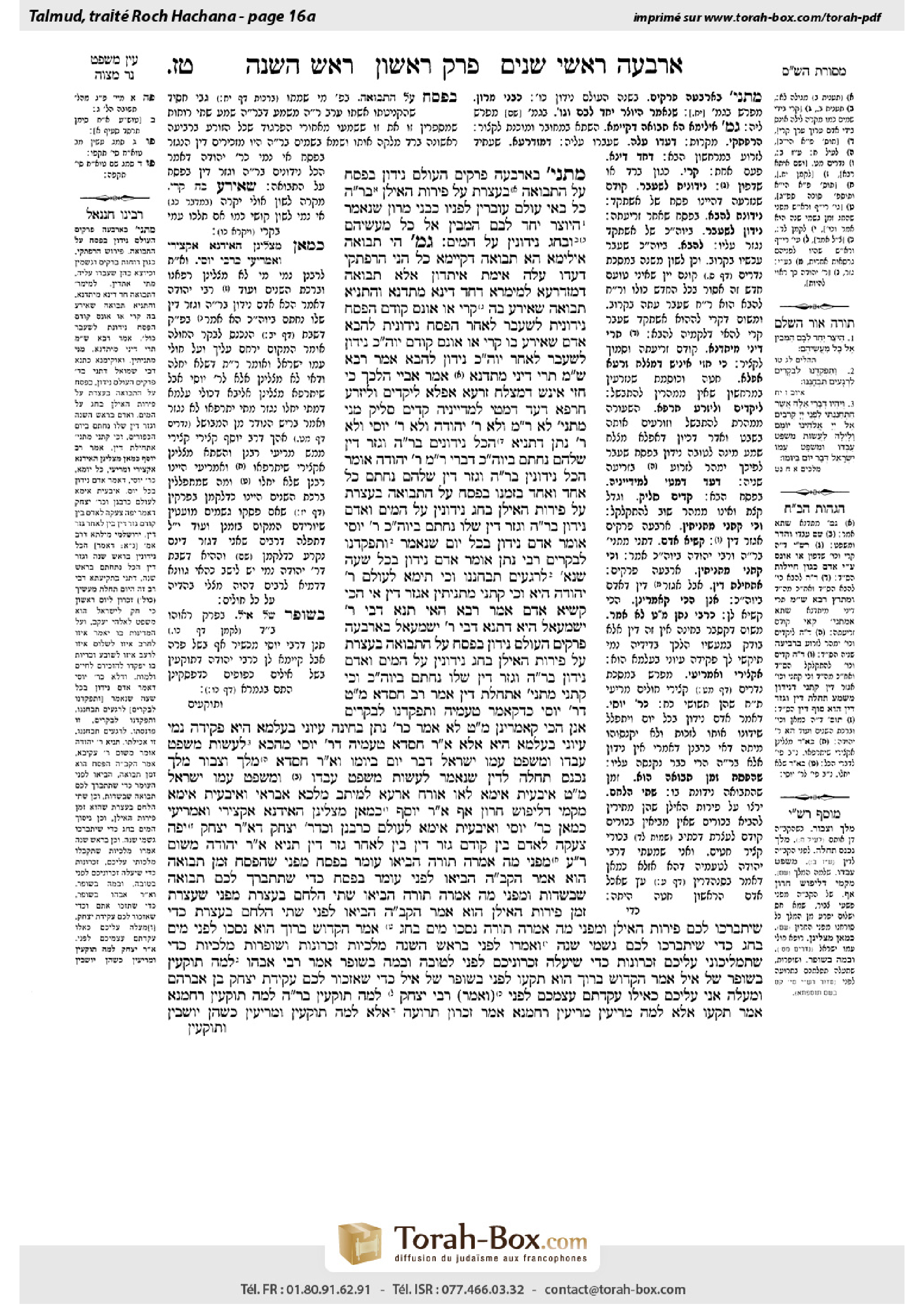
Rosh Hashanah 16a: Talmud study for Daf Yomi
Daf Yomi is the daily study of one Talmud folio. Explore 37 tractates with scans, Hebrew text, Sefaria English and AI-generated French translations where annotated.
Passage selection and English or AI-generated French translation are available where the scan has annotations. Daf Study is independent of Torah-Box and Sefaria.
Browse Rosh Hashanah · ראש השנה · All tractatesRosh Hashanah 16a text and translations
This page of Rosh Hashanah includes the Aramaic text, an English translation and an AI-generated French translation, alongside the scan above.
ראש השנה י״ו א · Aramaic and Hebrew text
מַתְנִי׳ בְּאַרְבָּעָה פְּרָקִים הָעוֹלָם נִידּוֹן: בַּפֶּסַח — עַל הַתְּבוּאָה, בַּעֲצֶרֶת — עַל פֵּירוֹת הָאִילָן, בְּרֹאשׁ הַשָּׁנָה — כׇּל בָּאֵי עוֹלָם עוֹבְרִין לְפָנָיו כִּבְנֵי מָרוֹן, שֶׁנֶּאֱמַר: ״הַיּוֹצֵר יַחַד לִבָּם הַמֵּבִין אֶל כׇּל מַעֲשֵׂיהֶם״, וּבֶחָג נִידּוֹנִין עַל הַמַּיִם.
גְּמָ׳ הֵי תְּבוּאָה? אִילֵּימָא הָא תְּבוּאָה דְּקָיְימָא, כׇּל הָנֵי הַרְפַּתְקֵי דַּעֲדוֹ עֲלַהּ אֵימַת אִיתְּדוּן? אֶלָּא תְּבוּאָה דְּמִזְדַּרְעָא.
לְמֵימְרָא דְּחַד דִּינָא מִתַּדְנָא? וְהָתַנְיָא: תְּבוּאָה שֶׁאֵירַע בָּהּ קֶרִי אוֹ אוֹנֶס, קוֹדֶם הַפֶּסַח — נִידּוֹנֶית לְשֶׁעָבַר, לְאַחַר הַפֶּסַח — נִידּוֹנֶית לְהַבָּא. אָדָם שֶׁאֵירַע בּוֹ קֶרִי אוֹ אוֹנֶס, קוֹדֶם יוֹם הַכִּפּוּרִים — נִידּוֹן לְשֶׁעָבַר, לְאַחַר יוֹם הַכִּפּוּרִים — נִידּוֹן לְהַבָּא.
אָמַר רָבָא: שְׁמַע מִינַּהּ תְּרֵי דִינֵי מִתַּדְנָא. אָמַר אַבָּיֵי: הִלְכָּךְ, כִּי חָזֵי אִינָשׁ דְּמַצְלַח זַרְעָא אַפְלָא — לִיקַדֵּים וְלִיזְרַע חָרְפָא. דְּעַד דְּמָטֵי לְמֵדַיְינֵיהּ — קָדֵים סָלֵיק.
מַנִּי מַתְנִיתִין? לָא רַבִּי מֵאִיר, וְלָא רַבִּי יְהוּדָה, וְלָא רַבִּי יוֹסֵי, וְלָא רַבִּי נָתָן.
דְּתַנְיָא: הַכֹּל נִידּוֹנִים בָּרֹאשׁ הַשָּׁנָה, וּגְזַר דִּין שֶׁלָּהֶם נֶחְתָּם בְּיוֹם הַכִּפּוּרִים, דִּבְרֵי רַבִּי מֵאִיר. רַבִּי יְהוּדָה אוֹמֵר: הַכֹּל נִידּוֹנִין בְּרֹאשׁ הַשָּׁנָה, וּגְזַר דִּין שֶׁלָּהֶם נֶחְתָּם כׇּל אֶחָד וְאֶחָד בִּזְמַנּוֹ: בַּפֶּסַח — עַל הַתְּבוּאָה, בַּעֲצֶרֶת — עַל פֵּירוֹת הָאִילָן, בֶּחָג נִידּוֹנִין עַל הַמַּיִם. וְאָדָם נִידּוֹן בְּרֹאשׁ הַשָּׁנָה, וּגְזַר דִּין שֶׁלּוֹ נֶחְתָּם בְּיוֹם הַכִּפּוּרִים.
רַבִּי יוֹסֵי אוֹמֵר: אָדָם נִידּוֹן בְּכׇל יוֹם, שֶׁנֶּאֱמַר: ״וַתִּפְקְדֶנּוּ לִבְקָרִים״. רַבִּי נָתָן אוֹמֵר: אָדָם נִידּוֹן בְּכׇל שָׁעָה, שֶׁנֶּאֱמַר: ״לִרְגָעִים תִּבְחָנֶנּוּ״.
וְכִי תֵּימָא: לְעוֹלָם רַבִּי יְהוּדָה הִיא, וְכִי קָתָנֵי מַתְנִיתִין — אַגְּזַר דִּין, אִי הָכִי — קַשְׁיָא אָדָם!
אָמַר רָבָא: הַאי תָּנָא דְּבֵי רַבִּי יִשְׁמָעֵאל הִיא, דְּתָנָא דְּבֵי רַבִּי יִשְׁמָעֵאל, בְּאַרְבָּעָה פְּרָקִים הָעוֹלָם נִידּוֹן: בַּפֶּסַח — עַל הַתְּבוּאָה, בַּעֲצֶרֶת — עַל פֵּירוֹת הָאִילָן, בְּחָג נִידּוֹנִין עַל הַמַּיִם. וְאָדָם נִידּוֹן בָּרֹאשׁ הַשָּׁנָה, וּגְזַר דִּין שֶׁלּוֹ נֶחְתָּם בְּיוֹם הַכִּפּוּרִים. וְכִי קָתָנֵי מַתְנִיתִין — אַתְּחִלַּת דִּין.
אָמַר רַב חִסְדָּא: מַאי טַעְמָא דְּרַבִּי יוֹסֵי? כִּדְקָאָמַר טַעְמֵיהּ: ״וַתִּפְקְדֶנּוּ לִבְקָרִים״! אֲנַן הָכִי קָאָמְרִינַן: מַאי טַעְמָא לָא אָמַר כְּרַבִּי נָתָן? בְּחִינָה — עַיּוֹנֵי בְּעָלְמָא הִיא. פְּקִידָה נָמֵי עַיּוֹנֵי בְּעָלְמָא הִיא?!
אֶלָּא אָמַר רַב חִסְדָּא: טַעְמֵיהּ דְּרַבִּי יוֹסֵי מֵהָכָא: ״לַעֲשׂוֹת מִשְׁפַּט עַבְדּוֹ וּמִשְׁפַּט עַמּוֹ יִשְׂרָאֵל דְּבַר יוֹם בְּיוֹמוֹ״.
וְאָמַר רַב חִסְדָּא: מֶלֶךְ וְצִבּוּר — מֶלֶךְ נִכְנָס תְּחִלָּה לַדִּין, שֶׁנֶּאֱמַר: ״לַעֲשׂוֹת מִשְׁפַּט עַבְדּוֹ וּמִשְׁפַּט עַמּוֹ יִשְׂרָאֵל״. מַאי טַעְמָא? אִיבָּעֵית אֵימָא: לָאו אוֹרַח אַרְעָא לְמֵיתַב מַלְכָּא אַבָּרַאי. וְאִיבָּעֵית אֵימָא: מִקַּמֵּי דְּלִיפּוֹשׁ חֲרוֹן אַף.
אָמַר רַב יוֹסֵף: כְּמַאן מְצַלִּינַן הָאִידָּנָא אַקְּצִירֵי וְאַמְּרִיעֵי, כְּמַאן — כְּרַבִּי יוֹסֵי. וְאִיבָּעֵית אֵימָא: לְעוֹלָם כְּרַבָּנַן, וְכִדְרַבִּי יִצְחָק. דְּאָמַר רַבִּי יִצְחָק: יָפָה צְעָקָה לָאָדָם בֵּין קוֹדֶם גְּזַר דִּין בֵּין לְאַחַר גְּזַר דִּין.
תַּנְיָא, אָמַר רַבִּי יְהוּדָה מִשּׁוּם רַבִּי עֲקִיבָא: מִפְּנֵי מָה אָמְרָה תּוֹרָה הָבִיאוּ עוֹמֶר בַּפֶּסַח — מִפְּנֵי שֶׁהַפֶּסַח זְמַן תְּבוּאָה הוּא, אָמַר הַקָּדוֹשׁ בָּרוּךְ הוּא: הָבִיאוּ לְפָנַי עוֹמֶר בַּפֶּסַח, כְּדֵי שֶׁתִּתְבָּרֵךְ לָכֶם תְּבוּאָה שֶׁבַּשָּׂדוֹת. וּמִפְּנֵי מָה אָמְרָה תּוֹרָה הָבִיאוּ שְׁתֵּי הַלֶּחֶם בָּעֲצֶרֶת — מִפְּנֵי שֶׁעֲצֶרֶת זְמַן פֵּירוֹת הָאִילָן הוּא, אָמַר הַקָּדוֹשׁ בָּרוּךְ הוּא: הָבִיאוּ לְפָנַי שְׁתֵּי הַלֶּחֶם בַּעֲצֶרֶת, כְּדֵי שֶׁיִּתְבָּרְכוּ לָכֶם פֵּירוֹת הָאִילָן.
וּמִפְּנֵי מָה אָמְרָה תּוֹרָה נַסְּכוּ מַיִם בֶּחָג — אָמַר הַקָּדוֹשׁ בָּרוּךְ הוּא: נַסְּכוּ לְפָנַי מַיִם בֶּחָג, כְּדֵי שֶׁיִּתְבָּרְכוּ לָכֶם גִּשְׁמֵי שָׁנָה. וְאִמְרוּ לְפָנַי בְּרֹאשׁ הַשָּׁנָה מַלְכִיּוֹת זִכְרוֹנוֹת וְשׁוֹפָרוֹת. מַלְכִיּוֹת — כְּדֵי שֶׁתַּמְלִיכוּנִי עֲלֵיכֶם, זִכְרוֹנוֹת — כְּדֵי שֶׁיַּעֲלֶה זִכְרוֹנְיכֶם לְפָנַי לְטוֹבָה, וּבַמֶּה — בְּשׁוֹפָר.
אָמַר רַבִּי אֲבָהוּ: לָמָה תּוֹקְעִין בְּשׁוֹפָר שֶׁל אַיִל? אָמַר הַקָּדוֹשׁ בָּרוּךְ הוּא: תִּקְעוּ לְפָנַי בְּשׁוֹפָר שֶׁל אַיִל, כְּדֵי שֶׁאֶזְכּוֹר לָכֶם עֲקֵידַת יִצְחָק בֶּן אַבְרָהָם, וּמַעֲלֶה אֲנִי עֲלֵיכֶם כְּאִילּוּ עֲקַדְתֶּם עַצְמְכֶם לְפָנַי.
וְאָמַר רַבִּי יִצְחָק: לָמָּה תּוֹקְעִין בְּרֹאשׁ הַשָּׁנָה? לָמָּה תּוֹקְעִין?! רַחֲמָנָא אָמַר תִּקְעוּ! אֶלָּא: לָמָּה מְרִיעִין? מְרִיעִין?! רַחֲמָנָא אָמַר ״זִכְרוֹן תְּרוּעָה״! אֶלָּא: לָמָּה תּוֹקְעִין וּמְרִיעִין כְּשֶׁהֵן יוֹשְׁבִין,
Rosh Hashanah 16a · English translation
MISHNA: At four times of the year the world is judged: On Passover judgment is passed concerning grain; on Shavuot concerning fruits that grow on a tree; on Rosh HaShana all creatures pass before Him like sheep [benei maron], as it is stated: “He Who fashions their hearts alike, Who considers all their deeds” (Psalms 33:15); and on the festival of Sukkot they are judged concerning water, i.e., the rainfall of the coming year.
GEMARA: The mishna taught that on Passover judgment is passed concerning grain. The Gemara asks: Which grain is judged on Passover? If we say it is the grain that is presently standing in the fields ready to be reaped between Passover and Shavuot, when was judgment passed with regard to all those events [harpatkei] that already happened to the grain while it was growing in the winter? Rather, the mishna must be referring to the grain that will be sown over the coming year.
The Gemara asks further: Is this to say that only one judgment is passed concerning a particular crop, and no more? But isn’t it taught in a baraita: If grain suffers an incident or accident before Passover, it was judged in the past, the previous Passover; if this occurs after Passover, it was judged this Passover for the future. And similarly, if a person suffered an incident or accident before Yom Kippur, he was judged in the past, the previous Rosh HaShana; if this occurred after Yom Kippur, he was judged this Rosh HaShana for the future.
Rava said: Learn from here that two judgments are passed concerning each crop, one covering the period between the time it is sown and Passover and another covering the period between Passover and the time it is harvested. Abaye said: Therefore, if a person sees that his slow-growing crops, those that are sown at the beginning of the winter but ripen only in the spring or summer, are doing well, he should quickly sow fast-growing crops, such as barley, which can be sown at the end of the winter and still ripen before Passover, as before it is brought to judgment on the next Passover it will already have successfully grown, since he knows that this year’s crops were judged for a favorable yield.
The Gemara raises a question about the mishna: Whose opinion is expressed in the mishna? It is not in accordance with the opinion of Rabbi Meir, and not in accordance with the opinion of Rabbi Yehuda, and not in accordance with the opinion of Rabbi Yosei, and not in accordance with the opinion of Rabbi Natan.
The Gemara explains: As it is taught in a baraita: All are judged on Rosh HaShana, and their sentence is sealed on Yom Kippur; this is the statement of Rabbi Meir. Rabbi Yehuda says: All are judged on Rosh HaShana, and their sentence is sealed each in its own time: On Passover the sentence is sealed concerning grain; on Shavuot concerning fruits that grow on a tree; on the festival of Sukkot they are judged concerning water; and mankind is judged on Rosh HaShana, and the sentence is sealed on Yom Kippur.
Rabbi Yosei says: A person is judged every day, and not just once a year, as it is stated: “You visit him every morning” (Job 7:18), meaning that every morning an accounting is made and a judgment is passed. Rabbi Natan says: A person is judged every hour, as it is stated: “You try him every moment” (Job 7:18).
And lest you say that actually, the mishna is taught in accordance with the opinion of Rabbi Yehuda, and when the mishna is taught, it is taught with regard to the sentence, and not the judgments, which are all passed on Rosh HaShana, if so, it is difficult with regard to mankind, as the mishna should have stated that the sentence is sealed on Yom Kippur.
Rava said: The tanna of the mishna is a tanna from the school of Rabbi Yishmael, as a tanna from the school of Rabbi Yishmael taught: At four times of the year the world is judged: On Passover concerning grain; on Shavuot concerning fruits that grow on a tree; on the festival of Sukkot they are judged concerning water; and mankind is judged on Rosh HaShana and the sentence is sealed on Yom Kippur. And when the mishna is taught, it is taught with regard to the beginning of the judgment process, i.e., the judgment of mankind is initially passed on Rosh HaShana.
Rav Ḥisda said: What is the reason for the opinion of Rabbi Yosei? The Gemara is astonished by this question: Why ask about his reason? He stated his reason, the verse that states: “You visit him every morning.” The Gemara explains: This is what we are saying: If Rabbi Yosei relies on this verse, what is the reason that he did not state his opinion in accordance with the opinion of Rabbi Natan that a person is judged every hour? And if you say that he holds that the verse “You try him every moment” cannot serve as proof, because trying merely indicates examination and not actual judgment, then in the same way visiting merely indicates examination. If so, there is no clear proof from this verse.
Rather, Rav Ḥisda said: Rabbi Yosei’s reason is from here, another verse, which states: “To make the judgment of His servant and the judgment of His people Israel at all times, as each day may require” (I Kings 8:59), which indicates that the entire world is judged every day.
§ About this verse Rav Ḥisda said: When a king and a community are brought before God for judgment, the king is brought in for judgment first, as it is stated: “To make the judgment of His servant,” and afterward: “And the judgment of His people Israel.” What is the reason for this? If you wish, say that it is not proper conduct for the king to stand outside and wait for the trial of his subjects to come to an end. And if you wish, say instead that the king is brought in first so that he may be judged before God’s anger intensifies due to the sins of the community, and consequently he may be saved from overly harsh judgment.
Rav Yosef said: In accordance with whose opinion do we pray nowadays on a daily basis for the sick and afflicted? The Gemara repeats the question: In accordance with whose opinion? It is in accordance with the opinion of Rabbi Yosei, who holds that one is judged every day, and so there is reason to pray every day in order to affect the outcome of his judgment. And if you wish, say that actually, normative practice is even in accordance with the opinion of the Rabbis, who hold that one is judged only once a year, but also in accordance with the opinion of Rabbi Yitzḥak. As Rabbi Yitzḥak said: Crying out to God is beneficial for a person both before his sentence has been issued and after his sentence has been issued.
§ It is taught in a baraita that Rabbi Yehuda said in the name of Rabbi Akiva: For what reason did the Torah say: Bring the omer offering on the second day of Passover? It is because Passover is the time of grain, the beginning of the grain harvest season, and therefore the Holy One, Blessed be He, said: Bring the omer offering before Me on Passover so that the grain in the fields will be blessed for you. And for what reason did the Torah say: Bring the offering of the two loaves from the new wheat on Shavuot? It is because Shavuot is the time of the fruits that grow on a tree, when it begins to ripen, and therefore the Holy One, Blessed be He, said: Bring the offering of the two loaves before Me on Shavuot so that the fruits that grow on a tree will be blessed for you.
And for what reason did the Torah say: Pour water onto the altar in the Temple on the festival of Sukkot? The Holy One, Blessed be He, said: Pour water before Me on the festival of Sukkot so that the rains of the year, which begin to fall after Sukkot, will be blessed for you. And recite before Me on Rosh HaShana verses that mention Kingships, Remembrances, and Shofarot: Kingships so that you will crown Me as King over you; Remembrances so that your remembrance will rise before Me for good; and with what will the remembrance rise? It will rise with the shofar.
Similarly, Rabbi Abbahu said: Why does one sound a blast with a shofar made from a ram’s horn on Rosh HaShana? The Holy One, Blessed be He, said: Sound a blast before Me with a shofar made from a ram’s horn, so that I will remember for you the binding of Isaac, son of Abraham, in whose stead a ram was sacrificed, and I will ascribe it to you as if you had bound yourselves before Me.
Rabbi Yitzḥak said: Why does one sound [tokin] a blast on Rosh HaShana? The Gemara is astonished by the question: Why do we sound a blast? The Merciful One states in the verse: “Sound [tiku] a shofar” (Psalms 81:4). Rather, the question is: Why does one sound a staccato series of shofar blasts [terua] in addition to a long continuous shofar blast [tekia]? The Gemara is still surprised by the question: Sound a terua? The Merciful One states: “In the seventh month, in the first day of the month, shall be a solemn rest unto you, a memorial proclaimed with the blast of horns [terua]” (Leviticus 23:24). Rather, Rabbi Yitzḥak asked about the common practice in Jewish communities, which is not explicitly stated in the Torah: Why does one sound a long, continuous shofar blast [tekia] and then a staccato series of shofar blasts [terua] while the congregation is still sitting before the silent prayer,
Rosh Hashanah 16a · Traduction française (IA)
MICHNA : À quatre moments de l’année, le monde est jugé : à Pessa’h, le jugement porte sur les céréales ; à Chavouot, sur les fruits des arbres ; à Roch Hachana, toutes les créatures passent devant Lui comme des moutons [benei maron], ainsi qu’il est dit : « Celui qui façonne leurs cœurs à tous et considère toutes leurs actions » (Psaumes 33, 15) ; et à la fête de Souccot, elles sont jugées au sujet de l’eau, c’est-à-dire des pluies de l’année à venir.
GUEMARA : La Michna enseigne qu’à Pessa’h, le jugement porte sur les céréales. La Guemara demande : De quelles céréales s’agit-il ? Si l’on dit qu’il s’agit des céréales qui se trouvent actuellement dans les champs, prêtes à être récoltées entre Pessa’h et Chavouot, quand le jugement a-t-il été rendu au sujet de tous les événements [harpatkei] qui leur sont déjà arrivés pendant leur croissance, en hiver ? Il faut donc plutôt comprendre que la Michna parle des céréales qui seront semées au cours de l’année à venir.
La Guemara demande encore : Cela signifie-t-il qu’un seul jugement est rendu au sujet d’une récolte donnée, et pas davantage ? Pourtant, n’est-il pas enseigné dans une baraïta : si un incident ou un accident touche les céréales avant Pessa’h, elles ont été jugées lors du Pessa’h précédent ; si cela se produit après Pessa’h, elles ont été jugées à ce Pessa’h pour l’avenir. De même, si un incident ou un accident touche une personne avant Yom Kippour, elle a été jugée lors du Roch Hachana précédent ; si cela se produit après Yom Kippour, elle a été jugée à ce Roch Hachana pour l’avenir.
Rava dit : Il faut en déduire que deux jugements sont rendus au sujet de chaque récolte : l’un couvre la période entre le moment où elle est semée et Pessa’h, et l’autre celle entre Pessa’h et le moment où elle est récoltée. Abayé dit : Par conséquent, si quelqu’un constate que ses cultures à croissance lente, semées au début de l’hiver mais qui ne mûrissent qu’au printemps ou en été, se portent bien, qu’il s’empresse de semer des cultures à croissance rapide, comme l’orge, qui peut être semée à la fin de l’hiver et mûrir avant Pessa’h. Avant que ces cultures ne soient jugées au Pessa’h suivant, elles auront déjà bien poussé, puisqu’il sait que les récoltes de cette année ont été jugées pour un rendement favorable.
La Guemara soulève une question à propos de la Michna : De qui la Michna exprime-t-elle l’opinion ? Elle n’est conforme ni à l’opinion de Rabbi Meïr, ni à celle de Rabbi Yehouda, ni à celle de Rabbi Yossé, ni à celle de Rabbi Natan.
La Guemara explique : Car il est enseigné dans une baraïta : Tous sont jugés à Roch Hachana, et leur sentence est scellée à Yom Kippour ; telle est l’opinion de Rabbi Meïr. Rabbi Yehouda dit : Tous sont jugés à Roch Hachana, et leur sentence est scellée chacun en son temps : à Pessa’h, la sentence est scellée au sujet des céréales ; à Chavouot, au sujet des fruits des arbres ; à la fête de Souccot, ils sont jugés au sujet de l’eau ; quant aux êtres humains, ils sont jugés à Roch Hachana et leur sentence est scellée à Yom Kippour.
Rabbi Yossé dit : Une personne est jugée chaque jour, et pas seulement une fois par an, ainsi qu’il est dit : « Tu la visites chaque matin » (Job 7, 18), ce qui signifie que chaque matin, un compte est établi et un jugement est rendu. Rabbi Natan dit : Une personne est jugée à chaque heure, ainsi qu’il est dit : « Tu l’éprouves à chaque instant » (Job 7, 18).
Et de peur que tu ne dises qu’en réalité, la Michna est conforme à l’opinion de Rabbi Yehouda et qu’elle parle de la sentence, et non des jugements, qui sont tous rendus à Roch Hachana, une difficulté se pose alors au sujet des êtres humains : la Michna aurait dû enseigner que leur sentence est scellée à Yom Kippour.
Rava dit : Le tanna de la Michna est un tanna de l’école de Rabbi Yishmaël, car un tanna de l’école de Rabbi Yishmaël a enseigné : À quatre moments de l’année, le monde est jugé : à Pessa’h, au sujet des céréales ; à Chavouot, au sujet des fruits des arbres ; à la fête de Souccot, ils sont jugés au sujet de l’eau ; et les êtres humains sont jugés à Roch Hachana et leur sentence est scellée à Yom Kippour. La Michna est enseignée au sujet du début du processus de jugement, c’est-à-dire que le jugement des êtres humains est rendu une première fois à Roch Hachana.
Rav Hisda dit : Quelle est la raison de l’opinion de Rabbi Yossé ? La Guemara s’étonne de cette question : pourquoi demander sa raison ? Il l’a donnée : le verset qui dit « Tu la visites chaque matin ». La Guemara explique : Voici ce que nous voulons dire : si Rabbi Yossé s’appuie sur ce verset, pourquoi n’a-t-il pas exprimé une opinion conforme à celle de Rabbi Natan, selon laquelle une personne est jugée à chaque heure ? Et si tu dis qu’il estime que le verset « Tu l’éprouves à chaque instant » ne peut servir de preuve, car éprouver signifie seulement examiner, et non juger véritablement, alors, de même, visiter signifie seulement examiner. Dans ce cas, ce verset ne constitue pas une preuve claire.
Rav Hisda dit plutôt : La raison de Rabbi Yossé se trouve dans un autre verset, qui dit : « Afin de rendre justice à Son serviteur et à Israël, Son peuple, selon le besoin de chaque jour » (I Rois 8, 59), ce qui indique que le monde entier est jugé chaque jour.
§ Au sujet de ce verset, Rav Hisda dit : Lorsqu’un roi et une communauté sont amenés devant Dieu pour être jugés, le roi est appelé à comparaître le premier, ainsi qu’il est dit : « Afin de rendre justice à Son serviteur », puis : « et à Israël, Son peuple ». Pour quelle raison ? Si tu le souhaites, dis que ce n’est pas une conduite convenable qu’un roi reste dehors à attendre que le procès de ses sujets se termine. Et si tu le souhaites, dis plutôt que le roi est appelé à comparaître le premier afin d’être jugé avant que la colère de Dieu ne s’intensifie à cause des péchés de la communauté, et qu’il puisse ainsi échapper à un jugement excessivement sévère.
Rav Yossef dit : Selon l’opinion de qui prions-nous aujourd’hui chaque jour pour les malades et les affligés ? La Guemara reprend la question : selon l’opinion de qui ? Selon celle de Rabbi Yossé, qui estime qu’une personne est jugée chaque jour ; il y a donc lieu de prier quotidiennement afin d’influer sur l’issue de son jugement. Et si tu le souhaites, dis qu’en réalité, la pratique est également conforme à l’opinion des Rabbins, qui estiment qu’une personne n’est jugée qu’une fois par an, mais aussi à celle de Rabbi Yitz’hak. Car Rabbi Yitz’hak a dit : Crier vers Dieu est bénéfique pour une personne aussi bien avant qu’après le prononcé de sa sentence.
§ Il est enseigné dans une baraïta que Rabbi Yehouda a dit au nom de Rabbi Akiva : Pour quelle raison la Torah a-t-elle dit d’apporter l’offrande du omer le deuxième jour de Pessa’h ? Parce que Pessa’h est la période des céréales, le début de la saison de leur récolte. Le Saint, béni soit-Il, a donc dit : « Apportez devant Moi l’offrande du omer à Pessa’h, afin que les céréales dans les champs soient bénies pour vous. » Et pour quelle raison la Torah a-t-elle dit d’apporter l’offrande des deux pains de blé nouveau à Chavouot ? Parce que Chavouot est la période des fruits des arbres, qui commencent alors à mûrir. Le Saint, béni soit-Il, a donc dit : « Apportez devant Moi l’offrande des deux pains à Chavouot, afin que les fruits des arbres soient bénis pour vous. »
Et pour quelle raison la Torah a-t-elle dit de verser de l’eau sur l’autel du Temple à la fête de Souccot ? Le Saint, béni soit-Il, a dit : « Versez de l’eau devant Moi à la fête de Souccot, afin que les pluies de l’année, qui commencent à tomber après Souccot, soient bénies pour vous. » Et récitez devant Moi, à Roch Hachana, des versets qui évoquent les Royautés, les Souvenirs et les Chofarot : les Royautés, afin que vous Me proclamiez roi sur vous ; les Souvenirs, afin que votre souvenir s’élève devant Moi pour le bien. Et par quoi ce souvenir s’élèvera-t-il ? Par le chofar.
De même, Rabbi Abbahou dit : Pourquoi sonne-t-on du chofar fait d’une corne de bélier à Roch Hachana ? Le Saint, béni soit-Il, a dit : « Sonnez devant Moi du chofar fait d’une corne de bélier, afin que Je me rappelle pour vous la ligature d’Isaac, fils d’Abraham, à la place duquel un bélier a été sacrifié, et que Je vous en tienne compte comme si vous vous étiez vous-mêmes ligaturés devant Moi. »
Rabbi Yitz’hak dit : Pourquoi sonne-t-on [tokin] du chofar à Roch Hachana ? La Guemara s’étonne de la question : pourquoi sonne-t-on du chofar ? Le Miséricordieux dit dans le verset : « Sonnez [tiku] du chofar » (Psaumes 81, 4). Il faut plutôt demander : pourquoi sonne-t-on une série de sons saccadés du chofar [terua], en plus d’un son long et continu [tekia] ? La Guemara s’étonne encore : sonner une terua ? Le Miséricordieux dit : « Au septième mois, le premier jour du mois, vous aurez un repos solennel, un mémorial proclamé au son des cors [terua] » (Lévitique 23, 24). Rabbi Yitz’hak pose plutôt une question au sujet de la pratique courante dans les communautés juives, qui n’est pas explicitement énoncée dans la Torah : pourquoi sonne-t-on un son long et continu du chofar [tekia], puis une série de sons saccadés du chofar [terua], alors que l’assemblée est encore assise avant la prière silencieuse,
Traduction française générée par IA à partir de l’édition anglaise de Sefaria. Vérifie toujours un passage avec le texte source.
Text from Sefaria: William Davidson Edition - Vocalized Aramaic (CC BY NC); William Davidson Edition - English (CC BY NC).