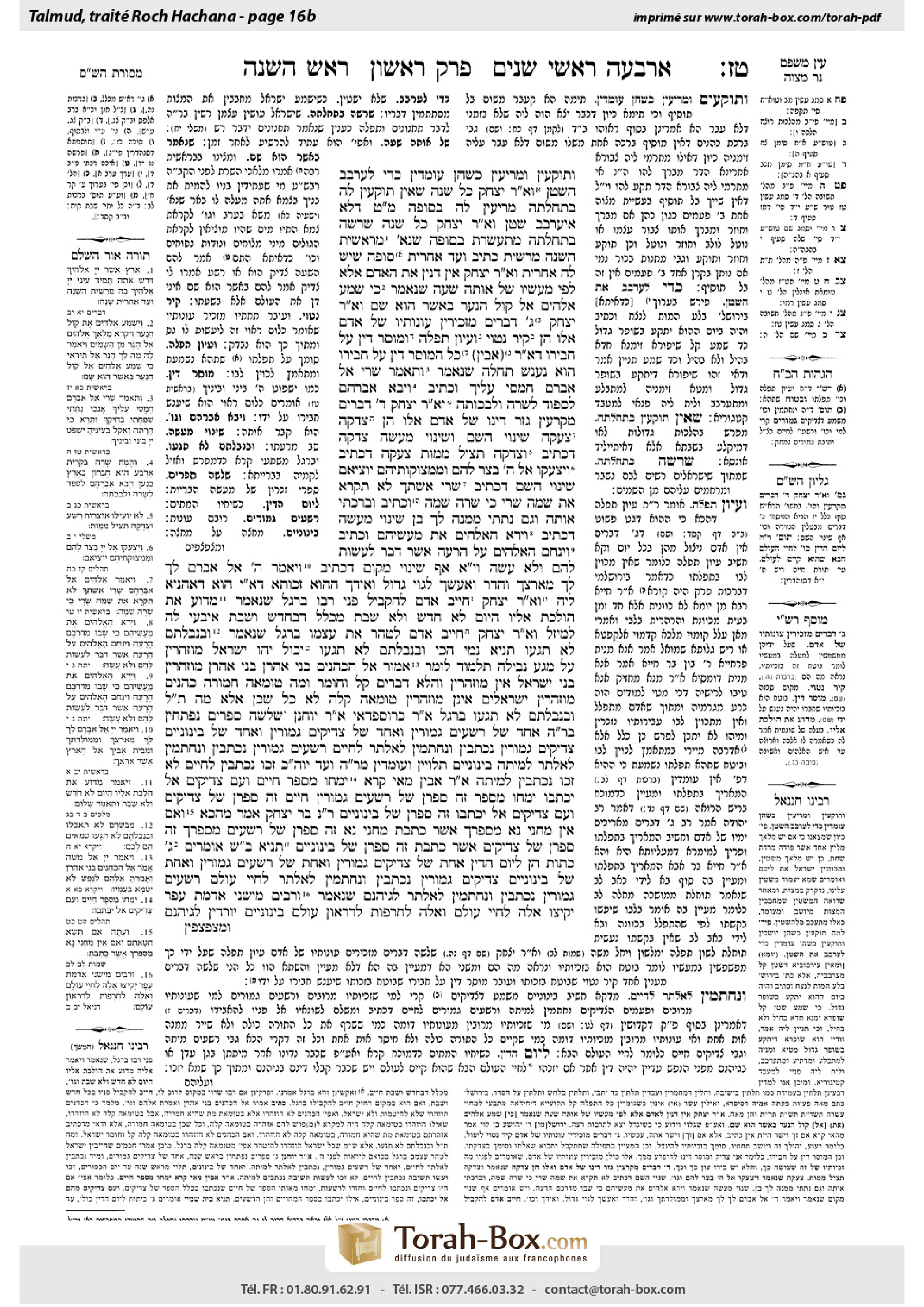
Rosh Hashanah 16b: Talmud study for Daf Yomi
Daf Yomi is the daily study of one Talmud folio. Explore 37 tractates with scans, Hebrew text, Sefaria English and AI-generated French translations where annotated.
Passage selection and English or AI-generated French translation are available where the scan has annotations. Daf Study is independent of Torah-Box and Sefaria.
Browse Rosh Hashanah · ראש השנה · All tractatesRosh Hashanah 16b text and translations
This page of Rosh Hashanah includes the Aramaic text, an English translation and an AI-generated French translation, alongside the scan above.
ראש השנה י״ו ב · Aramaic and Hebrew text
וְתוֹקְעִין וּמְרִיעִין כְּשֶׁהֵן עוֹמְדִין — כְּדֵי לְעַרְבֵּב הַשָּׂטָן.
וְאָמַר רַבִּי יִצְחָק: כׇּל שָׁנָה שֶׁאֵין תּוֹקְעִין לָהּ בִּתְחִלָּתָהּ — מְרִיעִין לָהּ בְּסוֹפָהּ. מַאי טַעְמָא — דְּלָא אִיעַרְבַּב שָׂטָן.
וְאָמַר רַבִּי יִצְחָק: כׇּל שָׁנָה שֶׁרָשָׁה בִּתְחִלָּתָהּ — מִתְעַשֶּׁרֶת בְּסוֹפָהּ, שֶׁנֶּאֱמַר: ״מֵרֵאשִׁית הַשָּׁנָה״ — ״מֵרֵשִׁית״ כְּתִיב. ״וְעַד אַחֲרִית״ — סוֹפָהּ שֶׁיֵּשׁ לָהּ אַחֲרִית.
וְאָמַר רַבִּי יִצְחָק: אֵין דָּנִין אֶת הָאָדָם אֶלָּא לְפִי מַעֲשָׂיו שֶׁל אוֹתָהּ שָׁעָה, שֶׁנֶּאֱמַר: ״כִּי שָׁמַע אֱלֹהִים אֶל קוֹל הַנַּעַר בַּאֲשֶׁר הוּא שָׁם״.
וְאָמַר רַבִּי יִצְחָק: שְׁלֹשָׁה דְּבָרִים מַזְכִּירִין עֲוֹנוֹתָיו שֶׁל אָדָם, אֵלּוּ הֵן: קִיר נָטוּי, וְעִיּוּן תְּפִלָּה, וּמוֹסֵר דִּין עַל חֲבֵירוֹ. דְּאָמַר רַבִּי אָבִין: כָּל הַמּוֹסֵר דִּין עַל חֲבֵירוֹ — הוּא נֶעֱנָשׁ תְּחִלָּה, שֶׁנֶּאֱמַר: ״וַתֹּאמֶר שָׂרַי אֶל אַבְרָם חֲמָסִי עָלֶיךָ״, וּכְתִיב: ״וַיָּבֹא אַבְרָהָם לִסְפּוֹד לְשָׂרָה וְלִבְכּוֹתָהּ״.
וְאָמַר רַבִּי יִצְחָק: אַרְבָּעָה דְּבָרִים מְקָרְעִין גְּזַר דִּינוֹ שֶׁל אָדָם, אֵלּוּ הֵן: צְדָקָה, צְעָקָה, שִׁינּוּי הַשֵּׁם, וְשִׁינּוּי מַעֲשֶׂה. צְדָקָה, דִּכְתִיב: ״וּצְדָקָה תַּצִּיל מִמָּוֶת״. צְעָקָה, דִּכְתִיב: ״וַיִּצְעֲקוּ אֶל ה׳ בַּצַּר לָהֶם וּמִמְּצוּקוֹתֵיהֶם יוֹצִיאֵם״. שִׁינּוּי הַשֵּׁם, דִּכְתִיב: ״שָׂרַי אִשְׁתְּךָ לֹא תִקְרָא אֶת שְׁמָהּ שָׂרָי כִּי שָׂרָה שְׁמָהּ״, וּכְתִיב: ״וּבֵרַכְתִּי אוֹתָהּ וְגַם נָתַתִּי מִמֶּנָּה לְךָ בֵּן״. שִׁינּוּי מַעֲשֶׂה, דִּכְתִיב: ״וַיַּרְא הָאֱלֹהִים אֶת מַעֲשֵׂיהֶם״, וּכְתִיב: ״וַיִּנָּחֶם הָאֱלֹהִים עַל הָרָעָה אֲשֶׁר דִּבֶּר לַעֲשׂוֹת לָהֶם וְלֹא עָשָׂה״.
וְיֵשׁ אוֹמְרִים: אַף שִׁינּוּי מָקוֹם, דִּכְתִיב: ״וַיֹּאמֶר ה׳ אֶל אַבְרָם לֶךְ לְךָ מֵאַרְצְךָ״, וַהֲדַר: ״וְאֶעֶשְׂךָ לְגוֹי גָּדוֹל״. וְאִידַּךְ: הָהוּא זְכוּתָא דְּאֶרֶץ יִשְׂרָאֵל הוּא דְּאַהַנְיָא לֵיהּ.
וְאָמַר רַבִּי יִצְחָק: חַיָּיב אָדָם לְהַקְבִּיל פְּנֵי רַבּוֹ בָּרֶגֶל, שֶׁנֶּאֱמַר: ״מַדּוּעַ אַתְּ הוֹלֶכֶת אֵלָיו הַיּוֹם לֹא חֹדֶשׁ וְלֹא שַׁבָּת״, מִכְּלָל דִּבְחֹדֶשׁ וְשַׁבָּת אִיבְּעִי לַהּ לְמֵיזַל.
וְאָמַר רַבִּי יִצְחָק: חַיָּיב אָדָם לְטַהֵר אֶת עַצְמוֹ בָּרֶגֶל, שֶׁנֶּאֱמַר: ״וּבְנִבְלָתָם לֹא תִגָּעוּ״.
תַּנְיָא נָמֵי הָכִי: ״וּבִנְבָלָתָם לֹא תִגָּעוּ״, יָכוֹל יְהוּ יִשְׂרָאֵל מוּזְהָרִין עַל מַגַּע נְבֵילָה, תַּלְמוּד לוֹמַר: ״אֱמוֹר אֶל הַכֹּהֲנִים בְּנֵי אַהֲרֹן״, בְּנֵי אַהֲרֹן מוּזְהָרִין, בְּנֵי יִשְׂרָאֵל אֵין מוּזְהָרִין.
וַהֲלֹא דְּבָרִים קַל וָחוֹמֶר: וּמָה טוּמְאָה חֲמוּרָה — כֹּהֲנִים מוּזְהָרִין, יִשְׂרְאֵלִים אֵינָן מוּזְהָרִין. טוּמְאָה קַלָּה — לֹא כׇּל שֶׁכֵּן? אֶלָּא, מָה תַּלְמוּד לוֹמַר ״וּבְנִבְלָתָם לֹא תִגָּעוּ״ — בָּרֶגֶל.
אָמַר רַבִּי כְּרוּסְפָּדַאי אָמַר רַבִּי יוֹחָנָן: שְׁלֹשָׁה סְפָרִים נִפְתָּחִין בְּרֹאשׁ הַשָּׁנָה, אֶחָד שֶׁל רְשָׁעִים גְּמוּרִין, וְאֶחָד שֶׁל צַדִּיקִים גְּמוּרִין, וְאֶחָד שֶׁל בֵּינוֹנִיִּים. צַדִּיקִים גְּמוּרִין — נִכְתָּבִין וְנֶחְתָּמִין לְאַלְתַּר לְחַיִּים, רְשָׁעִים גְּמוּרִין — נִכְתָּבִין וְנֶחְתָּמִין לְאַלְתַּר לְמִיתָה, בֵּינוֹנִיִּים — תְּלוּיִין וְעוֹמְדִין מֵרֹאשׁ הַשָּׁנָה וְעַד יוֹם הַכִּפּוּרִים, זָכוּ — נִכְתָּבִין לְחַיִּים, לֹא זָכוּ — נִכְתָּבִין לְמִיתָה.
אָמַר רַבִּי אָבִין, מַאי קְרָא: ״יִמָּחוּ מִסֵּפֶר חַיִּים וְעִם צַדִּיקִים אַל יִכָּתֵבוּ״. ״יִמָּחוּ מִסֵּפֶר״ — זֶה סִפְרָן שֶׁל רְשָׁעִים גְּמוּרִין, ״חַיִּים״ — זֶה סִפְרָן שֶׁל צַדִּיקִים, ״וְעִם צַדִּיקִים אַל יִכָּתֵבוּ״ — זֶה סִפְרָן שֶׁל בֵּינוֹנִיִּים.
רַב נַחְמָן בַּר יִצְחָק אָמַר, מֵהָכָא: ״וְאִם אַיִן מְחֵנִי נָא מִסִּפְרְךָ אֲשֶׁר כָּתָבְתָּ״, ״מְחֵנִי נָא״ — זֶה סִפְרָן שֶׁל רְשָׁעִים, ״מִסִּפְרְךָ״ — זֶה סִפְרָן שֶׁל צַדִּיקִים, ״אֲשֶׁר כָּתָבְתָּ״ — זֶה סִפְרָן שֶׁל בֵּינוֹנִיִּים.
תַּנְיָא, בֵּית שַׁמַּאי אוֹמְרִים: שָׁלֹשׁ כִּתּוֹת הֵן לְיוֹם הַדִּין: אַחַת שֶׁל צַדִּיקִים גְּמוּרִין, וְאַחַת שֶׁל רְשָׁעִים גְּמוּרִין, וְאַחַת שֶׁל בֵּינוֹנִיִּים. צַדִּיקִים גְּמוּרִין — נִכְתָּבִין וְנֶחְתָּמִין לְאַלְתַּר לְחַיֵּי עוֹלָם, רְשָׁעִים גְּמוּרִין — נִכְתָּבִין וְנֶחְתָּמִין לְאַלְתַּר לְגֵיהִנָּם, שֶׁנֶּאֱמַר: ״וְרַבִּים מִיְּשֵׁנֵי אַדְמַת עָפָר יָקִיצוּ אֵלֶּה לְחַיֵּי עוֹלָם וְאֵלֶּה לַחֲרָפוֹת לְדִרְאוֹן עוֹלָם״, בֵּינוֹנִיִּים — יוֹרְדִין לְגֵיהִנָּם,
Rosh Hashanah 16b · English translation
and then sound again a tekia and a terua while they are standing in the Amida prayer? He answers: In order to confuse the Satan, for this double blowing of the shofar demonstrates Israel’s love for the mitzva, and this will confuse Satan when he brings his accusations against Israel before the heavenly court, and the Jewish people will receive a favorable judgment.
And Rabbi Yitzḥak said, playing on the double meaning of the word meri’in, which can mean either sound a terua or cause misfortune: Any year during which, due to some mishap, the shofar was not sounded at its beginning will suffer evil and misfortune at its end. What is the reason? Because Satan was not confused, and he was able to put forward his accusations, so that the Jewish people would be punished.
§ The Gemara brings a series of statements in the name of Rabbi Yitzḥak, all of which relate to judgment: And Rabbi Yitzḥak said: Any year that is poor [rasha] and troubled at its beginning will be made rich at its end, for it is stated: “From the beginning [mereishit] of the year” (Deuteronomy 11:12). The word meireishit is written defectively, without an alef, so that it may also be understood in the sense of rashut, poverty. The verse continues: “And until the end [aḥarit] of the year,” which means that the end of the year will have expectations of good things in the end [aḥarit].
And Rabbi Yitzḥak said: A man is judged only according to his deeds at the time of his judgment, and not according to his future deeds, as it is stated with regard to Ishmael: “For God has heard the voice of the lad where he is” (Genesis 21:17). Although Ishmael and his descendants would act wickedly in the future, his prayer was heard and answered because he was innocent at the time.
And Rabbi Yitzḥak said: Three matters evoke a person’s sins, and they are: Endangering oneself by sitting next to an inclined wall that is about to collapse; expecting prayer to be accepted, as that leads to an assessment of one’s status and merit; and passing a case against another to Heaven, for Rabbi Avin said: Anyone who passes a case against another to God is punished first. Praying for God to pass judgment on another causes one’s own deeds to be examined and compared with the deeds of the other, as it is stated: “And Sarai said to Abram: My anger be upon you; I have given my maid into your bosom, and when she saw that she had conceived, I was despised in her eyes; let the Lord judge between me and you” (Genesis 16:5), and it is written afterward: “And Abraham came to mourn for Sarah and to weep for her” (Genesis 23:2). Sarah called upon Heaven to pass judgment between her and her husband, and therefore she was punished and died first.
And Rabbi Yitzḥak said: A person’s sentence is torn up on account of four types of actions. These are: Giving charity, crying out in prayer, a change of one’s name, and a change of one’s deeds for the better. An allusion may be found in Scripture for all of them: Giving charity, as it is written: “And charity delivers from death” (Proverbs 10:2); crying out in prayer, as it is written: “Then they cry to the Lord in their trouble, and He brings them out of their distresses” (Psalms 107:28); a change of one’s name, as it is written: “As for Sarai your wife, you shall not call her name Sarai, but Sarah shall her name be” (Genesis 17:15), and it is written there: “And I will bless her, and I will also give you a son from her” (Genesis 17:16); a change of one’s deeds for the better, as it is written: “And God saw their deeds” (Jonah 3:10), and it is written there: “And God repented of the evil, which He had said He would do to them, and He did not do it” (Jonah 3:10).
And some say: Also, a change of one’s place of residence cancels an evil judgment, as it is written: “And the Lord said to Abram: Go you out of your county” (Genesis 12:1), and afterward it is written: “And I will make of you a great nation” (Genesis 12: 2). The Gemara explains: And the other one, i.e., Rabbi Yitzḥak, who does not include a change of residence in his list, holds that in the case of Abram, it was the merit and sanctity of Eretz Yisrael that helped him become the father of a great nation.
The Gemara cites two more statements in the name of Rabbi Yitzḥak, relating to the Festivals: And Rabbi Yitzḥak said: A person is obligated to go out and greet his teacher on a Festival, as it is stated that the husband of the Shunamite woman asked, when she was readying herself to go to the prophet: “Why will you go to him today; it is neither the New Moon nor Shabbat” (II Kings 4:23). By inference, we learn that on the New Moon and on Shabbat, which in this context means a Festival that is a day of rest, she was required to go.
And Rabbi Yitzḥak said: A person is obligated to purify himself on a Festival, as it is stated: “And their carcasses you shall not touch; they are impure to you” (Leviticus 11:8). This verse is referring to the Festivals, as taught in the following baraita.
This is also taught in a baraita: The verse states: “And their carcass you shall not touch.” One might have thought that ordinary Jews are prohibited from touching an animal carcass. Therefore, the verse states: “Speak to the priests, the sons of Aaron, and say to them: There shall none be defiled for the dead among his people” (Leviticus 21:1). It is derived from here that the sons of Aaron are prohibited from defiling themselves, but the children of Israel, i.e., non-priests, are not prohibited from doing so.
But are these matters not an a fortiori inference? If, with regard to severe impurity, i.e., contact with a human corpse, priests are prohibited from defiling themselves, while ordinary Israelites are not prohibited from doing so, in the case of light impurity, e.g., touching an animal carcass, is it not all the more so that Israelites be permitted to defile themselves? Rather, what is the meaning when the verse states: “And their carcass you shall not touch?” It means that on a Festival all are obligated to purify themselves.
§ The Gemara goes back to discuss the Day of Judgment. Rabbi Kruspedai said that Rabbi Yoḥanan said: Three books are opened on Rosh HaShana before the Holy One, Blessed be He: One of wholly wicked people, and one of wholly righteous people, and one of middling people whose good and bad deeds are equally balanced. Wholly righteous people are immediately written and sealed for life; wholly wicked people are immediately written and sealed for death; and middling people are left with their judgment suspended from Rosh HaShana until Yom Kippur, their fate remaining undecided. If they merit, through the good deeds and mitzvot that they perform during this period, they are written for life; if they do not so merit, they are written for death.
Rabbi Avin said: What is the verse that alludes to this? “Let them be blotted out of the book of the living, but not be written with the righteous” (Psalms 69:29). “Let them be blotted out of the book”; this is the book of wholly wicked people, who are blotted out from the world. “Of the living”; this is the book of wholly righteous people. “But not be written with the righteous”; this is the book of middling people, who are written in a separate book, not with the righteous.
Rav Naḥman bar Yitzḥak said: This matter is derived from here: “And if not, blot me, I pray You, out of Your book which you have written” (Exodus 32:32). “Blot me, I pray You”; this is the book of wholly wicked people, who are blotted out from the world. “Out of Your book”; this is the book of wholly righteous people, which is special and attributed to God Himself. “Which You have written”; this is the book of middling people.
It is taught in a baraita: Beit Shammai say: There will be three groups of people on the great Day of Judgment at the end of days: One of wholly righteous people, one of wholly wicked people, and one of middling people. Wholly righteous people will immediately be written and sealed for eternal life. Wholly wicked people will immediately be written and sealed for Gehenna, as it is stated: “And many of those who sleep in the dust of the earth shall wake, some to eternal life and some to shame and everlasting contempt” (Daniel 12:2). Middling people will descend to Gehenna to be cleansed and to achieve atonement for their sins,
Rosh Hashanah 16b · Traduction française (IA)
puis sonner de nouveau une teki’a et une terou’a alors qu’ils sont debout pendant la prière de la Amida ? Il répond : afin de troubler le Satan, car cette double sonnerie du chofar témoigne de l’amour d’Israël pour la mitsva ; cela troublera le Satan lorsqu’il présentera ses accusations contre Israël devant le tribunal céleste, et le peuple juif recevra un jugement favorable.
Et Rabbi Yitsḥak dit, en jouant sur le double sens du mot meri’in, qui peut signifier soit sonner une terou’a, soit causer le malheur : toute année au début de laquelle, à la suite d’un contretemps, le chofar n’a pas été sonné sera frappée par le mal et le malheur à sa fin. Pour quelle raison ? Parce que le Satan n’aura pas été troublé et aura pu présenter ses accusations, de sorte que le peuple juif sera puni.
§ La Guemara rapporte une série d’enseignements transmis au nom de Rabbi Yitsḥak, qui portent tous sur le jugement. Rabbi Yitsḥak dit : toute année qui est pauvre [rasha] et troublée à son début deviendra prospère à sa fin, car il est dit : « Depuis le commencement [mereishit] de l’année » (Deutéronome 11:12). Le mot meireishit est écrit de façon défective, sans alef, de sorte qu’on peut aussi le comprendre au sens de rashut, la pauvreté. Le verset poursuit : « Et jusqu’à la fin [aḥarit] de l’année », ce qui signifie qu’à la fin de l’année, on peut espérer de bonnes choses pour la fin [aḥarit].
Et Rabbi Yitsḥak dit : l’homme n’est jugé qu’en fonction de ses actes au moment de son jugement, et non en fonction de ses actes futurs, comme il est dit au sujet d’Ishmaël : « Car Dieu a entendu la voix du garçon là où il est » (Genèse 21:17). Bien qu’Ishmaël et ses descendants agissent méchamment par la suite, sa prière fut entendue et exaucée parce qu’il était innocent à ce moment-là.
Et Rabbi Yitsḥak dit : trois choses font resurgir les péchés d’une personne : se mettre en danger en s’asseyant près d’un mur incliné sur le point de s’effondrer ; s’attendre à ce que sa prière soit acceptée, car cela entraîne un examen de son statut et de ses mérites ; et porter une accusation contre autrui devant le Ciel, car Rabbi Avin a dit : quiconque porte une accusation contre autrui devant Dieu est puni le premier. Prier Dieu afin qu’Il juge autrui entraîne l’examen de ses propres actes et leur comparaison avec ceux de l’autre, comme il est dit : « Et Saraï dit à Abram : Que le tort qui m’est fait retombe sur toi ; j’ai mis ma servante dans ton sein, et lorsqu’elle a vu qu’elle était enceinte, je suis devenue méprisable à ses yeux ; que l’Éternel juge entre moi et toi » (Genèse 16:5), et il est écrit ensuite : « Abraham vint pour mener le deuil de Sara et la pleurer » (Genèse 23:2). Sara en avait appelé au Ciel pour qu’Il juge entre elle et son mari ; elle fut donc punie et mourut la première.
Et Rabbi Yitsḥak dit : la sentence d’une personne est annulée à la suite de quatre types d’actions : faire la charité, crier dans la prière, changer de nom et améliorer sa conduite. On en trouve une allusion dans l’Écriture pour chacune d’elles : faire la charité, comme il est écrit : « La charité délivre de la mort » (Proverbes 10:2) ; crier dans la prière, comme il est écrit : « Alors ils crient vers l’Éternel dans leur détresse, et Il les délivre de leurs angoisses » (Psaumes 107:28) ; changer de nom, comme il est écrit : « Quant à Saraï, ta femme, tu ne l’appelleras plus Saraï ; son nom sera Sarah » (Genèse 17:15), et il est écrit ensuite : « Je la bénirai, et je te donnerai aussi d’elle un fils » (Genèse 17:16) ; améliorer sa conduite, comme il est écrit : « Dieu vit leurs actes » (Jonas 3:10), et il est écrit ensuite : « Dieu se repentit du mal qu’Il avait dit qu’Il leur ferait, et ne le fit pas » (Jonas 3:10).
Et certains disent : un changement de lieu de résidence annule aussi un jugement défavorable, comme il est écrit : « Et l’Éternel dit à Abram : Va-t’en de ton pays » (Genèse 12:1), puis il est écrit : « Je ferai de toi une grande nation » (Genèse 12:2). La Guemara explique : l’autre, c’est-à-dire Rabbi Yitsḥak, qui n’inclut pas un changement de résidence dans sa liste, estime que, dans le cas d’Abram, c’est le mérite et la sainteté d’Eretz Israël qui l’ont aidé à devenir le père d’une grande nation.
La Guemara cite deux autres enseignements de Rabbi Yitsḥak concernant les fêtes. Rabbi Yitsḥak dit : une personne est tenue d’aller accueillir son maître pendant une fête, comme on le voit lorsque le mari de la Shounamite lui demanda, alors qu’elle se préparait à aller voir le prophète : « Pourquoi vas-tu chez lui aujourd’hui ? Ce n’est ni la nouvelle lune ni le Chabbat » (II Rois 4:23). Nous en déduisons que, lors de la nouvelle lune et du Chabbat — ce qui, dans ce contexte, désigne une fête qui est un jour de repos —, elle était tenue d’y aller.
Et Rabbi Yitsḥak dit : une personne est tenue de se purifier pendant une fête, comme il est dit : « Vous ne toucherez pas leurs cadavres ; ils sont impurs pour vous » (Lévitique 11:8). Ce verset se rapporte aux fêtes, comme l’enseigne la baraïta suivante.
Cela est également enseigné dans une baraïta : le verset dit : « Vous ne toucherez pas leur cadavre. » On aurait pu penser qu’il est interdit aux Israélites ordinaires de toucher le cadavre d’un animal. Le verset dit donc : « Parle aux prêtres, fils d’Aaron, et dis-leur : Que nul ne se rende impur au contact d’un mort parmi les siens » (Lévitique 21:1). On déduit de là qu’il est interdit aux fils d’Aaron de se rendre impurs, mais que les enfants d’Israël, c’est-à-dire les non-prêtres, n’en ont pas l’interdiction.
Mais ces questions ne relèvent-elles pas d’un raisonnement a fortiori ? Si, en matière d’impureté grave, c’est-à-dire au contact d’un cadavre humain, il est interdit aux prêtres de se rendre impurs, tandis que les Israélites ordinaires n’en ont pas l’interdiction, à plus forte raison les Israélites seraient-ils autorisés à se rendre impurs dans le cas d’une impureté légère, par exemple en touchant le cadavre d’un animal. Que signifie donc le verset : « Vous ne toucherez pas leur cadavre » ? Cela signifie que, pendant une fête, tous sont tenus de se purifier.
§ La Guemara revient à la discussion sur le Jour du Jugement. Rabbi Kruspedai a dit au nom de Rabbi Yoḥanan : trois livres sont ouverts à Roch Hachana devant le Saint, béni soit-Il : l’un pour les méchants absolus, l’un pour les justes absolus et l’un pour les gens moyens, dont les bonnes et les mauvaises actions sont à égalité. Les justes absolus sont immédiatement inscrits et scellés pour la vie ; les méchants absolus sont immédiatement inscrits et scellés pour la mort ; quant aux gens moyens, leur jugement reste suspendu de Roch Hachana à Yom Kippour, leur sort demeurant indécis. S’ils le méritent par les bonnes actions et les mitsvot qu’ils accomplissent durant cette période, ils sont inscrits pour la vie ; s’ils ne le méritent pas ainsi, ils sont inscrits pour la mort.
Rabbi Avin dit : quel verset y fait allusion ? « Qu’ils soient effacés du livre des vivants, et qu’ils ne soient pas inscrits avec les justes » (Psaumes 69:29). « Qu’ils soient effacés du livre » : c’est le livre des méchants absolus, qui sont effacés du monde. « Des vivants » : c’est le livre des justes absolus. « Et qu’ils ne soient pas inscrits avec les justes » : c’est le livre des gens moyens, inscrits dans un livre distinct, et non avec les justes.
Rav Naḥman bar Yitsḥak dit : cette idée se déduit d’ici : « Sinon, je t’en prie, efface-moi du livre que tu as écrit » (Exode 32:32). « Efface-moi, je t’en prie » : c’est le livre des méchants absolus, qui sont effacés du monde. « Du livre » : c’est le livre des justes absolus, qui est particulier et attribué à Dieu Lui-même. « Que tu as écrit » : c’est le livre des gens moyens.
Il est enseigné dans une baraïta : Beit Shammaï dit qu’il y aura trois groupes de personnes lors du grand Jour du Jugement, à la fin des temps : un groupe de justes absolus, un groupe de méchants absolus et un groupe de gens moyens. Les justes absolus seront immédiatement inscrits et scellés pour la vie éternelle. Les méchants absolus seront immédiatement inscrits et scellés pour le Guéhinom, comme il est dit : « Beaucoup de ceux qui dorment dans la poussière de la terre se réveilleront, les uns pour la vie éternelle, les autres pour la honte et le mépris éternel » (Daniel 12:2). Les gens moyens descendront au Guéhinom pour être purifiés et obtenir l’expiation de leurs péchés,
Traduction française générée par IA à partir de l’édition anglaise de Sefaria. Vérifie toujours un passage avec le texte source.
Text from Sefaria: William Davidson Edition - Vocalized Aramaic (CC BY NC); William Davidson Edition - English (CC BY NC).