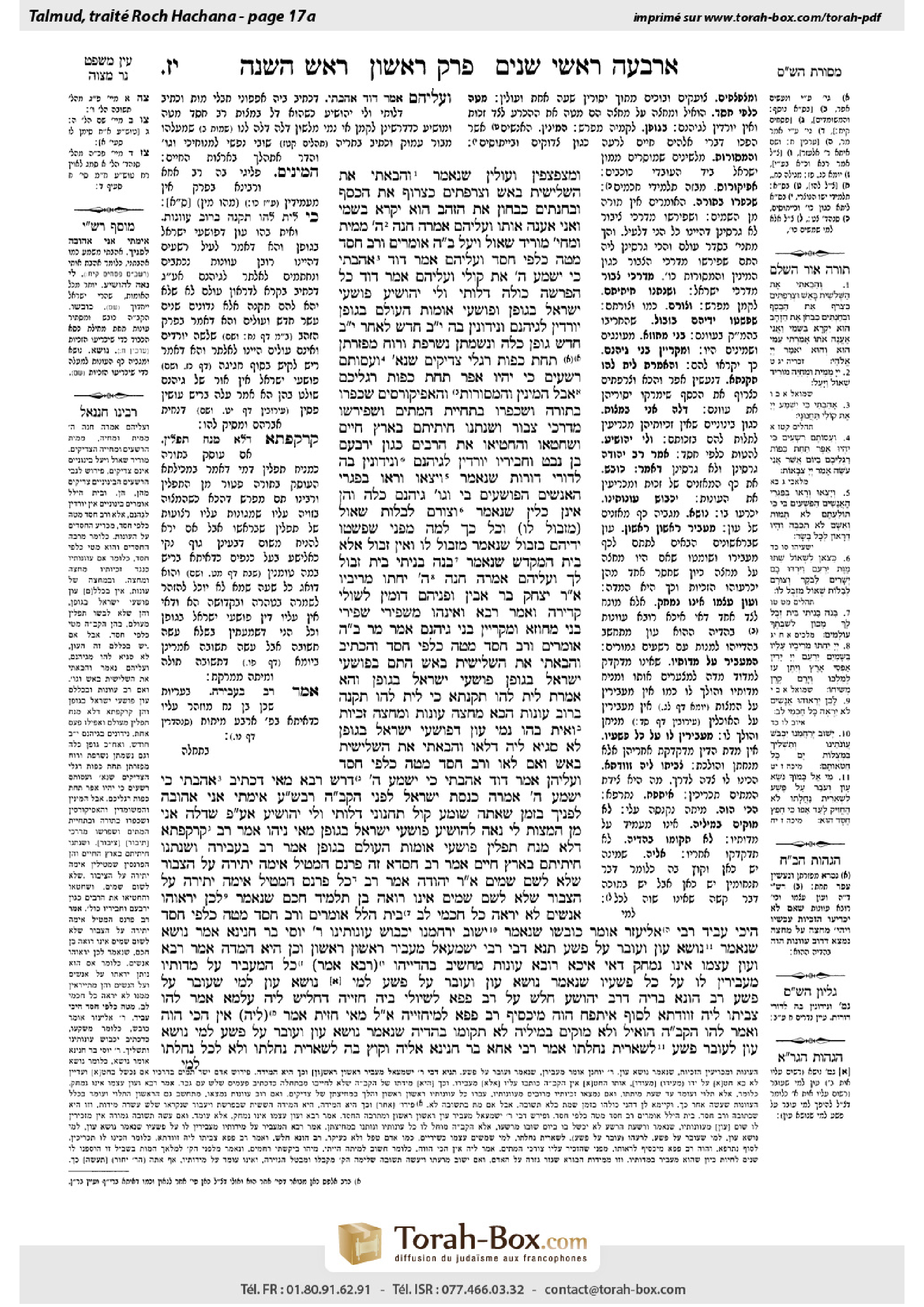
Rosh Hashanah 17a: Talmud study for Daf Yomi
Daf Yomi is the daily study of one Talmud folio. Explore 37 tractates with scans, Hebrew text, Sefaria English and AI-generated French translations where annotated.
Passage selection and English or AI-generated French translation are available where the scan has annotations. Daf Study is independent of Torah-Box and Sefaria.
Browse Rosh Hashanah · ראש השנה · All tractatesRosh Hashanah 17a text and translations
This page of Rosh Hashanah includes the Aramaic text, an English translation and an AI-generated French translation, alongside the scan above.
ראש השנה י״ז א · Aramaic and Hebrew text
וּמְצַפְצְפִין וְעוֹלִין, שֶׁנֶּאֱמַר: ״וְהֵבֵאתִי אֶת הַשְּׁלִישִׁית בָּאֵשׁ וּצְרַפְתִּים כִּצְרוֹף אֶת הַכֶּסֶף וּבְחַנְתִּים כִּבְחוֹן אֶת הַזָּהָב הוּא יִקְרָא בִשְׁמִי וַאֲנִי אֶעֱנֶה אוֹתוֹ״, וַעֲלֵיהֶם אָמְרָה חַנָּה: ״ה׳ מֵמִית וּמְחַיֶּה מוֹרִיד שְׁאוֹל וַיָּעַל״.
בֵּית הִלֵּל אוֹמְרִים: ״וְרַב חֶסֶד״ — מַטֶּה כְּלַפֵּי חֶסֶד. וַעֲלֵיהֶם אָמַר דָּוִד: ״אָהַבְתִּי כִּי יִשְׁמַע ה׳ אֶת קוֹלִי״, וַעֲלֵיהֶם אָמַר דָּוִד כׇּל הַפָּרָשָׁה כּוּלָּהּ — ״דַּלּוֹתִי וְלִי יְהוֹשִׁיעַ״.
פּוֹשְׁעֵי יִשְׂרָאֵל בְּגוּפָן, וּפוֹשְׁעֵי אוּמּוֹת הָעוֹלָם בְּגוּפָן — יוֹרְדִין לְגֵיהִנָּם וְנִידּוֹנִין בָּהּ שְׁנֵים עָשָׂר חֹדֶשׁ. לְאַחַר שְׁנֵים עָשָׂר חֹדֶשׁ — גּוּפָן כָּלֶה, וְנִשְׁמָתָן נִשְׂרֶפֶת, וְרוּחַ מְפַזַּרְתָּן תַּחַת כַּפּוֹת רַגְלֵי צַדִּיקִים, שֶׁנֶּאֱמַר: ״וְעַסּוֹתֶם רְשָׁעִים כִּי יִהְיוּ אֵפֶר תַּחַת כַּפּוֹת רַגְלֵיכֶם״.
אֲבָל הַמִּינִין וְהַמָּסוֹרוֹת וְהָאֶפִּיקוֹרְסִים שֶׁכָּפְרוּ בַּתּוֹרָה, וְשֶׁכָּפְרוּ בִּתְחִיַּית הַמֵּתִים, וְשֶׁפֵּירְשׁוּ מִדַּרְכֵי צִבּוּר, וְשֶׁנָּתְנוּ חִיתִּיתָם בְּאֶרֶץ חַיִּים, וְשֶׁחָטְאוּ וְהֶחְטִיאוּ אֶת הָרַבִּים, כְּגוֹן יָרׇבְעָם בֶּן נְבָט וַחֲבֵירָיו — יוֹרְדִין לְגֵיהִנָּם וְנִידּוֹנִין בָּהּ לְדוֹרֵי דּוֹרוֹת, שֶׁנֶּאֱמַר: ״וְיָצְאוּ וְרָאוּ בְּפִגְרֵי הָאֲנָשִׁים הַפּוֹשְׁעִים בִּי וְגוֹ׳״.
גֵּיהִנָּם כָּלֶה וְהֵן אֵינָן כָּלִין, שֶׁנֶּאֱמַר: ״וְצוּרָם לְבַלּוֹת שְׁאוֹל מִזְּבוּל לוֹ״. וְכׇל כָּךְ לָמָּה — מִפְּנֵי שֶׁפָּשְׁטוּ יְדֵיהֶם בִּזְבוּל, שֶׁנֶּאֱמַר: ״מִזְּבוּל לוֹ״, וְאֵין ״זְבוּל״ אֶלָּא בֵּית הַמִּקְדָּשׁ, שֶׁנֶּאֱמַר: ״בָּנֹה בָנִיתִי בֵּית זְבוּל לָךְ״, וַעֲלֵיהֶם אָמְרָה חַנָּה: ״ה׳ יֵחַתּוּ מְרִיבָיו״.
אָמַר רַבִּי יִצְחָק בַּר אָבִין: וּפְנֵיהֶם דּוֹמִין לְשׁוּלֵי קְדֵירָה. וְאָמַר רָבָא: וְאִינְהוּ מִשַּׁפִּירֵי שַׁפִּירֵי בְּנֵי מָחוֹזָא, וּמִקַּרְיִין ״בְּנֵי גֵיהִנָּם״.
אָמַר מָר, בֵּית הִלֵּל אוֹמְרִים: ״וְרַב חֶסֶד״ — מַטֶּה כְּלַפֵּי חֶסֶד, וְהָכְתִיב: ״וְהֵבֵאתִי אֶת הַשְּׁלִישִׁית בָּאֵשׁ״! הָתָם, בְּפוֹשְׁעֵי יִשְׂרָאֵל בְּגוּפָן.
פּוֹשְׁעֵי יִשְׂרָאֵל בְּגוּפָן — וְהָא אָמְרַתְּ לֵית לְהוּ תַּקַּנְתָּא?! כִּי לֵית לְהוּ תַּקָּנָה — בְּרוֹב עֲוֹנוֹת. הָכָא — מֶחֱצָה עֲוֹנוֹת וּמֶחֱצָה זְכִיּוֹת, וְאִית בְּהוּ נָמֵי עָוֹן דְּפוֹשְׁעֵי יִשְׂרָאֵל בְּגוּפָן, לָא סַגְיָא לֵיהּ דְּלָאו ״וְהֵבֵאתִי אֶת הַשְּׁלִישִׁית בָּאֵשׁ״. וְאִם לָאו, ״וְרַב חֶסֶד״ — מַטֶּה כְּלַפֵּי חֶסֶד. וַעֲלֵיהֶן אָמַר דָּוִד: ״אָהַבְתִּי כִּי יִשְׁמַע ה׳״.
דָּרֵשׁ רָבָא, מַאי דִּכְתִיב: ״אָהַבְתִּי כִּי יִשְׁמַע ה׳״ — אָמְרָה כְּנֶסֶת יִשְׂרָאֵל לִפְנֵי הַקָּדוֹשׁ בָּרוּךְ הוּא: רִבּוֹנוֹ שֶׁל עוֹלָם, אֵימָתַי אֲנִי אֲהוּבָה לְפָנֶיךָ — בִּזְמַן שֶׁאַתָּה שׁוֹמֵעַ קוֹל תַּחֲנוּנַי. ״דַּלּוֹתִי וְלִי יְהוֹשִׁיעַ״, אַף עַל פִּי שֶׁדַּלָּה אֲנִי מִן הַמִּצְוֹת — לִי נָאֶה לְהוֹשִׁיעַ.
פּוֹשְׁעֵי יִשְׂרָאֵל בְּגוּפָן, מַאי נִיהוּ? אָמַר רַב: קַרְקַפְתָּא דְּלָא מַנַּח תְּפִלִּין. פּוֹשְׁעֵי אוּמּוֹת הָעוֹלָם בְּגוּפָן — אָמַר רַב: בַּעֲבֵירָה.
וְשֶׁנָּתְנוּ חִיתִּיתָם בְּאֶרֶץ חַיִּים — אָמַר רַב חִסְדָּא: זֶה פַּרְנָס הַמַּטִּיל אֵימָה יְתֵירָה עַל הַצִּבּוּר שֶׁלֹּא לְשֵׁם שָׁמַיִם. אָמַר רַב יְהוּדָה אָמַר רַב: כׇּל פַּרְנָס הַמַּטִּיל אֵימָה יְתֵירָה עַל הַצִּבּוּר שֶׁלֹּא לְשֵׁם שָׁמַיִם אֵינוֹ רוֹאֶה בֵּן תַּלְמִיד חָכָם, שֶׁנֶּאֱמַר: ״לָכֵן יְרֵאוּהוּ אֲנָשִׁים לֹא יִרְאֶה כׇּל חַכְמֵי לֵב״.
בֵּית הִלֵּל אוֹמְרִים: ״וְרַב חֶסֶד״ — מַטֶּה כְּלַפֵּי חֶסֶד. הֵיכִי עָבֵיד? רַבִּי אֱלִיעֶזֶר אוֹמֵר: כּוֹבְשׁוֹ, שֶׁנֶּאֱמַר: ״יָשׁוּב יְרַחֲמֵנוּ יִכְבּוֹשׁ עֲוֹנוֹתֵינוּ״. רַבִּי יוֹסֵי בַּר חֲנִינָא אָמַר: נוֹשֵׂא, שֶׁנֶּאֱמַר: ״נוֹשֵׂא עָוֹן וְעוֹבֵר עַל פֶּשַׁע״.
תָּנָא דְּבֵי רַבִּי יִשְׁמָעֵאל: מַעֲבִיר רִאשׁוֹן רִאשׁוֹן, וְכֵן הִיא הַמִּדָּה. אָמַר רָבָא: וְעָוֹן עַצְמוֹ אֵינוֹ נִמְחָק. דְּאִי אִיכָּא רוּבָּא עֲוֹנוֹת — מִחֲשִׁיב בַּהֲדַיְיהוּ.
רָבָא אָמַר: כׇּל הַמַּעֲבִיר עַל מִדּוֹתָיו — מַעֲבִירִין לוֹ עַל כׇּל פְּשָׁעָיו, שֶׁנֶּאֱמַר: ״נוֹשֵׂא עָוֹן וְעוֹבֵר עַל פֶּשַׁע״. לְמִי נוֹשֵׂא עָוֹן — לְמִי שֶׁעוֹבֵר עַל פֶּשַׁע.
רַב הוּנָא בְּרֵיהּ דְּרַב יְהוֹשֻׁעַ חֲלַשׁ, עָל רַב פָּפָּא לְשַׁיּוֹלֵי בֵּיהּ. חַזְיֵיהּ דַּחֲלִישׁ לֵיהּ עָלְמָא, אֲמַר לְהוּ: צְבִיתוּ לֵיהּ זְוַודְתָּא. לְסוֹף אִיתְּפַח, הֲוָה מִיכְּסִיף רַב פָּפָּא לְמִיחְזְיֵיהּ. אֲמַרוּ לֵיהּ: מַאי חֲזֵית? אֲמַר לְהוּ: אִין, הָכִי הֲוָה, וַאֲמַר לְהוּ הַקָּדוֹשׁ בָּרוּךְ הוּא: הוֹאִיל וְלָא מוֹקֵים בְּמִילֵּיהּ — לָא תְּקוּמוּ בַּהֲדֵיהּ, שֶׁנֶּאֱמַר: ״נוֹשֵׂא עָוֹן וְעוֹבֵר עַל פֶּשַׁע״, לְמִי נוֹשֵׂא עָוֹן — לְעוֹבֵר פֶּשַׁע.
״לִשְׁאֵרִית נַחֲלָתוֹ״, אָמַר רַבִּי אַחָא בַּר חֲנִינָא: אַלְיָה — וְקוֹץ בָּהּ: ״לִשְׁאֵרִית נַחֲלָתוֹ״ — וְלֹא לְכׇל נַחֲלָתוֹ,
Rosh Hashanah 17a · English translation
and they will cry out in their pain and eventually ascend from there, as it is stated: “And I will bring the third part through the fire, and will refine them as silver is refined, and will try them as gold is tried; they shall call on My name, and I will answer them” (Zechariah 13:9). This is referring to the members of the third group, who require refinement and cleansing. And about them, Hannah said: “The Lord kills, and gives life; he brings down to the grave, and brings up” (I Samuel 2:6).
Beit Hillel say: He Who is “and abundant in kindness” (Exodus 34:6) tilts the scales in favor of kindness, so that middling people should not have to pass through Gehenna. And about them, David said: “I love the Lord, Who hears my voice and my supplications” (Psalms 116:1). And about them, David said the entire passage: “I was brought low [daloti] and He saved me” (Psalms 116:6). Although they are poor [dalim] in mitzvot, God saves them.
The rebellious Jews who have sinned with their bodies and also the rebellious people of the nations of the world who have sinned with their bodies descend to Gehenna and are judged there for twelve months. After twelve months, their bodies are consumed, their souls are burned, and a wind scatters them under the soles of the feet of the righteous, as it is stated: “And you shall tread down the wicked; for they shall be ashes under the soles of your feet” (Malachi 3:21).
But the heretics; and the informers; and the apostates [apikorsim]; and those who denied the Torah; and those who denied the resurrection of the dead; and those who separated from the ways of the Jewish community and refused to share the suffering; and those who cast their fear over the land of the living; and those who sinned and caused the masses to sin, for example, Jeroboam, son of Nebat, and his company; all of these people descend to Gehenna and are judged there for generations and generations, as it is stated: “And they shall go forth, and look upon the carcasses of the men that have rebelled against Me; for their worm shall not die; neither shall their fire be quenched; and they shall be an abhorrence to all flesh” (Isaiah 66:24).
Gehenna will terminate, but they still will not terminate, as it is stated: “And their form shall wear away the netherworld, so that there be no dwelling for Him” (Psalms 49:15); that is to say, Gehenna itself will be worn away before their punishment has come to an end. And why are they punished so severely? Because they stretched out their hands against God’s dwelling, the Temple, and everything else that is sanctified, as it is stated: “So that there be no dwelling [zevul] for Him.” Dwelling [zevul] is referring here only to the Temple, as it is stated: “I have built You a house for dwelling [zevul] in” (I Kings 8:13). And about them Hannah said: “The adversaries of the Lord shall be broken in pieces” (I Samuel 2:10).
Rabbi Yitzḥak bar Avin said: And their faces on the Day of Judgment will be black and sooty like the bottom of a pot. And Rava said: And they shall include the most handsome, i.e., upstanding, of the people of Meḥoza, as Rava thought that even the most upstanding people of the city of Meḥoza were wicked, and they shall be called the people of Gehenna.
The Master said in the baraita above: It stated that Beit Hillel say: He Who is “and abundant in kindness” (Exodus 34:6) tilts the scales in favor of kindness, so that middling people will not have to pass through Gehenna. The Gemara asks: But isn’t it written: “And I will bring the third part through the fire” (Zechariah 13:9), implying that there is a third group, which is sent to Gehenna temporarily? The Gemara answers: There, the verse is referring to the rebellious Jews who have sinned with their bodies.
The Gemara asks: Can the verse be referring to the rebellious Jews who have sinned with their bodies? But didn’t you say that they have no rectification? The Gemara responds: When do they have no rectification? When in addition to their having sinned with their bodies, the majority of their actions are sins. But here, the verse is referring to people for whom half of their actions are sins and half are meritorious deeds, and those sins include the sin of the rebellious Jews who sin with their bodies. It is not sufficient that they not be subject to the verse: “And I will bring the third part through the fire.” However, if their sins and meritorious deeds are equally balanced, and they did not sin with their bodies, He Who is “abundant in kindness” tilts the scales in favor of kindness. And about them, David said: “I love the Lord, Who hears my voice and my supplications” (Psalms 116:1).
Rava interpreted the verse homiletically: What is the meaning of that which is written: “I love the Lord, Who hears my voice and my supplications”? The Congregation of Israel said before the Holy One, Blessed be He: Master of the Universe, when do I know that I am loved by You? When You hear the voice of my supplications, as the verse states: “I was brought low [daloti], and He saved me” (Psalms 116:6). Although I am poor [dala] in mitzvot, nevertheless it is fitting to save me.
The Gemara asks: The rebellious Jews who have sinned with their bodies, who are they? Rav said: This is referring to the skull that did not ever don phylacteries. The Gemara asks further: The rebellious ones of the nations of the world who sin with their bodies, who are they? Rav said: They are those who engage in the sin, i.e., forbidden sexual relations.
And those who cast their fear over the land of the living, who are they? Rav Ḥisda said: This is referring to a communal leader [parnas] who casts excessive fear on the community not for the sake of Heaven. Rav Yehuda said that Rav said: Any community leader who casts excessive fear on the community not for the sake of Heaven will be punished and not see any Torah scholar among his sons, as it is stated: “Men do therefore fear him; he sees not any who are wise of heart” (Job 37:24). One who brings others to fear him will not merit having wise-hearted people in his family.
§ It was taught in the baraita: Beit Hillel say: He who is “and abundant in kindness” (Exodus 34:6) tilts the scales in favor of kindness, so that middling people will not have to pass through Gehenna. The Gemara asks: How does He do this? Rabbi Eliezer says: He pushes down on the side of the merits, tipping the scale in their favor, as it is stated: “He will again have compassion upon us; He will push down our iniquities” (Micah 7:19). Rabbi Yosei bar Ḥanina said: He bears, i.e., raises, the side of the sins, as it is stated: “He bears [noseh] sin and forgives transgression” (Micah 7:18).
A Sage from the school of Rabbi Yishmael taught in a baraita: He overlooks each and every first transgression, and that is the attribute of mercy, that God forgives one’s first sin, and therefore He tips the scale in favor of the merits. Rava said: But that sin itself, which God overlooks, is not completely erased; if the individual’s actions are still mostly sins, God counts the overlooked sin with them and metes out punishment accordingly.
Rava understood this verse differently and said: With regard to whoever forgoes his reckonings with others for injustices done to him, the heavenly court in turn forgoes punishment for all his sins, as it is stated: “He bears sin and forgives transgression” (Micah 7:18). Whose sins does He bear? The sins of one who forgoes his reckonings with others for injustices committed against him.
It is related that Rav Huna, son of Rav Yehoshua, became sick, and Rav Pappa went into his home to inquire about his well-being. He saw that the world was growing weak for Rav Huna, i.e., he was dying. Rav Pappa said to his attendants: Prepare his provisions [zavdata], i.e., his shrouds. In the end, Rav Huna recovered. Rav Pappa was embarrassed to go and see him, as it seemed as if he had decreed Rav Huna’s death. Rav Huna’s friends said to him: What did you see when you were lying there suspended between life and death? He said to them: Yes, it was so, I was truly close to dying, but the Holy One, Blessed be He, said to the heavenly court: Since he does not stand on his rights, i.e., he is ready to waive what is due him, you too should not be exacting with him in his judgment, as it is stated: “He bears [noseh] sin and forgives transgression.” Whose sins does He bear? The sins of one who forgoes his reckonings with others for injustices committed against him.
That same verse continues: “He bears sins and forgives transgression for the remnant of His inheritance” (Micah 7:18). Rav Aḥa bar Ḥanina said: This is like the fat tail that has a thorn in it, i.e., something good that contains something bad. God forgives and pardons only “for the remnant of His inheritance,” but not for all His inheritance.
Rosh Hashanah 17a · Traduction française (IA)
et ils crieront dans leur détresse et finiront par en sortir, comme il est dit : « Je ferai passer le tiers par le feu, je l’affinerai comme on affine l’argent et je l’éprouverai comme on éprouve l’or ; il invoquera Mon nom et Je lui répondrai » (Zacharie 13:9). Cela concerne les membres du troisième groupe, qui ont besoin d’être affinés et purifiés. À leur sujet, Hanna a dit : « Le Seigneur fait mourir et fait vivre ; Il fait descendre au séjour des morts et en fait remonter » (I Samuel 2:6).
Beit Hillel dit : Celui qui est « abondant en bonté » (Exode 34:6) fait pencher la balance en faveur de la bonté, de sorte que les personnes de condition intermédiaire n’aient pas à traverser la Géhenne. À leur sujet, David a dit : « J’aime le Seigneur, car Il entend ma voix et mes supplications » (Psaumes 116:1). David a dit à leur propos tout le passage : « J’étais accablé [daloti], et Il m’a sauvé » (Psaumes 116:6). Bien qu’ils soient pauvres [dalim] en mitsvot, Dieu les sauve.
Les Juifs rebelles qui ont péché par leur corps, ainsi que les rebelles des nations du monde qui ont péché par leur corps, descendent dans la Géhenne et y sont jugés pendant douze mois. Au terme de ces douze mois, leurs corps sont consumés, leurs âmes sont brûlées, et un vent les disperse sous la plante des pieds des justes, comme il est dit : « Vous foulerez les méchants, car ils seront comme de la cendre sous la plante de vos pieds » (Malachie 3:21).
Mais les hérétiques, les délateurs, les apostats [apikorsim], ceux qui ont renié la Torah, ceux qui ont nié la résurrection des morts, ceux qui se sont séparés des voies de la communauté juive et ont refusé de partager ses souffrances, ceux qui ont fait peser leur crainte sur la terre des vivants, ainsi que ceux qui ont péché et entraîné les masses dans le péché, comme Jéroboam fils de Nebat et ses compagnons : tous ceux-là descendent dans la Géhenne et y sont jugés de génération en génération, comme il est dit : « Ils sortiront et verront les cadavres des hommes qui se sont révoltés contre Moi ; leur ver ne mourra pas, leur feu ne s’éteindra pas, et ils seront en horreur à toute chair » (Isaïe 66:24).
La Géhenne prendra fin, mais eux ne cesseront pas d’être punis, comme il est dit : « Leur forme s’usera dans le séjour des morts, de sorte qu’il n’y ait plus de demeure pour Lui » (Psaumes 49:15) ; c’est-à-dire que la Géhenne elle-même s’usera avant que leur châtiment ne prenne fin. Et pourquoi sont-ils punis si sévèrement ? Parce qu’ils ont porté la main contre la demeure de Dieu, le Temple, et contre tout ce qui est sanctifié, comme il est dit : « De sorte qu’il n’y ait plus de demeure [zevul] pour Lui. » Ici, « demeure » [zevul] désigne uniquement le Temple, comme il est dit : « Je T’ai construit une maison comme demeure [zevul] » (I Rois 8:13). À leur sujet, Hanna a dit : « Les adversaires du Seigneur seront brisés » (I Samuel 2:10).
Rabbi Yitzḥak bar Avin a dit : Le jour du Jugement, leur visage sera noir et couvert de suie, comme le fond d’une marmite. Rava a dit : Parmi eux se trouveront les plus beaux, c’est-à-dire les plus respectables, des habitants de Meḥoza ; en effet, Rava estimait que même les habitants les plus respectables de la ville de Meḥoza étaient méchants. Ils seront appelés les gens de la Géhenne.
Le maître a dit dans la baraïta citée plus haut : Beit Hillel dit que Celui qui est « abondant en bonté » (Exode 34:6) fait pencher la balance en faveur de la bonté, de sorte que les personnes de condition intermédiaire n’aient pas à traverser la Géhenne. La Guemara demande : Mais n’est-il pas écrit : « Je ferai passer le tiers par le feu » (Zacharie 13:9), ce qui implique qu’il existe un troisième groupe, envoyé temporairement dans la Géhenne ? La Guemara répond : Là, le verset fait référence aux Juifs rebelles qui ont péché par leur corps.
La Guemara demande : Le verset peut-il faire référence aux Juifs rebelles qui ont péché par leur corps ? Mais n’as-tu pas dit qu’ils ne peuvent pas être réhabilités ? La Guemara répond : Ils ne peuvent pas être réhabilités lorsque, outre le fait d’avoir péché par leur corps, la majorité de leurs actes sont des péchés. Mais ici, le verset concerne des personnes dont la moitié des actes sont des péchés et l’autre moitié des actes méritoires, et parmi ces péchés figure le péché des Juifs rebelles qui pèchent par leur corps. Il ne suffit pas qu’ils ne relèvent pas du verset : « Je ferai passer le tiers par le feu. » Toutefois, si leurs péchés et leurs actes méritoires sont à égalité et qu’ils n’ont pas péché par leur corps, Celui qui est « abondant en bonté » fait pencher la balance en faveur de la bonté. À leur sujet, David a dit : « J’aime le Seigneur, car Il entend ma voix et mes supplications » (Psaumes 116:1).
Rava interpréta le verset de manière homilétique : Quel est le sens de ce qui est écrit : « J’aime le Seigneur, car Il entend ma voix et mes supplications » ? La communauté d’Israël dit au Saint, béni soit-Il : Maître de l’univers, à quel moment sais-je que Tu m’aimes ? Lorsque Tu entends la voix de mes supplications, comme le dit le verset : « J’étais accablée [daloti], et Il m’a sauvée » (Psaumes 116:6). Bien que je sois pauvre [dala] en mitsvot, il convient néanmoins de me sauver.
La Guemara demande : Qui sont les Juifs rebelles qui ont péché par leur corps ? Rav a dit : Il s’agit de celui dont le crâne n’a jamais porté de phylactères. La Guemara demande encore : Qui sont les rebelles des nations du monde qui pèchent par leur corps ? Rav a dit : Ce sont ceux qui se livrent au péché, c’est-à-dire à des relations sexuelles interdites.
Et qui sont ceux qui font peser leur crainte sur la terre des vivants ? Rav Ḥisda a dit : Il s’agit d’un dirigeant communautaire [parnas] qui fait peser une crainte excessive sur la communauté sans agir pour le Ciel. Rav Yehuda a dit au nom de Rav : Tout dirigeant communautaire qui fait peser une crainte excessive sur la communauté sans agir pour le Ciel sera puni et ne verra aucun sage de la Torah parmi ses fils, comme il est dit : « Les hommes le craignent donc ; il ne voit aucun homme au cœur sage » (Job 37:24). Celui qui amène les autres à le craindre ne méritera pas d’avoir des personnes au cœur sage dans sa famille.
§ Il a été enseigné dans une baraïta : Beit Hillel dit que Celui qui est « abondant en bonté » (Exode 34:6) fait pencher la balance en faveur de la bonté, de sorte que les personnes de condition intermédiaire n’aient pas à traverser la Géhenne. La Guemara demande : Comment s’y prend-Il ? Rabbi Eliezer dit : Il abaisse le plateau des mérites, faisant ainsi pencher la balance en leur faveur, comme il est dit : « Il aura de nouveau compassion de nous ; Il foulera aux pieds nos fautes » (Michée 7:19). Rabbi Yosei bar Ḥanina a dit : Il soulève le plateau des péchés, comme il est dit : « Il porte [noseh] la faute et pardonne la transgression » (Michée 7:18).
Un sage de l’école de Rabbi Yishmael a enseigné dans une baraïta : Il passe sur chacune des premières transgressions ; telle est la qualité de miséricorde : Dieu pardonne le premier péché d’une personne et fait ainsi pencher la balance en faveur de ses mérites. Rava a dit : Mais ce péché même, sur lequel Dieu passe, n’est pas complètement effacé ; si les actes de la personne restent majoritairement des péchés, Dieu compte aussi le péché passé sous silence et la punit en conséquence.
Rava a interprété ce verset autrement et a dit : Pour quiconque renonce à faire valoir ses droits envers autrui pour les torts que celui-ci lui a causés, le tribunal céleste renonce en retour à le punir pour tous ses péchés, comme il est dit : « Il porte la faute et pardonne la transgression » (Michée 7:18). De qui porte-t-Il les péchés ? De celui qui renonce à faire valoir ses droits envers autrui pour les torts que celui-ci lui a causés.
Il est rapporté que Rav Huna, fils de Rav Yehoshua, tomba malade et que Rav Pappa se rendit chez lui pour prendre de ses nouvelles. Il vit que Rav Huna était à l’agonie, c’est-à-dire qu’il était mourant. Rav Pappa dit à ses serviteurs : « Préparez ses affaires [zavdata] », c’est-à-dire ses linceuls. Finalement, Rav Huna se rétablit. Rav Pappa eut honte d’aller le voir, car cela donnait l’impression qu’il avait décrété la mort de Rav Huna. Les amis de Rav Huna lui demandèrent : « Qu’as-tu vu lorsque tu étais là, suspendu entre la vie et la mort ? » Il leur répondit : « Oui, c’est bien cela : j’étais réellement près de mourir, mais le Saint, béni soit-Il, a dit au tribunal céleste : “Puisqu’il ne fait pas valoir ses droits, c’est-à-dire qu’il est prêt à renoncer à ce qui lui est dû, vous aussi, ne soyez pas exigeants dans son jugement”, comme il est dit : “Il porte [noseh] la faute et pardonne la transgression.” De qui porte-t-Il les péchés ? De celui qui renonce à faire valoir ses droits envers autrui pour les torts que celui-ci lui a causés. »
Le même verset poursuit : « Il porte les péchés et pardonne les transgressions au reste de Son héritage » (Michée 7:18). Rav Aḥa bar Ḥanina a dit : Cela ressemble à une queue grasse qui contient une épine, c’est-à-dire à quelque chose de bon qui renferme quelque chose de mauvais. Dieu ne pardonne qu’« au reste de Son héritage », et non à l’ensemble de Son héritage.
Traduction française générée par IA à partir de l’édition anglaise de Sefaria. Vérifie toujours un passage avec le texte source.
Text from Sefaria: William Davidson Edition - Vocalized Aramaic (CC BY NC); William Davidson Edition - English (CC BY NC).