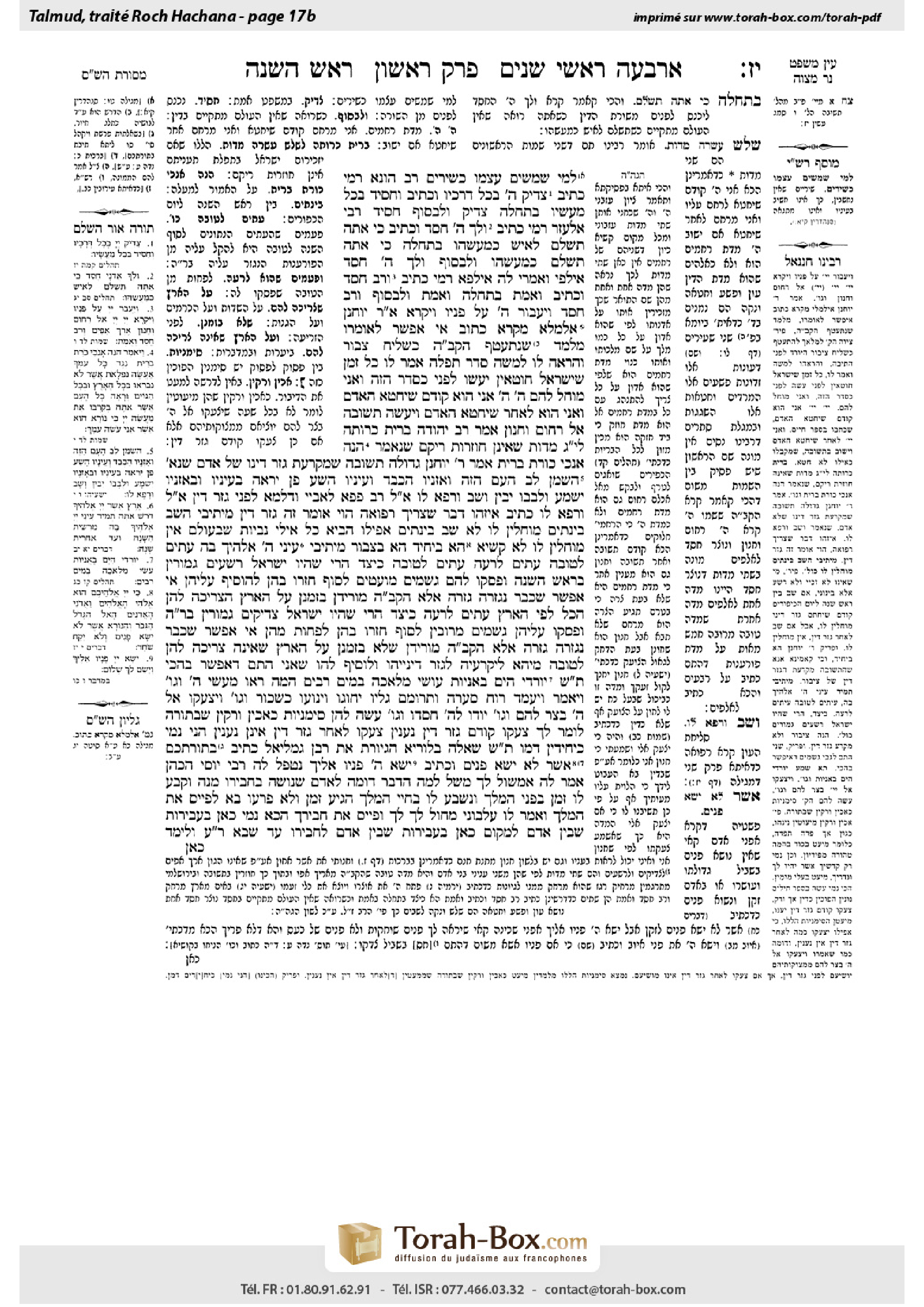
Rosh Hashanah 17b: Talmud study for Daf Yomi
Daf Yomi is the daily study of one Talmud folio. Explore 37 tractates with scans, Hebrew text, Sefaria English and AI-generated French translations where annotated.
Passage selection and English or AI-generated French translation are available where the scan has annotations. Daf Study is independent of Torah-Box and Sefaria.
Browse Rosh Hashanah · ראש השנה · All tractatesRosh Hashanah 17b text and translations
This page of Rosh Hashanah includes the Aramaic text, an English translation and an AI-generated French translation, alongside the scan above.
ראש השנה י״ז ב · Aramaic and Hebrew text
לְמִי שֶׁמֵּשִׂים עַצְמוֹ כְּשִׁירַיִם.
רַב הוּנָא רָמֵי, כְּתִיב: ״צַדִּיק ה׳ בְּכׇל דְּרָכָיו״, וּכְתִיב: ״וְחָסִיד בְּכׇל מַעֲשָׂיו״! בַּתְּחִלָּה — צַדִּיק, וּלְבַסּוֹף — חָסִיד.
רַבִּי אֶלְעָזָר רָמֵי, כְּתִיב: ״וּלְךָ ה׳ חָסֶד״, וּכְתִיב: ״כִּי אַתָּה תְשַׁלֵּם לְאִישׁ כְּמַעֲשֵׂהוּ״. בַּתְּחִלָּה — ״כִּי אַתָּה תְּשַׁלֵּם כְּמַעֲשֵׂהוּ״, וּלְבַסּוֹף — ״וּלְךָ ה׳ חָסֶד״.
אִילְפַי, וְאָמְרִי לַהּ אִילְפָא רָמֵי, כְּתִיב: ״וְרַב חֶסֶד״, וּכְתִיב: ״וֶאֱמֶת״. בַּתְּחִלָּה — ״וֶאֱמֶת״, וּלְבַסּוֹף — ״וְרַב חֶסֶד״.
״וַיַּעֲבוֹר ה׳ עַל פָּנָיו וַיִּקְרָא״. אָמַר רַבִּי יוֹחָנָן: אִלְמָלֵא מִקְרָא כָּתוּב, אִי אֶפְשָׁר לְאוֹמְרוֹ. מְלַמֵּד שֶׁנִּתְעַטֵּף הַקָּדוֹשׁ בָּרוּךְ הוּא כִּשְׁלִיחַ צִבּוּר, וְהֶרְאָה לוֹ לְמֹשֶׁה סֵדֶר תְּפִלָּה. אָמַר לוֹ: כׇּל זְמַן שֶׁיִּשְׂרָאֵל חוֹטְאִין — יַעֲשׂוּ לְפָנַי כַּסֵּדֶר הַזֶּה וַאֲנִי מוֹחֵל לָהֶם.
״ה׳ ה׳״ — אֲנִי הוּא קוֹדֶם שֶׁיֶּחְטָא הָאָדָם, וַאֲנִי הוּא לְאַחַר שֶׁיֶּחְטָא הָאָדָם וְיַעֲשֶׂה תְּשׁוּבָה — ״אֵל רַחוּם וְחַנּוּן״.
אָמַר רַב יְהוּדָה: בְּרִית כְּרוּתָה לִשְׁלֹשׁ עֶשְׂרֵה מִדּוֹת שֶׁאֵינָן חוֹזְרוֹת רֵיקָם, שֶׁנֶּאֱמַר: ״הִנֵּה אָנֹכִי כּוֹרֵת בְּרִית״.
אָמַר רַבִּי יוֹחָנָן: גְּדוֹלָה תְּשׁוּבָה שֶׁמְּקָרַעַת גְּזַר דִּינוֹ שֶׁל אָדָם, שֶׁנֶּאֱמַר: ״הַשְׁמֵן לֵב הָעָם הַזֶּה וְאׇזְנָיו הַכְבֵּד וְעֵינָיו הָשַׁע פֶּן יִרְאֶה בְעֵינָיו וּבְאׇזְנָיו יִשְׁמָע וּלְבָבוֹ יָבִין וָשָׁב וְרָפָא לוֹ״.
אֲמַר לֵיהּ רַב פָּפָּא לְאַבָּיֵי: וְדִלְמָא לִפְנֵי גְּזַר דִּין? אֲמַר לֵיהּ: ״וְרָפָא לוֹ״ כְּתִיב, אֵיזֶהוּ דָּבָר שֶׁצָּרִיךְ רְפוּאָה — הֱוֵי אוֹמֵר זֶה גְּזַר דִּין.
מֵיתִיבִי: הַשָּׁב בֵּינְתַיִם — מוֹחֲלִין לוֹ, לֹא שָׁב בֵּינְתַיִם — אֲפִילּוּ הֵבִיא כׇּל אֵילֵי נְבָיוֹת שֶׁבָּעוֹלָם אֵין מוֹחֲלִין לוֹ! לָא קַשְׁיָא: הָא — בְּיָחִיד, הָא — בְּצִבּוּר.
מֵיתִיבִי: ״עֵינֵי ה׳ אֱלֹהֶיךָ בָּהּ״ — עִתִּים לְטוֹבָה עִתִּים לְרָעָה. עִתִּים לְטוֹבָה כֵּיצַד? הֲרֵי שֶׁהָיוּ יִשְׂרָאֵל רְשָׁעִים גְּמוּרִין בְּרֹאשׁ הַשָּׁנָה וּפָסְקוּ לָהֶם גְּשָׁמִים מוּעָטִים, לְסוֹף חָזְרוּ בָּהֶן. לְהוֹסִיף עֲלֵיהֶן אִי אֶפְשָׁר — שֶׁכְּבָר נִגְזְרָה גְּזֵרָה, אֶלָּא הַקָּדוֹשׁ בָּרוּךְ הוּא מוֹרִידָן בִּזְמַנָּן, עַל הָאָרֶץ הַצְּרִיכָה לָהֶן — הַכֹּל לְפִי הָאָרֶץ.
עִתִּים לְרָעָה כֵּיצַד? הֲרֵי שֶׁהָיוּ יִשְׂרָאֵל צַדִּיקִים גְּמוּרִין בְּרֹאשׁ הַשָּׁנָה וּפָסְקוּ עֲלֵיהֶן גְּשָׁמִים מְרוּבִּין, לְסוֹף חָזְרוּ בָּהֶן. לִפְחוֹת מֵהֶן אִי אֶפְשָׁר — שֶׁכְּבָר נִגְזְרָה גְּזֵרָה, אֶלָּא הַקָּדוֹשׁ בָּרוּךְ הוּא מוֹרִידָן שֶׁלֹּא בִּזְמַנָּן, עַל הָאָרֶץ שֶׁאֵינָהּ צְרִיכָה לָהֶן.
לְטוֹבָה מִיהָא, לִיקְרְעֵיהּ לִגְזַר דִּינַיְיהוּ וְלוֹסֵיף לְהוּ! שָׁאנֵי הָתָם דְּאֶפְשָׁר בְּהָכִי.
תָּא שְׁמַע: ״יוֹרְדֵי הַיָּם בׇּאֳנִיּוֹת עוֹשֵׂי מְלָאכָה בְּמַיִם רַבִּים. הֵמָּה רָאוּ מַעֲשֵׂי ה׳ וְגוֹ׳ וַיֹּאמֶר וַיַּעֲמֵד רוּחַ סְעָרָה וַתְּרוֹמֵם גַּלָּיו. יָחוֹגּוּ וְיָנוּעוּ כַּשִּׁכּוֹר וְגוֹ׳ וַיִּצְעֲקוּ אֶל ה׳ בַּצַּר לָהֶם וְגוֹ׳ יוֹדוּ לַה׳ חַסְדּוֹ וְגוֹ׳״.
עָשָׂה לָהֶן סִימָנִיּוֹת כְּאַכִּין וְרַקִּין שֶׁבַּתּוֹרָה, לוֹמַר לָךְ: צָעֲקוּ קוֹדֶם גְּזַר דִּין — נַעֲנִין, צָעֲקוּ לְאַחַר גְּזַר דִּין — אֵינָן נַעֲנִין!
הָנֵי נָמֵי כִּיחִידִין דָּמוּ.
תָּא שְׁמַע: שָׁאֲלָה בְּלוֹרְיָא הַגִּיּוֹרֶת אֶת רַבָּן גַּמְלִיאֵל, כְּתִיב בְּתוֹרַתְכֶם: ״אֲשֶׁר לֹא יִשָּׂא פָנִים״, וּכְתִיב: ״יִשָּׂא ה׳ פָּנָיו אֵלֶיךָ״?
נִטְפַּל לַהּ רַבִּי יוֹסֵי הַכֹּהֵן. אָמַר לָהּ: אֶמְשׁוֹל לָךָ מָשָׁל, לְמָה הַדָּבָר דּוֹמֶה — לְאָדָם שֶׁנּוֹשֶׁה בַּחֲבֵירוֹ מָנֶה וְקָבַע לוֹ זְמַן בִּפְנֵי הַמֶּלֶךְ, וְנִשְׁבַּע לוֹ בְּחַיֵּי הַמֶּלֶךְ, הִגִּיעַ זְמַן וְלֹא פְּרָעוֹ. בָּא לְפַיֵּיס אֶת הַמֶּלֶךְ, וְאָמַר לוֹ: עֶלְבּוֹנִי מָחוּל לָךְ, לֵךְ וּפַיֵּיס אֶת חֲבֵירְךָ. הָכָא נָמֵי, כָּאן בַּעֲבֵירוֹת שֶׁבֵּין אָדָם לְמָקוֹם — כָּאן בַּעֲבֵירוֹת שֶׁבֵּין אָדָם לַחֲבֵירוֹ.
עַד שֶׁבָּא רַבִּי עֲקִיבָא וְלִימֵּד:
Rosh Hashanah 17b · English translation
That is to say, God forgives sins only for one who regards himself as a remainder, i.e., of only secondary importance.
§ Rav Huna raised a contradiction between the two halves of a verse. It is written: “The Lord is righteous [tzaddik] in all His ways” (Psalms 145:17), indicating that God acts in accordance with the attribute of strict justice [tzedek], and then it is written in the same verse: “And kind [ḥasid] in all His works,” implying that He acts with grace and loving-kindness [ḥesed], going beyond the letter of the law. Rav Huna explained: Initially, at the time of judgment, He is righteous, but in the end, at the time of punishment, He is gracious.
Rabbi Elazar raised a similar contradiction: It is written: “But to you, O Lord, belongs kindness” (Psalms 62:13), implying that God acts beyond the letter of the law, and then it is written in the same verse: “For You render to a man according to his deeds,” implying that He rewards and punishes measure for measure. Rabbi Elazar answered: Initially, at the time of judgment: “For You render to a man according to his deeds”; but in the end, at the time of punishment: “But to You, O Lord, belongs kindness.”
Ilfai, and some say it was the Sage Ilfa, also raised a contradiction: It is written in the list of God’s attributes: “And abundant in kindness” (Exodus 34:6), and it is written in the same verse: “And truth,” which implies the attribute of justice. He answered: Initially, at the time of judgment: “And truth,” i.e., God employs strict justice, but in the end, when He sees that the world cannot survive on judgment based only on truth and justice: “And abundant in kindness,” i.e., He is merciful.
§ The verse states: “And the Lord passed by before him, and proclaimed” (Exodus 34:6). Rabbi Yoḥanan said: Were it not explicitly written in the verse, it would be impossible to say this, as it would be insulting to God’s honor. The verse teaches that the Holy One, Blessed be He, wrapped Himself in a prayer shawl like a prayer leader and showed Moses the structure of the order of the prayer. He said to him: Whenever the Jewish people sin, let them act before Me in accordance with this order. Let the prayer leader wrap himself in a prayer shawl and publicly recite the thirteen attributes of mercy, and I will forgive them.
The verse continues: “The Lord, the Lord,” and it should be understood as follows: I am He before a person sins, and I am He after a person sins and performs repentance, as God does not recall for him his first sins, since He is always “God, merciful and gracious” (Exodus 34:6).
Rav Yehuda said: A covenant was made with the thirteen attributes that they will not return empty-handed, meaning that if one mentions them, he will certainly be answered, as it is stated in this regard: “Behold, I make a covenant” (Exodus 34:10).
§ Rabbi Yoḥanan said: Great is repentance, for it tears up the sentence issued against a person, as it is stated: “Make the heart of this people fat, and make their ears heavy, and smear over their eyes; lest they see with their eyes, and hear with their ears, and understand with their heart, and they will return, and be healed” (Isaiah 6:10), implying that if indeed they return and repent, they will be healed from all their sins.
Rav Pappa said to Abaye: But perhaps this was said before the sentence was issued, but after one’s sentence has been decreed repentance no longer helps. Abaye said to him: It is written here: “And they will return and be healed” (Isaiah 6:10). What requires healing? An illness does. Consequently, you must say that the reference here is to a sentence that has already been issued, and even so, after repentance, they will be healed.
The Gemara raises an objection from a baraita: If one repents in the meantime, between Rosh HaShana and Yom Kippur, he is forgiven; if he does not repent in the meantime, then even if he later brings as offerings all the rams of Nebaioth in the world, which are of the best quality, they do not forgive him in the Heavenly court. This implies that once one’s sentence has been decreed, even repentance cannot alter it. The Gemara answers: This is not difficult: Here, where repentance is effective only before the sentence on Yom Kippur, the baraita is referring to repentance of an individual; there, where forgiveness is granted even after a sentence is issued, it is referring to communal repentance.
The Gemara raises an objection from another baraita: The verse states: “A land which the Lord your God cares for; the eyes of the Lord your God are always upon it” (Deuteronomy 11:12). God’s constant providence over Eretz Yisrael is sometimes for the good and sometimes for the bad. Sometimes for the good; how so? If the Jews were wholly wicked on Rosh HaShana, so that only a meager amount of rain was decreed for them for the year, but in the end they repented, what can be done? To add rain is impossible, as the decree was already issued. Rather, the Holy One, Blessed be He, causes those sparse rains to fall at the appropriate times on land that needs it, e.g., fields, vineyards, and gardens, all according to requirements of the land, and those rains are just as effective as a lot of rain.
Sometimes for bad; how so? If the Jewish people were wholly righteous on Rosh HaShana, so that much rain was decreed for them for that year, but in the end they regressed and sinned, what can be done? To reduce the amount of rain is impossible, as the decree was already issued. Rather, the Holy One, Blessed be He, causes the rain to fall not at the appropriate time, and on land that does not need it, e.g., forests and deserts, and the ample rain is no more beneficial than meager rain.
The Gemara asks: When it is for good, however, let Him tear up their sentence and add to the rain that had originally been decreed for them. Since the baraita explains that God does not do so, it implies that an evil sentence cannot be rescinded, even if the entire community fully repents. The Gemara answers: It is different there, because it is possible to achieve the same result in this manner, by causing the rain to fall at the proper time and in the proper place, without rescinding the original sentence.
Come and hear a proof from a different baraita: The psalm states: “They that go down to the sea in ships, that do business in great waters; these saw the works of the Lord, and His wonders in the deep” (Psalms 107:23–24). The psalm continues: “For He commanded, and raised the stormy wind, which lifted up the waves thereof…They reel to and fro, and stagger like a drunken man, and are at their wits’ end” (Psalms 107:25–27). It continues further: “Then they cry to the Lord in their trouble, and He brings them out of their distresses” (Psalms 107:28). And finally, “Let them give thanks to the Lord for His mercy, and for His wonderful works to the children of men” (Psalms 107:31).
Markers were inserted here before each one of verses 23 through 28. These markers, which are the letter nun inverted, are similar in meaning to the words but and only in the Torah, to tell us that just as the Torah’s words are precise and cannot be changed, so too, these people cannot have their sentence changed. This tells you that if they cried out before the sentence was issued, they are answered, but if they cried out only after the sentence was issued, they are not answered.
The Gemara answers: This is not difficult, for those who go down to the sea in ships are also considered like individuals. Even if there are many such people, they do not constitute an entire community but only a small defined group within it.
The Gemara continues: Come and hear: Beloreya the convert once asked Rabban Gamliel: It is written in your Torah: “The great, mighty, and awesome God who favors no one” (Deuteronomy 10:17), and elsewhere it is written: “The Lord shall show favor to you and give you peace” (Numbers 6: 26). How can this contradiction be resolved?
Rabbi Yosei the priest joined the conversation with her and said: I will tell you a parable. To what is this matter comparable? To a person who lent his friend one hundred dinars and fixed a time for repayment of the loan before the king, and the borrower took an oath by the life of the king that he would repay the money. The time arrived, and he did not repay the loan. The delinquent borrower came to appease the king for not fulfilling the oath that he had sworn by the life of the king, and the king said to him: For my insult I forgive you, but you must still go and appease your friend. Here also the same is true: Here, the verse that states: “The Lord shall show favor to you,” is referring to sins committed between man and God, which God will forgive; there, the verse that states: “God favors no one,” is referring to sins committed between a person and another, which God will not forgive until the offender appeases the one he hurt.
This is how the contradiction had at first been resolved, until Rabbi Akiva came and taught as follows:
Rosh Hashanah 17b · Traduction française (IA)
Cela signifie que Dieu ne pardonne les fautes qu’à celui qui se considère comme un reste, c’est-à-dire comme n’ayant qu’une importance secondaire.
§ Rav Houna a relevé une contradiction entre les deux parties d’un verset. Il est écrit : « Le Seigneur est juste [tzaddik] dans toutes ses voies » (Psaumes 145:17), ce qui indique que Dieu agit selon l’attribut de justice stricte [tzedek] ; puis, dans le même verset, il est écrit : « et bienveillant [ḥasid] dans toutes ses œuvres », ce qui implique qu’Il agit avec grâce et bonté [ḥesed], au-delà de la lettre de la loi. Rav Houna expliqua : au début, au moment du jugement, Il est juste ; mais à la fin, au moment du châtiment, Il fait preuve de bonté.
Rabbi Elazar a relevé une contradiction semblable : il est écrit : « Mais à Toi, Seigneur, appartient la bonté » (Psaumes 62:13), ce qui implique que Dieu agit au-delà de la lettre de la loi ; puis, dans le même verset, il est écrit : « car Tu rends à chacun selon ses actes », ce qui implique qu’Il récompense et punit mesure pour mesure. Rabbi Elazar répondit : au début, au moment du jugement : « car Tu rends à chacun selon ses actes » ; mais à la fin, au moment du châtiment : « Mais à Toi, Seigneur, appartient la bonté. »
Ilfai, que certains identifient comme le Sage Ilfa, a également relevé une contradiction : il est écrit dans l’énumération des attributs divins : « abondant en bonté » (Exode 34:6), et, dans le même verset, il est écrit : « et vérité », ce qui implique l’attribut de justice. Il répondit : au début, au moment du jugement : « et vérité », c’est-à-dire que Dieu applique la justice stricte ; mais à la fin, lorsqu’Il voit que le monde ne peut subsister sous un jugement fondé uniquement sur la vérité et la justice : « abondant en bonté », c’est-à-dire qu’Il fait preuve de miséricorde.
§ Le verset dit : « Le Seigneur passa devant lui et proclama » (Exode 34:6). Rabbi Yoḥanan dit : si cela n’était pas explicitement écrit dans le verset, il serait impossible de le dire, car cela porterait atteinte à l’honneur de Dieu. Le verset enseigne que le Saint, béni soit-Il, s’enveloppa d’un châle de prière, comme un officiant, et montra à Moïse la structure de l’ordre de la prière. Il lui dit : « Chaque fois que le peuple juif pèche, qu’il agisse devant Moi selon cet ordre. Que l’officiant s’enveloppe d’un châle de prière et récite publiquement les treize attributs de miséricorde, et Je lui pardonnerai. »
Le verset poursuit : « Le Seigneur, le Seigneur », et il faut le comprendre ainsi : Je suis le même avant qu’une personne ne pèche et après qu’elle a péché et fait téchouva, car Dieu ne lui rappelle pas ses premières fautes, puisqu’Il est toujours « Dieu, miséricordieux et compatissant » (Exode 34:6).
Rav Yehouda dit : une alliance a été conclue au sujet des treize attributs : ils ne reviendront pas les mains vides, ce qui signifie que celui qui les mentionne sera certainement exaucé, comme il est dit à ce propos : « Voici, Je conclus une alliance » (Exode 34:10).
§ Rabbi Yoḥanan dit : grande est la téchouva, car elle déchire le décret prononcé contre une personne, comme il est dit : « Endurcis le cœur de ce peuple, rends ses oreilles pesantes et bouche ses yeux, de peur qu’il ne voie de ses yeux, n’entende de ses oreilles, ne comprenne de son cœur, ne revienne et ne soit guéri » (Isaïe 6:10). Cela implique que, s’ils reviennent effectivement et font téchouva, ils seront guéris de toutes leurs fautes.
Rav Pappa dit à Abayé : mais peut-être cela a-t-il été dit avant que le décret ne soit prononcé ; une fois le décret d’une personne scellé, la téchouva n’est-elle plus efficace ? Abayé lui répondit : il est écrit ici : « et ils reviendront et seront guéris » (Isaïe 6:10). Qu’est-ce qui nécessite une guérison ? Une maladie. Il faut donc dire que la référence porte ici sur un décret déjà prononcé ; malgré cela, après avoir fait téchouva, ils seront guéris.
La Guemara soulève une objection à partir d’une baraïta : si quelqu’un fait téchouva dans l’intervalle entre Roch Hachana et Yom Kippour, il est pardonné ; s’il ne fait pas téchouva dans l’intervalle, alors, même s’il apporte plus tard en offrande tous les béliers de Nebaioth du monde, qui sont de la meilleure qualité, ceux-ci ne lui obtiendront pas le pardon devant la cour céleste. Cela implique qu’une fois le décret d’une personne scellé, même la téchouva ne peut le modifier. La Guemara répond : il n’y a pas de difficulté. Ici, où la téchouva n’est efficace qu’avant le décret de Yom Kippour, la baraïta parle de la téchouva d’un individu ; là, où le pardon est accordé même après qu’un décret a été prononcé, il s’agit de la téchouva de la communauté.
La Guemara soulève une objection à partir d’une autre baraïta : le verset dit : « Un pays dont le Seigneur ton Dieu prend soin ; les yeux du Seigneur ton Dieu sont constamment tournés vers lui » (Deutéronome 11:12). La providence constante de Dieu sur Eretz Israël est parfois favorable et parfois défavorable. Comment est-elle parfois favorable ? Si les Juifs étaient entièrement méchants à Roch Hachana, de sorte qu’une quantité infime de pluie leur était décrétée pour l’année, mais qu’à la fin ils faisaient téchouva, que peut-on faire ? Il est impossible d’ajouter de la pluie, puisque le décret a déjà été prononcé. Le Saint, béni soit-Il, fait plutôt tomber ces faibles pluies au moment opportun sur les terres qui en ont besoin, par exemple les champs, les vignes et les jardins, selon les besoins du pays ; ces pluies sont alors aussi efficaces qu’une pluie abondante.
Comment est-elle parfois défavorable ? Si le peuple juif était entièrement juste à Roch Hachana, de sorte qu’une grande quantité de pluie lui était décrétée pour l’année, mais qu’à la fin il régressait et péchait, que peut-on faire ? Il est impossible de réduire la quantité de pluie, puisque le décret a déjà été prononcé. Le Saint, béni soit-Il, fait plutôt tomber la pluie au mauvais moment et sur des terres qui n’en ont pas besoin, par exemple les forêts et les déserts ; une pluie abondante n’est alors pas plus bénéfique qu’une pluie infime.
La Guemara demande : lorsqu’il s’agit d’une situation favorable, qu’Il déchire donc leur décret et ajoute de la pluie à celle qui leur avait initialement été décrétée. Puisque la baraïta explique que Dieu ne le fait pas, cela implique qu’un décret défavorable ne peut être annulé, même si toute la communauté fait pleinement téchouva. La Guemara répond : dans ce cas, la situation est différente, car on peut obtenir le même résultat de cette manière, en faisant tomber la pluie au moment voulu et au bon endroit, sans annuler le décret initial.
Viens et entends une preuve tirée d’une autre baraïta : le psaume dit : « Ceux qui descendent sur la mer dans des navires, qui font commerce sur les grandes eaux ; ceux-là ont vu les œuvres du Seigneur et ses merveilles dans les profondeurs » (Psaumes 107:23–24). Le psaume poursuit : « Car Il commanda et fit souffler le vent de tempête, qui souleva les vagues… Ils chancellent et titubent comme un homme ivre, et toute leur sagesse est réduite à néant » (Psaumes 107:25–27). Il poursuit encore : « Alors, dans leur détresse, ils crièrent au Seigneur, et Il les délivra de leurs angoisses » (Psaumes 107:28). Enfin : « Qu’ils rendent grâce au Seigneur pour sa bonté et pour ses merveilles envers les fils de l’homme » (Psaumes 107:31).
Des signes ont été insérés ici avant chacun des versets 23 à 28. Ces signes, des lettres noun inversées, ont un sens semblable à celui des mots « mais » et « seulement » dans la Torah : ils nous apprennent que, de même que les mots de la Torah sont précis et ne peuvent être modifiés, ces gens ne peuvent pas non plus voir leur décret modifié. Cela t’apprend que s’ils ont crié avant que le décret ne soit prononcé, ils sont exaucés ; mais s’ils n’ont crié qu’après qu’il a été prononcé, ils ne sont pas exaucés.
La Guemara répond : il n’y a pas de difficulté, car ceux qui descendent sur la mer dans des navires sont eux aussi considérés comme des individus. Même s’ils sont nombreux, ils ne constituent pas une communauté entière, mais seulement un petit groupe bien délimité au sein de celle-ci.
La Guemara poursuit : viens et entends : Beloreya la convertie demanda un jour à Rabban Gamliel : « Il est écrit dans votre Torah : “Le Dieu grand, puissant et redoutable, qui ne favorise personne” (Deutéronome 10:17), et ailleurs il est écrit : “Que le Seigneur t’accorde sa faveur et te donne la paix” (Nombres 6:26). Comment résoudre cette contradiction ? »
Rabbi Yossei le prêtre prit part à la conversation avec elle et dit : « Je vais te proposer une parabole. À quoi cette situation est-elle comparable ? À un homme qui prêta cent dinars à son ami et fixa la date du remboursement du prêt devant le roi ; l’emprunteur jura par la vie du roi qu’il rendrait l’argent. La date arriva et il ne remboursa pas le prêt. L’emprunteur défaillant vint implorer le roi de lui pardonner de ne pas avoir respecté le serment qu’il avait prêté par la vie du roi, et le roi lui dit : “Pour l’affront que tu m’as fait, je te pardonne ; mais tu dois encore aller implorer ton ami.” Ici aussi, il en va de même : le verset “Que le Seigneur t’accorde sa faveur” se rapporte aux fautes commises entre l’homme et Dieu, que Dieu pardonnera ; le verset “Dieu ne favorise personne” se rapporte aux fautes commises entre une personne et une autre, que Dieu ne pardonnera pas tant que l’offenseur n’aura pas imploré le pardon de celui qu’il a lésé. »
C’est ainsi que la contradiction avait d’abord été résolue, jusqu’à ce que Rabbi Akiva vienne enseigner ce qui suit :
Traduction française générée par IA à partir de l’édition anglaise de Sefaria. Vérifie toujours un passage avec le texte source.
Text from Sefaria: William Davidson Edition - Vocalized Aramaic (CC BY NC); William Davidson Edition - English (CC BY NC).