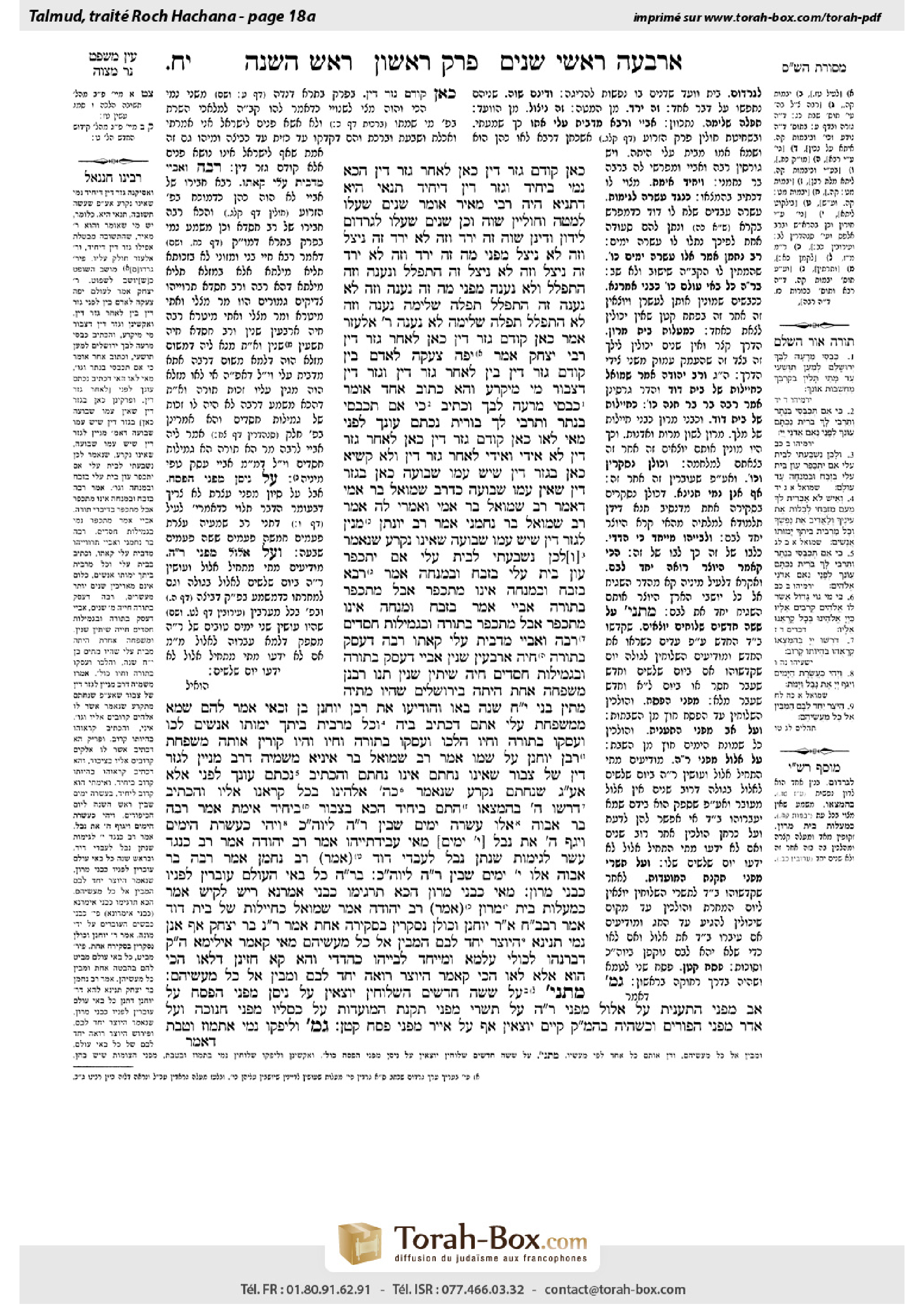
Rosh Hashanah 18a: Talmud study for Daf Yomi
Daf Yomi is the daily study of one Talmud folio. Explore 37 tractates with scans, Hebrew text, Sefaria English and AI-generated French translations where annotated.
Passage selection and English or AI-generated French translation are available where the scan has annotations. Daf Study is independent of Torah-Box and Sefaria.
Browse Rosh Hashanah · ראש השנה · All tractatesRosh Hashanah 18a text and translations
This page of Rosh Hashanah includes the Aramaic text, an English translation and an AI-generated French translation, alongside the scan above.
ראש השנה י״ח א · Aramaic and Hebrew text
כָּאן קוֹדֶם גְּזַר דִּין, כָּאן לְאַחַר גְּזַר דִּין! הָכָא נָמֵי בְּיָחִיד.
וּגְזַר דִּין דְּיָחִיד תַּנָּאֵי הִיא. דְּתַנְיָא, הָיָה רַבִּי מֵאִיר אוֹמֵר: שְׁנַיִם שֶׁעָלוּ לַמִּטָּה וְחוֹלְיָין שָׁוֶה, וְכֵן שְׁנַיִם שֶׁעָלוּ לַגַּרְדּוֹם לִידּוֹן וְדִינָן שָׁוֶה. זֶה יָרַד וְזֶה לֹא יָרַד, זֶה נִיצַּל וְזֶה לֹא נִיצַּל.
מִפְּנֵי מָה זֶה יָרַד וְזֶה לֹא יָרַד, זֶה נִיצַּל וְזֶה לֹא נִיצַּל? זֶה הִתְפַּלֵּל וְנַעֲנָה, וְזֶה הִתְפַּלֵּל וְלֹא נַעֲנָה. מִפְּנֵי מָה זֶה נַעֲנָה וְזֶה לֹא נַעֲנָה? זֶה הִתְפַּלֵּל תְּפִלָּה שְׁלֵימָה — נַעֲנָה, וְזֶה לֹא הִתְפַּלֵּל תְּפִלָּה שְׁלֵימָה — לֹא נַעֲנָה
רַבִּי אֶלְעָזָר אָמַר: כָּאן קוֹדֶם גְּזַר דִּין, כָּאן לְאַחַר גְּזַר דִּין. רַבִּי יִצְחָק אָמַר: יָפָה צְעָקָה לָאָדָם בֵּין קוֹדֶם גְּזַר דִּין בֵּין לְאַחַר גְּזַר דִּין.
וּגְזַר דִּין דְּצִבּוּר מִי מִיקְּרַע? וְהָא כָּתוּב אֶחָד אוֹמֵר: ״כַּבְּסִי מֵרָעָה לִבֵּךְ״, וּכְתִיב: ״כִּי אִם תְּכַבְּסִי בַּנֶּתֶר וְתַרְבִּי לָךְ בּוֹרִית נִכְתָּם עֲוֹנֵךְ לְפָנַי״, מַאי לָאו: כָּאן קוֹדֶם גְּזַר דִּין, כָּאן לְאַחַר גְּזַר דִּין!
לָא, אִידֵּי וְאִידֵּי לְאַחַר גְּזַר דִּין, וְלָא קַשְׁיָא: כָּאן בִּגְזַר דִּין שֶׁיֵּשׁ עִמּוֹ שְׁבוּעָה, כָּאן בִּגְזַר דִּין שֶׁאֵין עִמּוֹ שְׁבוּעָה.
כִּדְרַב שְׁמוּאֵל בַּר אַמֵּי. דְּאָמַר רַב שְׁמוּאֵל בַּר אַמֵּי. וְאָמְרִי לַהּ, אָמַר רַב שְׁמוּאֵל בַּר נַחְמָנִי אָמַר רַב יוֹנָתָן: מִנַּיִן לִגְזַר דִּין שֶׁיֵּשׁ עִמּוֹ שְׁבוּעָה שֶׁאֵינוֹ נִקְרָע — שֶׁנֶּאֱמַר: ״[וְ]לָכֵן נִשְׁבַּעְתִּי לְבֵית עֵלִי אִם יִתְכַּפֵּר עֲוֹן בֵּית עֵלִי בְּזֶבַח וּבְמִנְחָה״.
אָמַר רָבָא: בְּזֶבַח וּבַמִּנְחָה אֵינוֹ מִתְכַּפֵּר — אֲבָל מִתְכַּפֵּר בְּתוֹרָה. אַבָּיֵי אָמַר: בְּזֶבַח וּמִנְחָה אֵינוֹ מִתְכַּפֵּר — אֲבָל מִתְכַּפֵּר בְּתוֹרָה וּבִגְמִילוּת חֲסָדִים. רַבָּה וְאַבָּיֵי מִדְּבֵית עֵלִי קָאָתוּ. רַבָּה דַּעֲסַק בַּתּוֹרָה — חֲיָה אַרְבְּעִין שְׁנִין, אַבָּיֵי דַּעֲסַק בְּתוֹרָה וּבִגְמִילוּת חֲסָדִים — חֲיָה שִׁיתִּין שְׁנִין.
תָּנוּ רַבָּנַן: מִשְׁפָּחָה אַחַת הָיְתָה בִּירוּשָׁלַיִם שֶׁהָיוּ מֵתֶיהָ מֵתִין בְּנֵי שְׁמוֹנֶה עֶשְׂרֵה שָׁנָה. בָּאוּ וְהוֹדִיעוּ אֶת רַבָּן יוֹחָנָן בֶּן זַכַּאי, אָמַר לָהֶם: שֶׁמָּא מִמִּשְׁפַּחַת עֵלִי אַתֶּם, דִּכְתִיב בֵּיהּ: ״וְכׇל מַרְבִּית בֵּיתְךָ יָמוּתוּ אֲנָשִׁים״ — לְכוּ וְעִסְקוּ בַּתּוֹרָה וִחְיוּ. הָלְכוּ וְעָסְקוּ בַּתּוֹרָה וְחָיוּ. וְהָיוּ קוֹרִין אוֹתָהּ מִשְׁפַּחַת רַבָּן יוֹחָנָן עַל שְׁמוֹ.
אָמַר רַב שְׁמוּאֵל בַּר אִינְיָא מִשְּׁמֵיהּ דְּרַב: מִנַּיִין לִגְזַר דִּין שֶׁל צִבּוּר שֶׁאֵינוֹ נֶחְתָּם. אֵינוֹ נֶחְתָּם?! וְהָכְתִיב: ״נִכְתַּם עֲוֹנֵךְ לְפָנַי״! אֶלָּא: אַף עַל גַּב שֶׁנֶּחְתָּם — נִקְרָע, שֶׁנֶּאֱמַר: ״כַּה׳ אֱלֹהֵינוּ בְּכׇל קׇרְאֵנוּ אֵלָיו״.
וְהָכְתִיב: ״דִּרְשׁוּ ה׳ בְּהִמָּצְאוֹ״! הָתָם בְּיָחִיד, הָכָא בְּצִבּוּר.
בְּיָחִיד, אֵימַת? אָמַר רַבָּה בַּר אֲבוּהּ: אֵלּוּ עֲשָׂרָה יָמִים שֶׁבֵּין רֹאשׁ הַשָּׁנָה לְיוֹם הַכִּפּוּרִים. ״וַיְהִי כַּעֲשֶׂרֶת הַיָּמִים וַיִּגֹּף ה׳ אֶת נָבָל״ — עֲשָׂרָה יָמִים מַאי עֲבִידְתַּיְיהוּ? אָמַר רַב יְהוּדָה אָמַר רַב: כְּנֶגֶד עֶשֶׂר לְגִימוֹת שֶׁנָּתַן נָבָל לְעַבְדֵי דָּוִד. אָמַר רַב נַחְמָן אָמַר רַבָּה בַּר אֲבוּהּ: אֵלּוּ עֲשָׂרָה יָמִים שֶׁבֵּין רֹאשׁ הַשָּׁנָה לְיוֹם הַכִּפּוּרִים.
בְּרֹאשׁ הַשָּׁנָה כׇּל בָּאֵי הָעוֹלָם עוֹבְרִין לְפָנָיו כִּבְנֵי מָרוֹן. מַאי ״כִּבְנֵי מָרוֹן״? הָכָא תַּרְגִּימוּ: כִּבְנֵי אִמְּרָנָא. רֵישׁ לָקִישׁ אָמַר: כְּמַעֲלוֹת בֵּית מָרוֹן. אָמַר רַב יְהוּדָה אָמַר שְׁמוּאֵל: כַּחֲיָילוֹת שֶׁל בֵּית דָּוִד.
אָמַר רַבָּה בַּר בַּר חָנָה אָמַר רַבִּי יוֹחָנָן: וְכוּלָּן נִסְקָרִין בִּסְקִירָה אַחַת. אָמַר רַב נַחְמָן בַּר יִצְחָק, אַף אֲנַן נָמֵי תְּנֵינָא: ״הַיּוֹצֵר יַחַד לִבָּם הַמֵּבִין אֶל כׇּל מַעֲשֵׂיהֶם״. מַאי קָאָמַר? אִילֵּימָא הָכִי קָאָמַר: דִּבְרַנְהוּ לְכוּלֵּי עָלְמָא וּמְיַיחֵד לִבַּיְיהוּ כַּהֲדָדָי — וְהָא קָא חָזֵינַן דְּלָאו הָכִי הוּא! אֶלָּא לָאו, הָכִי קָאָמַר: הַיּוֹצֵר רוֹאֶה יַחַד לִבָּם וּמֵבִין אֶל כׇּל מַעֲשֵׂיהֶם.
מַתְנִי׳ עַל שִׁשָּׁה חֳדָשִׁים הַשְּׁלוּחִין יוֹצְאִין: עַל נִיסָן מִפְּנֵי הַפֶּסַח, עַל אָב מִפְּנֵי הַתַּעֲנִית, עַל אֱלוּל מִפְּנֵי רֹאשׁ הַשָּׁנָה, עַל תִּשְׁרֵי מִפְּנֵי תַּקָּנַת הַמּוֹעֲדוֹת, עַל כִּסְלֵיו מִפְּנֵי חֲנוּכָּה, וְעַל אֲדָר מִפְּנֵי הַפּוּרִים.
וּכְשֶׁהָיָה בֵּית הַמִּקְדָּשׁ קַיָּים — יוֹצְאִין אַף עַל אִיָּיר מִפְּנֵי פֶּסַח קָטָן.
גְּמָ׳ וְלִיפְּקוּ נָמֵי אַתַּמּוּז וְטֵבֵת!
Rosh Hashanah 18a · English translation
Here the verse is referring to the time before one’s sentence is issued, when God shows favor and forgives; and there the verse is referring to the time after the sentence has been issued, when He no longer forgives. This implies that after a sentence has been issued, there is no possibility of repentance, which seems to contradict the statement of Rabbi Yoḥanan. The Gemara answers: Here too it is referring to an individual, but a community is granted forgiveness even after its sentence has been issued.
§ The question of whether or not an individual’s sentence can be rescinded is a dispute between tanna’im, as it is taught in a baraita that Rabbi Meir would say: Two people take to their beds, and their illness is the same, or two people ascend to the tribunal [gardom] for judgment, and their potential sentence is the same; but this one comes down from his bed, while that one does not come down from his bed, and this one is saved from death, while that one is not saved.
For what reason did this one recover and come down from his bed, while that one did not recover and come down from his bed; and why was this one saved from death, while that one was not saved? The difference between them is that this one prayed and was answered, while that one prayed, but was not answered. And for what reason was this one answered and that one not answered? This one prayed a prayer with his whole heart and consequently was answered, while that one did not pray a prayer with his whole heart and therefore was not answered.
Rabbi Elazar said: Not so; rather, here he prayed before his heavenly sentence was issued, and so he was answered, whereas there the other one prayed after his heavenly sentence was issued, and therefore he was not answered. Rabbi Yitzḥak disagreed and said: Crying out to God is effective for a person, both before his sentence has been issued and also after his sentence has been issued, as even after his sentence has been issued, it can still be rescinded if he repents.
The Gemara asks: Can a sentence of a community really be torn up because they have repented? But one verse says: “O Jerusalem, wash your heart from wickedness, that you may be saved” (Jeremiah 4:14), and elsewhere it is written: “For though you wash yourself with lye, and use much soap, yet the stain of your iniquity is before Me, says the Lord God” (Jeremiah 2:22). What, is it not that here the verse is referring to the time before the sentence, when the heart can still be washed with repentance, whereas there the verse is referring to the time after the sentence, when washing no longer helps, as the sentence cannot be canceled?
The Gemara answers: No, both this verse and that verse refer to the time after the sentence has been decreed, and still it is not difficult: Here the verse is referring to a sentence accompanied by an oath taken by God not to cancel the sentence, whereas there the verse is referring to a sentence that is not accompanied by God’s oath not to cancel the sentence, and so the sentence can in fact be canceled through repentance.
This is like what Rav Shmuel bar Ami said, as Rav Shmuel bar Ami said, and some say that it was Rav Shmuel bar Naḥmani who said that Rabbi Yonatan said: From where is it derived that a sentence accompanied by God’s oath not to cancel it cannot be torn up or canceled? As it is stated: “And therefore I have sworn to the house of Eli, that the iniquity of Eli’s house will not be purged with sacrifice nor offering forever” (I Samuel 3:14).
With regard to this verse Rava said: With sacrifice or offering the sin of Eli’s house is not atoned, but it can be atoned through Torah study. Abaye said: With sacrifice or offering the sin of Eli’s house is not atoned, but it is atoned through Torah study and the performance of acts of kindness. It is related that Rabba and Abaye came from the house of Eli, which was subject to the curse that most of its members would die young. Rabba, who engaged almost exclusively in Torah study, lived for forty years, whereas Abaye, who engaged in both Torah study and in the performance of acts of kindness lived for sixty years.
The Sages taught in a baraita: There was a certain family in Jerusalem whose members used to die at the age of eighteen, and they did not know why. They came and told Rabban Yoḥanan ben Zakkai about their situation. He said to them: Perhaps you are descended from the family of Eli, as it is written about them: “And all the increase of your house shall die young men” (I Samuel 2:33). If indeed this is so, the remedy is as follows: Go and engage in Torah study, in the merit of which you will live. They went and engaged in Torah study and lived. And people would call that family afterward by the name of Rabbi Yoḥanan in his honor.
Rav Shmuel bar Inya said in the name of Rav: From where is it derived that the sentence of a community is never sealed [neḥtam]? The Gemara immediately asks: Is never sealed? But isn’t it written: “Yet the stain [nikhtam] of your iniquity is before Me” (Jeremiah 2:22), which implies that the sentence of a community is indeed sealed. Rather, one must say that the question was as follows: From where is it known with regard to the sentence of a community that although it is sealed, it can still be torn up? As it is stated: “As is the Lord our God whenever we call out to Him” (Deuteronomy 4:7). This implies that there is always a way to draw close to God.
The Gemara asks: But isn’t it written: “Seek the Lord while He may be found; call upon Him when He is near” (Isaiah 55:6), which implies that there are times when He is not near and does not answer. The Gemara answers: There the verse is referring to an individual, to whom God is near only at certain times; here the verse is referring to a community, to which God is close whenever the people call out to Him.
§ The Gemara asks: With regard to an individual, when is God near to him? Rabba bar Avuh said: These are the ten days between Rosh HaShana and Yom Kippur. The Gemara asks further: The verse states: “And it came to pass about ten days after that the Lord smote Nabal, and he died” (I Samuel 25:38). These ten days, what are they doing here, i.e., why was there a delay of ten days before Nabal died? Rav Yehuda said that Rav said: They correspond to the ten meals that Nabal gave the servants of David who came to visit him, as out of politeness he allowed David’s ten servants to eat, and therefore his punishment was delayed for ten days. Rav Naḥman said that Rabba bar Avuh said: These are the ten days between Rosh HaShana and Yom Kippur, during which everyone is given one last opportunity to repent for the sins he committed over the course of the previous year.
§ The mishna teaches: On Rosh HaShana all creatures pass before Him like benei maron. The Gemara asks: What is the meaning of the phrase benei maron? The Gemara answers: Here in Babylonia they interpreted it to mean: Like a flock of sheep [kivnei imarna]. Reish Lakish disagreed and said: Like the ascent of Beit Maron, which was very steep; one standing at the summit could discern all those climbing the mountain with a single look. Rav Yehuda said that Shmuel said another opinion: Like the soldiers of the house of King David, who could be surveyed with a single glance.
Rabba bar bar Ḥana said that Rabbi Yoḥanan said: And they are all scanned in a single scan. Rav Naḥman bar Yitzḥak said: We, too, learn this in the baraita: The verse states: “He who fashions their hearts alike, who considers all their deeds” (Psalms 33:15). What is this verse saying? If we say this is what it is saying: That He created everyone and unites all their hearts together, there is a difficulty, since don’t we see that it is not so, as the hearts of people are not united and are not similar to one another? Rather, is this not what it is saying: The Creator sees their hearts together and considers all their deeds with a single scan?
MISHNA: In six months of the year the messengers go out from the court in Jerusalem to report throughout Eretz Yisrael and the Diaspora which day was established as the New Moon, the thirtieth or the thirty-first day since the previous New Moon. They go out in the month of Nisan, due to Passover, so that people will know on which day to celebrate it; in the month of Av, due to the fast of the Ninth of Av; in Elul, due to Rosh HaShana, which begins thirty days after the New Moon of Elul; in Tishrei, due to the need to establish the correct dates on which to celebrate the Festivals of Tishrei, i.e., Yom Kippur and Sukkot; in Kislev, due to Hanukkah; and in Adar, due to Purim.
And when the Temple was standing, messengers would also go out in the month of Iyyar due to small Passover, i.e., second Pesaḥ, which occurs on the fourteenth of Iyyar. This holiday allowed those who were ritually impure or on a distant journey on the fourteenth of Nisan, and therefore incapable of bringing the Paschal lamb at that time, to bring their Paschal lamb a month later.
GEMARA: The Gemara asks: And if they go out for the month of Av due to the fast, let them go out also in the months of Tammuz and Tevet, as they too contain public fast days.
Rosh Hashanah 18a · Traduction française (IA)
Ici, le verset fait référence à la période qui précède le prononcé de la sentence, lorsque Dieu accorde sa faveur et pardonne ; là, il fait référence à la période qui suit le prononcé de la sentence, lorsqu’Il ne pardonne plus. Cela implique qu’après le prononcé d’une sentence, il n’est plus possible de se repentir, ce qui semble contredire l’enseignement de Rabbi Yoḥanan. La Guemara répond : ici aussi, il s’agit d’un individu, tandis qu’une communauté obtient le pardon même après que sa sentence a été prononcée.
§ La question de savoir si la sentence d’un individu peut ou non être annulée fait l’objet d’une controverse entre tannaïm, comme l’enseigne une baraïta : Rabbi Meïr disait : Deux personnes se mettent au lit et souffrent de la même maladie, ou deux personnes comparaissent devant le tribunal [gardom] pour être jugées et sont exposées à la même sentence ; pourtant, l’une se relève de son lit, tandis que l’autre ne se relève pas, et l’une échappe à la mort, tandis que l’autre n’y échappe pas.
Pour quelle raison l’une s’est-elle rétablie et relevée de son lit, tandis que l’autre ne s’est-elle pas rétablie et relevée de son lit ? Et pourquoi l’une a-t-elle échappé à la mort, tandis que l’autre n’y a-t-elle pas échappé ? La différence entre elles est que l’une a prié et a été exaucée, tandis que l’autre a prié sans être exaucée. Et pour quelle raison l’une a-t-elle été exaucée et pas l’autre ? L’une a prié de tout son cœur et a donc été exaucée, tandis que l’autre n’a pas prié de tout son cœur et n’a donc pas été exaucée.
Rabbi Elazar dit : Ce n’est pas ainsi ; l’un a prié avant que sa sentence céleste soit prononcée et a donc été exaucé, tandis que l’autre a prié après que sa sentence céleste a été prononcée et n’a donc pas été exaucé. Rabbi Yitzḥak n’était pas d’accord et dit : Implorer Dieu est efficace pour une personne, aussi bien avant qu’après le prononcé de sa sentence ; car même après que sa sentence a été prononcée, elle peut encore être annulée si elle se repent.
La Guemara demande : Une sentence prononcée contre une communauté peut-elle vraiment être annulée parce que ses membres se sont repentis ? Un verset dit : « Jérusalem, lave ton cœur de la méchanceté, afin que tu sois sauvée » (Jérémie 4:14), tandis qu’ailleurs il est écrit : « Même si tu te lavais avec de la soude et employais beaucoup de savon, la trace de ton iniquité serait devant Moi, dit le Seigneur Dieu » (Jérémie 2:22). N’est-ce pas que le premier verset fait référence à la période qui précède la sentence, lorsque le cœur peut encore être lavé par le repentir, tandis que le second fait référence à la période qui suit la sentence, lorsque le lavage ne sert plus à rien, puisque la sentence ne peut être annulée ?
La Guemara répond : Non, les deux versets font référence à la période qui suit le prononcé de la sentence, et pourtant il n’y a pas de difficulté : le premier verset fait référence à une sentence accompagnée d’un serment par lequel Dieu jure de ne pas l’annuler, tandis que le second fait référence à une sentence qui n’est pas accompagnée d’un tel serment de Dieu ; la sentence peut donc effectivement être annulée par le repentir.
Cela correspond à ce que Rav Shmuel bar Ami a dit — car Rav Shmuel bar Ami a dit, et certains disent que c’est Rav Shmuel bar Naḥmani qui a rapporté au nom de Rabbi Yonatan : D’où apprend-on qu’une sentence accompagnée d’un serment de Dieu de ne pas l’annuler ne peut être ni déchirée ni annulée ? Comme il est dit : « C’est pourquoi j’ai juré à la maison d’Éli que la faute de la maison d’Éli ne sera jamais expiée par un sacrifice ni par une offrande » (I Samuel 3:14).
À propos de ce verset, Rava a dit : La faute de la maison d’Éli ne peut être expiée par un sacrifice ni par une offrande, mais elle peut l’être par l’étude de la Torah. Abaye a dit : La faute de la maison d’Éli ne peut être expiée par un sacrifice ni par une offrande, mais elle peut l’être par l’étude de la Torah et l’accomplissement d’actes de bonté. Il est rapporté que Rabba et Abaye descendaient de la maison d’Éli, frappée par la malédiction selon laquelle la plupart de ses membres mourraient jeunes. Rabba, qui se consacrait presque exclusivement à l’étude de la Torah, vécut quarante ans, tandis qu’Abaye, qui se consacrait à la fois à l’étude de la Torah et à l’accomplissement d’actes de bonté, vécut soixante ans.
Les Sages ont enseigné dans une baraïta : Il y avait à Jérusalem une certaine famille dont les membres mouraient à l’âge de dix-huit ans, et ils ne savaient pas pourquoi. Ils vinrent exposer leur situation à Rabban Yoḥanan ben Zakkaï. Il leur dit : Peut-être descendez-vous de la famille d’Éli, dont il est écrit : « Tous les membres de ta maison mourront jeunes » (I Samuel 2:33). Si c’est bien le cas, voici le remède : allez étudier la Torah, et par ce mérite vous vivrez. Ils allèrent étudier la Torah et vécurent. Par la suite, les gens appelèrent cette famille du nom de Rabbi Yoḥanan, en son honneur.
Rav Shmuel bar Inya a dit au nom de Rav : D’où apprend-on que la sentence d’une communauté n’est jamais scellée [neḥtam] ? La Guemara demande aussitôt : Jamais scellée ? Pourtant, n’est-il pas écrit : « La trace [nikhtam] de ton iniquité est devant Moi » (Jérémie 2:22), ce qui implique que la sentence d’une communauté est bel et bien scellée ? Il faut plutôt dire que la question était la suivante : D’où sait-on que la sentence d’une communauté, même si elle est scellée, peut encore être déchirée ? Comme il est dit : « Comme le Seigneur notre Dieu l’est chaque fois que nous L’invoquons » (Deutéronome 4:7). Cela implique qu’il est toujours possible de se rapprocher de Dieu.
La Guemara demande : Pourtant, n’est-il pas écrit : « Cherchez le Seigneur tant qu’Il peut être trouvé, invoquez-Le tant qu’Il est proche » (Isaïe 55:6), ce qui implique qu’il y a des moments où Il n’est pas proche et ne répond pas ? La Guemara répond : là, le verset fait référence à un individu, auprès duquel Dieu n’est proche qu’à certains moments ; ici, il fait référence à une communauté, auprès de laquelle Dieu est proche chaque fois que ses membres L’invoquent.
§ La Guemara demande : En ce qui concerne un individu, quand Dieu est-Il proche de lui ? Rabba bar Avuh dit : Ce sont les dix jours entre Roch Hachana et Yom Kippour. La Guemara demande encore : Le verset dit : « Or, environ dix jours après, le Seigneur frappa Naval, et il mourut » (I Samuel 25:38). Que signifient ici ces dix jours, c’est-à-dire pourquoi un délai de dix jours s’est-il écoulé avant la mort de Naval ? Rav Yehouda dit au nom de Rav : Ils correspondent aux dix repas que Naval offrit aux serviteurs de David venus lui rendre visite ; par politesse, il permit aux dix serviteurs de David de manger, et son châtiment fut donc différé de dix jours. Rav Naḥman dit au nom de Rabba bar Avuh : Ce sont les dix jours entre Roch Hachana et Yom Kippour, durant lesquels chacun reçoit une dernière occasion de se repentir des péchés commis au cours de l’année précédente.
§ La Michna enseigne : À Roch Hachana, toutes les créatures passent devant Lui comme benei maron. La Guemara demande : Quel est le sens de l’expression benei maron ? La Guemara répond : Ici, en Babylonie, on l’interprétait ainsi : comme un troupeau de moutons [kivnei imarna]. Reish Lakish n’était pas d’accord et dit : comme la montée de Beit Maron, qui était très escarpée ; celui qui se tenait au sommet pouvait discerner d’un seul regard tous ceux qui gravissaient la montagne. Rav Yehouda dit au nom de Shmuel une autre interprétation : comme les soldats de la maison du roi David, que l’on pouvait passer en revue d’un seul regard.
Rabba bar bar Ḥana dit au nom de Rabbi Yoḥanan : Et ils sont tous examinés d’un seul regard. Rav Naḥman bar Yitzḥak dit : Nous l’apprenons également dans la baraïta : Le verset dit : « Lui qui façonne leurs cœurs ensemble, qui considère toutes leurs actions » (Psaumes 33:15). Que signifie ce verset ? Si l’on dit qu’il signifie que Dieu a créé tout le monde et unit tous les cœurs, cela pose une difficulté, car ne voyons-nous pas qu’il n’en est pas ainsi, puisque les cœurs des gens ne sont ni unis ni semblables ? Ne signifie-t-il pas plutôt que le Créateur voit tous leurs cœurs ensemble et considère toutes leurs actions d’un seul regard ?
Michna : Au cours de six mois de l’année, des messagers quittent le tribunal de Jérusalem pour annoncer dans tout Eretz Israël et dans la Diaspora quel jour a été fixé comme Roch Ḥodech : le trentième ou le trente et unième jour après le Roch Ḥodech précédent. Ils partent au mois de Nisan, en raison de Pessaḥ, afin que chacun sache quel jour le célébrer ; au mois d’Av, en raison du jeûne du Neuf Av ; à Eloul, en raison de Roch Hachana, qui commence trente jours après le Roch Ḥodech d’Eloul ; à Tishrei, afin d’établir les dates correctes des fêtes de Tishrei, c’est-à-dire Yom Kippour et Soukkot ; à Kislev, en raison de Ḥanouka ; et à Adar, en raison de Pourim.
Lorsque le Temple était debout, des messagers partaient également au mois d’Iyyar en raison du petit Pessaḥ, c’est-à-dire du second Pessaḥ, qui tombe le quatorzième jour d’Iyyar. Cette fête permettait à ceux qui étaient rituellement impurs ou en voyage lointain le quatorzième jour de Nisan, et qui étaient donc dans l’incapacité d’apporter l’agneau pascal à cette date, de l’apporter un mois plus tard.
Guemara : La Guemara demande : S’ils partent au mois d’Av en raison du jeûne, qu’ils partent aussi aux mois de Tammouz et de Tevet, puisqu’ils comportent eux aussi des jours de jeûne public.
Traduction française générée par IA à partir de l’édition anglaise de Sefaria. Vérifie toujours un passage avec le texte source.
Text from Sefaria: William Davidson Edition - Vocalized Aramaic (CC BY NC); William Davidson Edition - English (CC BY NC).