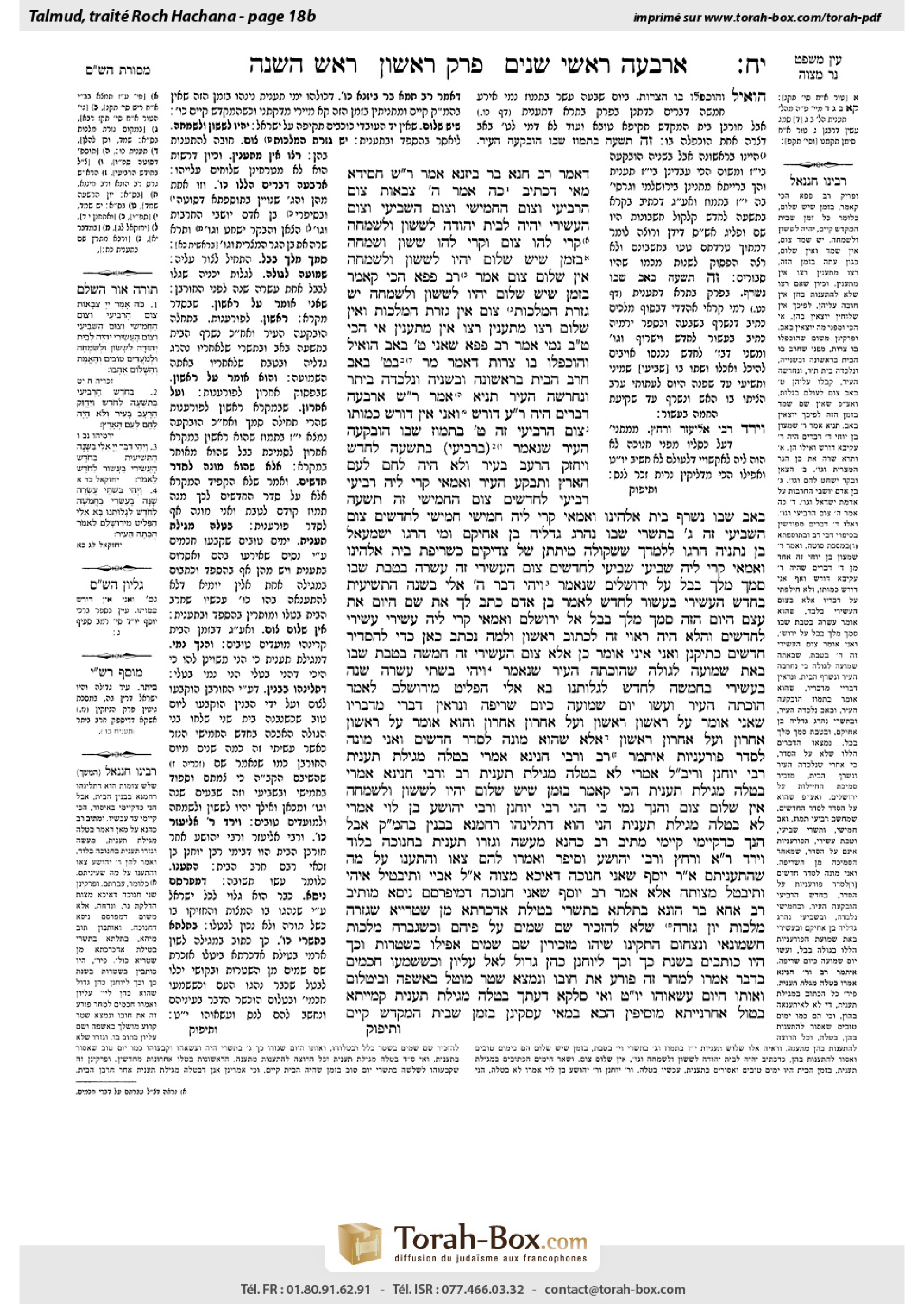
Rosh Hashanah 18b: Talmud study for Daf Yomi
Daf Yomi is the daily study of one Talmud folio. Explore 37 tractates with scans, Hebrew text, Sefaria English and AI-generated French translations where annotated.
Passage selection and English or AI-generated French translation are available where the scan has annotations. Daf Study is independent of Torah-Box and Sefaria.
Browse Rosh Hashanah · ראש השנה · All tractatesRosh Hashanah 18b text and translations
This page of Rosh Hashanah includes the Aramaic text, an English translation and an AI-generated French translation, alongside the scan above.
ראש השנה י״ח ב · Aramaic and Hebrew text
דְּאָמַר רַב חָנָא בַּר בִּיזְנָא אָמַר רַבִּי שִׁמְעוֹן חֲסִידָא, מַאי דִּכְתִיב: ״כֹּה אָמַר ה׳ צְבָאוֹת צוֹם הָרְבִיעִי וְצוֹם הַחֲמִישִׁי וְצוֹם הַשְּׁבִיעִי וְצוֹם הָעֲשִׂירִי יִהְיֶה לְבֵית יְהוּדָה לְשָׂשׂוֹן וּלְשִׂמְחָה״. קָרֵי לְהוּ ״צוֹם״, וְקָרֵי לְהוּ ״שָׂשׂוֹן וְשִׂמְחָה״! בִּזְמַן שֶׁיֵּשׁ שָׁלוֹם — יִהְיוּ לְשָׂשׂוֹן וּלְשִׂמְחָה, אֵין שָׁלוֹם — צוֹם.
אָמַר רַב פָּפָּא, הָכִי קָאָמַר: בִּזְמַן שֶׁיֵּשׁ שָׁלוֹם — יִהְיוּ לְשָׂשׂוֹן וּלְשִׂמְחָה, יֵשׁ שְׁמָד — צוֹם, אֵין שְׁמָד וְאֵין שָׁלוֹם — רָצוּ מִתְעַנִּין, רָצוּ אֵין מִתְעַנִּין.
אִי הָכִי, תִּשְׁעָה בְּאָב נָמֵי? אָמַר רַב פָּפָּא: שָׁאנֵי תִּשְׁעָה בְּאָב, הוֹאִיל וְהוּכְפְּלוּ בּוֹ צָרוֹת. דְּאָמַר מָר: בְּתִשְׁעָה בְּאָב חָרַב הַבַּיִת בָּרִאשׁוֹנָה וּבַשְּׁנִיָּה, וְנִלְכְּדָה בֵּיתָר, וְנֶחֶרְשָׁה הָעִיר.
תַּנְיָא אָמַר רַבִּי שִׁמְעוֹן: אַרְבָּעָה דְּבָרִים הָיָה רַבִּי עֲקִיבָא דּוֹרֵשׁ, וַאֲנִי אֵין דּוֹרֵשׁ כְּמוֹתוֹ: ״צוֹם הָרְבִיעִי״ — זֶה תִּשְׁעָה בְּתַמּוּז שֶׁבּוֹ הוּבְקְעָה הָעִיר, שֶׁנֶּאֱמַר: ״בָּרְבִיעִי בְּתִשְׁעָה לַחֹדֶשׁ וַיֶּחֱזַק הָרָעָב בָּעִיר וְלֹא הָיָה לֶחֶם לְעַם הָאָרֶץ וַתִּבָּקַע הָעִיר״. וְאַמַּאי קָרֵי לֵיהּ ״רְבִיעִי״ — רְבִיעִי לֶחֳדָשִׁים.
״צוֹם הַחֲמִישִׁי״ — זֶה תִּשְׁעָה בְּאָב, שֶׁבּוֹ נִשְׂרַף בֵּית אֱלֹהֵינוּ. וְאַמַּאי קָרֵי לֵיהּ ״חֲמִישִׁי״ — חֲמִישִׁי לֶחֳדָשִׁים. צוֹם הַשְּׁבִיעִי — זֶה שְׁלֹשָׁה בְּתִשְׁרִי, שֶׁבּוֹ נֶהֱרַג גְּדַלְיָה בֶּן אֲחִיקָם. וּמִי הֲרָגוֹ — יִשְׁמָעֵאל בֶּן נְתַנְיָה הֲרָגוֹ, לְלַמֶּדְךָ שֶׁשְּׁקוּלָה מִיתָתָן שֶׁל צַדִּיקִים כִּשְׂרֵיפַת בֵּית אֱלֹהֵינוּ. וְאַמַּאי קָרֵי לֵיהּ ״שְׁבִיעִי״ — שְׁבִיעִי לֶחֳדָשִׁים.
״צוֹם הָעֲשִׂירִי״ — זֶה עֲשָׂרָה בְּטֵבֵת, שֶׁבּוֹ סָמַךְ מֶלֶךְ בָּבֶל עַל יְרוּשָׁלַיִם, שֶׁנֶּאֱמַר: ״וַיְהִי דְבַר ה׳ אֵלַי בַּשָּׁנָה הַתְּשִׁיעִית בַּחֹדֶשׁ הָעֲשִׂירִי בֶּעָשׂוֹר לַחֹדֶשׁ לֵאמֹר. בֶּן אָדָם כְּתׇב לְךָ אֶת שֵׁם הַיּוֹם אֶת עֶצֶם הַיּוֹם הַזֶּה סָמַךְ מֶלֶךְ בָּבֶל אֶל יְרוּשָׁלִַים״. וְאַמַּאי קָרֵי לֵיהּ ״עֲשִׂירִי״ — עֲשִׂירִי לֶחֳדָשִׁים. וַהֲלֹא הָיָה רָאוּי זֶה לִכְתּוֹב רִאשׁוֹן? וְלָמָּה נִכְתַּב כָּאן — כְּדֵי לְהַסְדִּיר חֳדָשִׁים כְּתִיקְנָן.
וַאֲנִי אֵינִי אוֹמֵר כֵּן, אֶלָּא: ״צוֹם הָעֲשִׂירִי״ — זֶה חֲמִשָּׁה בְּטֵבֵת, שֶׁבּוֹ בָּאת שְׁמוּעָה לַגּוֹלָה שֶׁהוּכְּתָה הָעִיר, שֶׁנֶּאֱמַר: ״וַיְהִי בִּשְׁתֵּי עֶשְׂרֵה שָׁנָה בָּעֲשִׂירִי בַּחֲמִשָּׁה לַחֹדֶשׁ לְגָלוּתֵנוּ בָּא אֵלַי הַפָּלִיט מִירוּשָׁלִַם לֵאמֹר הוּכְּתָה הָעִיר״, וְעָשׂוּ יוֹם שְׁמוּעָה כְּיוֹם שְׂרֵיפָה.
וְנִרְאִין דְּבָרַי מִדְּבָרָיו, שֶׁאֲנִי אוֹמֵר עַל רִאשׁוֹן רִאשׁוֹן וְעַל אַחֲרוֹן אַחֲרוֹן, וְהוּא אוֹמֵר עַל רִאשׁוֹן אַחֲרוֹן וְעַל אַחֲרוֹן רִאשׁוֹן. אֶלָּא שֶׁהוּא מוֹנֶה לְסֵדֶר חֳדָשִׁים, וַאֲנִי מוֹנֶה לְסֵדֶר פּוּרְעָנִיּוֹת.
אִיתְּמַר, רַב וְרַבִּי חֲנִינָא אָמְרִי: בָּטְלָה מְגִילַּת תַּעֲנִית. רַבִּי יוֹחָנָן וְרַבִּי יְהוֹשֻׁעַ בֶּן לֵוִי אָמְרִי: לֹא בָּטְלָה מְגִילַּת תַּעֲנִית.
רַב וְרַבִּי חֲנִינָא אָמְרִי בָּטְלָה מְגִילַּת תַּעֲנִית, הָכִי קָאָמַר: בִּזְמַן שֶׁיֵּשׁ שָׁלוֹם — יִהְיוּ לְשָׂשׂוֹן וּלְשִׂמְחָה, אֵין שָׁלוֹם — צוֹם. וְהָנָךְ נָמֵי כִּי הָנֵי.
רַבִּי יוֹחָנָן וְרַבִּי יְהוֹשֻׁעַ בֶּן לֵוִי אָמְרִי: לֹא בָּטְלָה מְגִילַּת תַּעֲנִית — הָנֵי הוּא דִּתְלִינְהוּ רַחֲמָנָא בְּבִנְיַן בֵּית הַמִּקְדָּשׁ, אֲבָל הָנָךְ — כִּדְקָיְימִי קָיְימִי.
מֵתִיב רַב כָּהֲנָא: מַעֲשֶׂה וְגָזְרוּ תַּעֲנִית בַּחֲנוּכָּה בְּלוֹד, וְיָרַד רַבִּי אֱלִיעֶזֶר וְרָחַץ, וְרַבִּי יְהוֹשֻׁעַ וְסִיפֵּר. וְאָמְרוּ לָהֶם: צְאוּ וְהִתְעַנּוּ עַל מַה שֶּׁהִתְעַנִּיתֶם.
אָמַר רַב יוֹסֵף: שָׁאנֵי חֲנוּכָּה דְּאִיכָּא מִצְוָה. אָמַר לֵיהּ אַבָּיֵי: וְתִיבְטַיל אִיהִי וְתִיבְטַל מִצְוָתָהּ!
אֶלָּא אָמַר רַב יוֹסֵף, שָׁאנֵי חֲנוּכָּה דְּמִיפַּרְסַם נִיסָּא.
מוֹתֵיב רַב אַחָא בַּר הוּנָא: בִּתְלָתָא בְּתִשְׁרִי בְּטֵילַת אַדְכָּרְתָּא מִן שְׁטָרַיָּיא. שֶׁגָּזְרָה מַלְכוּת יָוָן גְּזֵרָה שֶׁלֹּא לְהַזְכִּיר שֵׁם שָׁמַיִם עַל פִּיהֶם, וּכְשֶׁגָּבְרָה מַלְכוּת חַשְׁמוֹנַאי וְנִצְּחוּם הִתְקִינוּ שֶׁיְּהוּ מַזְכִּירִין שֵׁם שָׁמַיִם אֲפִילּוּ בִּשְׁטָרוֹת. וְכָךְ הָיוּ כּוֹתְבִים: בִּשְׁנַת כָּךְ וְכָךְ לְיוֹחָנָן כֹּהֵן גָּדוֹל לְאֵל עֶלְיוֹן.
וּכְשֶׁשָּׁמְעוּ חֲכָמִים בַּדָּבָר, אָמְרוּ: לְמָחָר זֶה פּוֹרֵעַ אֶת חוֹבוֹ וְנִמְצָא שְׁטָר מוּטָּל בָּאַשְׁפָּה, וּבִיטְּלוּם, וְאוֹתוֹ הַיּוֹם עֲשָׂאוּהוּ יוֹם טוֹב. וְאִי סָלְקָא דַעְתָּךְ בָּטְלָה מְגִילַּת תַּעֲנִית — קַמָּיָיתָא בְּטוּל, אַחְרָנְיָיתָא מוֹסִיפִין?!
הָכָא בְּמַאי עָסְקִינַן, בִּזְמַן שֶׁבֵּית הַמִּקְדָּשׁ קַיָּים.
Rosh Hashanah 18b · English translation
As Rav Ḥana bar Bizna said that Rabbi Shimon Ḥasida said: What is the meaning of that which is written: “Thus said the Lord of hosts: The fast of the fourth month, and the fast of the fifth, and fast of the seventh, and the fast of the tenth, shall become times of joy and gladness, and cheerful seasons, to the house of Judah” (Zechariah 8:19). It calls them days of “fast” and it calls them “times of joy and gladness.” How so? When there is peace in the world, they will be times of joy and gladness, on which eulogies and fasting are forbidden; but when there is no peace, they are days of fasting. In a time when there is no peace, why are messengers not sent out also for the fourth and tenth months, so that people can know when to observe the fasts?
Rav Pappa said that this is what it is saying: When there is peace in the world and the Temple is standing, these days will be times of joy and gladness; when there is persecution and troubles for the Jewish people, they are days of fasting; and when there is no persecution but still no peace, neither particular troubles nor consolation for Israel, the halakha is as follows: If people wish, they fast, and if they wish, they do not fast. Since there is no absolute obligation to fast, messengers are not sent out for these months.
The Gemara asks: If so, the Ninth of Av should also be like the other fast days, that sometimes it is observed and sometimes not, depending upon the wishes of the community at the time. Why does the mishna state that messengers go out for the month of Av? Rav Pappa said: The Ninth of Av is different, since the calamities that occurred on that day were multiplied. As the Master said: On the Ninth of Av the Temple was destroyed, both the first one and the second one; on this day the city of Beitar was captured; and on this day the city of Jerusalem was plowed over by the enemies of the Jewish people, as a sign that it would never be rebuilt. Consequently, the fast of the Ninth of Av is obligatory, and not optional like the other fasts. Messengers are consequently sent out so that people will know when to fast.
§ The Sages disagreed about the fasts alluded to in the words of the prophet, as it is taught in a baraita. Rabbi Shimon said: Rabbi Akiva would expound four verses, but I would not expound the texts as he did. One of the disputes relates to the fasts mentioned by Zechariah. Rabbi Akiva would expound the verse as follows: “The fast of the fourth,” this is the ninth of Tammuz, on which the city of Jerusalem was breached, as it is stated: “And in the fourth month, on the ninth day of the month, the famine was severe in the city, so that there was no bread for the people of the land. Then the city was breached” (Jeremiah 52:6–7). And why does the prophet call it the fast of the fourth? Because it is in Tammuz, the fourth of the months when counting from Nisan.
“The fast of the fifth,” this is the Ninth of Av, on which the Temple of our Lord was burnt. And why does he call it the fast of the fifth? Because it falls in the fifth of the months. “The fast of the seventh,” this is the third of Tishrei, on which Gedaliah, son of Ahikam, was killed. And who killed him? Ishmael, son of Nethaniah, killed him (see II Kings 25:25; Jeremiah, chapter 41). The Sages established a fast to commemorate Gedaliah’s death to teach you that the death of the righteous is equivalent to the burning of the Temple of our Lord. And why did the prophet call it the fast of the seventh? Because Tishrei is the seventh of the months.
“The fast of the tenth,” This is the tenth of Tevet, on which the king of Babylonia laid siege to Jerusalem, as it is stated: “And in the ninth year, in the tenth month, on the tenth day of the month, the word of the Lord came to me, saying: Son of man, write the name of the day, of this same day: The king of Babylonia has laid siege to Jerusalem on this very day” (Ezekiel 24:1–2). And why did he call it the fast of the tenth? Because it is in Tevet, which is the tenth of the months. Wouldn’t it have been fitting to write this fast first, as the series of events began with the laying of the siege. Why was it written here at the end of the list? This was done in order to list the months in their proper order, as the prophet began with the fourth month and ended with the tenth month. This is the statement of Rabbi Akiva.
Rabbi Shimon disagreed and said: I do not say this, but rather I expound the verse as follows: “The fast of the tenth,” this is the fifth of Tevet, on which the report reached the Diaspora that the city had been smitten, as it is stated: “And it came to pass in the twelfth year of our exile, in the tenth month, on the fifth day of the month, that one that had escaped out of Jerusalem came to me, saying: The city is smitten” (Ezekiel 33:21); and they made the day of the report of the destruction like the day of the actual burning and decreed a fast on that day.
And Rabbi Shimon added: And my statement seems more convincing than his statement, as I say about the first fast mentioned by the prophet that it marks the event that took place first, and about the last fast that it marks the event that took place last. According to Rabbi Shimon, the fasts are listed in accordance with the chronological order of the events. But he, Rabbi Akiva, says about the first fast mentioned by the prophet that it marks the event that took place last, and about the last fast mentioned that it marks the event that took place first, only that he lists the fasts in the order of the months, whereas I list them also in the order of the calamities that they mark.
§ It was stated that the Sages disagreed about the following matter: Rav and Rabbi Ḥanina both say: Megillat Ta’anit, a listing of days on which fasting and eulogizing are forbidden, has been nullified, as in the present period of exile there is no reason to celebrate the joyous events that these days commemorate. Rabbi Yoḥanan and Rabbi Yehoshua ben Levi say: Megillat Ta’anit has not been nullified.
The Gemara explains: Rav and Rabbi Ḥanina say that Megillat Ta’anit has been nullified. This is what the prophet is saying: At a time when there is peace in the world, the dates listed will be times of joy and gladness, on which eulogies and fasting are forbidden; but when there is no peace, they are days of fasting. And those days mentioned in Megillat Ta’anit are also like these days of fasting, that is to say, the days of joy listed in Megillat Ta’anit are also nullified when there is no peace.
Rabbi Yoḥanan and Rabbi Yehoshua ben Levi say that Megillat Ta’anit has not been nullified, and they reason as follows: It was those fast days mentioned in the Bible that the Merciful One makes contingent on the building of the Temple, but these festive days listed in Megillat Ta’anit remain as they were and have not been nullified.
Rav Kahana raised an objection against Rav and Rabbi Ḥanina from a baraita: There was an incident and the Sages decreed a fast on Hanukkah in Lod, and Rabbi Eliezer went down on that day and bathed in the bathhouse and Rabbi Yehoshua went down and cut his hair to show that they did not accept the fast. Furthermore, these two Sages said to the others: Go out and fast another fast as an act of penitence for what you have already fasted, as the days of Hanukkah are days of joy, on which fasting is forbidden. Hanukkah is one of the Festivals listed in Megillat Ta’anit. Even after the destruction of the Temple Hanukkah is celebrated, demonstrating that Megillat Ta’anit has not been nullified.
Rav Yosef said: Hanukkah is different, as there is the mitzva of lighting candles, and so, unlike the other days listed in Megillat Ta’anit, the festival of Hanukkah was not nullified. Abaye said to him: What is this argument? Let Hanukkah itself be nullified, and let its mitzva of lighting candles be nullified with it.
Rather, Rav Yosef retracted his previous explanation and said: Hanukkah is different, as its miracle is well known, and it has become so widely accepted by all the Jewish people that it would be inappropriate to nullify it.
Rav Aḥa bar Huna raised an objection: It is stated in Megillat Ta’anit: On the third of Tishrei the ordinance requiring the mention of God’s name in legal documents was abolished, and on that day fasting is forbidden. For the kingdom of Greece had issued a decree against the Jews forbidding them to mention the name of Heaven on their lips. When the Hasmonean kingdom became strong and defeated the Greeks, they instituted that people should mention the name of Heaven even in their legal documents. And therefore they would write: In year such and such of Yoḥanan the High Priest of the God Most High.
And when the Sages heard about this they said: Tomorrow this one, the borrower, will repay his debt, the lender will no longer need to save the loan document, the document will be cast on a dunghill, and the name of Heaven written there will come to disgrace. And so they annulled the ordinance to mention God’s name in documents, and they made that day into a Festival. And if it enters your mind to say that Megillat Ta’anit has been nullified, can you say that the first prohibitions against fasting they annulled, and then later ones were added?
The Gemara answers: With what are we dealing here? This is referring to a time when the Temple was standing and all the days listed in Megillat Ta’anit were in force. From time to time new days of commemoration were added. When the amora’im stated that Megillat Ta’anit was nullified they were referring to the time after the destruction of the Temple.
Rosh Hashanah 18b · Traduction française (IA)
Comme l’a dit Rav Ḥana bar Bizna au nom de Rabbi Shimon Ḥasida : Quel est le sens de ce qui est écrit : « Ainsi parle le Seigneur des armées : Le jeûne du quatrième mois, le jeûne du cinquième, le jeûne du septième et le jeûne du dixième deviendront pour la maison de Juda des temps de joie et d’allégresse, des saisons de fête » (Zacharie 8,19). Le verset les appelle des jours de « jeûne », mais aussi des « temps de joie et d’allégresse ». Comment comprendre cela ? Lorsque la paix règne dans le monde, ils sont des temps de joie et d’allégresse, durant lesquels les oraisons funèbres et le jeûne sont interdits ; mais lorsqu’il n’y a pas de paix, ce sont des jours de jeûne. En l’absence de paix, pourquoi n’envoie-t-on pas aussi des messagers pour les quatrième et dixième mois, afin que les gens sachent quand observer les jeûnes ?
Rav Pappa dit que voici ce que signifie le verset : lorsque la paix règne dans le monde et que le Temple est debout, ces jours sont des temps de joie et d’allégresse ; lorsqu’il y a persécution et détresse pour le peuple juif, ce sont des jours de jeûne ; et lorsqu’il n’y a pas de persécution, mais toujours pas de paix, ni détresse particulière ni consolation pour Israël, la halakha est la suivante : si les gens le souhaitent, ils jeûnent, et s’ils le souhaitent, ils ne jeûnent pas. Puisqu’il n’y a pas d’obligation absolue de jeûner, on n’envoie pas de messagers pour ces mois.
La Guemara demande : dans ce cas, le neuf Av devrait lui aussi être comme les autres jours de jeûne, observé parfois et parfois non, selon la volonté de la communauté à ce moment-là. Pourquoi la Michna dit-elle que des messagers sont envoyés pour le mois d’Av ? Rav Pappa dit : le neuf Av est différent, car les calamités qui s’y sont produites se sont multipliées. En effet, comme l’a dit le Maître : le neuf Av, le Temple fut détruit, tant le premier que le second ; ce jour-là, la ville de Beitar fut prise ; et ce jour-là, la ville de Jérusalem fut labourée par les ennemis du peuple juif, en signe qu’elle ne serait jamais reconstruite. Par conséquent, le jeûne du neuf Av est obligatoire et non facultatif comme les autres jeûnes. Des messagers sont donc envoyés afin que les gens sachent quand jeûner.
§ Les Sages étaient en désaccord au sujet des jeûnes évoqués par les paroles du prophète, comme l’enseigne une baraïta. Rabbi Shimon dit : Rabbi Akiva interprétait quatre versets, mais moi, je n’interprétais pas les textes comme lui. L’un de leurs désaccords porte sur les jeûnes mentionnés par Zacharie. Rabbi Akiva interprétait le verset ainsi : « Le jeûne du quatrième », c’est le neuf Tammouz, jour où la ville de Jérusalem fut percée, comme il est dit : « Au quatrième mois, le neuvième jour du mois, la famine était si grave dans la ville qu’il n’y avait plus de pain pour le peuple du pays. Alors la ville fut percée » (Jérémie 52,6-7). Pourquoi le prophète l’appelle-t-il le jeûne du quatrième ? Parce qu’il a lieu en Tammouz, le quatrième mois si l’on compte à partir de Nissan.
« Le jeûne du cinquième », c’est le neuf Av, jour où le Temple de notre Seigneur fut brûlé. Pourquoi l’appelle-t-il le jeûne du cinquième ? Parce qu’il tombe au cinquième mois. « Le jeûne du septième », c’est le trois Tishri, jour où Gedalia, fils d’Aḥikam, fut tué. Et qui l’a tué ? Ishmael, fils de Nethania, l’a tué (voir II Rois 25,25 ; Jérémie, chapitre 41). Les Sages instituèrent un jeûne pour commémorer la mort de Gedalia, afin de t’enseigner que la mort des justes équivaut à l’incendie du Temple de notre Seigneur. Pourquoi le prophète l’appelle-t-il le jeûne du septième ? Parce que Tishri est le septième mois.
« Le jeûne du dixième », c’est le dix Tevet, jour où le roi de Babylone mit le siège devant Jérusalem, comme il est dit : « La neuvième année, au dixième mois, le dixième jour du mois, la parole du Seigneur me fut adressée en ces termes : Fils d’homme, écris le nom de ce jour, de ce jour même : le roi de Babylone a mis le siège devant Jérusalem en ce jour même » (Ézéchiel 24,1-2). Pourquoi l’appelle-t-il le jeûne du dixième ? Parce qu’il a lieu en Tevet, qui est le dixième mois. N’aurait-il pas été approprié de mentionner ce jeûne en premier, puisque la série des événements a commencé par le siège ? Pourquoi est-il mentionné à la fin de la liste ? C’est afin d’énumérer les mois dans leur ordre correct, puisque le prophète commence par le quatrième mois et termine par le dixième. Telle est la déclaration de Rabbi Akiva.
Rabbi Shimon n’était pas d’accord et dit : Je ne dis pas cela ; j’interprète plutôt le verset ainsi : « Le jeûne du dixième », c’est le cinq Tevet, jour où la nouvelle parvint à la Diaspora que la ville avait été frappée, comme il est dit : « La douzième année de notre exil, au dixième mois, le cinq du mois, un homme qui avait échappé de Jérusalem vint à moi et dit : “La ville a été frappée” » (Ézéchiel 33,21). Ils firent du jour où la nouvelle de la destruction fut annoncée l’équivalent du jour de l’incendie lui-même et décrétèrent un jeûne ce jour-là.
Et Rabbi Shimon ajouta : Mon propos semble plus convaincant que le sien, car je dis, au sujet du premier jeûne mentionné par le prophète, qu’il marque l’événement qui s’est produit en premier, et, au sujet du dernier jeûne, qu’il marque l’événement qui s’est produit en dernier. Selon Rabbi Shimon, les jeûnes sont énumérés dans l’ordre chronologique des événements. Mais Rabbi Akiva dit, au sujet du premier jeûne mentionné par le prophète, qu’il marque l’événement qui s’est produit en dernier, et, au sujet du dernier jeûne mentionné, qu’il marque l’événement qui s’est produit en premier. Il n’énumère toutefois les jeûnes que dans l’ordre des mois, tandis que moi, je les énumère aussi dans l’ordre des calamités qu’ils commémorent.
§ Il a été rapporté que les Sages étaient en désaccord sur la question suivante : Rav et Rabbi Ḥanina disent tous deux que la Meguilat Ta’anit, une liste des jours où le jeûne et les oraisons funèbres sont interdits, a été abolie, car, dans la période actuelle de l’exil, il n’y a aucune raison de célébrer les événements heureux que ces jours commémorent. Rabbi Yoḥanan et Rabbi Yehoshua ben Levi disent que la Meguilat Ta’anit n’a pas été abolie.
La Guemara explique : Rav et Rabbi Ḥanina disent que la Meguilat Ta’anit a été abolie. Voici ce que dit le prophète : lorsque la paix règne dans le monde, les dates mentionnées sont des temps de joie et d’allégresse, durant lesquels les oraisons funèbres et le jeûne sont interdits ; mais lorsqu’il n’y a pas de paix, ce sont des jours de jeûne. Les jours mentionnés dans la Meguilat Ta’anit sont eux aussi comme ces jours de jeûne ; autrement dit, les jours de joie énumérés dans la Meguilat Ta’anit sont également abolis lorsqu’il n’y a pas de paix.
Rabbi Yoḥanan et Rabbi Yehoshua ben Levi disent que la Meguilat Ta’anit n’a pas été abolie, et ils raisonnent ainsi : c’est pour ces jours de jeûne mentionnés dans la Bible que le Miséricordieux a subordonné leur statut à l’édification du Temple ; mais les jours de fête énumérés dans la Meguilat Ta’anit demeurent tels qu’ils étaient et n’ont pas été abolis.
Rav Kahana souleva une objection contre Rav et Rabbi Ḥanina à partir d’une baraïta : Un jour, les Sages décrétèrent un jeûne à Lod pendant Hanoucca. Rabbi Eliezer descendit ce jour-là pour se baigner aux bains, et Rabbi Yehoshua descendit se faire couper les cheveux, afin de montrer qu’ils n’acceptaient pas le jeûne. De plus, ces deux Sages dirent aux autres : « Allez jeûner un autre jour en pénitence pour le jeûne que vous avez déjà observé », car les jours de Hanoucca sont des jours de joie durant lesquels le jeûne est interdit. Hanoucca est l’une des fêtes énumérées dans la Meguilat Ta’anit. Même après la destruction du Temple, Hanoucca est célébrée, ce qui démontre que la Meguilat Ta’anit n’a pas été abolie.
Rav Yosef dit : Hanoucca est différente, car elle comporte la mitsva d’allumer des lumières ; ainsi, contrairement aux autres jours mentionnés dans la Meguilat Ta’anit, la fête de Hanoucca n’a pas été abolie. Abaye lui dit : Quel est cet argument ? Que Hanoucca elle-même soit abolie, et que sa mitsva d’allumer des lumières le soit également.
Rav Yosef revint plutôt sur son explication précédente et dit : Hanoucca est différente, car son miracle est bien connu et il est si largement reconnu par tout le peuple juif qu’il serait inapproprié de l’abolir.
Rav Aḥa bar Huna souleva une objection : Il est dit dans la Meguilat Ta’anit : Le trois Tishri, l’ordonnance exigeant la mention du nom de Dieu dans les actes juridiques fut abolie, et le jeûne est interdit ce jour-là. En effet, le royaume grec avait édicté un décret contre les Juifs leur interdisant de prononcer le nom du Ciel. Lorsque le royaume des Hasmonéens devint puissant et vainquit les Grecs, ils instituèrent que l’on mentionne le nom du Ciel même dans les actes juridiques. Ils écrivaient donc : « En telle et telle année de Yoḥanan, grand prêtre du Dieu Très-Haut ».
Lorsque les Sages l’apprirent, ils dirent : « Demain, cet homme, l’emprunteur, remboursera sa dette ; le prêteur n’aura plus besoin de conserver le document de prêt, qui sera jeté sur un tas de fumier, et le nom du Ciel qui y est écrit sera ainsi déshonoré. » Ils abolirent donc l’ordonnance exigeant la mention du nom de Dieu dans les documents et firent de ce jour une fête. Or, si l’on prétend que la Meguilat Ta’anit a été abolie, peut-on dire qu’ils abolirent d’abord les premières interdictions de jeûner, puis en ajoutèrent d’autres par la suite ?
La Guemara répond : De quoi s’agit-il ici ? D’une époque où le Temple était debout et où tous les jours énumérés dans la Meguilat Ta’anit étaient en vigueur. De temps à autre, de nouveaux jours commémoratifs étaient ajoutés. Lorsque les amoraïm ont déclaré que la Meguilat Ta’anit avait été abolie, ils parlaient de la période qui a suivi la destruction du Temple.
Traduction française générée par IA à partir de l’édition anglaise de Sefaria. Vérifie toujours un passage avec le texte source.
Text from Sefaria: William Davidson Edition - Vocalized Aramaic (CC BY NC); William Davidson Edition - English (CC BY NC).