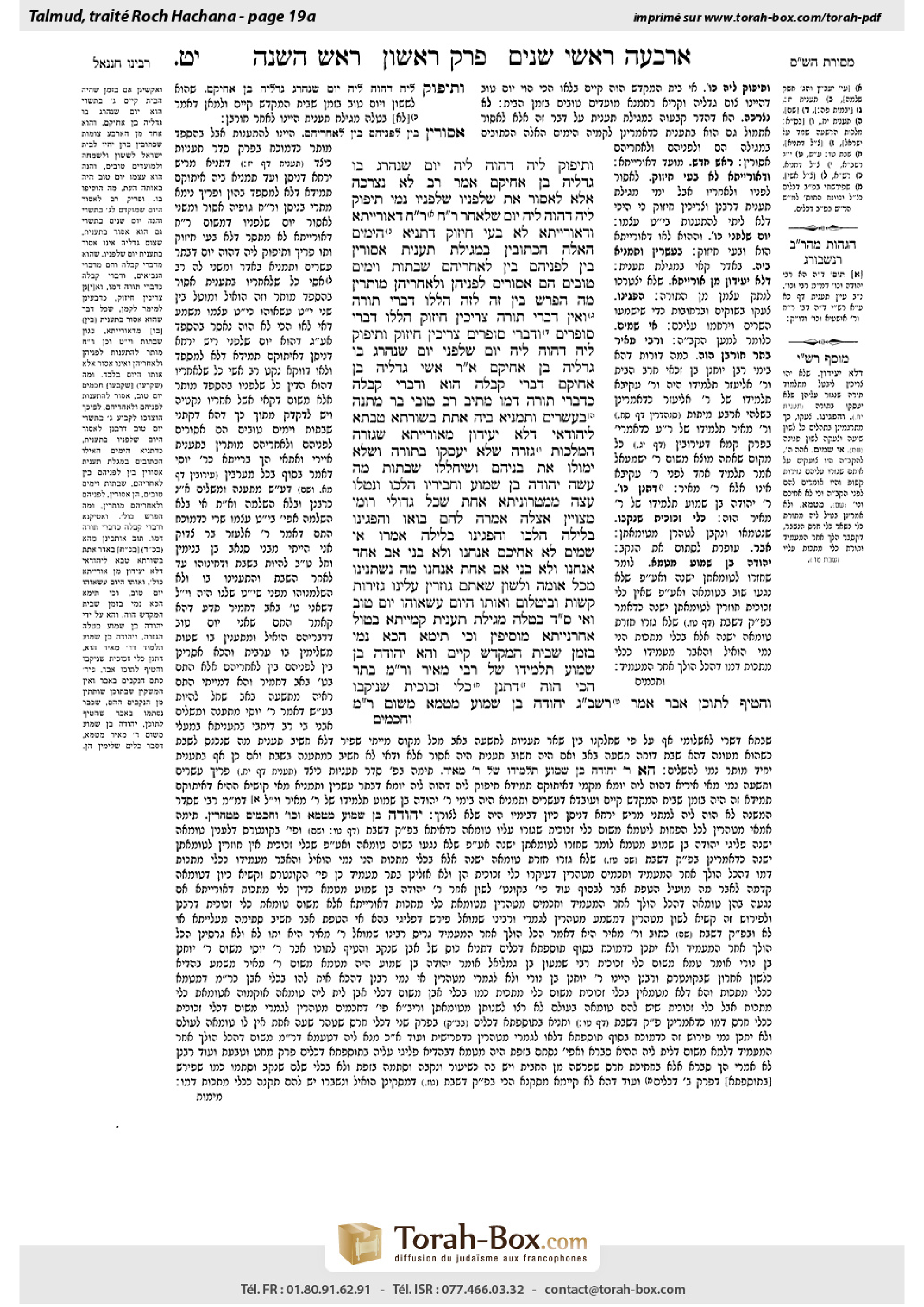
Rosh Hashanah 19a: Talmud study for Daf Yomi
Daf Yomi is the daily study of one Talmud folio. Explore 37 tractates with scans, Hebrew text, Sefaria English and AI-generated French translations where annotated.
Passage selection and English or AI-generated French translation are available where the scan has annotations. Daf Study is independent of Torah-Box and Sefaria.
Browse Rosh Hashanah · ראש השנה · All tractatesRosh Hashanah 19a text and translations
This page of Rosh Hashanah includes the Aramaic text, an English translation and an AI-generated French translation, alongside the scan above.
ראש השנה י״ט א · Aramaic and Hebrew text
וְתִיפּוֹק לֵיהּ דְּהָוֵה לֵיהּ יוֹם שֶׁנֶּהֱרַג בּוֹ גְּדַלְיָה בֶּן אֲחִיקָם! אָמַר רַב: לֹא נִצְרְכָה אֶלָּא לֶאֱסוֹר אֶת שֶׁלְּפָנָיו.
שֶׁלְּפָנָיו נָמֵי, תִּיפּוֹק לֵיהּ דְּהָוֵה לֵיהּ יוֹם שֶׁלְּאַחַר רֹאשׁ חֹדֶשׁ! רֹאשׁ חֹדֶשׁ דְּאוֹרָיְיתָא, וּדְאוֹרָיְיתָא לָא בָּעֵי חִיזּוּק.
דְּתַנְיָא: הַיָּמִים הָאֵלֶּה הַכְּתוּבִין בִּמְגִילַּת תַּעֲנִית אֲסוּרִין, בֵּין לִפְנֵיהֶם בֵּין לְאַחֲרֵיהֶם. שַׁבָּתוֹת וְיָמִים טוֹבִים — הֵם אֲסוּרִים, לִפְנֵיהֶן וּלְאַחֲרֵיהֶן מוּתָּרִין. מָה הֶפְרֵשׁ בֵּין זֶה לָזֶה? הַלָּלוּ דִּבְרֵי תוֹרָה, וְאֵין דִּבְרֵי תוֹרָה צְרִיכִין חִיזּוּק. הַלָּלוּ דִּבְרֵי סוֹפְרִים, וְדִבְרֵי סוֹפְרִים צְרִיכִין חִיזּוּק.
וְתִיפּוֹק לֵיהּ דְּהָוֵה לֵיהּ יוֹם שֶׁלִּפְנֵי יוֹם שֶׁנֶּהֱרַג בּוֹ גְּדַלְיָה בֶּן אֲחִיקָם! אָמַר רַב אָשֵׁי: גְּדַלְיָה בֶּן אֲחִיקָם דִּבְרֵי קַבָּלָה הוּא, וְדִבְרֵי קַבָּלָה כְּדִבְרֵי תוֹרָה דָּמוּ.
מֵתִיב רַב טוֹבִי בַּר מַתְנָה: בְּעֶשְׂרִים וּתְמָנְיָא בֵּיהּ אֲתָת בְּשׂוֹרְתָּא טָבְתָּא לִיהוּדָאֵי דְּלָא יְעִידוֹן מֵאוֹרָיְיתָא. שֶׁגָּזְרָה מַלְכוּת הָרְשָׁעָה גְּזֵרָה שֶׁלֹּא יַעַסְקוּ בַּתּוֹרָה, וְשֶׁלֹּא יָמוּלוּ אֶת בְּנֵיהֶם, וְשֶׁיְּחַלְּלוּ שַׁבָּתוֹת. מָה עָשָׂה יְהוּדָה בֶּן שַׁמּוּעַ וַחֲבֵירָיו? הָלְכוּ וְנָטְלוּ עֵצָה מִמַּטְרוֹנִיתָא אַחַת שֶׁכׇּל גְּדוֹלֵי רוֹמִי מְצוּיִין אֶצְלָהּ.
אָמְרָה לָהֶם: בּוֹאוּ וְהַפְגִּינוּ בַּלַּיְלָה. הָלְכוּ וְהִפְגִּינוּ בַּלַּיְלָה, אָמְרוּ: אֵי שָׁמַיִם! לֹא אֲחֵיכֶם אֲנַחְנוּ, וְלֹא בְּנֵי אָב אֶחָד אֲנַחְנוּ, וְלֹא בְּנֵי אֵם אַחַת אֲנַחְנוּ? מָה נִשְׁתַּנֵּינוּ מִכׇּל אוּמָּה וְלָשׁוֹן שֶׁאַתֶּם גּוֹזְרִין עָלֵינוּ גְּזֵירוֹת קָשׁוֹת? וּבִיטְּלוּם. וְאוֹתוֹ הַיּוֹם עֲשָׂאוּהוּ יוֹם טוֹב. וְאִי סָלְקָא דַּעְתָּךְ בָּטְלָה מְגִילַּת תַּעֲנִית — קַמָּיָיתָא בְּטוּל, אַחְרָנְיָיתָא מוֹסִיפִין?!
וְכִי תֵּימָא הָכָא נָמֵי בִּזְמַן שֶׁבֵּית הַמִּקְדָּשׁ קַיָּים — וְהָא יְהוּדָה בֶּן שַׁמּוּעַ תַּלְמִידוֹ שֶׁל רַבִּי מֵאִיר, וְרַבִּי מֵאִיר בָּתַר הָכִי הֲוָה! דִּתְנַן: כְּלֵי זְכוּכִית שֶׁנִּיקְּבוּ וְהִטִּיף לְתוֹכָן אֲבָר, אָמַר רַבָּן שִׁמְעוֹן בֶּן גַּמְלִיאֵל: יְהוּדָה בֶּן שַׁמּוּעַ מְטַמֵּא מִשּׁוּם רַבִּי מֵאִיר,
Rosh Hashanah 19a · English translation
The Gemara raises a difficulty: But if this was at the time that the Temple was standing, derive the prohibition against fasting on the third of Tishrei from the fact that it is the day that Gedaliah, son of Ahikam, was killed. During the time of the Temple the biblical fast days were celebrated as days of joy. Rav said: It was only necessary to include the third of Tishrei in Megillat Ta’anit in order to prohibit fasting on the preceding day as well. Fasting was forbidden not only on the actual days listed in Megillat Ta’anit, but also on the preceding day and the following day.
The Gemara raises another difficulty: With regard to the prohibition against fasting on the preceding day, the second of Tishrei, also derive it because it is the day after the New Moon, and fasting is forbidden not only on festive days, but also on the preceding day and the following day. The Gemara rejects this argument: The New Moon is by Torah law, and festive days that are by Torah law do not require reinforcement. Therefore no decree was ever enacted prohibiting fasting on the days before and after.
As it is taught in a baraita: These days that are written in Megillat Ta’anit are days on which fasting is prohibited, as are both the day before them and the day after them. With regard to Shabbatot and Festivals, fasting on them is forbidden, but on the day before them and the day after them fasting is permitted. What is the difference between this class of days and that class of days? These days, Shabbatot and Festivals, are by Torah law, and Torah laws do not need reinforcement, and therefore even if a fast day were decreed on the day before or after them, the Festival itself would not be nullified; whereas those days mentioned in Megillat Ta’anit are by rabbinic law, and rabbinic laws need reinforcement, and therefore fasting is prohibited even on the day before and the day after.
The Gemara raises yet another difficulty: The prohibition against fasting on the second of Tishrei, derive it from the fact that it is the day before the day that Gedaliah, son of Ahikam, was killed, and since in Temple times the fast of Gedaliah was celebrated as a festive day, fasting should also be prohibited on the preceding day. Rav Ashi said: The fast of Gedaliah, son of Ahikam, is derived from the texts of the tradition, i.e., Prophets and Writings, and as the texts of the tradition are treated like Torah statements for this purpose, they too do not need reinforcement.
Rav Tovi bar Mattana raised an objection against the opinion that Megillat Ta’anit was nullified, from that which is written in it: On the twenty-eighth of Adar the good tidings came to the Jews that they should not turn away from the Torah, and on that day fasting is forbidden. And this is explained: For the wicked kingdom issued a decree against Israel that they should not occupy themselves with Torah study, and that they should not circumcise their sons, and that they should desecrate Shabbat. What did Yehuda ben Shammua and his colleagues do? They went and took advice from a certain matron [matronita] whom all the prominent men of Rome would visit regularly, thinking that she would know how to annul the decree.
She said to them as follows: Come and cry out [hafgginu] at night in the streets and markets. They went and cried out at night, saying: O Heavens! Are we Jews not your brothers; are we not children of one father; are we not children of one mother? How are we different from every other nation and tongue that you issue such harsh decrees against us? And indeed the decrees were annulled, and the Sages made that day a festive day. And if it enters your mind to say that Megillat Ta’anit has been nullified, can you say that the first prohibitions against fasting they annulled, and then later ones were added?
And if you say that here too it is referring to the time when the Temple was standing, there is a difficulty, as Yehuda ben Shammua was a student of Rabbi Meir, and Rabbi Meir was after the destruction of the Temple. And proof that Rabbi Yehuda ben Shammua was a student of Rabbi Meir may be brought, as we learned in a mishna: With regard to glass vessels that had holes in them, which afterward were filled in with lead, the Sages dispute whether the utensil is considered a whole utensil, which can become ritually impure, or whether it is considered a broken utensil, which does not. Rabban Shimon ben Gamliel said: Yehuda ben Shammua declares that it becomes impure, in the name of Rabbi Meir;
Rosh Hashanah 19a · Traduction française (IA)
La Guemara soulève une difficulté : mais si cela se passait à l’époque où le Temple était debout, déduisons l’interdiction de jeûner le trois Tichri du fait que c’est le jour où Guedalia, fils d’Ahikam, fut tué. À l’époque du Temple, les jours de jeûne bibliques étaient célébrés comme des jours de joie. Rav dit : il fallait inclure le trois Tichri dans la Meguilat Ta’anit uniquement pour interdire également le jeûne la veille. Il était interdit de jeûner non seulement les jours mêmes mentionnés dans la Meguilat Ta’anit, mais aussi la veille et le lendemain.
La Guemara soulève une autre difficulté : quant à l’interdiction de jeûner la veille, le deux Tichri, déduisons-la également du fait que c’est le lendemain de la nouvelle lune, et que le jeûne est interdit non seulement les jours de fête, mais aussi la veille et le lendemain. La Guemara rejette cet argument : la nouvelle lune relève de la Torah, et les jours de fête prescrits par la Torah n’ont pas besoin d’être renforcés. Par conséquent, aucun décret n’a jamais été promulgué pour interdire le jeûne les jours qui précèdent et suivent ces jours.
Comme il est enseigné dans une baraïta : les jours mentionnés dans la Meguilat Ta’anit sont des jours où le jeûne est interdit, de même que la veille et le lendemain. Quant aux Chabbatot et aux fêtes, il est interdit d’y jeûner, mais le jeûne est permis la veille et le lendemain. Quelle est la différence entre cette catégorie de jours et l’autre ? Les Chabbatot et les fêtes sont prescrits par la Torah, et les lois de la Torah n’ont pas besoin d’être renforcées ; ainsi, même si un jour de jeûne était décrété la veille ou le lendemain, la fête elle-même ne serait pas annulée. En revanche, les jours mentionnés dans la Meguilat Ta’anit relèvent de la loi rabbinique, et les lois rabbiniques ont besoin d’être renforcées ; c’est pourquoi le jeûne est interdit même la veille et le lendemain.
La Guemara soulève encore une difficulté : l’interdiction de jeûner le deux Tichri, déduisons-la du fait que c’est la veille du jour où Guedalia, fils d’Ahikam, fut tué ; et puisque, à l’époque du Temple, le jeûne de Guedalia était célébré comme un jour de fête, le jeûne devrait également être interdit la veille. Rav Ashi dit : le jeûne de Guedalia, fils d’Ahikam, est déduit des textes de la tradition, c’est-à-dire des Prophètes et des Écrits ; et, à cet égard, ces textes étant traités comme des paroles de la Torah, ils n’ont pas non plus besoin d’être renforcés.
Rav Tovi bar Mattana soulève une objection contre l’opinion selon laquelle la Meguilat Ta’anit a été annulée, en s’appuyant sur ce qui y est écrit : le vingt-huit Adar, la bonne nouvelle fut annoncée aux Juifs qu’ils ne devaient pas se détourner de la Torah, et le jeûne est interdit ce jour-là. Voici l’explication : le royaume pervers promulgua un décret contre Israël, lui interdisant de s’adonner à l’étude de la Torah, de circoncire ses fils et de profaner le Chabbat. Que firent Yehuda ben Shammua et ses collègues ? Ils allèrent demander conseil à une certaine matrone [matronita], que tous les dignitaires de Rome avaient l’habitude de visiter régulièrement, pensant qu’elle saurait comment faire annuler le décret.
Elle leur dit : « Venez pousser des cris [hafgginu] la nuit dans les rues et les marchés. » Ils allèrent crier la nuit, en disant : « Ô Cieux ! Nous, les Juifs, ne sommes-nous pas vos frères ? Ne sommes-nous pas les enfants d’un même père ? Ne sommes-nous pas les enfants d’une même mère ? En quoi sommes-nous différents de toutes les autres nations et langues, pour que vous décrétiez contre nous de telles mesures si sévères ? » Et, de fait, les décrets furent annulés, et les Sages firent de ce jour un jour de fête. Et si l’on envisage de dire que la Meguilat Ta’anit a été annulée, peut-on dire qu’ils ont annulé les premières interdictions de jeûner, puis en ont ajouté d’autres par la suite ?
Et si l’on dit qu’ici aussi, il s’agit de l’époque où le Temple était debout, une difficulté se pose, car Yehuda ben Shammua était un élève de Rabbi Meir, et Rabbi Meir vécut après la destruction du Temple. On peut apporter la preuve que Yehuda ben Shammua était un élève de Rabbi Meir, comme nous l’avons appris dans une Michna : au sujet de récipients en verre qui étaient percés, puis dont les trous furent bouchés avec du plomb, les Sages sont en désaccord : l’ustensile est-il considéré comme entier, auquel cas il peut devenir rituellement impur, ou comme brisé, auquel cas il ne le peut pas ? Rabban Shimon ben Gamliel dit : « Yehuda ben Shammua déclare qu’il devient impur, au nom de Rabbi Meir. »
Traduction française générée par IA à partir de l’édition anglaise de Sefaria. Vérifie toujours un passage avec le texte source.
Text from Sefaria: William Davidson Edition - Vocalized Aramaic (CC BY NC); William Davidson Edition - English (CC BY NC).