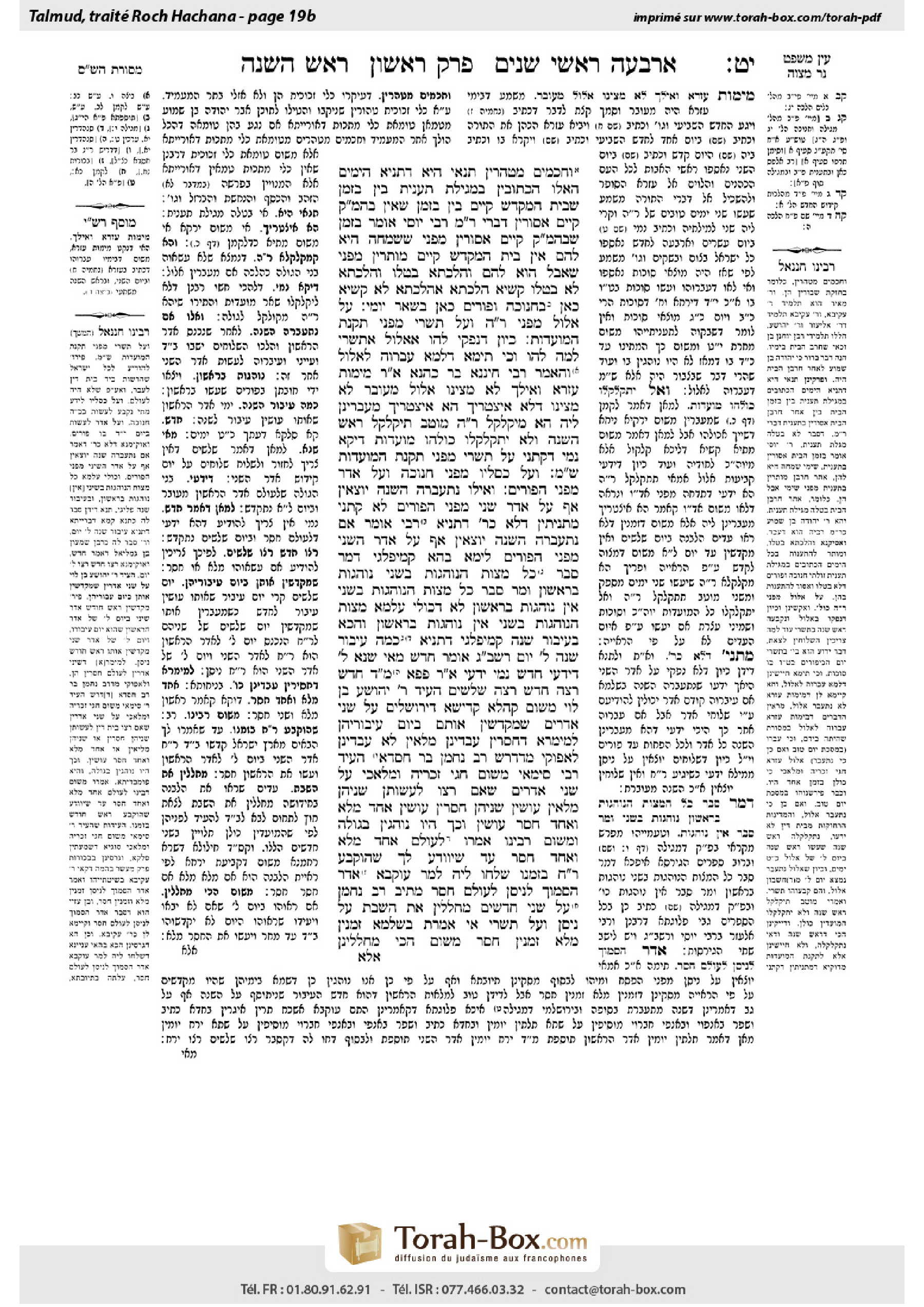
Rosh Hashanah 19b: Talmud study for Daf Yomi
Daf Yomi is the daily study of one Talmud folio. Explore 37 tractates with scans, Hebrew text, Sefaria English and AI-generated French translations where annotated.
Passage selection and English or AI-generated French translation are available where the scan has annotations. Daf Study is independent of Torah-Box and Sefaria.
Browse Rosh Hashanah · ראש השנה · All tractatesRosh Hashanah 19b text and translations
This page of Rosh Hashanah includes the Aramaic text, an English translation and an AI-generated French translation, alongside the scan above.
ראש השנה י״ט ב · Aramaic and Hebrew text
וַחֲכָמִים מְטַהֲרִין.
תַּנָּאֵי הִיא. דְּתַנְיָא: הַיָּמִים הָאֵלּוּ הַכְּתוּבִין בִּמְגִילַּת תַּעֲנִית, בֵּין בִּזְמַן שֶׁבֵּית הַמִּקְדָּשׁ קַיָּים בֵּין בִּזְמַן שֶׁאֵין בֵּית הַמִּקְדָּשׁ קַיָּים — אֲסוּרִין, דִּבְרֵי רַבִּי מֵאִיר. רַבִּי יוֹסֵי אוֹמֵר: בִּזְמַן שֶׁבֵּית הַמִּקְדָּשׁ קַיָּים — אֲסוּרִין, מִפְּנֵי שֶׁשִּׂמְחָה הִיא לָהֶם. אֵין בֵּית הַמִּקְדָּשׁ קַיָּים — מוּתָּרִין, מִפְּנֵי שֶׁאֵבֶל הוּא לָהֶם.
וְהִלְכְתָא בָּטְלוּ, וְהִלְכְתָא לֹא בָּטְלוּ. קַשְׁיָא הִלְכְתָא אַהִלְכְתָא! לָא קַשְׁיָא: כָּאן בַּחֲנוּכָּה וּפוּרִים, כָּאן בִּשְׁאָר יוֹמֵי.
עַל אֱלוּל מִפְּנֵי רֹאשׁ הַשָּׁנָה, וְעַל תִּשְׁרִי מִפְּנֵי תַּקָּנַת הַמּוֹעֲדוֹת. כֵּיוָן דְּנָפְקִי לְהוּ אַאֱלוּל, אַתִּשְׁרִי לְמָה לְהוּ?
וְכִי תֵּימָא דִּלְמָא עַבְּרוּהּ לֶאֱלוּל, וְהָאָמַר רַבִּי חִינָּנָא בַּר כָּהֲנָא אָמַר רַב: מִימוֹת עֶזְרָא וְאֵילָךְ לֹא מָצִינוּ אֱלוּל מְעוּבָּר!
לֹא מָצִינוּ — דְּלָא אִיצְטְרִיךְ, הָא אִיצְטְרִיךְ — מְעַבְּרִינַן לֵיהּ.
הָא מִיקַּלְקַל רֹאשׁ הַשָּׁנָה! מוּטָב תִּיקַּלְקֵל רֹאשׁ הַשָּׁנָה וְלֹא יִתְקַלְקְלוּ כּוּלְּהוּ מוֹעֲדוֹת.
דַּיְקָא נָמֵי, דְּקָתָנֵי: עַל תִּשְׁרִי מִפְּנֵי תַּקָּנַת הַמּוֹעֲדוֹת, שְׁמַע מִינַּהּ.
וְעַל כִּסְלֵיו מִפְּנֵי חֲנוּכָּה, וְעַל אֲדָר מִפְּנֵי הַפּוּרִים. וְאִילּוּ נִתְעַבְּרָה הַשָּׁנָה יוֹצְאִין אַף עַל אֲדָר שֵׁנִי מִפְּנֵי הַפּוּרִים — לָא קָתָנֵי. מַתְנִיתִין דְּלָא כְּרַבִּי. דְּתַנְיָא, רַבִּי אוֹמֵר: אִם נִתְעַבְּרָה הַשָּׁנָה — יוֹצְאִין אַף עַל אֲדָר הַשֵּׁנִי מִפְּנֵי הַפּוּרִים.
לֵימָא בְּהָא קָמִיפַּלְגִי, דְּמָר סָבַר: כׇּל מִצְוֹת הַנּוֹהֲגוֹת בַּשֵּׁנִי — נוֹהֲגוֹת בָּרִאשׁוֹן, וּמָר סָבַר: כׇּל מִצְוֹת הַנּוֹהֲגוֹת בַּשֵּׁנִי — אֵין נוֹהֲגוֹת בָּרִאשׁוֹן.
לָא, דְּכוּלֵּי עָלְמָא מִצְוֹת הַנּוֹהֲגוֹת בַּשֵּׁנִי — אֵין נוֹהֲגוֹת בָּרִאשׁוֹן, וְהָכָא בְּעִיבּוּר שָׁנָה קָמִיפַּלְגִי. דְּתַנְיָא: כַּמָּה עִיבּוּר שָׁנָה — שְׁלֹשִׁים יוֹם, רַבָּן שִׁמְעוֹן בֶּן גַּמְלִיאֵל אוֹמֵר: חֹדֶשׁ.
מַאי שְׁנָא שְׁלֹשִׁים — דְּיָדְעִי? חֹדֶשׁ נָמֵי יָדְעִי! אָמַר רַב פָּפָּא: מַאן דְּאָמַר חֹדֶשׁ, רָצָה — חֹדֶשׁ, רָצָה — שְׁלֹשִׁים.
הֵעִיד רַבִּי יְהוֹשֻׁעַ בֶּן לֵוִי מִשּׁוּם קְהָלָא קַדִּישָׁא דִּירוּשָׁלַיִם עַל שְׁנֵי אֲדָרִים שֶׁמְּקַדְּשִׁין אוֹתָם בְּיוֹם עִיבּוּרֵיהֶן.
לְמֵימְרָא דַּחֲסֵרִין עָבְדִינַן, מְלֵאִין לָא עָבְדִינַן! לְאַפּוֹקֵי מִדְּדָרֵשׁ רַב נַחְמָן בַּר חִסְדָּא. הֵעִיד רַבִּי סִימַאי מִשּׁוּם חַגַּי זְכַרְיָה וּמַלְאָכִי עַל שְׁנֵי אֲדָרִים, שֶׁאִם רָצוּ לַעֲשׂוֹתָן שְׁנֵיהֶן מְלֵאִין — עוֹשִׂין, שְׁנֵיהֶן חֲסֵרִין — עוֹשִׂין, אֶחָד מָלֵא וְאֶחָד חָסֵר — עוֹשִׂין, וְכָךְ הָיוּ נוֹהֲגִין בַּגּוֹלָה. וּמִשּׁוּם רַבֵּינוּ אָמְרוּ: לְעוֹלָם אֶחָד מָלֵא וְאֶחָד חָסֵר, עַד שֶׁיִּוּוֹדַע לָךְ שֶׁהוּקְבַּע רֹאשׁ חֹדֶשׁ בִּזְמַנּוֹ.
שְׁלַחוּ לֵיהּ לְמָר עוּקְבָא: אֲדָר הַסָּמוּךְ לְנִיסָן — לְעוֹלָם חָסֵר.
מֵתִיב רַב נַחְמָן: עַל שְׁנֵי חֳדָשִׁים מְחַלְּלִין אֶת הַשַּׁבָּת — עַל נִיסָן וְעַל תִּשְׁרִי. אִי אָמְרַתְּ בִּשְׁלָמָא זִמְנִין מָלֵא זִמְנִין חָסֵר — מִשּׁוּם הָכִי מְחַלְּלִינַן.
Rosh Hashanah 19b · English translation
whereas the Sages declare it pure. According to them, it is still considered a broken utensil. Rabbi Meir himself lived after the destruction of the Second Temple. The festive day commemorating the annulling of the decree of Rome was instituted as a result of an incident involving his student, Rabbi Yehuda ben Shammua. From this, it is clear that Megillat Ta’anit had not yet been nullified.
The Gemara answers: The question whether or not Megillat Ta’anit has been nullified is the subject of a dispute between tanna’im, as it is taught in a baraita: These days, which are written in Megillat Ta’anit, both when the Temple is standing and when the Temple is not standing, are days on which fasting is prohibited; this is the statement of Rabbi Meir. Rabbi Yosei says: When the Temple is standing, these days are prohibited for fasting because these days are a source of joy for Israel. But when the Temple is not standing, these days are permitted for fasting because these days are a source of mourning for them.
The Gemara concludes: And the halakha is that these days were nullified, and the halakha is that they were not nullified. The Gemara asks: This is difficult, as one halakha contradicts the other halakha. The Gemara answers: It is not difficult. Here, it is referring to Hanukkah and Purim. These Festival days were never nullified, and Hanukkah is listed among the Festivals of Megillat Ta’anit. There, the halakha is referring to the rest of the days listed in Megillat Ta’anit, all of which were nullified.
§ The mishna taught: Messengers go out to inform about the sanctification of the New Moon in Elul, due to Rosh HaShana, and in Tishrei, due to the need to establish the correct dates on which to celebrate the Festivals of Tishrei. The Gemara asks: Once the messengers have gone out in the month of Elul to inform the people when the New Moon was declared, why do they need to go out again in Tishrei, as the New Moon of Tishrei always falls on the thirtieth day after the New Moon of Elul?
And if you say that messengers must go out for Tishrei as well, as perhaps the court added another day to the month of Elul, so that Rosh HaShana occurs on the thirty-first day after the New Moon of Elul, there is a difficulty. Didn’t Rabbi Ḥinnana bar Kahana say that Rav said: From the days of Ezra and onward, we have never found that the month of Elul had an additional day. Consequently, it is simple to calculate the days on which the Festivals of Tishrei occur, and there should be no need to send out messengers in Tishrei.
The Gemara answers: When we say: We have not found that the month of Elul ever had an additional day, this does not mean that Elul cannot have an additional day, but only that it never happened because it was not necessary to add a day. But if it had been necessary, they would have added an additional day. Since it is possible that the month of Elul could have had another day added, there is reason to send out messengers for the month of Tishrei, so that all will know when to celebrate the Festivals.
The Gemara asks: But if Elul has an additional day Rosh HaShana will be ruined, because people will celebrate it thirty days after the New Moon of Elul, when its real date is on the thirty-first day. The Gemara answers: Better that Rosh HaShana be ruined, and all the Festivals, i.e., Yom Kippur, Sukkot, and the Eighth Day of Assembly, not be ruined.
The language of the mishna is also precise, as it teaches: Messengers go out in the month of Tishrei due to the need to establish the correct dates on which to celebrate the Festivals of Tishrei. The Gemara summarizes: Indeed, conclude from here that this is the correct understanding.
§ The mishna taught: Messengers go out in Kislev, due to Hanukkah, and in Adar, due to Purim. Whereas, it is not taught: If the year was a leap year, with an additional month of Adar, the messengers go out also in the second Adar due to Purim, which is celebrated in the second Adar. This indicates that the mishna is not in accordance with the opinion of Rabbi Yehuda HaNasi, as it is taught in a baraita: Rabbi Yehuda HaNasi says: If the year was a leap year, the messengers go out also in the second Adar, due to Purim.
The Gemara suggests: Let us say that they disagree about this. One Sage, the author of this mishna, holds that all the mitzvot observed in the second Adar, i.e., the special Torah readings and the mitzvot of Purim, are also observed in the first Adar. If they were observed in the first Adar and not in the second, the people have fulfilled their obligation. Therefore, there is no need to send messengers in the second Adar. And one Sage, Rabbi Yehuda HaNasi, holds that all the mitzvot observed in the second Adar are not observed in the first. It is therefore necessary to send messengers in the second Adar, so that people will know when to keep the mitzvot of Adar.
The Gemara rejects this argument: No, everyone agrees that the mitzvot observed in the second Adar are not observed on the first, and here they disagree about the length of the additional month in the leap year, as it is taught in a baraita: How long is the additional month in a leap year? Thirty days. Rabban Shimon ben Gamliel says: A month. Rabbi Yehuda HaNasi holds in accordance with the opinion of Rabban Shimon ben Gamliel, and since the additional month does not have a fixed number of days, it is necessary to send messengers also for the second Adar, so that people will know when to celebrate Purim. However, according to the first tanna, since the first Adar is always a fixed length, there is no need to send messengers.
The Gemara asks: What is different about thirty days? It is different because people can count thirty days and know when the month ends and when Purim occurs. A month also, people know the length of it. The term month implies that it is a month of twenty-nine days, and based on that they know when to celebrate Purim. Rav Pappa said: The one who said that a month is added does not mean necessarily a month of twenty-nine days. Rather, if the judges of the court wish, they add a month of twenty-nine days; and if it wishes, they add thirty days. Therefore, it is necessary to send messengers also for the second Adar.
Rabbi Yehoshua ben Levi testified in the name of the holy community of Jerusalem about the two months of Adar, that they are sanctified on the day that could have been added to make them a full month, i.e., the thirtieth day after the previous New Moon. That is to say, the thirtieth day after the New Moon of the first Adar is always the New Moon of the second Adar, and thirty days after the New Moon of the second Adar is always the New Moon of Nisan.
The Gemara comments: That is to say that they make the two months of Adar short months, of twenty-nine days, but they do not make them full months, of thirty days. This is to the exclusion of what Rav Naḥman bar Ḥisda taught, as Rav Naḥman bar Ḥisda taught: Rabbi Simai testified in the name of Haggai, Zechariah, and Malachi about two months of Adar in a leap year, that if the members of the court wish to make them both full, they may do so; and if they wish to make them both short, they may do so; and if they wish to make one full and one short, they may do so. And this is what they would do in the Diaspora, when they did not know which day was established as the New Moon. And in the name of our teacher, Rav, they said: The two months of Adar are always observed, one full and one short, unless it is known to you that the New Moon was fixed in its proper time, i.e., the first Adar is also short.
A ruling was sent from Eretz Yisrael to Mar Ukva, the Exilarch in Babylonia: The Adar that immediately precedes Nisan is always short, both in a regular year and in a leap year. But the first Adar in a leap year, which does not immediately precede Nisan, is sometimes full.
Rav Naḥman raised an objection from what was taught in a mishna: Witnesses who saw the new moon may desecrate Shabbat for the fixing of the New Moon of two months, for the month of Nisan and for the month of Tishrei, due to the important Festivals that occur in them. Granted, if you say that the Adar immediately preceding Nisan is sometimes full and sometimes short, due to that reason the witnesses may desecrate Shabbat, as if the witnesses come on the thirtieth, the month will be made short and that day will be declared the New Moon; otherwise, the month will be made full and the next day will be declared the New Moon.
Rosh Hashanah 19b · Traduction française (IA)
tandis que les Sages le déclarent pur. Selon eux, il est encore considéré comme un ustensile brisé. Rabbi Meïr lui-même vécut après la destruction du Second Temple. La journée festive commémorant l’annulation du décret de Rome fut instituée à la suite d’un incident impliquant son élève, Rabbi Yehuda ben Shammua. Il est donc clair que la Meguilat Ta’anit n’avait pas encore été annulée.
La Guemara répond : La question de savoir si la Meguilat Ta’anit a été annulée ou non fait l’objet d’un désaccord entre des tannaïm, comme l’enseigne une baraïta : Ces jours, inscrits dans la Meguilat Ta’anit, sont des jours où il est interdit de jeûner, que le Temple soit debout ou non ; telle est l’opinion de Rabbi Meïr. Rabbi Yossei dit : Lorsque le Temple est debout, il est interdit de jeûner ces jours-là, car ils sont une source de joie pour Israël. Mais lorsque le Temple n’est pas debout, il est permis de jeûner ces jours-là, car ils sont une source de deuil pour Israël.
La Guemara conclut : La halakha est que ces jours ont été annulés, et la halakha est qu’ils n’ont pas été annulés. La Guemara demande : Cela est difficile, car une halakha contredit l’autre. La Guemara répond : Il n’y a pas de difficulté. Ici, il s’agit de Hanouka et de Pourim. Ces jours de fête n’ont jamais été annulés, et Hanouka figure parmi les fêtes mentionnées dans la Meguilat Ta’anit. Là, la halakha concerne les autres jours mentionnés dans la Meguilat Ta’anit, qui ont tous été annulés.
§ La Michna enseignait : Des messagers partent annoncer la sanctification de la nouvelle lune au mois d’Eloul, en raison de Roch Hachana, et au mois de Tichri, afin d’établir les dates exactes des fêtes de Tichri. La Guemara demande : Une fois que les messagers sont partis au mois d’Eloul pour annoncer au peuple la date à laquelle la nouvelle lune a été proclamée, pourquoi doivent-ils repartir au mois de Tichri, alors que la nouvelle lune de Tichri tombe toujours le trentième jour après celle d’Eloul ?
Et si tu dis que des messagers doivent également partir pour Tichri, car le tribunal a peut-être ajouté un jour au mois d’Eloul, de sorte que Roch Hachana tombe le trente et unième jour après la nouvelle lune d’Eloul, une difficulté se pose. Rabbi Ḥinnana bar Kahana n’a-t-il pas dit au nom de Rav : Depuis l’époque d’Ezra, nous n’avons jamais constaté que le mois d’Eloul ait compté un jour supplémentaire ? Par conséquent, il est facile de calculer les dates des fêtes de Tichri, et il ne devrait pas être nécessaire d’envoyer des messagers au mois de Tichri.
La Guemara répond : Lorsque nous disons que nous n’avons jamais constaté que le mois d’Eloul ait compté un jour supplémentaire, cela ne signifie pas qu’il ne peut pas en compter un, mais seulement que cela ne s’est jamais produit parce qu’il n’a pas été nécessaire d’ajouter un jour. Mais si cela avait été nécessaire, ils auraient ajouté un jour. Puisqu’il est possible qu’un jour soit ajouté au mois d’Eloul, il y a lieu d’envoyer des messagers pour le mois de Tichri, afin que tous sachent quand célébrer les fêtes.
La Guemara demande : Mais si le mois d’Eloul compte un jour supplémentaire, Roch Hachana sera compromis, car les gens le célébreront trente jours après la nouvelle lune d’Eloul, alors que sa véritable date tombe le trente et unième jour. La Guemara répond : Mieux vaut que Roch Hachana soit compromis plutôt que toutes les fêtes — c’est-à-dire Yom Kippour, Soukkot et le Huitième Jour de l’Assemblée — ne le soient.
La formulation de la Michna est également précise, puisqu’elle enseigne : Des messagers partent au mois de Tichri afin d’établir les dates exactes des fêtes de Tichri. La Guemara conclut : En effet, déduis-en que telle est l’interprétation correcte.
§ La Michna enseignait : Des messagers partent au mois de Kislev, en raison de Hanouka, et au mois d’Adar, en raison de Pourim. En revanche, elle n’enseigne pas que, si l’année est embolismique et comporte un mois d’Adar supplémentaire, les messagers partent aussi au second mois d’Adar, en raison de Pourim, qui est célébré au second Adar. Cela indique que la Michna ne suit pas l’opinion de Rabbi Yehuda HaNassi, comme l’enseigne une baraïta : Rabbi Yehuda HaNassi dit : Si l’année est embolismique, les messagers partent aussi au second Adar, en raison de Pourim.
La Guemara propose : Disons qu’ils sont en désaccord sur ce point. Un Sage, l’auteur de cette Michna, estime que toutes les mitsvot observées au second Adar, c’est-à-dire les lectures particulières de la Torah et les mitsvot de Pourim, sont également observées au premier Adar. Si elles sont observées au premier Adar et non au second, les gens se sont acquittés de leur obligation. Il n’est donc pas nécessaire d’envoyer des messagers au second Adar. L’autre Sage, Rabbi Yehuda HaNassi, estime que les mitsvot observées au second Adar ne sont pas observées au premier. Il est donc nécessaire d’envoyer des messagers au second Adar, afin que les gens sachent quand accomplir les mitsvot du mois d’Adar.
La Guemara rejette cet argument : Non, tous conviennent que les mitsvot observées au second Adar ne sont pas observées au premier. Leur désaccord porte ici sur la durée du mois supplémentaire de l’année embolismique, comme l’enseigne une baraïta : Quelle est la durée du mois supplémentaire dans une année embolismique ? Trente jours. Rabban Shimon ben Gamliel dit : Un mois. Rabbi Yehuda HaNassi suit l’opinion de Rabban Shimon ben Gamliel et, puisque le mois supplémentaire n’a pas un nombre de jours fixe, il est nécessaire d’envoyer aussi des messagers au second Adar, afin que les gens sachent quand célébrer Pourim. En revanche, selon le premier tanna, puisque le premier Adar a toujours une durée fixe, il n’est pas nécessaire d’envoyer des messagers.
La Guemara demande : En quoi trente jours est-il différent ? Ils sont différents parce que les gens peuvent compter trente jours et savoir quand le mois se termine et quand Pourim a lieu. Mais la durée d’un mois est également connue. Le terme « mois » implique qu’il s’agit d’un mois de vingt-neuf jours, et les gens savent ainsi quand célébrer Pourim. Rav Pappa dit : Celui qui a dit qu’on ajoute un mois ne voulait pas nécessairement dire qu’il s’agissait d’un mois de vingt-neuf jours. Au contraire, si les juges du tribunal le souhaitent, ils ajoutent un mois de vingt-neuf jours ; s’ils le souhaitent, ils en ajoutent un de trente jours. Il est donc nécessaire d’envoyer aussi des messagers au second Adar.
Rabbi Yehoshua ben Levi témoigna au nom de la sainte communauté de Jérusalem au sujet des deux mois d’Adar : ils sont sanctifiés le jour qui aurait pu être ajouté pour en faire un mois complet, c’est-à-dire le trentième jour après la nouvelle lune précédente. Autrement dit, le trentième jour après la nouvelle lune du premier Adar est toujours la nouvelle lune du second Adar, et trente jours après la nouvelle lune du second Adar est toujours la nouvelle lune de Nissan.
La Guemara fait remarquer : Cela signifie que les deux mois d’Adar sont des mois incomplets, de vingt-neuf jours, et non des mois complets, de trente jours. Cela exclut l’enseignement de Rav Naḥman bar Ḥisda, car Rav Naḥman bar Ḥisda enseigna : Rabbi Simai témoigna au nom de Haggai, Zechariah et Malachi au sujet des deux mois d’Adar d’une année embolismique : si les membres du tribunal souhaitent les rendre tous deux complets, ils le peuvent ; s’ils souhaitent les rendre tous deux incomplets, ils le peuvent ; et s’ils souhaitent rendre l’un complet et l’autre incomplet, ils le peuvent. C’est ainsi qu’ils procédaient en Diaspora, où ils ne savaient pas quel jour avait été fixé comme nouvelle lune. Et, au nom de notre maître Rav, ils dirent : Les deux mois d’Adar sont toujours observés, l’un complet et l’autre incomplet, sauf si l’on sait que la nouvelle lune a été fixée en son temps, c’est-à-dire que le premier Adar est lui aussi incomplet.
Une décision fut envoyée depuis Eretz Israël à Mar Ukva, l’exilarque de Babylonie : l’Adar qui précède immédiatement Nissan est toujours incomplet, aussi bien lors d’une année ordinaire que lors d’une année embolismique. Mais le premier Adar d’une année embolismique, qui ne précède pas immédiatement Nissan, est parfois complet.
Rav Naḥman souleva une objection à partir de ce qui est enseigné dans une Michna : Les témoins qui ont vu la nouvelle lune peuvent profaner le Chabbat pour la fixation de la nouvelle lune de deux mois, celui de Nissan et celui de Tichri, en raison des fêtes importantes qui y ont lieu. Il est compréhensible que, si tu dis que l’Adar qui précède immédiatement Nissan est parfois complet et parfois incomplet, les témoins puissent profaner le Chabbat pour cette raison : s’ils se présentent le trentième jour, le mois sera incomplet et ce jour sera déclaré nouvelle lune ; sinon, le mois sera complet et le jour suivant sera déclaré nouvelle lune.
Traduction française générée par IA à partir de l’édition anglaise de Sefaria. Vérifie toujours un passage avec le texte source.
Text from Sefaria: William Davidson Edition - Vocalized Aramaic (CC BY NC); William Davidson Edition - English (CC BY NC).