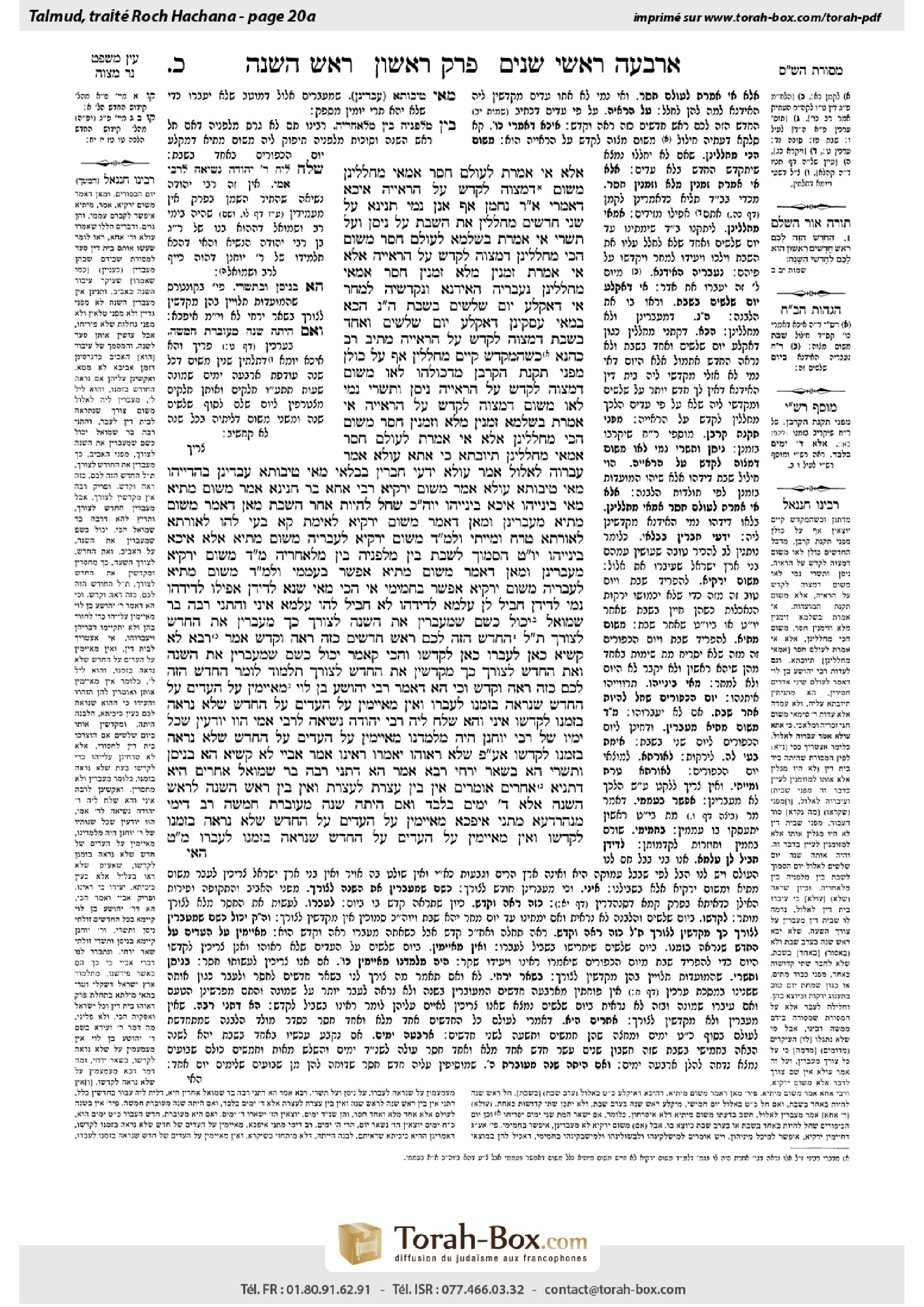
Rosh Hashanah 20a: Talmud study for Daf Yomi
Daf Yomi is the daily study of one Talmud folio. Explore 37 tractates with scans, Hebrew text, Sefaria English and AI-generated French translations where annotated.
Passage selection and English or AI-generated French translation are available where the scan has annotations. Daf Study is independent of Torah-Box and Sefaria.
Browse Rosh Hashanah · ראש השנה · All tractatesRosh Hashanah 20a text and translations
This page of Rosh Hashanah includes the Aramaic text, an English translation and an AI-generated French translation, alongside the scan above.
ראש השנה כ׳ א · Aramaic and Hebrew text
אֶלָּא אִי אָמְרַתְּ לְעוֹלָם חָסֵר, אַמַּאי מְחַלְּלִינַן? מִשּׁוּם דְּמִצְוָה לְקַדֵּשׁ עַל הָרְאִיָּיה.
אִיכָּא דְּאָמְרִי, אָמַר רַב נַחְמָן, אַף אֲנַן נָמֵי תְּנֵינָא: עַל שְׁנֵי חֳדָשִׁים מְחַלְּלִין אֶת הַשַּׁבָּת — עַל נִיסָן וְעַל תִּשְׁרִי. אִי אָמְרַתְּ בִּשְׁלָמָא לְעוֹלָם חָסֵר — מִשּׁוּם הָכִי מְחַלְּלִינַן, דְּמִצְוָה לְקַדֵּשׁ עַל הָרְאִיָּיה.
אֶלָּא אִי אָמְרַתְּ זִמְנִין מָלֵא זִמְנִין חָסֵר — אַמַּאי מְחַלְּלִינַן? נְעַבְּרֵיהּ הָאִידָּנָא, וּנְקַדְּשֵׁיהּ לִמְחַר.
אִי דְּאִקְּלַע יוֹם שְׁלֹשִׁים בְּשַׁבָּת — הָכִי נָמֵי. הָכָא בְּמַאי עָסְקִינַן: דְּאִקְּלַע יוֹם שְׁלֹשִׁים וְאֶחָד בְּשַׁבָּת, דְּמִצְוָה לְקַדֵּשׁ עַל הָרְאִיָּיה.
מֵתִיב רַב כָּהֲנָא: כְּשֶׁהַמִּקְדָּשׁ קַיָּים מְחַלְּלִין אַף עַל כּוּלָּן, מִפְּנֵי תַּקָּנַת הַקׇּרְבָּן.
מִדְּכוּלְּהוּ לָאו מִשּׁוּם דְּמִצְוָה לְקַדֵּשׁ עַל הָרְאִיָּיה — נִיסָן וְתִשְׁרִי נָמֵי לָאו מִשּׁוּם דְּמִצְוָה לְקַדֵּשׁ עַל הָרְאִיָּיה.
אִי אָמְרַתְּ בִּשְׁלָמָא זִמְנִין מָלֵא וְזִמְנִין חָסֵר, מִשּׁוּם הָכִי מְחַלְּלִינַן. אֶלָּא אִי אָמְרַתְּ לְעוֹלָם חָסֵר, אַמַּאי מְחַלְּלִינַן? תְּיוּבְתָּא.
כִּי אֲתָא עוּלָּא, אָמַר: עַבְּרוּהּ לֶאֱלוּל. אָמַר עוּלָּא: יָדְעִי חַבְרִין בַּבְלָאֵי מַאי טֵיבוּתָא עָבְדִינַן בַּהֲדַיְיהוּ!
מַאי טֵיבוּתָא? עוּלָּא אָמַר: מִשּׁוּם יַרְקַיָּא. רַבִּי אַחָא בַּר חֲנִינָא אָמַר: מִשּׁוּם מִתַיָּא.
מַאי בֵּינַיְיהוּ? אִיכָּא בֵּינַיְיהוּ: יוֹם הַכִּפּוּרִים שֶׁחָל לִהְיוֹת אַחַר הַשַּׁבָּת. מַאן דְּאָמַר מִשּׁוּם מִתַיָּא — מְעַבְּרִינַן. וּמַאן דְּאָמַר מִשּׁוּם יַרְקַיָּא, לְאֵימַת קָא בָּעֵי לְהוּ — לְאוּרְתָּא, לְאוּרְתָּא טָרַח וּמַיְיתֵי.
וּלְמַאן דְּאָמַר מִשּׁוּם יַרְקַיָּא, לְעַבְּרֵיהּ מִשּׁוּם מִתַיָּא! אֶלָּא: אִיכָּא בֵּינַיְיהוּ יוֹם טוֹב הַסָּמוּךְ לַשַּׁבָּת בֵּין מִלְּפָנֶיהָ בֵּין מִלְּאַחֲרֶיהָ. מַאן דְּאָמַר מִשּׁוּם יַרְקַיָּא — מְעַבְּרִינַן, וּמַאן דְּאָמַר מִשּׁוּם מִתַיָּא — אֶפְשָׁר בְּעַמְמֵי.
וּלְמַאן דְּאָמַר מִשּׁוּם מִתַיָּא, לְעַבְּרֵיהּ מִשּׁוּם יַרְקַיָּא! אֶפְשָׁר בְּחַמִּימֵי.
אִי הָכִי: מַאי שְׁנָא לְדִידַן, אֲפִילּוּ לְדִידְהוּ נָמֵי! לְדִידַן חֲבִיל לַן עָלְמָא, לְדִידְהוּ לָא חֲבִיל לְהוּ עָלְמָא.
אִינִי?! וְהָתָנֵי רַבָּה בַּר שְׁמוּאֵל: יָכוֹל כְּשֵׁם שֶׁמְּעַבְּרִין אֶת הַשָּׁנָה לְצוֹרֶךְ, כָּךְ מְעַבְּרִין אֶת הַחֹדֶשׁ לְצוֹרֶךְ? תַּלְמוּד לוֹמַר: ״הַחֹדֶשׁ הַזֶּה לָכֶם רֹאשׁ חֳדָשִׁים״ — כָּזֶה רְאֵה וְקַדֵּשׁ.
אָמַר רָבָא, לָא קַשְׁיָא: כָּאן לְעַבְּרוֹ, כָּאן לְקַדְּשׁוֹ. וְהָכִי קָאָמַר: יָכוֹל כְּשֵׁם שֶׁמְּעַבְּרִין אֶת הַשָּׁנָה וְאֶת הַחֹדֶשׁ לְצוֹרֶךְ, כָּךְ מְקַדְּשִׁין אֶת הַחֹדֶשׁ לְצוֹרֶךְ — תַּלְמוּד לוֹמַר: ״הַחֹדֶשׁ הַזֶּה לָכֶם״ — כָּזֶה רְאֵה וְקַדֵּשׁ.
וְכִי הָא דְּאָמַר רַבִּי יְהוֹשֻׁעַ בֶּן לֵוִי: מְאַיְּימִין עַל הָעֵדִים עַל הַחֹדֶשׁ שֶׁנִּרְאָה בִּזְמַנּוֹ — לְעַבְּרוֹ, וְאֵין מְאַיְּימִין עַל הָעֵדִים עַל הַחֹדֶשׁ שֶׁלֹּא נִרְאָה בִּזְמַנּוֹ — לְקַדְּשׁוֹ.
אִינִי?! וְהָא שְׁלַח לֵיהּ רַבִּי יְהוּדָה נְשִׂיאָה לְרַבִּי אַמֵּי: הֱווּ יוֹדְעִין שֶׁכׇּל יָמָיו שֶׁל רַבִּי יוֹחָנָן הָיָה מְלַמְּדֵנוּ: מְאַיְּימִין עַל הָעֵדִים עַל הַחֹדֶשׁ שֶׁלֹּא נִרְאָה בִּזְמַנּוֹ — לְקַדְּשׁוֹ, אַף עַל פִּי שֶׁלֹּא רָאוּהוּ, יֹאמְרוּ ״רָאִינוּ״!
אָמַר אַבָּיֵי, לָא קַשְׁיָא: הָא בְּנִיסָן וְתִשְׁרִי, הָא בִּשְׁאָר יַרְחֵי.
רָבָא אָמַר: הָא דְּתָנֵי רַבָּה בַּר שְׁמוּאֵל — אֲחֵרִים הִיא. דְּתַנְיָא, אֲחֵרִים אוֹמְרִים: אֵין בֵּין עֲצֶרֶת לַעֲצֶרֶת וְאֵין בֵּין רֹאשׁ הַשָּׁנָה לָרֹאשׁ הַשָּׁנָה אֶלָּא אַרְבָּעָה יָמִים בִּלְבַד. וְאִם הָיְתָה שָׁנָה מְעוּבֶּרֶת — חֲמִשָּׁה.
רַב דִּימִי מִנְּהַרְדְּעָא מַתְנֵי אִיפְּכָא: מְאַיְּימִין עַל הָעֵדִים עַל הַחֹדֶשׁ שֶׁלֹּא נִרְאָה בִּזְמַנּוֹ — לְקַדְּשׁוֹ, וְאֵין מְאַיְּימִין עַל הָעֵדִים עַל הַחֹדֶשׁ שֶׁנִּרְאָה בִּזְמַנּוֹ — לְעַבְּרוֹ.
מַאי טַעְמָא —
Rosh Hashanah 20a · English translation
But if you say that the Adar immediately preceding Nisan is always short, why should they desecrate Shabbat? The court can calculate the time of the New Moon without witnesses. The Gemara answers: Because it is a mitzva to sanctify the New Moon on the basis of the testimony of witnesses who actually saw the new moon and not rely on calculations or established practices.
Some say that Rav Naḥman said: We, too, learn in a mishna: Witnesses who saw the new moon may desecrate Shabbat to establish the New Moon for two months, for the month of Nisan and for the month of Tishrei. Granted, if you say that the Adar immediately preceding Nisan is always short, due to that reason the witnesses may desecrate Shabbat, because it is a mitzva to sanctify the month on the basis of the testimony of witnesses who actually saw the new moon.
But if you say that the Adar immediately preceding Nisan is sometimes full and sometimes short, and there is no regularity to it, why should the witnesses desecrate Shabbat? Have the court add an extra day to the month now, since it can decide whether the thirtieth day or the thirty-first day is the beginning of the new month, and let the members of the court sanctify the next day as the New Moon.
The Gemara rejects this argument: If the thirtieth of Adar falls on Shabbat, this is indeed what is done. The witnesses are not permitted to desecrate Shabbat. Rather, the month is made full and the next day is sanctified as the New Moon. Here we are dealing with a case where the thirty-first of Adar falls on Shabbat, and so the sanctification of the New Moon cannot be pushed off to the next day, as a month cannot be longer than thirty days. In that case, the witnesses may desecrate Shabbat because it is a mitzva to sanctify the month based on testimony of witnesses who actually saw the new moon.
Rav Kahana raised an objection from the continuation of the mishna, which teaches: When the Temple was standing, the witnesses would desecrate Shabbat for establishing the New Moon even for all the months, in order to rectify the offering of the New Moon, i.e., ensure that it is at the proper time.
From the fact that the reason that the witnesses are permitted to desecrate Shabbat for all the other months is not because it is a mitzva to sanctify the month based on testimony of witnesses who saw the new moon, the implication is that with regard to Nisan and Tishrei as well, the witnesses are permitted to desecrate Shabbat for another reason and not because it is a mitzva to sanctify the month based on the testimony of witnesses who saw the new moon.
Granted, if you say that Adar is sometimes full and sometimes short, due to that reason the witnesses may desecrate Shabbat. But if you say that Adar is always short, why should they desecrate Shabbat? The court knows in advance when will be the New Moon of Nisan. The Gemara concludes: This is indeed a conclusive refutation to the proof brought by Rav Naḥman.
§ It is related that when Ulla came from Eretz Yisrael to Babylonia, he said: This year they added an extra day to the month of Elul. Ulla continued and said: Do our Babylonian colleagues understand what benefit we did for them? We pushed off Rosh HaShana for a day, so that the Festival would not occur adjacent to Shabbat.
The Gemara asks: What is the benefit in having a weekday between Shabbat and a Festival? Ulla said: Due to the vegetables that would not be picked for two days and those picked beforehand that would no longer be fresh. Rabbi Aḥa bar Ḥanina said: Due to the dead who would not be buried for two days and consequently would begin to decompose.
The Gemara asks: What is the practical difference between these two concerns? The Gemara answers: The practical difference between them is in the case where Yom Kippur occurs directly after Shabbat. According to the one who said that the reason is due to the dead that would go unburied for two days, the court adds an extra day to Elul so that Yom Kippur will not occur on Sunday. But according to the one who said that the reason is due to the vegetables that would not be fresh, there is no need to add an extra day to Elul. When would he require the vegetables? Only in the evening following Yom Kippur; and if Yom Kippur falls on Sunday, he can go out in the evening after the fast and bring fresh vegetables.
The Gemara asks: But according to the one who says that the reason is due to vegetables, the court should still make Elul full due to the dead, as this is also an important consideration. Rather, the practical difference between them is with regard to the case where the Festival of Rosh HaShana occurs adjacent to Shabbat, either before it or after it. According to the one who said that the reason is due to the vegetables that would wither, the court adds an extra day to Elul. But according to the one who said that the reason is due to the dead that would go unburied, there is no reason to make Elul full, because on a Festival it is possible to arrange that the dead be buried by gentiles.
The Gemara asks: But according to the one who said that the reason is due to the dead, the court should still add an extra day to Elul due to the vegetables. The Gemara answers: According to him this is not an important consideration, because it is possible to soak the withered vegetables in hot water and thereby restore their freshness.
The Gemara asks: If so, what is different about those who live in Babylonia and those who live in Eretz Yisrael? Why did Ulla specifically say that adding an extra day to Elul was beneficial to us, in Babylonia; it was beneficial to them as well. The Gemara answers: For us in Babylonia the weather is very hot, and so vegetables wither and corpses decompose quickly. But for them in Eretz Yisrael, the weather is not as hot, and vegetables and corpses can be kept for two days.
§ It was taught above that for various reasons a month can have an extra day added, even if the new moon was seen on the night before the thirtieth. The Gemara challenges this assumption: Is that so? But didn’t Rabba bar Shmuel teach in a baraita: One might have thought that just as the court adds an extra month to a year for some pressing communal need, so too, the court adds an extra day to a month for some similar need. Therefore, the verse states: “This month shall be to you the beginning of months” (Exodus 12:2). This teaches that when there is a moon like this, see it and sanctify the month. When the new moon is seen, the month must be sanctified without delay.
Rava said: This is not difficult: Here it is speaking of adding an extra day to the month, although the new moon was seen on the thirtieth, which is permitted; whereas there it is speaking of sanctifying the month on the thirtieth, although the new moon was not yet seen, which is prohibited. And this is what the baraita is saying: One might have thought that just as the court adds to a year or a month for some pressing communal need, so too, a month can be sanctified early on the thirtieth even without seeing the new moon. Therefore, the verse states: “This month shall be to you the beginning of months,” which teaches: Only when the moon appears like this, see it and sanctify the month, but not before.
The Gemara comments that this is like that which Rabbi Yehoshua ben Levi said: The court may intimidate witnesses through rigorous and confusing examination, so that they will give inadmissible testimony about the new moon that was seen at its due time, the thirtieth of the month. This is so that the court can add an extra day to it, and the New Moon will be sanctified on the thirty-first day. But the court may not intimidate witnesses into giving testimony about the new moon that was not seen on its due time, in order to sanctify the New Moon early, on the thirtieth.
The Gemara asks: Is that so? But didn’t Rabbi Yehuda Nesia, who was the Nasi of the Sanhedrin, send a message to Rabbi Ami: Be aware that all the days of Rabbi Yoḥanan he would teach us that witnesses may be intimidated into giving testimony about the new moon that was not seen in its due time. This was done in order that the new month may be sanctified early, already on the thirtieth. Although the witnesses did not see the moon, they may say: We saw it.
Abaye said: This is not difficult: This ruling is referring to Nisan and Tishrei, which may be sanctified early in order to set the Festivals that occur in those months; that ruling is referring to the other months, which may not be sanctified early, even for some other pressing need.
Rava said: That which Rabba bar Shmuel taught, that the court may not lengthen or shorten the months for reason of communal need, follows the opinion of Aḥerim, as it is taught in a baraita: Aḥerim say: The difference between the festival of Shavuot of one year and the festival of Shavuot of the following year, and similarly, between Rosh HaShana of one year and Rosh HaShana of the following year, is only four days of the week. There are 354 days in a lunar year, which are divided into twelve alternating months, six months that are thirty days long and six months that are twenty-nine days long. Therefore, every year is fifty weeks and four days long. And if it was a leap year, in which case the year is comprised of 383 days, or fifty-four weeks and five days, there is a difference of five days between them.
Rav Dimi from Neharde’a taught the baraita in the opposite manner: The court may intimidate the witnesses into giving testimony about the new moon that was not seen in its due time in order that the new month may be sanctified early, already on the thirtieth. But the court may not intimidate witnesses so that they do not give acceptable testimony about the new moon that was seen in its due time, in order to add an extra day to the old month, so that the New Moon is sanctified on the thirty-first.
The Gemara asks: What is the reason for Rav Dimi’s opinion? Intimidating witnesses into testifying about something that they did not see is worse than intimidating them to withhold testimony about something that they did see.
Rosh Hashanah 20a · Traduction française (IA)
Mais si tu dis que le mois d’Adar qui précède immédiatement Nisan est toujours court, pourquoi profaner le Chabbat ? Le tribunal peut calculer la date de la nouvelle lune sans témoins. La Guemara répond : parce que c’est une mitsva de sanctifier la nouvelle lune sur la foi du témoignage de témoins qui l’ont effectivement vue, plutôt que de s’en remettre à des calculs ou à des pratiques établies.
Certains disent que Rav Naḥman a dit : Nous aussi, nous apprenons dans une Michna que des témoins qui ont vu la nouvelle lune peuvent profaner le Chabbat afin de fixer le début de deux mois, celui de Nisan et celui de Tishrei. Il est compréhensible que, si tu dis que le mois d’Adar qui précède immédiatement Nisan est toujours court, les témoins puissent profaner le Chabbat pour cette raison, car c’est une mitsva de sanctifier le mois sur la foi du témoignage de témoins qui ont effectivement vu la nouvelle lune.
Mais si tu dis que le mois d’Adar qui précède immédiatement Nisan est parfois plein et parfois court, sans régularité, pourquoi les témoins profaneraient-ils le Chabbat ? Que le tribunal ajoute maintenant un jour au mois, puisqu’il peut décider si le trentième ou le trente et unième jour marque le début du nouveau mois, et que les membres du tribunal sanctifient le lendemain comme nouvelle lune.
La Guemara rejette cet argument : si le trentième jour d’Adar tombe un Chabbat, c’est effectivement ainsi que l’on procède. Les témoins ne sont pas autorisés à profaner le Chabbat. On rend plutôt le mois plein, et le lendemain est sanctifié comme nouvelle lune. Ici, il s’agit d’un cas où le trente et unième jour d’Adar tombe un Chabbat, de sorte que la sanctification de la nouvelle lune ne peut être reportée au lendemain, puisqu’un mois ne peut pas compter plus de trente jours. Dans ce cas, les témoins peuvent profaner le Chabbat, car c’est une mitsva de sanctifier le mois sur la foi du témoignage de témoins qui ont effectivement vu la nouvelle lune.
Rav Kahana souleva une objection à partir de la suite de la Michna, qui enseigne : lorsque le Temple était debout, les témoins profanaient le Chabbat pour fixer le début de tous les mois, afin de régulariser l’offrande de la nouvelle lune, c’est-à-dire de veiller à ce qu’elle soit apportée au moment voulu.
Puisque, pour les autres mois, les témoins ne sont pas autorisés à profaner le Chabbat parce que sanctifier le mois sur la foi du témoignage de témoins ayant vu la nouvelle lune serait une mitsva, on en déduit que, pour Nisan et Tishrei également, les témoins sont autorisés à profaner le Chabbat pour une autre raison, et non parce que sanctifier le mois sur la foi du témoignage de témoins ayant vu la nouvelle lune serait une mitsva.
Il est compréhensible que, si tu dis que le mois d’Adar est parfois plein et parfois court, les témoins puissent profaner le Chabbat pour cette raison. Mais si tu dis que le mois d’Adar est toujours court, pourquoi profaneraient-ils le Chabbat ? Le tribunal sait à l’avance quand aura lieu la nouvelle lune de Nisan. La Guemara conclut : il s’agit effectivement d’une réfutation décisive de la preuve avancée par Rav Naḥman.
§ Il est rapporté que, lorsqu’Ulla vint de la terre d’Israël en Babylonie, il dit : « Cette année, ils ont ajouté un jour au mois d’Eloul. » Ulla poursuivit : « Nos collègues babyloniens comprennent-ils quel avantage nous leur avons procuré ? Nous avons reporté Roch Hachana d’un jour, afin que la fête ne tombe pas juste avant ou juste après le Chabbat. »
La Guemara demande : quel avantage y a-t-il à avoir un jour de semaine entre le Chabbat et une fête ? Ulla dit : c’est à cause des légumes qui ne seraient pas cueillis pendant deux jours et de ceux qui, cueillis auparavant, ne seraient plus frais. Rabbi Aḥa bar Ḥanina dit : c’est à cause des morts, qui ne seraient pas enterrés pendant deux jours et commenceraient par conséquent à se décomposer.
La Guemara demande : quelle est la différence pratique entre ces deux préoccupations ? La Guemara répond : la différence pratique concerne le cas où Yom Kippour tombe juste après le Chabbat. Selon celui qui dit que la raison tient aux morts qui resteraient sans sépulture pendant deux jours, le tribunal ajoute un jour à Eloul afin que Yom Kippour ne tombe pas un dimanche. Mais selon celui qui dit que la raison tient aux légumes qui ne seraient plus frais, il n’est pas nécessaire d’ajouter un jour à Eloul. Quand aurait-on besoin des légumes ? Seulement le soir suivant Yom Kippour ; si Yom Kippour tombe un dimanche, on peut sortir le soir, après le jeûne, et apporter des légumes frais.
La Guemara demande : mais selon celui qui dit que la raison tient aux légumes, le tribunal devrait tout de même rendre Eloul plein à cause des morts, puisque c’est également une considération importante. La différence pratique concerne plutôt le cas où la fête de Roch Hachana tombe juste avant ou juste après le Chabbat. Selon celui qui dit que la raison tient aux légumes qui se flétriraient, le tribunal ajoute un jour à Eloul. Mais selon celui qui dit que la raison tient aux morts qui resteraient sans sépulture, il n’y a pas lieu de rendre Eloul plein, car, un jour de fête, on peut faire en sorte que des non-Juifs enterrent les morts.
La Guemara demande : mais selon celui qui dit que la raison tient aux morts, le tribunal devrait tout de même ajouter un jour à Eloul à cause des légumes. La Guemara répond : selon lui, ce n’est pas une considération importante, car il est possible de faire tremper les légumes flétris dans de l’eau chaude et de leur rendre ainsi leur fraîcheur.
La Guemara demande : dans ce cas, quelle différence y a-t-il entre les habitants de Babylonie et ceux de la terre d’Israël ? Pourquoi Ulla a-t-il dit précisément que l’ajout d’un jour à Eloul nous était bénéfique, à nous qui sommes en Babylonie ? Cela leur était également bénéfique. La Guemara répond : chez nous, en Babylonie, il fait très chaud, si bien que les légumes se flétrissent et que les cadavres se décomposent rapidement. Mais chez eux, en terre d’Israël, il ne fait pas aussi chaud, et les légumes comme les cadavres peuvent être conservés pendant deux jours.
§ Il a été enseigné plus haut que, pour diverses raisons, on peut ajouter un jour à un mois, même si la nouvelle lune a été vue la veille du trentième jour. La Guemara remet cette hypothèse en question : en est-il bien ainsi ? Pourtant, Rabba bar Shmuel n’a-t-il pas enseigné dans une baraïta : on aurait pu penser que, de même que le tribunal ajoute un mois à une année en cas de besoin urgent de la communauté, il ajoute aussi un jour à un mois pour un besoin similaire. Le verset dit donc : « Ce mois sera pour vous le commencement des mois » (Exode 12,2). Cela enseigne : lorsque la lune apparaît ainsi, voyez-la et sanctifiez le mois. Quand la nouvelle lune est visible, le mois doit être sanctifié sans délai.
Rava dit : il n’y a pas de difficulté. Ici, il est question d’ajouter un jour au mois, bien que la nouvelle lune ait été vue le trentième jour, ce qui est permis ; là, il est question de sanctifier le mois le trentième jour alors que la nouvelle lune n’a pas encore été vue, ce qui est interdit. Voici ce que dit la baraïta : on aurait pu penser que, de même que le tribunal ajoute un mois à une année ou un jour à un mois en cas de besoin urgent de la communauté, le mois peut aussi être sanctifié par anticipation le trentième jour, même sans avoir vu la nouvelle lune. Le verset dit donc : « Ce mois sera pour vous le commencement des mois », ce qui enseigne : seulement lorsque la lune apparaît ainsi, voyez-la et sanctifiez le mois, mais pas avant.
La Guemara fait remarquer que cela correspond à ce que Rabbi Yehoshua ben Levi a dit : le tribunal peut intimider les témoins en les soumettant à un interrogatoire rigoureux et déconcertant, afin qu’ils livrent un témoignage irrecevable au sujet de la nouvelle lune apparue à son échéance, le trentième jour du mois. Cela permet au tribunal d’ajouter un jour au mois, et la nouvelle lune est alors sanctifiée le trente et unième jour. Mais le tribunal ne peut pas intimider des témoins pour qu’ils témoignent au sujet d’une nouvelle lune qui n’est pas apparue à son échéance, afin de sanctifier la nouvelle lune par anticipation, le trentième jour.
La Guemara demande : en est-il bien ainsi ? Pourtant, Rabbi Yehuda Nesia, qui était le Nasi du Sanhédrin, n’a-t-il pas envoyé un message à Rabbi Ami : « Sache que, du temps de Rabbi Yoḥanan, il nous enseignait que les témoins peuvent être intimidés pour témoigner au sujet d’une nouvelle lune qui n’est pas apparue à son échéance. » Cela se faisait afin que le nouveau mois puisse être sanctifié par anticipation, dès le trentième jour. Bien que les témoins n’aient pas vu la lune, ils peuvent dire : « Nous l’avons vue. »
Abaye dit : il n’y a pas de difficulté. Cette décision concerne Nisan et Tishrei, qui peuvent être sanctifiés par anticipation afin de fixer les fêtes qui tombent au cours de ces mois ; l’autre décision concerne les autres mois, qui ne peuvent pas être sanctifiés par anticipation, même en cas de besoin urgent.
Rava dit : l’enseignement de Rabba bar Shmuel, selon lequel le tribunal ne peut ni allonger ni raccourcir les mois pour répondre à un besoin communautaire, suit l’opinion des Aḥerim, comme il est enseigné dans une baraïta : les Aḥerim disent que l’écart entre la fête de Chavouot d’une année et celle de l’année suivante, et, de même, entre Roch Hachana d’une année et Roch Hachana de l’année suivante, n’est que de quatre jours de la semaine. Une année lunaire compte 354 jours, répartis en douze mois alternant entre six mois de trente jours et six mois de vingt-neuf jours. Chaque année compte donc cinquante semaines et quatre jours. Et s’il s’agit d’une année embolismique, qui compte 383 jours, soit cinquante-quatre semaines et cinq jours, l’écart entre elles est de cinq jours.
Rav Dimi de Neharde’a enseigna la baraïta en sens inverse : le tribunal peut intimider les témoins pour qu’ils témoignent au sujet d’une nouvelle lune qui n’est pas apparue à son échéance, afin que le nouveau mois soit sanctifié par anticipation, dès le trentième jour. Mais le tribunal ne peut pas intimider des témoins pour qu’ils s’abstiennent de livrer un témoignage recevable au sujet d’une nouvelle lune apparue à son échéance, afin d’ajouter un jour à l’ancien mois et de sanctifier ainsi la nouvelle lune le trente et unième jour.
La Guemara demande : quelle est la raison de l’opinion de Rav Dimi ? Intimider des témoins pour qu’ils témoignent de quelque chose qu’ils n’ont pas vu est plus grave que les intimider pour qu’ils s’abstiennent de témoigner de quelque chose qu’ils ont vu.
Traduction française générée par IA à partir de l’édition anglaise de Sefaria. Vérifie toujours un passage avec le texte source.
Text from Sefaria: William Davidson Edition - Vocalized Aramaic (CC BY NC); William Davidson Edition - English (CC BY NC).