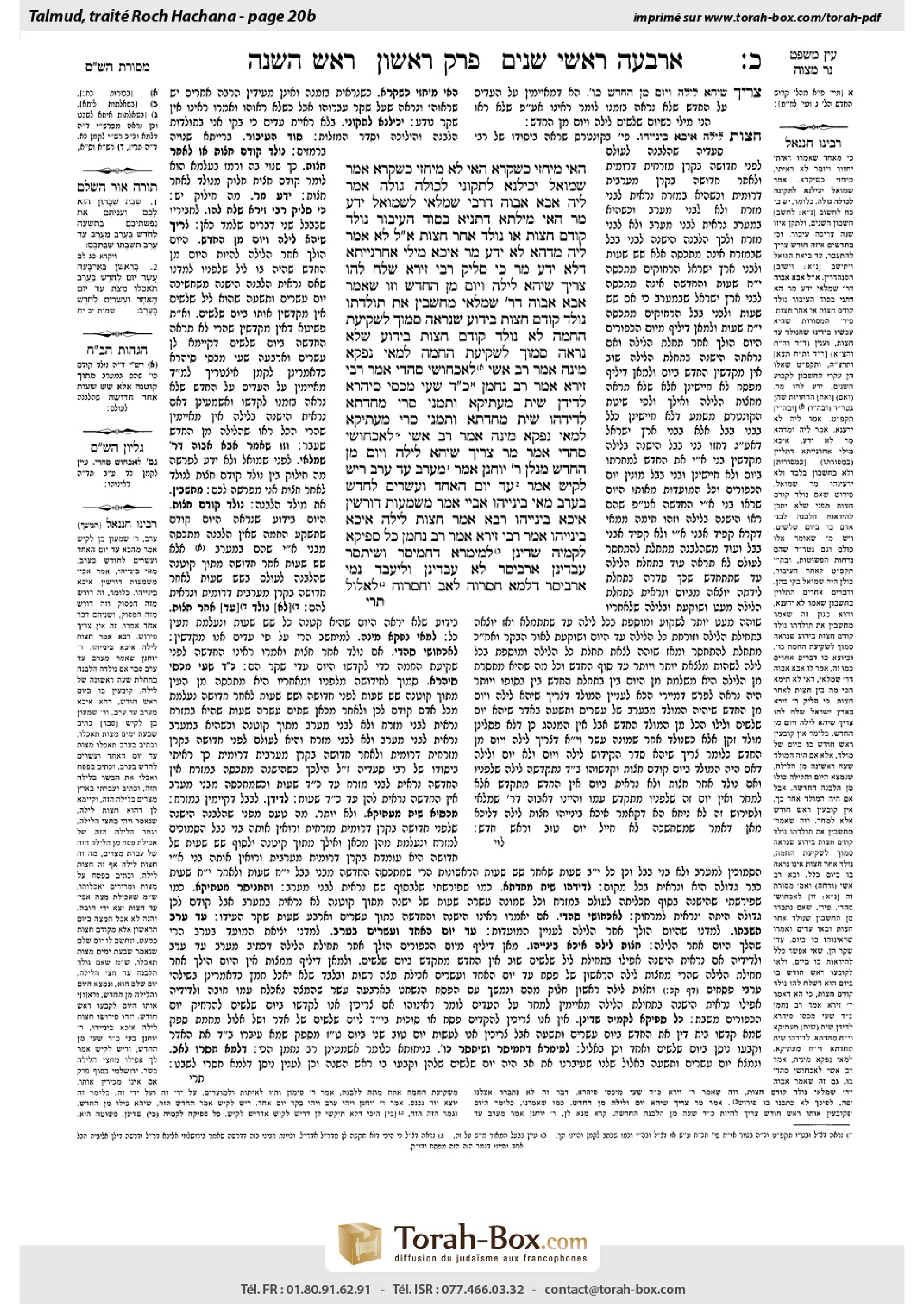
Rosh Hashanah 20b: Talmud study for Daf Yomi
Daf Yomi is the daily study of one Talmud folio. Explore 37 tractates with scans, Hebrew text, Sefaria English and AI-generated French translations where annotated.
Passage selection and English or AI-generated French translation are available where the scan has annotations. Daf Study is independent of Torah-Box and Sefaria.
Browse Rosh Hashanah · ראש השנה · All tractatesRosh Hashanah 20b text and translations
This page of Rosh Hashanah includes the Aramaic text, an English translation and an AI-generated French translation, alongside the scan above.
ראש השנה כ׳ ב · Aramaic and Hebrew text
הַאי מִיחֲזֵי כְּשִׁקְרָא, הַאי לָא מִיחֲזֵי כְּשִׁקְרָא.
אָמַר שְׁמוּאֵל: יָכֵילְנָא לְתַקּוֹנֵי לְכוּלַּהּ גּוֹלָה.
אֲמַר לֵיהּ אַבָּא אֲבוּהּ דְּרַבִּי שִׂמְלַאי לִשְׁמוּאֵל: יָדַע מָר הַאי מִילְּתָא דְּתַנְיָא בְּסוֹד הָעִיבּוּר: נוֹלַד קוֹדֶם חֲצוֹת אוֹ נוֹלַד אַחַר חֲצוֹת? אֲמַר לֵיהּ: לָא. אֲמַר לֵיהּ: מִדְּהָא לָא יָדַע מָר — אִיכָּא מִילֵּי אַחְרָנְיָיתָא דְּלָא יָדַע מָר.
כִּי סְלֵיק רַבִּי זֵירָא, שְׁלַח לְהוּ: צָרִיךְ שֶׁיְּהֵא לַיְלָה וָיוֹם מִן הֶחָדָשׁ.
וְזוֹ שֶׁאָמַר אַבָּא אֲבוּהּ דְּרַבִּי שִׂמְלַאי: מְחַשְּׁבִין אֶת תּוֹלַדְתּוֹ. נוֹלַד קוֹדֶם חֲצוֹת — בְּיָדוּעַ שֶׁנִּרְאָה סָמוּךְ לִשְׁקִיעַת הַחַמָּה. לֹא נוֹלַד קוֹדֶם חֲצוֹת — בְּיָדוּעַ שֶׁלֹּא נִרְאָה סָמוּךְ לִשְׁקִיעַת הַחַמָּה.
לְמַאי נָפְקָא מִינַּהּ? אָמַר רַב אָשֵׁי: לְאַכְחוֹשֵׁי סָהֲדֵי.
אָמַר רַבִּי זֵירָא אָמַר רַב נַחְמָן: עֶשְׂרִים וְאַרְבְּעָה שָׁעֵי מִכַּסֵּי סֵיהֲרָא. לְדִידַן — שֵׁית מֵעַתִּיקָא וְתַמְנֵי סְרֵי מֵחַדְתָּא, לְדִידְהוּ — שֵׁית מֵחַדְתָּא וְתַמְנֵי סְרֵי מֵעַתִּיקָא.
לְמַאי נָפְקָא מִינַּהּ? אָמַר רַב אָשֵׁי: לְאַכְחוֹשֵׁי סָהֲדֵי.
אָמַר מָר: צָרִיךְ שֶׁיְּהֵא לַיְלָה וָיוֹם מִן הֶחָדָשׁ. מְנָלַן? רַבִּי יוֹחָנָן אָמַר: ״מֵעֶרֶב עַד עֶרֶב״.
רֵישׁ לָקִישׁ אָמַר: ״עַד יוֹם הָאֶחָד וְעֶשְׂרִים לַחֹדֶשׁ בָּעָרֶב״.
מַאי בֵּינַיְיהוּ? אַבָּיֵי אָמַר: מַשְׁמָעוּת דּוֹרְשִׁין אִיכָּא בֵּינַיְיהוּ.
רָבָא אָמַר: חֲצוֹת לַיְלָה אִיכָּא בֵּינַיְיהוּ.
אָמַר רַבִּי זֵירָא אָמַר רַב נַחְמָן: כֹּל סְפֵיקָא לְקַמֵּיהּ שָׁדֵינַן. לְמֵימְרָא דַּחֲמֵיסַר וְשִׁיתְּסַר עָבְדִינַן, אַרְבֵּיסַר לָא עָבְדִינַן.
וְלֶיעְבַּד נָמֵי אַרְבֵּיסַר? דִּלְמָא חַסְּרוּהּ לְאָב וְחַסְּרוּהּ לֶאֱלוּל!
Rosh Hashanah 20b · English translation
In this case, where the witnesses withhold testimony about what they saw and the New Moon is pushed off to the next day, it looks like a lie, as the moon might have been seen by others as well, and people will wonder why the New Moon was not sanctified the previous day. In that case, where the witnesses testify about something that they did not see and the New Moon is a day early, it does not look like a lie, as everybody knows that it is possible that only a few people saw the new moon.
§ Shmuel said: I am able to fix the calendar for the entire Diaspora without witnesses. Shmuel was an expert on the movement of the celestial bodies and on the principles governing leap years and additional days added to months.
Abba, the father of Rabbi Simlai, said to Shmuel: Does the Master know the meaning of this statement, as it is taught in a baraita dealing with the secret of addition, which discusses calendric calculations: Differentiate between when the molad occurred before midday and when the molad occurred after midday? He said to him: No, I do not know what this means. He said to him: Since the Master does not know this, there are probably other matters that the Master does not know, and therefore you must not establish a calendar, relying upon calculations that were made based on faulty or insufficient knowledge.
As for the meaning of this obscure baraita, when Rabbi Zeira went up from Babylonia to Eretz Yisrael, he sent back a letter to his colleagues in Babylonia: In order for a day to be sanctified as the New Moon, it is necessary that both the night and the day be of the new month. That is to say, the molad must occur before the beginning of the night.
And this is what Abba, the father of Rabbi Simlai, said: The baraita means as follows: They calculate the molad; if the molad occurred before midday, so that there are at least six more hours left of the day, it is known that the moon will be visible close to sunset. If, however, the molad did not occur before midday, so that there are fewer than six hours left of the day, it is known that the moon will not be visible close to sunset.
The Gemara asks: What is the practical difference that this statement makes? In any case, the court is dependent upon the testimony of witnesses. Rav Ashi said: This information is used to refute the witnesses, as if the witnesses claim that they saw the new moon at a time when it was not visible according to the calculations, they are clearly false witnesses.
Rabbi Zeira said that Rav Naḥman said: For twenty-four hours the moon is covered, i.e., not visible. This occurs between the last sighting of the old moon and the first sighting of the new moon. For us, in Babylonia, it is not visible for six hours of the old moon and eighteen hours of the new; for them, in Eretz Yisrael, it is not visible for six hours of the new moon and eighteen hours of the old.
The Gemara asks: What is the practical difference that this statement makes? Rav Ashi said: It is used to refute the witnesses, as if they testify that they saw two moons, the old and the new, within a single twenty-four hour period, they are certainly false witnesses.
§ The Master said above: In order for a day to be sanctified as the New Moon, it is necessary that both the night and the day be of the new moon. The Gemara asks: From where do we derive this? Rabbi Yoḥanan said: The verse states: “From evening to evening shall you celebrate your Shabbat” (Leviticus 23:32). This teaches that the day follows the night for all the calculations pertaining to the Festivals and New Moons.
Reish Lakish said: It is derived from the verse that states: “In the first month, on the fourteenth day of the month at the evening, you shall eat unleavened bread, until the twenty-first day of the month at the evening” (Exodus 12:18). This teaches that the Festival terminates at the end of the day, and a new day begins in the evening.
The Gemara asks: What is the practical difference between these two derivations? Abaye said: There is no practical difference between them. The interpretation of the meaning of the verse is the difference between them.
Rava said: There is a practical difference between them with regard to the hours before midnight. According to Rabbi Yoḥanan, who derives the halakha from the verse: “From evening to evening,” the previous day ends at nightfall. Therefore, if the new moon was seen only at the beginning of the night of the thirtieth, the thirtieth is not sanctified as the New Moon. However, according to Reish Lakish, who derives the halakha from the verse with regard to Passover: “Until the twenty-first day of the month at the evening,” the moon may be sanctified if it was seen before midnight. Eating unleavened bread on Passover is an obligation only on the first night until midnight. After that time, it is optional. The verse states: “You shall eat unleavened bread, until the twenty-first day of the month at the evening,” implying that it is not obligatory but optional to eat unleavened bread. Since the optional time of eating unleavened bread begins at midnight, after the conclusion of the obligatory time, the conclusion of that time is also at midnight on the twenty-first day. This implies that there is a concept of a day beginning at midnight. Accordingly, if the new moon was seen at the beginning of the night of the thirtieth, the thirtieth can still be sanctified as the New Moon.
§ With regard to the extra Festival day that is observed in the Diaspora, Rabbi Zeira said that Rav Naḥman said: Any time that an extra Festival day is observed out of uncertainty with regard to the calendar, we cast it forward, i.e., it is observed on the following day and not on the preceding day. That is to say, owing to the uncertainty we observe Sukkot in the Diaspora on the fifteenth and the sixteenth of Tishrei, but not on the fourteenth.
The Gemara asks: But why not observe it also on the fourteenth, as perhaps both the month of Av and the month of Elul were made short? In that case, the day that is considered the fourteenth of Tishrei in the Diaspora would actually be the fifteenth of Tishrei, and therefore it should also be observed as Sukkot.
Rosh Hashanah 20b · Traduction française (IA)
Dans ce cas, lorsque les témoins taisent ce qu’ils ont vu et que la nouvelle lune est reportée au lendemain, cela ressemble à un mensonge, car d’autres personnes auraient pu voir la lune elles aussi, et les gens se demanderont pourquoi la nouvelle lune n’a pas été sanctifiée la veille. Dans l’autre cas, lorsque les témoins témoignent d’une chose qu’ils n’ont pas vue et que la nouvelle lune est fixée un jour trop tôt, cela ne ressemble pas à un mensonge, car chacun sait qu’il est possible que seules quelques personnes aient vu la nouvelle lune.
§ Chmouel dit : Je suis capable d’établir le calendrier pour toute la Diaspora sans témoins. Chmouel était expert dans le mouvement des corps célestes et dans les principes régissant les années embolismiques et les jours supplémentaires ajoutés aux mois.
Abba, le père de Rabbi Simlaï, dit à Chmouel : Le Maître connaît-il le sens de cette déclaration, enseignée dans une baraïta traitant du secret de l’ajout, qui porte sur les calculs calendaires : « Distingue le cas où le molad a eu lieu avant midi de celui où le molad a eu lieu après midi » ? Il lui répondit : Non, je ne sais pas ce que cela signifie. Il lui dit : Puisque le Maître ne sait pas cela, il y a probablement d’autres choses qu’il ignore ; tu ne dois donc pas établir un calendrier en te fondant sur des calculs faits à partir de connaissances erronées ou insuffisantes.
Quant au sens de cette baraïta obscure, lorsque Rabbi Zeira monta de Babylonie en Terre d’Israël, il envoya une lettre à ses collègues de Babylonie : pour qu’un jour soit sanctifié comme nouvelle lune, il faut que la nuit et le jour appartiennent tous deux au nouveau mois. Autrement dit, le molad doit avoir lieu avant le début de la nuit.
Et voici ce qu’Abba, le père de Rabbi Simlaï, voulait dire : la baraïta signifie ceci : on calcule le molad ; s’il a eu lieu avant midi, de sorte qu’il reste au moins six heures dans la journée, on sait que la lune sera visible près du coucher du soleil. En revanche, si le molad n’a pas eu lieu avant midi, de sorte qu’il reste moins de six heures dans la journée, on sait que la lune ne sera pas visible près du coucher du soleil.
La Guemara demande : Quelle est la conséquence pratique de cette déclaration ? De toute façon, le tribunal dépend du témoignage des témoins. Rav Achi dit : cette information sert à réfuter les témoins ; si ceux-ci prétendent avoir vu la nouvelle lune à un moment où, selon les calculs, elle n’était pas visible, ce sont manifestement de faux témoins.
Rabbi Zeira dit au nom de Rav Naḥman : pendant vingt-quatre heures, la lune est cachée, c’est-à-dire invisible. Cela se produit entre la dernière apparition de l’ancienne lune et la première apparition de la nouvelle lune. Chez nous, en Babylonie, elle est invisible pendant six heures de l’ancienne lune et dix-huit heures de la nouvelle ; chez eux, en Terre d’Israël, elle est invisible pendant six heures de la nouvelle lune et dix-huit heures de l’ancienne.
La Guemara demande : Quelle est la conséquence pratique de cette déclaration ? Rav Achi dit : elle sert à réfuter les témoins ; s’ils témoignent avoir vu deux lunes, l’ancienne et la nouvelle, au cours d’une même période de vingt-quatre heures, ce sont certainement de faux témoins.
§ Le Maître a dit plus haut : pour qu’un jour soit sanctifié comme nouvelle lune, il faut que la nuit et le jour appartiennent tous deux à la nouvelle lune. La Guemara demande : D’où déduisons-nous cela ? Rabbi Yoḥanan dit : le verset dit : « Du soir au soir, vous célébrerez votre Chabbat » (Lévitique 23, 32). Cela enseigne que, pour tous les calculs relatifs aux fêtes et aux nouvelles lunes, le jour suit la nuit.
Reich Lakich dit : Cela se déduit du verset qui dit : « Le premier mois, le quatorzième jour du mois, au soir, vous mangerez des pains sans levain, jusqu’au vingt et unième jour du mois, au soir » (Exode 12, 18). Cela enseigne que la fête prend fin à la fin du jour et qu’un nouveau jour commence le soir.
La Guemara demande : Quelle est la conséquence pratique de ces deux déductions ? Abayé dit : Elles n’ont aucune différence pratique. Ce qui les distingue, c’est l’interprétation du sens du verset.
Rava dit : Elles diffèrent dans la pratique en ce qui concerne les heures avant minuit. Selon Rabbi Yoḥanan, qui déduit la halakha du verset « Du soir au soir », le jour précédent prend fin à la tombée de la nuit. Par conséquent, si la nouvelle lune n’a été vue qu’au début de la nuit du trentième jour, celui-ci n’est pas sanctifié comme nouvelle lune. En revanche, selon Reich Lakich, qui déduit la halakha du verset relatif à Pessa’h : « jusqu’au vingt et unième jour du mois, au soir », la lune peut être sanctifiée si elle a été vue avant minuit. Manger des pains sans levain à Pessa’h n’est obligatoire que pendant la première nuit, jusqu’à minuit. Après cette heure, c’est facultatif. Le verset dit : « Vous mangerez des pains sans levain, jusqu’au vingt et unième jour du mois, au soir », ce qui implique qu’il n’est pas obligatoire de manger des pains sans levain, mais que cela est facultatif. Puisque la période où il est facultatif de manger des pains sans levain commence à minuit, après la fin de la période où cela est obligatoire, cette dernière période prend elle aussi fin à minuit le vingt et unième jour. Cela implique qu’il existe une notion de jour qui commence à minuit. Ainsi, si la nouvelle lune a été vue au début de la nuit du trentième jour, celui-ci peut encore être sanctifié comme nouvelle lune.
§ À propos du jour supplémentaire de fête observé dans la Diaspora, Rabbi Zeira dit au nom de Rav Naḥman : chaque fois qu’un jour supplémentaire de fête est observé en raison d’une incertitude concernant le calendrier, nous le reportons, c’est-à-dire qu’il est observé le lendemain et non la veille. Autrement dit, en raison de l’incertitude, nous observons Soukkot dans la Diaspora les quinzième et seizième jours de Tichri, mais pas le quatorzième.
La Guemara demande : Mais pourquoi ne pas l’observer aussi le quatorzième jour, puisqu’il se peut que les mois d’Av et d’Éloul aient tous deux été raccourcis ? Dans ce cas, le jour considéré dans la Diaspora comme le quatorzième de Tichri serait en réalité le quinzième de Tichri, et il faudrait donc aussi l’observer comme Soukkot.
Traduction française générée par IA à partir de l’édition anglaise de Sefaria. Vérifie toujours un passage avec le texte source.
Text from Sefaria: William Davidson Edition - Vocalized Aramaic (CC BY NC); William Davidson Edition - English (CC BY NC).