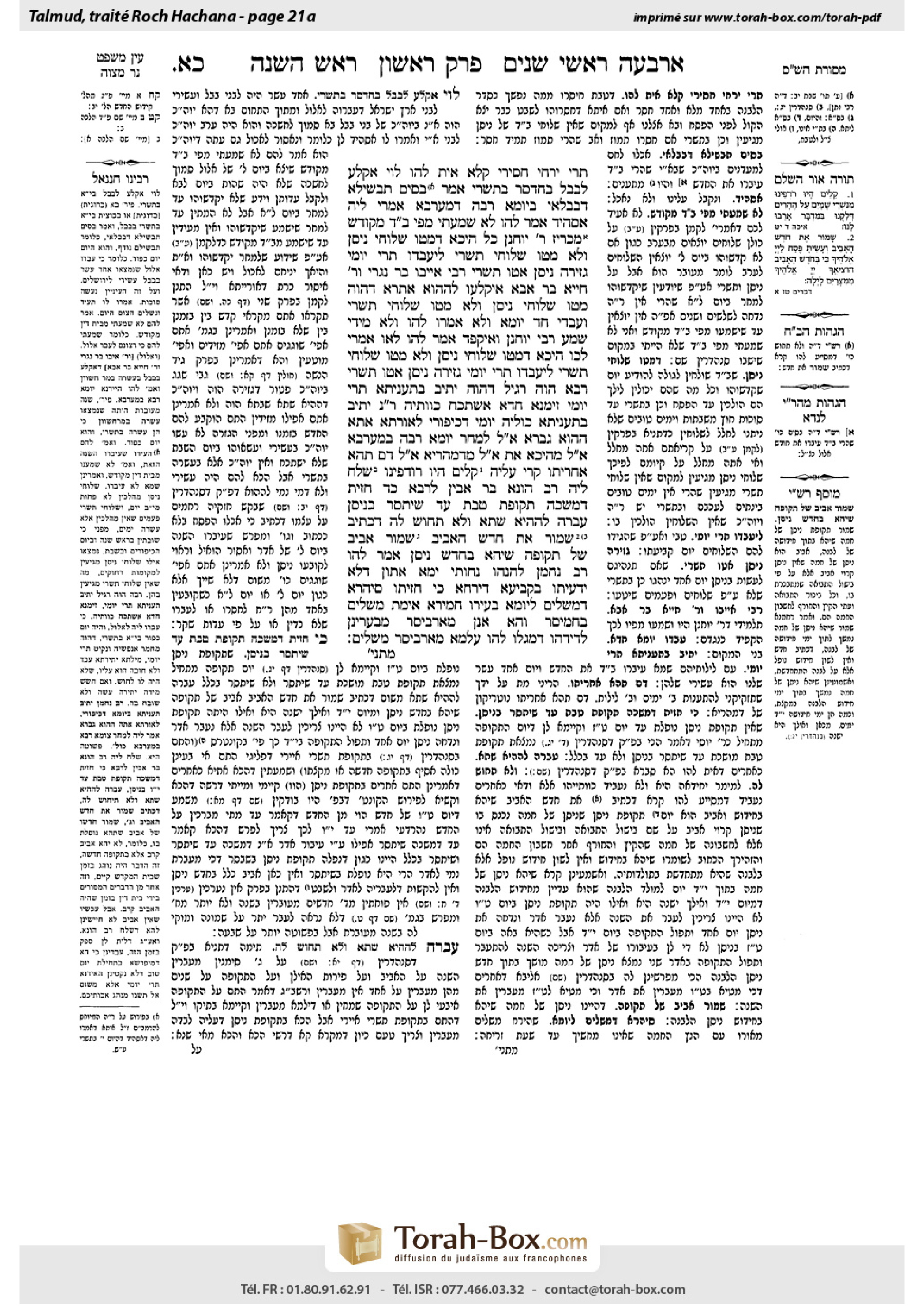
Rosh Hashanah 21a: Talmud study for Daf Yomi
Daf Yomi is the daily study of one Talmud folio. Explore 37 tractates with scans, Hebrew text, Sefaria English and AI-generated French translations where annotated.
Passage selection and English or AI-generated French translation are available where the scan has annotations. Daf Study is independent of Torah-Box and Sefaria.
Browse Rosh Hashanah · ראש השנה · All tractatesRosh Hashanah 21a text and translations
This page of Rosh Hashanah includes the Aramaic text, an English translation and an AI-generated French translation, alongside the scan above.
ראש השנה כ״א א · Aramaic and Hebrew text
תְּרֵי יַרְחֵי חַסִּירֵי קָלָא אִית לְהוּ.
לֵוִי אִקְּלַע לְבָבֶל בְּחַדְסַר בְּתִשְׁרִי. אֲמַר: בְּסִים תַּבְשִׁילָא דְבַבְלָאֵי בְּיוֹמָא רַבָּה דְּמַעְרְבָא. אָמְרִי לֵיהּ: אַסְהֵיד! אֲמַר לְהוּ: לֹא שָׁמַעְתִּי מִפִּי בֵּית דִּין ״מְקוּדָּשׁ״.
מַכְרִיז רַבִּי יוֹחָנָן: כׇּל הֵיכָא דְּמָטוּ שְׁלוּחֵי נִיסָן, וְלָא מָטוּ שְׁלוּחֵי תִּשְׁרֵי — לִיעְבְּדוּ תְּרֵי יוֹמֵי. גְּזֵירָה נִיסָן אַטּוּ תִּשְׁרֵי.
רַבִּי אַיְיבוּ בַּר נַגָּרֵי וְרַבִּי חִיָּיא בַּר אַבָּא אִיקְּלַעוּ לְהָהוּא אַתְרָא דַּהֲוָה מָטוּ שְׁלוּחֵי נִיסָן וְלָא מָטוּ שְׁלוּחֵי תִּשְׁרֵי, וְעָבְדִי חַד יוֹמָא, וְלָא אֲמַרוּ לְהוּ וְלָא מִידֵּי. שְׁמַע רַבִּי יוֹחָנָן וְאִיקְּפַד. אֲמַר לְהוּ: לָאו אֲמַרִי לְכוּ הֵיכָא דְּמָטוּ שְׁלוּחֵי נִיסָן וְלָא מָטוּ שְׁלוּחֵי תִּשְׁרֵי לִיעְבְּדוּ תְּרֵי יוֹמֵי, גְּזֵירָה נִיסָן אַטּוּ תִּשְׁרֵי!
רָבָא הֲוָה רְגִיל דַּהֲוָה יָתֵיב בְּתַעֲנִיתָא תְּרֵי יוֹמֵי. זִימְנָא חֲדָא אִשְׁתְּכַח כְּווֹתֵיהּ.
רַב נַחְמָן יְתֵיב בְּתַעֲנִיתָא כּוּלֵּיהּ יוֹמֵי דְּכִיפּוּרֵי. לְאוּרְתָּא אֲתָא הָהוּא גַּבְרָא, אֲמַר לֵיהּ: לִמְחַר יוֹמָא רַבָּה בְּמַעְרְבָא.
אֲמַר לֵיהּ: מֵהֵיכָא אַתְּ? אֲמַר לֵיהּ: מִדִּמְהַרְיָא. אֲמַר לֵיהּ: דָּם תְּהֵא אַחֲרִיתוֹ. קָרֵי עֲלֵיהּ: ״קַלִּים הָיוּ רוֹדְפֵינוּ״.
שְׁלַח לֵיהּ רַב הוּנָא בַּר אָבִין לְרָבָא: כַּד חָזֵית דְּמָשְׁכָה תְּקוּפַת טֵבֵת עַד שִׁיתְּסַר בְּנִיסָן — עַבְּרַהּ לְהַהִיא שַׁתָּא וְלָא תְּחוּשׁ לַהּ, דִּכְתִיב: ״שָׁמוֹר אֶת חֹדֶשׁ הָאָבִיב״, שְׁמוֹר אָבִיב שֶׁל תְּקוּפָה שֶׁיְּהֵא בְּחֹדֶשׁ נִיסָן.
אֲמַר לְהוּ רַב נַחְמָן לְהָנְהוּ נָחוֹתֵי יַמָּא: אַתּוּן דְּלָא יָדְעִיתוּ בִּקְבִיעָא דְיַרְחָא, כִּי חָזֵיתוּ סֵיהֲרָא דְּמַשְׁלֵים לְיוֹמָא — בַּעִירוּ חֲמִירָא.
אֵימַת מַשְׁלֵים — בַּחֲמֵיסַר. וְהָא אֲנַן מֵאַרְבֵּיסַר מְבַעֲרִינַן! לְדִידְהוּ דִּמְגַלּוּ לְהוּ עָלְמָא, מֵאַרְבֵּיסַר מַשְׁלֵים.
Rosh Hashanah 21a · English translation
The Gemara answers: It is a rare occurrence that two consecutive months are made short, and this would generate publicity, so that everyone would know about it.
§ It was related that Levi once arrived in Babylonia on what was observed there as the eleventh of Tishrei. He said: How tasty is the dish of the Babylonians on the great day of Yom Kippur, as they are observing Yom Kippur in the West, Eretz Yisrael. The month of Elul had been declared full in Eretz Yisrael, and according to the calendar there, it was only the tenth of Tishrei. They said to him: Testify that today is Yom Kippur and we shall observe it. He said to them: I myself did not hear the court proclaim: It is sanctified. Although I know that the month had been declared full, since I did not personally hear the proclamation, I cannot offer direct testimony such that you should change your calculations.
It was further related that Rabbi Yoḥanan used to proclaim: Anywhere that can be reached by the messengers who go out in Nisan in time to inform the people when to observe Passover, but cannot be reached by the messengers sent out in Tishrei, let them also observe the festival of Passover for two days. The messengers did not travel on Rosh HaShana or Yom Kippur, and therefore they could travel three days further in Nisan than in Tishrei. The Sages instituted that two days must be observed in Nisan as a rabbinic decree due to Tishrei, for if they observe Passover for only one day, they will come to observe Sukkot for one day as well, and this they are not permitted to do.
It was reported that Rabbi Aivu bar Naggarei and Rabbi Ḥiyya bar Abba, two disciples of Rabbi Yoḥanan, once arrived in a certain place that could be reached by the messengers who go out in Nisan, but could not be reached by the messengers who go out in Tishrei. And they saw that the locals observed only one day of Passover. They said nothing to them to correct their practice. Rabbi Yoḥanan heard this and he became angry with Rabbi Aivu and Rabbi Ḥiyya, for they had failed to rebuke the people who were acting contrary to Rabbi Yoḥanan’s explicit ruling. He said to them: Did I not say to you that anywhere that can be reached by the messengers sent out in Nisan but not by those sent out in Tishrei must observe two days of Passover, for the Sages instituted a rabbinic decree in Nisan due to Tishrei?
§ The Gemara relates that Rava would regularly sit in observance of the fast of Yom Kippur for two days, in case Elul had been declared a thirty-day month and Yom Kippur should be observed on what was observed in Babylonia as the eleventh of Tishrei. It once happened in accordance with his opinion. Elul had been declared a thirty-day month, and he was the only one who observed Yom Kippur on the correct day.
It was related that Rav Naḥman had once fasted the entire day of Yom Kippur as usual. In the evening, toward the end of his fast, a certain man came and said to him: Tomorrow is the great day, Yom Kippur, in the West, Eretz Yisrael, and it is therefore necessary to fast tomorrow.
Rav Naḥman said to him: From where do you come? He said to him: From a place called Damihareya. He said to him, playing on the name of his place: Blood will be his end, meaning Rav Naḥman’s own end. Due to this information, Rav Naḥman would have to fast two successive days, and thereby suffer greatly, as if his blood were being shed. He read the verse about him: “Our pursuers were swifter than vultures in the sky” (Lamentations 4:19), for had this messenger arrived just a little bit later, they would have eaten and drunk in the meantime.
§ Rav Huna bar Avin sent this instruction to Rava: When you see that, according to your calculations, the season of Tevet, i.e., winter, will extend to the sixteenth of Nisan, and the spring equinox will occur after the sixteenth of Nisan, add an extra month to that year, making it a leap year. And do not worry about finding an additional reason to justify making it a leap year, as it is written: “Observe the month of spring” (Deuteronomy 16:1). That is to say, see to it that the spring of the season, i.e., the spring equinox, is in the new part of Nisan, i.e., the first half, before Passover.
It was related that Rav Naḥman said to those setting out to sea before Nisan: Since you will not know the determination of the first day of the new month, this is what you should do: When you see that the moon sets at daybreak, i.e., that it is visible all night from sundown to sunrise, know that it is the middle of the month of Nisan and burn your leaven.
The Gemara asks: When does the moon set at daybreak? On the fifteenth of the month. But on the fourteenth of Nisan we burn leaven. The Gemara answers: For those out at sea, to whom the world is revealed, to whom the horizon is wide open and clearly visible, the moon completes its course at sunrise already on the fourteenth of the month. They can therefore rely on this sign to establish the date of Passover and the time for burning leaven.
Rosh Hashanah 21a · Traduction française (IA)
La Guemara répond : Il est rare que deux mois consécutifs soient écourtés ; cela ferait donc parler, si bien que tout le monde en serait informé.
§ On rapporte que Levi arriva un jour en Babylonie alors qu’on y observait le onze Tichri. Il dit : « Comme le plat des Babyloniens est savoureux en ce grand jour de Yom Kippour ! » En effet, en Occident, c’est-à-dire en terre d’Israël, on observait Yom Kippour. Le mois d’Eloul avait été déclaré complet en terre d’Israël et, selon leur calendrier, ce n’était que le dix Tichri. Ils lui dirent : « Témoigne qu’aujourd’hui est Yom Kippour et nous l’observerons. » Il leur répondit : « Moi-même, je n’ai pas entendu le tribunal proclamer : “Il est sanctifié.” Bien que je sache que le mois avait été déclaré complet, puisque je n’ai pas personnellement entendu la proclamation, je ne peux pas apporter un témoignage direct qui vous conduirait à modifier vos calculs. »
On rapporte également que Rabbi Yoḥanan avait coutume de proclamer : « Partout où les messagers envoyés en Nissan peuvent parvenir à temps pour informer les gens de la date à laquelle observer Pessa’h, mais où les messagers envoyés en Tichri ne peuvent parvenir, on observera aussi la fête de Pessa’h pendant deux jours. » Les messagers ne voyageaient ni à Roch Hachana ni à Yom Kippour ; ils pouvaient donc parcourir trois jours de chemin de plus en Nissan qu’en Tichri. Les Sages instituèrent que deux jours soient observés en Nissan par décret rabbinique en raison de Tichri : en effet, si l’on n’observait Pessa’h qu’un seul jour, on en viendrait aussi à observer Soukkot un seul jour, ce qui n’est pas permis.
On rapporte que Rabbi Aivu bar Naggarei et Rabbi Ḥiyya bar Abba, deux disciples de Rabbi Yoḥanan, arrivèrent un jour dans un lieu que les messagers envoyés en Nissan pouvaient atteindre, mais pas ceux envoyés en Tichri. Ils virent que les habitants n’observaient Pessa’h qu’un seul jour. Ils ne leur dirent rien pour corriger leur pratique. Rabbi Yoḥanan l’apprit et se mit en colère contre Rabbi Aivu et Rabbi Ḥiyya, car ils avaient omis de réprimander les gens qui agissaient à l’encontre de sa décision explicite. Il leur dit : « Ne vous ai-je pas dit que partout où les messagers envoyés en Nissan peuvent parvenir, mais pas ceux envoyés en Tichri, on doit observer Pessa’h pendant deux jours, car les Sages ont institué en Nissan un décret rabbinique en raison de Tichri ? »
§ La Guemara rapporte que Rava avait coutume de jeûner deux jours pour Yom Kippour, au cas où Eloul aurait été déclaré mois de trente jours et où Yom Kippour aurait dû être observé le jour que l’on observait en Babylonie comme le onze Tichri. Un jour, les choses se passèrent comme il l’avait prévu : Eloul avait été déclaré mois de trente jours, et il fut le seul à observer Yom Kippour le bon jour.
On rapporte que Rav Naḥman avait jeûné toute la journée de Yom Kippour, comme à son habitude. Le soir, vers la fin de son jeûne, un homme vint lui dire : « Demain est le grand jour, Yom Kippour, en Occident, c’est-à-dire en terre d’Israël ; il faut donc jeûner demain. »
Rav Naḥman lui dit : « D’où viens-tu ? » Il lui répondit : « D’un lieu appelé Damihareya. » Jouant sur le nom de ce lieu, Rav Naḥman lui dit : « Le sang sera sa fin », c’est-à-dire la fin de Rav Naḥman lui-même. À cause de cette information, Rav Naḥman devrait jeûner deux jours de suite et souffrir terriblement, comme si son sang était versé. Il cita à son sujet le verset : « Nos poursuivants étaient plus rapides que les vautours du ciel » (Lamentations 4:19), car si ce messager était arrivé ne serait-ce qu’un peu plus tard, ils auraient mangé et bu entre-temps.
§ Rav Huna bar Avin adressa cette instruction à Rava : « Lorsque tu verras, d’après tes calculs, que la saison de Tevet, c’est-à-dire l’hiver, s’étendra jusqu’au seize Nissan et que l’équinoxe de printemps aura lieu après le seize Nissan, ajoute un mois à cette année pour en faire une année embolismique. Ne t’inquiète pas de devoir trouver une raison supplémentaire pour justifier cette décision, car il est écrit : “Observe le mois du printemps” (Deutéronome 16:1). Autrement dit, veille à ce que le printemps de la saison, c’est-à-dire l’équinoxe de printemps, tombe dans la partie nouvelle de Nissan, c’est-à-dire sa première moitié, avant Pessa’h. »
On rapporte que Rav Naḥman dit à ceux qui prenaient la mer avant Nissan : « Puisque vous ne connaîtrez pas la détermination du premier jour du nouveau mois, voici ce que vous devez faire : lorsque vous verrez la lune se coucher à l’aube, c’est-à-dire qu’elle sera visible toute la nuit, du coucher au lever du soleil, sachez que c’est le milieu du mois de Nissan et brûlez votre ḥamets. »
La Guemara demande : Quand la lune se couche-t-elle à l’aube ? Le quinze du mois. Or, c’est le quatorze Nissan que l’on brûle le ḥamets. La Guemara répond : Pour ceux qui sont en mer, à qui le monde se dévoile et dont l’horizon est largement ouvert et clairement visible, la lune achève déjà sa course au lever du soleil le quatorze du mois. Ils peuvent donc se fier à ce signe pour déterminer la date de Pessa’h et le moment où brûler le ḥamets.
Traduction française générée par IA à partir de l’édition anglaise de Sefaria. Vérifie toujours un passage avec le texte source.
Text from Sefaria: William Davidson Edition - Vocalized Aramaic (CC BY NC); William Davidson Edition - English (CC BY NC).