Rosh Hashanah 2a: Talmud study for Daf Yomi
Daf Yomi is the daily study of one Talmud folio. Explore 37 tractates with scans, Hebrew text, Sefaria English and AI-generated French translations where annotated.
Passage selection and English or AI-generated French translation are available where the scan has annotations. Daf Study is independent of Torah-Box and Sefaria.
Browse Rosh Hashanah · ראש השנה · All tractatesRosh Hashanah 2a text and translations
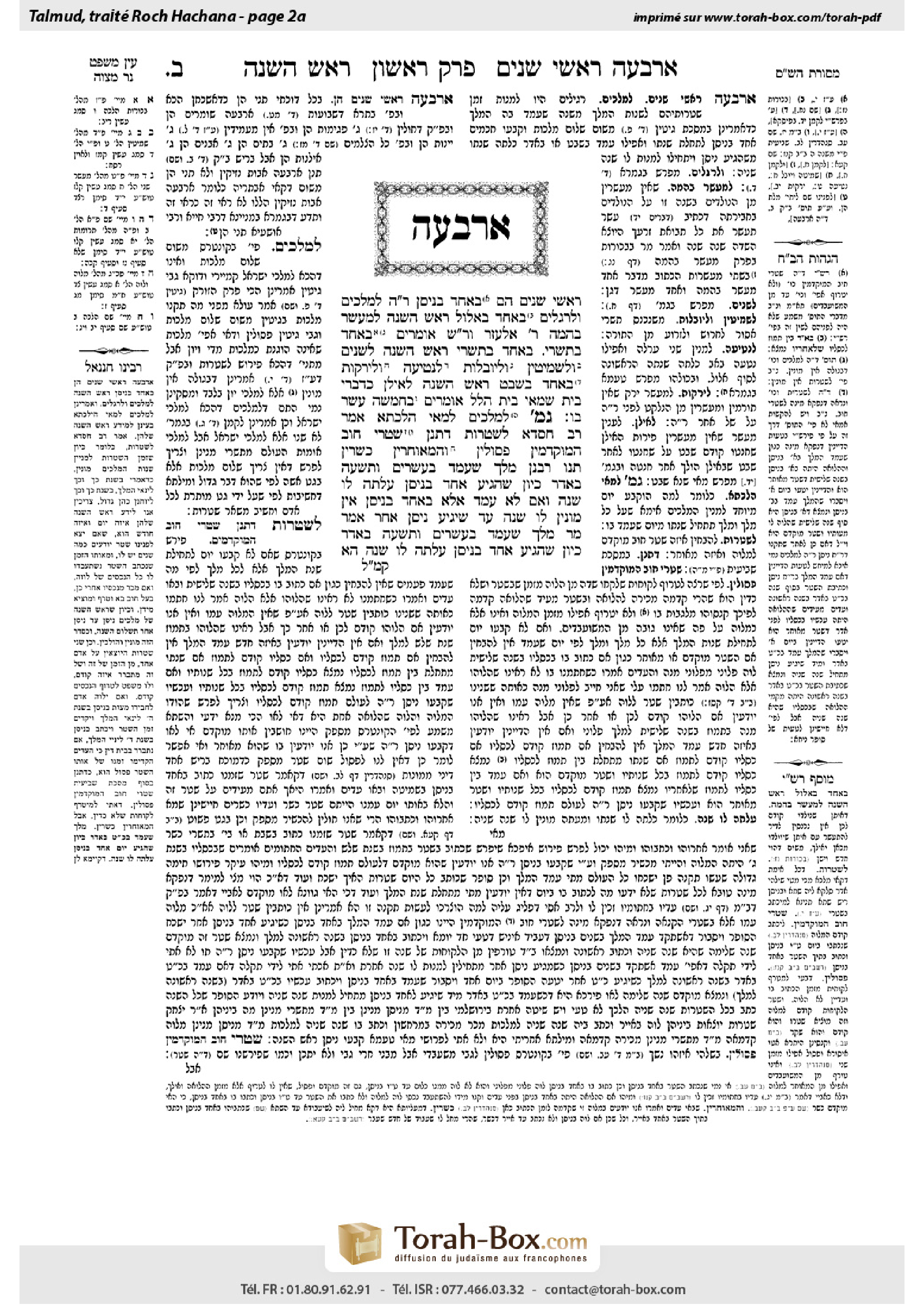
This page of Rosh Hashanah includes the Aramaic text, an English translation and an AI-generated French translation, alongside the scan above.
ראש השנה ב׳ א · Aramaic and Hebrew text
אַרְבָּעָה רָאשֵׁי שָׁנִים הֵם, בְּאֶחָד בְּנִיסָן — רֹאשׁ הַשָּׁנָה לַמְּלָכִים וְלָרְגָלִים.
בְּאֶחָד בֶּאֱלוּל — רֹאשׁ הַשָּׁנָה לְמַעְשַׂר בְּהֵמָה. רַבִּי אֶלְעָזָר וְרַבִּי שִׁמְעוֹן אוֹמְרִים: בְּאֶחָד בְּתִשְׁרִי.
בְּאֶחָד בְּתִשְׁרִי — רֹאשׁ הַשָּׁנָה לַשָּׁנִים וְלַשְּׁמִיטִּין וְלַיּוֹבְלוֹת, לִנְטִיעָה וְלִירָקוֹת.
בְּאֶחָד בִּשְׁבָט — רֹאשׁ הַשָּׁנָה לָאִילָן כְּדִבְרֵי בֵּית שַׁמַּאי. בֵּית הִלֵּל אוֹמְרִים: בַּחֲמִשָּׁה עָשָׂר בּוֹ.
גְּמָ׳ לַמְּלָכִים, לְמַאי הִלְכְתָא? אָמַר רַב חִסְדָּא: לִשְׁטָרוֹת.
דִּתְנַן: שִׁטְרֵי חוֹב הַמּוּקְדָּמִין — פְּסוּלִין, וְהַמְאוּחָרִין — כְּשֵׁרִין.
תָּנוּ רַבָּנַן: מֶלֶךְ שֶׁעָמַד בְּעֶשְׂרִים וְתִשְׁעָה בַּאֲדָר, כֵּיוָן שֶׁהִגִּיעַ אֶחָד בְּנִיסָן — עָלְתָה לוֹ שָׁנָה. וְאִם לֹא עָמַד אֶלָּא בְּאֶחָד בְּנִיסָן — אֵין מוֹנִין לוֹ שָׁנָה עַד שֶׁיַּגִּיעַ נִיסָן אַחֵר.
אָמַר מָר: מֶלֶךְ שֶׁעָמַד בְּעֶשְׂרִים וְתִשְׁעָה בַּאֲדָר, כֵּיוָן שֶׁהִגִּיעַ אֶחָד בְּנִיסָן — עָלְתָה לוֹ שָׁנָה. הָא
Rosh Hashanah 2a · English translation
MISHNA: They are four days in the year that serve as the New Year, each for a different purpose: On the first of Nisan is the New Year for kings; it is from this date that the years of a king’s rule are counted. And the first of Nisan is also the New Year for the order of the Festivals, as it determines which is considered the first Festival of the year and which the last.
On the first of Elul is the New Year for animal tithes; all the animals born prior to that date belong to the previous tithe year and are tithed as a single unit, whereas those born after that date belong to the next tithe year. Rabbi Elazar and Rabbi Shimon say: The New Year for animal tithes is on the first of Tishrei.
On the first of Tishrei is the New Year for counting years, as will be explained in the Gemara; for calculating Sabbatical Years and Jubilee Years, i.e., from the first of Tishrei there is a biblical prohibition to work the land during these years; for planting, for determining the years of orla, the three-year period from when a tree has been planted during which time its fruit is forbidden; and for tithing vegetables, as vegetables picked prior to that date cannot be tithed together with vegetables picked after that date.
On the first of Shevat is the New Year for the tree; the fruit of a tree that was formed prior to that date belong to the previous tithe year and cannot be tithed together with fruit that was formed after that date; this ruling is in accordance with the statement of Beit Shammai. But Beit Hillel say: The New Year for trees is on the fifteenth of Shevat.
GEMARA: The New Year for kings; with regard to what halakha is it mentioned in the mishna? Why is it necessary to set a specific date to count the years of a king’s rule, rather than counting them from the day that he ascends to the throne? Rav Ḥisda said: It is for determining the validity of documents.
It was the common practice to date documents in accordance with the years of the king’s rule; therefore, it was important that these years begin at a fixed time, so that one knows whether a particular document was antedated or postdated, as we learned in a mishna: Antedated promissory notes, i.e., promissory notes dated prior to the date on which the loan actually took place, are invalid because a loan document creates a lien on the borrower’s property. By dating the document earlier than the loan itself, the lender has a fraudulent mortgage on the property, which can be used against any future purchaser. Therefore, the Sages ordained that an antedated promissory note does not establish a lien, even from the true date of the loan. But postdated promissory notes bearing a date that is later than the date when the loan actually took place are valid, as postdating the note presents no opportunity for defrauding a purchaser.
The Sages taught in a baraita: If a king ascended to the throne on the twenty-ninth of Adar, the month preceding Nisan, once the first of Nisan arrives, although he reigned for only one day, a year is counted toward his reign; his first year of rule is completed from the first of Nisan. But if he ascended to the throne only on the first of Nisan, one counts an additional year toward his reign only when the next Nisan arrives.
The Master said, citing the baraita: If a king ascended to the throne on the twenty-ninth of Adar, once the first of Nisan arrives a year is counted toward his reign. The Gemara comments: This
Rosh Hashanah 2a · Traduction française (IA)
Michna : Il y a quatre dates dans l’année qui servent de nouvel an, chacune à une fin différente. Le premier Nissan est le nouvel an des rois : c’est à partir de cette date que l’on compte les années du règne d’un roi. Le premier Nissan est également le nouvel an pour l’ordre des fêtes, car il détermine quelle fête est considérée comme la première de l’année et laquelle en est la dernière.
Le premier Eloul est le nouvel an pour la dîme des animaux : tous les animaux nés avant cette date relèvent de l’année de dîme précédente et sont soumis à la dîme comme un seul ensemble, tandis que ceux nés après cette date relèvent de l’année de dîme suivante. Rabbi Elazar et Rabbi Shimon disent : Le nouvel an pour la dîme des animaux est le premier Tichri.
Le premier Tichri est le nouvel an pour le décompte des années, comme l’expliquera la Guemara ; pour le calcul des années sabbatiques et des années de jubilé — c’est-à-dire qu’à partir du premier Tichri, il est interdit par la Torah de travailler la terre pendant ces années — ; pour les plantations, afin de déterminer les années d’orla, période de trois ans à compter de la plantation d’un arbre durant laquelle ses fruits sont interdits ; et pour la dîme des légumes, car ceux récoltés avant cette date ne peuvent pas être soumis à la dîme avec ceux récoltés après cette date.
Le premier Chevat est le nouvel an de l’arbre : les fruits qui se sont formés avant cette date relèvent de l’année de dîme précédente et ne peuvent pas être soumis à la dîme avec les fruits qui se sont formés après cette date. Cette règle est conforme à l’opinion de Beit Shammaï. Mais Beit Hillel disent : Le nouvel an des arbres est le quinze Chevat.
Guemara : Le nouvel an des rois : à quelle halakha la Michna fait-elle référence ? Pourquoi est-il nécessaire de fixer une date précise pour compter les années du règne d’un roi, au lieu de les compter à partir du jour où il monte sur le trône ? Rav Ḥisda dit : Cela sert à déterminer la validité des actes.
Il était d’usage de dater les actes selon les années du règne du roi. Il était donc important que ces années commencent à une date fixe, afin de savoir si un acte donné avait été antidaté ou postdaté, comme nous l’avons appris dans une Michna : Les reconnaissances de dette antidatées, c’est-à-dire portant une date antérieure à celle à laquelle le prêt a réellement été consenti, sont invalides, car un acte de prêt crée un droit de gage sur les biens de l’emprunteur. En datant l’acte d’avant le prêt lui-même, le prêteur obtient frauduleusement une sûreté sur les biens, qu’il peut opposer à tout acquéreur ultérieur. Les Sages ont donc décrété qu’une reconnaissance de dette antidatée ne crée aucun droit de gage, même à compter de la date réelle du prêt. En revanche, les reconnaissances de dette postdatées, portant une date postérieure à celle à laquelle le prêt a réellement été consenti, sont valides, car la postdatation de l’acte ne permet pas de tromper un acquéreur.
Les Sages ont enseigné dans une baraïta : Si un roi est monté sur le trône le vingt-neuf Adar, le mois qui précède Nissan, dès que le premier Nissan arrive, une année de règne lui est comptée, bien qu’il n’ait régné qu’un seul jour ; sa première année de règne s’achève à partir du premier Nissan. Mais s’il n’est monté sur le trône que le premier Nissan, une année supplémentaire de règne ne lui est comptée qu’à l’arrivée du Nissan suivant.
Le Maître a dit, en citant la baraïta : Si un roi est monté sur le trône le vingt-neuf Adar, dès que le premier Nissan arrive, une année de règne lui est comptée. La Guemara fait remarquer : Cela
Traduction française générée par IA à partir de l’édition anglaise de Sefaria. Vérifie toujours un passage avec le texte source.
Text from Sefaria: William Davidson Edition - Vocalized Aramaic (CC BY NC); William Davidson Edition - English (CC BY NC).