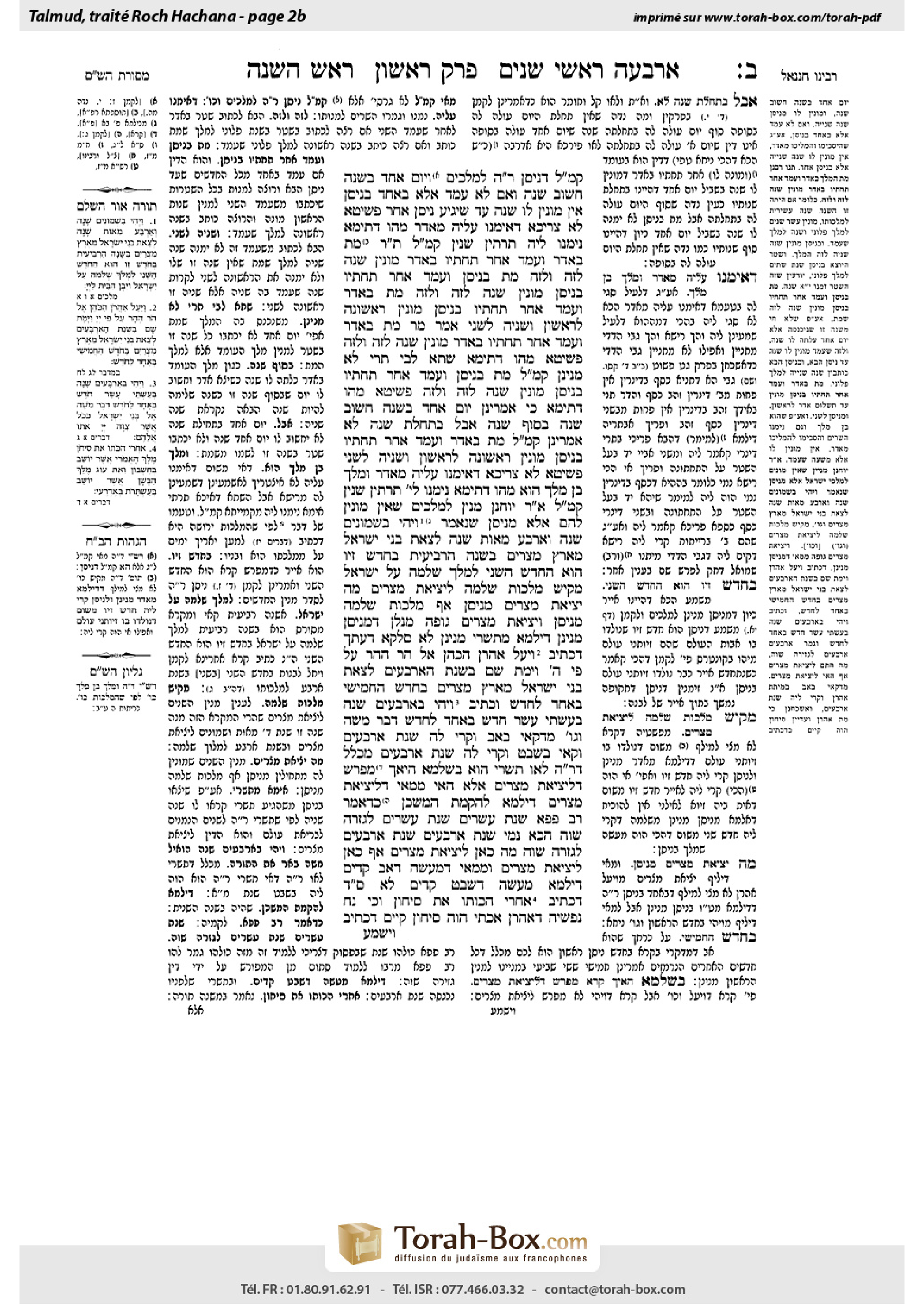
Rosh Hashanah 2b: Talmud study for Daf Yomi
Daf Yomi is the daily study of one Talmud folio. Explore 37 tractates with scans, Hebrew text, Sefaria English and AI-generated French translations where annotated.
Passage selection and English or AI-generated French translation are available where the scan has annotations. Daf Study is independent of Torah-Box and Sefaria.
Browse Rosh Hashanah · ראש השנה · All tractatesRosh Hashanah 2b text and translations
This page of Rosh Hashanah includes the Aramaic text, an English translation and an AI-generated French translation, alongside the scan above.
ראש השנה ב׳ ב · Aramaic and Hebrew text
קָא מַשְׁמַע לַן דְּנִיסָן רֹאשׁ הַשָּׁנָה לִמְלָכִים, וְיוֹם אֶחָד בַּשָּׁנָה חָשׁוּב שָׁנָה. וְאִם לֹא עָמַד אֶלָּא בְּאֶחָד בְּנִיסָן, אֵין מוֹנִין לוֹ שָׁנָה עַד שֶׁיַּגִּיעַ נִיסָן אַחֵר. פְּשִׁיטָא!
לָא צְרִיכָא, דְּאִימְּנוֹ עֲלֵיהּ מֵאֲדָר. מַהוּ דְּתֵימָא, נִימְנוֹ לֵיהּ תַּרְתֵּין שְׁנִין, קָא מַשְׁמַע לַן.
תָּנוּ רַבָּנַן: מֵת בַּאֲדָר וְעָמַד אַחֵר תַּחְתָּיו בַּאֲדָר — מוֹנִין שָׁנָה לְזֶה וְלָזֶה. מֵת בְּנִיסָן וְעָמַד אַחֵר תַּחְתָּיו בְּנִיסָן — מוֹנִין שָׁנָה לְזֶה וְלָזֶה. מֵת בַּאֲדָר וְעָמַד אַחֵר תַּחְתָּיו בְּנִיסָן — מוֹנִין רִאשׁוֹנָה לָרִאשׁוֹן, וּשְׁנִיָּה לַשֵּׁנִי.
אָמַר מַר: מֵת בַּאֲדָר וְעָמַד אַחֵר תַּחְתָּיו בַּאֲדָר — מוֹנִין שָׁנָה לְזֶה וְלָזֶה. פְּשִׁיטָא! מַהוּ דְּתֵימָא: שַׁתָּא לְבֵי תְרֵי לָא מָנִינַן, קָא מַשְׁמַע לַן.
מֵת בְּנִיסָן וְעָמַד אַחֵר תַּחְתָּיו בְּנִיסָן — מוֹנִין שָׁנָה לְזֶה וְלָזֶה. פְּשִׁיטָא! מַהוּ דְּתֵימָא: כִּי אָמְרִינַן יוֹם אֶחָד בַּשָּׁנָה חָשׁוּב שָׁנָה — בְּסוֹף שָׁנָה. אֲבָל בִּתְחִלַּת שָׁנָה — לָא אָמְרִינַן, קָא מַשְׁמַע לַן.
מֵת בַּאֲדָר וְעָמַד אַחֵר תַּחְתָּיו בְּנִיסָן — מוֹנִין רִאשׁוֹנָה לָרִאשׁוֹן וּשְׁנִיָּה לַשֵּׁנִי. פְּשִׁיטָא! לָא צְרִיכָא, דְּאִימְּנוֹ עֲלֵיהּ מֵאֲדָר, וּמֶלֶךְ בֶּן מֶלֶךְ הוּא, מַהוּ דְּתֵימָא: נִימְנוֹ לֵיהּ תַּרְתֵּין שְׁנִין, קָא מַשְׁמַע לַן.
אָמַר רַבִּי יוֹחָנָן: מִנַּיִן לַמְּלָכִים שֶׁאֵין מוֹנִין לָהֶם אֶלָּא מִנִּיסָן — שֶׁנֶּאֱמַר: ״וַיְהִי בִשְׁמוֹנִים שָׁנָה וְאַרְבַּע מֵאוֹת שָׁנָה לְצֵאת בְּנֵי יִשְׂרָאֵל מֵאֶרֶץ מִצְרַיִם בַּשָּׁנָה הָרְבִיעִית בְּחֹדֶשׁ זִיו הוּא הַחֹדֶשׁ הַשֵּׁנִי לִמְלֹךְ שְׁלֹמֹה עַל יִשְׂרָאֵל״. מַקִּישׁ מַלְכוּת שְׁלֹמֹה לִיצִיאַת מִצְרַיִם: מָה יְצִיאַת מִצְרַיִם מִנִּיסָן — אַף מַלְכוּת שְׁלֹמֹה מִנִּיסָן.
וִיצִיאַת מִצְרַיִם גּוּפַהּ מְנָלַן דְּמִנִּיסָן מָנִינַן? דִּילְמָא מִתִּשְׁרִי מָנִינַן!
לָא סָלְקָא דַּעְתָּךְ, דִּכְתִיב: ״וַיַּעַל אַהֲרֹן הַכֹּהֵן אֶל הֹר הָהָר עַל פִּי ה׳ וַיָּמׇת שָׁם בִּשְׁנַת הָאַרְבָּעִים לְצֵאת בְּנֵי יִשְׂרָאֵל מֵאֶרֶץ מִצְרַיִם בַּחֹדֶשׁ הַחֲמִישִׁי בְּאֶחָד לַחֹדֶשׁ״, וּכְתִיב: ״וַיְהִי בְּאַרְבָּעִים שָׁנָה בְּעַשְׁתֵּי עָשָׂר חֹדֶשׁ בְּאֶחָד לַחֹדֶשׁ דִּבֶּר מֹשֶׁה וְגוֹ׳״. מִדְּקָאֵי בְּאָב וְקָרֵי לַהּ ״שְׁנַת אַרְבָּעִים״, וְקָאֵי בִּשְׁבָט וְקָרֵי לַהּ ״שְׁנַת אַרְבָּעִים״ — מִכְּלָל דְּרֹאשׁ הַשָּׁנָה לָאו תִּשְׁרֵי הוּא.
בִּשְׁלָמָא הַיְאךְ — מְפָרֵשׁ דְּלִיצִיאַת מִצְרַיִם, אֶלָּא הַאי, מִמַּאי דְּלִיצִיאַת מִצְרַיִם, דִּילְמָא לַהֲקָמַת הַמִּשְׁכָּן?
כִּדְאָמַר רַב פָּפָּא: ״שְׁנַת עֶשְׂרִים״ ״שְׁנַת עֶשְׂרִים״ — לִגְזֵרָה שָׁוָה, הָכָא נָמֵי: ״שְׁנַת אַרְבָּעִים״ ״שְׁנַת אַרְבָּעִים״ — לִגְזֵרָה שָׁוָה: מָה כָּאן לִיצִיאַת מִצְרַיִם — אַף כָּאן לִיצִיאַת מִצְרַיִם.
וּמִמַּאי דְּמַעֲשֶׂה דְּאָב קָדֵים, דִּילְמָא מַעֲשֶׂה דִּשְׁבָט קָדֵים!
לָא סָלְקָא דַּעְתָּךְ, דִּכְתִיב: ״אַחֲרֵי הַכֹּתוֹ אֶת סִיחוֹן״, וְכִי נָח נַפְשֵׁיהּ דְּאַהֲרֹן אַכַּתִּי הֲוָה סִיחוֹן קַיָּים, דִּכְתִיב:
Rosh Hashanah 2b · English translation
teaches us that Nisan is the New Year for kings, and it also teaches us that one day in a year is considered a year; although this king ruled for only one day, a full year is counted toward his reign. The Gemara asks: Consider the next clause of the baraita: But if he ascended to the throne only on the first of Nisan, a year is not counted toward his reign until the next first of Nisan arrives. Isn’t this obvious?
The Gemara explains: No, it is necessary for a case where the princes agreed to appoint him as king already in the month of Adar. Lest you say that since the decision to appoint him king was made already in Adar, once the first of Nisan arrives they should count it the second year of his reign, therefore the baraita teaches us that the count begins only from when he actually began his rule.
§ The Sages taught in a baraita: If the king died in the month of Adar and another king succeeded him to the throne in that same Adar, one counts the year to this one, i.e., the previous king, as his final year, and to that one, i.e., the new king who began his reign in Adar. If the first king died in the month of Nisan and another king succeeded him in that same Nisan, one counts the year to this one, the previous king, and to that one, the new king. But if the first king died in Adar and another king succeeded him in Nisan, one counts the first year to the first king as his final year, and the second year to the second king as the first year of his reign.
The Master said: If the king died in Adar and another king succeeded him to the throne in that same Adar, one counts the year to this one, i.e., the previous king, as his final year, and to that one, i.e., the new king, as the first year of his reign. The Gemara asks: Isn’t this obvious? The Gemara explains: Lest you say that one year cannot be counted toward two kings, and so the entire year should be counted only toward the previous king, the baraita therefore teaches us that the years of two kings can overlap and be counted in a single year.
The Gemara cites the next phrase of the baraita: If the first king died in Nisan and another king succeeded him in that same Nisan, one counts the year to this one, the previous king, and to that one, the new king. The Gemara asks: Isn’t this obvious? The Gemara explains: Lest you say that when we say that one day in a year is considered a full year, this only applies when the day is at the end of the year, i.e., since his reign will continue in the coming year the day is considered like a whole year, but if the day is at the beginning of the year we should not say that the beginning of Nisan is counted as another year for the previous king; therefore, it teaches us that there is no such a distinction.
It was further taught in the baraita: But if the first king died in Adar and another king succeeded him in Nisan, one counts the first year to the first king as his final year, and the second year to the second king as the first year of his reign. The Gemara asks: Isn’t this obvious? The Gemara explains: No, it is necessary for a case where the princes decided to appoint him as king in Adar, and he is also a king, son of the previous king, so that his succession to the throne is automatic. Lest you say that by the time the first of Nisan arrives, two years should be counted toward his reign, it therefore teaches us that one counts only from Nisan, when he actually succeeded his father to the throne.
§ Rabbi Yoḥanan said: From where is it derived that one counts the years of kings’ reigns only from Nisan? As it is stated: “And it came to pass in the four hundred and eightieth year after the children of Israel were come out of the land of Egypt, in the fourth year of Solomon’s reign over Israel, in the month Ziv, which is the second month, that he began to build the house of the Lord” (I Kings 6:1). This verse juxtaposes the reign of Solomon to the exodus from Egypt: Just as one counts the years since the exodus from Egypt from Nisan, when the Jewish people left Egypt, so too, one counts the years of Solomon’s reign from Nisan.
The Gemara asks: And from where do we derive that we count the years from the exodus from Egypt themselves from Nisan? Perhaps we count them from Tishrei.
The Gemara answers: It should not enter your mind to say this, as it is written: “And Aaron the priest went up to Mount Hor at the commandment of the Lord, and died there, in the fortieth year after the children of Israel were come out of the land of Egypt, in the fifth month, on the first day of the month” (Numbers 33:38), and it is later written: “And it came to pass in the fortieth year, in the eleventh month, on the first of the month, that Moses spoke to the children of Israel” (Deuteronomy 1:3). From the fact that when the Bible speaks of the month of Av, which is the fifth month, it calls that year “the fortieth year,” and when it speaks of the following Shevat, it also calls that year “the fortieth year,” the implication is that the New Year does not begin in Tishrei. Were it the case that the New Year begins in Tishrei, Av and the following Shevat would not be in the same year because the year would have changed in Tishrei.
The Gemara raises an objection: Granted, in this case of Aaron’s death it is explicitly stated that the year is counted from the exodus from Egypt, as it states: “In the fortieth year after the children of Israel were come out of the land of Egypt.” But with regard to this other incident of Moses’ oration, from where is it known that the year is counted from the exodus from Egypt? Perhaps it is forty years since the establishment of the Tabernacle in the wilderness.
The Gemara answers: In accordance with what Rav Pappa said in a different context, that the meaning of one instance of the expression “the twentieth year” may be inferred from another instance of the expression “the twentieth year” by way of a verbal analogy, here too, the meaning of one instance of the expression “the fortieth year” may be inferred from another instance of the expression “the fortieth year” by way of a verbal analogy: Just as here, with regard to Aaron’s death, the count is from the exodus from Egypt, so too, here, with regard to Moses’ oration, although this is not stated explicitly, the count is from the exodus from Egypt.
The Gemara raises another question: Even if this serves as proof that these two events both took place in the fortieth year from the exodus from Egypt, from where is it known that the incident of Aaron’s death in Av took place first? Perhaps the incident of Moses’ oration in Shevat took place first, in which case it is possible that the years from the Exodus are counted not from Nisan, but from Tishrei.
The Gemara rejects this argument: It should not enter your mind to say this, as it is written that Moses delivered his oration “after he had slain Sihon” (Deuteronomy 1:4), and when Aaron died Sihon was still alive, as it is written:
Rosh Hashanah 2b · Traduction française (IA)
Cela nous enseigne que Nissan est le Nouvel An des rois, et aussi qu’un seul jour compte comme une année entière : bien que ce roi n’ait régné qu’un seul jour, une année entière est comptée dans la durée de son règne. La Guemara demande : Considérons la clause suivante de la baraïta : « Mais s’il n’est monté sur le trône que le premier Nissan, une année ne sera comptée dans la durée de son règne qu’à l’arrivée du premier Nissan suivant. » N’est-ce pas évident ?
La Guemara explique : Non, cela est nécessaire dans le cas où les princes avaient convenu de le nommer roi dès le mois d’Adar. De peur que l’on dise que, puisque la décision de le nommer roi avait déjà été prise en Adar, à l’arrivée du premier Nissan, on devrait compter la deuxième année de son règne, la baraïta nous enseigne que le décompte ne commence qu’au moment où il a effectivement commencé à régner.
§ Les Sages ont enseigné dans une baraïta : Si le roi mourut au mois d’Adar et qu’un autre roi lui succéda sur le trône au cours de ce même mois, on compte l’année pour celui-ci, c’est-à-dire le roi précédent, comme sa dernière année, et pour celui-là, c’est-à-dire le nouveau roi qui commença son règne en Adar, comme sa première année. Si le premier roi mourut au mois de Nissan et qu’un autre roi lui succéda au cours de ce même mois, on compte l’année pour celui-ci, le roi précédent, et pour celui-là, le nouveau roi. Mais si le premier roi mourut en Adar et qu’un autre roi lui succéda en Nissan, on compte la première année pour le premier roi comme sa dernière année, et la deuxième année pour le second roi comme la première année de son règne.
Le Maître a dit : Si le roi mourut en Adar et qu’un autre roi lui succéda sur le trône au cours de ce même mois, on compte l’année pour celui-ci, c’est-à-dire le roi précédent, comme sa dernière année, et pour celui-là, c’est-à-dire le nouveau roi, comme la première année de son règne. La Guemara demande : N’est-ce pas évident ? La Guemara explique : De peur que l’on dise qu’une même année ne peut être comptée pour deux rois et que l’année entière doit donc être comptée uniquement pour le roi précédent, la baraïta nous enseigne que les règnes de deux rois peuvent se chevaucher et être comptabilisés au cours d’une même année.
La Guemara cite la phrase suivante de la baraïta : Si le premier roi mourut en Nissan et qu’un autre roi lui succéda au cours de ce même mois, on compte l’année pour celui-ci, le roi précédent, et pour celui-là, le nouveau roi. La Guemara demande : N’est-ce pas évident ? La Guemara explique : De peur que l’on dise que, lorsque nous affirmons qu’un seul jour de l’année compte comme une année entière, cela ne s’applique que lorsque ce jour se trouve à la fin de l’année — c’est-à-dire que, puisque son règne se poursuivra l’année suivante, ce jour est considéré comme une année entière —, mais que, si le jour se trouve au début de l’année, il ne faut pas considérer le début de Nissan comme une année supplémentaire pour le roi précédent ; la baraïta nous enseigne donc qu’il n’y a pas de distinction de ce genre.
La baraïta enseigne encore : Mais si le premier roi mourut en Adar et qu’un autre roi lui succéda en Nissan, on compte la première année pour le premier roi comme sa dernière année, et la deuxième année pour le second roi comme la première année de son règne. La Guemara demande : N’est-ce pas évident ? La Guemara explique : Non, cela est nécessaire dans le cas où les princes décidèrent de le nommer roi en Adar et où il est également le fils du roi précédent, de sorte que sa succession au trône est automatique. De peur que l’on dise qu’à l’arrivée du premier Nissan, deux années devraient être comptées dans la durée de son règne, la baraïta nous enseigne que l’on ne compte qu’à partir de Nissan, lorsqu’il succéda effectivement à son père sur le trône.
§ Rabbi Yoḥanan a dit : D’où déduit-on que les années de règne des rois ne se comptent qu’à partir de Nissan ? Car il est dit : « Or, la quatre cent quatre-vingtième année après la sortie des enfants d’Israël du pays d’Égypte, la quatrième année du règne de Salomon sur Israël, au mois de Ziv, qui est le deuxième mois, il commença à bâtir la maison du Seigneur » (I Rois 6,1). Ce verset met en parallèle le règne de Salomon et la sortie d’Égypte : de même que l’on compte les années depuis la sortie d’Égypte à partir de Nissan, lorsque le peuple juif quitta l’Égypte, de même compte-t-on les années du règne de Salomon à partir de Nissan.
La Guemara demande : Et d’où déduit-on que les années écoulées depuis la sortie d’Égypte elle-même se comptent à partir de Nissan ? Peut-être les compte-t-on à partir de Tichri.
La Guemara répond : Il ne faut pas envisager cette possibilité, car il est écrit : « Aaron le prêtre monta au mont Hor sur l’ordre du Seigneur et y mourut, la quarantième année après la sortie des enfants d’Israël du pays d’Égypte, au cinquième mois, le premier jour du mois » (Nombres 33,38), et il est écrit plus loin : « Or, la quarantième année, le premier jour du onzième mois, Moïse parla aux enfants d’Israël » (Deutéronome 1,3). Le fait que, lorsqu’elle parle du mois d’Av, qui est le cinquième mois, la Bible appelle cette année « la quarantième année », et que, lorsqu’elle parle du mois de Chevat suivant, elle appelle également cette année « la quarantième année », implique que le Nouvel An ne commence pas en Tichri. Si le Nouvel An commençait en Tichri, Av et le Chevat suivant ne seraient pas dans la même année, puisque l’année aurait changé en Tichri.
La Guemara soulève une objection : Certes, dans le cas de la mort d’Aaron, il est explicitement dit que l’année se compte à partir de la sortie d’Égypte, puisqu’il est écrit : « La quarantième année après la sortie des enfants d’Israël du pays d’Égypte. » Mais, concernant cet autre événement, le discours de Moïse, d’où sait-on que l’année se compte à partir de la sortie d’Égypte ? Peut-être s’agit-il de la quarantième année depuis l’érection du Tabernacle dans le désert.
La Guemara répond : Conformément à ce que Rav Pappa a dit dans un autre contexte, à savoir que le sens d’une occurrence de l’expression « la vingtième année » peut être déduit d’une autre occurrence de cette expression au moyen d’une analogie verbale, il en va de même ici : le sens d’une occurrence de l’expression « la quarantième année » peut être déduit d’une autre occurrence de cette expression au moyen d’une analogie verbale. De même qu’ici, à propos de la mort d’Aaron, le décompte part de la sortie d’Égypte, de même ici, à propos du discours de Moïse, bien que cela ne soit pas explicitement indiqué, le décompte part de la sortie d’Égypte.
La Guemara soulève une autre question : Même si cela prouve que ces deux événements ont tous deux eu lieu au cours de la quarantième année depuis la sortie d’Égypte, d’où sait-on que la mort d’Aaron en Av a eu lieu en premier ? Peut-être le discours de Moïse en Chevat a-t-il eu lieu en premier, auquel cas il est possible que les années depuis la sortie d’Égypte se comptent non pas à partir de Nissan, mais à partir de Tichri.
La Guemara rejette cet argument : Il ne faut pas envisager cette possibilité, car il est écrit que Moïse prononça son discours « après avoir vaincu Sihon » (Deutéronome 1,4), alors qu’à la mort d’Aaron, Sihon était encore vivant, comme il est écrit :
Traduction française générée par IA à partir de l’édition anglaise de Sefaria. Vérifie toujours un passage avec le texte source.
Text from Sefaria: William Davidson Edition - Vocalized Aramaic (CC BY NC); William Davidson Edition - English (CC BY NC).