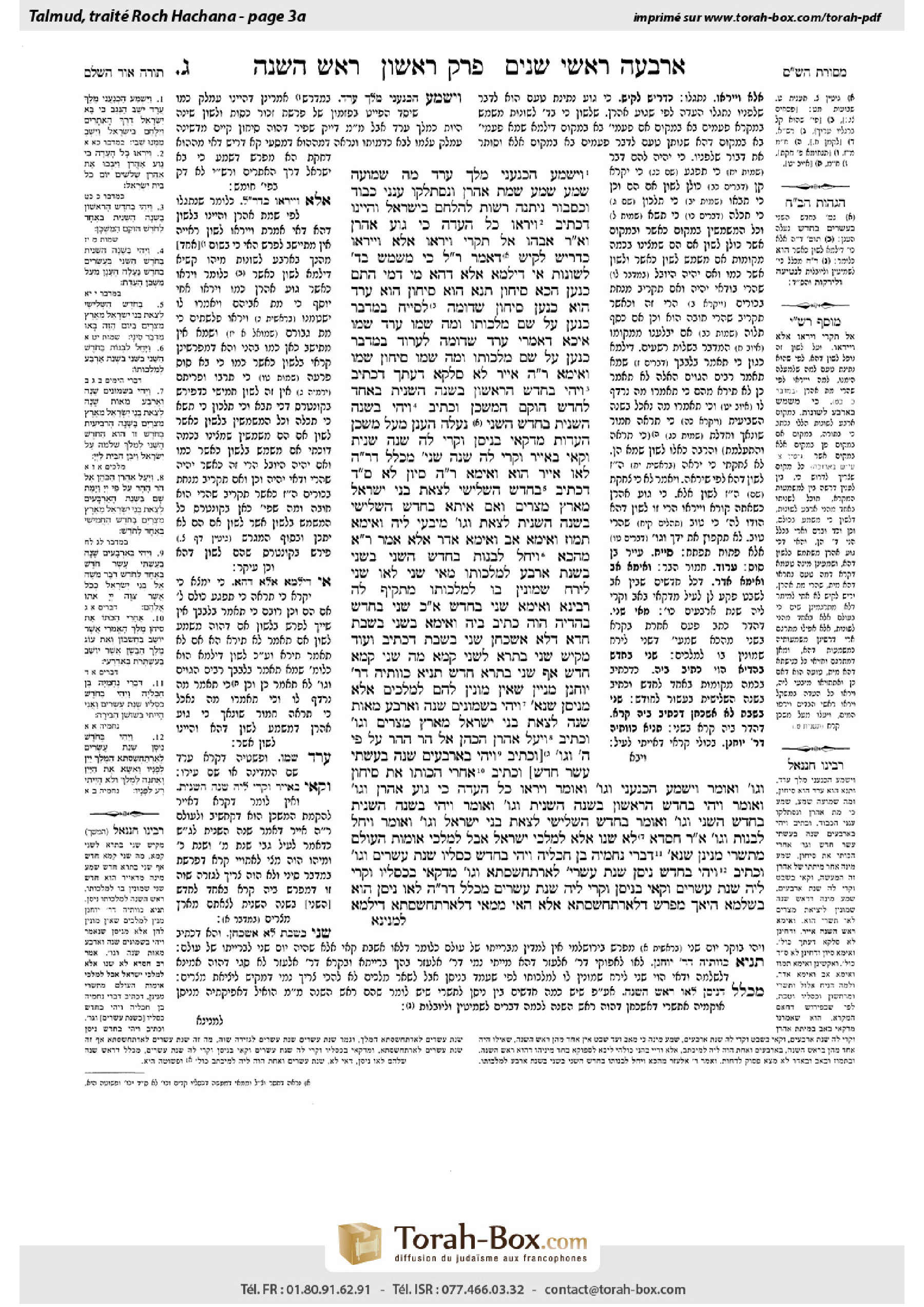
Rosh Hashanah 3a: Talmud study for Daf Yomi
Daf Yomi is the daily study of one Talmud folio. Explore 37 tractates with scans, Hebrew text, Sefaria English and AI-generated French translations where annotated.
Passage selection and English or AI-generated French translation are available where the scan has annotations. Daf Study is independent of Torah-Box and Sefaria.
Browse Rosh Hashanah · ראש השנה · All tractatesRosh Hashanah 3a text and translations
This page of Rosh Hashanah includes the Aramaic text, an English translation and an AI-generated French translation, alongside the scan above.
ראש השנה ג׳ א · Aramaic and Hebrew text
״וַיִּשְׁמַע הַכְּנַעֲנִי מֶלֶךְ עֲרָד״, מָה שְׁמוּעָה שָׁמַע? שָׁמַע שֶׁמֵּת אַהֲרֹן, וְנִסְתַּלְּקוּ עַנְנֵי כָּבוֹד, וּכְסָבוּר נִיתְּנָה רְשׁוּת לְהִלָּחֵם בְּיִשְׂרָאֵל. וְהַיְינוּ דִּכְתִיב: ״וַיִּרְאוּ כׇּל הָעֵדָה כִּי גָוַע אַהֲרֹן״,
וְאָמַר רַבִּי אֲבָהוּ: אַל תִּקְרֵי ״וַיִּרְאוּ״, אֶלָּא ״וַיִּירָאוּ״, כִּדְרֵישׁ לָקִישׁ. דְּאָמַר רֵישׁ לָקִישׁ, ״כִּי״ מְשַׁמֵּשׁ בְּאַרְבַּע לְשׁוֹנוֹת: אִי, דִּילְמָא, אֶלָּא, דְּהָא.
מִי דָּמֵי? הָתָם כְּנַעַן, הָכָא סִיחוֹן! תָּנָא: הוּא סִיחוֹן, הוּא עֲרָד, הוּא כְּנַעַן. סִיחוֹן — שֶׁדּוֹמֶה לִסְיָיח בַּמִּדְבָּר, כְּנַעַן — עַל שֵׁם מַלְכוּתוֹ, וּמָה שְׁמוֹ — עֲרָד שְׁמוֹ. אִיכָּא דְּאָמְרִי: עֲרָד — שֶׁדּוֹמֶה לְעָרוֹד בַּמִּדְבָּר, כְּנַעַן — עַל שֵׁם מַלְכוּתוֹ, וּמָה שְׁמוֹ — סִיחוֹן שְׁמוֹ.
וְאֵימָא רֹאשׁ הַשָּׁנָה אִיָּיר!
לָא סָלְקָא דַּעְתָּךְ, דִּכְתִיב: ״וַיְהִי בַּחֹדֶשׁ הָרִאשׁוֹן בַּשָּׁנָה הַשֵּׁנִית בְּאֶחָד לַחֹדֶשׁ הוּקַם הַמִּשְׁכָּן״, וּכְתִיב: ״וַיְהִי בַּשָּׁנָה הַשֵּׁנִית בַּחֹדֶשׁ הַשֵּׁנִי נַעֲלָה הֶעָנָן מֵעַל מִשְׁכַּן הָעֵדוּת״, מִדְּקָאֵי בְּנִיסָן וְקָרֵי לַהּ ״שָׁנָה שֵׁנִית״, וְקָאֵי בְּאִיָּיר וְקָרֵי לַהּ ״שָׁנָה שֵׁנִית״ — מִכְּלָל דְּרֹאשׁ הַשָּׁנָה לָאו אִיָּיר הוּא!
וְאֵימָא רֹאשׁ הַשָּׁנָה סִיוָן? לָא סָלְקָא דַּעְתָּךְ, דִּכְתִיב: ״בַּחֹדֶשׁ הַשְּׁלִישִׁי לְצֵאת בְּנֵי יִשְׂרָאֵל מֵאֶרֶץ מִצְרַיִם״, וְאִם אִיתָא — ״בַּחֹדֶשׁ הַשְּׁלִישִׁי בַּשָּׁנָה הַשֵּׁנִית לְצֵאת וְגוֹ׳״ מִיבְּעֵי לֵיהּ!
וְאֵימָא תַּמּוּז! וְאֵימָא אָב! וְאֵימָא אֲדָר!
אֶלָּא אָמַר רַבִּי אֶלְעָזָר, מֵהָכָא: ״וַיָּחֶל לִבְנוֹת בַּחֹדֶשׁ הַשֵּׁנִי בַּשֵּׁנִי בִּשְׁנַת אַרְבַּע לְמַלְכוּתוֹ״. מַאי ״שֵׁנִי״? לָאו שֵׁנִי לְיֶרַח שֶׁמּוֹנִין בּוֹ לְמַלְכוּתוֹ?!
מַתְקֵיף לַהּ רָבִינָא: וְאֵימָא שֵׁנִי בַּחֹדֶשׁ! אִם כֵּן, ״שֵׁנִי בַּחֹדֶשׁ״ בְּהֶדְיָא הֲוָה כְּתִיב בֵּיהּ.
וְאֵימָא בְּשֵׁנִי בַּשַּׁבָּת! חֲדָא, דְּלָא אַשְׁכְּחַן שֵׁנִי בַּשַּׁבָּת דִּכְתִיב. וְעוֹד: מַקִּישׁ שֵׁנִי בָּתְרָא לְשֵׁנִי קַמָּא: מָה שֵׁנִי קַמָּא — חֹדֶשׁ, אַף שֵׁנִי בָּתְרָא — חֹדֶשׁ.
תַּנְיָא כְּווֹתֵיהּ דְּרַבִּי יוֹחָנָן: מִנַּיִין שֶׁאֵין מוֹנִין לָהֶם לַמְּלָכִים אֶלָּא מִנִּיסָן, שֶׁנֶּאֱמַר: ״וַיְהִי בִשְׁמוֹנִים שָׁנָה וְאַרְבַּע מֵאוֹת שָׁנָה לְצֵאת בְּנֵי יִשְׂרָאֵל מֵאֶרֶץ מִצְרַיִם וְגוֹ׳״, וּכְתִיב: ״וַיַּעַל אַהֲרֹן הַכֹּהֵן אֶל הֹר הָהָר עַל פִּי ה׳ וְגוֹ׳״, וּכְתִיב: ״וַיְהִי בְּאַרְבָּעִים שָׁנָה בְּעַשְׁתֵּי עָשָׂר חֹדֶשׁ״.
וּכְתִיב: ״אַחֲרֵי הַכּוֹתוֹ אֶת סִיחוֹן וְגוֹ׳״, וְאוֹמֵר: ״וַיִּשְׁמַע הַכְּנַעֲנִי וְגוֹ׳״, וְאוֹמֵר: ״וַיִּרְאוּ כׇּל הָעֵדָה כִּי גָוַע אַהֲרֹן וְגוֹ׳״, וְאוֹמֵר: ״וַיְהִי בַּחֹדֶשׁ הָרִאשׁוֹן בַּשָּׁנָה הַשֵּׁנִית וְגוֹ׳״.
וְאוֹמֵר: ״וַיְהִי בַּשָּׁנָה הַשֵּׁנִית בַּחֹדֶשׁ הַשֵּׁנִי וְגוֹ׳״, וְאוֹמֵר: ״בַּחֹדֶשׁ הַשְּׁלִישִׁי לְצֵאת בְּנֵי יִשְׂרָאֵל וְגוֹ׳״, וְאוֹמֵר: ״וַיָּחֶל לִבְנוֹת וְגוֹ׳״.
אָמַר רַב חִסְדָּא: לֹא שָׁנוּ אֶלָּא לְמַלְכֵי יִשְׂרָאֵל, אֲבָל לְמַלְכֵי אוּמּוֹת הָעוֹלָם — מִתִּשְׁרִי מָנִינַן, ״שֶׁנֶּאֱמַר: ״דִּבְרֵי נְחֶמְיָה בֶּן חֲכַלְיָה וַיְהִי בְחֹדֶשׁ כִּסְלֵיו שְׁנַת עֶשְׂרִים וְגוֹ׳״, וּכְתִיב: ״וַיְהִי בְּחֹדֶשׁ נִיסָן שְׁנַת עֶשְׂרִים לְאַרְתַּחְשַׁסְתְּא וְגוֹ׳״.
מִדְּקָאֵי בְּכִסְלֵיו וְקָרֵי לֵיהּ ״שְׁנַת עֶשְׂרִים״, וְקָאֵי בְּנִיסָן וְקָרֵי לֵיהּ ״שְׁנַת עֶשְׂרִים״ — מִכְּלָל דְּרֹאשׁ הַשָּׁנָה לָאו נִיסָן הוּא.
בִּשְׁלָמָא הַיְאךְ — מְפָרֵשׁ דִּלְאַרְתַּחְשַׁסְתְּא, אֶלָּא הַאי — מִמַּאי דִּלְאַרְתַּחְשַׁסְתְּא? דִּילְמָא
Rosh Hashanah 3a · English translation
“And when the Canaanite, the king of Arad, who dwelt in the South, heard tell that Israel came by the way of Atharim; and he fought against Israel” (Numbers 21:1). What report did he hear? He heard that Aaron had died, and that the clouds of glory had withdrawn from the Jewish people, and he thought that he had been granted permission to wage war against the Jewish people. And this is as it is written: “And all the congregation saw that [ki] Aaron was dead, and they wept for Aaron thirty days, all the house of Israel” (Numbers 20:29).
About this, Rabbi Abbahu said: Do not read the verse as: “And they saw [vayiru]”; rather, read it as: “And they were seen [vayeira’u]” by others, because the cover of the clouds of glory had been removed from them. And the next word, “that [ki],” should be understood as meaning because, in accordance with the statement of Reish Lakish, as Reish Lakish said: The word ki is used in the Bible in four senses: If, perhaps, but, and because. Therefore, the verse should be understood as follows: And all the congregation was seen, i.e., revealed, because Aaron had died. This shows that at the time of Aaron’s death Sihon was still alive; perforce, Moses’ oration, which was delivered after he had slain Sihon, must have occurred later.
The Gemara raises an objection against this proof: Is it comparable? There, the verse is speaking of Canaan, king of Arad, whereas here, the verse is speaking of Sihon. What proof, then, can be brought from the one with regard to the other? The Gemara explains: A Sage taught in a baraita: All three names are referring to the same person: He is Sihon, and he is Arad, and he is also Canaan. He was called Sihon because he was similar in his wildness to a foal [seyyaḥ] in the desert; and he was called Canaan after his kingdom, as he ruled over the Canaanite people; and what was his real name? Arad was his name. Some say an alternative explanation: He was called Arad because he was similar to a wild ass [arod] in the desert; and he was called Canaan after his kingdom; and what was his real name? Sihon was his name.
The Gemara raises another question: Granted, when counting the years from the exodus from Egypt, Av and the following Shevat are both part of the same year, but it has not been established that the counting of years from the Exodus is specifically from Nisan. Say that the New Year for this purpose is in the following month, the month of Iyyar.
The Gemara rejects this proposal: It should not enter your mind to say this, as it is written: “And it came to pass in the first month in the second year, on the first day of the month, that the Tabernacle was established” (Exodus 40:17), and it is written: “And it came to pass in the second year, in the second month, on the twentieth day of the month, that the cloud was taken up from over the Tabernacle of the testimony” (Numbers 10:11). It may be argued as follows: From the fact that when the Bible speaks of Nisan, which is the first month, it calls it “the second year,” and when it speaks of the following Iyyar, which is the second month, it also calls it “the second year,” by inference, Rosh HaShana is not at the beginning of Iyyar. Were it the case that the New Year begins in Iyyar, Nisan and the following Iyyar would not occur in the same year, as the year would have changed in Iyyar.
The Gemara asks further: And say that the New Year for this purpose is in the third month, the month of Sivan. The Gemara rejects this suggestion: It should not enter your mind to say this, as it is written: “In the third month, after the children of Israel had gone out of the land of Egypt, the same day they came into the wilderness of Sinai” (Exodus 19:1). And if it is so that the New Year is the beginning of Sivan, the verse should have said: In the third month, in the second year after the children of Israel had gone out of the land of Egypt, as a new year had started.
The Gemara continues: But perhaps one could say that the New Year for counting the Exodus is in the fourth month, the month of Tammuz; or say that it is in the fifth month, the month of Av; or say that it is in the twelfth month, the month of Adar. There is no clear refutation that these months are not the New Year.
Rather, Rabbi Elazar said: It is from here that it is derived that the years of a king’s rule are counted from Nisan, as it is stated: “And he began to build in the second month, in the second, in the fourth year of his reign” (II Chronicles 3:2). What is the meaning of the words “the second”? Doesn’t it mean second to the month from which Solomon’s reign is counted? This is clear proof that the years of a king’s rule are counted from the first month, i.e., the month of Nisan.
Ravina strongly objects to this: Why not say that the words “the second” are referring to the second day of the month? The Gemara answers: If so, it should have explicitly stated: “On the second of the month,” as that is the formulation usually used in the Bible to refer to a specific day of the month.
The Gemara raises another objection: Why not say that the words “the second” are referring to the second day of the week? This argument is rejected for two reasons: First, we have not found the second day of the week ever being written; nowhere does the Bible give the day of the week on which a particular event transpired. And further, the verse juxtaposes the second instance of the word “second” to the first instance of the word “second”: Just as the first “second” is referring to a month, so too, the latter “second” is referring to a month.
It is taught in a baraita in accordance with the opinion of Rabbi Yoḥanan: From where is it derived that one counts the years of kings’ reigns only from the month of Nisan? As it is stated: “And it came to pass in the four hundred and eightieth year after the children of Israel were come out of the land of Egypt, in the fourth year of Solomon’s reign over Israel, in the month Ziv, which is the second month, that he began to build the house of the Lord” (I Kings 6:1). And it is written: “And Aaron the priest went up to Mount Hor at the commandment of the Lord, and died there, in the fortieth year after the children of Israel were come out of the land of Egypt, in the fifth month, on the first day of the month” (Numbers 33:38). And it is later written: “And it came to pass in the fortieth year, in the eleventh month, on the first of the month, that Moses spoke to the children of Israel” (Deuteronomy 1:3).
And it is written: “After he had slain Sihon, the king of the Amorites, who dwelt in Heshbon” (Deuteronomy 1:4). And it says: “And when the Canaanite, the king of Arad, who dwelt in the South, heard” (Numbers 33:40). And it says: “And all the congregation saw that Aaron was dead, and they wept for Aaron thirty days” (Numbers 20:29). And it says: “And it came to pass in the first month in the second year, on the first day of the month, that the Tabernacle was established” (Exodus 40:17).
And it says: “And it came to pass in the second year, in the second month, on the twentieth day of the month, that the cloud was taken up from off the Tabernacle of the testimony” (Numbers 10:11). And it says: “In the third month, after the children of Israel had gone out of the land of Egypt, the same day they came into the wilderness of Sinai” (Exodus 19:1). And it says: “And he began to build in the second month, in the second, in the fourth year of his reign” (II Chronicles 3:2). This list of verses summarizes Rabbi Yoḥanan’s explanation.
§ Rav Ḥisda said: They taught that the years of a king’s rule are counted from the first of Nisan only with regard to the Jewish kings of Israel, but the years of the kings of the gentile nations of the world are counted from Tishrei, as it is stated: “The words of Nehemiah, son of Hachaliah. And it came to pass in the month Kislev, in the twentieth year, as I was in Shushan the capital” (Nehemiah 1:1). And it is written: “And it came to pass in the month Nisan, in the twentieth year of Artaxerxes the king, that wine was before him, and I took up the wine, and gave it to the king” (Nehemiah 2:1).
From the fact that when the Bible speaks of the month of Kislev it calls it the twentieth year, and when it speaks of the following Nisan it also calls it the twentieth year, by inference, the New Year for gentile kings does not begin in Nisan. Were it the case that the New Year did begin in Nisan, Kislev and the following Nisan would not occur in the same year.
The Gemara raises an objection: Granted, in this second verse it is explicitly stated that the count relates to the years of Artaxerxes. But as for that first verse, from where is it known that the count relates to the years of Artaxerxes? Perhaps
Rosh Hashanah 3a · Traduction française (IA)
« Lorsque le Cananéen, le roi d’Arad, qui habitait dans le Néguev, apprit qu’Israël venait par la route d’Atharim, il combattit Israël » (Nombres 21:1). Quelle nouvelle avait-il entendue ? Il avait appris qu’Aaron était mort et que les nuées de gloire s’étaient retirées du peuple juif ; il pensa alors qu’il avait reçu la permission de faire la guerre au peuple juif. C’est ce qui est écrit : « Toute la communauté vit que [ki] Aaron était mort, et toute la maison d’Israël pleura Aaron pendant trente jours » (Nombres 20:29).
À ce sujet, Rabbi Abbahou a dit : Ne lis pas le verset ainsi : « Ils virent [vayiru] » ; lis plutôt : « Ils furent vus [vayeira’u] » par les autres, car la couverture des nuées de gloire leur avait été retirée. Le mot suivant, « que [ki] », doit être compris au sens de « parce que », conformément à l’enseignement de Reish Lakish. En effet, Reish Lakish a dit : Dans la Bible, le mot ki est employé dans quatre sens : si, peut-être, mais et parce que. Le verset doit donc se comprendre ainsi : Toute la communauté fut vue, c’est-à-dire révélée, parce qu’Aaron était mort. Cela montre qu’à l’époque de la mort d’Aaron, Sihon était encore vivant ; nécessairement, le discours de Moïse, prononcé après qu’il eut tué Sihon, a eu lieu plus tard.
La Guemara soulève une objection contre cette preuve : Les deux cas sont-ils comparables ? Là, le verset parle de Canaan, roi d’Arad, tandis qu’ici, il parle de Sihon. Quelle preuve peut-on donc tirer de l’un au sujet de l’autre ? La Guemara explique : Un Sage a enseigné dans une baraïta que les trois noms désignent la même personne : c’est Sihon, c’est Arad, et c’est aussi Canaan. On l’appelait Sihon parce qu’il était aussi sauvage qu’un poulain [seyyaḥ] dans le désert ; on l’appelait Canaan d’après son royaume, puisqu’il régnait sur le peuple cananéen ; et quel était son vrai nom ? Arad. Certains donnent une autre explication : on l’appelait Arad parce qu’il était semblable à un âne sauvage [arod] dans le désert ; on l’appelait Canaan d’après son royaume ; et quel était son vrai nom ? Sihon.
La Guemara soulève une autre question : Il est certes établi que, lorsqu’on compte les années à partir de la sortie d’Égypte, av et le chevat qui suit appartiennent tous deux à la même année ; toutefois, il n’a pas été établi que le décompte des années à partir de la sortie d’Égypte commence précisément en nissan. Peut-être le nouvel an à cet effet tombe-t-il le mois suivant, au mois d’iyar.
La Guemara rejette cette proposition : Il ne faut pas envisager cela, car il est écrit : « Il arriva, au premier mois de la deuxième année, le premier jour du mois, que le Tabernacle fut dressé » (Exode 40:17), et il est écrit : « Il arriva, la deuxième année, au deuxième mois, le vingtième jour du mois, que la nuée se leva de dessus le Tabernacle du témoignage » (Nombres 10:11). On peut raisonner ainsi : puisque, lorsque la Bible parle de nissan, le premier mois, elle l’appelle « la deuxième année », et que, lorsqu’elle parle de l’iyar qui suit, le deuxième mois, elle l’appelle également « la deuxième année », il en ressort que Roch Hachana ne tombe pas au début d’iyar. Si le nouvel an commençait en iyar, nissan et l’iyar qui suit n’appartiendraient pas à la même année, puisque l’année aurait changé en iyar.
La Guemara demande encore : Peut-être le nouvel an à cet effet tombe-t-il au troisième mois, celui de sivane ? La Guemara rejette cette suggestion : Il ne faut pas envisager cela, car il est écrit : « Au troisième mois après la sortie des enfants d’Israël du pays d’Égypte, ce jour-là, ils arrivèrent au désert du Sinaï » (Exode 19:1). Si le nouvel an tombait au début de sivane, le verset aurait dû dire : « Au troisième mois, pendant la deuxième année après la sortie des enfants d’Israël du pays d’Égypte », puisqu’une nouvelle année aurait commencé.
La Guemara poursuit : Mais peut-être pourrait-on dire que le nouvel an pour le décompte à partir de la sortie d’Égypte tombe au quatrième mois, celui de tammouz ; ou au cinquième mois, celui d’av ; ou encore au douzième mois, celui d’adar. Rien ne réfute clairement l’idée que ces mois marquent le nouvel an.
Rabbi Elazar a plutôt dit : C’est d’ici que l’on déduit que les années de règne d’un roi se comptent à partir de nissan, comme il est dit : « Il commença à bâtir au deuxième mois, le deuxième, la quatrième année de son règne » (II Chroniques 3:2). Que signifie le mot « deuxième » ? Ne signifie-t-il pas que ce mois est le deuxième par rapport au mois à partir duquel on compte le règne de Salomon ? Cela prouve clairement que les années de règne d’un roi se comptent à partir du premier mois, c’est-à-dire nissan.
Ravina objecte avec véhémence : Pourquoi ne pas dire que le mot « deuxième » désigne le deuxième jour du mois ? La Guemara répond : Dans ce cas, le verset aurait explicitement dit : « Le deuxième jour du mois », car c’est la formulation habituellement employée dans la Bible pour désigner un jour précis du mois.
La Guemara soulève une autre objection : Pourquoi ne pas dire que le mot « deuxième » désigne le deuxième jour de la semaine ? Cet argument est rejeté pour deux raisons. Premièrement, nous ne trouvons nulle part le deuxième jour de la semaine mentionné par écrit ; la Bible n’indique jamais le jour de la semaine où un événement particulier s’est produit. En outre, le deuxième emploi du mot « deuxième » est juxtaposé au premier : de même que le premier « deuxième » désigne un mois, le second « deuxième » désigne lui aussi un mois.
Il est enseigné dans une baraïta conformément à l’opinion de Rabbi Yoḥanan : D’où déduit-on que l’on compte les années de règne des rois uniquement à partir du mois de nissan ? Il est dit : « La quatre cent quatre-vingtième année après la sortie des enfants d’Israël du pays d’Égypte, la quatrième année du règne de Salomon sur Israël, au mois de ziv, qui est le deuxième mois, il commença à bâtir la maison du Seigneur » (I Rois 6:1). Et il est écrit : « Aaron le prêtre monta sur le mont Hor, sur l’ordre du Seigneur, et mourut là, la quarantième année après la sortie des enfants d’Israël du pays d’Égypte, au cinquième mois, le premier jour du mois » (Nombres 33:38). Et il est écrit plus loin : « Il arriva, la quarantième année, au onzième mois, le premier jour du mois, que Moïse parla aux enfants d’Israël » (Deutéronome 1:3).
Et il est écrit : « Après qu’il eut tué Sihon, roi des Amoréens, qui habitait à Heshbon » (Deutéronome 1:4). Et il est dit : « Lorsque le Cananéen, le roi d’Arad, qui habitait dans le Néguev, entendit » (Nombres 33:40). Et il est dit : « Toute la communauté vit qu’Aaron était mort, et elle pleura Aaron pendant trente jours » (Nombres 20:29). Et il est dit : « Il arriva, au premier mois de la deuxième année, le premier jour du mois, que le Tabernacle fut dressé » (Exode 40:17).
Et il est dit : « Il arriva, la deuxième année, au deuxième mois, le vingtième jour du mois, que la nuée se leva de dessus le Tabernacle du témoignage » (Nombres 10:11). Et il est dit : « Au troisième mois après la sortie des enfants d’Israël du pays d’Égypte, ce jour-là, ils arrivèrent au désert du Sinaï » (Exode 19:1). Et il est dit : « Il commença à bâtir au deuxième mois, le deuxième, la quatrième année de son règne » (II Chroniques 3:2). Cette liste de versets résume l’explication de Rabbi Yoḥanan.
§ Rav Ḥisda a dit : L’enseignement selon lequel les années de règne d’un roi se comptent à partir du premier nissan ne concerne que les rois juifs d’Israël ; les années de règne des rois des nations non juives se comptent à partir de tishri, comme il est dit : « Paroles de Neḥemia, fils de Ḥakhalia. Il arriva, au mois de kislev, la vingtième année, alors que je me trouvais à Suse, la capitale » (Neḥemia 1:1). Et il est écrit : « Il arriva, au mois de nissan, la vingtième année du roi Artaxerxès, alors que du vin était devant lui ; je pris le vin et le servis au roi » (Neḥemia 2:1).
Puisque, lorsque la Bible parle du mois de kislev, elle l’appelle la vingtième année, et que, lorsqu’elle parle du nissan suivant, elle l’appelle également la vingtième année, il en ressort que le nouvel an des rois des nations non juives ne commence pas en nissan. S’il commençait en nissan, kislev et le nissan suivant n’appartiendraient pas à la même année.
La Guemara soulève une objection : Il est certes explicitement indiqué dans ce deuxième verset que le décompte concerne les années d’Artaxerxès. Mais pour ce qui est du premier verset, d’où sait-on que le décompte concerne les années d’Artaxerxès ? Peut-être
Traduction française générée par IA à partir de l’édition anglaise de Sefaria. Vérifie toujours un passage avec le texte source.
Text from Sefaria: William Davidson Edition - Vocalized Aramaic (CC BY NC); William Davidson Edition - English (CC BY NC).