Rosh Hashanah 3b: Talmud study for Daf Yomi
Daf Yomi is the daily study of one Talmud folio. Explore 37 tractates with scans, Hebrew text, Sefaria English and AI-generated French translations where annotated.
Passage selection and English or AI-generated French translation are available where the scan has annotations. Daf Study is independent of Torah-Box and Sefaria.
Browse Rosh Hashanah · ראש השנה · All tractatesRosh Hashanah 3b text and translations
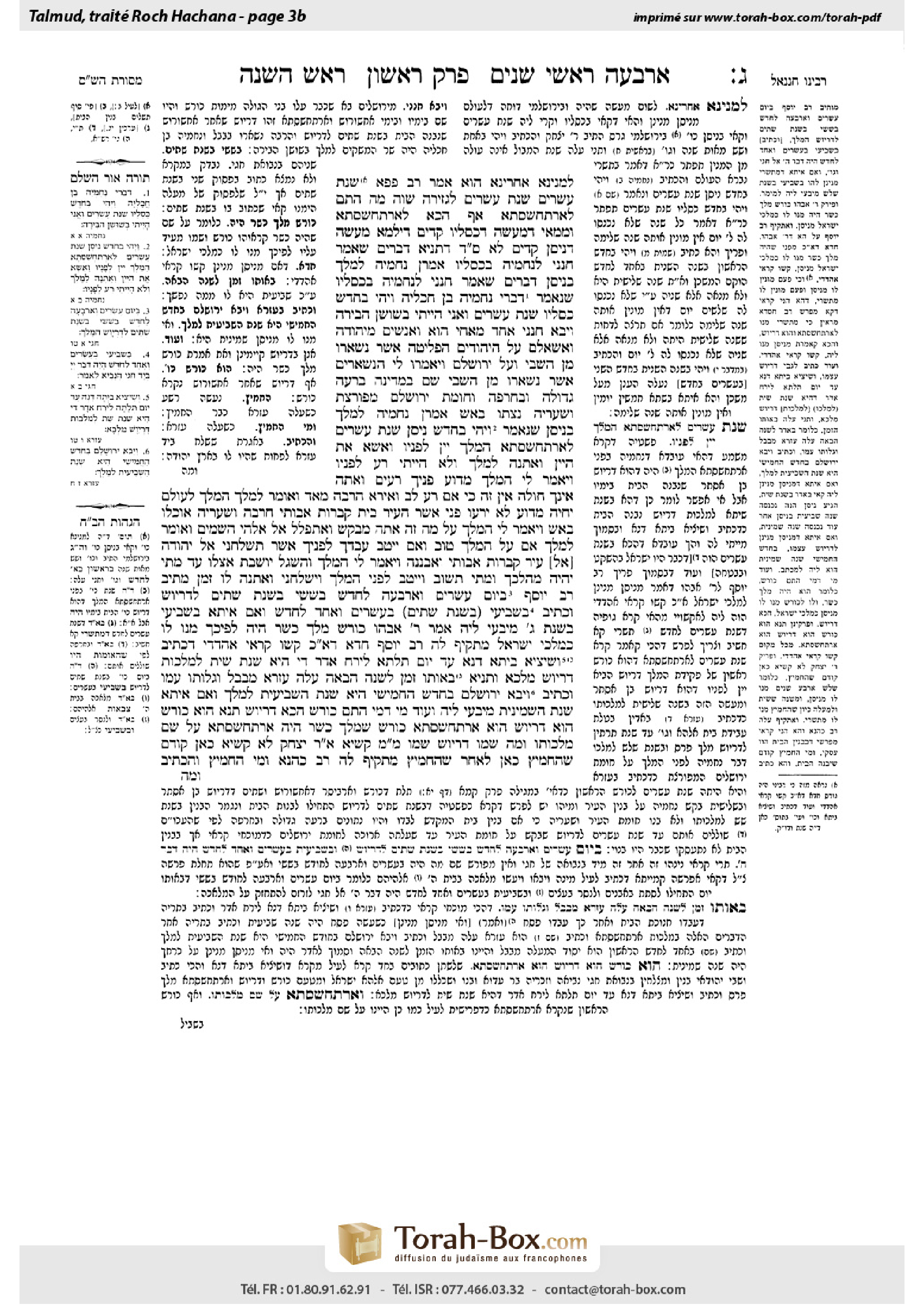
This page of Rosh Hashanah includes the Aramaic text, an English translation and an AI-generated French translation, alongside the scan above.
ראש השנה ג׳ ב · Aramaic and Hebrew text
לְמִנְיָנָא אַחֲרִינָא הוּא? אָמַר רַב פָּפָּא: ״שְׁנַת עֶשְׂרִים״ ״שְׁנַת עֶשְׂרִים״ — לִגְזֵירָה שָׁוָה: מָה הָתָם לְאַרְתַּחְשַׁסְתְּא, אַף הָכָא לְאַרְתַּחְשַׁסְתְּא.
וּמִמַּאי דְּמַעֲשֶׂה דְּכִסְלֵיו קָדֵים, דִּילְמָא מַעֲשֶׂה דְּנִיסָן קָדֵים?
לָא סָלְקָא דַּעְתָּךְ, דְּתַנְיָא: דְּבָרִים שֶׁאָמַר חֲנָנִי לִנְחֶמְיָה בְּכִסְלֵיו, אֲמָרָן נְחֶמְיָה לַמֶּלֶךְ בְּנִיסָן.
דְּבָרִים שֶׁאָמַר חֲנָנִי לִנְחֶמְיָה בְּכִסְלֵיו — שֶׁנֶּאֱמַר: ״דִּבְרֵי נְחֶמְיָה בֶּן חֲכַלְיָה וַיְהִי בְחֹדֶשׁ כִּסְלֵיו שְׁנַת עֶשְׂרִים וַאֲנִי הָיִיתִי בְּשׁוּשַׁן הַבִּירָה. וַיָּבֹא חֲנָנִי אֶחָד מֵאַחַי הוּא וַאֲנָשִׁים מִיהוּדָה וָאֶשְׁאָלֵם עַל הַיְּהוּדִים הַפְּלֵיטָה אֲשֶׁר נִשְׁאֲרוּ מִן הַשֶּׁבִי וְעַל יְרוּשָׁלִָם. וַיֹּאמְרוּ לִי הַנִּשְׁאָרִים אֲשֶׁר נִשְׁאֲרוּ מִן הַשְּׁבִי שָׁם בַּמְּדִינָה בְּרָעָה גְדוֹלָה וּבְחֶרְפָּה וְחוֹמַת יְרוּשָׁלִַם מְפוֹרָצֶת וּשְׁעָרֶיהָ נִצְּתוּ בָאֵשׁ״.
אֲמָרָן נְחֶמְיָה לַמֶּלֶךְ בְּנִיסָן, שֶׁנֶּאֱמַר: ״וַיְהִי בְּחֹדֶשׁ נִיסָן שְׁנַת עֶשְׂרִים לְאַרְתַּחְשַׁסְתְּא הַמֶּלֶךְ יַיִן לְפָנָיו וָאֶשָּׂא אֶת הַיַּיִן וָאֶתְּנָה לַמֶּלֶךְ וְלֹא הָיִיתִי רַע לְפָנָיו. וַיֹּאמֶר לִי הַמֶּלֶךְ מַדּוּעַ פָּנֶיךָ רָעִים וְאַתָּה אֵינְךָ חוֹלֶה אֵין זֶה כִּי אִם רֹעַ לֵב וָאִירָא הַרְבֵּה מְאֹד. וָאוֹמַר לַמֶּלֶךְ הַמֶּלֶךְ לְעוֹלָם יִחְיֶה מַדּוּעַ לֹא יֵרְעוּ פָנַי אֲשֶׁר הָעִיר בֵּית קִבְרוֹת אֲבוֹתַי חֲרֵבָה וּשְׁעָרֶיהָ אוּכְּלוּ בָאֵשׁ״.
״וַיֹּאמֶר לִי הַמֶּלֶךְ עַל מַה זֶּה אַתָּה מְבַקֵּשׁ וָאֶתְפַּלֵּל אֶל אֱלֹהֵי הַשָּׁמָיִם. וָאוֹמַר לַמֶּלֶךְ אִם עַל הַמֶּלֶךְ טוֹב וְאִם יִיטַב עַבְדְּךָ לְפָנֶיךָ אֲשֶׁר תִּשְׁלָחֵנִי אֶל יְהוּדָה אֶל עִיר קִבְרוֹת אֲבוֹתַי וְאֶבְנֶנָּה. וַיֹּאמֶר לִי הַמֶּלֶךְ וְהַשֵּׁגַל יוֹשֶׁבֶת אֶצְלוֹ עַד מָתַי יִהְיֶה מַהֲלָכְךָ וּמָתַי תָּשׁוּב וַיִּיטַב לִפְנֵי הַמֶּלֶךְ וַיִּשְׁלָחֵנִי וָאֶתְּנָה לוֹ זְמָן״.
מֵתִיב רַב יוֹסֵף: ״בְּיוֹם עֶשְׂרִים וְאַרְבָּעָה לַחֹדֶשׁ בַּשִּׁשִּׁי בִּשְׁנַת שְׁתַּיִם לְדָרְיָוֶשׁ״, וּכְתִיב: ״בַּשְּׁבִיעִי בִּשְׁנַת שְׁתַּיִם בְּעֶשְׂרִים וְאֶחָד לַחֹדֶשׁ״. וְאִם אִיתָא — ״בַּשְּׁבִיעִי בִּשְׁנַת שָׁלֹשׁ״ מִיבְּעֵי לֵיהּ!
אָמַר רַבִּי אֲבָהוּ: כּוֹרֶשׁ מֶלֶךְ כָּשֵׁר הָיָה, לְפִיכָךְ מָנוּ לוֹ כְּמַלְכֵי יִשְׂרָאֵל.
מַתְקֵיף לַהּ רַב יוֹסֵף: חֲדָא — דְּאִם כֵּן קָשׁוּ קְרָאֵי אַהֲדָדֵי, דִּכְתִיב: ״וְשֵׁיצִיא בַּיְתָא דְנָא עַד יוֹם תְּלָתָא לִירַח אֲדָר דִּי הִיא שְׁנַת שֵׁית לְמַלְכוּת דָּרְיָוֶשׁ מַלְכָּא״, וְתַנְיָא: בְּאוֹתוֹ זְמַן לַשָּׁנָה הַבָּאָה עָלָה עֶזְרָא מִבָּבֶל וְגָלוּתוֹ עִמּוֹ, וּכְתִיב: ״וַיָּבֹא יְרוּשָׁלִַם בַּחֹדֶשׁ הַחֲמִישִׁי הִיא שְׁנַת הַשְּׁבִיעִית לַמֶּלֶךְ״, וְאִם אִיתָא — ״שְׁנַת הַשְּׁמִינִית״ מִיבְּעֵי לֵיהּ.
וְעוֹד: מִי דָּמֵי? הָתָם כּוֹרֶשׁ, הָכָא דָּרְיָוֶשׁ! תָּנָא: הוּא כּוֹרֶשׁ, הוּא דָּרְיָוֶשׁ, הוּא אַרְתַּחְשַׁסְתְּא. כּוֹרֶשׁ — שֶׁמֶּלֶךְ כָּשֵׁר הָיָה, אַרְתַּחְשַׁסְתְּא — עַל שֵׁם מַלְכוּתוֹ, וּמָה שְׁמוֹ — דָּרְיָוֶשׁ שְׁמוֹ.
מִכׇּל מָקוֹם קַשְׁיָא! אָמַר רַבִּי יִצְחָק, לָא קַשְׁיָא: כָּאן קוֹדֶם שֶׁהֶחְמִיץ, כָּאן לְאַחַר שֶׁהֶחְמִיץ.
מַתְקֵיף לַהּ רַב כָּהֲנָא: וּמִי הֶחְמִיץ? וְהָכְתִיב:
Rosh Hashanah 3b · English translation
it follows some other count. Rav Pappa said: The meaning of the first instance of the expression “the twentieth year” may be inferred from the second instance of the expression “the twentieth year” by way of a verbal analogy: Just as there the reference is to the twentieth year of Artaxerxes, so too, here the reference is to the twentieth year of Artaxerxes.
The Gemara raises another question: Even though those two events took place in the same year, from where is it known that the incident that occurred in Kislev took place first? Perhaps the incident that occurred in Nisan took place first, in which case it is possible that even the years of gentile kings are counted from Nisan.
The Gemara answers: It should not enter your mind to say this, as it is taught in a baraita: The words that Hanani told Nehemiah in the month of Kislev, Nehemiah told the king in the month of Nisan.
The baraita explains: The words that Hanani said to Nehemiah in Kislev are as it is stated: “The words of Nehemiah, son of Hachaliah: And it came to pass in the month Kislev, in the twentieth year, as I was in Shushan the capital, that Hanani, one of my brothers, came out of Judah, he and certain men; and I asked them concerning the Jews who had escaped, who were left of the captivity, and concerning Jerusalem. And they said to me: The remnant who are left of the captivity there in the province suffer much hardship and insult; and the wall of Jerusalem is broken down, and its gates are burned with fire” (Nehemiah 1:1–3).
Nehemiah told these words to the king in Nisan, as it is stated: “And it came to pass in the month Nisan, in the twentieth year of Artaxerxes the king, that wine was before him, and I took up the wine and gave it to the king. Now I had not been sad before in his presence. And the king said to me: Why is your face sad, seeing that you are not sick? This is nothing else but sorrow of the heart. Then I was very much afraid, and I said to the king: Let the king live forever: Why should not my face be sad, when the city, the place of the tombs of my ancestors, lies waste, and its gates are consumed with fire?” (Nehemiah 2:1–3).
“Then the king said to me: For what do you ask? So I prayed to the God of heaven. And I said to the king: If it please the king, and if your servant has found favor in your sight, that you would send me to Judea, to the city of the graves of my ancestors, that I may rebuild it. And the king said to me, the consort also sitting by him: For how long shall your journey be? And when will you return? So it pleased the king to send me; and I set him a time” (Nehemiah 2:4–6).
Rav Yosef raised an objection against the rule established by Rav Ḥisda that the years of gentile kings are counted from Tishrei from the verse that states: “On the twenty-fourth day of the sixth month, in the second year of Darius the king” (Haggai 1:15), and it is written immediately afterward: “In the seventh month, in the second year, on the twenty-first day of the month, the word of the Lord came by the prophet Haggai, saying” (Haggai 2:1). And if it were so that the years of gentile kings are counted from Tishrei, what the verse needed to state is: In the seventh month in the third year, as a new year had already started for him.
Rabbi Abbahu said in answer to this objection: Cyrus was a virtuous king, and consequently Haggai counted the years of his reign like those of the kings of Israel, i.e., from Nisan.
Rav Yosef strongly objects to this explanation for two reasons: One objection is that if this is so, the verses contradict each other, as it is written: “And this house was finished on the third of the month Adar, which was in the sixth year of the reign of Darius the king” (Ezra 6:15), and it is taught in a baraita: At that same time in the following year Ezra went up from Babylonia together with his company of exiles. And it is written in the Bible: “And he came to Jerusalem in the fifth month, which was in the seventh year of the king” (Ezra 7:8). And if it were so that this king’s years were counted like those of the kings of Israel, what the verse needed to state is: Which was in the eighth year of the king.
And further, a second objection: Are Rav Yosef’s objection and Rabbi Abbahu’s resolution comparable? There, Rabbi Abbahu speaks of Cyrus, whereas here, the verses speak of Darius, and it was never said about Darius that he was a virtuous king. The Gemara explains: This is not difficult, as the Sages taught in a baraita: All three names are referring to the same person: He is Cyrus; he is Darius; and he is also Artaxerxes. He was called Cyrus [Koresh] because he was a virtuous [kasher] king; he was called Artaxerxes after his kingdom, i.e., this was his royal title; and what was his real name? Darius was his name.
The Gemara notes: In any case, it is difficult, as in one place his years are counted from Nisan, whereas in another place they are counted from Tishrei. Rabbi Yitzḥak said: This is not difficult, as it can be explained as follows: Here, where his years are counted from Nisan like the kings of Israel, it speaks of him before he became corrupt, whereas there, where his years are counted from Tishrei, it speaks of him after he became corrupt.
Rav Kahana strongly objects to this explanation: Did he really become corrupt after Ezra went to Eretz Yisrael? But isn’t it written:
Rosh Hashanah 3b · Traduction française (IA)
il s’agit d’un autre mode de décompte. Rav Pappa dit : Le sens de la première occurrence de l’expression « la vingtième année » peut être déduit de la seconde occurrence de cette même expression par une analogie verbale : de même que là, il s’agit de la vingtième année d’Artaxerxès, de même ici, il s’agit de la vingtième année d’Artaxerxès.
La Guemara soulève une autre question : même si ces deux événements ont eu lieu au cours de la même année, d’où sait-on que l’incident survenu en Kislev a eu lieu en premier ? Peut-être l’incident survenu en Nisan a-t-il eu lieu en premier, auquel cas il est possible que les années des rois non juifs soient elles aussi comptées à partir de Nisan.
La Guemara répond : il ne faut pas penser ainsi, car une baraïta enseigne : Les paroles que Hanani adressa à Nehemia au mois de Kislev, Nehemia les adressa au roi au mois de Nisan.
La baraïta explique : Les paroles que Hanani adressa à Nehemia en Kislev sont rapportées ainsi : « Paroles de Nehemia, fils de Hachaliah. Il arriva, au mois de Kislev, la vingtième année, alors que je me trouvais à Suse, la citadelle, que Hanani, l’un de mes frères, vint de Juda avec quelques hommes. Je les interrogeai au sujet des Juifs qui avaient échappé, ceux qui étaient restés de la captivité, et au sujet de Jérusalem. Ils me répondirent : “Ceux qui sont restés de la captivité, là dans la province, connaissent de grandes difficultés et sont couverts d’opprobre ; la muraille de Jérusalem est en ruines et ses portes ont été consumées par le feu.” » (Néhémie 1,1-3).
Nehemia adressa ces paroles au roi au mois de Nisan, comme il est dit : « Il arriva, au mois de Nisan, la vingtième année du roi Artaxerxès, alors que du vin était devant lui ; je pris le vin et le présentai au roi. Or, je n’avais jamais été triste en sa présence. Le roi me dit : “Pourquoi ton visage est-il triste, alors que tu n’es pas malade ? Ce ne peut être qu’une peine de cœur.” Je fus alors saisi d’une grande crainte et je dis au roi : “Que le roi vive éternellement ! Pourquoi mon visage ne serait-il pas triste, lorsque la ville, le lieu des sépultures de mes ancêtres, est en ruines et que ses portes ont été consumées par le feu ?” » (Néhémie 2,1-3).
« Le roi me dit alors : “Que demandes-tu ?” Je priai le Dieu des cieux, puis je dis au roi : “S’il plaît au roi et si ton serviteur a trouvé grâce à tes yeux, envoie-moi en Judée, dans la ville où se trouvent les sépultures de mes ancêtres, afin que je la rebâtisse.” Le roi me dit, tandis que sa consort était assise à ses côtés : “Combien de temps durera ton voyage ? Et quand reviendras-tu ?” Le roi accepta donc de m’envoyer, et je lui fixai une échéance. » (Néhémie 2,4-6).
Rav Yossef soulève une objection contre la règle établie par Rav Hisda, selon laquelle les années des rois non juifs sont comptées à partir de Tichri. Il s’appuie sur le verset : « Le vingt-quatrième jour du sixième mois, la deuxième année du roi Darius » (Aggée 1,15), suivi immédiatement de celui-ci : « Au septième mois, la deuxième année, le vingt et unième jour du mois, la parole de l’Éternel fut adressée par l’intermédiaire du prophète Aggée, en ces termes » (Aggée 2,1). Or, si les années des rois non juifs étaient comptées à partir de Tichri, le verset aurait dû dire : « Au septième mois, la troisième année », puisque la nouvelle année avait déjà commencé pour lui.
Rabbi Abbahou répond à cette objection : Cyrus était un roi vertueux ; par conséquent, Aggée a compté les années de son règne comme celles des rois d’Israël, c’est-à-dire à partir de Nisan.
Rav Yossef s’oppose vivement à cette explication pour deux raisons. Première objection : si tel était le cas, les versets se contrediraient, car il est écrit : « Cette maison fut achevée le troisième jour du mois d’Adar, la sixième année du règne du roi Darius » (Esdras 6,15), et une baraïta enseigne : À la même époque, l’année suivante, Esdras monta de Babylonie avec son groupe d’exilés. Or, il est écrit dans la Bible : « Il arriva à Jérusalem au cinquième mois, la septième année du roi » (Esdras 7,8). Si les années de ce roi étaient comptées comme celles des rois d’Israël, le verset aurait dû dire : « la huitième année du roi ».
Et une seconde objection : l’objection de Rav Yossef et la réponse de Rabbi Abbahou sont-elles comparables ? Là, Rabbi Abbahou parle de Cyrus, tandis qu’ici, les versets parlent de Darius, et il n’a jamais été dit de Darius qu’il était un roi vertueux. La Guemara explique : Il n’y a pas de difficulté, car les Sages enseignent dans une baraïta que ces trois noms désignent la même personne : c’est Cyrus, c’est Darius, et c’est aussi Artaxerxès. Il était appelé Cyrus [Koresh] parce qu’il était un roi vertueux [kasher] ; il était appelé Artaxerxès d’après son royaume, c’est-à-dire que c’était son titre royal ; et quel était son véritable nom ? Darius était son nom.
La Guemara fait remarquer : Quoi qu’il en soit, la difficulté subsiste, car à un endroit ses années sont comptées à partir de Nisan, tandis qu’à un autre endroit elles sont comptées à partir de Tichri. Rabbi Yitzhak dit : Il n’y a pas de difficulté, car on peut expliquer les choses ainsi : ici, là où ses années sont comptées à partir de Nisan, comme celles des rois d’Israël, il s’agit de lui avant qu’il ne devienne corrompu ; tandis que là, là où ses années sont comptées à partir de Tichri, il s’agit de lui après qu’il est devenu corrompu.
Rav Kahana s’oppose vivement à cette explication : Est-il vraiment devenu corrompu après qu’Esdras fut monté en Eretz Israël ? Pourtant, n’est-il pas écrit :
Traduction française générée par IA à partir de l’édition anglaise de Sefaria. Vérifie toujours un passage avec le texte source.
Text from Sefaria: William Davidson Edition - Vocalized Aramaic (CC BY NC); William Davidson Edition - English (CC BY NC).