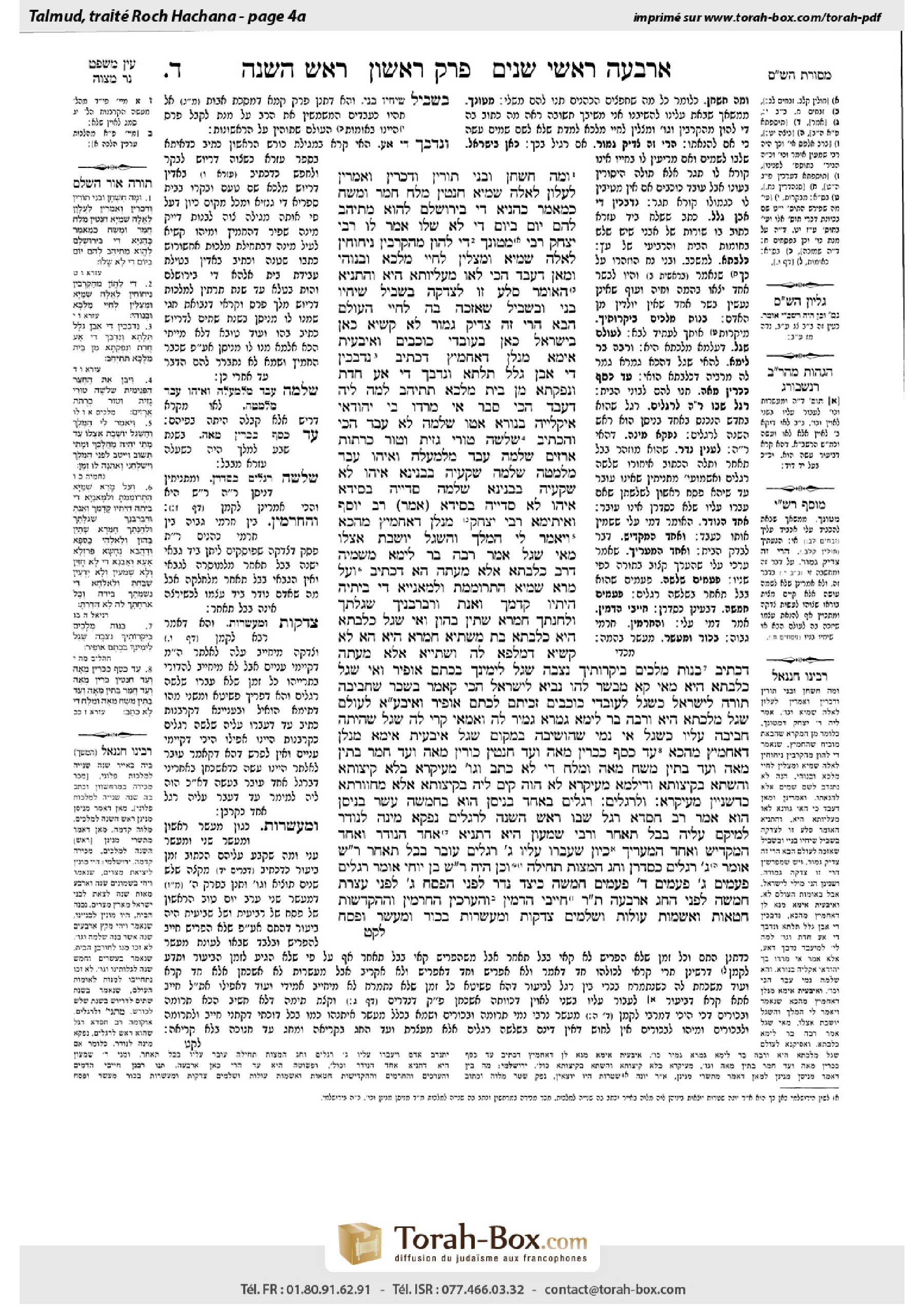
Rosh Hashanah 4a: Talmud study for Daf Yomi
Daf Yomi is the daily study of one Talmud folio. Explore 37 tractates with scans, Hebrew text, Sefaria English and AI-generated French translations where annotated.
Passage selection and English or AI-generated French translation are available where the scan has annotations. Daf Study is independent of Torah-Box and Sefaria.
Browse Rosh Hashanah · ראש השנה · All tractatesRosh Hashanah 4a text and translations
This page of Rosh Hashanah includes the Aramaic text, an English translation and an AI-generated French translation, alongside the scan above.
ראש השנה ד׳ א · Aramaic and Hebrew text
״וּמָה חַשְׁחָן וּבְנֵי תוֹרִין וְדִכְרִין וְאִמְּרִין לַעֲלָוָן לֶאֱלָהּ שְׁמַיָּא חִנְטִין מְלַח חֲמַר וּמְשַׁח כְּמֵאמַר כָּהֲנַיָּא דִי בִירוּשְׁלֶם לֶהֱוֵא מִתְיְהֵב לְהֹם יוֹם בְּיוֹם דִּי לָא שָׁלוּ״! אָמַר לוֹ רַבִּי יִצְחָק: רַבִּי, מִטּוּנָךְ: ״דִּי לֶהֱוֹן מְהַקְרְבִין נִיחוֹחִין לֶאֱלָהּ שְׁמַיָּא וּמְצַלַּיִן לְחַיֵּי מַלְכָּא וּבְנוֹהִי״.
וּמַאן דְּעָבֵד הָכִי לָאו מְעַלְּיוּתָא הִיא? וְהָתַנְיָא, הָאוֹמֵר: ״סֶלַע זוֹ לִצְדָקָה בִּשְׁבִיל שֶׁיִּחְיוּ בָּנַי״, וּ״בִשְׁבִיל שֶׁאֶזְכֶּה בָּהּ לְחַיֵּי הָעוֹלָם הַבָּא״ — הֲרֵי זֶה צַדִּיק גָּמוּר.
לָא קַשְׁיָא: כָּאן בְּיִשְׂרָאֵל, כָּאן בְּגוֹיִם.
וְאִיבָּעֵית אֵימָא: מְנָלַן דְּאַחְמִיץ — דִּכְתִיב: ״נִדְבָּכִין דִּי אֶבֶן גְּלָל תְּלָתָא וְנִדְבָּךְ דִּי אָע חֲדַת וְנִפְקְתָא מִן בֵּית מַלְכָּא תִּתְיְהִב״, לְמָה לֵיהּ דַּעֲבַד הָכִי? סָבַר: אִי מָרְדוּ בִּי יְהוּדָאֵי — אִיקְלְיֵיהּ בְּנוּרָא.
אַטּוּ שְׁלֹמֹה לָא עֲבַד הָכִי? וְהָכְתִיב: ״שְׁלֹשָׁה טוּרֵי גָזִית וְטוּר כְּרֻתוֹת אֲרָזִים״! שְׁלֹמֹה עֲבַד מִלְּמַעְלָה, וְאִיהוּ עֲבַד מִלְּמַטָּה. שְׁלֹמֹה שַׁקְּעֵיהּ בְּבִנְיָנָא, אִיהוּ לָא שַׁקְּעֵיהּ בְּבִנְיָנָא. שְׁלֹמֹה סַדְיֵיהּ בְּסִידָא, אִיהוּ לָא סַדְיֵיהּ בְּסִידָא.
אָמַר רַב יוֹסֵף, וְאִיתֵּימָא רַבִּי יִצְחָק: מְנָלַן דְּאַחְמִיץ — מֵהָכָא: ״וַיֹּאמֶר לִי הַמֶּלֶךְ וְהַשֵּׁגַל יוֹשֶׁבֶת אֶצְלוֹ״. מַאי ״שֵׁגַל״? אָמַר רַבָּה בַּר לִימָא מִשְּׁמֵיהּ דְּרַב: כַּלְבְּתָא.
אֶלָּא מֵעַתָּה, הָא דִּכְתִיב: ״וְעַל מָרֵא שְׁמַיָּא הִתְרוֹמַמְתָּ וּלְמָאנַיָּיא דִי בַיְתֵיהּ הַיְתִיו קׇדָמָךְ וְאַנְתְּ וְרַבְרְבָנָךְ שֵׁגְלָתָךְ וּלְחֵנָתָךְ חַמְרָא שָׁתַיִן בְּהוֹן״, וְאִי ״שֵׁגַל״ כַּלְבְּתָא הִיא, כַּלְבְּתָא בַּת מִשְׁתְּיָא חַמְרָא הִיא? הָא לָא קַשְׁיָא, דְּמַלְּפָא לָה וְשָׁתְיָיא.
אֶלָּא מֵעַתָּה דִּכְתִיב: ״בְּנוֹת מְלָכִים בְּיִקְּרוֹתֶיךָ נִצְּבָה שֵׁגַל לִימִינְךָ בְּכֶתֶם אוֹפִיר״, וְאִי שֵׁגַל כַּלְבְּתָא הִיא, מַאי קָא מְבַשַּׂר לְהוּ נָבִיא לְיִשְׂרָאֵל?! הָכִי קָאָמַר: בִּשְׂכַר שֶׁחֲבִיבָה תּוֹרָה לְיִשְׂרָאֵל כְּשֵׁגַל לַגּוֹיִם — זְכִיתֶם לְכֶתֶם אוֹפִיר.
וְאִיבָּעֵית אֵימָא: לְעוֹלָם ״שֵׁגַל״ — מַלְכְּתָא הִיא, וְרַבָּה בַּר לִימָא גְּמָרָא, גְּמִיר לַהּ. וְאַמַּאי קָרֵי לַהּ ״שֵׁגַל״? שֶׁהָיְתָה חֲבִיבָה עָלָיו כְּשֵׁגַל. אִי נָמֵי: שֶׁהוֹשִׁיבָהּ בִּמְקוֹם שֵׁגַל.
וְאִיבָּעֵית אֵימָא: מְנָלַן דְּאַחְמִיץ — מֵהָכָא: ״עַד כְּסַף כַּכְּרִין מְאָה וְעַד חִנְטִין כּוֹרִין מְאָה וְעַד חֲמַר בַּתִּין מְאָה וְעַד בַּתִּין מְשַׁח מְאָה וּמְלַח דִּי לָא כְתָב וְגוֹ׳״. מֵעִיקָּרָא — בְּלָא קִיצּוּתָא, וְהַשְׁתָּא — בְּקִיצּוּתָא.
וְדִילְמָא מֵעִיקָּרָא לָא הֲוָה קִים לֵיהּ בְּקִיצּוּתָא? אֶלָּא, מְחַוַּורְתָּא כִּדְשַׁנִּיין מֵעִיקָּרָא.
וְלָרְגָלִים. רְגָלִים בְּאֶחָד בְּנִיסָן הוּא? בַּחֲמִשָּׁה עָשָׂר בְּנִיסָן הוּא! אָמַר רַב חִסְדָּא: רֶגֶל שֶׁבּוֹ, רֹאשׁ הַשָּׁנָה לָרְגָלִים.
נָפְקָא מִינַּהּ לְנוֹדֵר, לְמֵיקַם עֲלֵיהּ בְּ״בַל תְּאַחֵר״, וְרַבִּי שִׁמְעוֹן הִיא. דְּתַנְיָא: אֶחָד הַנּוֹדֵר, וְאֶחָד הַמַּקְדִּישׁ, וְאֶחָד הַמַּעֲרִיךְ, כֵּיוָן שֶׁעָבְרוּ עָלָיו שְׁלֹשָׁה רְגָלִים — עוֹבֵר בְּ״בַל תְּאַחֵר״.
רַבִּי שִׁמְעוֹן אוֹמֵר: שְׁלֹשָׁה רְגָלִים כְּסִדְרָן, וְחַג הַמַּצּוֹת תְּחִילָּה. וְכֵן הָיָה רַבִּי שִׁמְעוֹן בֶּן יוֹחַי אוֹמֵר: רְגָלִים, פְּעָמִים שְׁלֹשָׁה, פְּעָמִים אַרְבָּעָה, פְּעָמִים חֲמִשָּׁה. כֵּיצַד? נָדַר לִפְנֵי הַפֶּסַח — שְׁלֹשָׁה. לִפְנֵי עֲצֶרֶת — חֲמִשָּׁה. לִפְנֵי הֶחָג — אַרְבָּעָה.
תָּנוּ רַבָּנַן: חַיָּיבֵי הַדָּמִין וְהָעֲרָכִין, הַחֲרָמִין וְהַהֶקְדֵּשׁוֹת, חַטָּאוֹת וַאֲשָׁמוֹת, עוֹלוֹת וּשְׁלָמִים, צְדָקוֹת וּמַעַשְׂרוֹת, בְּכוֹר וּמַעֲשֵׂר וּפֶסַח,
Rosh Hashanah 4a · English translation
“And that which they need, both young bullocks, and rams, and lambs, for the burnt-offerings of the God of heaven, wheat, salt, wine, and oil, according to the word of the priests who are at Jerusalem, let it be given them day by day without fail” (Ezra 6:9)? Doesn’t Cyrus’ contribution to the Temple demonstrate his fear of Heaven? Rabbi Yitzḥak said to Rav Kahana: My teacher, a refutation can be brought from your own burden, from the text you yourself cited, as the next verse continues: “That they may sacrifice offerings of sweet savor to the God of heaven, and pray for the life of the king and of his sons” (Ezra 6:10). This shows that Cyrus did this solely for his own benefit, so that the Jews would sacrifice offerings and pray for him and his sons.
The Gemara asks: And one who acts in this manner, is he not acting in exemplary fashion? Isn’t it taught in a baraita: If one gives charity, saying: I give this sela for charity in order that my children may live, or: I give it in order that through it I may merit life in the World-to-Come, he is still considered a full-fledged righteous person? If so, what was wrong with the king bringing offerings so that the Jews would pray for his life and the life of his children?
The Gemara answers: This is not difficult. Here, in the case of one who makes his charity conditional yet is considered to be righteous, it is referring to a Jew. This is because even if his condition is not fulfilled, he will not complain to God. However, there, where Cyrus was not given credit for his good deed because it was conditional, it is referring to gentiles. A gentile may come to regret his actions and complain to God if his condition is not fulfilled.
And if you wish, say: From where do we derive that Cyrus became corrupt? As it is written with regard to the building of the Temple that he issued the following command: “Let the house be built…with three rows of great stones, and a row of new timber, and let the expense be paid out of the king’s house” (Ezra 6:4). Why did he do it in this manner and command that the Temple be built with a row of timber? He thought: If the Jews rebel against me, I will burn their Temple with fire, and it will be more flammable because of the wood.
The Gemara raises a question: Is that to say that Solomon did not do this very same thing when he built the first Temple? Isn’t it written: “And he built the inner court, three rows of hewn stone and a row of cedar beams” (I Kings 6:36)? The Gemara answers: Solomon placed the wood above the stone foundation, so that even if the Temple were burned, the stone foundation would remain, whereas Cyrus placed it below, so that if he were to set fire to the Temple, the whole structure would collapse. Also, Solomon sunk the wood into the building in order to make it less flammable, whereas Cyrus did not sink it into the building. Furthermore, Solomon plastered the wood over with plaster to prevent it from catching fire, whereas Cyrus did not plaster the wood over with plaster.
Rav Yosef said, and some say that it was Rabbi Yitzḥak who said: From where do we derive that Cyrus became corrupt? From here, as it is written: “And the king said to me, the consort [shegal] also sitting by him: For how long shall your journey be? And when will you return? So it pleased the king to send me, and I set him a time” (Nehemiah 2:6). What is the meaning of the word shegal in the verse? Rabba bar Lima said in the name of Rav: It means a she-dog that sat next to him, which he used for sexual relations.
The Gemara raises a difficulty: However, if that is so, there is a contradiction from that which is written about Belshazzar: “But you have lifted up yourself against the Lord of heaven; and they have brought the vessels of His house before you, and you, and your lords, your consorts [shegal] and your concubines, have drunk wine in them” (Daniel 5:23). If shegal means a she-dog, does a she-dog drink wine? The Gemara explains: This is not difficult, as perhaps they trained it to drink wine.
The Gemara raises another difficulty: However, if that is so, there is a contradiction from that which is written: “Kings’ daughters are among your favorites; upon your right hand stands a consort [shegal] in gold of Ophir” (Psalms 45:10). Now, if shegal is a she-dog, what is the prophet heralding for the Jewish people? The Gemara explains: This is what the prophet is saying: In reward for the Torah being as precious to the Jews as a she-dog is to gentiles, you merited the gold of Ophir.
And if you wish, say: Actually, the word shegal in all these other contexts means consort, but Rabba bar Lima had a tradition that in connection with Cyrus the word shegal means she-dog. And why was it called a consort [shegal]? It is because the dog was as precious to him as a consort; or else, because he set the dog next to him in place of a consort.
And if you wish, say: From where do we derive that Cyrus became corrupt? It is from here, as it is stated: “Up to a hundred talents of silver, and up to a hundred measures of wheat, and up to a hundred bat of wine, and up to a hundred bat of oil, and salt without prescribed limit” (Ezra 7:22). Initially he gave without setting a limit, but now he introduced a limit.
This is rejected: But perhaps initially he did not know what limit to set, as he was not familiar with the daily needs of the Temple, and afterward, when the matter became clarified, he set an appropriate limit. Rather, it is clear as we initially answered that the evidence that Cyrus became corrupt is based on his relationship with his consort rather than on his donations to the Temple.
§ The mishna teaches: And the first of Nisan is also the New Year for the order of the Festivals. The Gemara asks: Is the New Year for the Festivals really on the first of Nisan? Isn’t it on the fifteenth of Nisan, the first day of the festival of Passover? Rav Ḥisda said: What the mishna means is that the Festival that occurs in the month of Nisan is the New Year for Festivals.
The Gemara comments: This ruling makes a practical difference to one who makes a vow, in order to determine when he is liable for violating the prohibition: You shall not delay. And the mishna was taught in accordance with the opinion of Rabbi Shimon, as it is taught in a baraita: Whether one makes a vow to bring an offering to the Temple, or consecrates an item to the Temple, or makes a valuation, promising to pay the value of a particular person to the Temple treasury, once three Festivals have passed from that day and he has not yet fulfilled his promise, he transgresses the prohibition: You shall not delay, as stated in the verse: “When you shall vow a vow to the Lord your God, you shall not delay paying it” (Deuteronomy 23:22).
Rabbi Shimon says: One transgresses the prohibition against delaying not when any three Festivals have passed, but when three Festivals have passed in their proper order, i.e., Passover, Shavuot, and Sukkot, with Passover first. And, so too, Rabbi Shimon ben Yoḥai would say: The Festivals that must pass before a person is liable for violating the prohibition against delaying are sometimes three, sometimes four, and sometimes five. How so? If one made his vow before Passover they are three, as he may delay bringing his offering until the festival of Sukkot; if he made his vow before Shavuot they are five, as the counting of three Festivals begins only from the next Passover; and if he made his vow before the festival of Sukkot, they are four.
The Sages taught in a baraita: With regard to those who are liable for vows of monetary payment, or for vows of valuations, or for dedications, or for consecrations, sin-offerings, guilt-offerings, burnt-offerings, peace-offerings, vows of charity, tithes, firstborn offerings, animal tithes, or the Paschal offering,
Rosh Hashanah 4a · Traduction française (IA)
« Et tout ce dont ils ont besoin — jeunes taureaux, béliers et agneaux pour les holocaustes offerts au Dieu du ciel, blé, sel, vin et huile — selon les instructions des prêtres qui sont à Jérusalem, qu’on le leur fournisse jour après jour, sans faute » (Esdras 6:9). La contribution de Cyrus au Temple ne démontre-t-elle pas sa crainte du Ciel ? Rabbi Yitzḥak dit à Rav Kahana : « Maître, on peut réfuter votre argument à partir de votre propre citation, du texte que vous avez vous-même cité, car le verset suivant poursuit ainsi : “Afin qu’ils offrent des sacrifices d’agréable odeur au Dieu du ciel et prient pour la vie du roi et de ses fils” (Esdras 6:10). » Cela montre que Cyrus a agi uniquement dans son propre intérêt, afin que les Juifs offrent des sacrifices et prient pour lui et ses fils.
La Guemara demande : Celui qui agit de cette manière n’agit-il pas de façon exemplaire ? N’est-il pas enseigné dans une baraïta : Si quelqu’un fait la charité en disant : « Je donne cette séla à titre de charité afin que mes enfants vivent », ou : « Je la donne afin de mériter ainsi la vie dans le monde à venir », il est tout de même considéré comme un juste à part entière. Dans ce cas, qu’y avait-il de répréhensible à ce que le roi offre des sacrifices afin que les Juifs prient pour sa vie et celle de ses enfants ?
La Guemara répond : Il n’y a pas de difficulté. Ici, dans le cas de celui qui assortit sa charité d’une condition tout en étant considéré comme juste, il s’agit d’un Juif. En effet, même si sa condition n’est pas remplie, il ne se plaindra pas à Dieu. Là-bas, en revanche, si le mérite de son acte n’a pas été reconnu à Cyrus parce qu’il était conditionnel, c’est qu’il s’agit d’un non-Juif. Un non-Juif peut regretter son acte et se plaindre à Dieu si sa condition n’est pas remplie.
Et si tu veux, dis plutôt : D’où déduisons-nous que Cyrus s’est corrompu ? Du fait qu’au sujet de la construction du Temple, il est écrit qu’il donna l’ordre suivant : « Que la maison soit construite […] avec trois rangées de grandes pierres et une rangée de bois neuf, et que la dépense soit payée par la maison du roi » (Esdras 6:4). Pourquoi a-t-il agi ainsi et ordonné que le Temple soit construit avec une rangée de bois ? Il pensait : « Si les Juifs se rebellent contre moi, je brûlerai leur Temple, et le bois le rendra plus inflammable. »
La Guemara soulève une question : Cela voudrait-il dire que Salomon n’a pas fait précisément la même chose lorsqu’il a construit le premier Temple ? N’est-il pas écrit : « Il construisit le parvis intérieur avec trois rangées de pierres de taille et une rangée de poutres de cèdre » (I Rois 6:36) ? La Guemara répond : Salomon plaça le bois au-dessus des fondations de pierre, de sorte que même si le Temple était brûlé, les fondations de pierre subsisteraient, tandis que Cyrus le plaça en dessous, de sorte que, s’il mettait le feu au Temple, toute la structure s’effondrerait. De plus, Salomon enchâssa le bois dans la construction afin de le rendre moins inflammable, tandis que Cyrus ne l’y enchâssa pas. En outre, Salomon recouvrit le bois de plâtre pour l’empêcher de prendre feu, tandis que Cyrus ne le recouvrit pas de plâtre.
Rav Yosef dit, et certains disent que c’est Rabbi Yitzḥak qui dit : D’où déduisons-nous que Cyrus s’est corrompu ? De là, car il est écrit : « Le roi me dit, tandis que la consort [shegal] était assise à ses côtés : “Combien de temps durera ton voyage ? Et quand reviendras-tu ?” Le roi se plut alors à m’envoyer, et je lui indiquai une date » (Néhémie 2:6). Que signifie le mot shegal dans ce verset ? Rabba bar Lima dit au nom de Rav : Il désigne une chienne assise à ses côtés, avec laquelle il avait des relations sexuelles.
La Guemara soulève une difficulté : Toutefois, s’il en est ainsi, il y a contradiction avec ce qui est écrit au sujet de Belshatsar : « Mais tu t’es élevé contre le Seigneur du ciel ; on a apporté devant toi les vases de sa maison, et toi, tes seigneurs, tes consorts [shegal] et tes concubines, vous avez bu du vin dans ces vases » (Daniel 5:23). Si shegal signifie « chienne », une chienne boit-elle du vin ? La Guemara explique : Il n’y a pas de difficulté, car il se peut qu’ils l’aient dressée à boire du vin.
La Guemara soulève une autre difficulté : Toutefois, s’il en est ainsi, il y a contradiction avec ce qui est écrit : « Les filles des rois figurent parmi tes favorites ; à ta droite se tient une consort [shegal], parée d’or d’Ophir » (Psaumes 45:10). Or, si shegal désigne une chienne, qu’annonce le prophète au peuple juif ? La Guemara explique : Voici ce que dit le prophète : En récompense du fait que la Torah était aussi précieuse aux yeux des Juifs qu’une chienne aux yeux des non-Juifs, vous avez mérité l’or d’Ophir.
Et si tu veux, dis plutôt : En réalité, dans tous ces autres contextes, le mot shegal signifie « consort », mais Rabba bar Lima avait reçu la tradition que, dans le cas de Cyrus, le mot shegal signifie « chienne ». Et pourquoi l’appelait-on une consort [shegal] ? Parce que la chienne lui était aussi précieuse qu’une consort ; ou bien parce qu’il plaçait la chienne à ses côtés à la place d’une consort.
Et si tu veux, dis plutôt : D’où déduisons-nous que Cyrus s’est corrompu ? De là, car il est écrit : « Jusqu’à cent talents d’argent, jusqu’à cent mesures de blé, jusqu’à cent baths de vin, jusqu’à cent baths d’huile, et du sel sans quantité prescrite » (Esdras 7:22). Au début, il donnait sans fixer de limite, mais maintenant il en a fixé une.
Cette réponse est rejetée : Mais peut-être qu’au début, il ne savait pas quelle limite fixer, car il ne connaissait pas les besoins quotidiens du Temple, puis, une fois la question éclaircie, il a fixé une limite appropriée. Il faut donc plutôt conclure, comme nous l’avons répondu initialement, que la preuve de la corruption de Cyrus repose sur sa relation avec sa consort, et non sur ses dons au Temple.
§ La Michna enseigne : Le premier jour de Nisan est également le nouvel an pour l’ordre des fêtes. La Guemara demande : Le nouvel an des fêtes est-il vraiment le premier jour de Nisan ? N’est-ce pas le quinzième jour de Nisan, premier jour de la fête de Pessaḥ ? Rav Ḥisda dit : Ce que veut dire la Michna, c’est que la fête qui a lieu au mois de Nisan marque le nouvel an des fêtes.
La Guemara fait remarquer : Cette règle a une conséquence pratique pour celui qui fait un vœu, car elle permet de déterminer à quel moment il devient passible d’avoir transgressé l’interdiction : « Tu ne tarderas pas. » Et la Michna a été enseignée conformément à l’opinion de Rabbi Shimon, comme il est enseigné dans une baraïta : Que l’on fasse un vœu d’apporter une offrande au Temple, que l’on consacre un objet au Temple, ou que l’on fasse une évaluation en promettant de verser au trésor du Temple la valeur d’une personne donnée, dès que trois fêtes sont passées depuis ce jour sans que l’on ait encore accompli sa promesse, on transgresse l’interdiction : « Tu ne tarderas pas », comme l’indique le verset : « Lorsque tu feras un vœu à l’Éternel, ton Dieu, tu ne tarderas pas à l’acquitter » (Deutéronome 23:22).
Rabbi Shimon dit : On ne transgresse pas l’interdiction de tarder dès que trois fêtes quelconques sont passées, mais lorsque trois fêtes sont passées dans leur ordre approprié, c’est-à-dire Pessaḥ, Chavouot et Soukkot, avec Pessaḥ en premier. Rabbi Shimon ben Yoḥai disait également : Les fêtes qui doivent passer avant qu’une personne soit passible d’avoir transgressé l’interdiction de tarder sont parfois au nombre de trois, parfois de quatre et parfois de cinq. Comment cela ? Si elle a fait son vœu avant Pessaḥ, il y en a trois, car elle peut retarder l’apport de son offrande jusqu’à la fête de Soukkot ; si elle a fait son vœu avant Chavouot, il y en a cinq, car le compte des trois fêtes ne commence qu’à partir du Pessaḥ suivant ; et si elle a fait son vœu avant la fête de Soukkot, il y en a quatre.
Les Sages enseignent dans une baraïta : Quant à ceux qui sont tenus par des vœux de paiement d’argent, des vœux d’évaluation, des consécrations, des objets voués au Temple, des sacrifices expiatoires, des sacrifices de culpabilité, des holocaustes, des sacrifices de paix, des vœux de charité, des dîmes, des offrandes des premiers-nés, des dîmes animales ou l’offrande de Pessaḥ,
Traduction française générée par IA à partir de l’édition anglaise de Sefaria. Vérifie toujours un passage avec le texte source.
Text from Sefaria: William Davidson Edition - Vocalized Aramaic (CC BY NC); William Davidson Edition - English (CC BY NC).