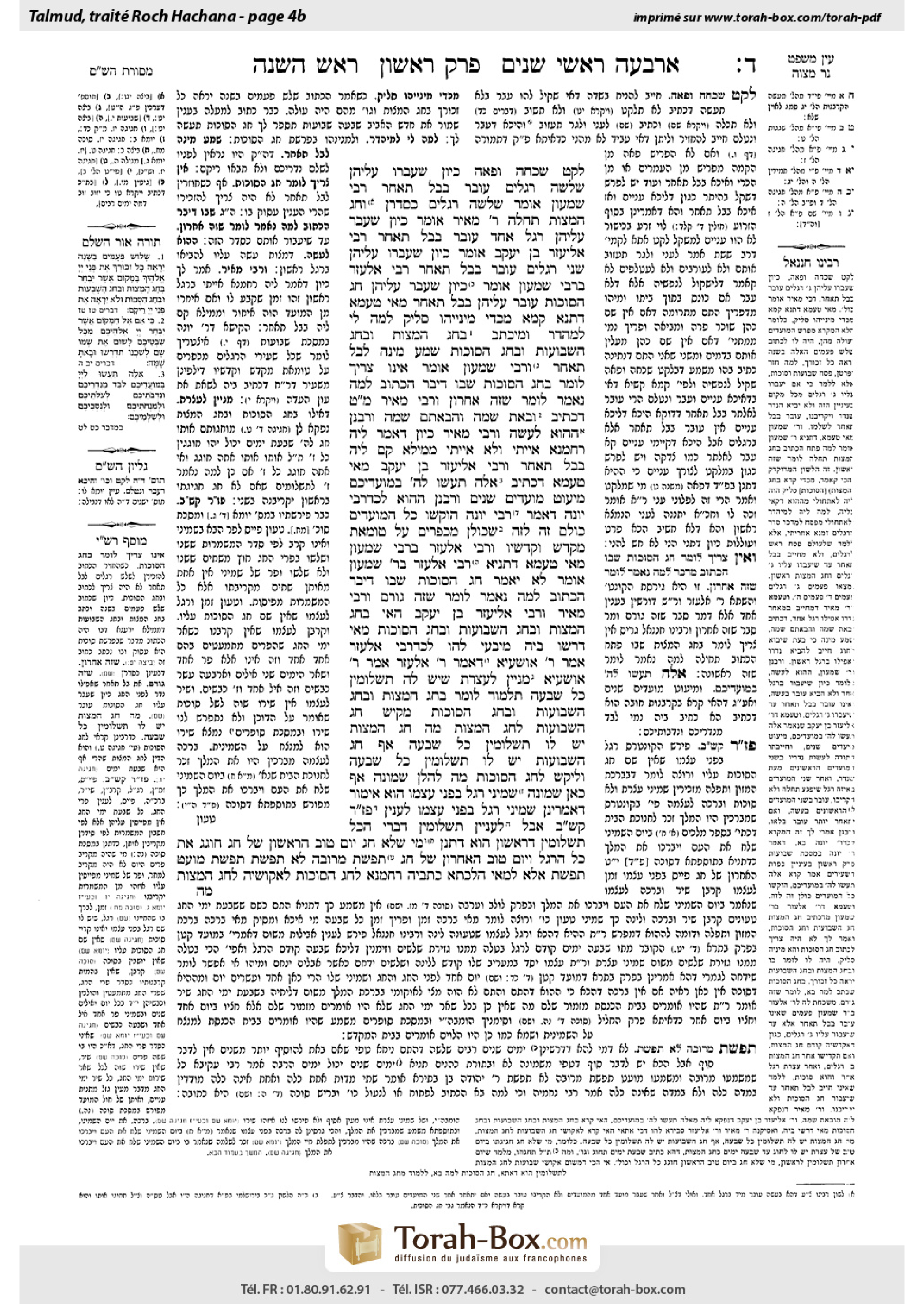
Rosh Hashanah 4b: Talmud study for Daf Yomi
Daf Yomi is the daily study of one Talmud folio. Explore 37 tractates with scans, Hebrew text, Sefaria English and AI-generated French translations where annotated.
Passage selection and English or AI-generated French translation are available where the scan has annotations. Daf Study is independent of Torah-Box and Sefaria.
Browse Rosh Hashanah · ראש השנה · All tractatesRosh Hashanah 4b text and translations
This page of Rosh Hashanah includes the Aramaic text, an English translation and an AI-generated French translation, alongside the scan above.
ראש השנה ד׳ ב · Aramaic and Hebrew text
לֶקֶט שִׁכְחָה וּפֵאָה, כֵּיוָן שֶׁעָבְרוּ עֲלֵיהֶן שְׁלֹשָׁה רְגָלִים — עוֹבֵר בְּ״בַל תְּאַחֵר״. רַבִּי שִׁמְעוֹן אוֹמֵר: שְׁלֹשָׁה רְגָלִים כְּסִדְרָן, וְחַג הַמַּצּוֹת תְּחִלָּה.
רַבִּי מֵאִיר אוֹמֵר: כֵּיוָן שֶׁעָבַר עֲלֵיהֶן רֶגֶל אֶחָד — עוֹבֵר בְּ״בַל תְּאַחֵר״. רַבִּי אֱלִיעֶזֶר בֶּן יַעֲקֹב אוֹמֵר: כֵּיוָן שֶׁעָבְרוּ עֲלֵיהֶן שְׁנֵי רְגָלִים — עוֹבֵר בְּ״בַל תְּאַחֵר״. רַבִּי אֶלְעָזָר בְּרַבִּי שִׁמְעוֹן אוֹמֵר: כֵּיוָן שֶׁעָבַר עֲלֵיהֶן חַג הַסּוּכּוֹת — עוֹבֵר עֲלֵיהֶן בְּ״בַל תְּאַחֵר״.
מַאי טַעְמָא דְּתַנָּא קַמָּא — מִכְּדֵי מִינַּיְיהוּ סָלֵיק, לְמָה לִי לְמֶהְדַּר וּמִיכְתַּב: ״בְּחַג הַמַּצּוֹת וּבְחַג הַשָּׁבוּעוֹת וּבְחַג הַסּוּכּוֹת״? שְׁמַע מִינַּהּ לְ״בַל תְּאַחֵר״.
וְרַבִּי שִׁמְעוֹן אוֹמֵר: אֵינוֹ צָרִיךְ לוֹמַר ״בְּחַג הַסּוּכּוֹת״, שֶׁבּוֹ דִּיבֵּר הַכָּתוּב, לָמָּה נֶאֱמַר — לוֹמַר שֶׁזֶּה אַחֲרוֹן.
וְרַבִּי מֵאִיר — מַאי טַעְמָא? דִּכְתִיב: ״וּבָאתָ שָּׁמָּה ... וַהֲבֵאתֶם שָׁמָּה״.
וְרַבָּנַן — הַהוּא לַעֲשֵׂה.
וְרַבִּי מֵאִיר, כֵּיוָן דְּאָמַר לֵיהּ רַחֲמָנָא אַיְיתִי וְלָא אַיְיתִי — מִמֵּילָא קָם לֵיהּ בְּ״בַל תְּאַחֵר״.
וְרַבִּי אֱלִיעֶזֶר בֶּן יַעֲקֹב, מַאי טַעְמָא? דִּכְתִיב: ״אֵלֶּה תַּעֲשׂוּ לַה׳ בְּמוֹעֲדֵיכֶם״ — מִיעוּט מוֹעֲדִים שְׁנַיִם.
וְרַבָּנַן — הַהוּא לְכִדְרַבִּי יוֹנָה. דְּאָמַר רַבִּי יוֹנָה: הוּקְשׁוּ כׇּל הַמּוֹעֲדִים כּוּלָּם זֶה לָזֶה, שֶׁכּוּלָּן מְכַפְּרִים עַל טוּמְאַת מִקְדָּשׁ וְקָדָשָׁיו.
וְרַבִּי אֶלְעָזָר בְּרַבִּי שִׁמְעוֹן, מַאי טַעְמָא? דְּתַנְיָא, רַבִּי אֶלְעָזָר בְּרַבִּי שִׁמְעוֹן אוֹמֵר: לֹא יֵאָמֵר ״חַג הַסּוּכּוֹת״, שֶׁבּוֹ דִּיבֵּר הַכָּתוּב, לָמָּה נֶאֱמַר — לוֹמַר שֶׁזֶּה גּוֹרֵם.
וְרַבִּי מֵאִיר וְרַבִּי אֱלִיעֶזֶר בֶּן יַעֲקֹב: הַאי ״בְּחַג הַמַּצּוֹת וּבְחַג הַשָּׁבוּעוֹת וּבְחַג הַסּוּכּוֹת״ מַאי דָּרְשׁוּ בֵּיהּ? מִיבְּעֵי לְהוּ לְכִדְרַבִּי אֶלְעָזָר אָמַר רַבִּי אוֹשַׁעְיָא. דְּאָמַר רַבִּי אֶלְעָזָר אָמַר רַבִּי אוֹשַׁעְיָא: מִנַּיִין לַעֲצֶרֶת שֶׁיֵּשׁ לָהּ תַּשְׁלוּמִין כׇּל שִׁבְעָה? תַּלְמוּד לוֹמַר: ״בְּחַג הַמַּצּוֹת וּבְחַג הַשָּׁבוּעוֹת וּבְחַג הַסּוּכּוֹת״, מַקִּישׁ חַג הַשָּׁבוּעוֹת לְחַג הַמַּצּוֹת: מָה חַג הַמַּצּוֹת יֵשׁ לוֹ תַּשְׁלוּמִין כׇּל שִׁבְעָה — אַף חַג הַשָּׁבוּעוֹת יֵשׁ לוֹ תַּשְׁלוּמִין כׇּל שִׁבְעָה.
וְלַיקִּשׁ לְחַג הַסּוּכּוֹת: מָה לְּהַלָּן שְׁמוֹנָה — אַף כָּאן שְׁמוֹנָה! שְׁמִינִי רֶגֶל בִּפְנֵי עַצְמוֹ הוּא.
אֵימוֹר דְּאָמְרִינַן שְׁמִינִי רֶגֶל בִּפְנֵי עַצְמוֹ לְעִנְיַן פָּזֵ״ר קָשֶׁ״ב, אֲבָל לְעִנְיַין תַּשְׁלוּמִין — דִּבְרֵי הַכֹּל תַּשְׁלוּמִין דְּרִאשׁוֹן הוּא!
דִּתְנַן: מִי שֶׁלֹּא חָג יוֹם טוֹב הָרִאשׁוֹן שֶׁל חַג — חוֹגֵג אֶת כָּל הָרֶגֶל וְיוֹם טוֹב הָאַחֲרוֹן שֶׁל חַג.
תָּפַשְׂתָּ מְרוּבֶּה — לֹא תָּפַשְׂתָּ, תָּפַשְׂתָּ מוּעָט — תָּפַשְׂתָּ.
אֶלָּא לְמַאי הִלְכְתָא כַּתְבֵיהּ רַחֲמָנָא לְחַג הַסּוּכּוֹת? לְאַקּוֹשֵׁיהּ לְחַג הַמַּצּוֹת:
Rosh Hashanah 4b · English translation
or for gleanings, forgotten sheaves, or produce of the corner of the field, three obligatory agricultural gifts that must be given to the poor, once three Festivals have passed they transgress the prohibition: You shall not delay. Rabbi Shimon says: These three Festivals must be in their proper order, with the festival of Passover first.
Rabbi Meir says: Once even one Festival has passed, one transgresses the prohibition: You shall not delay. Rabbi Eliezer ben Ya’akov says: Once two Festivals have passed, one transgresses the prohibition: You shall not delay. Rabbi Elazar, son of Rabbi Shimon, says: Once the festival of Sukkot has passed, one transgresses the prohibition: You shall not delay.
The Gemara proceeds to explain the various opinions: What is the rationale of the first tanna? Since the entire chapter (Deuteronomy, chapter 16) has just concluded a discussion of the three pilgrimage Festivals, why, after stating: “Three times a year shall all your males appear before the Lord your God” (Deuteronomy 16:16), do I need the Torah to write again: “On the festival of Passover, and on the festival of Shavuot, and on the festival of Sukkot; and they shall not appear before the Lord empty-handed” (Deuteronomy 16:16)? Rather, learn from here that the verse comes to teach with regard to the halakha of: You shall not delay, that one does not transgress the prohibition unless these three Festivals have passed.
And Rabbi Shimon, who said that one does not transgress the prohibition against delaying unless these three Festivals have passed in order, says in explanation of his opinion: It was not necessary for the verse to say again “on the festival of Sukkot,” of which the immediately preceding text was speaking. Why, then, is it stated? It is to teach that this must be the last one, i.e., that the three Festivals must pass in order, so that Sukkot is the last of the three.
And Rabbi Meir, who says that one transgresses the prohibition against delaying as soon as one Festival has passed, what is the rationale for his opinion? It is as it is written: “But to the place which the Lord your God shall choose out of all your tribes to put His name there, there shall you seek Him, at his dwelling, and there shall you come: And there you shall bring your burnt-offerings and your sacrifices, and your tithes, and the offerings of your hand, and your vows, and your gift offerings, and the firstlings of your herds and your flocks” (Deuteronomy 12:5–6). This teaches that one transgresses the prohibition if he fails to bring the offerings for which he is liable as soon as the time has arrived that “there shall you come,” i.e., by the first Festival.
The Gemara asks: And the Rabbis, who say that one transgresses the prohibition against delaying only after three Festivals have passed, how do they understand this verse? The Gemara answers: In their opinion, this verse teaches that there is a positive mitzva to bring one’s vow-offerings on the first Festival; however, if one did not bring them, he has not transgressed the prohibition against delaying, although he has failed to perform the positive mitzva.
The Gemara asks: And how does Rabbi Meir counter this argument? The Gemara answers: He would say that since the Merciful One tells one to bring the offering at that time and he did not bring it, automatically he is liable for transgressing the prohibition: You shall not delay, as he has missed the time set by the Torah.
The Gemara asks: And Rabbi Eliezer ben Ya’akov, who said that one transgresses the prohibition against delaying once two Festivals have passed, what is the rationale for his opinion? The Gemara explains: It is as it is written: “These things you shall do to the Lord in your appointed times, besides your vows, and your gift offerings, for your burnt-offerings, and for your meal-offerings, and for your drink-offerings, and for your peace-offerings” (Numbers 29:39). According to this verse, the time set for the bringing of vows is at the “appointed times,” and the minimum number of appointed times in the plural is two.
The Gemara asks: And how do the Rabbis understand this verse? The Gemara explains: They say that the term “appointed times” is needed for the teaching of Rabbi Yona, as Rabbi Yona said: All the Festivals are equated with each other, insofar as all the goats brought as sin-offerings on the Festivals atone for the impurity of the Temple and its sacred objects, just like the goat brought as a sin-offering on the New Moon.
The Gemara asks further: And Rabbi Elazar, son of Rabbi Shimon, who says that once the festival of Sukkot has passed one immediately transgresses the prohibition against delaying, what is the rationale for his opinion? The Gemara explains: It is as it is taught in a baraita: Rabbi Elazar, son of Rabbi Shimon, says: It was not necessary for the verse to mention “the festival of Sukkot” (Deuteronomy 16:16), of which the immediately preceding text was speaking. If so, why is it stated? It is to say that this Festival is what causes one to be considered late in fulfilling his vow, since by the end of the Festival he must bring all of his current vows to the Temple, whether he took his vow shortly before Sukkot or much earlier.
And Rabbi Meir and Rabbi Eliezer ben Ya’akov, what do they expound from this verse: “On the festival of Passover, and on the festival of Shavuot, and on the festival of Sukkot”? The Gemara explains: They require this verse for the halakha that Rabbi Elazar said that Rabbi Oshaya said, as Rabbi Elazar said that Rabbi Oshaya said: From where is it derived that the Shavuot offering has redress all seven days, i.e., that if one failed to bring the Festival peace-offering on the Festival itself, he has six more days to bring it? The verse states: “On the festival of Passover, and on the festival of Shavuot, and on the festival of Sukkot,” thereby equating the festival of Shavuot to the festival of Passover. Just as the festival of Passover has redress all seven days, as Passover is seven days long, so too, the festival of Shavuot has redress all seven days, during the week following the festival of Shavuot.
The Gemara asks: If so, draw an analogy from the festival of Shavuot to the festival of Sukkot, which is also mentioned in close proximity to it, and say: Just as below, on Sukkot, the offering may be brought for eight days, so too, here, on Shavuot, it should be possible to bring the offering for eight days. The Gemara rejects this suggestion: This is not so, as even on Sukkot the Festival peace-offering may be brought only for seven days, as the eighth day is a separate Festival in and of itself.
The Gemara raises a question: But can’t you say that we say that the Eighth Day of Assembly is a Festival in and of itself only with regard to peh, zayin, reish, kuf, shin, beit, an acronym that stands for six unique aspects to the Eighth Day of Assembly. But with regard to the matter of redress for failing to bring a Festival peace-offering, everyone agrees that the Eighth Day of Assembly is still a day of redress for the first day of the festival of Sukkot.
As we learned in a mishna: If one did not bring his Festival peace-offering on the first day of the festival of Sukkot, he may still bring the Festival peace-offering during all of the Festival and even on the last day of the Festival, as the Eighth Day of Assembly is regarded as part of Sukkot for this purpose. If so, perhaps the festival of Shavuot can be compared to the festival of Sukkot such that the Festival peace-offering of Shavuot may also be brought for eight days.
The Gemara answers: It is preferable to equate Shavuot to Passover and not to Sukkot due to the general principle: If you grasped many, you did not grasp anything; if you grasped few, you grasped something. That is to say, in a case of doubt, choose the smaller number, as it is included within the larger number.
The Gemara asks: But if so, with regard to what halakha did the Merciful One write the festival of Sukkot in this verse? The Gemara explains: It is to draw an analogy from Sukkot to the festival of Passover with regard to a different issue:
Rosh Hashanah 4b · Traduction française (IA)
ou pour les glanures, les gerbes oubliées ou les produits du coin du champ, trois dons agricoles obligatoires qui doivent être remis aux pauvres, dès que trois fêtes sont passées, ils transgressent l’interdiction : « Tu ne tarderas pas. » Rabbi Shimon dit : Ces trois fêtes doivent passer dans leur ordre, avec la fête de Pessa’h en premier.
Rabbi Meir dit : Dès qu’une seule fête est passée, on transgresse l’interdiction : « Tu ne tarderas pas. » Rabbi Eliezer ben Ya’akov dit : Dès que deux fêtes sont passées, on transgresse l’interdiction : « Tu ne tarderas pas. » Rabbi Elazar, fils de Rabbi Shimon, dit : Dès que la fête de Soukkot est passée, on transgresse l’interdiction : « Tu ne tarderas pas. »
La Guemara explique les différentes opinions : Quel est le raisonnement du premier tanna ? Puisque tout le chapitre (Deutéronome, chapitre 16) vient de s’achever sur une discussion des trois fêtes de pèlerinage, pourquoi la Torah doit-elle écrire à nouveau, après avoir énoncé : « Trois fois par an, tous tes mâles se présenteront devant le Seigneur ton Dieu » (Deutéronome 16,16) : « À la fête de Pessa’h, à la fête de Chavouot et à la fête de Soukkot ; ils ne se présenteront pas devant le Seigneur les mains vides » (Deutéronome 16,16) ? Il faut plutôt en déduire que le verset vient enseigner, au sujet de la halakha « Tu ne tarderas pas », qu’on ne transgresse pas l’interdiction avant que ces trois fêtes soient passées.
Et Rabbi Shimon, qui affirme qu’on ne transgresse pas l’interdiction de tarder avant que ces trois fêtes soient passées dans l’ordre, explique ainsi son opinion : Il n’était pas nécessaire que le verset mentionne à nouveau « à la fête de Soukkot », dont parlait le texte immédiatement précédent. Pourquoi cette mention figure-t-elle donc ? Pour enseigner que Soukkot doit être la dernière, c’est-à-dire que les trois fêtes doivent passer dans l’ordre, Soukkot étant la dernière des trois.
Et Rabbi Meir, qui dit qu’on transgresse l’interdiction de tarder dès qu’une fête est passée, quel est le raisonnement de son opinion ? C’est ce qui est écrit : « Mais vous rechercherez le lieu que le Seigneur votre Dieu choisira parmi toutes vos tribus pour y établir Son nom ; vous irez là où Il réside. C’est là que vous apporterez vos holocaustes, vos sacrifices, vos dîmes, les offrandes de vos mains, vos vœux, vos offrandes volontaires, ainsi que les premiers-nés de vos bovins et de vos ovins » (Deutéronome 12,5-6). Cela enseigne qu’on transgresse l’interdiction si l’on n’apporte pas les offrandes dont on est redevable dès que vient le moment où « vous irez là », c’est-à-dire à la première fête.
La Guemara demande : Et comment les rabbins, qui affirment qu’on ne transgresse l’interdiction de tarder qu’après le passage de trois fêtes, comprennent-ils ce verset ? La Guemara répond : Selon eux, ce verset enseigne qu’il y a une mitsva positive d’apporter ses offrandes votives dès la première fête ; toutefois, si on ne les apporte pas, on n’a pas transgressé l’interdiction de tarder, même si l’on n’a pas accompli la mitsva positive.
La Guemara demande : Et comment Rabbi Meir réfute-t-il cet argument ? La Guemara répond : Il dirait que, puisque le Miséricordieux ordonne d’apporter l’offrande à ce moment-là et qu’on ne l’a pas apportée, on est automatiquement passible d’avoir transgressé l’interdiction : « Tu ne tarderas pas », car on a dépassé le délai fixé par la Torah.
La Guemara demande : Et Rabbi Eliezer ben Ya’akov, qui dit qu’on transgresse l’interdiction de tarder après le passage de deux fêtes, quel est le raisonnement de son opinion ? La Guemara explique : C’est ce qui est écrit : « Vous ferez ces choses pour le Seigneur aux temps fixés, en plus de vos vœux et de vos offrandes volontaires, pour vos holocaustes, vos offrandes de farine, vos libations et vos sacrifices de paix » (Nombres 29,39). Selon ce verset, le moment fixé pour apporter les vœux est celui des « temps fixés » ; or, le pluriel implique au minimum deux temps fixés.
La Guemara demande : Et comment les rabbins comprennent-ils ce verset ? La Guemara explique : Ils disent que l’expression « temps fixés » est nécessaire pour l’enseignement de Rabbi Yona, car Rabbi Yona a dit : Toutes les fêtes sont assimilées les unes aux autres, en ce que tous les boucs apportés en sacrifice expiatoire lors des fêtes expient l’impureté du Temple et de ses objets sacrés, tout comme le bouc apporté en sacrifice expiatoire à la néoménie.
La Guemara demande encore : Et Rabbi Elazar, fils de Rabbi Shimon, qui dit que dès que la fête de Soukkot est passée, on transgresse immédiatement l’interdiction de tarder, quel est le raisonnement de son opinion ? La Guemara explique : C’est ce qui est enseigné dans une baraïta : Rabbi Elazar, fils de Rabbi Shimon, dit : Il n’était pas nécessaire que le verset mentionne « la fête de Soukkot » (Deutéronome 16,16), dont parlait le texte immédiatement précédent. Pourquoi cette mention figure-t-elle donc ? Pour enseigner que cette fête est celle qui fait considérer qu’on a tardé à accomplir son vœu, car, à la fin de la fête, on doit apporter au Temple tous les vœux qu’on a formulés jusque-là, que l’on ait fait son vœu peu avant Soukkot ou bien plus tôt.
Et que déduisent Rabbi Meir et Rabbi Eliezer ben Ya’akov de ce verset : « À la fête de Pessa’h, à la fête de Chavouot et à la fête de Soukkot » ? La Guemara explique : Ils ont besoin de ce verset pour la halakha que Rabbi Elazar a enseignée au nom de Rabbi Oshaya, car Rabbi Elazar a enseigné au nom de Rabbi Oshaya : D’où apprend-on que le sacrifice de Chavouot peut être apporté en rattrapage pendant les sept jours, c’est-à-dire que si l’on n’a pas apporté le sacrifice de paix de la fête le jour même, on dispose encore de six jours pour l’apporter ? Le verset énonce : « À la fête de Pessa’h, à la fête de Chavouot et à la fête de Soukkot », assimilant ainsi la fête de Chavouot à celle de Pessa’h. De même que la fête de Pessa’h permet un rattrapage pendant les sept jours, puisque Pessa’h dure sept jours, de même la fête de Chavouot permet un rattrapage pendant les sept jours, durant la semaine qui suit la fête de Chavouot.
La Guemara demande : Dans ce cas, ne peut-on pas établir une analogie entre la fête de Chavouot et celle de Soukkot, qui est également mentionnée à proximité, et dire : de même que là, à Soukkot, l’offrande peut être apportée pendant huit jours, de même ici, à Chavouot, on devrait pouvoir apporter l’offrande pendant huit jours ? La Guemara rejette cette suggestion : Il n’en est pas ainsi, car même à Soukkot, le sacrifice de paix de la fête ne peut être apporté que pendant sept jours, le huitième jour étant une fête distincte à part entière.
La Guemara soulève une question : Mais ne peut-on pas dire que le Huitième Jour d’Assemblée est considéré comme une fête distincte à part entière uniquement en ce qui concerne peh, zayin, reish, kuf, shin, beit, acronyme désignant six aspects qui lui sont propres ? Mais, en ce qui concerne le rattrapage de l’omission d’apporter un sacrifice de paix de la fête, tous s’accordent à dire que le Huitième Jour d’Assemblée reste un jour de rattrapage pour le premier jour de la fête de Soukkot.
Comme nous l’avons appris dans une Michna : Si l’on n’a pas apporté son sacrifice de paix de la fête le premier jour de la fête de Soukkot, on peut encore l’apporter pendant toute la fête, même le dernier jour, car, à cette fin, le Huitième Jour d’Assemblée est considéré comme faisant partie de Soukkot. Dans ce cas, peut-être la fête de Chavouot peut-elle être comparée à celle de Soukkot, de sorte que le sacrifice de paix de la fête de Chavouot puisse lui aussi être apporté pendant huit jours.
La Guemara répond : Il est préférable d’assimiler Chavouot à Pessa’h plutôt qu’à Soukkot, selon le principe général : « Si tu as saisi beaucoup, tu n’as rien saisi ; si tu as saisi peu, tu as saisi quelque chose. » Autrement dit, en cas de doute, on choisit le nombre le plus petit, puisqu’il est inclus dans le plus grand.
La Guemara demande : Mais dans ce cas, pour quelle halakha le Miséricordieux a-t-il mentionné la fête de Soukkot dans ce verset ? La Guemara explique : C’est pour établir une analogie entre Soukkot et la fête de Pessa’h au sujet d’une autre question :
Traduction française générée par IA à partir de l’édition anglaise de Sefaria. Vérifie toujours un passage avec le texte source.
Text from Sefaria: William Davidson Edition - Vocalized Aramaic (CC BY NC); William Davidson Edition - English (CC BY NC).