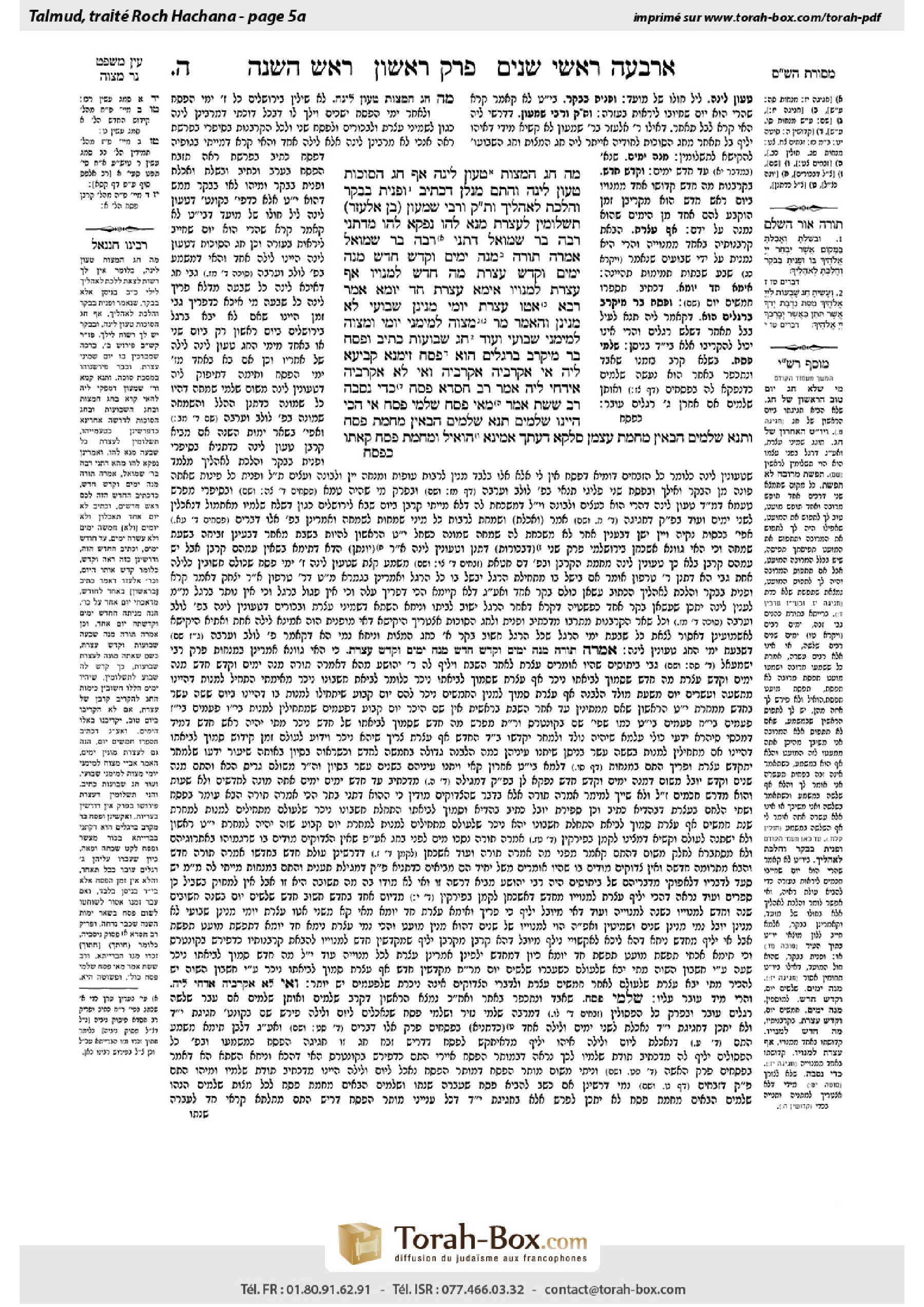
Rosh Hashanah 5a: Talmud study for Daf Yomi
Daf Yomi is the daily study of one Talmud folio. Explore 37 tractates with scans, Hebrew text, Sefaria English and AI-generated French translations where annotated.
Passage selection and English or AI-generated French translation are available where the scan has annotations. Daf Study is independent of Torah-Box and Sefaria.
Browse Rosh Hashanah · ראש השנה · All tractatesRosh Hashanah 5a text and translations
This page of Rosh Hashanah includes the Aramaic text, an English translation and an AI-generated French translation, alongside the scan above.
ראש השנה ה׳ א · Aramaic and Hebrew text
מָה חַג הַמַּצּוֹת טָעוּן לִינָה — אַף חַג הַסּוּכּוֹת טָעוּן לִינָה.
וְהָתָם מְנָלַן? דִּכְתִיב: ״וּפָנִיתָ בַבֹּקֶר וְהָלַכְתָּ לְאֹהָלֶיךָ״.
וְתַנָּא קַמָּא וְרַבִּי שִׁמְעוֹן (בֶּן אֶלְעָזָר) — תַּשְׁלוּמִין לַעֲצֶרֶת מְנָא לְהוּ?
נָפְקָא לְהוּ מִדְּתָנֵי רַבָּה בַּר שְׁמוּאֵל. דְּתָנֵי רַבָּה בַּר שְׁמוּאֵל: אָמְרָה תּוֹרָה מְנֵה יָמִים וְקַדֵּשׁ חֹדֶשׁ, מְנֵה יָמִים וְקַדֵּשׁ עֲצֶרֶת. מָה חֹדֶשׁ לִמְנוּיָו — אַף עֲצֶרֶת לִמְנוּיָו.
אֵימָא עֲצֶרֶת חַד יוֹמָא? אָמַר רָבָא: אַטּוּ עֲצֶרֶת יוֹמֵי מָנִינַן, שָׁבוּעֵי לָא מָנִינַן? וְהָאָמַר מָר: מִצְוָה לְמִימְנֵי יוֹמֵי, וּמִצְוָה לְמִימְנֵי שָׁבוּעֵי. וְעוֹד: ״חַג שָׁבוּעוֹת״ כְּתִיב.
וּפֶסַח בַּר מִיקְרַב בִּרְגָלִים הוּא? פֶּסַח זִימְנָא קְבִיעָא לֵיהּ, אִי אַקְרְבֵיהּ — אַקְרְבֵיהּ, וְאִי לָא אַקְרְבֵיהּ — אִידְּחִי לֵיהּ!
אָמַר רַב חִסְדָּא: פֶּסַח כְּדִי נַסְבֵהּ.
רַב שֵׁשֶׁת אָמַר: מַאי ״פֶּסַח״ — שַׁלְמֵי פֶסַח.
אִי הָכִי — הַיְינוּ שְׁלָמִים! תְּנָא שְׁלָמִים הַבָּאִין מֵחֲמַת פֶּסַח, וּתְנָא שְׁלָמִים הַבָּאִין מֵחֲמַת עַצְמָן. סָלְקָא דַּעְתָּךְ אָמֵינָא: הוֹאִיל וּמֵחֲמַת פֶּסַח קָאָתוּ,
Rosh Hashanah 5a · English translation
Just as the festival of Passover requires remaining overnight in Jerusalem, and only on the following day may one return home, so too, the festival of Sukkot requires remaining overnight in Jerusalem before returning home.
The Gemara asks: And there, with regard to Passover, from where do we derive this halakha? The Gemara explains: As it is written about the Paschal offering: “And you shall roast and eat it in the place which the Lord your God shall choose; and you shall turn in the morning, and go to your tents” (Deuteronomy 16:7).
The Gemara asks: And the first tanna of the baraita and Rabbi Shimon, who learn from the verse: “On the festival of Passover, and on the festival of Shavuot, and on the festival of Sukkot” (Deuteronomy 16:16), that one transgresses the prohibition against delaying only after three Festivals have passed, from where do they derive the halakha that the Shavuot offering has redress for seven days?
The Gemara answers: They derive it from that which Rabba bar Shmuel taught, as Rabba bar Shmuel taught: The Torah states to count the days, as it is stated: “A month of days” (Numbers 11:20), and then sanctify a new month with offerings. And the Torah also said to count the days from Passover, as it is stated: “You shall count fifty days” (Leviticus 23:16), and then sanctify the festival of Shavuot with offerings. Just as the new month is sanctified for the unit of time by which it is counted, i.e., for one day, so too, Shavuot is sanctified for the unit of time by which it is counted, i.e., for one full week, as it is stated: “Seven complete weeks shall there be” (Leviticus 23:15).
The Gemara asks: But if so, say that the Shavuot offering may be redressed for only one day, as Shavuot is determined by a count of fifty days from Passover. How, then, is it known that the Shavuot offering has seven days for redress? Rava said: Is that to say that we count only days until Shavuot, but we do not also count weeks? But didn’t the Master say: It is a mitzva to count fifty days, and it is also a mitzva to count seven weeks, which teaches that the Festival peace-offering brought on Shavuot may be sacrificed for an entire week. And further, it is written in the verse: “The festival of weeks [Shavuot],” which teaches that it is a Festival that is established through a count of weeks.
§ It was taught in the baraita that one becomes liable for transgressing the prohibition against delaying if he delays bringing the Paschal lamb. The Gemara expresses its astonishment about this ruling: But is the Paschal lamb fit to be sacrificed on the other Festivals? The Paschal lamb has a fixed time to be brought, on the fourteenth of Nisan; if one sacrificed it then, he has sacrificed it, but if he did not sacrifice it then, it is excluded forever from any use.
Rav Ḥisda said: The Paschal lamb is cited here for no reason [kedi]; that is to say, the prohibition against delaying is not relevant to the Paschal lamb, and the latter was mentioned in the baraita only because firstborn offerings, animal tithes, and the Paschal lamb are often grouped together.
Rav Sheshet said a different explanation: What is meant here by a Paschal lamb? It is the peace-offering that is brought in place of a Paschal lamb. If a lamb that had been set aside to be sacrificed as a Paschal offering was lost, and its owner took another lamb and sacrificed that as his Paschal lamb, and afterward the first animal was found, it must now be brought as a peace-offering. This offering is subject to all the halakhot of the prohibition against delaying.
The Gemara asks: If so, this is the same as the peace-offerings listed earlier, and it is still redundant. The Gemara answers: The baraita taught the halakha with regard to peace-offerings brought in place of a Paschal lamb, and it also taught the halakha with regard to peace-offerings brought independently. The reason for this repetition is that it might enter your mind to say: Since the peace-offerings are brought in place of a Paschal lamb,
Rosh Hashanah 5a · Traduction française (IA)
De même que la fête de Pessa’h exige que l’on passe la nuit à Jérusalem et que l’on ne puisse rentrer chez soi que le lendemain, de même la fête de Soukkot exige que l’on passe la nuit à Jérusalem avant de rentrer chez soi.
La Guemara demande : Et concernant Pessa’h, d’où déduisons-nous cette halakha ? La Guemara explique : Car il est écrit au sujet de l’offrande pascale : « Tu la feras rôtir et tu la mangeras dans le lieu que l’Éternel, ton Dieu, choisira ; puis, le matin, tu t’en retourneras et tu iras dans tes tentes » (Deutéronome 16,7).
La Guemara demande : Et le premier tanna de la baraïta ainsi que Rabbi Shimon, qui déduisent du verset : « À la fête de Pessa’h, à la fête de Chavouot et à la fête de Soukkot » (Deutéronome 16,16) que l’on ne transgresse l’interdiction de différer qu’après le passage de trois fêtes, d’où déduisent-ils la halakha selon laquelle l’offrande de Chavouot peut être présentée pendant sept jours ?
La Guemara répond : Ils la déduisent de l’enseignement de Rabba bar Shmuel. En effet, Rabba bar Shmuel a enseigné : La Torah prescrit de compter les jours, comme il est dit : « Un mois de jours » (Nombres 11,20), puis de sanctifier le nouveau mois au moyen d’offrandes. La Torah prescrit également de compter les jours à partir de Pessa’h, comme il est dit : « Vous compterez cinquante jours » (Lévitique 23,16), puis de sanctifier la fête de Chavouot au moyen d’offrandes. De même que le nouveau mois est sanctifié pour la durée correspondant à l’unité de temps utilisée pour le compter, c’est-à-dire un jour, de même Chavouot est sanctifiée pour la durée correspondant à l’unité de temps utilisée pour la compter, c’est-à-dire une semaine entière, comme il est dit : « Il y aura sept semaines complètes » (Lévitique 23,15).
La Guemara demande : Mais si tel est le cas, disons que l’offrande de Chavouot peut être présentée pendant un seul jour, puisque Chavouot est déterminée par un décompte de cinquante jours à partir de Pessa’h. Comment sait-on alors que l’offrande de Chavouot peut être présentée pendant sept jours ? Rava dit : Est-ce à dire que nous ne comptons que les jours jusqu’à Chavouot, sans compter également les semaines ? Pourtant, le Maître n’a-t-il pas dit : C’est une mitsva de compter cinquante jours, et c’est aussi une mitsva de compter sept semaines ? Cela enseigne que l’offrande de paix de la fête apportée à Chavouot peut être sacrifiée pendant une semaine entière. En outre, le verset dit : « La fête des semaines [Chavouot] », ce qui enseigne qu’il s’agit d’une fête dont la date est fixée par le décompte des semaines.
§ Il a été enseigné dans la baraïta que l’on devient passible d’avoir transgressé l’interdiction de différer si l’on tarde à apporter l’agneau pascal. La Guemara exprime son étonnement devant cette règle : Mais l’agneau pascal peut-il être sacrifié lors des autres fêtes ? L’agneau pascal ne peut être apporté qu’à une date fixe, le quatorze nissan ; s’il a été sacrifié à cette date, il l’a été, mais s’il ne l’a pas été à cette date, il est à jamais exclu de tout usage.
Rav Ḥisda dit : L’agneau pascal est mentionné ici sans raison [kedi] ; autrement dit, l’interdiction de différer ne s’applique pas à l’agneau pascal, qui n’est mentionné dans la baraïta que parce que les offrandes du premier-né, les dîmes animales et l’agneau pascal sont souvent regroupés.
Rav Sheshet donne une autre explication : Que désigne ici l’agneau pascal ? Il s’agit de l’offrande de paix apportée à la place d’un agneau pascal. Si un agneau destiné à être sacrifié comme offrande pascale a été perdu, que son propriétaire en a pris un autre et l’a sacrifié comme agneau pascal, puis que le premier animal a été retrouvé, celui-ci doit alors être apporté comme offrande de paix. Cette offrande est soumise à toutes les halakhot relatives à l’interdiction de différer.
La Guemara demande : Si tel est le cas, cela revient aux offrandes de paix mentionnées plus tôt et reste donc redondant. La Guemara répond : La baraïta a enseigné la halakha concernant les offrandes de paix apportées à la place d’un agneau pascal, et elle a aussi enseigné celle concernant les offrandes de paix apportées de leur propre chef. Cette répétition s’explique par le fait que l’on pourrait être tenté de dire : puisque les offrandes de paix sont apportées à la place d’un agneau pascal,
Traduction française générée par IA à partir de l’édition anglaise de Sefaria. Vérifie toujours un passage avec le texte source.
Text from Sefaria: William Davidson Edition - Vocalized Aramaic (CC BY NC); William Davidson Edition - English (CC BY NC).