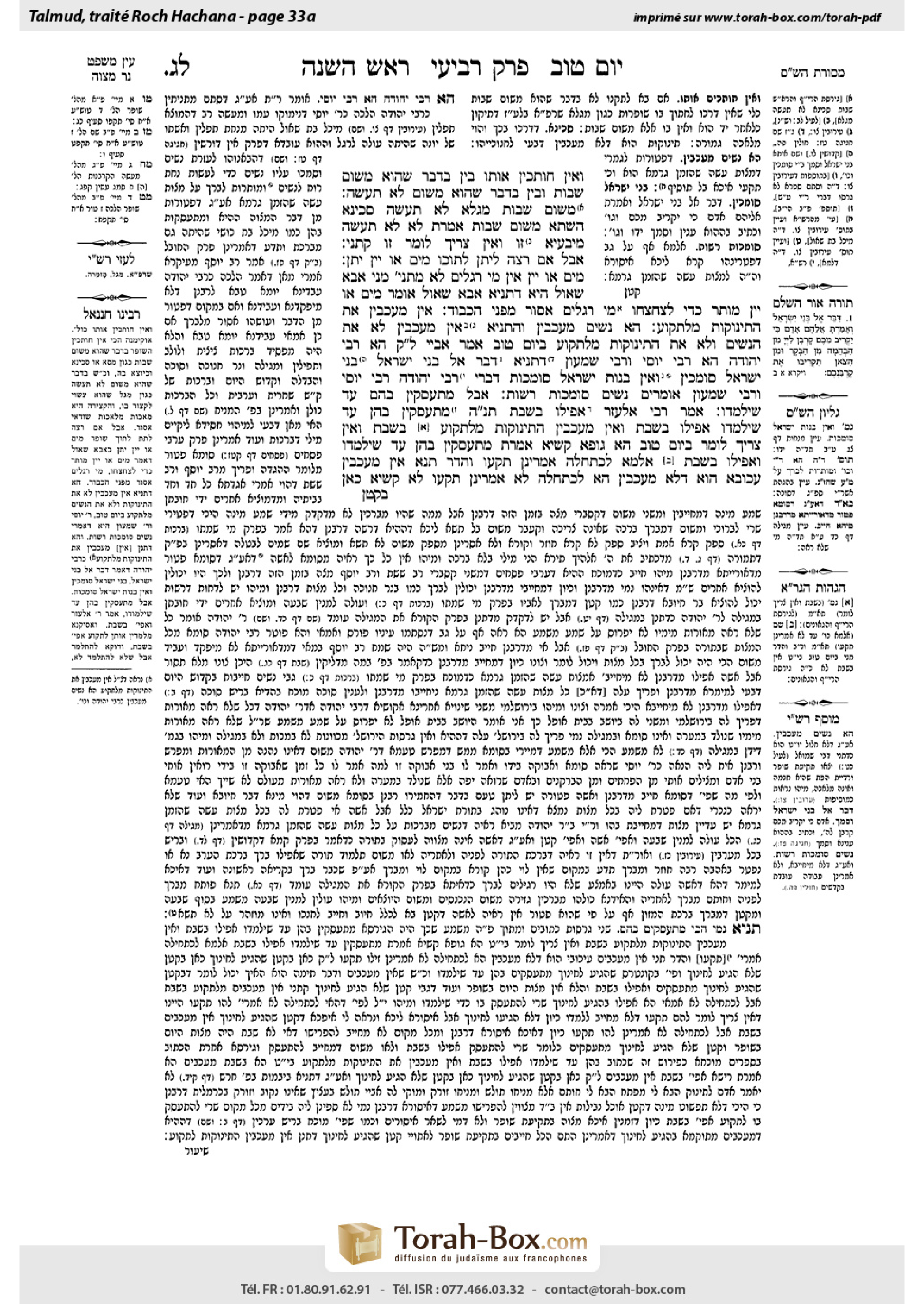
Rosh Hashanah 33a: Talmud study for Daf Yomi
Daf Yomi is the daily study of one Talmud folio. Explore 37 tractates with scans, Hebrew text, Sefaria English and AI-generated French translations where annotated.
Passage selection and English or AI-generated French translation are available where the scan has annotations. Daf Study is independent of Torah-Box and Sefaria.
Browse Rosh Hashanah · ראש השנה · All tractatesRosh Hashanah 33a text and translations
This page of Rosh Hashanah includes the Aramaic text, an English translation and an AI-generated French translation, alongside the scan above.
ראש השנה ל״ג א · Aramaic and Hebrew text
וְאֵין חוֹתְכִין אוֹתוֹ, בֵּין בְּדָבָר שֶׁהוּא מִשּׁוּם שְׁבוּת וּבֵין בְּדָבָר שֶׁהוּא מִשּׁוּם לֹא תַעֲשֶׂה. מִשּׁוּם שְׁבוּת — מַגָּלָא. לֹא תַעֲשֶׂה — סַכִּינָא.
הַשְׁתָּא מִשּׁוּם שְׁבוּת אָמְרַתְּ לָא — לֹא תַעֲשֶׂה מִיבַּעְיָא? זוֹ וְאֵין צָרִיךְ לוֹמַר זוֹ קָתָנֵי.
אֲבָל אִם רָצָה לִיתֵּן לְתוֹכוֹ מַיִם אוֹ יַיִן — יִתֵּן. מַיִם אוֹ יַיִן — אֵין, מֵי רַגְלַיִם — לָא.
מַתְנִיתִין מַנִּי — אַבָּא שָׁאוּל הִיא. דְּתַנְיָא, אַבָּא שָׁאוּל אוֹמֵר: מַיִם אוֹ יַיִן — מוּתָּר, כְּדֵי לְצַחְצְחוֹ. מֵי רַגְלַיִם — אָסוּר, מִפְּנֵי הַכָּבוֹד.
אֵין מְעַכְּבִין אֶת הַתִּינוֹקוֹת מִלִּתְקוֹעַ. הָא נָשִׁים — מְעַכְּבִין, וְהָתַנְיָא: אֵין מְעַכְּבִין לֹא אֶת הַנָּשִׁים וְלֹא אֶת הַתִּינוֹקוֹת מִלִּתְקוֹעַ בְּיוֹם טוֹב! אֲמַר אַבָּיֵי, לָא קַשְׁיָא: הָא רַבִּי יְהוּדָה, הָא רַבִּי יוֹסֵי וְרַבִּי שִׁמְעוֹן.
דְּתַנְיָא: ״דַּבֵּר אֶל בְּנֵי יִשְׂרָאֵל״. בְּנֵי יִשְׂרָאֵל סוֹמְכִין, וְאֵין בְּנוֹת יִשְׂרָאֵל סוֹמְכוֹת, דִּבְרֵי רַבִּי יְהוּדָה. רַבִּי יוֹסֵי וְרַבִּי שִׁמְעוֹן אוֹמְרִים: נָשִׁים סוֹמְכוֹת — רְשׁוּת.
אֲבָל מִתְעַסְּקִין בָּהֶם עַד שֶׁיִּלְמְדוּ. אָמַר רַבִּי אֶלְעָזָר: אֲפִילּוּ בְּשַׁבָּת. תַּנְיָא נָמֵי הָכִי: מִתְעַסְּקִין בָּהֶן עַד שֶׁיִּלְמְדוּ, אֲפִילּוּ בְּשַׁבָּת. וְאֵין מְעַכְּבִין הַתִּינוֹקוֹת מִלִּתְקוֹעַ בְּשַׁבָּת, וְאֵין צָרִיךְ לוֹמַר בְּיוֹם טוֹב.
הָא גוּפָא קַשְׁיָא, אָמְרַתְּ: מִתְעַסְּקִין בָּהֶן עַד שֶׁיִּלְמְדוּ, וַאֲפִילּוּ בְּשַׁבָּת — אַלְמָא לְכַתְּחִלָּה אָמְרִינַן תִּקְעוּ. וַהֲדַר תָּנָא: אֵין מְעַכְּבִין — עִכּוּבָא הוּא דְּלָא מְעַכְּבִין, הָא לְכַתְּחִלָּה לָא אָמְרִינַן תִּקְעוּ!
לָא קַשְׁיָא: כָּאן
Rosh Hashanah 33a · English translation
§ The mishna stated: One may not cut the shofar if it needs to be prepared, neither with an object that is prohibited due to a rabbinic decree nor with an object that may not be used due to a Torah prohibition. The Gemara explains: An example of an object prohibited due to a rabbinic decree is a sickle, which is not ordinarily used for preparing a shofar; an example of an object that may not be used due to a prohibition by Torah law is a knife.
The Gemara asks: Now that you have said that to sound the shofar one may not perform an action that is prohibited due to rabbinic law, is it necessary to say that one may not perform an action that violates a prohibition by Torah law? The Gemara answers: The mishna teaches employing the style: This, and it is unnecessary to say that.
§ The mishna continues. However, if one wishes to place water or wine into the shofar on Rosh HaShana, so that it should emit a clear sound, he may place it. The Gemara infers: Water or wine, yes, one may insert these substances into a shofar. However, urine, whose acidity is good for the shofar, no.
The Gemara asks: Who is the tanna of the mishna? The Gemara answers: It is Abba Shaul, as it is taught in a baraita that Abba Shaul says: With regard to water or wine, one is permitted to pour these liquids into a shofar on Rosh HaShana in order to make its sound clear. However, with regard to urine, one is prohibited to do so due to the respect that must be shown to the shofar. Although urine is beneficial, it is disrespectful to place it in a shofar, which serves for a mitzva.
§ The mishna further teaches: One need not prevent children from sounding the shofar on Rosh HaShana. The Gemara infers: If women wish to sound the shofar, one indeed prevents them from doing so. The Gemara asks: Isn’t it taught in a baraita that one does not prevent women or children from sounding the shofar on a Festival? The Gemara answers that Abaye said: This is not difficult: This mishna is in accordance with the opinion of Rabbi Yehuda, while that baraita is in accordance with the opinion of Rabbi Yosei and Rabbi Shimon.
As it is taught in a baraita: “Speak to the children of Israel…and he shall place his hands upon the head of the burnt-offering” (Leviticus 1:2–4). The phrase “children of Israel” literally means sons of Israel, and this teaches that the sons of Israel place their hands upon offerings, but the daughters of Israel do not place their hands upon offerings; this is the statement of Rabbi Yehuda. Rabbi Yosei and Rabbi Shimon say: It is optional for women to place their hands on the head of an offering before it is slaughtered, although they are not obligated to do so. Apparently, according to the opinion of Rabbi Yosei and Rabbi Shimon, if a woman wishes to perform any mitzva that is not obligatory for her, she is permitted to do so. Here too, one does not prevent a woman from sounding the shofar.
§ The mishna further states: Rather, one occupies himself with them, encouraging and instructing children, until they learn how to sound it properly. Rabbi Elazar said: This applies even when Rosh HaShana occurs on Shabbat. This is also taught in a baraita: One occupies himself with children until they learn to sound the shofar properly, even on Shabbat. And one does not prevent the children from sounding the shofar on Shabbat, and needless to say one does not prevent them on the festival of Rosh HaShana that occurs on a weekday.
The Gemara asks: This matter itself is difficult, i.e., there is an internal contradiction in the baraita. You said that one occupies himself with the children until they learn how to sound the shofar, and this applies even on Shabbat. Apparently, we say to them ab initio: Sound the shofar. And then the baraita taught: One does not prevent them from sounding the shofar, which indicates that although one does not prevent them from sounding it, we do not say ab initio: Sound it.
The Gemara explains: This is not difficult. Here,
Rosh Hashanah 33a · Traduction française (IA)
§ La Michna a enseigné : On ne peut pas tailler le chofar s’il doit être préparé, ni au moyen d’un objet dont l’usage est interdit par décret rabbinique, ni au moyen d’un objet dont l’usage est interdit par la Torah. La Guemara explique : un exemple d’objet dont l’usage est interdit par décret rabbinique est une faucille, qui n’est pas habituellement utilisée pour préparer un chofar ; un exemple d’objet dont l’usage est interdit par la Torah est un couteau.
La Guemara demande : Puisqu’on a dit qu’on ne peut pas accomplir, pour sonner du chofar, un acte interdit par décret rabbinique, est-il nécessaire de préciser qu’on ne peut pas accomplir un acte qui enfreint une interdiction de la Torah ? La Guemara répond : La Michna emploie la tournure « ceci, et il n’est pas nécessaire de préciser cela ».
§ La Michna poursuit : Cependant, si quelqu’un souhaite mettre de l’eau ou du vin dans le chofar à Roch Hachana afin qu’il émette un son clair, il peut le faire. La Guemara en déduit : De l’eau ou du vin, oui, on peut en introduire dans un chofar ; mais de l’urine, dont l’acidité est bénéfique pour le chofar, non.
La Guemara demande : Qui est le tanna de la Michna ? La Guemara répond : C’est Abba Shaul, comme on l’enseigne dans une baraïta : Abba Shaul dit qu’il est permis de verser de l’eau ou du vin dans un chofar à Roch Hachana afin d’en clarifier le son. En revanche, il est interdit d’y verser de l’urine, par respect pour le chofar. Bien que l’urine soit bénéfique, il est irrespectueux d’en mettre dans un chofar, qui sert à accomplir une mitsva.
§ La Michna enseigne ensuite : Il n’est pas nécessaire d’empêcher les enfants de sonner du chofar à Roch Hachana. La Guemara en déduit : Si des femmes souhaitent sonner du chofar, on doit effectivement les en empêcher. La Guemara demande : N’enseigne-t-on pas dans une baraïta qu’on n’empêche ni les femmes ni les enfants de sonner du chofar lors d’un jour de fête ? La Guemara répond qu’Abayé a dit : Il n’y a pas de difficulté : cette Michna est conforme à l’opinion de Rabbi Yehouda, tandis que cette baraïta est conforme à l’opinion de Rabbi Yossei et de Rabbi Shimon.
En effet, on enseigne dans une baraïta : « Parle aux enfants d’Israël… et il posera ses mains sur la tête de l’holocauste » (Lévitique 1, 2-4). L’expression « enfants d’Israël » signifie littéralement « fils d’Israël » ; cela enseigne que les fils d’Israël posent leurs mains sur les offrandes, mais que les filles d’Israël ne posent pas leurs mains sur les offrandes. Telle est l’opinion de Rabbi Yehouda. Rabbi Yossei et Rabbi Shimon disent : Les femmes peuvent, si elles le souhaitent, poser leurs mains sur la tête d’une offrande avant qu’elle soit abattue, bien qu’elles n’y soient pas obligées. Il ressort donc que, selon Rabbi Yossei et Rabbi Shimon, si une femme souhaite accomplir une mitsva qui ne lui incombe pas, elle en a le droit. Ici aussi, on n’empêche pas une femme de sonner du chofar.
§ La Michna enseigne ensuite : On s’occupe plutôt des enfants, en les encourageant et en les instruisant, jusqu’à ce qu’ils apprennent à sonner correctement. Rabbi Elazar a dit : Cela s’applique même lorsque Roch Hachana tombe un Chabbat. C’est également enseigné dans une baraïta : On s’occupe des enfants jusqu’à ce qu’ils apprennent à sonner correctement du chofar, même le Chabbat. On n’empêche pas les enfants de sonner du chofar le Chabbat, et à plus forte raison ne les en empêche-t-on pas lorsque Roch Hachana tombe un jour de semaine.
La Guemara demande : Cette affirmation elle-même soulève une difficulté, car il y a une contradiction interne dans la baraïta. Tu as dit qu’on s’occupe des enfants jusqu’à ce qu’ils apprennent à sonner du chofar, et que cela s’applique même le Chabbat. Il semblerait donc qu’on leur dise d’emblée : « Sonnez du chofar. » Puis la baraïta enseigne : On ne les empêche pas de sonner du chofar, ce qui indique que, bien qu’on ne les empêche pas de sonner, on ne leur dit pas d’emblée : « Sonnez. »
La Guemara explique : Il n’y a pas de difficulté. Ici,
Traduction française générée par IA à partir de l’édition anglaise de Sefaria. Vérifie toujours un passage avec le texte source.
Text from Sefaria: William Davidson Edition - Vocalized Aramaic (CC BY NC); William Davidson Edition - English (CC BY NC).