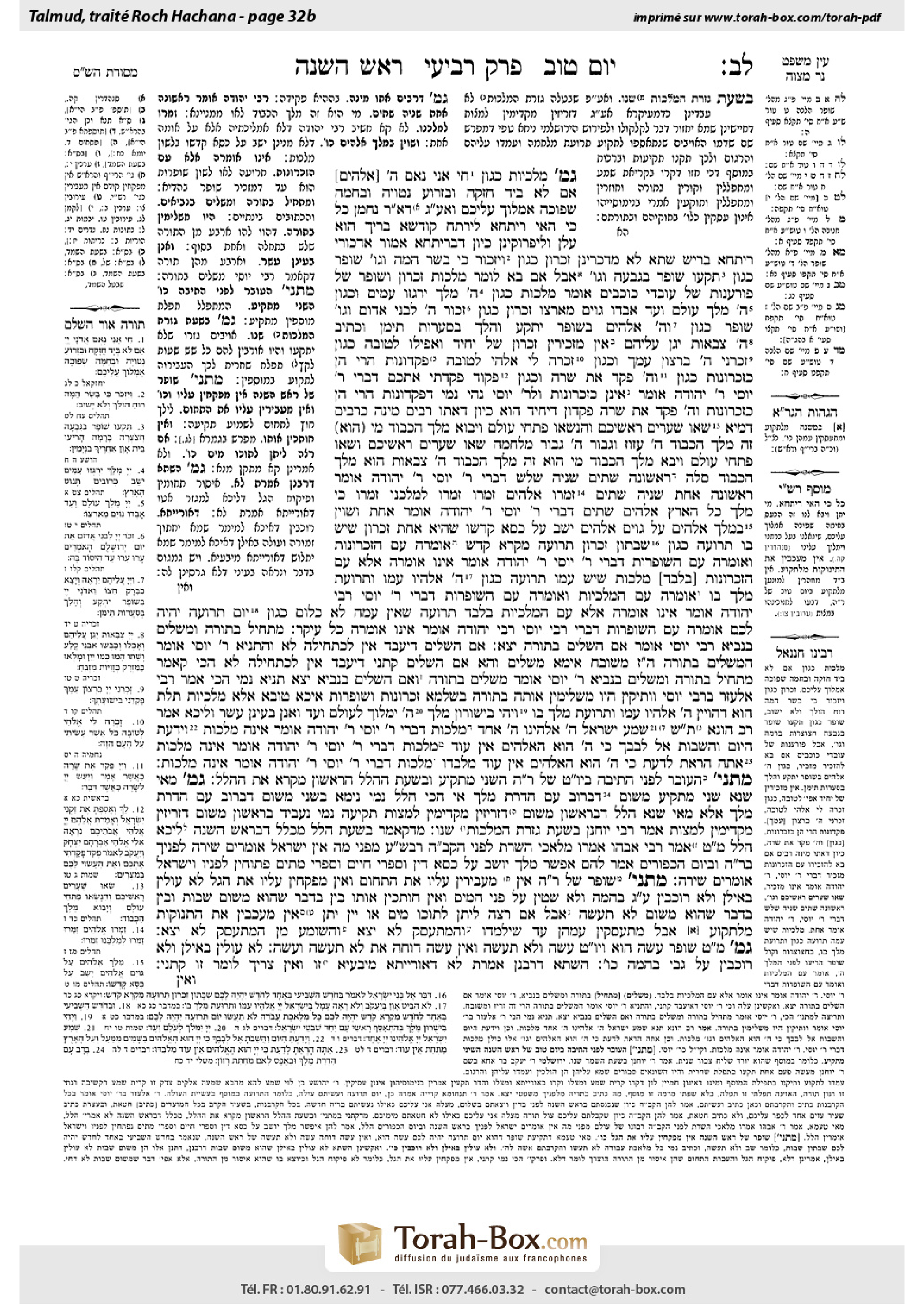
Rosh Hashanah 32b: Talmud study for Daf Yomi
Daf Yomi is the daily study of one Talmud folio. Explore 37 tractates with scans, Hebrew text, Sefaria English and AI-generated French translations where annotated.
Passage selection and English or AI-generated French translation are available where the scan has annotations. Daf Study is independent of Torah-Box and Sefaria.
Browse Rosh Hashanah · ראש השנה · All tractatesRosh Hashanah 32b text and translations
This page of Rosh Hashanah includes the Aramaic text, an English translation and an AI-generated French translation, alongside the scan above.
ראש השנה ל״ב ב · Aramaic and Hebrew text
גְּמָ׳ מַלְכִיּוֹת, כְּגוֹן: ״חַי אָנִי נְאֻם ה׳ [אֱלֹהִים] אִם לֹא בְּיָד חֲזָקָה וּבִזְרוֹעַ נְטוּיָה וּבְחֵמָה שְׁפוּכָה אֶמְלוֹךְ עֲלֵיכֶם״, וְאַף עַל גַּב דְּאָמַר רַב נַחְמָן: כֹּל כִּי הַאי רִיתְחָא לִירְתַּח קוּדְשָׁא בְּרִיךְ הוּא עֲלַן וְלִיפְרוֹקִינַן, כֵּיוָן דִּבְרִיתְחָא אֲמוּר — אַדְכּוֹרֵי רִיתְחָא בְּרֵישׁ שַׁתָּא לָא מַדְכְּרִינַן.
זִכָּרוֹן — כְּגוֹן: ״וַיִּזְכּוֹר כִּי בָשָׂר הֵמָּה וְגוֹ׳״ שׁוֹפָר — כְּגוֹן: ״תִּקְעוּ שׁוֹפָר בַּגִּבְעָה וְגוֹ׳״.
אֲבָל אִם בָּא לוֹמַר מַלְכוּת זִכָּרוֹן וְשׁוֹפָר שֶׁל פּוּרְעָנוּת שֶׁל נׇכְרִים, אוֹמֵר. מַלְכוּת — כְּגוֹן: ״ה׳ מָלָךְ יִרְגְּזוּ עַמִּים, וּכְגוֹן: ״ה׳ מֶלֶךְ עוֹלָם וָעֶד אָבְדוּ גוֹיִם מֵאַרְצוֹ״. זִכָּרוֹן — כְּגוֹן: ״זְכוֹר ה׳ לִבְנֵי אֱדוֹם וְגוֹ׳״. שׁוֹפָר — כְּגוֹן: ״וַה׳ אֱלֹהִים בַּשּׁוֹפָר יִתְקָע וְהָלַךְ בְּסַעֲרוֹת תֵּימָן״, וּכְתִיב: ״ה׳ צְבָאוֹת יָגֵן עֲלֵיהֶם״.
אֵין מַזְכִּירִין זִכָּרוֹן שֶׁל יָחִיד, וַאֲפִילּוּ לְטוֹבָה, כְּגוֹן: ״זׇכְרֵנִי ה׳ בִּרְצוֹן עַמֶּךָ״, וּכְגוֹן: ״זׇכְרָה לִּי אֱלֹהַי לְטוֹבָה״.
פִּקְדוֹנוֹת — הֲרֵי הֵן כְּזִכְרוֹנוֹת, כְּגוֹן: ״וַה׳ פָּקַד אֶת שָׂרָה״, וּכְגוֹן: ״פָּקוֹד פָּקַדְתִּי אֶתְכֶם״, דִּבְרֵי רַבִּי יוֹסֵי. רַבִּי יְהוּדָה אוֹמֵר: אֵינָן כְּזִכְרוֹנוֹת.
וּלְרַבִּי יוֹסֵי נְהִי נָמֵי דְּפִקְדוֹנוֹת הֲרֵי הֵן כְּזִכְרוֹנוֹת, ״וַה׳ פָּקַד אֶת שָׂרָה״ — פִּקָּדוֹן דְּיָחִיד הוּא! כֵּיוָן דְּאָתוּ רַבִּים מִינַּהּ — כְּרַבִּים דָּמְיָא.
״שְׂאוּ שְׁעָרִים רָאשֵׁיכֶם וְהִנָּשְׂאוּ פִּתְחֵי עוֹלָם וְיָבוֹא מֶלֶךְ הַכָּבוֹד. מִי זֶה מֶלֶךְ הַכָּבוֹד ה׳ עִזּוּז וְגִבּוֹר ה׳ גִּבּוֹר מִלְחָמָה. שְׂאוּ שְׁעָרִים רָאשֵׁיכֶם וּשְׂאוּ פִּתְחֵי עוֹלָם וְיָבֹא מֶלֶךְ הַכָּבוֹד. מִי הוּא זֶה מֶלֶךְ הַכָּבוֹד ה׳ צְבָאוֹת הוּא מֶלֶךְ הַכָּבוֹד סֶלָה״. רִאשׁוֹנָה — שְׁתַּיִם, שְׁנִיָּה — שָׁלֹשׁ, דִּבְרֵי רַבִּי יוֹסֵי.
רַבִּי יְהוּדָה אוֹמֵר: רִאשׁוֹנָה — אַחַת, שְׁנִיָּה — שְׁתַּיִם.
״זַמְּרוּ אֱלֹהִים זַמֵּרוּ זַמְּרוּ לְמַלְכֵּנוּ זַמֵּרוּ. כִּי מֶלֶךְ כׇּל הָאָרֶץ אֱלֹהִים״ — שְׁתַּיִם, דִּבְרֵי רַבִּי יוֹסֵי. רַבִּי יְהוּדָה אוֹמֵר: אַחַת. וְשָׁוִין בְּ״מָלַךְ אֱלֹהִים עַל גּוֹיִם אֱלֹהִים יָשַׁב עַל כִּסֵּא קׇדְשׁוֹ״, שֶׁהִיא אַחַת.
זִכְרוֹן שֶׁיֵּשׁ בּוֹ תְּרוּעָה — כְּגוֹן: ״שַׁבָּתוֹן זִכְרוֹן תְּרוּעָה מִקְרָא קֹדֶשׁ״ — אוֹמְרָהּ עִם הַזִּכְרוֹנוֹת וְאוֹמְרָהּ עִם הַשּׁוֹפָרוֹת, דִּבְרֵי רַבִּי יוֹסֵי. רַבִּי יְהוּדָה אוֹמֵר: אֵינוֹ אוֹמְרָהּ אֶלָּא עִם הַזִּכְרוֹנוֹת בִּלְבָד.
מַלְכוּת שֶׁיֵּשׁ עִמּוֹ תְּרוּעָה — כְּגוֹן: ״ה׳ אֱלֹהָיו עִמּוֹ וּתְרוּעַת מֶלֶךְ בּוֹ״ — אוֹמְרָהּ עִם הַמַּלְכִיּוֹת וְאוֹמְרָהּ עִם הַשּׁוֹפָרוֹת, דִּבְרֵי רַבִּי יוֹסֵי. רַבִּי יְהוּדָה אוֹמֵר: אֵינוֹ אוֹמְרָהּ אֶלָּא עִם הַמַּלְכִיּוֹת בִּלְבָד.
תְּרוּעָה שֶׁאֵין עִמָּהּ לֹא כְּלוּם — כְּגוֹן: ״יוֹם תְּרוּעָה יִהְיֶה לָכֶם״ — אוֹמְרָהּ עִם הַשּׁוֹפָרוֹת, דִּבְרֵי רַבִּי יוֹסֵי. רַבִּי יְהוּדָה אוֹמֵר: אֵינוֹ אוֹמְרָהּ כׇּל עִיקָּר.
מַתְחִיל בַּתּוֹרָה וּמַשְׁלִים בְּנָבִיא, רַבִּי יוֹסֵי אוֹמֵר: אִם הִשְׁלִים בַּתּוֹרָה — יָצָא. ״אִם הִשְׁלִים״, דִּיעֲבַד — אִין, לְכַתְּחִילָּה — לָא. וְהָתַנְיָא, רַבִּי יוֹסֵי אוֹמֵר: הַמַּשְׁלִים בַּתּוֹרָה — הֲרֵי זֶה מְשׁוּבָּח! אֵימָא: ״מַשְׁלִים״.
וְהָא ״אִם הִשְׁלִים״ קָתָנֵי, דִּיעֲבַד — אִין, לְכַתְּחִילָּה — לָא! הָכִי קָאָמַר: מַתְחִיל בַּתּוֹרָה וּמַשְׁלִים בְּנָבִיא. רַבִּי יוֹסֵי אוֹמֵר: מַשְׁלִים בַּתּוֹרָה, וְאִם הִשְׁלִים בְּנָבִיא — יָצָא. תַּנְיָא נָמֵי הָכִי, אָמַר רַבִּי אֶלְעָזָר בְּרַבִּי יוֹסֵי: ווֹתִיקִין הָיוּ מַשְׁלִימִין אוֹתָהּ בַּתּוֹרָה.
בִּשְׁלָמָא זִכְרוֹנוֹת וְשׁוֹפָרוֹת אִיכָּא טוּבָא, אֶלָּא מַלְכִיּוֹת — תְּלָת הוּא דְּהָוְיָין: ״ה׳ אֱלֹהָיו עִמּוֹ וּתְרוּעַת מֶלֶךְ בּוֹ״, ״וַיְהִי בִּישׁוּרוּן מֶלֶךְ״, ״ה׳ יִמְלוֹךְ לְעוֹלָם וָעֶד״, וַאֲנַן בָּעֵינַן עֶשֶׂר, וְלֵיכָּא!
אָמַר רַב הוּנָא, תָּא שְׁמַע: ״שְׁמַע יִשְׂרָאֵל ה׳ אֱלֹהֵינוּ ה׳ אֶחָד״ — מַלְכוּת, דִּבְרֵי רַבִּי יוֹסֵי. רַבִּי יְהוּדָה אוֹמֵר: אֵינָהּ מַלְכוּת.
״וְיָדַעְתָּ הַיּוֹם וַהֲשֵׁבוֹתָ אֶל לְבָבֶךָ כִּי ה׳ הוּא הָאֱלֹהִים אֵין עוֹד״ — מַלְכוּת, דִּבְרֵי רַבִּי יוֹסֵי. רַבִּי יְהוּדָה אוֹמֵר: אֵינָהּ מַלְכוּת. ״אַתָּה הׇרְאֵתָ לָדַעַת כִּי ה׳ הוּא הָאֱלֹהִים אֵין עוֹד מִלְבַדּוֹ״ — מַלְכוּת, דִּבְרֵי רַבִּי יוֹסֵי. רַבִּי יְהוּדָה אוֹמֵר: אֵינָהּ מַלְכוּת.
מַתְנִי׳ הָעוֹבֵר לִפְנֵי הַתֵּיבָה בְּיוֹם טוֹב שֶׁל רֹאשׁ הַשָּׁנָה, הַשֵּׁנִי מַתְקִיעַ. וּבִשְׁעַת הַהַלֵּל, הָרִאשׁוֹן מַקְרֵא אֶת הַהַלֵּל.
גְּמָ׳ מַאי שְׁנָא שֵׁנִי מַתְקִיעַ — מִשּׁוּם דִּ״בְרוֹב עָם הַדְרַת מֶלֶךְ״, אִי הָכִי הַלֵּל נָמֵי — נֵימָא בַּשֵּׁנִי מִשּׁוּם דִּ״בְרוֹב עָם הַדְרַת מֶלֶךְ״!
אֶלָּא: מַאי שְׁנָא הַלֵּל דְּבָרִאשׁוֹן — מִשּׁוּם דִּזְרִיזִין מַקְדִּימִין לְמִצְוֹת, תְּקִיעָה נָמֵי נַעֲבֵיד בָּרִאשׁוֹן, מִשּׁוּם דִּזְרִיזִין מַקְדִּימִין לְמִצְוֹת!
אָמַר רַבִּי יוֹחָנָן: בִּשְׁעַת הַשְּׁמָד שָׁנוּ.
מִדְּקָאָמַר ״בִּשְׁעַת הַלֵּל״, מִכְּלַל דִּבְרֹאשׁ הַשָּׁנָה לֵיכָּא הַלֵּל. מַאי טַעְמָא? אָמַר רַבִּי אֲבָהוּ: אָמְרוּ מַלְאֲכֵי הַשָּׁרֵת לִפְנֵי הַקָּדוֹשׁ בָּרוּךְ הוּא: רִבּוֹנוֹ שֶׁל עוֹלָם! מִפְּנֵי מָה אֵין יִשְׂרָאֵל אוֹמְרִים שִׁירָה לְפָנֶיךָ בְּרֹאשׁ הַשָּׁנָה וּבְיוֹם הַכִּפּוּרִים? אָמַר לָהֶם: אֶפְשָׁר מֶלֶךְ יוֹשֵׁב עַל כִּסֵּא דִין, וְסִפְרֵי חַיִּים וְסִפְרֵי מֵתִים פְּתוּחִין לְפָנָיו — וְיִשְׂרָאֵל אוֹמְרִים שִׁירָה?!
מַתְנִי׳ שׁוֹפָר שֶׁל רֹאשׁ הַשָּׁנָה אֵין מַעֲבִירִין עָלָיו אֶת הַתְּחוּם, וְאֵין מְפַקְּחִין עָלָיו אֶת הַגַּל. לֹא עוֹלִין בָּאִילָן, וְלֹא רוֹכְבִין עַל גַּבֵּי בְהֵמָה, וְלֹא שָׁטִין עַל פְּנֵי הַמַּיִם, וְאֵין חוֹתְכִין אוֹתוֹ — בֵּין בְּדָבָר שֶׁהוּא מִשּׁוּם שְׁבוּת, וּבֵין בְּדָבָר שֶׁהוּא מִשּׁוּם לֹא תַעֲשֶׂה. אֲבָל אִם רָצָה לִיתֵּן לְתוֹכוֹ מַיִם אוֹ יַיִן — יִתֵּן.
אֵין מְעַכְּבִין אֶת הַתִּנוֹקוֹת מִלִּתְקוֹעַ, אֲבָל מִתְעַסְּקִין עִמָּהֶן עַד שֶׁיִּלְמְדוּ. וְהַמִּתְעַסֵּק — לֹא יָצָא, וְהַשּׁוֹמֵעַ מִן הַמִּתְעַסֵּק — לֹא יָצָא.
גְּמָ׳ מַאי טַעְמָא? שׁוֹפָר עֲשֵׂה הוּא, וְיוֹם טוֹב עֲשֵׂה וְלֹא תַעֲשֶׂה — וְאֵין עֲשֵׂה דּוֹחֶה אֶת לֹא תַעֲשֶׂה וַעֲשֵׂה.
לֹא עוֹלִין בָּאִילָן וְלֹא רוֹכְבִין עַל גַּבֵּי בְּהֵמָה וְכוּ׳. הַשְׁתָּא דְּרַבָּנַן אָמְרַתְּ לָא, דְּאוֹרָיְיתָא מִיבַּעְיָא?! זוֹ וְאֵין צָרִיךְ לוֹמַר זוֹ קָתָנֵי.
Rosh Hashanah 32b · English translation
GEMARA: The Gemara cites examples of verses that may not be used in Rosh HaShana prayers because they deal with punishment. With regard to verses of Kingship, for example: “As I live, says the Lord God, surely with a mighty hand, and with an outstretched arm, and with fury poured out, will I be King over you” (Ezekiel 20:33). And although Rav Naḥman said about this verse: With regard to any anger like this, let the Holy One, blessed be He, express that anger upon us and let Him redeem us, if that is the process necessary for redemption, since the verse was said with anger it is not included, as one does not mention anger on Rosh HaShana.
Similarly, verses of remembrance that speak of a punishment may not be used in Rosh HaShana prayers, for example: “So He remembered that they were but flesh, a wind that passes away, and does not come again” (Psalms 78:39). Nor verses of shofar, which refer to calamity, for example: “Sound the shofar in Giva, and the trumpet in Rama; sound an alarm at Beit Aven, behind you, O Benjamin” (Hosea 5:8).
The Gemara qualifies the mishna’s ruling. However, if one comes to recite verses of Kingship, remembrance, and shofar with a theme of the punishment of gentiles, one may recite them. The Gemara offers examples of these verses: With regard to the verses of Kingship, for example: “The Lord reigns, let the peoples tremble” (Psalms 99:1), and, for example: “The Lord is King for ever and ever; the nations are perished out of His land” (Psalms 10:16). With regard to remembrance, for example: “Remember, O Lord, against the children of Edom the day of Jerusalem, who said: Raze it, raze it, to its very foundation” (Psalms 137:7). With regard to the verses of shofar, for example: “And the Lord God will sound the shofar, and will go with whirlwinds of the south” (Zechariah 9:14), and it is written: “The Lord of hosts will defend them” (Zechariah 9:15), i.e., God will defend the Jewish people against their enemies.
The Gemara states: One does not recite a verse dealing with the remembrance of an individual, even if it is for good, for example: “Remember me, O Lord, when You show favor to Your people” (Psalms 106:4), and, for example: “Remember me, my God, for good” (Nehemiah 5:19).
Verses that mention God’s revisitings [pikdonot] are equivalent to verses of remembrances [zikhronot], and therefore they may be counted in the ten verses. For example: “And the Lord revisited [pakad] Sarah” (Genesis 21:1), and, for example: “I have surely revisited [pakadeti] you” (Exodus 3:16). This is the statement of Rabbi Yosei. Rabbi Yehuda says: They are not equivalent to verses of remembrances.
The Gemara asks: And according to the opinion of Rabbi Yosei, although verses that speak of God revisiting man are equivalent to verses of remembrances, he cites the following verse as an example: “And the Lord revisited Sarah,” which is a revisiting of an individual. Despite the fact that it was stated above that a remembrance must refer to the collective, since many descendants came from her, as Sarah is the mother of the Jewish people, she is considered like many. Therefore, this verse is effectively dealing with the remembrance of the entire Jewish people.
The Gemara discusses several verses from Psalms. “Lift up your heads, O you gates, and be lifted up, you everlasting doors, that the King of glory may come in. Who is the King of glory? The Lord strong and mighty, the Lord mighty in battle” (Psalms 24:7–8). The psalm continues: “Lift up your heads, O you gates, and lift them up, you everlasting doors; that the King of glory may come in. Who then is the King of glory? The Lord of hosts, He is the King of glory, Selah” (Psalms 24:9–10). The first section is counted as two verses of Kingship, as the term king is mentioned twice, while the second section is counted as three verses of Kingship; this is the statement of Rabbi Yosei.
Rabbi Yehuda says: The first section is counted as only one verse of Kingship, as the question: “Who is the King of glory,” is not considered a verse of Kingship. By the same reasoning, the second section is counted as only two verses of Kingship.
Similarly, the Gemara discusses the following verses: “Sing praises to God, sing praises, sing praises to our King, sing praises. For God is the King of all the earth; sing praises in a skillful song” (Psalms 47:7–8). These are counted as two verses of Kingship; this is the statement of Rabbi Yosei. Rabbi Yehuda says: They count as only one verse of Kingship, as the phrase: “Sing praises to our King,” is referring to God as the King of the Jewish people, not the King of the entire world. And they both agree with regard to the verse: “God reigns over the nations, God sits upon His sacred throne” (Psalms 47:9), that it is considered as only one verse of Kingship, as the phrase: “Sits upon His sacred throne,” is not referring to God explicitly as King.
With regard to a verse of remembrance that also has a mention of sounding the shofar, for example: “A solemn rest, a memorial of blasts, a sacred convocation” (Leviticus 23:24), one may recite it with the verses of remembrances, and one may also recite it with the verses of shofarot; this is the statement of Rabbi Yosei. Rabbi Yehuda says: One may recite it only with the verses of remembrances alone, as it does not explicitly mention a shofar.
With regard to a verse of Kingship that also has a mention of sounding the shofar, for example: “The Lord his God is with him, and the sounding of a king is among them” (Numbers 23:21), one may recite it with the verses of Kingship and one may also recite it with the verses of shofarot; This is the statement of Rabbi Yosei. Rabbi Yehuda says: One may recite it only with the verses of Kingship.
With regard to a verse that mentions sounding the shofar that has nothing else with it, i.e., no mention of remembrances, Kingship, or an actual shofar, for example: “It is a day of sounding the shofar to you” (Numbers 29:1), one may recite it with the verses of shofarot; this is the statement of Rabbi Yosei. Rabbi Yehuda says: One may not recite it at all, as it contains no explicit mention of a shofar.
§ The mishna taught: When reciting the ten verses, one begins with verses from the Torah and concludes with verses from the Prophets. Rabbi Yosei says: If he concluded with a verse from the Torah, he has fulfilled his obligation. The Gemara notes that Rabbi Yosei’s formulation: If he concluded, indicates that after the fact, yes, he has fulfilled his obligation; ab initio, no, he has not fulfilled his obligation to recite the necessary verses. The Gemara asks: But isn’t it taught in a baraita that Rabbi Yosei says: One who concludes the series of verses with a verse from the Torah is praiseworthy? The Gemara answers: Say that the text of the mishna must be modified so that it reads: Rabbi Yosei says: He concludes with a verse from the Torah, i.e., one should do so ab initio.
The Gemara raises a difficulty. Doesn’t the mishna teach: If he concluded? This indicates that after the fact, yes, one has fulfilled his obligation; ab initio, no, he has not fulfilled his obligation. The Gemara answers that this is what the mishna is saying: One begins with verses from the Torah and concludes with a single verse from the Prophets. Rabbi Yosei says: One concludes with a single verse from the Torah, and if he concluded with a single verse from the Prophets he has fulfilled his obligation. This is also taught in a baraita. Rabbi Elazar, son of Rabbi Yosei, said: Pious individuals [vatikin], who were scrupulous in their performance of mitzvot, would conclude the series with a single verse from the Torah. Presumably, Rabbi Elazar followed the opinion of his father, Rabbi Yosei.
The Gemara asks: Granted, it is possible to conclude Remembrances and Shofarot with a verse from the Torah, as there are many such verses. However, with regard to Kingship, there are only three: “The Lord his God is with him, and the sounding of a king is among them” (Numbers 23:21); “And he was king in Jeshurun” (Deuteronomy 33:5); and: “The Lord shall reign for ever and ever” (Exodus 15:18). And we require ten verses, and according to Rabbi Yosei there are not enough, as he maintains that one should recite four verses from the Torah, the first three and the concluding one.
Rav Huna said: Come and hear a solution from that which was taught in the Tosefta (2:11): The verse: “Hear, O Israel, the Lord our God, the Lord is one” (Deuteronomy 6:4), is a verse of Kingship; this is the statement of Rabbi Yosei. Rabbi Yehuda says: It is not a verse of Kingship.
“Know this day, and lay it to your heart, that the Lord, He is God in heaven above, and upon the earth beneath; there is none else” (Deuteronomy 4:39), is a verse of Kingship; this is the statement of Rabbi Yosei. Rabbi Yehuda says: It is not a verse of Kingship. “To you it was shown, that you might know that the Lord, He is God; there is none else beside Him” (Deuteronomy 4:35), is a verse of Kingship; this is the statement of Rabbi Yosei. Rabbi Yehuda says: It is not a verse of Kingship. This shows that according to the opinion of Rabbi Yosei there are sufficient verses of Kingship in the Torah to recite three at the beginning and one at the end.
MISHNA: With regard to one who is passing before the ark, as prayer leader, on the festival of Rosh HaShana, it is the second prayer leader, i.e., the one who leads the additional prayer, who sounds the shofar on behalf of the congregation. And on a day when the hallel is recited, the first prayer leader, i.e., the one who leads the morning prayer, recites the hallel on behalf of the congregation.
GEMARA: The Gemara asks: What is different about the second prayer leader, that he sounds the shofar during the additional prayer? Is it due to the principle that: “The splendor of the King is in the multitude of the people” (Proverbs 14:28)? In other words, is the shofar sounded during the additional prayer because all of the congregants will have arrived by then? If so, with regard to hallel too, let us say that it should be read by the second prayer leader, due to the principle that “The splendor of the King is in the multitude of the people.”
Rather, what is different about hallel that it is recited by the first prayer leader? It is due to the principle that the vigilant are early in the performance of mitzvot. This is also difficult. With regard to the sounding of the shofar, too, let us perform it by means of the first prayer leader, due to the principle that the vigilant are early in the performance of mitzvot.
Rabbi Yoḥanan said: They taught the halakha that the shofar is sounded during the additional prayer in a time of religious persecution. The gentile authorities prohibited sounding the shofar and appointed guards during the morning to ensure that the Jews comply. Therefore, the Sages delayed the sounding of the shofar until after the guards had left. A similar decree was not imposed against the recitation of hallel, and therefore it was recited during the morning prayer, at the earliest possible time.
§ The Gemara comments: From the fact that the mishna states: When hallel is recited, one can conclude by inference that on Rosh HaShana there is no recitation of hallel. What is the reason that hallel is omitted on Rosh HaShana? Rabbi Abbahu said: The ministering angels said before the Holy One, Blessed be He: Master of the Universe, for what reason don’t the Jewish people recite songs of praise, i.e., hallel, before You on Rosh HaShana and on Yom Kippur? He said to them: Is it possible that while the King is sitting on the throne of judgment and the books of life and the books of death are open before Him, the Jewish people are reciting joyous songs of praise? Rosh HaShana and Yom Kippur are somber days of judgment whose mood is incompatible with the recitation of hallel.
MISHNA: With regard to the shofar of Rosh HaShana, one may not pass the Shabbat limit for it, i.e., to go and hear it, nor may one clear a pile of rubble to uncover a buried shofar. One may not climb a tree, nor may one ride on an animal, nor may one swim in water, in order to find a shofar to sound. And one may not cut the shofar to prepare it for use, neither with an object that is prohibited due to a rabbinic decree nor with an object that may not be used due to a prohibition by Torah law. However, if one wishes to place water or wine into the shofar on Rosh HaShana so that it emits a clear sound, he may place it, as this does not constitute a prohibited labor.
One need not prevent children from sounding the shofar on Rosh HaShana, despite the fact that they are not obligated in mitzvot. Rather, one occupies himself with them, encouraging and instructing them, until they learn how to sound it properly. The mishna adds: One who acts unawares and sounds the shofar without any intention to perform the mitzva has not fulfilled his obligation. And, similarly, one who hears the shofar blasts from one who acts unawares has not fulfilled his obligation.
GEMARA: The Gemara asks: There is a principle that a positive mitzva overrides a negative mitzva. With this in mind, what is the reason that one may not perform a prohibited labor on Rosh HaShana to fulfill the positive mitzva of sounding the shofar? The Gemara answers: Sounding the shofar is a positive mitzva, but performing prohibited labor on a Festival violates both the positive mitzva to rest and the prohibition against performing prohibited labor, and a positive mitzva does not override both a prohibition and a positive mitzva.
§ The mishna taught: One may not pass the Shabbat limit for it, i.e., to go and hear it, nor may one clear a pile of rubble to uncover a buried shofar. One may not climb a tree, nor may one ride on an animal to find a shofar to sound. The Gemara questions the order of these prohibitions: Now that you have said that to sound the shofar one may not perform an action that is prohibited by rabbinic law, i.e., passing the Shabbat limit or clearing a pile of rubble, is it necessary to say that one may not perform an action that could lead to an act prohibited by Torah law, i.e., climbing a tree or riding an animal? The Gemara answers: The mishna teaches employing the style: This, and it is unnecessary to say that. It begins with the more novel case before moving on to the more straightforward one.
Rosh Hashanah 32b · Traduction française (IA)
GUEMARA : La Guemara cite des exemples de versets qui ne peuvent pas être employés dans les prières de Roch Hachana, car ils traitent de châtiments. Pour les versets de royauté, par exemple : « Aussi vrai que Je suis vivant, dit le Seigneur Dieu, c’est bien d’une main puissante, d’un bras étendu et dans une fureur déversée que Je régnerai sur vous » (Ézéchiel 20:33). Et bien que Rav Naḥman ait dit à propos de ce verset : « Pour une telle colère, que le Saint, béni soit-Il, déverse cette colère sur nous et nous délivre, si tel est le processus nécessaire à la délivrance », comme le verset a été prononcé avec colère, il n’est pas inclus, car on ne mentionne pas la colère à Roch Hachana.
De même, les versets de souvenir qui évoquent un châtiment ne peuvent pas être employés dans les prières de Roch Hachana, par exemple : « Il se souvint qu’ils n’étaient que chair, un souffle qui passe et ne revient pas » (Psaumes 78:39). Il en va de même des versets de chofar qui font référence à une calamité, par exemple : « Sonnez du chofar à Guiva, de la trompette à Rama ; poussez le cri d’alarme à Beit Aven, derrière toi, Benjamin » (Osée 5:8).
La Guemara précise la règle de la Michna. Toutefois, si l’on veut réciter des versets de royauté, de souvenir et de chofar qui évoquent le châtiment des nations, on peut les réciter. La Guemara donne des exemples de ces versets. Pour les versets de royauté, par exemple : « Le Seigneur règne, que les peuples tremblent » (Psaumes 99:1), et : « Le Seigneur est roi pour toujours et à jamais ; les nations ont péri sur sa terre » (Psaumes 10:16). Pour les versets de souvenir, par exemple : « Souviens-toi, Seigneur, des fils d’Édom, au jour de Jérusalem, lorsqu’ils disaient : “Rasez-la, rasez-la jusqu’à ses fondations !” » (Psaumes 137:7). Pour les versets de chofar, par exemple : « Le Seigneur Dieu fera retentir le chofar et s’avancera dans les tourbillons du midi » (Zacharie 9:14), et il est écrit : « Le Seigneur des armées les protégera » (Zacharie 9:15), c’est-à-dire que Dieu protégera le peuple juif contre ses ennemis.
La Guemara affirme : On ne récite pas un verset qui évoque le souvenir d’un individu, même si c’est pour son bien, par exemple : « Souviens-toi de moi, Seigneur, lorsque Tu accordes Ta faveur à Ton peuple » (Psaumes 106:4), ou encore : « Souviens-toi de moi, mon Dieu, pour mon bien » (Néhémie 5:19).
Les versets qui mentionnent les interventions de Dieu [pikdonot] sont équivalents aux versets de souvenir [zikhronot] et peuvent donc être comptés parmi les dix versets. Par exemple : « Le Seigneur intervint en faveur de Sarah [pakad] » (Genèse 21:1), ou encore : « Je vous ai certainement visités [pakadeti] » (Exode 3:16). Telle est la position de Rabbi Yosei. Rabbi Yehuda dit : Ils ne sont pas équivalents aux versets de souvenir.
La Guemara demande : Selon l’opinion de Rabbi Yosei, bien que les versets qui parlent de l’intervention de Dieu en faveur de l’homme soient équivalents aux versets de souvenir, il cite comme exemple le verset : « Le Seigneur intervint en faveur de Sarah », qui concerne l’intervention en faveur d’un individu. Pourtant, il a été dit plus haut que le souvenir doit concerner la collectivité. Comme Sarah a eu de nombreux descendants et qu’elle est la mère du peuple juif, elle est considérée comme une multitude. Ainsi, ce verset concerne en réalité le souvenir de l’ensemble du peuple juif.
La Guemara examine plusieurs versets des Psaumes. « Portes, élevez vos linteaux ; élevez-vous, portes éternelles, afin que le Roi de gloire fasse son entrée. Qui est le Roi de gloire ? Le Seigneur, fort et puissant, le Seigneur, puissant au combat » (Psaumes 24:7-8). Le psaume poursuit : « Portes, élevez vos linteaux ; élevez-les, portes éternelles, afin que le Roi de gloire fasse son entrée. Qui donc est le Roi de gloire ? Le Seigneur des armées, c’est Lui le Roi de gloire. Sélah » (Psaumes 24:9-10). Selon Rabbi Yosei, la première partie compte comme deux versets de royauté, car le terme « roi » y est mentionné deux fois, tandis que la seconde partie compte comme trois versets de royauté.
Rabbi Yehuda dit : La première partie ne compte que comme un seul verset de royauté, car la question « Qui est le Roi de gloire ? » n’est pas considérée comme un verset de royauté. Selon le même raisonnement, la seconde partie ne compte que comme deux versets de royauté.
De même, la Guemara examine les versets suivants : « Chantez des louanges à Dieu, chantez des louanges ; chantez des louanges à notre Roi, chantez des louanges. Car Dieu est le Roi de toute la terre ; chantez des louanges avec art » (Psaumes 47:7-8). Selon Rabbi Yosei, ils comptent comme deux versets de royauté. Rabbi Yehuda dit : Ils ne comptent que comme un seul verset de royauté, car l’expression « chantez des louanges à notre Roi » désigne Dieu comme le roi du peuple juif, et non comme le roi du monde entier. Ils s’accordent tous deux à dire que le verset « Dieu règne sur les nations, Dieu siège sur Son trône sacré » (Psaumes 47:9) ne compte que comme un seul verset de royauté, car l’expression « siège sur Son trône sacré » ne désigne pas explicitement Dieu comme roi.
Pour un verset de souvenir qui mentionne aussi la sonnerie du chofar, par exemple : « Un repos solennel, un mémorial de sonneries, une sainte convocation » (Lévitique 23:24), Rabbi Yosei estime qu’on peut le réciter avec les versets de souvenir, mais aussi avec les versets de chofar. Rabbi Yehuda dit : On ne peut le réciter qu’avec les versets de souvenir, car il ne mentionne pas explicitement un chofar.
Pour un verset de royauté qui mentionne aussi la sonnerie du chofar, par exemple : « Le Seigneur, son Dieu, est avec lui, et l’acclamation d’un roi retentit parmi eux » (Nombres 23:21), Rabbi Yosei estime qu’on peut le réciter avec les versets de royauté, mais aussi avec les versets de chofar. Rabbi Yehuda dit : On ne peut le réciter qu’avec les versets de royauté.
Pour un verset qui mentionne la sonnerie du chofar sans rien d’autre, c’est-à-dire sans mention de souvenir, de royauté ni d’un chofar proprement dit, par exemple : « C’est pour vous un jour de sonnerie du chofar » (Nombres 29:1), Rabbi Yosei estime qu’on peut le réciter avec les versets de chofar. Rabbi Yehuda dit : On ne peut pas le réciter du tout, car il ne contient aucune mention explicite d’un chofar.
§ La Michna enseigne : Lorsqu’on récite les dix versets, on commence par des versets de la Torah et l’on conclut par des versets des Prophètes. Rabbi Yosei dit : S’il a conclu par un verset de la Torah, il s’est acquitté de son obligation. La Guemara relève que la formulation de Rabbi Yosei, « s’il a conclu », indique qu’après coup, oui, il s’est acquitté de son obligation, mais qu’a priori, non, il ne s’est pas acquitté de l’obligation de réciter les versets nécessaires. La Guemara demande : Mais n’est-il pas enseigné dans une baraïta que Rabbi Yosei dit : « Celui qui conclut la série de versets par un verset de la Torah est digne d’éloge » ? La Guemara répond : Il faut modifier le texte de la Michna ainsi : Rabbi Yosei dit : « Il conclut par un verset de la Torah », c’est-à-dire qu’il convient de le faire a priori.
La Guemara soulève une difficulté. La Michna n’enseigne-t-elle pas : « S’il a conclu » ? Cela indique qu’après coup, oui, on s’est acquitté de son obligation, mais qu’a priori, non, on ne s’en est pas acquitté. La Guemara répond que voici ce que dit la Michna : On commence par des versets de la Torah et l’on conclut par un seul verset des Prophètes. Rabbi Yosei dit : On conclut par un seul verset de la Torah et, si l’on conclut par un seul verset des Prophètes, on s’est acquitté de son obligation. C’est également enseigné dans une baraïta. Rabbi Elazar, fils de Rabbi Yosei, dit : Les hommes pieux [vatikin], scrupuleux dans l’accomplissement des mitsvot, concluaient la série par un seul verset de la Torah. On peut supposer que Rabbi Elazar suivait l’opinion de son père, Rabbi Yosei.
La Guemara demande : Il est certes possible de conclure les sections des souvenirs et des versets de chofar par un verset de la Torah, car il en existe beaucoup. Mais, pour la royauté, il n’y en a que trois : « Le Seigneur, son Dieu, est avec lui, et l’acclamation d’un roi retentit parmi eux » (Nombres 23:21) ; « Il fut roi en Yeshouroun » (Deutéronome 33:5) ; et « Le Seigneur régnera à jamais » (Exode 15:18). Or, nous avons besoin de dix versets et, selon Rabbi Yosei, ils sont insuffisants, puisqu’il estime qu’on doit réciter quatre versets de la Torah : les trois premiers et le dernier.
Rav Huna dit : Viens et écoute une solution tirée de ce qui a été enseigné dans la Tosefta (2:11) : le verset « Écoute, Israël : le Seigneur est notre Dieu, le Seigneur est Un » (Deutéronome 6:4) est un verset de royauté ; telle est la position de Rabbi Yosei. Rabbi Yehuda dit : Ce n’est pas un verset de royauté.
« Sache-le aujourd’hui et prends-le à cœur : le Seigneur, Lui, est Dieu dans les cieux, en haut, et sur la terre, en bas ; il n’y en a pas d’autre » (Deutéronome 4:39) est un verset de royauté ; telle est la position de Rabbi Yosei. Rabbi Yehuda dit : Ce n’est pas un verset de royauté. « C’est à toi qu’il a été montré, afin que tu saches que le Seigneur, Lui, est Dieu ; il n’y en a pas d’autre que Lui » (Deutéronome 4:35) est un verset de royauté ; telle est la position de Rabbi Yosei. Rabbi Yehuda dit : Ce n’est pas un verset de royauté. Cela montre que, selon l’opinion de Rabbi Yosei, il y a dans la Torah suffisamment de versets de royauté pour en réciter trois au début et un à la fin.
MICHNA : Pour celui qui se tient devant l’arche comme officiant à Roch Hachana, c’est le second officiant, c’est-à-dire celui qui dirige la prière supplémentaire, qui sonne le chofar pour la communauté. Et les jours où l’on récite le Hallel, c’est le premier officiant, c’est-à-dire celui qui dirige la prière du matin, qui récite le Hallel pour la communauté.
GUEMARA : La Guemara demande : Pourquoi est-ce le second officiant qui sonne le chofar pendant la prière supplémentaire ? Est-ce en vertu du principe selon lequel « la splendeur du roi réside dans la multitude du peuple » (Proverbes 14:28) ? Autrement dit, le chofar est-il sonné pendant la prière supplémentaire parce qu’à ce moment-là tous les membres de la communauté sont arrivés ? Si c’est le cas, pour le Hallel aussi, disons qu’il doit être récité par le second officiant, en vertu du principe selon lequel « la splendeur du roi réside dans la multitude du peuple ».
Mais alors, pourquoi le Hallel est-il récité par le premier officiant ? C’est en vertu du principe selon lequel les zélés s’empressent d’accomplir les mitsvot. Cette explication soulève elle aussi une difficulté. Pour la sonnerie du chofar également, faisons-la accomplir par le premier officiant, en vertu du principe selon lequel les zélés s’empressent d’accomplir les mitsvot.
Rabbi Yoḥanan dit : Ils ont enseigné que le chofar est sonné pendant la prière supplémentaire en période de persécution religieuse. Les autorités non juives interdisaient de sonner le chofar et plaçaient des gardes le matin pour s’assurer que les Juifs respectent cette interdiction. Les Sages ont donc retardé la sonnerie du chofar jusqu’au départ des gardes. Aucun décret semblable n’avait été imposé contre la récitation du Hallel ; celui-ci était donc récité pendant la prière du matin, au premier moment possible.
§ La Guemara fait remarquer : Du fait que la Michna dit « lorsqu’on récite le Hallel », on peut déduire qu’on ne récite pas le Hallel à Roch Hachana. Pour quelle raison le Hallel est-il omis à Roch Hachana ? Rabbi Abbahu dit : Les anges du Service dirent devant le Saint, béni soit-Il : « Maître de l’Univers, pourquoi le peuple juif ne chante-t-il pas devant Toi des louanges, c’est-à-dire le Hallel, à Roch Hachana et à Yom Kippour ? » Il leur répondit : « Est-il possible que, tandis que le Roi siège sur le trône du jugement et que les livres de la vie et les livres de la mort sont ouverts devant Lui, le peuple juif chante des louanges joyeuses ? » Roch Hachana et Yom Kippour sont des jours solennels de jugement, dont l’atmosphère ne convient pas à la récitation du Hallel.
MICHNA : Concernant le chofar de Roch Hachana, on ne peut pas franchir la limite du Chabbat pour aller l’entendre, ni déblayer un tas de gravats afin de dégager un chofar enseveli. On ne peut pas grimper à un arbre, monter sur un animal ni nager dans l’eau pour trouver un chofar à sonner. On ne peut pas non plus tailler le chofar pour le préparer à l’usage, que ce soit avec un outil dont l’emploi est interdit par décret rabbinique ou avec un outil dont l’emploi est interdit par la Torah. Toutefois, si quelqu’un souhaite verser de l’eau ou du vin dans le chofar à Roch Hachana afin qu’il produise un son clair, il peut le faire, car cela ne constitue pas un travail interdit.
Il n’est pas nécessaire d’empêcher les enfants de sonner le chofar à Roch Hachana, bien qu’ils ne soient pas astreints aux mitsvot. On s’occupe plutôt d’eux, on les encourage et on les instruit jusqu’à ce qu’ils apprennent à le sonner correctement. La Michna ajoute : Celui qui agit sans intention d’accomplir la mitsva et sonne le chofar ne s’est pas acquitté de son obligation. De même, celui qui entend les sonneries du chofar de la part de quelqu’un qui agit sans intention d’accomplir la mitsva ne s’est pas acquitté de son obligation.
GUEMARA : La Guemara demande : Un principe veut qu’une mitsva positive l’emporte sur une interdiction. Dans ce cas, pourquoi ne peut-on pas accomplir un travail interdit à Roch Hachana afin d’accomplir la mitsva positive de sonner le chofar ? La Guemara répond : Sonner le chofar est une mitsva positive, mais accomplir un travail interdit pendant une fête transgresse à la fois la mitsva positive de se reposer et l’interdiction d’accomplir un travail interdit ; une mitsva positive ne l’emporte pas à la fois sur une interdiction et sur une mitsva positive.
§ La Michna enseigne : On ne peut pas franchir la limite du Chabbat pour aller entendre le chofar, ni déblayer un tas de gravats afin de dégager un chofar enseveli. On ne peut pas grimper à un arbre ni monter sur un animal pour trouver un chofar à sonner. La Guemara interroge l’ordre de ces interdictions : Puisque nous avons établi qu’on ne peut pas accomplir, pour sonner le chofar, une action interdite par le droit rabbinique, c’est-à-dire franchir la limite du Chabbat ou déblayer un tas de gravats, est-il nécessaire de préciser qu’on ne peut pas accomplir une action susceptible d’entraîner un acte interdit par la Torah, c’est-à-dire grimper à un arbre ou monter sur un animal ? La Guemara répond : La Michna emploie la formule « ceci, et il n’est pas nécessaire de dire cela ». Elle commence par le cas le moins évident avant de passer au cas le plus simple.
Traduction française générée par IA à partir de l’édition anglaise de Sefaria. Vérifie toujours un passage avec le texte source.
Text from Sefaria: William Davidson Edition - Vocalized Aramaic (CC BY NC); William Davidson Edition - English (CC BY NC).