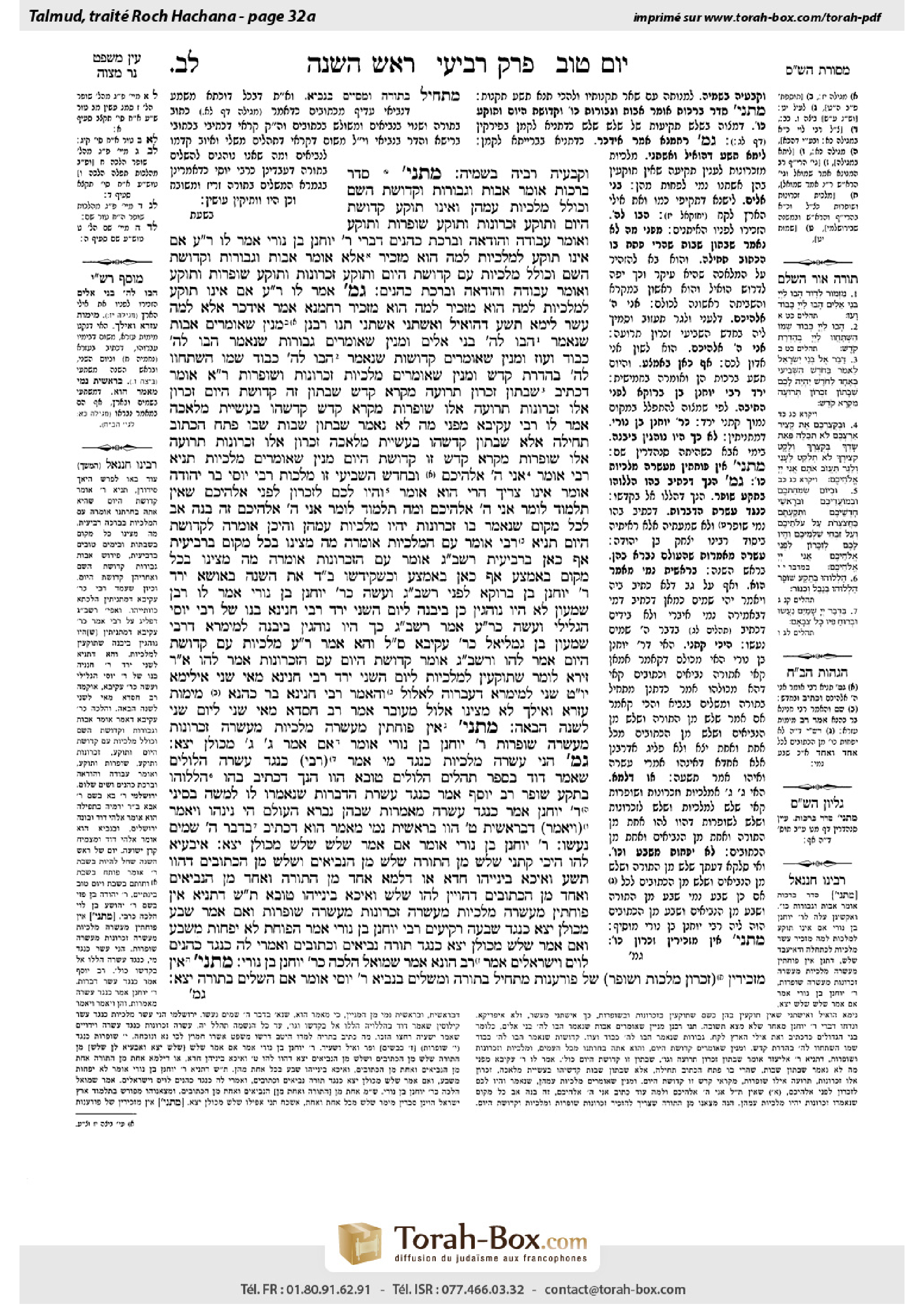
Rosh Hashanah 32a: Talmud study for Daf Yomi
Daf Yomi is the daily study of one Talmud folio. Explore 37 tractates with scans, Hebrew text, Sefaria English and AI-generated French translations where annotated.
Passage selection and English or AI-generated French translation are available where the scan has annotations. Daf Study is independent of Torah-Box and Sefaria.
Browse Rosh Hashanah · ראש השנה · All tractatesRosh Hashanah 32a text and translations
This page of Rosh Hashanah includes the Aramaic text, an English translation and an AI-generated French translation, alongside the scan above.
ראש השנה ל״ב א · Aramaic and Hebrew text
וְקַבְעֵיהּ רַבֵּיהּ בִּשְׁמֵיהּ.
מַתְנִי׳ סֵדֶר בְּרָכוֹת: אוֹמֵר אָבוֹת וּגְבוּרוֹת וּקְדוּשַּׁת הַשֵּׁם, וְכוֹלֵל מַלְכִיּוֹת עִמָּהֶן, וְאֵינוֹ תּוֹקֵעַ.
קְדוּשַּׁת הַיּוֹם וְתוֹקֵעַ, זִכְרוֹנוֹת וְתוֹקֵעַ, שׁוֹפָרוֹת וְתוֹקֵעַ, וְאוֹמֵר עֲבוֹדָה וְהוֹדָאָה וּבִרְכַּת כֹּהֲנִים, דִּבְרֵי רַבִּי יוֹחָנָן בֶּן נוּרִי.
אָמַר לוֹ רַבִּי עֲקִיבָא: אִם אֵינוֹ תּוֹקֵעַ לְמַלְכִיּוֹת — לָמָה הוּא מַזְכִּיר? אֶלָּא: אוֹמֵר אָבוֹת וּגְבוּרוֹת וּקְדוּשַּׁת הַשֵּׁם, וְכוֹלֵל מַלְכִיּוֹת עִם קְדוּשַּׁת הַיּוֹם וְתוֹקֵעַ, זִכְרוֹנוֹת וְתוֹקֵעַ, שׁוֹפָרוֹת וְתוֹקֵעַ, וְאוֹמֵר עֲבוֹדָה וְהוֹדָאָה וּבִרְכַּת כֹּהֲנִים.
גְּמָ׳ אָמַר לוֹ רַבִּי עֲקִיבָא: אִם אֵינוֹ תּוֹקֵעַ לְמַלְכִיּוֹת — לָמָה הוּא מַזְכִּיר? לָמָה הוּא מַזְכִּיר?! רַחֲמָנָא אָמַר אַידְכַּר! אֶלָּא: לָמָה עֶשֶׂר? לֵימָא תֵּשַׁע, דְּהוֹאִיל וְאִשְׁתַּנִּי אִשְׁתַּנִּי!
תָּנוּ רַבָּנַן: מִנַּיִן שֶׁאוֹמְרִים אָבוֹת — שֶׁנֶּאֱמַר: ״הָבוּ לַה׳ בְּנֵי אֵלִים״. וּמִנַּיִן שֶׁאוֹמְרִים גְּבוּרוֹת — שֶׁנֶּאֱמַר: ״הָבוּ לַה׳ כָּבוֹד וָעוֹז״. וּמִנַּיִן שֶׁאוֹמְרִים קְדוּשּׁוֹת — שֶׁנֶּאֱמַר: ״הָבוּ לַה׳ כְּבוֹד שְׁמוֹ הִשְׁתַּחֲווּ לַה׳ בְּהַדְרַת קֹדֶשׁ״.
וּמִנַּיִן שֶׁאוֹמְרִים מַלְכִיּוֹת זִכְרוֹנוֹת וְשׁוֹפָרוֹת — רַבִּי אֱלִיעֶזֶר אוֹמֵר: דִּכְתִיב ״שַׁבָּתוֹן זִכְרוֹן תְּרוּעָה מִקְרָא קֹדֶשׁ״. ״שַׁבָּתוֹן״ — זֶה קְדוּשַּׁת הַיּוֹם; ״זִכְרוֹן״ — אֵלּוּ זִכְרוֹנוֹת; ״תְּרוּעָה״ — אֵלּוּ שׁוֹפָרוֹת; ״מִקְרָא קֹדֶשׁ״ — קַדְּשֵׁהוּ בַּעֲשִׂיַּית מְלָאכָה.
אָמַר לוֹ רַבִּי עֲקִיבָא: מִפְּנֵי מָה לֹא נֹאמַר ״שַׁבָּתוֹן״ — שְׁבוּת, שֶׁבּוֹ פָּתַח הַכָּתוּב תְּחִילָּה! אֶלָּא: ״שַׁבָּתוֹן״ — קַדְּשֵׁהוּ בַּעֲשִׂיַּית מְלָאכָה; ״זִכְרוֹן״ — אֵלּוּ זִכְרוֹנוֹת; ״תְּרוּעָה״ — אֵלּוּ שׁוֹפָרוֹת; ״מִקְרָא קֹדֶשׁ״ — זוֹ קְדוּשַּׁת הַיּוֹם.
מִנַּיִן שֶׁאוֹמְרִים מַלְכִיּוֹת? תַּנְיָא, רַבִּי אוֹמֵר: ״אֲנִי ה׳ אֱלֹהֵיכֶם״, וּ״בַּחֹדֶשׁ הַשְּׁבִיעִי״ — זוֹ מַלְכוּת.
רַבִּי יוֹסֵי בַּר יְהוּדָה אוֹמֵר: אֵינוֹ צָרִיךְ, הֲרֵי הוּא אוֹמֵר: ״וְהָיוּ לָכֶם לְזִכָּרוֹן לִפְנֵי אֱלֹהֵיכֶם״, שֶׁאֵין תַּלְמוּד לוֹמַר ״אֲנִי ה׳ אֱלֹהֵיכֶם״, וּמָה תַּלְמוּד לוֹמַר ״אֲנִי ה׳ אֱלֹהֵיכֶם״ — זֶה בָּנָה אָב לְכׇל מָקוֹם שֶׁנֶּאֱמַר בּוֹ זִכְרוֹנוֹת — יִהְיוּ מַלְכִיּוֹת עִמָּהֶן.
וְהֵיכָן אוֹמְרָהּ לִקְדוּשַּׁת הַיּוֹם? תַּנְיָא, רַבִּי אוֹמֵר: עִם הַמַּלְכִיּוֹת אוֹמְרָהּ. מָה מָצִינוּ בְּכׇל מָקוֹם בָּרְבִיעִית — אַף כָּאן בָּרְבִיעִית.
רַבָּן שִׁמְעוֹן בֶּן גַּמְלִיאֵל אוֹמֵר: עִם הַזִּכְרוֹנוֹת אוֹמְרָהּ. מַה מָצִינוּ בְּכׇל מָקוֹם בָּאֶמְצַע — אַף כָּאן בָּאֶמְצַע.
וּכְשֶׁקִּידְּשׁוּ בֵּית דִּין אֶת הַשָּׁנָה בְּאוּשָׁא, יָרַד רַבִּי יוֹחָנָן בֶּן בְּרוֹקָא לִפְנֵי רַבָּן שִׁמְעוֹן בֶּן גַּמְלִיאֵל, וְעָשָׂה כְּרַבִּי יוֹחָנָן בֶּן נוּרִי. אָמַר לוֹ רַבָּן שִׁמְעוֹן: לֹא הָיוּ נוֹהֲגִין כֵּן בְּיַבְנֶה. לַיּוֹם הַשֵּׁנִי יָרַד רַבִּי חֲנִינָא בְּנוֹ שֶׁל רַבִּי יוֹסֵי הַגְּלִילִי וְעָשָׂה כְּרַבִּי עֲקִיבָא. אָמַר רַבָּן שִׁמְעוֹן בֶּן גַּמְלִיאֵל: כָּךְ הָיוּ נוֹהֲגִין בְּיַבְנֶה.
לְמֵימְרָא דְּרַבָּן שִׁמְעוֹן בֶּן גַּמְלִיאֵל כְּרַבִּי עֲקִיבָא סְבִירָא לֵיהּ? וְהָא אָמַר רַבִּי עֲקִיבָא: מַלְכִיּוֹת עִם קְדוּשַּׁת הַיּוֹם אָמַר לְהוּ, וְרַבָּן שִׁמְעוֹן בֶּן גַּמְלִיאֵל אוֹמֵר: קְדוּשַּׁת הַיּוֹם עִם הַזִּכְרוֹנוֹת אָמַר לְהוּ? אָמַר רַבִּי זֵירָא: לוֹמַר שֶׁתּוֹקְעִין לְמַלְכִיּוֹת.
לַיּוֹם הַשֵּׁנִי יָרַד רַבִּי חֲנִינָא. מַאי שֵׁנִי? אִילֵּימָא יוֹם טוֹב שֵׁנִי — לְמֵימְרָא דְּעַבְּרוּהּ לֶאֱלוּל?! וְהָאָמַר רַבִּי חֲנִינָא בַּר כָּהֲנָא: מִימוֹת עֶזְרָא וְאֵילָךְ לֹא מָצִינוּ אֱלוּל מְעוּבָּר! אָמַר רַב חִסְדָּא: מַאי שֵׁנִי — לְיוֹם שֵׁנִי, לַשָּׁנָה הַבָּאָה.
מַתְנִי׳ אֵין פּוֹחֲתִין מֵעֲשָׂרָה מַלְכִיּוֹת, מֵעֲשָׂרָה זִכְרוֹנוֹת, מֵעֲשָׂרָה שׁוֹפָרוֹת. רַבִּי יוֹחָנָן בֶּן נוּרִי אוֹמֵר: אִם אָמַר שָׁלֹשׁ שָׁלֹשׁ מִכּוּלָּן — יָצָא.
גְּמָ׳ הָנֵי עֲשָׂרָה מַלְכִיּוֹת כְּנֶגֶד מִי? אָמַר רַבִּי: כְּנֶגֶד עֲשָׂרָה הִלּוּלִים שֶׁאָמַר דָּוִד בְּסֵפֶר תְּהִלִּים. הִלּוּלִים טוּבָא הָווּ! הָנָךְ דִּכְתִיב בְּהוּ ״הַלְלוּהוּ בְּתֵקַע שׁוֹפָר״.
רַב יוֹסֵף אָמַר: כְּנֶגֶד עֲשֶׂרֶת הַדִּבְּרוֹת שֶׁנֶּאֶמְרוּ לוֹ לְמֹשֶׁה בְּסִינַי. רַבִּי יוֹחָנָן אָמַר: כְּנֶגֶד עֲשָׂרָה מַאֲמָרוֹת שֶׁבָּהֶן נִבְרָא הָעוֹלָם. הֵי נִינְהוּ? ״וַיֹּאמֶר״ —
״וַיֹּאמֶר״ דִּבְרֵאשִׁית תִּשְׁעָה הָווּ! ״בְּרֵאשִׁית״ נָמֵי מַאֲמָר הוּא, דִּכְתִיב: ״בִּדְבַר ה׳ שָׁמַיִם נַעֲשׂוּ״.
רַבִּי יוֹחָנָן בֶּן נוּרִי אוֹמֵר: אִם אָמַר שָׁלֹשׁ שָׁלֹשׁ מִכּוּלָּן — יָצָא. אִיבַּעְיָא לְהוּ, הֵיכִי קָתָנֵי: שָׁלֹשׁ מִן הַתּוֹרָה, שָׁלֹשׁ מִן הַנְּבִיאִים, וְשָׁלֹשׁ מִן הַכְּתוּבִים — דְּהָווּ תֵּשַׁע, וְאִיכָּא בֵּינַיְיהוּ חֲדָא, אוֹ דִלְמָא: אֶחָד מִן הַתּוֹרָה, וְאֶחָד מִן הַנְּבִיאִים, וְאֶחָד מִן הַכְּתוּבִים — דְּהָוְיָין לְהוּ שָׁלֹשׁ, וְאִיכָּא בֵּינַיְיהוּ טוּבָא?
תָּא שְׁמַע, דְּתַנְיָא: אֵין פּוֹחֲתִין מֵעֲשָׂרָה מַלְכִיּוֹת, מֵעֲשָׂרָה זִכְרוֹנוֹת, מֵעֲשָׂרָה שׁוֹפָרוֹת, וְאִם אָמַר שֶׁבַע מִכּוּלָּן — יָצָא, כְּנֶגֶד שִׁבְעָה רְקִיעִים.
רַבִּי יוֹחָנָן בֶּן נוּרִי אָמַר: הַפּוֹחֵת — לֹא יִפְחוֹת מִשֶּׁבַע, וְאִם אָמַר שָׁלֹשׁ מִכּוּלָּן — יָצָא, כְּנֶגֶד תּוֹרָה נְבִיאִים וּכְתוּבִים, וְאָמְרִי לַהּ: כְּנֶגֶד כֹּהֲנִים לְוִיִּם וְיִשְׂרְאֵלִים. אָמַר רַב הוּנָא אָמַר שְׁמוּאֵל: הֲלָכָה כְּרַבִּי יוֹחָנָן בֶּן נוּרִי.
מַתְנִי׳ אֵין מַזְכִּירִין זִכָּרוֹן מַלְכוּת וְשׁוֹפָר שֶׁל פּוּרְעָנוּת. מַתְחִיל בַּתּוֹרָה, וּמַשְׁלִים בַּנָּבִיא, רַבִּי יוֹסֵי אוֹמֵר: אִם הִשְׁלִים בַּתּוֹרָה — יָצָא.
Rosh Hashanah 32a · English translation
and his teacher established it in his name. Consequently, it is counted as one of Rabban Yoḥanan ben Zakkai’s ordinances.
MISHNA: The order of the blessings of the additional prayer on Rosh HaShana is as follows: One recites the blessing of the Patriarchs, the blessing of God’s Mighty Deeds, and the blessing of the Sanctification of God’s Name, all of which are recited all year long. And one includes the blessing of Kingship, containing many biblical verses on that theme, with them, i.e., in the blessing of the Sanctification of God’s Name, and he does not sound the shofar after it.
Next, one adds a special blessing for the Sanctification of the Day, and sounds the shofar after it; followed by the blessing of Remembrances, which contains many biblical verses addressing that theme, and sounds the shofar after it; and recites the blessing of Shofarot, which includes verses that mention the shofar, and sounds the shofar after it. And he then returns to the regular Amida prayer and recites the blessing of God’s Service and the blessing of Thanksgiving and the Priestly Blessing. This is the statement of Rabbi Yoḥanan ben Nuri.
Rabbi Akiva said to him: If one does not sound the shofar for the blessing of Kingship, why does he mention it? Rather, the order of the blessings is as follows: One recites the blessing of the Patriarchs and that of God’s Mighty Deeds and that of the Sanctification of God’s Name. He subsequently includes the blessing of Kingship in the blessing of the Sanctification of the Day, and sounds the shofar. Next he recites the blessing of Remembrances, and sounds the shofar after it, and the blessing of Shofarot and sounds the shofar after it. He then recites the blessing of God’s Service and the blessing of Thanksgiving and the Priestly Blessing.
GEMARA: The mishna taught that Rabbi Akiva said to him: If one does not sound the shofar for the blessing of Kingship, why does he mention it? The Gemara expresses surprise at this question: Why does he mention it? The Merciful One states that one should mention it. It is a mitzva to recite the blessing of Kingship, regardless of the sounding of the shofar. Rather, this is what Rabbi Akiva meant: Why does one mention ten verses of Kingship, as in the other blessings? Let him recite nine verses or fewer. Since the blessing is different in that it is not followed by shofar blasts, let it also be different with regard to the number of verses it includes.
§ The Sages taught in a baraita: From where is it derived that one recites the blessing of the Patriarchs? As it is stated: “Ascribe to the Lord, O you sons of the mighty” (Psalms 29:1), which is interpreted to mean that one should mention before God the greatness of the mighty, i.e., the righteous Patriarchs. And from where is it derived that one recites the blessing of God’s Mighty Deeds? As it is stated: “Ascribe to the Lord glory and strength” (Psalms 29:1). And from where is it derived that one recites the blessing of the Sanctification of God’s Name? As it is stated: “Ascribe to the Lord the glory due to His name; worship the Lord in the beauty of sanctity” (Psalms 29:2).
And from where is it derived that on Rosh HaShana one recites the blessings of Kingship, Remembrances, and Shofarot? Rabbi Eliezer says: As it is written: “In the seventh month, on the first day of the month, you shall have a solemn rest, a memorial of blasts, a sacred convocation” (Leviticus 23:24). This verse is interpreted as follows: “A solemn rest,” this is referring to the blessing of the Sanctification of the Day; “a memorial,” this is Remembrances; “blasts,” this is Shofarot; “a sacred convocation” this means sanctify it by abstaining from performing prohibited labor.
Rabbi Akiva said to Rabbi Eliezer: For what reason isn’t it stated instead that the phrase “solemn rest” teaches that one must rest by abstaining from prohibited labor, as this is the term with which the verse opened first. It stands to reason that the verse would begin with the main issue, i.e., that this day is a Festival on which performing labor is prohibited. Rather, the verse should be explained as follows: “A solemn rest,” sanctify it by abstaining from performing prohibited labor; “a memorial,” this is Remembrances; “blasts,” this is Shofarot; “a sacred convocation,” this is the Sanctification of the Day.
From where is it derived that that one recites the blessing of Kingship? It is taught in a baraita that Rabbi Yehuda HaNasi says: One verse states: “I am the Lord your God” (Leviticus 23:22), which is referring to God’s Kingship over the world; and two verses later it states: “In the seventh month” (Leviticus 23:24). This teaches that God’s Kingship must be mentioned on Rosh HaShana.
Rabbi Yosei bar Yehuda says: This is not necessary, as the verse states: “Also in the day of your gladness, and in your appointed seasons, and in your New Moons, you shall blow with the trumpets over your burnt-offerings, and over the sacrifices of your peace-offerings; that they may be to you for a remembrance before your God: I am the Lord your God” (Numbers 10:10). As there is no need for the verse to state: “I am the Lord your God,” and therefore what is the meaning when the verse states: “I am the Lord your God”? This is a paradigm that in all places where verses of Remembrances are stated, verses of Kingship should be recited with them.
§ The Gemara returns to the issue discussed in the mishna: And where does one recite the Sanctification of the Day? It is taught in a baraita that Rabbi Yehuda HaNasi says: One recites it with the blessing of Kingship, in the fourth blessing. He explains: Just as we find in all other places that the Sanctification of the Day is mentioned in the fourth blessing of the Amida prayer, so too here, it is recited in the fourth blessing.
Rabban Shimon ben Gamliel says: One recites it together with the blessing of Remembrances, in the fifth blessing. He explains: Just as we find in all other places that the Sanctification of the Day is mentioned in the middle blessing of the Amida prayer, e.g., on Shabbat, when it is the fourth of seven blessings, so too here, it is recited in the middle blessing, which in the case of Rosh HaShana is the fifth blessing, as the Rosh HaShana Amida prayer is comprised of nine blessings.
§ And the baraita relates that when the court sanctified the year in Usha, Rabbi Yoḥanan ben Beroka descended as the prayer leader in the presence of Rabban Shimon ben Gamliel, and he acted in accordance with the opinion of Rabban Yoḥanan ben Nuri by including the blessing of Kingship in the blessing of the Sanctification of God’s Name. Rabban Shimon said to him: They were not accustomed to act in this manner in Yavne. On the second day, Rabbi Ḥanina, son of Rabbi Yosei HaGelili, descended as the prayer leader, and he acted in accordance with the opinion of Rabbi Akiva by including the blessing of Kingship in the blessing of the Sanctification of the Day. Rabban Shimon ben Gamliel said: This is how they were accustomed to act in Yavne.
The Gemara asks a question concerning this baraita: Is that to say that Rabban Shimon ben Gamliel holds in accordance with the opinion of Rabbi Akiva? But didn’t Rabbi Akiva say that one recites the blessing of Kingship with the blessing of the Sanctification of the Day, and Rabban Shimon ben Gamliel says that one recites the blessing of the Sanctification of the Day with the blessing of Remembrances? Why then did Rabban Shimon ben Gamliel indicate his agreement with Rabbi Akiva’s practice? Rabbi Zeira said: Rabban Shimon ben Gamliel merely meant to say that he agrees that one sounds the shofar together with the blessing of Kingship, and that this was how they were accustomed to act in Yavne.
The baraita taught that on the second day Rabbi Ḥanina descended as the prayer leader. The Gemara asks: What is the meaning of: The second day? If we say that this is referring to the second day of the Festival day of Rosh HaShana, is that to say that they rendered Elul a full month, so that the thirtieth day of Elul was the first day of Rosh HaShana and the first day of Tishrei was the second day? But didn’t Rabbi Ḥanina bar Kahana say: From the days of Ezra onward we have not found that the month of Elul was ever rendered full. If so, it is difficult to believe that a case of this kind occurred in the time of the tanna’im. Rav Ḥisda said: What is the meaning of: The second day? It means on the second day, the next time it was Rosh HaShana, i.e., on Rosh HaShana of the following year.
MISHNA: One does not recite fewer than ten verses in the blessing of Kingship, or fewer than ten verses in the blessing of Remembrances, or fewer than ten verses in the blessing of Shofarot. Rabbi Yoḥanan ben Nuri says: If one recited three from each of them, he has fulfilled his obligation.
GEMARA: The Gemara asks: These ten verses of Kingship, to what do they correspond? Rabbi Yehuda HaNasi said: They correspond to the ten praises that David said in the book of Psalms. The Gemara asks: There are many more praises than that in the book of Psalms. The Gemara answers that he means those in which it is written by them: “Praise Him with the blast of the shofar” (Psalms 150:3). In that chapter the phrase “Praise Him” appears ten times.
Rav Yosef said: The ten verses correspond to the Ten Commandments, which were said to Moses at Sinai. Rabbi Yoḥanan said: They correspond to the ten utterances through which the world was created. The Gemara asks: Which are these ten utterances? The Gemara explains: This is referring to the ten times that the phrase “And He said” appears in the story of Creation in the first two chapters of Genesis.
The Gemara asks: Does it refer to the repetition of the phrase: “And He said” in Genesis? There are only nine such phrases, not ten. The Gemara answers that the phrase “In the beginning” is also considered an utterance, as it is written: “By the word of the Lord were the heavens made” (Psalms 33:6), which indicates that all of creation came into existence through a single utterance, after which all matter was formed into separate and distinct entities by means of the other nine utterances.
§ The mishna taught that Rabbi Yoḥanan ben Nuri says: If one recited three from each of them, he has fulfilled his obligation. A dilemma was raised before the Sages: What is he teaching here? Does Rabbi Yoḥanan ben Nuri mean that one must recite three verses from the Torah, three from the Prophets, and three from the Writings, which are nine in total, and if so the practical difference between the opinions of Rabbi Yoḥanan ben Nuri and the first tanna is only one verse? Or perhaps he means that one must recite one verse from the Torah and one from the Prophets and one from the Writings, which are three altogether, and the practical difference between them is a large number of verses, i.e., seven.
The Gemara clarifies this matter: Come and hear a proof, as it is taught in a baraita: One does not recite fewer than ten verses of Kingship, or fewer than ten verses of Remembrances, or fewer than ten verses of Shofarot. And if one recited seven from each of them, he has fulfilled his obligation, as they correspond to the seven firmaments in heaven.
Rabbi Yoḥanan ben Nuri said: One who recites fewer than the requisite ten should not recite fewer than seven, but if he recited three from each of them he has fulfilled his obligation, as they correspond to the Torah, the Prophets, and the Writings. And some say: They correspond to the priests, the Levites, and the Israelites. This indicates that Rabbi Yoḥanan ben Nuri means a total of three verses for each blessing. Rav Huna said that Shmuel said: The halakha is in accordance with the opinion of Rabbi Yoḥanan ben Nuri.
MISHNA: One does not mention verses of Remembrance, Kingship, and Shofar that have a theme of punishment. When reciting the ten verses, one begins with verses from the Torah and concludes with verses from the Prophets. Rabbi Yosei says: If he concluded with a verse from the Torah, he has fulfilled his obligation.
Rosh Hashanah 32a · Traduction française (IA)
et son maître l’établit en son nom. Par conséquent, elle est comptée parmi les ordonnances de Rabban Yoḥanan ben Zakkai.
MICHNA : Voici l’ordre des bénédictions de la prière supplémentaire de Roch Hachana : on récite la bénédiction des Patriarches, celle des Puissances divines et celle de la Sanctification du Nom de Dieu, qui sont toutes récitées toute l’année. On y inclut la bénédiction de la Royauté, qui comporte de nombreux versets bibliques sur ce thème, c’est-à-dire dans la bénédiction de la Sanctification du Nom de Dieu, et l’on ne sonne pas du chofar après celle-ci.
Ensuite, on ajoute une bénédiction spéciale pour la Sanctification du Jour, puis on sonne du chofar. Viennent ensuite la bénédiction des Souvenirs, qui contient de nombreux versets bibliques sur ce thème, et l’on sonne du chofar après celle-ci ; puis on récite la bénédiction des Chofars, qui comprend des versets mentionnant le chofar, et l’on sonne du chofar après celle-ci. On revient alors à la prière régulière de la Amida et l’on récite la bénédiction du Service divin, celle de l’Action de grâce et la Bénédiction sacerdotale. Telle est la déclaration de Rabbi Yoḥanan ben Nuri.
Rabbi Akiva lui dit : « Si l’on ne sonne pas du chofar pour la bénédiction de la Royauté, pourquoi la mentionner ? » L’ordre des bénédictions est plutôt le suivant : on récite la bénédiction des Patriarches, celle des Puissances divines et celle de la Sanctification du Nom de Dieu. On inclut ensuite la bénédiction de la Royauté dans celle de la Sanctification du Jour, et l’on sonne du chofar. Puis on récite la bénédiction des Souvenirs et l’on sonne du chofar après celle-ci, puis la bénédiction des Chofars et l’on sonne du chofar après celle-ci. On récite ensuite la bénédiction du Service divin, celle de l’Action de grâce et la Bénédiction sacerdotale.
GUEMARA : La Michna enseignait que Rabbi Akiva lui dit : « Si l’on ne sonne pas du chofar pour la bénédiction de la Royauté, pourquoi la mentionner ? » La Guemara s’étonne de cette question : pourquoi la mentionner ? Le Miséricordieux a dit qu’il faut la mentionner. C’est une mitsva de réciter la bénédiction de la Royauté, indépendamment du fait de sonner du chofar. Rabbi Akiva voulait plutôt dire ceci : pourquoi mentionner dix versets de Royauté, comme dans les autres bénédictions ? Qu’on en récite neuf ou moins. Puisque cette bénédiction se distingue en ce qu’elle n’est pas suivie de sonneries de chofar, qu’elle se distingue aussi par le nombre de versets qu’elle comprend.
§ Les Sages ont enseigné dans une baraïta : D’où sait-on qu’on récite la bénédiction des Patriarches ? Comme il est dit : « Rendez au Seigneur, fils des puissants » (Psaumes 29, 1), ce qui est interprété comme signifiant qu’il faut rappeler devant Dieu la grandeur des puissants, c’est-à-dire des Patriarches justes. Et d’où sait-on qu’on récite la bénédiction des Puissances divines ? Comme il est dit : « Rendez au Seigneur gloire et puissance » (Psaumes 29, 1). Et d’où sait-on qu’on récite la bénédiction de la Sanctification du Nom de Dieu ? Comme il est dit : « Rendez au Seigneur la gloire due à son nom ; prosternez-vous devant le Seigneur dans la splendeur de la sainteté » (Psaumes 29, 2).
Et d’où sait-on qu’à Roch Hachana on récite les bénédictions de la Royauté, des Souvenirs et des Chofars ? Rabbi Eliezer dit : comme il est écrit : « Au septième mois, le premier jour du mois, vous aurez un repos solennel, un mémorial de sonneries, une convocation sacrée » (Lévitique 23, 24). Ce verset s’interprète ainsi : « un repos solennel », cela désigne la bénédiction de la Sanctification du Jour ; « un mémorial », cela désigne les Souvenirs ; « des sonneries », cela désigne les Chofars ; « une convocation sacrée » signifie qu’il faut le sanctifier en s’abstenant d’accomplir les travaux interdits.
Rabbi Akiva dit à Rabbi Eliezer : « Pourquoi ne pas dire plutôt que l’expression “repos solennel” enseigne qu’il faut se reposer en s’abstenant d’accomplir les travaux interdits, puisque c’est le terme par lequel le verset commence ? » Il est logique que le verset commence par l’essentiel, à savoir que ce jour est une fête pendant laquelle les travaux sont interdits. Il faut plutôt expliquer le verset ainsi : « un repos solennel », sanctifiez-le en vous abstenant d’accomplir les travaux interdits ; « un mémorial », cela désigne les Souvenirs ; « des sonneries », cela désigne les Chofars ; « une convocation sacrée », cela désigne la Sanctification du Jour.
D’où sait-on qu’on récite la bénédiction de la Royauté ? Une baraïta enseigne que Rabbi Yehouda HaNassi dit : un verset énonce : « Je suis le Seigneur votre Dieu » (Lévitique 23, 22), ce qui renvoie à la Royauté de Dieu sur le monde ; et deux versets plus loin, il est dit : « Au septième mois » (Lévitique 23, 24). Cela enseigne qu’il faut mentionner la Royauté de Dieu à Roch Hachana.
Rabbi Yossi bar Yehouda dit : Cela n’est pas nécessaire, car le verset énonce : « Le jour de votre joie, à vos fêtes et à vos nouvelles lunes, vous sonnerez des trompettes sur vos holocaustes et sur les sacrifices de vos offrandes de paix ; elles seront pour vous un mémorial devant votre Dieu : Je suis le Seigneur votre Dieu » (Nombres 10, 10). Puisque le verset n’a pas besoin d’énoncer : « Je suis le Seigneur votre Dieu », que signifie donc cette expression ? Elle fournit un principe : partout où sont mentionnés des versets des Souvenirs, il faut les accompagner de versets de la Royauté.
§ La Guemara revient à la question abordée dans la Michna : où récite-t-on la Sanctification du Jour ? Une baraïta enseigne que Rabbi Yehouda HaNassi dit : on la récite avec la bénédiction de la Royauté, dans la quatrième bénédiction. Il explique : de même que, partout ailleurs, la Sanctification du Jour est mentionnée dans la quatrième bénédiction de la Amida, de même ici, on la récite dans la quatrième bénédiction.
Rabban Shimon ben Gamliel dit : on la récite avec la bénédiction des Souvenirs, dans la cinquième bénédiction. Il explique : de même que, partout ailleurs, la Sanctification du Jour est mentionnée dans la bénédiction centrale de la Amida, par exemple à Chabbat, où elle est la quatrième des sept bénédictions, de même ici, on la récite dans la bénédiction centrale, qui, dans le cas de Roch Hachana, est la cinquième bénédiction, puisque la Amida de Roch Hachana comporte neuf bénédictions.
§ La baraïta rapporte que, lorsque le tribunal sanctifia l’année à Ousha, Rabbi Yoḥanan ben Beroka descendit devant Rabban Shimon ben Gamliel pour diriger la prière et suivit l’opinion de Rabban Yoḥanan ben Nuri en incluant la bénédiction de la Royauté dans celle de la Sanctification du Nom de Dieu. Rabban Shimon lui dit : « À Yavné, on n’avait pas coutume d’agir ainsi. » Le deuxième jour, Rabbi Ḥanina, fils de Rabbi Yossi HaGelili, descendit pour diriger la prière et suivit l’opinion de Rabbi Akiva en incluant la bénédiction de la Royauté dans celle de la Sanctification du Jour. Rabban Shimon ben Gamliel dit : « C’est ainsi qu’on avait coutume d’agir à Yavné. »
La Guemara pose une question au sujet de cette baraïta : faut-il en conclure que Rabban Shimon ben Gamliel suit l’opinion de Rabbi Akiva ? Or Rabbi Akiva a dit qu’on récite la bénédiction de la Royauté avec celle de la Sanctification du Jour, tandis que Rabban Shimon ben Gamliel dit qu’on récite la bénédiction de la Sanctification du Jour avec celle des Souvenirs. Pourquoi donc Rabban Shimon ben Gamliel a-t-il indiqué son accord avec la pratique de Rabbi Akiva ? Rabbi Zeira dit : Rabban Shimon ben Gamliel voulait simplement dire qu’il est d’accord pour qu’on sonne du chofar avec la bénédiction de la Royauté et que telle était la coutume à Yavné.
La baraïta enseignait que, le deuxième jour, Rabbi Ḥanina descendit pour diriger la prière. La Guemara demande : que signifie « le deuxième jour » ? Si l’on dit que cela désigne le deuxième jour de la fête de Roch Hachana, faut-il en conclure qu’ils avaient fait d’Eloul un mois complet, de sorte que le trentième jour d’Eloul était le premier jour de Roch Hachana et le premier jour de Tichri le deuxième jour ? Or Rabbi Ḥanina bar Kahana n’a-t-il pas dit : « Depuis l’époque d’Ezra, nous n’avons jamais constaté que le mois d’Eloul ait été complet » ? Il est donc difficile de croire qu’un tel cas se soit produit à l’époque des tannaïm. Rav Ḥisda dit : que signifie « le deuxième jour » ? Cela signifie le deuxième jour, la fois suivante où ce fut Roch Hachana, c’est-à-dire Roch Hachana de l’année suivante.
MICHNA : On ne récite pas moins de dix versets dans la bénédiction de la Royauté, ni moins de dix versets dans la bénédiction des Souvenirs, ni moins de dix versets dans la bénédiction des Chofars. Rabbi Yoḥanan ben Nuri dit : si l’on en a récité trois pour chacune d’elles, on s’est acquitté de son obligation.
GUEMARA : La Guemara demande : à quoi correspondent ces dix versets de Royauté ? Rabbi Yehouda HaNassi dit : ils correspondent aux dix louanges que David a prononcées dans le livre des Psaumes. La Guemara demande : il y a bien plus de louanges que cela dans le livre des Psaumes. La Guemara répond qu’il parle de celles qui sont accompagnées de la formule : « Louez-le au son du chofar » (Psaumes 150, 3). Dans ce chapitre, l’expression « Louez-le » apparaît dix fois.
Rav Yossef dit : les dix versets correspondent aux Dix Commandements, qui furent énoncés à Moïse au Sinaï. Rabbi Yoḥanan dit : ils correspondent aux dix paroles par lesquelles le monde fut créé. La Guemara demande : quelles sont ces dix paroles ? La Guemara explique : il s’agit des dix occurrences de l’expression « Et Il dit » dans le récit de la Création, dans les deux premiers chapitres de la Genèse.
La Guemara demande : s’agit-il des répétitions de l’expression « Et Il dit » dans la Genèse ? Il n’y a que neuf occurrences de cette expression, et non dix. La Guemara répond que l’expression « Au commencement » est également considérée comme une parole, car il est écrit : « Par la parole du Seigneur, les cieux furent faits » (Psaumes 33, 6), ce qui indique que toute la Création est venue à l’existence par une seule parole, après quoi toute matière fut façonnée en entités distinctes au moyen des neuf autres paroles.
§ La Michna enseignait que Rabbi Yoḥanan ben Nuri dit : si l’on en a récité trois pour chacune d’elles, on s’est acquitté de son obligation. Les Sages furent saisis d’un doute : qu’enseigne-t-il ici ? Rabbi Yoḥanan ben Nuri veut-il dire qu’il faut réciter trois versets de la Torah, trois des Prophètes et trois des Écrits, soit neuf au total, auquel cas la différence pratique entre l’opinion de Rabbi Yoḥanan ben Nuri et celle du premier tanna ne porte que sur un seul verset ? Ou bien veut-il dire qu’il faut réciter un verset de la Torah, un des Prophètes et un des Écrits, soit trois au total, et que la différence pratique entre eux porte alors sur un grand nombre de versets, c’est-à-dire sept ?
La Guemara précise la question : écoutez une preuve, car une baraïta enseigne : on ne récite pas moins de dix versets de Royauté, ni moins de dix versets des Souvenirs, ni moins de dix versets des Chofars. Et si l’on en a récité sept pour chacune d’elles, on s’est acquitté de son obligation, car ils correspondent aux sept firmaments du ciel.
Rabbi Yoḥanan ben Nuri dit : celui qui récite moins que les dix versets requis ne doit pas en réciter moins de sept ; mais s’il en a récité trois pour chacune d’elles, il s’est acquitté de son obligation, car ils correspondent à la Torah, aux Prophètes et aux Écrits. Certains disent : ils correspondent aux prêtres, aux Lévites et aux Israélites. Cela indique que, selon Rabbi Yoḥanan ben Nuri, il s’agit de trois versets au total pour chaque bénédiction. Rav Houna dit au nom de Shmuel : la halakha suit l’opinion de Rabbi Yoḥanan ben Nuri.
MICHNA : On ne mentionne pas de versets des Souvenirs, de la Royauté ni du Chofar qui évoquent un châtiment. Lorsqu’on récite les dix versets, on commence par des versets de la Torah et l’on termine par des versets des Prophètes. Rabbi Yossi dit : s’il a terminé par un verset de la Torah, il s’est acquitté de son obligation.
Traduction française générée par IA à partir de l’édition anglaise de Sefaria. Vérifie toujours un passage avec le texte source.
Text from Sefaria: William Davidson Edition - Vocalized Aramaic (CC BY NC); William Davidson Edition - English (CC BY NC).