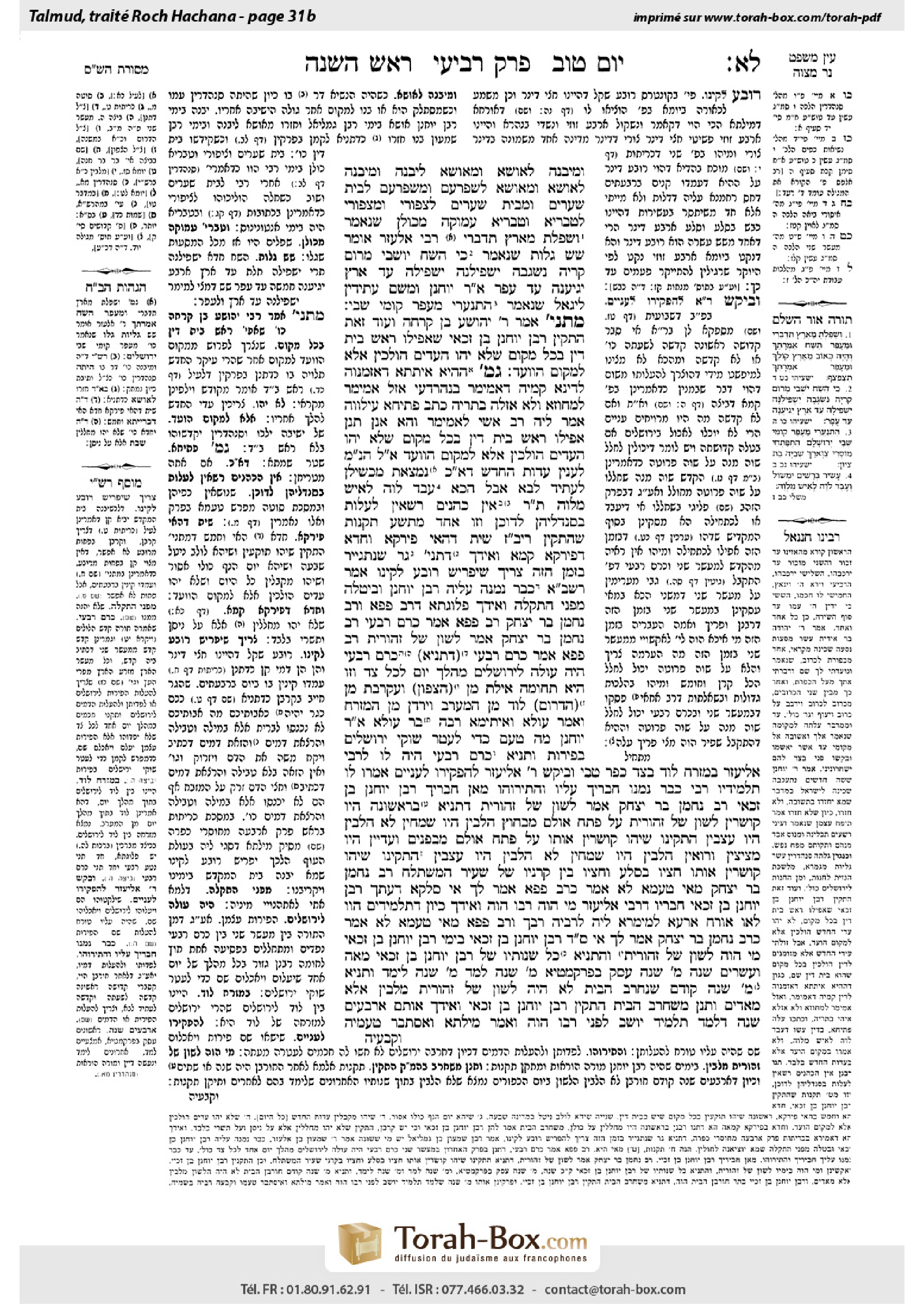
Rosh Hashanah 31b: Talmud study for Daf Yomi
Daf Yomi is the daily study of one Talmud folio. Explore 37 tractates with scans, Hebrew text, Sefaria English and AI-generated French translations where annotated.
Passage selection and English or AI-generated French translation are available where the scan has annotations. Daf Study is independent of Torah-Box and Sefaria.
Browse Rosh Hashanah · ראש השנה · All tractatesRosh Hashanah 31b text and translations
This page of Rosh Hashanah includes the Aramaic text, an English translation and an AI-generated French translation, alongside the scan above.
ראש השנה ל״א ב · Aramaic and Hebrew text
וּמִיַּבְנֶה לְאוּשָׁא, וּמֵאוּשָׁא לְיַבְנֶה, וּמִיַּבְנֶה לְאוּשָׁא, וּמֵאוּשָׁא לִשְׁפַרְעָם, וּמִשְּׁפַרְעָם לְבֵית שְׁעָרִים, וּמִבֵּית שְׁעָרִים לְצִפּוֹרִי, וּמִצִּפּוֹרִי לִטְבֶרְיָא. וּטְבֶרְיָא עֲמוּקָּה מִכּוּלָּן, שֶׁנֶּאֱמַר: ״וְשָׁפַלְתְּ מֵאֶרֶץ תְּדַבֵּרִי״.
רַבִּי אֶלְעָזָר אוֹמֵר: שֵׁשׁ גָּלוּת, שֶׁנֶּאֱמַר: ״כִּי הֵשַׁח יוֹשְׁבֵי מָרוֹם קִרְיָה נִשְׂגָּבָה יַשְׁפִּילֶנָּה יַשְׁפִּילָהּ עַד אֶרֶץ יַגִּיעֶנָּה עַד עָפָר״. אָמַר רַבִּי יוֹחָנָן: וּמִשָּׁם עֲתִידִין לִיגָּאֵל, שֶׁנֶּאֱמַר: ״הִתְנַעֲרִי מֵעָפָר קוּמִי שְּׁבִי״.
מַתְנִי׳ אָמַר רַבִּי יְהוֹשֻׁעַ בֶּן קׇרְחָה: וְעוֹד זֹאת הִתְקִין רַבָּן יוֹחָנָן בֶּן זַכַּאי, שֶׁאֲפִילּוּ רֹאשׁ בֵּית דִּין בְּכׇל מָקוֹם, שֶׁלֹּא יְהוּ הָעֵדִים הוֹלְכִין אֶלָּא לִמְקוֹם הַוַּעַד.
גְּמָ׳ הַהִיא אִיתְּתָא דְּאַזְמְנוּהָ לְדִינָא קַמֵּיהּ דְּאַמֵּימָר בִּנְהַרְדְּעָא. אֲזַל אַמֵּימָר לְמָחוֹזָא, וְלָא אֲזַלָה בָּתְרֵיהּ. כְּתַב פְּתִיחָא עִילָּוַהּ. אֲמַר לֵיהּ רַב אָשֵׁי לְאַמֵּימָר, וְהָא אֲנַן תְּנַן: אֲפִילּוּ רֹאשׁ בֵּית דִּין בְּכׇל מָקוֹם, שֶׁלֹּא יְהוּ הָעֵדִים הוֹלְכִין אֶלָּא לִמְקוֹם הַוַּעַד!
אֲמַר לֵיהּ: הָנֵי מִילֵּי לְעִנְיַן עֵדוּת הַחֹדֶשׁ, דְּאִם כֵּן נִמְצֵאתָ מַכְשִׁילָן לֶעָתִיד לָבֹא. אֲבָל הָכָא — ״עֶבֶד לֹוֶה לְאִישׁ מַלְוֶה״.
תָּנוּ רַבָּנַן: אֵין כֹּהֲנִים רַשָּׁאִין לַעֲלוֹת בְּסַנְדְּלֵיהֶן לַדּוּכָן, וְזוֹ אֶחָד מִתֵּשַׁע תַּקָּנוֹת שֶׁהִתְקִין רַבָּן יוֹחָנָן בֶּן זַכַּאי. שֵׁית דְּהַאי פִּירְקָא, וַחֲדָא דְּפִירְקָא קַמָּא.
וְאִידַּךְ, דְּתַנְיָא: גֵּר שֶׁנִּתְגַּיֵּיר בַּזְּמַן הַזֶּה, צָרִיךְ שֶׁיַּפְרִישׁ רוֹבַע לְקִינּוֹ. אָמַר רַבִּי שִׁמְעוֹן בֶּן אֶלְעָזָר: כְּבָר נִמְנָה עָלֶיהָ רַבָּן יוֹחָנָן וּבִיטְּלָהּ, מִפְּנֵי הַתַּקָּלָה.
וְאִידַּךְ פְּלוּגְתָּא דְּרַב פָּפָּא וְרַב נַחְמָן בַּר יִצְחָק. רַב פָּפָּא אָמַר: כֶּרֶם רְבָעִי, רַב נַחְמָן בַּר יִצְחָק אָמַר: לָשׁוֹן שֶׁל זְהוֹרִית.
רַב פָּפָּא אָמַר: כֶּרֶם רְבָעִי, דְּתַנְיָא: כֶּרֶם רְבָעִי הָיָה עוֹלֶה לִירוּשָׁלַיִם מַהֲלַךְ יוֹם לְכׇל צַד, וְזוֹ הִיא תְּחוּמָהּ: אֵילַת מִן הַצָּפוֹן, וְעַקְרַבַּת מִן הַדָּרוֹם, לוֹד מִן הַמַּעֲרָב, וְיַרְדֵּן מִן הַמִּזְרָח.
וְאָמַר עוּלָּא, וְאִיתֵּימָא רַבָּה בַּר עוּלָּא אָמַר רַבִּי יוֹחָנָן: מָה טַעַם — כְּדֵי לְעַטֵּר שׁוּקֵי יְרוּשָׁלַיִם בְּפֵירוֹת.
וְתַנְיָא: כֶּרֶם רְבָעִי הָיָה לוֹ לְרַבִּי אֱלִיעֶזֶר בְּמִזְרַח לוֹד בְּצַד כְּפַר טָבִי, וּבִיקֵּשׁ רַבִּי אֱלִיעֶזֶר לְהַפְקִירוֹ לַעֲנִיִּים.
אָמְרוּ לוֹ תַּלְמִידָיו: רַבִּי, כְּבָר נִמְנוּ חֲבֵרֶיךָ עָלָיו וְהִתִּירוּהוּ. מַאן חֲבֵרֶיךָ — רַבָּן יוֹחָנָן בֶּן זַכַּאי.
רַב נַחְמָן בַּר יִצְחָק אָמַר: לָשׁוֹן שֶׁל זְהוֹרִית, דְּתַנְיָא: בָּרִאשׁוֹנָה הָיוּ קוֹשְׁרִין לָשׁוֹן שֶׁל זְהוֹרִית עַל פֶּתַח אוּלָם מִבַּחוּץ, הִלְבִּין — הָיוּ שְׂמֵחִין, לֹא הִלְבִּין — הָיוּ עֲצֵבִין, הִתְקִינוּ שֶׁיְּהוּ קוֹשְׁרִין אוֹתוֹ עַל פֶּתַח אוּלָם מִבִּפְנִים.
וַעֲדַיִין הָיוּ מְצִיצִין וְרוֹאִין, הִלְבִּין — הָיוּ שְׂמֵחִין, לֹא הִלְבִּין — הָיוּ עֲצֵבִין, הִתְקִינוּ שֶׁיְּהוּ קוֹשְׁרִין אוֹתוֹ חֶצְיוֹ בַּסֶּלַע וְחֶצְיוֹ בֵּין קַרְנָיו שֶׁל שָׂעִיר הַמִּשְׁתַּלֵּחַ.
רַב נַחְמָן בַּר יִצְחָק מַאי טַעְמָא לָא אָמַר כְּרַב פָּפָּא? אָמַר לָךְ: אִי סָלְקָא דַעְתָּךְ רַבָּן יוֹחָנָן בֶּן זַכַּאי, חֲבֵרָיו דְּרַבִּי אֱלִיעֶזֶר מִי הֲוָה? רַבּוֹ הֲוָה. וְאִידַּךְ? כֵּיוָן דְּתַלְמִידִים הֲווֹ — לָאו אוֹרַח אַרְעָא לְמֵימְרָא לֵיהּ לְרַבֵּיהּ ״רַבָּךְ״.
וְרַב פָּפָּא מַאי טַעְמָא לָא אָמַר כְּרַב נַחְמָן בַּר יִצְחָק? אָמַר לָךְ: אִי סָלְקָא דַעְתָּךְ רַבָּן יוֹחָנָן בֶּן זַכַּאי — בִּימֵי רַבָּן יוֹחָנָן בֶּן זַכַּאי מִי הֲוָה לָשׁוֹן שֶׁל זְהוֹרִית? וְהָתַנְיָא: כׇּל שְׁנוֹתָיו שֶׁל רַבָּן יוֹחָנָן בֶּן זַכַּאי מֵאָה וְעֶשְׂרִים שָׁנָה. אַרְבָּעִים שָׁנָה — עָסַק בִּפְרַקְמַטְיָא, אַרְבָּעִים שָׁנָה — לָמַד, אַרְבָּעִים שָׁנָה — לִימֵּד.
וְתַנְיָא: אַרְבָּעִים שָׁנָה קוֹדֶם שֶׁנֶּחֱרַב הַבַּיִת לֹא הָיָה לָשׁוֹן שֶׁל זְהוֹרִית מַלְבִּין אֶלָּא מַאֲדִים. וּתְנַן: מִשֶּׁחָרַב הַבַּיִת הִתְקִין רַבָּן יוֹחָנָן בֶּן זַכַּאי! וְאִידַּךְ: אוֹתָם אַרְבָּעִים שָׁנָה דְּלָמַד — תַּלְמִיד יוֹשֵׁב לִפְנֵי רַבּוֹ הֲוָה, וַאֲמַר מִילְּתָא וְאִסְתַּבַּר טַעְמֵיהּ.
Rosh Hashanah 31b · English translation
and from Yavne to Usha; and from Usha it returned to Yavne; and from Yavne it went back to Usha; and from Usha to Shefaram; and from Shefaram to Beit She’arim; and from Beit She’arim to Tzippori; and from Tzippori to Tiberias. And Tiberias is lower than all of them, as it is in the Jordan Valley. A verse alludes to these movements, as it is stated: “And brought down, you shall speak out of the ground” (Isaiah 29:4).
Rabbi Elazar says: There are six exiles, if you count only the places, not the number of journeys, and a different verse alludes to this, as it is stated: “For He has brought down those who dwell high, the lofty city laying it low, laying it low, to the ground, bringing it to the dust” (Isaiah 26:5). This verse mentions six expressions of lowering: Brought down, laying it low, laying it low, to the ground, bringing it, and to the dust. Rabbi Yoḥanan said: And from there, i.e., from their lowest place of descent, they are destined to be redeemed in the future, as it is stated: “Shake yourself from the dust, arise, sit, Jerusalem” (Isaiah 52:2).
MISHNA: Rabbi Yehoshua ben Korḥa said: And this, too, Rabban Yoḥanan ben Zakkai instituted, that even if the head of the court of seventy-one is in any other place, not where the Great Sanhedrin is in session, the witnesses should nevertheless go only to the place where the Great Sanhedrin gathers to deliver testimony to determine the start of the month. Although the date of the month is dependent on the head of the Great Sanhedrin, as it is he who declares that the month is sanctified (see 24a), nevertheless, Rabban Yoḥanan ben Zakkai instituted that the members of the Great Sanhedrin may sanctify the month in the absence of the head of the court.
GEMARA: The Gemara relates: There was a certain woman who was called to judgment before Ameimar in Neharde’a. Ameimar temporarily went to Meḥoza, and she did not follow him to be judged there. He wrote a document of excommunication [petiḥa] concerning her, for disobeying the court. Rav Ashi said to Ameimar: Didn’t we learn in the mishna: Even if the head of the court of seventy-one is in any other place, the witnesses should go only to the place where the Great Sanhedrin gathers? This shows that one must appear in the court itself, rather than follow the head of the court.
Ameimar said to him: This applies only to testimony to determine the start of the month, for which it is necessary to have a fixed place. The reason is that if so, if the witnesses come to court when the head of the court is absent and they will have to go to another place, consequently you will be obstructing them for future occasions, as they will consider it too much trouble and perhaps they will not come the next time. Therefore, the Sages said that these witnesses should go to the regular place where the Great Sanhedrin meets. However, here, with regard to monetary claims, the verse states: “The borrower is servant to the lender” (Proverbs 22:7), i.e., the defendant must act as is convenient to the claimant and the court.
§ The Sages taught in a baraita: Priests are not allowed to ascend with their sandals to the platform to recite the Priestly Blessing in the synagogue. And this is one of the nine ordinances that Rabban Yoḥanan ben Zakkai instituted. Six are mentioned in this chapter: Sounding the shofar on Shabbat in Yavne, taking the lulav all seven days, the prohibition against eating new grain the entire day of waving, accepting testimony to determine the start of the month all day, having the witnesses to the New Moon go to the place of meeting, and reciting the Priestly Blessing without sandals. And one is stated in the first chapter, that the witnesses to the New Moon may desecrate Shabbat only for the months of Tishrei and Nisan.
And the other, as it is taught in a baraita: A convert who converts nowadays is required to set aside a quarter-shekel for his nest, i.e., his pair of doves. By Torah law a convert must bring two burnt-offerings of birds, in addition to his immersion and circumcision. After the destruction, it was instituted that he must set aside the value of two young pigeons in anticipation of the rebuilding of the Temple. Rabbi Shimon ben Elazar said: Rabban Yoḥanan ben Zakkai already assembled a majority who voted and rescinded the ordinance due to a potential mishap. If a convert is obligated to set aside money, someone might unwittingly use this money, thereby violating the prohibition against misuse of consecrated property.
And the other ordinance, the ninth, is the subject of a dispute between Rav Pappa and Rav Naḥman bar Yitzḥak. Rav Pappa said: The ordinance concerned the fruit of a fourth-year grapevine. Rav Naḥman bar Yitzḥak said: It was with regard to the strip of crimson wool.
The Gemara elaborates: Rav Pappa said that the ordinance is referring to the fruit of a fourth-year grapevine, as it is taught in a mishna (Beitza 5a): The fruit of a fourth-year grapevine has the status of second-tithe fruits, and therefore their owner would ascend to Jerusalem and eat the grapes there. If he is unable to do so, due to the distance involved or the weight of the load, he may redeem the fruits with money where he is, and later redeem that money for other fruits in Jerusalem. However, the Sages decreed that fruit from the environs of Jerusalem should not be redeemed; rather, the owners should bring the fruit itself to Jerusalem. The environs of Jerusalem for this purpose were defined as a day’s walk in each direction. And this is its boundary: Eilat to the north, Akrabat to the south, Lod to the west, and the Jordan river to the east.
And Ulla said, and some say Rabba bar Ulla said that Rabbi Yoḥanan said: For what reason did the Sages institute this ordinance, that one who lives near Jerusalem must bring his fruit there? In order to adorn the markets of Jerusalem with fruit, as this decree ensures that there is always an abundance of fruit in Jerusalem.
And it was further taught in a baraita: Rabbi Eliezer ben Hyrcanus, a student of Rabban Yoḥanan ben Zakkai, had a fourth-year grapevine located between Lod and Jerusalem, to the east of Lod alongside the village of Tavi. The vine was within the boundaries of Jerusalem for the purpose of this halakha. Rabbi Eliezer could not bring the fruit to the Temple, as the Temple had been destroyed, and Rabbi Eliezer sought to render the fruit ownerless in favor of the poor, for whom it would be worth the effort to bring the fruit to Jerusalem.
His students said to him: Our teacher, there is no need to do so, as your colleagues have already voted on the matter and permitted it, as after the destruction of the Temple there is no need to adorn the markets of Jerusalem. The Gemara explains: Who are: Your colleagues? This is referring to Rabban Yoḥanan ben Zakkai.
Rav Naḥman bar Yitzḥak said: The ordinance was with regard to the strip of crimson wool used on Yom Kippur. As it is taught in a baraita: At first they would tie a strip of crimson wool to the opening of the Entrance Hall of the Temple on the outside. If, after the sacrificing of the offerings and the sending of the scapegoat, the strip turned white, the people would rejoice, as this indicated that their sins had been atoned for. If it did not turn white they would be sad. When the Sages saw that people were overly distressed on Yom Kippur, they instituted that they should tie the strip of crimson wool to the opening of the Entrance Hall on the inside, where only a few could enter to see it.
But people would still peek and see it, and once again, if it turned white they would rejoice, and if it did not turn white they would be sad. Therefore, the Sages instituted that they should tie half of the strip to a rock near the place where the one who sent the scapegoat stood and half of it between the horns of the scapegoat, so that the people would not know what happened to the strip until after the conclusion of Yom Kippur. This ordinance was instituted by Rabban Yoḥanan ben Zakkai.
The Gemara explains this dispute: What is the reason that Rav Naḥman bar Yitzḥak did not state his opinion with regard to the ordinance in accordance with the opinion of Rav Pappa? He could have said to you: If it enters your mind to say that Rabban Yoḥanan ben Zakkai rescinded the ordinance of the fruit of fourth-year grapevines, was he one of Rabbi Eliezer’s colleagues, that the students would have referred to him in this manner? He was his teacher. Therefore, Rabbi Yoḥanan cannot be the one who instituted this ordinance. And the other, Rav Pappa, what would he respond to this? He would say that since they were Rabbi Eliezer’s students it is not proper conduct for one to say to his teacher: Your teacher. Therefore, they referred to Rabbi Yoḥanan as Rabbi Eliezer’s colleague.
The Gemara asks: And what is the reason that Rav Pappa did not state his opinion in accordance with the opinion of Rav Naḥman bar Yitzḥak? Rav Pappa could have said to you: If it enters your mind to say that this ordinance for Yom Kippur was instituted by Rabban Yoḥanan ben Zakkai, in the days of Rabban Yoḥanan ben Zakkai was there in fact a strip of crimson wool? Isn’t it taught in a baraita: All the years of Rabban Yoḥanan ben Zakkai’s life were 120 years: Forty years he was involved in business so that he could achieve financial independence and study Torah, forty years he studied Torah, and forty years he taught Torah.
And it is taught in a baraita: During the forty years before the Second Temple was destroyed the strip of crimson wool would not turn white; rather, it would turn a deeper shade of red. And we learned in the mishna: When the Temple was destroyed Rabban Yoḥanan ben Zakkai instituted his ordinances. This shows that Rabban Yoḥanan lived and taught Torah after the destruction. Therefore the ordinance of the crimson wool must have been made while Rabban Yoḥanan was still studying Torah, before he instituted any ordinances. The Gemara asks: And the other Sage, Rav Naḥman bar Yitzḥak, what would he answer? According to him, that ordinance was instituted during those forty years that he studied Torah. He was then a student sitting before his teacher, and he said a matter, i.e., he suggested this ordinance, and his reasoning made sense to the Sages,
Rosh Hashanah 31b · Traduction française (IA)
et de Yavné à Oucha ; d’Oucha, elle retourna à Yavné ; de Yavné, elle repartit à Oucha ; d’Oucha à Shefar’am ; de Shefar’am à Beit She’arim ; de Beit She’arim à Tsippori ; et de Tsippori à Tibériade. Tibériade est plus basse que toutes les autres, car elle se trouve dans la vallée du Jourdain. Un verset fait allusion à ces déplacements, comme il est dit : « Abaissée, tu parleras depuis la terre » (Isaïe 29, 4).
Rabbi Elazar dit : Il y a six exils, si l’on ne compte que les lieux et non le nombre de déplacements ; un autre verset y fait allusion, comme il est dit : « Car Il a abaissé ceux qui habitent en haut, la ville élevée ; Il l’a renversée, renversée jusqu’à terre, Il l’a amenée à la poussière » (Isaïe 26, 5). Ce verset comporte six expressions d’abaissement : « abaissé », « renversée », « renversée », « jusqu’à terre », « amenée » et « à la poussière ». Rabbi Yoḥanan dit : Et de là, c’est-à-dire du lieu le plus bas où ils sont descendus, ils seront délivrés à l’avenir, comme il est dit : « Secoue-toi de la poussière, lève-toi, assieds-toi, Jérusalem » (Isaïe 52, 2).
MICHNA : Rabbi Yehoshua ben Korḥa dit : Rabban Yoḥanan ben Zakkaï institua aussi ceci : même si le chef du tribunal des soixante et onze se trouve ailleurs que là où siège le Grand Sanhédrin, les témoins doivent néanmoins se rendre uniquement au lieu où le Grand Sanhédrin se réunit, afin de déposer leur témoignage pour fixer le début du mois. Bien que la date du mois dépende du chef du Grand Sanhédrin, puisque c’est lui qui déclare que le mois est sanctifié (voir 24a), Rabban Yoḥanan ben Zakkaï institua néanmoins que les membres du Grand Sanhédrin peuvent sanctifier le mois en l’absence du chef du tribunal.
GUEMARA : La Guemara rapporte qu’une certaine femme fut convoquée en justice devant Ameimar, à Neharde’a. Ameimar se rendit temporairement à Meḥoza, mais elle ne le suivit pas pour y être jugée. Il rédigea contre elle un acte d’excommunication [petiḥa], parce qu’elle avait désobéi au tribunal. Rav Ashi dit à Ameimar : N’avons-nous pas appris dans la Michna : « Même si le chef du tribunal des soixante et onze se trouve ailleurs, les témoins doivent se rendre uniquement au lieu où le Grand Sanhédrin se réunit » ? Cela montre qu’il faut se présenter au tribunal lui-même, plutôt que de suivre le chef du tribunal.
Ameimar lui dit : Cela ne s’applique qu’aux témoignages servant à fixer le début du mois, pour lesquels il est nécessaire d’avoir un lieu fixe. En effet, si les témoins se présentent au tribunal alors que le chef du tribunal est absent et qu’ils doivent se rendre ailleurs, on les découragera de venir à l’avenir : ils considéreront que cela demande trop d’efforts et risqueront de ne pas venir la fois suivante. C’est pourquoi les Sages ont dit que ces témoins doivent se rendre au lieu habituel où siège le Grand Sanhédrin. Mais ici, pour les litiges pécuniaires, le verset dit : « L’emprunteur est l’esclave du prêteur » (Proverbes 22, 7), c’est-à-dire que le défendeur doit se conformer à ce qui convient au demandeur et au tribunal.
§ Les Sages enseignèrent dans une baraïta : Les prêtres n’ont pas le droit de monter sur l’estrade avec leurs sandales pour réciter la bénédiction sacerdotale dans la synagogue. C’est l’une des neuf ordonnances instituées par Rabban Yoḥanan ben Zakkaï. Six sont mentionnées dans ce chapitre : sonner du chofar à Chabbat à Yavné ; prendre le loulav pendant les sept jours ; l’interdiction de manger du grain nouveau pendant toute la journée de la présentation de l’omer ; recevoir des témoignages servant à fixer le début du mois pendant toute la journée ; demander aux témoins de la nouvelle lune de se rendre au lieu de réunion ; et réciter la bénédiction sacerdotale sans sandales. Une autre est énoncée dans le premier chapitre : les témoins de la nouvelle lune ne peuvent profaner Chabbat que pour les mois de Tichri et de Nissan.
Et la dernière, comme il est enseigné dans une baraïta : De nos jours, un converti doit mettre de côté un quart de sicle pour son nid, c’est-à-dire sa paire de colombes. Selon la Torah, un converti doit apporter deux holocaustes d’oiseaux, en plus de son immersion et de sa circoncision. Après la destruction du Temple, il fut institué qu’il mette de côté la valeur de deux jeunes pigeons, en prévision de la reconstruction du Temple. Rabbi Shimon ben Elazar dit : Rabban Yoḥanan ben Zakkaï avait déjà réuni une majorité qui vota l’abrogation de cette ordonnance, en raison d’un risque d’incident. Si un converti est tenu de mettre de l’argent de côté, quelqu’un pourrait l’utiliser par inadvertance et ainsi transgresser l’interdiction de faire un usage profane de biens consacrés.
Et l’autre ordonnance, la neuvième, fait l’objet d’un désaccord entre Rav Pappa et Rav Naḥman bar Yitzḥak. Rav Pappa dit : L’ordonnance concernait les fruits d’une vigne de quatrième année. Rav Naḥman bar Yitzḥak dit : Elle concernait le fil de laine écarlate.
La Guemara développe : Rav Pappa dit que l’ordonnance concerne les fruits d’une vigne de quatrième année, comme il est enseigné dans une Michna (Beitsa 5a) : Les fruits d’une vigne de quatrième année ont le statut des fruits de la seconde dîme ; leur propriétaire montait donc à Jérusalem et y mangeait les raisins. S’il ne pouvait pas le faire en raison de la distance ou du poids de la charge, il pouvait racheter les fruits contre de l’argent là où il se trouvait, puis racheter plus tard cet argent contre d’autres fruits à Jérusalem. Cependant, les Sages décrétèrent que les fruits provenant des environs de Jérusalem ne pouvaient pas être rachetés ; leurs propriétaires devaient plutôt apporter les fruits eux-mêmes à Jérusalem. Pour cette règle, les environs de Jérusalem furent définis comme une journée de marche dans chaque direction. Voici les limites : Eilat au nord, Akrabat au sud, Lod à l’ouest et le Jourdain à l’est.
Et Oulla dit — certains disent que c’est Rabba bar Oulla qui dit au nom de Rabbi Yoḥanan : Pour quelle raison les Sages instituèrent-ils cette ordonnance, selon laquelle celui qui habite près de Jérusalem doit y apporter ses fruits ? Afin d’orner les marchés de Jérusalem de fruits, car ce décret garantit qu’il y ait toujours une abondance de fruits à Jérusalem.
Il fut également enseigné dans une baraïta : Rabbi Eliezer ben Hyrcanus, un disciple de Rabban Yoḥanan ben Zakkaï, possédait une vigne de quatrième année située entre Lod et Jérusalem, à l’est de Lod, près du village de Tavi. Pour l’application de cette halakha, la vigne se trouvait dans les limites de Jérusalem. Rabbi Eliezer ne pouvait pas apporter les fruits au Temple, puisque celui-ci avait été détruit, et il cherchait à déclarer les fruits sans propriétaire au profit des pauvres, pour qui il valait la peine de les apporter à Jérusalem.
Ses disciples lui dirent : Notre maître, vous n’avez pas besoin de le faire, car vos collègues ont déjà voté sur la question et l’ont permis, puisque, après la destruction du Temple, il n’est plus nécessaire d’orner les marchés de Jérusalem. La Guemara explique : Qui sont ceux qu’ils désignent par « vos collègues » ? Il s’agit de Rabban Yoḥanan ben Zakkaï.
Rav Naḥman bar Yitzḥak dit : L’ordonnance concernait le fil de laine écarlate utilisé à Yom Kippour. Comme il est enseigné dans une baraïta : Au début, on attachait un fil de laine écarlate à l’ouverture du vestibule du Temple, à l’extérieur. Si, après le sacrifice des offrandes et l’envoi du bouc émissaire, le fil devenait blanc, le peuple se réjouissait, car cela indiquait que ses péchés avaient été expiés. S’il ne devenait pas blanc, le peuple était triste. Lorsque les Sages virent que les gens étaient excessivement affligés à Yom Kippour, ils instituèrent qu’on attache le fil de laine écarlate à l’ouverture du vestibule, à l’intérieur, où seules quelques personnes pouvaient entrer pour le voir.
Mais les gens continuaient à jeter un coup d’œil pour le voir ; s’il devenait blanc, ils se réjouissaient de nouveau, et s’il ne devenait pas blanc, ils étaient tristes. Les Sages instituèrent donc qu’on attache une moitié du fil à un rocher, près de l’endroit où se tenait celui qui envoyait le bouc émissaire, et l’autre moitié entre les cornes du bouc émissaire, afin que le peuple ne sache pas ce qu’il était advenu du fil avant la fin de Yom Kippour. Cette ordonnance fut instituée par Rabban Yoḥanan ben Zakkaï.
La Guemara explique ce désaccord : Pour quelle raison Rav Naḥman bar Yitzḥak n’a-t-il pas exprimé son opinion conformément à celle de Rav Pappa ? Il aurait pu lui répondre : Si tu envisages que Rabban Yoḥanan ben Zakkaï ait abrogé l’ordonnance concernant les fruits des vignes de quatrième année, était-il le collègue de Rabbi Eliezer, pour que ses disciples l’aient désigné ainsi ? Il était son maître. Rabbi Yoḥanan ne peut donc pas être celui qui a institué cette ordonnance. Et que répondrait l’autre, Rav Pappa ? Il dirait que, puisqu’ils étaient les disciples de Rabbi Eliezer, il n’était pas convenable que l’un d’eux dise à son maître : « Votre maître ». C’est pourquoi ils ont désigné Rabbi Yoḥanan comme le collègue de Rabbi Eliezer.
La Guemara demande : Et pour quelle raison Rav Pappa n’a-t-il pas exprimé son opinion conformément à celle de Rav Naḥman bar Yitzḥak ? Rav Pappa aurait pu lui répondre : Si tu envisages que cette ordonnance pour Yom Kippour ait été instituée par Rabban Yoḥanan ben Zakkaï, y avait-il vraiment un fil de laine écarlate à l’époque de Rabban Yoḥanan ben Zakkaï ? N’est-il pas enseigné dans une baraïta : Rabban Yoḥanan ben Zakkaï vécut cent vingt ans : pendant quarante ans, il s’occupa d’affaires afin d’acquérir son indépendance financière et d’étudier la Torah ; pendant quarante ans, il étudia la Torah ; et pendant quarante ans, il enseigna la Torah.
Et il est enseigné dans une baraïta : Pendant les quarante années qui précédèrent la destruction du Second Temple, le fil de laine écarlate ne devenait pas blanc ; au contraire, il prenait une nuance de rouge plus intense. Et nous avons appris dans la Michna : Lorsque le Temple fut détruit, Rabban Yoḥanan ben Zakkaï institua ses ordonnances. Cela montre que Rabban Yoḥanan vécut et enseigna la Torah après la destruction. L’ordonnance concernant le fil de laine écarlate dut donc être prise alors que Rabban Yoḥanan étudiait encore la Torah, avant qu’il n’institue des ordonnances. La Guemara demande : Et que répondrait l’autre Sage, Rav Naḥman bar Yitzḥak ? Selon lui, cette ordonnance fut instituée pendant ces quarante années où Rabban Yoḥanan étudiait la Torah. Il était alors un disciple assis devant son maître ; il soumit une proposition, c’est-à-dire qu’il suggéra cette ordonnance, et son raisonnement parut convaincant aux Sages,
Traduction française générée par IA à partir de l’édition anglaise de Sefaria. Vérifie toujours un passage avec le texte source.
Text from Sefaria: William Davidson Edition - Vocalized Aramaic (CC BY NC); William Davidson Edition - English (CC BY NC).