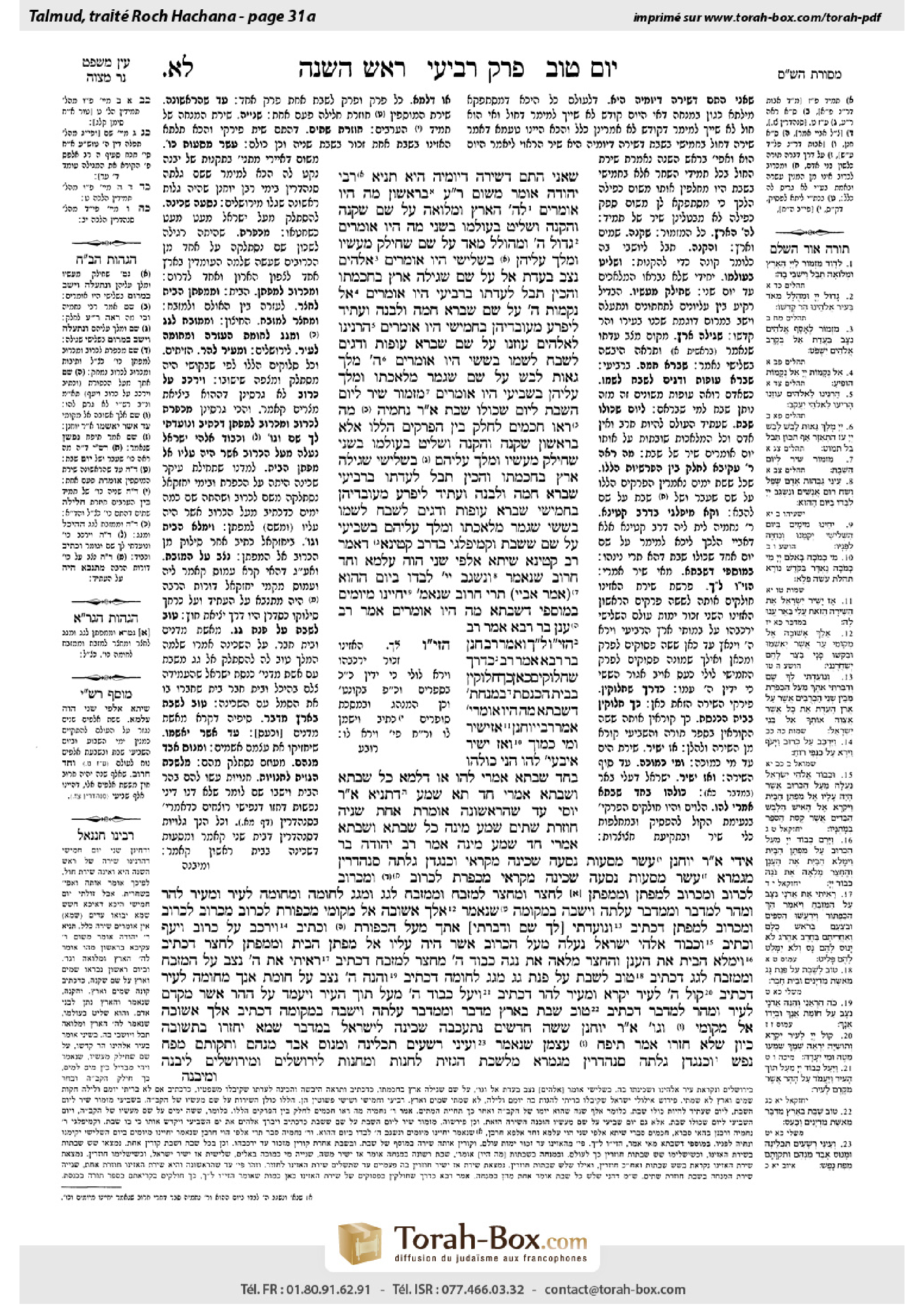
Rosh Hashanah 31a: Talmud study for Daf Yomi
Daf Yomi is the daily study of one Talmud folio. Explore 37 tractates with scans, Hebrew text, Sefaria English and AI-generated French translations where annotated.
Passage selection and English or AI-generated French translation are available where the scan has annotations. Daf Study is independent of Torah-Box and Sefaria.
Browse Rosh Hashanah · ראש השנה · All tractatesRosh Hashanah 31a text and translations
This page of Rosh Hashanah includes the Aramaic text, an English translation and an AI-generated French translation, alongside the scan above.
ראש השנה ל״א א · Aramaic and Hebrew text
שָׁאנֵי הָתָם, דְּשִׁירָה דְּיוֹמֵיהּ הִיא.
תַּנְיָא, רַבִּי יְהוּדָה אוֹמֵר מִשּׁוּם רַבִּי עֲקִיבָא: בָּרִאשׁוֹן מָה הָיוּ אוֹמְרִים — ״לַה׳ הָאָרֶץ וּמְלוֹאָהּ״, עַל שֵׁם שֶׁקָּנָה וְהִקְנָה וְשַׁלִּיט בְּעוֹלָמוֹ.
בַּשֵּׁנִי מָה הָיוּ אוֹמְרִים — ״גָּדוֹל ה׳ וּמְהוּלָּל מְאֹד״, עַל שֵׁם שֶׁחִילֵּק מַעֲשָׂיו וּמָלַךְ עֲלֵיהֶן.
בַּשְּׁלִישִׁי הָיוּ אוֹמְרִים: ״אֱלֹהִים נִצָּב בַּעֲדַת אֵל״, עַל שֵׁם שֶׁגִּילָּה אֶרֶץ בְּחׇכְמָתוֹ, וְהֵכִין תֵּבֵל לַעֲדָתוֹ. בָּרְבִיעִי הָיוּ אוֹמְרִים: ״אֵל נְקָמוֹת ה׳״, עַל שֵׁם שֶׁבָּרָא חַמָּה וּלְבָנָה, וְעָתִיד לִיפָּרַע מֵעוֹבְדֵיהֶן.
בַּחֲמִישִׁי הָיוּ אוֹמְרִים: ״הַרְנִינוּ לֵאלֹהִים עוּזֵּנוּ״, עַל שֵׁם שֶׁבָּרָא עוֹפוֹת וְדָגִים לְשַׁבֵּחַ לִשְׁמוֹ. בַּשִּׁשִּׁי הָיוּ אוֹמְרִים: ״ה׳ מָלָךְ גֵּאוּת לָבֵשׁ״, עַל שֵׁם שֶׁגָּמַר מְלַאכְתּוֹ וּמָלַךְ עֲלֵיהֶן. בַּשְּׁבִיעִי הָיוּ אוֹמְרִים: ״מִזְמוֹר שִׁיר לְיוֹם הַשַּׁבָּת״, לְיוֹם שֶׁכּוּלּוֹ שַׁבָּת.
אָמַר רַבִּי נְחֶמְיָה: מָה רָאוּ חֲכָמִים לְחַלֵּק בֵּין הַפְּרָקִים הַלָּלוּ? אֶלָּא: בָּרִאשׁוֹן — שֶׁקָּנָה וְהִקְנָה וְשַׁלִּיט בְּעוֹלָמוֹ. בַּשֵּׁנִי — שֶׁחִילֵּק מַעֲשָׂיו וּמָלַךְ עֲלֵיהֶם. בַּשְּׁלִישִׁי — שֶׁגִּילָּה אֶרֶץ בְּחׇכְמָתוֹ וְהֵכִין תֵּבֵל לַעֲדָתוֹ.
בָּרְבִיעִי — שֶׁבָּרָא חַמָּה וּלְבָנָה וְעָתִיד לִיפָּרַע מֵעוֹבְדֵיהֶן. בַּחֲמִישִׁי — שֶׁבָּרָא עוֹפוֹת וְדָגִים לְשַׁבֵּחַ לִשְׁמוֹ. בַּשִּׁשִּׁי — שֶׁגָּמַר מְלַאכְתּוֹ וּמָלַךְ עֲלֵיהֶם. בַּשְּׁבִיעִי — עַל שֵׁם שֶׁשָּׁבַת.
וְקָמִיפַּלְגִי בִּדְרַב קַטִּינָא, דְּאָמַר רַב קַטִּינָא: שִׁיתָּא אַלְפֵי שְׁנֵי הָוֵה עָלְמָא וְחַד חָרוּב, שֶׁנֶּאֱמַר: ״וְנִשְׂגַּב ה׳ לְבַדּוֹ בְּיוֹם הַהוּא״. אָמַר אַבָּיֵי: תְּרֵי חָרוּב, שֶׁנֶּאֱמַר: ״יְחַיֵּינוּ מִיּוֹמָיִם״.
בְּמוּסְפֵי דְשַׁבְּתָא מָה הָיוּ אוֹמְרִים? אָמַר רַב עָנָן בַּר רָבָא אָמַר רַב: ״הַזִּיו לָךְ״.
וְאָמַר רַב חָנָן בַּר רָבָא אָמַר רַב: כְּדֶרֶךְ שֶׁחֲלוּקִים כָּאן — כָּךְ חֲלוּקִין בְּבֵית הַכְּנֶסֶת.
בְּמִנְחֲתָא דְשַׁבְּתָא מָה הָיוּ אוֹמְרִים? אָמַר רַבִּי יוֹחָנָן: ״אָז יָשִׁיר״, וּ״מִי כָמוֹךָ״, וְ״אָז יָשִׁיר״.
אִיבַּעְיָא לְהוּ: הָנֵי כּוּלְּהוּ בְּחַד שַׁבְּתָא אָמְרִי לְהוּ, אוֹ דִלְמָא כֹּל שַׁבְּתָא וְשַׁבְּתָא אָמְרִי חַד? תָּא שְׁמַע, דְּתַנְיָא, אָמַר רַבִּי יוֹסֵי: עַד שֶׁהָרִאשׁוֹנָה אוֹמֶרֶת אַחַת — שְׁנִיָּה חוֹזֶרֶת שְׁתַּיִם. שְׁמַע מִינַּהּ כׇּל שַׁבְּתָא וְשַׁבְּתָא אָמְרִי חַד, שְׁמַע מִינַּהּ.
אָמַר רַב יְהוּדָה בַּר אִידֵּי אָמַר רַבִּי יוֹחָנָן: עֶשֶׂר מַסָּעוֹת נָסְעָה שְׁכִינָה, מִקְּרָאֵי, וּכְנֶגְדָּן גָּלְתָה סַנְהֶדְרִין, מִגְּמָרָא.
עֶשֶׂר מַסָּעוֹת נָסְעָה שְׁכִינָה, מִקְּרָאֵי: מִכַּפֹּרֶת לִכְרוּב, וּמִכְּרוּב לִכְרוּב, וּמִכְּרוּב לְמִפְתָּן, וּמִמִּפְתָּן לְחָצֵר, וּמֵחָצֵר לְמִזְבֵּחַ, וּמִמִּזְבֵּחַ לְגַג, וּמִגַּג לְחוֹמָה, וּמֵחוֹמָה לָעִיר, וּמֵעִיר לְהַר, וּמֵהַר לְמִדְבָּר, וּמִמִּדְבָּר עָלְתָה וְיָשְׁבָה בִּמְקוֹמָהּ — שֶׁנֶּאֱמַר: ״אֵלֵךְ אָשׁוּבָה אֶל מְקוֹמִי״.
מִכַּפּוֹרֶת לִכְרוּב, מִכְּרוּב לִכְרוּב, וּמִכְּרוּב לְמִפְתָּן — דִּכְתִיב: ״וְנוֹעַדְתִּי לְךָ שָׁם וְדִבַּרְתִּי אִתְּךָ מֵעַל הַכַּפּוֹרֶת״, וּכְתִיב: ״וַיִּרְכַּב עַל כְּרוּב וַיָּעֹף״, וּכְתִיב: ״וּכְבוֹד אֱלֹהֵי יִשְׂרָאֵל נַעֲלָה מֵעַל הַכְּרוּב אֲשֶׁר הָיָה עָלָיו אֶל מִפְתַּן הַבָּיִת״.
וּמִמִּפְתָּן לְחָצֵר, דִּכְתִיב: ״וַיִּמָּלֵא הַבַּיִת אֶת הֶעָנָן וְהֶחָצֵר מָלְאָה אֶת נֹגַהּ כְּבוֹד ה׳״. מֵחָצֵר לְמִזְבֵּחַ, דִּכְתִיב: ״רָאִיתִי אֶת ה׳ נִצָּב עַל הַמִּזְבֵּחַ״. וּמִמִּזְבֵּחַ לְגַג, דִּכְתִיב: ״טוֹב לָשֶׁבֶת עַל פִּנַּת גָּג״. מִגַּג לְחוֹמָה, דִּכְתִיב: ״וְהִנֵּה ה׳ נִצָּב עַל חוֹמַת אֲנָךְ״. מֵחוֹמָה לָעִיר, דִּכְתִיב: ״קוֹל ה׳ לָעִיר יִקְרָא״.
וּמֵעִיר לְהַר, דִּכְתִיב: ״וַיַּעַל כְּבוֹד ה׳ מֵעַל תּוֹךְ הָעִיר וַיַּעֲמֹד עַל הָהָר אֲשֶׁר מִקֶּדֶם לָעִיר״. וּמֵהַר לְמִדְבָּר, דִּכְתִיב: ״טוֹב שֶׁבֶת בְּאֶרֶץ מִדְבָּר״. וּמִמִּדְבָּר עָלְתָה וְיָשְׁבָה בִּמְקוֹמָהּ, דִּכְתִיב: ״אֵלֵךְ אָשׁוּבָה אֶל מְקוֹמִי וְגוֹ׳״.
אָמַר רַבִּי יוֹחָנָן: שִׁשָּׁה חֳדָשִׁים נִתְעַכְּבָה שְׁכִינָה לְיִשְׂרָאֵל בַּמִּדְבָּר, שֶׁמָּא יַחְזְרוּ בִּתְשׁוּבָה. כֵּיוָן שֶׁלֹּא חָזְרוּ — אָמַר: תִּיפַּח עַצְמָן, שֶׁנֶּאֱמַר: ״וְעֵינֵי רְשָׁעִים תִּכְלֶינָה וּמָנוֹס אָבַד מִנְהֶם וְתִקְוָתָם מַפַּח נָפֶשׁ״.
וּכְנֶגְדָּן גָּלְתָה סַנְהֶדְרִין, מִגְּמָרָא: מִלִּשְׁכַּת הַגָּזִית לַחֲנוּת, וּמֵחֲנוּת לִירוּשָׁלַיִם, וּמִירוּשָׁלַיִם לְיַבְנֶה,
Rosh Hashanah 31a · English translation
The Gemara rejects this argument. It is different there, as in any case “Sing aloud” is the psalm of the day, either because it was an ordinary Thursday or because it was Rosh HaShana. However, there is no proof from here that in all uncertain cases they would recite the psalm for an ordinary weekday, as it is possible that they did not recite any psalm at all.
§ The Gemara expands on the topic of the daily psalms recited by the Levites. It is taught in a baraita that Rabbi Yehuda said in the name of Rabbi Akiva: On the first day of the week, Sunday, what psalm would the Levites recite? The psalm beginning with the phrase: “The earth is the Lord’s, and its fullness” (Psalms 24:1), in commemoration of the first day of Creation, because on that day He acquired the world and transferred it to man, and He was the only ruler in His world, as the angels were not created until the second day.
On the second day of the week what psalm would the Levites recite? The psalm that begins: “Great is the Lord, and highly to be praised in the city of our God, His sacred mountain” (Psalms 48:2). This is because on the second day of Creation He separated His works, dividing between the upper waters and the lower waters, and ruled over them as King; and this psalm speaks of Jerusalem as “The city of a great King” (Psalms 48:3).
On the third day of the week they would recite the psalm beginning: “God stands in the congregation of God” (Psalms 82:1), because on the third day of Creation He revealed the land in His wisdom and thereby prepared the world for His assembly that could now live on the dry land. On the fourth day of the week they would recite the psalm beginning: “O Lord God, to Whom vengeance belongs” (Psalms 94:1), because on the fourth day of Creation He created the sun and the moon, and in the future He will punish and take vengeance upon those who worship them.
On the fifth day of the week the Levites would recite the psalm beginning: “Sing aloud to God our strength” (Psalms 81:2), because on the fifth day of Creation He created birds and fish to praise His name. On the sixth day of the week they would recite the psalm beginning: “The Lord reigns, He is clothed with majesty” (Psalms 93:1), because on that day He completed His labor and ruled over all of creation in full glory. On the seventh day of the week, Shabbat, they would recite the psalm beginning: “A psalm, a song for the day of Shabbat” (Psalms 92:1), as the future world will be a day that is all Shabbat.
Rabbi Neḥemya said: What did the Sages see that led them to distinguish between these chapters, as they interpret the psalms recited on the six weekdays as referring to the past, whereas the psalm recited on Shabbat is referring to the future. Rather, all of the psalms refer to the past. The first six are as explained above: On the first day, the reason is that He acquired the world and transferred it to man, and He was the only ruler in His world; on the second day, the reason is that He separated His works and ruled over them as King; on the third day, the reason is that He revealed the land in His wisdom and thereby prepared the world for His assembly.
On the fourth day, the reason is that He created the sun and the moon, and in the future He will punish those who worship them; on the fifth day, the reason is that He created birds and fish to praise His name; on the sixth day, the reason is that He completed His labor and ruled over all of creation. However, on the seventh day, the reason is that He rested from His work, as the phrase “A psalm, a song for the day of Shabbat” is referring to the first Shabbat of Creation.
The Gemara comments: And these tanna’im disagree with regard to a statement of Rav Ketina, as Rav Ketina said: The world will exist for six thousand years, and for one thousand years it will be destroyed, as it is stated: “And the Lord alone shall be exalted on that day” (Isaiah 2:11), and one day for God is a thousand years, as indicated in the verse: “For a thousand years in Your sight are but as yesterday when it is past” (Psalms 90:4). Rav Ketina’s statement is in accordance with the opinion of Rabbi Akiva. Conversely, Abaye said: The world will be destroyed for two thousand years, as it is stated: “After two days He will revive us” (Hosea 6:2). According to the opinion of Abaye that the destruction will be for two days, there is no connection between the future world and the day of Shabbat, which is only one day.
§ The Gemara further asks: When it came to the additional offerings of Shabbat, what would the Levites recite? Rav Anan bar Rava said that Rav said: They would recite in accordance with the mnemonic hei, zayin, yod, vav, lamed, kaf. They would divide the song of Ha’azinu into six sections, each of which began with a letter of the mnemonic: “Give ear [ha’azinu], you heavens” (Deuteronomy 32:1); “Remember [zekhor] the days of old” (Deuteronomy 32:7); “He made him ride [yarkivehu] on the high places of the earth” (Deuteronomy 32:13); “The Lord saw it [vayar] and spurned” (Deuteronomy 32:19); “Were it not [lulei] that I dread the enemy’s provocation” (Deuteronomy 32:27); “For [ki] the Lord will judge His people” (Deuteronomy 32:36).
And Rav Ḥanan bar Rava said that Rav said: In the manner that the verses of the song of Ha’azinu are divided here for the recitation of the additional offerings of Shabbat in the Temple, so too are they divided when they are read in the synagogue on Shabbat.
The Gemara asks another question: When it came to the daily afternoon offering on Shabbat, what would the Levites recite? Rabbi Yoḥanan said: “Then sang Moses” (Exodus 15:1), and: “Who is like You” (Exodus 15:11), the two halves of the Song of the Sea, and: “Then Israel sang this song” (Numbers 21:17), the entire Song of the Well.
A dilemma was raised before the Sages: Does one recite all these sections of the song of Ha’azinu on each Shabbat, or perhaps on each and every Shabbat they would recite one section? The Gemara suggests: Come and hear, as it is taught in a baraita that Rabbi Yosei said: By the time that those who recite the first set, i.e., the verses for the additional offerings brought on Shabbat, recite it once, those who recite the second set, for the daily afternoon offering, would repeat their cycle twice, as the first set was comprised of six sections, whereas the second set included only three sections. Learn from here that each and every Shabbat they would recite only one section. The Gemara concludes: Indeed, learn from here that this is correct.
§ Rav Yehuda bar Idi said that Rabbi Yoḥanan said: The Divine Presence traveled ten journeys, i.e., it left the Temple and Eretz Yisrael in ten stages at the time of the destruction of the First Temple, as derived from verses. And corresponding to them the Sanhedrin was exiled in ten stages at the end of the Second Temple period and after the destruction of the Temple, and this is known from tradition.
The Gemara elaborates. The Divine Presence traveled ten journeys, as derived from verses. The ten journeys are: From the Ark cover to the cherub; and from one cherub to the other cherub; and from the second cherub to the threshold of the Sanctuary; and from the threshold to the courtyard; and from the courtyard to the altar; and from the altar to the roof; and from the roof to the wall of the Temple Mount; and from the wall to the city; and from the city to a mountain close to Jerusalem; and from that mountain to the wilderness; and from the wilderness it ascended and rested in its place in Heaven, isolated from humanity, as it is stated: “I will go and return to My place” (Hosea 5:15).
The Gemara cites the sources for each of these stages: From the Ark cover the Divine Presence traveled to the cherub, and from one cherub to the other cherub, and from the second cherub to the threshold, as it is written with regard to Moses in the Tabernacle: “And there I will meet with you, and I will speak to you from above the Ark cover, from between the two cherubs” (Exodus 25:22). And it is written: “And He rode upon a cherub, and flew” (II Samuel 22:11), which indicates that the glory of the Divine Presence can rest upon one cherub. And it is written: “And the glory of the God of Israel had ascended from the cherub, on which it was, to the threshold of the House” (Ezekiel 9:3), i.e., the Divine Presence moved from the cherub to the threshold.
And from the threshold of the Sanctuary the Divine Presence went to the courtyard, as it is written: “And the House was filled with the cloud and the courtyard was full of the brightness of the Lord’s glory” (Ezekiel 10:4). From the courtyard to the altar, as it is written: “I saw the Lord standing on the altar” (Amos 9:1). And from the altar to the roof, as it is written: “It is better to dwell in a corner of the roof than in a house together with a contentious woman” (Proverbs 21:9). From the roof to the wall, as it is written: “And behold, the Lord stood upon a wall made by a plumb line” (Amos 7:7). From the wall to the city, as it is written: “The Lord’s voice cries to the city” (Micah 6:9).
And from the city the Divine Presence arose to the mountain nearest the Sanctuary, i.e., the Mount of Olives, as it is written: “And the glory of the Lord went up from the midst of the city, and stood upon the mountain, which is on the east side of the city” (Ezekiel 11:23). And from the mountain to the wilderness, as it is written: “It is better to live in the wilderness than with a contentious and fretful woman” (Proverbs 21:19). And from the wilderness it ascended and rested in its place in Heaven, as it is written: “I will go and return to My place until they acknowledge their guilt” (Hosea 5:15).
Rabbi Yoḥanan said: For six months the Divine Presence lingered in the wilderness, waiting for the Jewish people, hoping that perhaps they would repent and it would be able to return to its place. When they did not repent, the Divine Presence said: Let them despair and be lost, as it is stated: “But the eyes of the wicked shall fail, and they shall have no way to flee, and their hope shall be the drooping of the soul” (Job 11:20). This concludes the discussion of the ten stages of the exile of the Divine Presence from the Holy of Holies.
And corresponding to these ten stages, the Sanhedrin was exiled in ten stages at the end of the Second Temple period and after the destruction of the Temple, and this is known from tradition: From the Chamber of Hewn Stone, its fixed seat in the Temple, to Ḥanut, literally, shop, a designated spot on the Temple Mount outside the Temple proper; and from Ḥanut to Jerusalem; and from Jerusalem to Yavne;
Rosh Hashanah 31a · Traduction française (IA)
La Guemara rejette cet argument. Le cas est différent, car, de toute façon, « Chantez à pleine voix » est le psaume du jour, soit parce que c’était un jeudi ordinaire, soit parce que c’était Roch Hachana. Toutefois, cela ne prouve pas que, dans tous les cas incertains, ils récitaient le psaume d’un jour de semaine ordinaire, car il est possible qu’ils n’aient récité aucun psaume.
§ La Guemara développe le sujet des psaumes quotidiens récités par les Lévites. Une baraïta enseigne que Rabbi Yehouda a dit au nom de Rabbi Akiva : Le premier jour de la semaine, le dimanche, quel psaume les Lévites récitaient-ils ? Celui qui commence par les mots : « À l’Éternel la terre et tout ce qu’elle renferme » (Psaumes 24:1), en souvenir du premier jour de la Création, car ce jour-là, Il acquit le monde et le transmit à l’homme ; Il était le seul souverain de Son monde, puisque les anges ne furent créés que le deuxième jour.
Le deuxième jour de la semaine, quel psaume les Lévites récitaient-ils ? Celui qui commence par : « Grand est l’Éternel et digne de grandes louanges dans la ville de notre Dieu, sa montagne sainte » (Psaumes 48:2). En effet, le deuxième jour de la Création, Il sépara Ses œuvres, en distinguant les eaux supérieures des eaux inférieures, et régna sur elles en Roi ; or ce psaume parle de Jérusalem comme de « la ville du grand Roi » (Psaumes 48:3).
Le troisième jour de la semaine, ils récitaient le psaume qui commence par : « Dieu se tient dans l’assemblée divine » (Psaumes 82:1), car, le troisième jour de la Création, Il fit apparaître la terre par Sa sagesse et prépara ainsi le monde à Son assemblée, qui pouvait désormais vivre sur la terre ferme. Le quatrième jour de la semaine, ils récitaient le psaume qui commence par : « Éternel, Dieu des vengeances » (Psaumes 94:1), car, le quatrième jour de la Création, Il créa le soleil et la lune, et à l’avenir, Il punira et châtiera ceux qui les adorent.
Le cinquième jour de la semaine, les Lévites récitaient le psaume qui commence par : « Chantez à Dieu, notre force » (Psaumes 81:2), car, le cinquième jour de la Création, Il créa les oiseaux et les poissons pour qu’ils louent Son nom. Le sixième jour de la semaine, ils récitaient le psaume qui commence par : « L’Éternel règne, Il est revêtu de majesté » (Psaumes 93:1), car ce jour-là, Il acheva Son œuvre et régna dans toute Sa gloire sur l’ensemble de la Création. Le septième jour de la semaine, le Chabbat, ils récitaient le psaume qui commence par : « Psaume, chant pour le jour du Chabbat » (Psaumes 92:1), car le monde futur sera un jour qui ne sera que Chabbat.
Rabbi Neḥemya dit : Qu’est-ce qui a conduit les Sages à distinguer ces chapitres, en interprétant les psaumes récités pendant les six jours de semaine comme se rapportant au passé, tandis que le psaume récité le Chabbat se rapporte à l’avenir ? Au contraire, tous les psaumes se rapportent au passé. Les raisons des six premiers sont celles qui ont été expliquées : le premier jour, parce qu’Il acquit le monde et le transmit à l’homme, et qu’Il était le seul souverain de Son monde ; le deuxième jour, parce qu’Il sépara Ses œuvres et régna sur elles en Roi ; le troisième jour, parce qu’Il fit apparaître la terre par Sa sagesse et prépara ainsi le monde à Son assemblée.
Le quatrième jour, la raison est qu’Il créa le soleil et la lune, et qu’à l’avenir, Il punira ceux qui les adorent ; le cinquième jour, qu’Il créa les oiseaux et les poissons pour qu’ils louent Son nom ; le sixième jour, qu’Il acheva Son œuvre et régna sur l’ensemble de la Création. Quant au septième jour, la raison est qu’Il se reposa de Son œuvre, car l’expression « Psaume, chant pour le jour du Chabbat » se rapporte au premier Chabbat de la Création.
La Guemara fait remarquer que ces tannaïm sont en désaccord au sujet d’une déclaration de Rav Ketina. Rav Ketina a dit : Le monde subsistera pendant six mille ans, puis sera détruit pendant mille ans, comme il est dit : « Et l’Éternel seul sera élevé en ce jour-là » (Isaïe 2:11) ; en effet, un jour pour Dieu équivaut à mille ans, comme l’indique le verset : « Car mille ans sont à Tes yeux comme le jour d’hier, lorsqu’il est passé » (Psaumes 90:4). La déclaration de Rav Ketina est conforme à l’opinion de Rabbi Akiva. À l’inverse, Abaye a dit : Le monde sera détruit pendant deux mille ans, comme il est dit : « Après deux jours, Il nous rendra la vie » (Osée 6:2). Selon l’opinion d’Abaye, d’après laquelle la destruction durera deux jours, le monde futur n’a aucun lien avec le jour du Chabbat, qui ne dure qu’un jour.
§ La Guemara pose une autre question : Lors des offrandes supplémentaires du Chabbat, que récitaient les Lévites ? Rav Anan bar Rava a dit au nom de Rav : Ils récitaient selon le moyen mnémotechnique hei, zayin, yod, vav, lamed, kaf. Ils divisaient le chant de Ha’azinu en six sections, chacune commençant par une lettre de ce moyen mnémotechnique : « Prêtez l’oreille [ha’azinu], cieux » (Deutéronome 32:1) ; « Souviens-toi [zekhor] des jours d’autrefois » (Deutéronome 32:7) ; « Il le fit chevaucher [yarkivehu] sur les hauteurs de la terre » (Deutéronome 32:13) ; « L’Éternel le vit [vayar] et le repoussa » (Deutéronome 32:19) ; « Si je ne craignais [lulei] la provocation de l’ennemi » (Deutéronome 32:27) ; « Car [ki] l’Éternel jugera Son peuple » (Deutéronome 32:36).
Et Rav Ḥanan bar Rava a dit au nom de Rav : De même que les versets du chant de Ha’azinu sont divisés ici pour être récités lors des offrandes supplémentaires du Chabbat au Temple, ils sont également divisés de cette manière lorsqu’ils sont lus à la synagogue le Chabbat.
La Guemara pose une autre question : Lors de l’offrande quotidienne de l’après-midi du Chabbat, que récitaient les Lévites ? Rabbi Yoḥanan a dit : « Alors Moïse chanta » (Exode 15:1), puis « Qui est comme Toi » (Exode 15:11), les deux moitiés du chant de la Mer, ainsi que « Alors Israël chanta ce chant » (Nombres 21:17), l’intégralité du chant du Puits.
Une question fut soulevée devant les Sages : Récitait-on toutes ces sections du chant de Ha’azinu chaque Chabbat, ou bien récitaient-ils une seule section à chaque Chabbat ? La Guemara propose : « Viens et écoute », car une baraïta enseigne que Rabbi Yosei a dit : Au moment où ceux qui récitent le premier ensemble, c’est-à-dire les versets correspondant aux offrandes supplémentaires apportées le Chabbat, l’avaient récité une fois, ceux qui récitent le deuxième ensemble, pour l’offrande quotidienne de l’après-midi, avaient déjà parcouru leur cycle deux fois, puisque le premier ensemble comprenait six sections, tandis que le deuxième n’en comptait que trois. Apprends-en que chaque Chabbat, ils ne récitaient qu’une seule section. La Guemara conclut : En effet, apprends-en que c’est bien ainsi.
Rav Yehuda bar Idi a dit au nom de Rabbi Yoḥanan : La Présence divine effectua dix déplacements, c’est-à-dire qu’au moment de la destruction du Premier Temple, elle quitta le Temple et la terre d’Israël en dix étapes, comme le montrent les versets. En correspondance avec ces déplacements, le Sanhédrin fut exilé en dix étapes à la fin de la période du Second Temple et après la destruction du Temple, comme on le sait par tradition.
La Guemara développe : La Présence divine effectua dix déplacements, comme le montrent les versets. Voici ces déplacements : du propitiatoire au chérubin ; d’un chérubin à l’autre ; du second chérubin au seuil du Sanctuaire ; du seuil au parvis ; du parvis à l’autel ; de l’autel au toit ; du toit au mur du mont du Temple ; du mur à la ville ; de la ville à une montagne proche de Jérusalem ; de cette montagne au désert ; puis, du désert, elle s’éleva et se reposa en son lieu au Ciel, à l’écart de l’humanité, comme il est dit : « Je m’en irai et retournerai en mon lieu » (Osée 5:15).
La Guemara cite les sources de chacune de ces étapes : la Présence divine passa du propitiatoire au chérubin, puis d’un chérubin à l’autre, et du second chérubin au seuil, comme il est écrit au sujet de Moïse dans le Tabernacle : « C’est là que je te rencontrerai et que je te parlerai, de dessus le propitiatoire, d’entre les deux chérubins » (Exode 25:22). Il est également écrit : « Il chevaucha un chérubin et s’envola » (II Samuel 22:11), ce qui indique que la gloire de la Présence divine peut reposer sur un seul chérubin. Et il est écrit : « La gloire du Dieu d’Israël s’éleva du chérubin sur lequel elle se trouvait vers le seuil de la Maison » (Ézéchiel 9:3), c’est-à-dire que la Présence divine passa du chérubin au seuil.
Du seuil du Sanctuaire, la Présence divine se rendit au parvis, comme il est écrit : « La Maison fut remplie de la nuée et le parvis fut rempli de l’éclat de la gloire de l’Éternel » (Ézéchiel 10:4). Du parvis, elle alla à l’autel, comme il est écrit : « J’ai vu l’Éternel debout sur l’autel » (Amos 9:1). De l’autel, elle alla au toit, comme il est écrit : « Mieux vaut habiter dans un coin du toit que dans une maison avec une femme querelleuse » (Proverbes 21:9). Du toit, elle alla au mur, comme il est écrit : « Et voici, l’Éternel se tenait sur un mur construit au fil à plomb » (Amos 7:7). Du mur, elle alla à la ville, comme il est écrit : « La voix de l’Éternel crie vers la ville » (Michée 6:9).
De la ville, la Présence divine s’éleva vers la montagne la plus proche du Sanctuaire, c’est-à-dire le mont des Oliviers, comme il est écrit : « La gloire de l’Éternel s’éleva du milieu de la ville et se tint sur la montagne située à l’est de la ville » (Ézéchiel 11:23). De la montagne, elle alla au désert, comme il est écrit : « Mieux vaut habiter dans le désert qu’avec une femme querelleuse et irascible » (Proverbes 21:19). Puis, du désert, elle s’éleva et se reposa en son lieu au Ciel, comme il est écrit : « Je m’en irai et retournerai en mon lieu jusqu’à ce qu’ils reconnaissent leur faute » (Osée 5:15).
Rabbi Yoḥanan a dit : Pendant six mois, la Présence divine demeura dans le désert, attendant le peuple juif et espérant qu’il se repentirait peut-être, afin qu’elle puisse retourner en son lieu. Lorsqu’ils ne se repentirent pas, la Présence divine dit : Qu’ils désespèrent et périssent, comme il est dit : « Les yeux des méchants défailliront, ils ne trouveront aucune issue pour fuir, et leur espoir sera l’expiration de leur âme » (Job 11:20). Ainsi s’achève la discussion des dix étapes de l’exil de la Présence divine hors du Saint des Saints.
En correspondance avec ces dix déplacements, le Sanhédrin fut exilé en dix étapes à la fin de la période du Second Temple et après la destruction du Temple, comme on le sait par tradition : de la Chambre de pierre de taille, son siège permanent dans le Temple, à Ḥanut, littéralement « boutique », un emplacement désigné sur le mont du Temple, à l’extérieur du Temple proprement dit ; de Ḥanut à Jérusalem ; et de Jérusalem à Yavné ;
Traduction française générée par IA à partir de l’édition anglaise de Sefaria. Vérifie toujours un passage avec le texte source.
Text from Sefaria: William Davidson Edition - Vocalized Aramaic (CC BY NC); William Davidson Edition - English (CC BY NC).