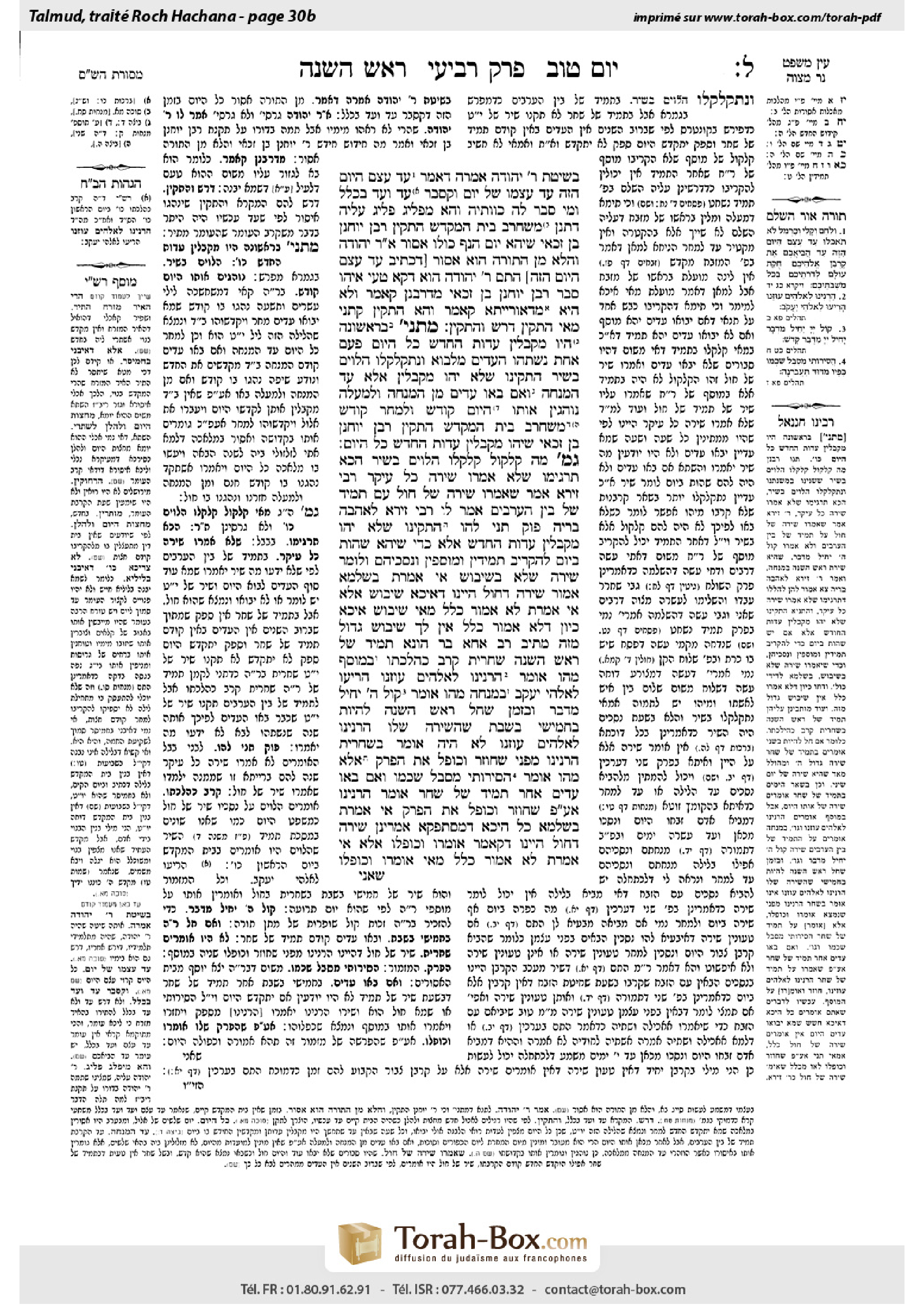
Rosh Hashanah 30b: Talmud study for Daf Yomi
Daf Yomi is the daily study of one Talmud folio. Explore 37 tractates with scans, Hebrew text, Sefaria English and AI-generated French translations where annotated.
Passage selection and English or AI-generated French translation are available where the scan has annotations. Daf Study is independent of Torah-Box and Sefaria.
Browse Rosh Hashanah · ראש השנה · All tractatesRosh Hashanah 30b text and translations
This page of Rosh Hashanah includes the Aramaic text, an English translation and an AI-generated French translation, alongside the scan above.
ראש השנה ל׳ ב · Aramaic and Hebrew text
בְּשִׁיטַת רַבִּי יְהוּדָה אַמְרַהּ, דְּאָמַר: ״עַד עֶצֶם הַיּוֹם הַזֶּה״, עַד עַצְמוֹ שֶׁל יוֹם. וְקָסָבַר: עַד, וְעַד בַּכְּלָל.
וּמִי סָבַר לַהּ כְּווֹתֵיהּ? וְהָא מְפַלֵּיג פְּלִיג עֲלֵיהּ, דִּתְנַן: מִשֶּׁחָרַב בֵּית הַמִּקְדָּשׁ, הִתְקִין רַבָּן יוֹחָנָן בֶּן זַכַּאי שֶׁיְּהֵא יוֹם הֶנֶף כּוּלּוֹ אָסוּר. אָמַר רַבִּי יְהוּדָה: וַהֲלֹא מִן הַתּוֹרָה הוּא אָסוּר, דִּכְתִיב: ״עַד עֶצֶם הַיּוֹם הַזֶּה״!
הָתָם — רַבִּי יְהוּדָה הוּא דְּקָא טָעֵי. אִיהוּ סָבַר רַבָּן יוֹחָנָן בֶּן זַכַּאי מִדְּרַבָּנַן קָאָמַר, וְלָא הִיא, מִדְּאוֹרָיְיתָא קָאָמַר.
וְהָא הִתְקִין קָתָנֵי! מַאי הִתְקִין — דָּרַשׁ וְהִתְקִין.
מַתְנִי׳ בָּרִאשׁוֹנָה הָיוּ מְקַבְּלִין עֵדוּת הַחֹדֶשׁ כׇּל הַיּוֹם.
פַּעַם אַחַת נִשְׁתַּהוּ הָעֵדִים מִלָּבוֹא, וְנִתְקַלְקְלוּ הַלְוִיִּם בַּשִּׁיר. הִתְקִינוּ שֶׁלֹּא יְהוּ מְקַבְּלִין אֶלָּא עַד הַמִּנְחָה.
וְאִם בָּאוּ עֵדִים מִן הַמִּנְחָה וּלְמַעְלָה — נוֹהֲגִין אוֹתוֹ הַיּוֹם קוֹדֶשׁ, וּלְמָחָר קוֹדֶשׁ.
מִשֶּׁחָרַב בֵּית הַמִּקְדָּשׁ, הִתְקִין רַבָּן יוֹחָנָן בֶּן זַכַּאי שֶׁיְּהוּ מְקַבְּלִין עֵדוּת הַחֹדֶשׁ כׇּל הַיּוֹם.
גְּמָ׳ מָה קִלְקוּל קִלְקְלוּ הַלְוִיִּם בַּשִּׁיר? הָכָא תַּרְגִּימוּ: שֶׁלֹּא אָמְרוּ שִׁירָה כׇּל עִיקָּר. רַבִּי זֵירָא אָמַר: שֶׁאָמְרוּ שִׁירָה שֶׁל חוֹל עִם תָּמִיד שֶׁל בֵּין הָעַרְבַּיִם.
אָמַר לוֹ רַבִּי זֵירָא לְאַהֲבָה בְּרֵיהּ, פּוֹק תְּנִי לְהוּ: הִתְקִינוּ שֶׁלֹּא יְהוּ מְקַבְּלִין עֵדוּת הַחֹדֶשׁ אֶלָּא כְּדֵי שֶׁיְּהֵא שְׁהוּת בַּיּוֹם לְהַקְרִיב תְּמִידִין וּמוּסָפִין וְנִסְכֵּיהֶם, וְלוֹמַר שִׁירָה שֶׁלֹּא בְּשִׁיבּוּשׁ. אִי אָמְרַתְּ בִּשְׁלָמָא אֲמוּר שִׁירָה דְחוֹל — הַיְינוּ דְּאִיכָּא שִׁיבּוּשׁ. אֶלָּא אִי אָמְרַתְּ לָא אֲמוּר כְּלָל — מַאי שִׁיבּוּשׁ אִיכָּא!
כֵּיוָן דְּלָא אֲמוּר כְּלָל — אֵין לְךָ שִׁיבּוּשׁ גָּדוֹל מִזֶּה.
מֵתִיב רַב אַחָא בַּר הוּנָא: תָּמִיד שֶׁל רֹאשׁ הַשָּׁנָה שַׁחֲרִית קָרֵב כְּהִלְכָתוֹ, בְּמוּסָף מַהוּ אוֹמֵר — ״הַרְנִינוּ לֵאלֹהִים עוּזֵּנוּ הָרִיעוּ לֵאלֹהֵי יַעֲקֹב״, בְּמִנְחָה מַהוּ אוֹמֵר — ״קוֹל ה׳ יָחִיל מִדְבָּר״.
וּבִזְמַן שֶׁחָל רֹאשׁ הַשָּׁנָה לִהְיוֹת בַּחֲמִישִׁי בַּשַּׁבָּת, שֶׁהַשִּׁירָה שֶׁלּוֹ ״הַרְנִינוּ לֵאלֹהִים עוּזֵּנוּ״ — לֹא הָיָה אוֹמֵר בְּשַׁחֲרִית ״הַרְנִינוּ״, מִפְּנֵי שֶׁחוֹזֵר וְכוֹפֵל אֶת הַפֶּרֶק.
אֶלָּא מַהוּ אוֹמֵר — ״הֲסִירוֹתִי מִסֵּבֶל שִׁכְמוֹ״. וְאִם בָּאוּ עֵדִים אַחַר תָּמִיד שֶׁל שַׁחַר, אוֹמֵר ״הַרְנִינוּ״ אַף עַל פִּי שֶׁחוֹזֵר וְכוֹפֵל אֶת הַפֶּרֶק.
אִי אָמְרַתְּ בִּשְׁלָמָא, כׇּל הֵיכָא דְּמִסְתַּפְּקָא אָמְרִינַן שִׁירָה דְחוֹל — הַיְינוּ דְּקָאָמַר: אוֹמְרוֹ וְכוֹפְלוֹ. אֶלָּא אִי אָמְרַתְּ לָא אֲמוּר כְּלָל — מַאי אוֹמְרוֹ וְכוֹפְלוֹ?
Rosh Hashanah 30b · English translation
stated his decree in accordance with the opinion of Rabbi Yehuda, who said: When the verse states: “And you shall eat neither bread nor parched corn, nor fresh stalks, until this selfsame [etzem] day, until you have brought the offering of your God” (Leviticus 23:14), this does not teach that it is permitted to eat the new grain on the morning of the sixteenth when the eastern horizon is illuminated. Rather, it is prohibited until the essence [atzmo] of the day. And he holds that when the verse says: Until that day, it means until and including this date. If so, by Torah law, eating the new grain is permitted only after the conclusion of the sixteenth, unless the omer offering was sacrificed, in which case it is permitted to eat the new grain immediately afterward.
The Gemara asks: And does Rabban Yoḥanan ben Zakkai hold in accordance with the opinion of Rabbi Yehuda? But he disagrees with him, as we learned in a mishna (Sukka 41a): After the Temple was destroyed, Rabban Yoḥanan ben Zakkai instituted that for the entire day of waving the omer offering, eating the grain of the new crop is prohibited. Rabbi Yehuda said: But isn’t it prohibited by Torah law, as it is written: “Until this selfsame day”? This indicates that Rabbi Yehuda disagrees with Rabban Yoḥanan ben Zakkai.
The Gemara rejects this argument. There, it was Rabbi Yehuda who erred in his understanding. He thought that Rabban Yoḥanan ben Zakkai was saying that eating new grain on the sixteenth of Nisan is prohibited by rabbinic law. But that is not so; he was actually saying that it is prohibited by Torah law.
The Gemara raises a difficulty. But it is taught in the mishna: Instituted. This term is referring to a rabbinic ordinance, not a Torah law. The Gemara explains: What is the meaning of the term instituted? It means that Rabban Yoḥanan ben Zakkai interpreted the verse, and instituted that this is how one should act from now onward. When the Temple was standing there was no need for this halakha, as it was permitted to eat the new grain after the sacrificing of the omer.
MISHNA: Initially, they would accept testimony to determine the start of the month throughout the entire thirtieth day from the beginning of the month of Elul, before Rosh HaShana, and if witnesses arrived from afar and testified that they had sighted the New Moon the previous night, they would declare that day the Festival.
Once, the witnesses tarried coming until the hour was late, and the Levites erred with regard to the song, i.e., the psalm that they were supposed to recite, as they did not know at the time whether it was a Festival or an ordinary weekday. From that point on, the Sages instituted that they would accept testimony to determine the start of the month only until minḥa time. If witnesses had not arrived by that hour, they would declare Elul a thirty-day month and calculate the dates of the Festivals accordingly.
And if witnesses came from minḥa time onward, although the calculations for the dates of the Festivals would begin from the following day, the people would nevertheless observe that day, on which the witnesses arrived, as sacred, so that in future years they would not treat the entire day as a weekday and engage in labor from the morning on the assumption that the witnesses will arrive only after minḥa time. And they would also observe the following day as sacred. On the second day, they observed Rosh HaShana in full, both by sacrificing its offerings as well as by calculating the upcoming Festivals from that date.
After the Temple was destroyed and there was no longer any reason for this ordinance, Rabban Yoḥanan ben Zakkai instituted that they would once again accept testimony to determine the start of the month the entire day.
GEMARA: The Gemara asks: What error did the Levites make with regard to the song they were supposed to recite? The Gemara answers: Here, in Babylonia, they interpreted that they did not recite any song at all, as they did not know which psalm should be sung, the one for an ordinary weekday or the special one for the Festival. Rabbi Zeira said: Their mistake was that they recited the song of an ordinary weekday with the daily afternoon offering. After the witnesses testified, it became clear that they should have recited the psalm of the Festival.
Rabbi Zeira said to his son Ahava: Go out and teach the following baraita to the Sages of Babylonia: They instituted that on Rosh HaShana the court would accept testimony to determine the start of the month only if there was enough time left in the day to sacrifice the daily offerings and the additional offerings of the Festival and their libations, and to recite the appropriate song without a mistake. Granted, if you say that they recited the song of an ordinary weekday, this is a case in which there is a mistake. However, if you say that they did not recite any psalm at all, what mistake is there? The term: Mistake, indicates the performance of an incorrect action.
The Gemara explains: Since they did not recite any psalm at all, you do not have a mistake greater than this. The failure to recite the appropriate psalm disrupts the entire sacrificial service.
Rav Aḥa bar Huna raised an objection from a baraita: With regard to the daily offering on Rosh HaShana, in the morning it is sacrificed in accordance with its regular halakhot, i.e., the Levites recite the regular psalm for that day of the week. When it comes to the additional offering of Rosh HaShana, what psalm does one recite? The psalm that includes the verse: “Sing aloud to God our strength; shout to the God of Jacob” (Psalms 81:2). With regard to the daily afternoon offering, what psalm does one recite? The psalm that includes the verse: “The voice of the Lord shakes the wilderness” (Psalms 29:8).
And when Rosh HaShana occurs on a Thursday, whose regular psalm even on an ordinary weekday is: “Sing aloud to God our strength,” and the witnesses came before the daily morning offering was sacrificed, one would not recite: “Sing aloud to God our strength; shout to the God of Jacob” with the daily morning offering, because one goes back and repeats that section at the time of the additional offering.
Rather, what does one recite? “I removed his shoulder from the burden” (Psalms 81:7), which is referring to Joseph, who was set free from prison on Rosh HaShana. In other words, the second half of Psalm 81 was recited with the morning offering, while the first half was recited with the additional offering. And if the witnesses came on a Thursday after the daily morning offering had already been sacrificed, one recites: “Sing aloud to God” at the additional offering, even though this means that one goes back and repeats that section again. This concludes the baraita.
The Gemara explains the objection from this baraita: Granted, if you say that anywhere there is a doubt with regard to what to say, one recites the song of an ordinary weekday, this is the meaning of that which the tanna states: One recites the psalm for an ordinary weekday and then repeats it. However, if you say that in a case of doubt no psalm is recited at all, what is the meaning of the clause: One recites it and repeats it?
Rosh Hashanah 30b · Traduction française (IA)
Il a énoncé son décret conformément à l’opinion de Rabbi Yehuda, qui a dit : Lorsque le verset dit : « Vous ne mangerez ni pain, ni grain grillé, ni épis frais, jusqu’à ce jour même [etzem], jusqu’à ce que vous ayez apporté l’offrande de votre Dieu » (Lévitique 23:14), cela n’enseigne pas qu’il est permis de manger le grain nouveau le matin du seize, dès que l’horizon oriental s’éclaire. Il est plutôt interdit d’en manger jusqu’à l’essence [atzmo] du jour. Il considère que, lorsque le verset dit « jusqu’à ce jour », cela signifie jusqu’à cette date, celle-ci incluse. Si tel est le cas, selon la Torah, il n’est permis de manger le grain nouveau qu’après la fin du seize, à moins que l’offrande de l’omer ait été sacrifiée ; dans ce cas, il est permis d’en manger immédiatement après.
La Guemara demande : Rabban Yoḥanan ben Zakkai est-il donc d’accord avec l’opinion de Rabbi Yehuda ? Pourtant, il est en désaccord avec lui, comme nous l’avons appris dans une Michna (Soukka 41a) : Après la destruction du Temple, Rabban Yoḥanan ben Zakkai institua que, pendant toute la journée de la présentation de l’offrande de l’omer, il serait interdit de manger le grain de la nouvelle récolte. Rabbi Yehuda dit : Mais n’est-ce pas interdit par la Torah, comme il est écrit : « Jusqu’à ce jour même » ? Cela indique que Rabbi Yehuda est en désaccord avec Rabban Yoḥanan ben Zakkai.
La Guemara rejette cet argument. Là, c’est Rabbi Yehuda qui s’est trompé dans sa compréhension. Il pensait que Rabban Yoḥanan ben Zakkai disait qu’il était interdit, par décret rabbinique, de manger du grain nouveau le seize nissan. Mais ce n’est pas le cas : il disait en réalité que cela est interdit par la Torah.
La Guemara soulève une difficulté. Pourtant, la Michna enseigne : « institua ». Ce terme désigne une ordonnance rabbinique, et non une loi de la Torah. La Guemara explique : Que signifie le terme « institua » ? Il signifie que Rabban Yoḥanan ben Zakkai interpréta le verset et institua que l’on devait agir ainsi désormais. Lorsque le Temple était debout, cette halakha n’était pas nécessaire, car il était permis de manger le grain nouveau après le sacrifice de l’omer.
Michna : Au début, on acceptait les témoignages destinés à déterminer le début du mois pendant toute la trentième journée à compter du début du mois d’Eloul, avant Roch Hachana. Si des témoins arrivaient de loin et témoignaient avoir aperçu la nouvelle lune la nuit précédente, on déclarait ce jour fête.
Une fois, les témoins tardèrent à arriver, jusqu’à une heure avancée, et les Lévites se trompèrent au sujet du chant, c’est-à-dire du psaume qu’ils devaient réciter, car ils ne savaient pas alors s’il s’agissait d’une fête ou d’un jour de semaine ordinaire. À partir de ce moment, les Sages instituèrent que l’on n’accepterait les témoignages destinés à déterminer le début du mois que jusqu’à l’heure de minḥa. Si les témoins n’étaient pas arrivés à cette heure-là, on déclarait qu’Eloul comptait trente jours et on calculait les dates des fêtes en conséquence.
Et si des témoins arrivaient à partir de l’heure de minḥa, bien que le calcul des dates des fêtes commence à partir du lendemain, le peuple observait néanmoins comme sacré le jour de l’arrivée des témoins, afin que, les années suivantes, on ne traite pas toute cette journée comme un jour de semaine ordinaire et que l’on ne se livre pas au travail dès le matin en supposant que les témoins n’arriveraient qu’après l’heure de minḥa. On observait également le lendemain comme un jour sacré. Le deuxième jour, on célébrait Roch Hachana dans son intégralité, en sacrifiant ses offrandes et en calculant à partir de cette date les fêtes à venir.
Après la destruction du Temple, lorsqu’il n’y avait plus de raison de maintenir cette ordonnance, Rabban Yoḥanan ben Zakkai institua que l’on accepterait de nouveau les témoignages destinés à déterminer le début du mois pendant toute la journée.
Guemara : La Guemara demande : En quoi les Lévites se sont-ils trompés au sujet du chant qu’ils devaient réciter ? La Guemara répond : Ici, en Babylonie, on a expliqué qu’ils n’avaient récité aucun chant, car ils ne savaient pas quel psaume chanter : celui d’un jour de semaine ordinaire ou celui, spécifique, de la fête. Rabbi Zeïra dit : Leur erreur fut d’avoir récité le chant d’un jour de semaine ordinaire avec l’offrande quotidienne de l’après-midi. Après le témoignage des témoins, il apparut qu’ils auraient dû réciter le psaume de la fête.
Rabbi Zeïra dit à son fils Ahava : Va enseigner la baraïta suivante aux Sages de Babylonie : Ils instituèrent qu’à Roch Hachana, le tribunal n’accepterait les témoignages destinés à déterminer le début du mois que s’il restait assez de temps dans la journée pour sacrifier les offrandes quotidiennes et les offrandes supplémentaires de la fête, avec leurs libations, et pour réciter le chant approprié sans erreur. Il est compréhensible que, si tu dis qu’ils récitaient le chant d’un jour de semaine ordinaire, il s’agisse là d’une erreur. Mais si tu dis qu’ils ne récitaient aucun psaume, quelle erreur y a-t-il ? Le terme « erreur » désigne l’accomplissement d’un acte incorrect.
La Guemara explique : Puisqu’ils n’ont récité aucun psaume, on ne peut imaginer erreur plus grave. L’omission du psaume approprié perturbe tout le service sacrificiel.
Rav Aḥa bar Huna soulève une objection à partir d’une baraïta : À Roch Hachana, l’offrande quotidienne est sacrifiée le matin conformément à ses halakhot habituelles, c’est-à-dire que les Lévites récitent le psaume habituel correspondant à ce jour de la semaine. Lorsqu’on en vient à l’offrande supplémentaire de Roch Hachana, quel psaume récite-t-on ? Le psaume qui contient le verset : « Chantez à Dieu, notre force ; poussez des cris de joie vers le Dieu de Jacob » (Psaumes 81:2). Pour l’offrande quotidienne de l’après-midi, quel psaume récite-t-on ? Le psaume qui contient le verset : « La voix du Seigneur ébranle le désert » (Psaumes 29:8).
Et lorsque Roch Hachana tombe un jeudi, dont le psaume habituel, même un jour de semaine ordinaire, est « Chantez à Dieu, notre force », si les témoins arrivaient avant que l’offrande quotidienne du matin ait été sacrifiée, on ne récitait pas « Chantez à Dieu, notre force ; poussez des cris de joie vers le Dieu de Jacob » avec l’offrande quotidienne du matin, car on reprend cette partie et on la répète au moment de l’offrande supplémentaire.
Que récite-t-on donc ? « J’ai retiré son épaule de sous le fardeau » (Psaumes 81:7), ce qui fait référence à Joseph, libéré de prison à Roch Hachana. Autrement dit, la seconde moitié du psaume 81 était récitée avec l’offrande du matin, tandis que la première moitié était récitée avec l’offrande supplémentaire. Et si les témoins arrivaient un jeudi après que l’offrande quotidienne du matin avait déjà été sacrifiée, on récitait « Chantez à Dieu » avec l’offrande supplémentaire, même si cela signifiait reprendre cette partie et la répéter. La baraïta s’achève ici.
La Guemara explique l’objection tirée de cette baraïta : Il est compréhensible que, si tu dis que chaque fois qu’il y a un doute sur ce qu’il faut réciter, on récite le chant d’un jour de semaine ordinaire, tel est le sens de ce que le tanna enseigne : on récite le psaume d’un jour de semaine ordinaire, puis on le répète. Mais si tu dis qu’en cas de doute on ne récite aucun psaume, quel sens a la clause : « On le récite et on le répète » ?
Traduction française générée par IA à partir de l’édition anglaise de Sefaria. Vérifie toujours un passage avec le texte source.
Text from Sefaria: William Davidson Edition - Vocalized Aramaic (CC BY NC); William Davidson Edition - English (CC BY NC).