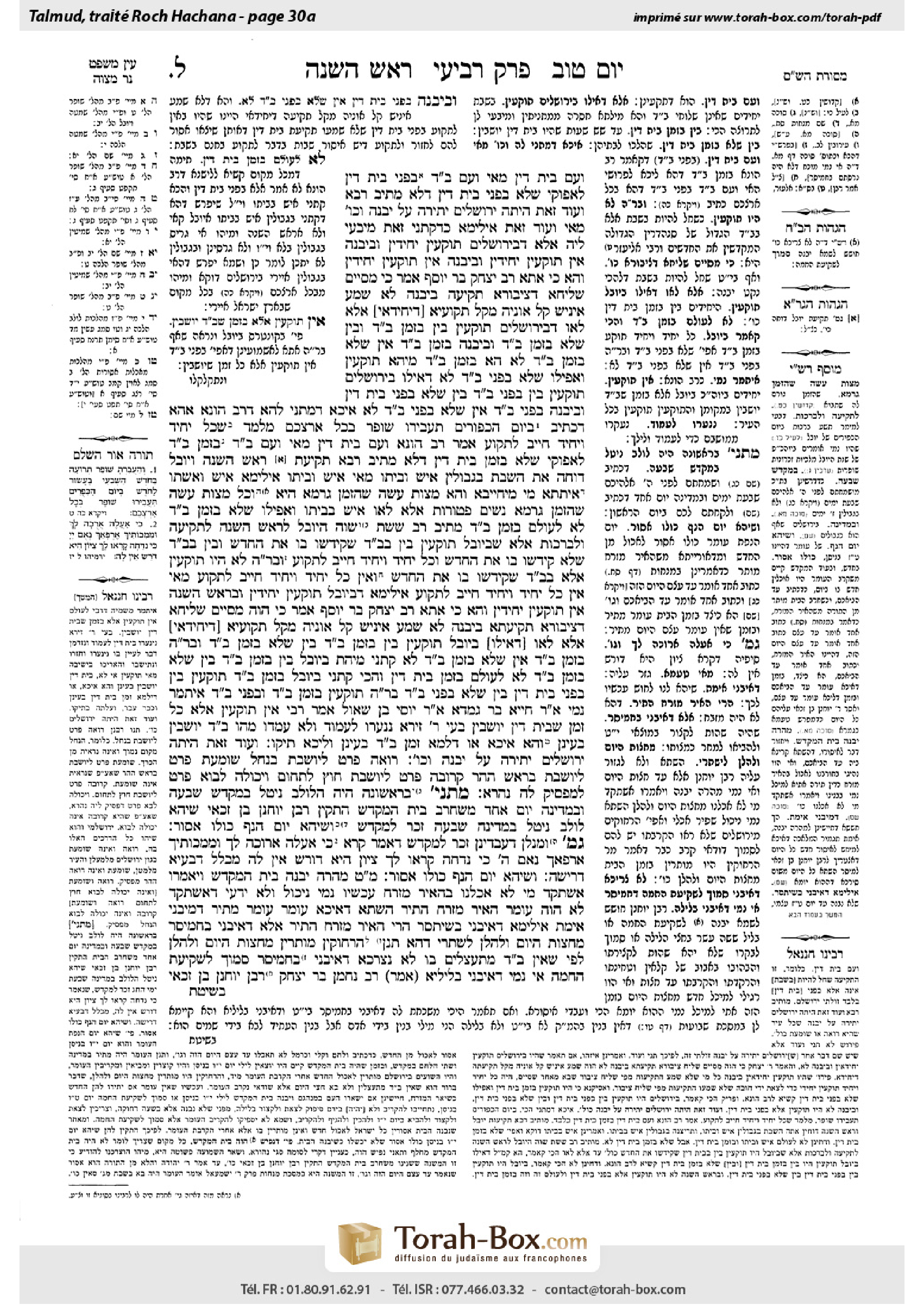
Rosh Hashanah 30a: Talmud study for Daf Yomi
Daf Yomi is the daily study of one Talmud folio. Explore 37 tractates with scans, Hebrew text, Sefaria English and AI-generated French translations where annotated.
Passage selection and English or AI-generated French translation are available where the scan has annotations. Daf Study is independent of Torah-Box and Sefaria.
Browse Rosh Hashanah · ראש השנה · All tractatesRosh Hashanah 30a text and translations
This page of Rosh Hashanah includes the Aramaic text, an English translation and an AI-generated French translation, alongside the scan above.
ראש השנה ל׳ א · Aramaic and Hebrew text
וְעִם בֵּית דִּין. מַאי וְעִם בֵּית דִּין? בִּפְנֵי בֵּית דִּין, לְאַפּוֹקֵי שֶׁלֹּא בִּפְנֵי בֵּית דִּין — דְּלָא.
מֵתִיב רָבָא: וְעוֹד זֹאת הָיְתָה יְרוּשָׁלַיִם יְתֵירָה עַל יַבְנֶה וְכוּ׳. מַאי וְעוֹד זֹאת? אִילֵּימָא כִּדְקָתָנֵי — ״זֹאת״ מִיבְּעֵי לֵיהּ. אֶלָּא: דְּבִירוּשָׁלַיִם תּוֹקְעִין יְחִידִין, וּבְיַבְנֶה אֵין תּוֹקְעִין יְחִידִין.
וּבְיַבְנֶה אֵין תּוֹקְעִין יְחִידִין? וְהָא כִּי אֲתָא רַב יִצְחָק בַּר יוֹסֵף, אָמַר: כִּי מְסַיֵּים שְׁלִיחָא דְצִיבּוּרָא תְּקִיעָה בְּיַבְנֶה — לָא שָׁמַע אִינִישׁ קָל אוּנֵּיה מִקָּל תָּקוֹעַיָּא דִּיחִידָאֵי.
אֶלָּא לָאו: דְּבִירוּשָׁלַיִם תּוֹקְעִין בֵּין בִּזְמַן בֵּית דִּין וּבֵין שֶׁלֹּא בִּזְמַן בֵּית דִּין, וּבְיַבְנֶה, בִּזְמַן בֵּית דִּין — אִין, שֶׁלֹּא בִּזְמַן בֵּית דִּין — לָא. הָא בִּזְמַן בֵּית דִּין מִיהָא תּוֹקְעִין, וַאֲפִילּוּ שֶׁלֹּא בִּפְנֵי בֵּית דִּין!
לָא: דְּאִילּוּ בִּירוּשָׁלַיִם תּוֹקְעִין בֵּין בִּפְנֵי בֵּית דִּין בֵּין שֶׁלֹּא בִּפְנֵי בֵּית דִּין, וּבְיַבְנֶה, בִּפְנֵי בֵּית דִּין — אִין, שֶׁלֹּא בִּפְנֵי בֵּית דִּין — לָא.
אִיכָּא דְּמַתְנֵי לְהָא דְּרַב הוּנָא אַהָא דִּכְתִיב ״בְּיוֹם הַכִּפּוּרִים תַּעֲבִירוּ שׁוֹפָר בְּכׇל אַרְצְכֶם״ — מְלַמֵּד שֶׁכׇּל יָחִיד וְיָחִיד חַיָּיב לִתְקוֹעַ. אָמַר רַב הוּנָא: וְעִם בֵּית דִּין. מַאי וְעִם בֵּית דִּין — בִּזְמַן בֵּית דִּין. לְאַפּוֹקֵי שֶׁלֹּא בִּזְמַן בֵּית דִּין, דְּלָא.
מֵתִיב רָבָא: תְּקִיעַת רֹאשׁ הַשָּׁנָה וְיוֹבֵל דּוֹחָה אֶת הַשַּׁבָּת בִּגְבוּלִין, אִישׁ וּבֵיתוֹ. מַאי ״אִישׁ וּבֵיתוֹ״? אִילֵּימָא אִישׁ וְאִשְׁתּוֹ — אִיתְּתָא מִי מִיחַיְּיבָא? וְהָא מִצְוַת עֲשֵׂה שֶׁהַזְּמַן גְּרָמָא הִיא, וְכׇל מִצְוַת עֲשֵׂה שֶׁהַזְּמַן גְּרָמָא — נָשִׁים פְּטוּרוֹת.
אֶלָּא לָאו: אִישׁ בְּבֵיתוֹ, וַאֲפִילּוּ שֶׁלֹּא בִּזְמַן בֵּית דִּין! לָא, לְעוֹלָם בִּזְמַן בֵּית דִּין.
מֵתִיב רַב שֵׁשֶׁת: שָׁוֶה הַיּוֹבֵל לְרֹאשׁ הַשָּׁנָה לַתְּקִיעָה וְלַבְּרָכוֹת, אֶלָּא שֶׁבַּיּוֹבֵל תּוֹקְעִין בֵּין בְּבֵית דִּין שֶׁקִּידְּשׁוּ בּוֹ אֶת הַחֹדֶשׁ, וּבֵין בְּבֵית דִּין שֶׁלֹּא קִידְּשׁוּ בּוֹ אֶת הַחֹדֶשׁ, וְכׇל יָחִיד וְיָחִיד חַיָּיב לִתְקוֹעַ. בְּרֹאשׁ הַשָּׁנָה לֹא הָיוּ תּוֹקְעִין אֶלָּא בְּבֵית דִּין שֶׁקִּידְּשׁוּ בּוֹ אֶת הַחֹדֶשׁ, וְאֵין כׇּל יָחִיד וְיָחִיד חַיָּיב לִתְקוֹעַ.
מַאי אֵין כׇּל יָחִיד וְיָחִיד חַיָּיב לִתְקוֹעַ? אִילֵּימָא דְּבַיּוֹבֵל תּוֹקְעִין יְחִידִין וּבְרֹאשׁ הַשָּׁנָה אֵין תּוֹקְעִין יְחִידִין — וְהָא כִּי אֲתָא רַב יִצְחָק בַּר יוֹסֵף, אָמַר: כִּי הֲוָה מְסַיֵּים שְׁלִיחָא דְצִיבּוּרָא תְּקִיעָתָא בְּיַבְנֶה — לָא שָׁמַע אִינִישׁ קָל אוּנֵּיה מִקָּל תָּקוֹעַיָּא דִּיחִידָאֵי.
אֶלָּא לָאו: דְּאִילּוּ בַּיּוֹבֵל תּוֹקְעִין בֵּין בִּזְמַן בֵּית דִּין בֵּין שֶׁלֹּא בִּזְמַן בֵּית דִּין, וּבְרֹאשׁ הַשָּׁנָה, בִּזְמַן בֵּית דִּין — אֵין, שֶׁלֹּא בִּזְמַן בֵּית דִּין — לָא. קָתָנֵי מִיהַת: בַּיּוֹבֵל בֵּין בִּזְמַן בֵּית דִּין, בֵּין שֶׁלֹּא בִּזְמַן בֵּית דִּין!
לָא, לְעוֹלָם בִּזְמַן בֵּית דִּין, וְהָכִי קָתָנֵי: בַּיּוֹבֵל, בִּזְמַן בֵּית דִּין — תּוֹקְעִין בֵּין בִּפְנֵי בֵּית דִּין, בֵּין שֶׁלֹּא בִּפְנֵי בֵּית דִּין. בְּרֹאשׁ הַשָּׁנָה, תּוֹקְעִין בִּזְמַן בֵּית דִּין, וּבִפְנֵי בֵּית דִּין. אִיתְּמַר נָמֵי: אָמַר רַבִּי חִיָּיא בַּר גַּמָּדָא אָמַר רַבִּי יוֹסֵי בֶּן שָׁאוּל אָמַר רַבִּי: אֵין תּוֹקְעִין אֶלָּא כׇּל זְמַן שֶׁבֵּית דִּין יוֹשְׁבִין.
בָּעֵי רַבִּי זֵירָא: נִנְעֲרוּ לַעֲמוֹד וְלֹא עָמְדוּ, מַהוּ? בֵּית דִּין יוֹשְׁבִין בָּעֵינַן — וְהָא אִיכָּא, אוֹ דִלְמָא: זְמַן בֵּית דִּין בָּעֵינַן — וְלֵיכָּא? תֵּיקוּ.
וְעוֹד זֹאת הָיְתָה יְרוּשָׁלַיִם יְתֵירָה עַל יַבְנֶה וְכוּ׳. רוֹאָה — פְּרָט לְיוֹשֶׁבֶת בַּנַּחַל.
שׁוֹמַעַת — פְּרָט לְיוֹשֶׁבֶת בְּרֹאשׁ הָהָר. קְרוֹבָה — פְּרָט לְיוֹשֶׁבֶת חוּץ לַתְּחוּם. וִיכוֹלָה לָבוֹא — פְּרָט לְמַפְסֵיק לַהּ נַהֲרָא.
מַתְנִי׳ בָּרִאשׁוֹנָה הָיָה הַלּוּלָב נִיטָּל בַּמִּקְדָּשׁ שִׁבְעָה, וּבַמְּדִינָה יוֹם אֶחָד. מִשֶּׁחָרַב בֵּית הַמִּקְדָּשׁ, הִתְקִין רַבָּן יוֹחָנָן בֶּן זַכַּאי שֶׁיְּהֵא לוּלָב נִיטָּל בַּמְּדִינָה שִׁבְעָה, זֵכֶר לַמִּקְדָּשׁ.
וְשֶׁיְּהֵא יוֹם הֶנֶף כּוּלּוֹ אָסוּר.
גְּמָ׳ וּמְנָלַן דְּעָבְדִינַן זֵכֶר לַמִּקְדָּשׁ? דְּאָמַר קְרָא: ״כִּי אַעֲלֶה אֲרוּכָה לָךְ וּמִמַּכּוֹתַיִךְ אֶרְפָּאֵךְ נְאֻם ה׳ כִּי נִדָּחָה קָרְאוּ לָךְ צִיּוֹן הִיא דּוֹרֵשׁ אֵין לָהּ״, מִכְּלַל דְּבָעֲיָא דְּרִישָׁה.
וְשֶׁיְּהֵא יוֹם הֶנֶף כּוּלּוֹ אָסוּר. מַאי טַעְמָא — מְהֵרָה יִבָּנֶה בֵּית הַמִּקְדָּשׁ, וְיֹאמְרוּ: אֶשְׁתָּקַד מִי לֹא אָכַלְנוּ בְּהֵאִיר מִזְרָח — עַכְשָׁיו נָמֵי נֵיכוֹל.
וְלָא יָדְעִי דְּאֶשְׁתָּקַד לָא הֲוָה עוֹמֶר, הֵאִיר מִזְרָח — הִתִּיר. הַשְׁתָּא דְּאִיכָּא עוֹמֶר — עוֹמֶר מַתִּיר.
דְּמִיבְּנֵי אֵימַת? אִילֵּימָא דְּאִיבְּנִי בְּשִׁיתְּסַר, הֲרֵי הֵאִיר מִזְרָח — הִתִּיר.
אֶלָּא דְּאִיבְּנִי בַּחֲמֵיסַר. מֵחֲצוֹת הַיּוֹם וּלְהַלָּן לִשְׁתְּרֵי, דְּהָא תְּנַן: הָרְחוֹקִין — מוּתָּרִין מֵחֲצוֹת הַיּוֹם וּלְהַלָּן, לְפִי שֶׁאֵין בֵּית דִּין מִתְעַצְּלִים בּוֹ!
לֹא נִצְרְכָא, דְּאִיבְּנִי בַּחֲמֵיסַר סָמוּךְ לִשְׁקִיעַת הַחַמָּה. אִי נָמֵי, דְּאִיבְּנִי בְּלֵילְיָא.
אָמַר רַב נַחְמָן בַּר יִצְחָק: רַבָּן יוֹחָנָן בֶּן זַכַּאי
Rosh Hashanah 30a · English translation
And they would sound the shofar on Shabbat with the court. Rav Huna’s brief statement is obscure, and therefore the Gemara asks: What is the meaning of the phrase: With the court? It means: In the presence of the court, i.e., in the place where the court convenes. This comes to exclude any place that is not in the presence of the court, as the shofar is not sounded there.
§ Rava raised an objection from the mishna: And Jerusalem had this additional superiority over Yavne. What is the meaning of the phrase: And this additional? If we say that it is referring only to that which it teaches in the mishna, it should have simply said: This, without mentioning that it is an additional superiority. Rather, it indicates that in Jerusalem even private individuals sound the shofar on Shabbat, whereas in Yavne individuals do not sound it, but only agents of the court.
And this too is difficult: Don’t individuals sound the shofar in Yavne? But when Rav Yitzḥak bar Yosef came from Eretz Yisrael to Babylonia, he said: When the prayer leader completed the sounding of the shofar in Yavne, nobody could hear the sound of his own voice in his ears due to the noise of the sounding of individuals. After the leader of the congregation finished sounding on behalf of the entire community, many individuals would take out their shofars and blast them, which created a loud noise. This indicates that individuals would sound the shofar on Shabbat even in Yavne.
Rather, is it not the case that in Jerusalem they sound the shofar both when the court was in session, i.e., until midday, and when the court was not in session. And by contrast, in Yavne, when the court was in session, yes, they would sound the shofar, whereas when the court was not in session, no, they would not sound it. If so, this indicates that when the court was in session they would in any case sound the shofar in Yavne, even though this was not in the presence of the court. This contradicts Rav Huna’s opinion that in Yavne they would sound the shofar only in the presence of the court.
The Gemara rejects this argument. No, the term additional can be explained to mean that whereas in Jerusalem they would sound the shofar on Shabbat both in the presence of the court and not in the presence of the court, with regard to Yavne, in the presence of the court, yes, they would indeed sound it, but if it was not in the presence of the court, no, they would not sound the shofar.
§ Some teach this statement of Rav Huna not with regard to this mishna, but rather with regard to this baraita that deals with the Jubilee Year. As it is written: “On Yom Kippur you shall proclaim with the shofar throughout all your land” (Leviticus 25:9). This teaches that each and every individual is obligated to sound the shofar. In this connection Rav Huna said: And they sound it with the court. The Gemara asks: What is the meaning of the phrase: With the court? The Gemara explains: When the court is in session. This serves to exclude a case when the court is not in session, that the shofar is not sounded.
Rava raised an objection from a baraita: The sounding of the shofar on Rosh HaShana and on Yom Kippur of the Jubilee Year overrides the prohibitions of Shabbat even in the outlying areas outside the Temple, every man and his house. The Gemara asks: What is the meaning of the phrase: Every man and his house? If we say that it means, as usual: Every man and his wife, is a woman obligated to sound the shofar? Isn’t sounding the shofar a positive, time-bound mitzva, i.e., one that can be performed only at a certain time of the day, or during the day rather than during the night, or only on certain days of the year? And the principle is that with regard to any positive, time-bound mitzva, women are exempt.
Rather, is it not the case that this phrase means: Every man in his house, and even at a time when the court is not in session? This presents a difficulty for the opinion of Rav Huna. The Gemara rejects this interpretation: No; actually it means that every man may sound the shofar in his house, but only at a time when the court is in session.
Rav Sheshet raised an objection from another baraita: Yom Kippur of the Jubilee Year is the same as Rosh HaShana with regard to both the shofar sounding and the additional blessings recited in the Amida prayer. However, the difference is that on Yom Kippur of the Jubilee Year they sound the shofar both in the court where they sanctified the month and in a court where they did not sanctify the month, and each and every individual is obligated to sound the shofar. Conversely, on Rosh HaShana they sound the shofar only in the court where they sanctified the month, and each and every individual is not obligated to sound it.
The Gemara asks: What is the meaning of the clause: Each and every individual is not obligated to sound it? If we say that on Yom Kippur of the Jubilee Year individuals sound the shofar, whereas on Rosh HaShana individuals do not sound it at all, this is difficult: But when Rav Yitzḥak bar Yosef came from Eretz Yisrael to Babylonia, he said: When the prayer leader completed the sounding of the shofar in Yavne, nobody could hear the sound of his own voice in his ears due to the noise of the sounding of individuals. This indicates that individuals would sound the shofar even on Rosh HaShana.
Rather, is it not the case that whereas on Yom Kippur of the Jubilee Year they sound the shofar both when the court is in session and when the court is not in session, on Rosh HaShana, when the court was in session, yes, they would indeed sound it, but at a time when the court was not in session, no, they would not sound the shofar. In any event, the baraita is teaching that on Yom Kippur of the Jubilee Year they would sound the shofar both when the court was in session and when the court was not in session. This presents a difficulty for the opinion of Rav Huna.
The Gemara rejects this argument. No; actually they sound the shofar only when the court was in session, and this is what the baraita is teaching: On Yom Kippur of the Jubilee Year, when the court was in session they sound the shofar both in the presence of the court and not in the presence of the court; however, on Rosh HaShana they sound it only when the court was in session, and even then only in the presence of the court. It was also stated that Rabbi Ḥiyya bar Gamda said that Rabbi Yosei ben Shaul said that Rabbi Yehuda HaNasi said: They sound the shofar only throughout the period when the court is sitting in session, and only in its presence.
Rabbi Zeira raised a dilemma: If the members of the court stirred themselves to rise at the end of the session, but there was some delay and they did not actually rise, what is the halakha? Do we require that the court be seated, and that is the case here, as the judges are still sitting? Or perhaps we require that the shofar must be sounded when the court is in session, and that is not the case, as they have stirred to rise. No relevant sources were found in this regard, and therefore the Gemara states that the question shall stand unresolved.
§ The mishna stated: And Jerusalem had this additional superiority over Yavne. Any city that could see Jerusalem and hear the sounding of the shofar there, and was nearby, and people could come from there, they would sound the shofar there as well. The Gemara clarifies these requirements: The clause that the city had to be able to see Jerusalem comes to exclude a city that sits in a deep valley, from which one can hear but cannot see Jerusalem from afar.
When the mishna states that the city must be able to hear, this serves to exclude a city sitting on a mountaintop, from where one can see Jerusalem but cannot hear sounds from it. As for the requirement that the city must be near, this comes to exclude a place sitting beyond the Shabbat limit of Jerusalem, even if one can see and hear from that place. And with regard to the statement that one can come, this serves to exclude a city that is separated from Jerusalem by a river, which renders it impossible for people to come to the city, even if it is close by.
MISHNA: After the previous mishna mentioned Rabban Yoḥanan ben Zakkai’s ordinance that applies to the sounding of the shofar, this mishna records other ordinances instituted by the same Sage: At first, during the Temple era, the lulav was taken in the Temple all seven days of Sukkot, and in the rest of the country outside the Temple, it was taken only one day, on the first day of the Festival. After the Temple was destroyed, Rabban Yoḥanan ben Zakkai instituted that the lulav should be taken even in the rest of the country all seven days, in commemoration of the Temple.
And for similar reasons, Rabban Yoḥanan ben Zakkai instituted that for the entire day of waving the omer offering, i.e., the sixteenth of Nisan, eating the grain of the new crop is prohibited. By Torah law, when the Temple is standing the new grain may not be eaten until after the omer offering is brought on the sixteenth of Nisan, usually early in the morning. When the Temple is not standing it may be eaten from the time that the eastern horizon is illuminated at daybreak. However, Rabban Yoḥanan ben Zakkai instituted a prohibition against eating the new grain throughout the entire sixteenth of Nisan, until the seventeenth, to commemorate the Temple.
GEMARA: The Gemara asks: And from where do we derive that one performs actions in commemoration of the Temple? As the verse states: “For I will restore health to you, and I will heal you of your wounds, said the Lord; because they have called you an outcast: She is Zion, there is none who care for her” (Jeremiah 30:17). This verse teaches by inference that Jerusalem requires caring through acts of commemoration.
§ The mishna taught: Rabban Yoḥanan ben Zakkai also instituted that for the entire day of waving the omer offering, eating the grain of the new crop is prohibited. The Gemara asks: What is the reason for this ordinance? The reasoning is that soon the Temple will be rebuilt and people will say: Last year, when the Temple was in ruins, didn’t we eat from the new crop as soon as the eastern horizon was illuminated on the morning of the sixteenth of Nisan, as the new crop was permitted immediately? Now too, let us eat the new grain at that time.
And they do not know that last year, when there was no omer, the eastern horizon illuminating, i.e., the morning of the sixteenth of Nisan, served to permit the consumption of the new grain immediately. However, now that the Temple has been rebuilt and there is an omer offering, it is the omer that permits the consumption of the new grain. When the Temple is standing, the new grain is not permitted until the omer offering has been sacrificed.
The Gemara clarifies: In this scenario, when is it that the Temple was built? If we say that it was rebuilt on the sixteenth of Nisan, then the Temple was not standing in the morning and therefore the eastern horizon illuminating indeed rendered eating the new grain permitted, as it was not yet possible to bring the omer offering.
Rather, you must say that it was rebuilt on the fifteenth of Nisan or on some earlier date, in which case the new grain would not become permitted by the illumination of the eastern horizon. In that scenario, from midday onward let it be permitted to eat the new grain, as didn’t we learn in a mishna in tractate Menaḥot: The people distant from Jerusalem, who are unaware of the precise time when the omer was brought, are permitted to eat the new grain from midday onward, because the members of the court are not indolent with regard to the omer offering and would certainly have sacrificed it by midday. If so, now too, it should be permitted to eat the new grain beginning at that time. Why did Rabban Yoḥanan ben Zakkai prohibit it for the entire day?
The Gemara answers: This ordinance was necessary only in a case where the Temple was rebuilt on the fifteenth adjacent to sunset. Alternatively, in a situation where the Temple was rebuilt at night, on the evening of the sixteenth, and there was no opportunity to cut the omer that night. In either case there is insufficient time to complete all the preparations so that the offering can be sacrificed by noon the next day. If people eat the new grain at midday, they will have retroactively transgressed a prohibition. Therefore, Rabban Yoḥanan ben Zakkai instituted that the new grain should be prohibited for the entire day of the sixteenth.
Rav Naḥman bar Yitzḥak said: That is not the reason. Rather, Rabban Yoḥanan ben Zakkai
Rosh Hashanah 30a · Traduction française (IA)
Et l’on sonnait du chofar le Chabbat en présence du tribunal. La brève déclaration de Rav Houna est obscure ; la Guemara demande donc : Que signifie l’expression « en présence du tribunal » ? Elle signifie : devant le tribunal, c’est-à-dire à l’endroit où il siège. Cela exclut tout lieu qui ne se trouve pas en présence du tribunal, car on n’y sonne pas du chofar.
§ Rava soulève une objection à partir de la Michna : « Jérusalem avait cette supériorité supplémentaire sur Yavné. » Que signifie l’expression « cette supériorité supplémentaire » ? Si elle se rapportait uniquement à ce que la Michna enseigne, celle-ci aurait simplement dû dire : « cette supériorité », sans préciser qu’elle était supplémentaire. Cela indique plutôt qu’à Jérusalem, même les particuliers sonnaient du chofar le Chabbat, tandis qu’à Yavné, les particuliers ne sonnaient pas ; seuls les émissaires du tribunal le faisaient.
Mais cela aussi est difficile : les particuliers ne sonnaient-ils pas du chofar à Yavné ? En effet, lorsque Rav Yitzḥak bar Yosef arriva d’Eretz Israël en Babylonie, il dit : « Lorsque l’officiant eut terminé de sonner du chofar à Yavné, personne ne pouvait entendre sa propre voix tant le vacarme des particuliers qui sonnaient était grand. » Après que l’officiant eut sonné pour toute la communauté, de nombreux particuliers sortaient leurs chofars et en sonnaient à grand bruit. Cela indique que les particuliers sonnaient du chofar le Chabbat, même à Yavné.
Mais n’est-ce pas plutôt qu’à Jérusalem, on sonnait du chofar aussi bien lorsque le tribunal siégeait, c’est-à-dire jusqu’à midi, que lorsqu’il ne siégeait pas ? À l’inverse, à Yavné, on sonnait du chofar lorsque le tribunal siégeait, mais pas lorsqu’il ne siégeait pas. Cela indique donc que, lorsque le tribunal siégeait, on sonnait du chofar à Yavné, même si l’on ne se trouvait pas en présence du tribunal. Cela contredit l’avis de Rav Houna, selon lequel, à Yavné, on ne sonnait du chofar qu’en présence du tribunal.
La Guemara rejette cet argument. Non, le terme « supplémentaire » peut s’expliquer ainsi : à Jérusalem, on sonnait du chofar le Chabbat aussi bien en présence du tribunal qu’en son absence ; quant à Yavné, on sonnait bien du chofar en présence du tribunal, mais pas en son absence.
§ Certains rapportent cette déclaration de Rav Houna non à propos de cette Michna, mais à propos de cette baraïta qui traite de l’année jubilaire. Car il est écrit : « Le jour de Kippour, vous sonnerez du chofar dans tout votre pays » (Lévitique 25:9). Cela enseigne que chaque individu est tenu de sonner du chofar. À ce sujet, Rav Houna dit : « Et l’on sonne en présence du tribunal. » La Guemara demande : Que signifie l’expression « en présence du tribunal » ? La Guemara explique : lorsque le tribunal siège. Cela exclut le cas où le tribunal ne siège pas : on ne sonne alors pas du chofar.
Rava soulève une objection à partir d’une baraïta : « La sonnerie du chofar à Roch Hachana et à Yom Kippour de l’année jubilaire repousse les interdits du Chabbat, même dans les régions éloignées, hors du Temple : chaque homme et sa maison. » La Guemara demande : Que signifie l’expression « chaque homme et sa maison » ? Si elle signifie, comme d’habitude, « chaque homme et sa femme », une femme est-elle tenue de sonner du chofar ? La sonnerie du chofar n’est-elle pas une mitsva positive liée au temps, c’est-à-dire une mitsva qui ne peut être accomplie qu’à un moment précis de la journée, ou le jour plutôt que la nuit, ou seulement certains jours de l’année ? Or, le principe est que les femmes sont exemptées de toute mitsva positive liée au temps.
Mais n’est-ce pas plutôt que cette expression signifie : chaque homme dans sa maison, même lorsque le tribunal ne siège pas ? Cela pose une difficulté à l’avis de Rav Houna. La Guemara rejette cette interprétation : non, elle signifie en réalité que chaque homme peut sonner du chofar dans sa maison, mais seulement lorsque le tribunal siège.
Rav Sheshet soulève une objection à partir d’une autre baraïta : « Yom Kippour de l’année jubilaire est semblable à Roch Hachana tant pour la sonnerie du chofar que pour les bénédictions supplémentaires récitées dans la Amida. La différence est toutefois qu’à Yom Kippour de l’année jubilaire, on sonne du chofar aussi bien au tribunal qui a sanctifié le mois qu’à un tribunal qui ne l’a pas sanctifié, et chaque individu est tenu de sonner du chofar. En revanche, à Roch Hachana, on sonne du chofar uniquement au tribunal qui a sanctifié le mois, et chaque individu n’est pas tenu d’en sonner. »
La Guemara demande : Que signifie la clause « chaque individu n’est pas tenu d’en sonner » ? Si l’on dit qu’à Yom Kippour de l’année jubilaire, les particuliers sonnent du chofar, tandis qu’à Roch Hachana ils n’en sonnent pas du tout, cela pose une difficulté : lorsque Rav Yitzḥak bar Yosef arriva d’Eretz Israël en Babylonie, il dit : « Lorsque l’officiant eut terminé de sonner du chofar à Yavné, personne ne pouvait entendre sa propre voix tant le vacarme des particuliers qui sonnaient était grand. » Cela indique que les particuliers sonnaient du chofar même à Roch Hachana.
Mais n’est-ce pas plutôt qu’à Yom Kippour de l’année jubilaire, on sonnait du chofar aussi bien lorsque le tribunal siégeait que lorsqu’il ne siégeait pas, tandis qu’à Roch Hachana, on sonnait du chofar lorsque le tribunal siégeait, mais pas lorsqu’il ne siégeait pas ? En tout état de cause, la baraïta enseigne qu’à Yom Kippour de l’année jubilaire, on sonnait du chofar aussi bien lorsque le tribunal siégeait que lorsqu’il ne siégeait pas. Cela pose une difficulté à l’avis de Rav Houna.
La Guemara rejette cet argument. Non ; en réalité, on ne sonnait du chofar que lorsque le tribunal siégeait, et voici ce que la baraïta enseigne : à Yom Kippour de l’année jubilaire, lorsque le tribunal siégeait, on sonnait du chofar aussi bien en présence du tribunal qu’en son absence ; en revanche, à Roch Hachana, on sonnait du chofar uniquement lorsque le tribunal siégeait, et alors, uniquement en sa présence. Il a également été enseigné que Rabbi Ḥiyya bar Gamda a dit au nom de Rabbi Yosei ben Shaoul, qui a dit au nom de Rabbi Yehouda HaNassi : « On ne sonne du chofar que pendant toute la période où le tribunal siège, et uniquement en sa présence. »
Rabbi Zeira soulève une question : si les membres du tribunal se sont apprêtés à se lever à la fin de la séance, mais qu’il y a eu un retard et qu’ils ne se sont pas effectivement levés, quelle est la halakha ? Faut-il que le tribunal soit assis, ce qui est bien le cas ici puisque les juges sont encore assis ? Ou faut-il que le chofar soit sonné pendant que le tribunal siège, ce qui n’est pas le cas ici puisqu’ils se sont apprêtés à se lever ? Aucune source pertinente n’ayant été trouvée à ce sujet, la Guemara indique que la question reste sans réponse.
§ La Michna a enseigné : « Jérusalem avait cette supériorité supplémentaire sur Yavné. Toute ville d’où l’on pouvait voir Jérusalem, entendre la sonnerie du chofar qui y retentissait, et qui était proche, de sorte que l’on pouvait s’y rendre, sonnait elle aussi du chofar. » La Guemara précise ces conditions : l’exigence que la ville puisse voir Jérusalem exclut une ville située au fond d’une vallée, d’où l’on peut entendre la sonnerie, mais pas voir Jérusalem au loin.
Lorsque la Michna précise que la ville doit pouvoir entendre, cela exclut une ville située au sommet d’une montagne, d’où l’on peut voir Jérusalem, mais pas entendre les sons qui en proviennent. Quant à l’exigence que la ville soit proche, elle exclut un lieu situé au-delà de la limite de déplacement du Chabbat de Jérusalem, même si l’on peut voir Jérusalem et entendre les sons depuis ce lieu. Enfin, la condition selon laquelle on peut s’y rendre exclut une ville séparée de Jérusalem par un fleuve, qui empêche les gens de s’y rendre, même si elle est proche.
MICHNA : Après que la Michna précédente a mentionné l’institution de Rabban Yoḥanan ben Zakkaï concernant la sonnerie du chofar, cette Michna rapporte d’autres institutions du même Sage : au début, à l’époque du Temple, on prenait le loulav dans le Temple pendant les sept jours de Souccot, et dans le reste du pays, hors du Temple, on ne le prenait qu’un seul jour, le premier jour de la fête. Après la destruction du Temple, Rabban Yoḥanan ben Zakkaï institua que l’on prenne le loulav pendant les sept jours également dans le reste du pays, en souvenir du Temple.
Pour des raisons similaires, Rabban Yoḥanan ben Zakkaï institua que, pendant toute la journée de présentation de l’offrande du omer, c’est-à-dire le 16 nissan, il soit interdit de consommer le grain de la nouvelle récolte. Selon la Torah, lorsque le Temple est debout, il est interdit de consommer le nouveau grain jusqu’à ce que l’offrande du omer soit apportée le 16 nissan, généralement tôt le matin. Lorsque le Temple n’est pas debout, on peut en consommer dès que l’horizon oriental s’éclaire à l’aube. Rabban Yoḥanan ben Zakkaï institua toutefois l’interdiction de consommer le nouveau grain pendant toute la journée du 16 nissan, jusqu’au 17, en souvenir du Temple.
GUEMARA : La Guemara demande : D’où déduit-on que l’on accomplit des actes en souvenir du Temple ? Comme le dit le verset : « Car je te rendrai la santé et je guérirai tes blessures, dit le Seigneur, parce qu’ils t’ont appelée “la repoussée” : “C’est Sion, personne ne se soucie d’elle” » (Jérémie 30:17). Ce verset enseigne par déduction que Jérusalem doit faire l’objet d’une sollicitude exprimée par des actes commémoratifs.
§ La Michna a enseigné : « Rabban Yoḥanan ben Zakkaï institua également que, pendant toute la journée de présentation de l’offrande du omer, il soit interdit de consommer le grain de la nouvelle récolte. » La Guemara demande : Quelle est la raison de cette institution ? La raison est que le Temple sera bientôt reconstruit et que les gens diront : « L’année dernière, alors que le Temple était en ruines, n’avons-nous pas consommé le nouveau grain dès que l’horizon oriental s’est éclairé le matin du 16 nissan, puisque le nouveau grain était alors immédiatement permis ? Cette année aussi, consommons donc le nouveau grain à ce moment-là. »
Mais ils ne savent pas que l’année dernière, en l’absence d’offrande du omer, l’éclaircissement de l’horizon oriental, c’est-à-dire le matin du 16 nissan, permettait de consommer immédiatement le nouveau grain. En revanche, à présent que le Temple a été reconstruit et qu’il y a une offrande du omer, c’est celle-ci qui permet de consommer le nouveau grain. Lorsque le Temple est debout, le nouveau grain n’est permis qu’après que l’offrande du omer a été sacrifiée.
La Guemara précise : dans ce scénario, quand le Temple a-t-il été reconstruit ? Si l’on dit qu’il l’a été le 16 nissan, alors il n’était pas encore debout le matin ; l’éclaircissement de l’horizon oriental aurait donc effectivement rendu la consommation du nouveau grain permise, puisqu’il n’était pas encore possible d’apporter l’offrande du omer.
Il faut plutôt dire qu’il a été reconstruit le 15 nissan ou à une date antérieure ; dans ce cas, le nouveau grain ne serait pas devenu permis au moment où l’horizon oriental s’éclaire. Dans ce scénario, on pourrait le consommer à partir de midi : n’avons-nous pas appris dans une Michna du traité Menaḥot que les habitants éloignés de Jérusalem, qui ignorent l’heure précise à laquelle l’offrande du omer a été apportée, sont autorisés à consommer le nouveau grain à partir de midi, car les membres du tribunal ne sont pas négligents au sujet de l’offrande du omer et l’auraient certainement sacrifiée avant midi ? Si tel est le cas, maintenant aussi, on devrait être autorisé à consommer le nouveau grain à partir de ce moment-là. Pourquoi Rabban Yoḥanan ben Zakkaï en a-t-il interdit la consommation pendant toute la journée ?
La Guemara répond : cette institution n’était nécessaire que dans le cas où le Temple aurait été reconstruit le 15 nissan, à l’approche du coucher du soleil. Autre possibilité : le Temple aurait été reconstruit pendant la nuit, au début du 16, et il n’y aurait pas eu la possibilité de couper le omer cette nuit-là. Dans les deux cas, il n’y aurait pas assez de temps pour achever toutes les préparations afin que l’offrande puisse être sacrifiée avant midi le lendemain. Si les gens consommaient le nouveau grain à midi, ils auraient transgressé une interdiction rétroactivement. Rabban Yoḥanan ben Zakkaï institua donc l’interdiction de consommer le nouveau grain pendant toute la journée du 16.
Rav Naḥman bar Yitzḥak dit : telle n’est pas la raison. Rabban Yoḥanan ben Zakkaï
Traduction française générée par IA à partir de l’édition anglaise de Sefaria. Vérifie toujours un passage avec le texte source.
Text from Sefaria: William Davidson Edition - Vocalized Aramaic (CC BY NC); William Davidson Edition - English (CC BY NC).