Rosh Hashanah 29b: Talmud study for Daf Yomi
Daf Yomi is the daily study of one Talmud folio. Explore 37 tractates with scans, Hebrew text, Sefaria English and AI-generated French translations where annotated.
Passage selection and English or AI-generated French translation are available where the scan has annotations. Daf Study is independent of Torah-Box and Sefaria.
Browse Rosh Hashanah · ראש השנה · All tractatesRosh Hashanah 29b text and translations
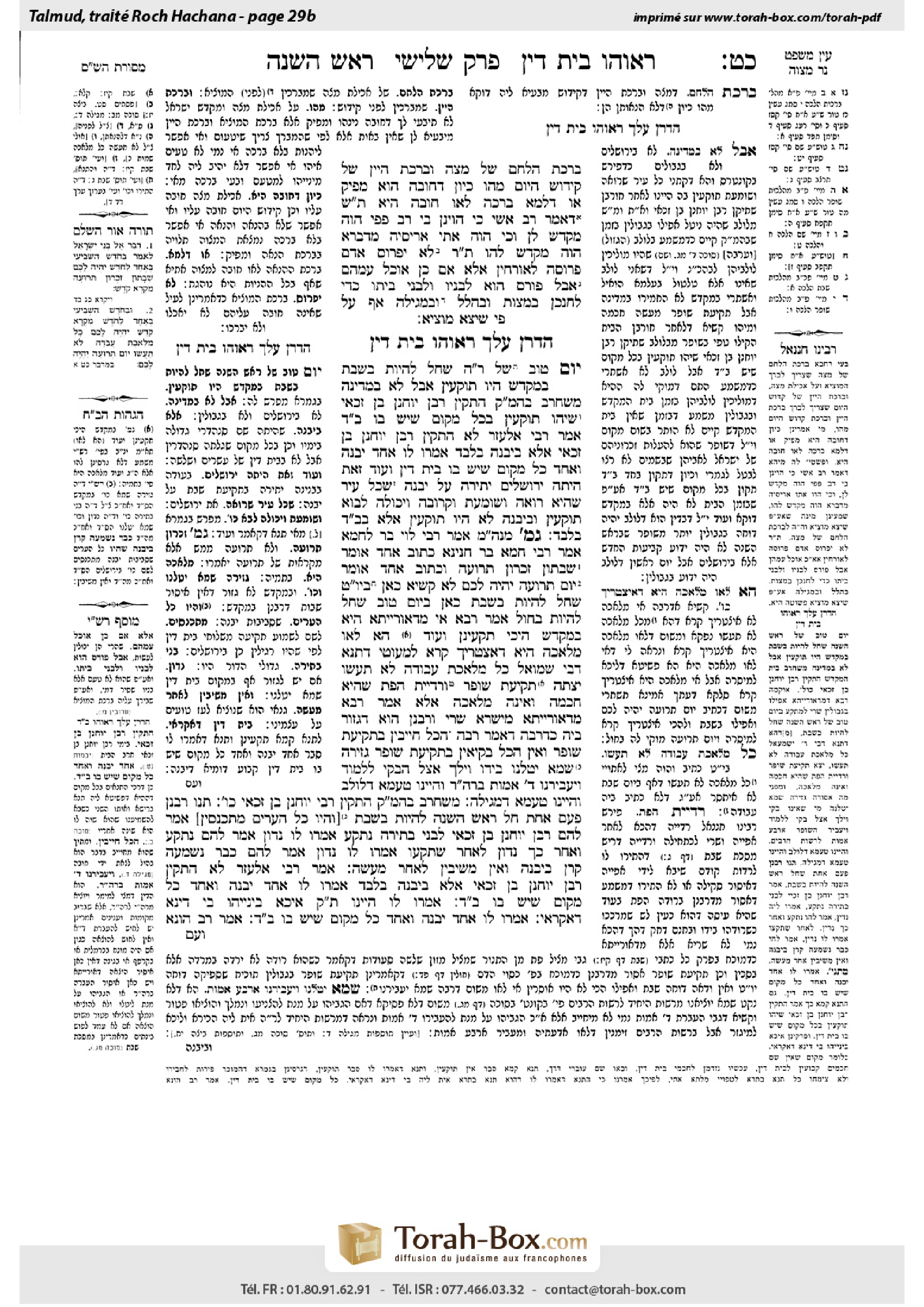
This page of Rosh Hashanah includes the Aramaic text, an English translation and an AI-generated French translation, alongside the scan above.
ראש השנה כ״ט ב · Aramaic and Hebrew text
בִּרְכַּת הַלֶּחֶם שֶׁל מַצָּה, וּבִרְכַּת הַיַּיִן שֶׁל קִידּוּשׁ הַיּוֹם, מַהוּ? כֵּיוָן דְּחוֹבָה הוּא — מַפֵּיק, אוֹ דִלְמָא: בְּרָכָה לָאו חוֹבָה הִיא.
תָּא שְׁמַע, דְּאָמַר רַב אָשֵׁי: כִּי הֲוֵינַן בֵּי רַב פַּפֵּי, הֲוָה מְקַדֵּשׁ לַן. וְכִי הֲוָה אָתֵי אֲרִיסֵיהּ מִדַּבְרָא, הֲוָה מְקַדֵּשׁ לְהוּ.
תָּנוּ רַבָּנַן: לָא יִפְרוֹס אָדָם פְּרוּסָה לָאוֹרְחִין אֶלָּא אִם כֵּן אוֹכֵל עִמָּהֶם, אֲבָל פּוֹרֵס הוּא לְבָנָיו וְלִבְנֵי בֵיתוֹ כְּדֵי לְחַנְּכָן בְּמִצְוֹת. וּבְהַלֵּל וּבַמְּגִילָּה, אַף עַל פִּי שֶׁיָּצָא — מוֹצִיא.
הֲדַרַן עֲלָךְ רָאוּהוּ בֵּית דִּין
יוֹם טוֹב שֶׁל רֹאשׁ הַשָּׁנָה שֶׁחָל לִהְיוֹת בְּשַׁבָּת — בַּמִּקְדָּשׁ הָיוּ תּוֹקְעִין, אֲבָל לֹא בַּמְּדִינָה. מִשֶּׁחָרַב בֵּית הַמִּקְדָּשׁ, הִתְקִין רַבָּן יוֹחָנָן בֶּן זַכַּאי שֶׁיְּהוּ תּוֹקְעִין בְּכׇל מָקוֹם שֶׁיֵּשׁ בּוֹ בֵּית דִּין. אָמַר רַבִּי אֶלְעָזָר: לֹא הִתְקִין רַבָּן יוֹחָנָן בֶּן זַכַּאי אֶלָּא בְּיַבְנֶה בִּלְבַד. אָמְרוּ לוֹ: אֶחָד יַבְנֶה, וְאֶחָד כׇּל מָקוֹם שֶׁיֵּשׁ בּוֹ בֵּית דִּין.
וְעוֹד זֹאת הָיְתָה יְרוּשָׁלַיִם יְתֵירָה עַל יַבְנֶה, שֶׁכׇּל עִיר שֶׁהִיא רוֹאָה, וְשׁוֹמַעַת, וּקְרוֹבָה, וִיכוֹלָה לָבוֹא — תּוֹקְעִין. וּבְיַבְנֶה לֹא הָיוּ תּוֹקְעִין אֶלָּא בְּבֵית דִּין בִּלְבַד.
גְּמָ׳ מְנָא הָנֵי מִילֵּי? אָמַר רַבִּי לֵוִי בַּר לַחְמָא אָמַר רַבִּי חָמָא בַּר חֲנִינָא: כָּתוּב אֶחָד אוֹמֵר: ״שַׁבָּתוֹן זִכְרוֹן תְּרוּעָה״. וְכָתוּב אֶחָד אוֹמֵר: ״יוֹם תְּרוּעָה יִהְיֶה לָכֶם״! לָא קַשְׁיָא: כָּאן — בְּיוֹם טוֹב שֶׁחָל לִהְיוֹת בַּשַּׁבָּת, כָּאן — בְּיוֹם טוֹב שֶׁחָל לִהְיוֹת בַּחוֹל.
אָמַר רָבָא: אִי מִדְּאוֹרָיְיתָא הִיא, בַּמִּקְדָּשׁ הֵיכִי תָּקְעִינַן? וְעוֹד: הָא לָאו מְלָאכָה הִיא, דְּאִצְטְרִיךְ קְרָא לְמַעוֹטֵי.
דְּתָנָא דְּבֵי שְׁמוּאֵל: ״כׇּל מְלֶאכֶת עֲבוֹדָה לֹא תַּעֲשׂוּ״, יָצְתָה תְּקִיעַת שׁוֹפָר וּרְדִיַּית הַפַּת, שֶׁהִיא חָכְמָה וְאֵינָהּ מְלָאכָה.
אֶלָּא אָמַר רָבָא: מִדְּאוֹרָיְיתָא מִישְׁרֵא שְׁרֵי, וְרַבָּנַן הוּא דִּגְזוּר בֵּיהּ כִּדְרַבָּה. דְּאָמַר רַבָּה: הַכֹּל חַיָּיבִין בִּתְקִיעַת שׁוֹפָר, וְאֵין הַכֹּל בְּקִיאִין בִּתְקִיעַת שׁוֹפָר, גְּזֵירָה שֶׁמָּא יִטְּלֶנּוּ בְּיָדוֹ וְיֵלֵךְ אֵצֶל הַבָּקִי לִלְמוֹד, וְיַעֲבִירֶנּוּ אַרְבַּע אַמּוֹת בִּרְשׁוּת הָרַבִּים.
וְהַיְינוּ טַעְמָא דְלוּלָב, וְהַיְינוּ טַעְמָא דִמְגִילָּה.
מִשֶּׁחָרַב בֵּית הַמִּקְדָּשׁ הִתְקִין רַבָּן יוֹחָנָן בֶּן זַכַּאי וְכוּ׳. תָּנוּ רַבָּנַן: פַּעַם אַחַת חָל רֹאשׁ הַשָּׁנָה לִהְיוֹת בְּשַׁבָּת, וְהָיוּ כׇל הֶעָרִים מִתְכַּנְּסִין. אָמַר לָהֶם רַבָּן יוֹחָנָן בֶּן זַכַּאי לִבְנֵי בְּתִירָה: נִתְקַע! אָמְרוּ לוֹ: נָדוּן.
אָמַר לָהֶם: נִתְקַע, וְאַחַר כָּךְ נָדוּן. לְאַחַר שֶׁתָּקְעוּ, אָמְרוּ לוֹ: נָדוּן! אָמַר לָהֶם: כְּבָר נִשְׁמְעָה קֶרֶן בְּיַבְנֶה, וְאֵין מְשִׁיבִין לְאַחַר מַעֲשֶׂה.
אָמַר רַבִּי אֶלְעָזָר: לֹא הִתְקִין רַבָּן יוֹחָנָן בֶּן זַכַּאי אֶלָּא בְּיַבְנֶה בִּלְבַד. אָמְרוּ לוֹ: אֶחָד יַבְנֶה וְאֶחָד כׇּל מָקוֹם שֶׁיֵּשׁ בּוֹ בֵּית דִּין. אָמְרוּ לוֹ: הַיְינוּ תַּנָּא קַמָּא!
אִיכָּא בֵּינַיְיהוּ בֵּי דִינָא דְּאַקְרַאי.
אָמְרוּ לוֹ: אֶחָד יַבְנֶה וְאֶחָד כׇּל מָקוֹם שֶׁיֵּשׁ בּוֹ בֵּית דִּין. אָמַר רַב הוּנָא:
Rosh Hashanah 29b · English translation
With regard to the blessing over bread that is recited before eating matza at the Passover seder and the blessing over wine recited as part of the sanctification of the day of Shabbat or a Festival, what is the halakha? The Gemara analyzes the question: Do we say that since there is an obligation to recite these blessings due to the mitzva involved, therefore one can discharge the obligation for others, even if he himself has already fulfilled his obligation? Or perhaps we say that the blessing itself is not an obligation, but rather the obligation lies in the eating and drinking, and the blessing is recited over one’s physical enjoyment; therefore, if he already fulfilled his own obligation, he cannot recite the blessing for others, as he derives no pleasure at this time.
The Gemara answers: Come and hear an answer to this question from what Rav Ashi said: When we were studying in the school of Rav Pappi, he would recite kiddush for us, and when his tenants would arrive from the field he would recite kiddush once again on their behalf. Therefore, it is clear that one may recite kiddush on behalf of others, including the blessing that is recited over the wine, even if he himself has already fulfilled his own obligation.
The Sages taught in a baraita: One should not break bread and recite a blessing for guests unless he is eating with them, so that he is obligated to recite a blessing for himself. But he may break bread for his children and for the other members of his household and recite the blessing, in order to educate them to perform the mitzvot, so that they know how to recite a blessing. And with regard to hallel and the Scroll of Esther, the halakha is that even if he already fulfilled his obligation, he can still discharge the obligation of others.
MISHNA: With regard to the Festival day of Rosh HaShana that occurs on Shabbat, in the Temple they would sound the shofar as usual. However, they would not sound it in the rest of the country outside the Temple. After the Temple was destroyed, Rabban Yoḥanan ben Zakkai instituted that the people should sound the shofar on Shabbat in every place where there is a court of twenty-three judges. Rabbi Elazar said: Rabban Yoḥanan ben Zakkai instituted this practice only in Yavne, where the Great Sanhedrin of seventy-one judges resided in his time, but nowhere else. They said to him: He instituted the practice both in Yavne and in any place where there is a court.
The mishna adds: And Jerusalem in earlier times had this additional superiority over Yavne after Rabban Yoḥanan ben Zakkai instituted this practice, for in any city whose residents could see Jerusalem and hear the sounding of the shofar from there, and which was near to Jerusalem and people could come to Jerusalem from there, they would sound the shofar there as well, as it was considered part of Jerusalem. But in Yavne they would sound the shofar only in the court itself, not in the surrounding cities.
GEMARA: The Gemara asks: From where are these matters; from where is it derived that the shofar is not sounded on Shabbat? Rabbi Levi bar Laḥma said that Rabbi Ḥama bar Ḥanina said: One verse says, with regard to Rosh HaShana: “A solemn rest, a memorial of blasts” (Leviticus 23:24), which indicates that one should merely remember the shofar without actually sounding it. And another verse says: “It is a day of blowing for you” (Numbers 29:1), i.e., a day on which one must actually sound the shofar. This apparent contradiction is not difficult: Here, the verse in which the shofar is only being remembered but not sounded, is referring to a Festival that occurs on Shabbat; there, the verse in which the shofar is actually sounded, is referring to a Festival that occurs on a weekday.
Rava said: This explanation is difficult, for if the distinction between Shabbat and the rest of the week applies by Torah law, how does one sound the shofar on Shabbat in the Temple? If it is prohibited to sound the shofar on Shabbat, it should be prohibited everywhere. And furthermore, there is an additional problem with this explanation: Although the Sages prohibited sounding a shofar and playing other musical instruments on Shabbat, by Torah law sounding a shofar is not a prohibited labor on Shabbat such that a verse is necessary to exclude it when Rosh HaShana occurs on Shabbat.
The Gemara cites a proof for this last claim: As a Sage of the school of Shmuel taught in a baraita, with regard to the verse that prohibits performing prohibited labor on Festivals: “Any prohibited labor of work you shall not perform” (Numbers 29:1). This comes to exclude from the category of prohibited labors the sounding of the shofar and the removal of bread from the oven, each of which is a skill and not a labor, and therefore they are not included in the category of prohibited labor. Apparently, sounding the shofar is not prohibited by Torah law.
Rather, Rava said: By Torah law one is permitted to sound the shofar on Rosh HaShana even on Shabbat, and it was the Sages who decreed that it is prohibited. This is in accordance with the opinion of Rabba, as Rabba said: All are obligated to sound the shofar on Rosh HaShana, but not all are experts in sounding the shofar. Therefore, the Sages instituted a decree that the shofar should not be sounded on Shabbat, lest one take the shofar in his hand and go to an expert to learn how to sound it or to have him sound it for him, and due to his preoccupation he might carry it four cubits in the public domain, which is a desecration of Shabbat.
The Gemara comments: And this is also the reason for the rabbinical decree that the palm branch [lulav] may not be taken on Shabbat, and this is likewise the reason for the decree that the Megilla of Esther may not be read on Shabbat. The Sages were concerned that one might carry the lulav or the Megilla four cubits in the public domain to take it to an expert who will teach him the proper manner to perform these mitzvot.
§ The mishna taught: After the Temple was destroyed, Rabban Yoḥanan ben Zakkai instituted that the people should sound the shofar even on Shabbat in every place where there is a court of twenty-three judges. The background to this decree is related in greater detail in a baraita, as the Sages taught: Once Rosh HaShana occurred on Shabbat, and all the cities gathered at the Great Sanhedrin in Yavne for the Festival prayers. Rabban Yoḥanan ben Zakkai said to the sons of Beteira, who were the leading halakhic authorities of the generation: Let us sound the shofar, as in the Temple. They said to him: Let us discuss whether or not this is permitted.
He said to them: First let us sound it, and afterward, when there is time, let us discuss the matter. After they sounded the shofar, the sons of Beteira said to Rabban Yoḥanan ben Zakkai: Let us now discuss the issue. He said to them: The horn has already been heard in Yavne, and one does not refute a ruling after action has already been taken. There is no point in discussing the matter, as it would be inappropriate to say that the community acted erroneously after the fact.
§ The mishna further stated that Rabbi Elazar said: Rabban Yoḥanan ben Zakkai instituted this practice only in Yavne. They said to him: He instituted the practice both in Yavne and in any place where there is a court. The Gemara asks: This last statement of the Rabbis: They said to him, etc.; is the same as the opinion of the first tanna of the mishna. Why did the mishna repeat this opinion?
The Gemara answers: The practical difference between the opinion of the first tanna and the opinion of the Rabbis who issued that last statement is with regard to a temporary court, i.e., one that is not fixed in a certain place. According to the opinion of the first tanna, the shofar is sounded there as well, whereas according to the opinion of the Rabbis who responded to Rabbi Elazar, the shofar is sounded only in a place where there is a permanent court, similar to that in Yavne.
§ The mishna taught that they said to him: He instituted the practice both in Yavne and in any place where there is a court. Rav Huna said:
Rosh Hashanah 29b · Traduction française (IA)
Concernant la bénédiction sur le pain, récitée avant de manger la matsa au seder de Pessa’h, et la bénédiction sur le vin, récitée dans le cadre de la sanctification du jour de Chabbat ou d’une fête, quelle est la halakha ? La Guemara examine la question : dit-on que, puisqu’il est obligatoire de réciter ces bénédictions en raison de la mitsva concernée, on peut acquitter les autres de leur obligation, même si l’on a soi-même déjà accompli la sienne ? Ou bien dit-on que la bénédiction elle-même n’est pas obligatoire, mais que l’obligation porte sur le fait de manger et de boire, et que la bénédiction est récitée sur le plaisir physique que l’on en retire ? Par conséquent, si l’on a déjà accompli sa propre obligation, on ne peut pas réciter la bénédiction pour les autres, puisqu’on n’en retire soi-même aucun plaisir à ce moment-là.
La Guemara répond : Viens et écoute une réponse à cette question, fondée sur ce que Rav Ashi a dit : lorsque nous étudiions à l’école de Rav Pappi, celui-ci récitait le kiddouch pour nous, puis, quand ses métayers arrivaient des champs, il récitait de nouveau le kiddouch pour eux. Il est donc clair que l’on peut réciter le kiddouch pour acquitter les autres, y compris de la bénédiction sur le vin, même si l’on a déjà accompli sa propre obligation.
Les Sages ont enseigné dans une baraïta : on ne doit pas rompre le pain et réciter la bénédiction pour des invités à moins de manger avec eux, de sorte que l’on soit soi-même tenu de réciter une bénédiction. Mais on peut rompre le pain pour ses enfants et les autres membres de son foyer et réciter la bénédiction, afin de les éduquer à accomplir les mitsvot et de leur apprendre à réciter une bénédiction. Quant au Hallel et au Rouleau d’Esther, la halakha est que, même si l’on a déjà accompli sa propre obligation, on peut encore acquitter les autres de la leur.
MICHNA : Lorsque le jour de fête de Roch Hachana tombe un Chabbat, on sonnait du chofar au Temple comme d’habitude. Cependant, on ne sonnait pas du chofar dans le reste du pays, en dehors du Temple. Après la destruction du Temple, Rabban Yoḥanan ben Zakkaï institua que l’on sonne du chofar le Chabbat partout où se trouve un tribunal de vingt-trois juges. Rabbi Elazar dit : Rabban Yoḥanan ben Zakkaï n’institua cette pratique qu’à Yavné, où résidait à son époque le Grand Sanhédrin de soixante et onze juges, mais nulle part ailleurs. Ils lui dirent : Il institua cette pratique à Yavné ainsi qu’en tout lieu où se trouve un tribunal.
La Michna ajoute : autrefois, Jérusalem avait également cette supériorité sur Yavné après que Rabban Yoḥanan ben Zakkaï eut institué cette pratique : dans toute ville dont les habitants pouvaient voir Jérusalem et entendre le son du chofar depuis Jérusalem, et qui était suffisamment proche pour que l’on puisse se rendre à Jérusalem depuis cette ville, on sonnait également du chofar, car cette ville était considérée comme faisant partie de Jérusalem. Mais à Yavné, on ne sonnait du chofar qu’au tribunal même, et non dans les villes alentour.
GUEMARA : La Guemara demande : d’où viennent ces règles ? D’où déduit-on qu’on ne sonne pas du chofar le Chabbat ? Rabbi Levi bar Laḥma a dit au nom de Rabbi Ḥama bar Ḥanina : un verset dit, au sujet de Roch Hachana : « Un repos solennel, un souvenir de sonneries » (Lévitique 23, 24), ce qui indique qu’il faut seulement se souvenir du chofar, sans en sonner effectivement. Un autre verset dit : « C’est pour vous un jour de sonnerie » (Nombres 29, 1), c’est-à-dire un jour où l’on doit effectivement sonner du chofar. Cette contradiction apparente ne pose pas de difficulté : ici, le verset où l’on se souvient seulement du chofar, sans en sonner, concerne une fête qui tombe un Chabbat ; là, le verset où l’on sonne effectivement du chofar concerne une fête qui tombe un jour de semaine.
Rava dit : cette explication pose problème. Si la distinction entre le Chabbat et les autres jours de la semaine relève de la Torah, comment peut-on sonner du chofar le Chabbat au Temple ? Si sonner du chofar est interdit le Chabbat, cela devrait être interdit partout. De plus, cette explication soulève une autre difficulté : bien que les Sages aient interdit de sonner du chofar et de jouer d’autres instruments de musique le Chabbat, sonner du chofar ne constitue pas, selon la Torah, un travail interdit le Chabbat ; il n’est donc pas nécessaire d’invoquer un verset pour l’exclure lorsque Roch Hachana tombe un Chabbat.
La Guemara apporte une preuve à cette dernière affirmation : un sage de l’école de Shmuel a enseigné dans une baraïta, à propos du verset qui interdit d’accomplir un travail interdit les jours de fête : « Vous n’accomplirez aucun travail interdit » (Nombres 29, 1). Ce verset vient exclure de la catégorie des travaux interdits le fait de sonner du chofar et celui de retirer du pain du four : chacun de ces actes relève d’un savoir-faire et non d’un travail ; ils ne sont donc pas compris dans la catégorie des travaux interdits. Il apparaît ainsi que sonner du chofar n’est pas interdit par la Torah.
Rava dit plutôt : selon la Torah, il est permis de sonner du chofar à Roch Hachana, même le Chabbat, et ce sont les Sages qui ont décrété que cela était interdit. Cela correspond à l’opinion de Rabba, car Rabba a dit : tous sont tenus de sonner du chofar à Roch Hachana, mais tous ne savent pas sonner du chofar. Les Sages ont donc décrété de ne pas sonner du chofar le Chabbat, de crainte que quelqu’un ne prenne le chofar et ne se rende chez un expert pour apprendre à en sonner ou pour qu’il en sonne à sa place ; absorbé par cette démarche, il pourrait le transporter sur quatre coudées dans le domaine public, ce qui constituerait une profanation du Chabbat.
La Guemara fait remarquer que c’est également la raison du décret rabbinique interdisant de prendre la branche de palmier [lulav] le Chabbat, ainsi que du décret interdisant de lire le Rouleau d’Esther le Chabbat. Les Sages craignaient que l’on transporte le lulav ou le Rouleau sur quatre coudées dans le domaine public pour le porter à un expert qui lui enseignerait la manière correcte d’accomplir ces mitsvot.
§ La Michna a enseigné : après la destruction du Temple, Rabban Yoḥanan ben Zakkaï institua que l’on sonne du chofar même le Chabbat partout où se trouve un tribunal de vingt-trois juges. Le contexte de ce décret est relaté plus en détail dans une baraïta, car les Sages ont enseigné : une fois, Roch Hachana tomba un Chabbat, et toutes les villes se rassemblèrent auprès du Grand Sanhédrin de Yavné pour les prières de la fête. Rabban Yoḥanan ben Zakkaï dit aux fils de Beteira, qui étaient les plus éminentes autorités de halakha de la génération : « Sonnons du chofar, comme au Temple. » Ils lui dirent : « Examinons si cela est permis ou non. »
Il leur dit : « Sonnons-le d’abord, puis, lorsque nous en aurons le temps, examinons la question. » Après qu’ils eurent sonné du chofar, les fils de Beteira dirent à Rabban Yoḥanan ben Zakkaï : « Examinons maintenant la question. » Il leur dit : « Le son du chofar a déjà retenti à Yavné, et on ne remet pas en cause une décision après qu’elle a été mise en pratique. » Il n’y avait aucun intérêt à examiner la question, car il aurait été inconvenant de déclarer après coup que la communauté avait agi par erreur.
§ La Michna a également rapporté que Rabbi Elazar disait : Rabban Yoḥanan ben Zakkaï n’institua cette pratique qu’à Yavné. Ils lui dirent : il institua cette pratique à Yavné ainsi qu’en tout lieu où se trouve un tribunal. La Guemara demande : cette dernière déclaration des rabbins — « Ils lui dirent, etc. » — est identique à l’opinion du premier tanna de la Michna. Pourquoi la Michna répète-t-elle cette opinion ?
La Guemara répond : la différence pratique entre l’opinion du premier tanna et celle des rabbins qui ont formulé cette dernière déclaration concerne un tribunal temporaire, c’est-à-dire un tribunal qui n’est pas établi en un lieu déterminé. Selon le premier tanna, on y sonne également du chofar, tandis que, selon les rabbins qui ont répondu à Rabbi Elazar, on ne sonne du chofar que dans un lieu où se trouve un tribunal permanent, semblable à celui de Yavné.
§ La Michna a enseigné qu’ils lui dirent : il institua cette pratique à Yavné ainsi qu’en tout lieu où se trouve un tribunal. Rav Houna dit :
Traduction française générée par IA à partir de l’édition anglaise de Sefaria. Vérifie toujours un passage avec le texte source.
Text from Sefaria: William Davidson Edition - Vocalized Aramaic (CC BY NC); William Davidson Edition - English (CC BY NC).