Rosh Hashanah 29a: Talmud study for Daf Yomi
Daf Yomi is the daily study of one Talmud folio. Explore 37 tractates with scans, Hebrew text, Sefaria English and AI-generated French translations where annotated.
Passage selection and English or AI-generated French translation are available where the scan has annotations. Daf Study is independent of Torah-Box and Sefaria.
Browse Rosh Hashanah · ראש השנה · All tractatesRosh Hashanah 29a text and translations
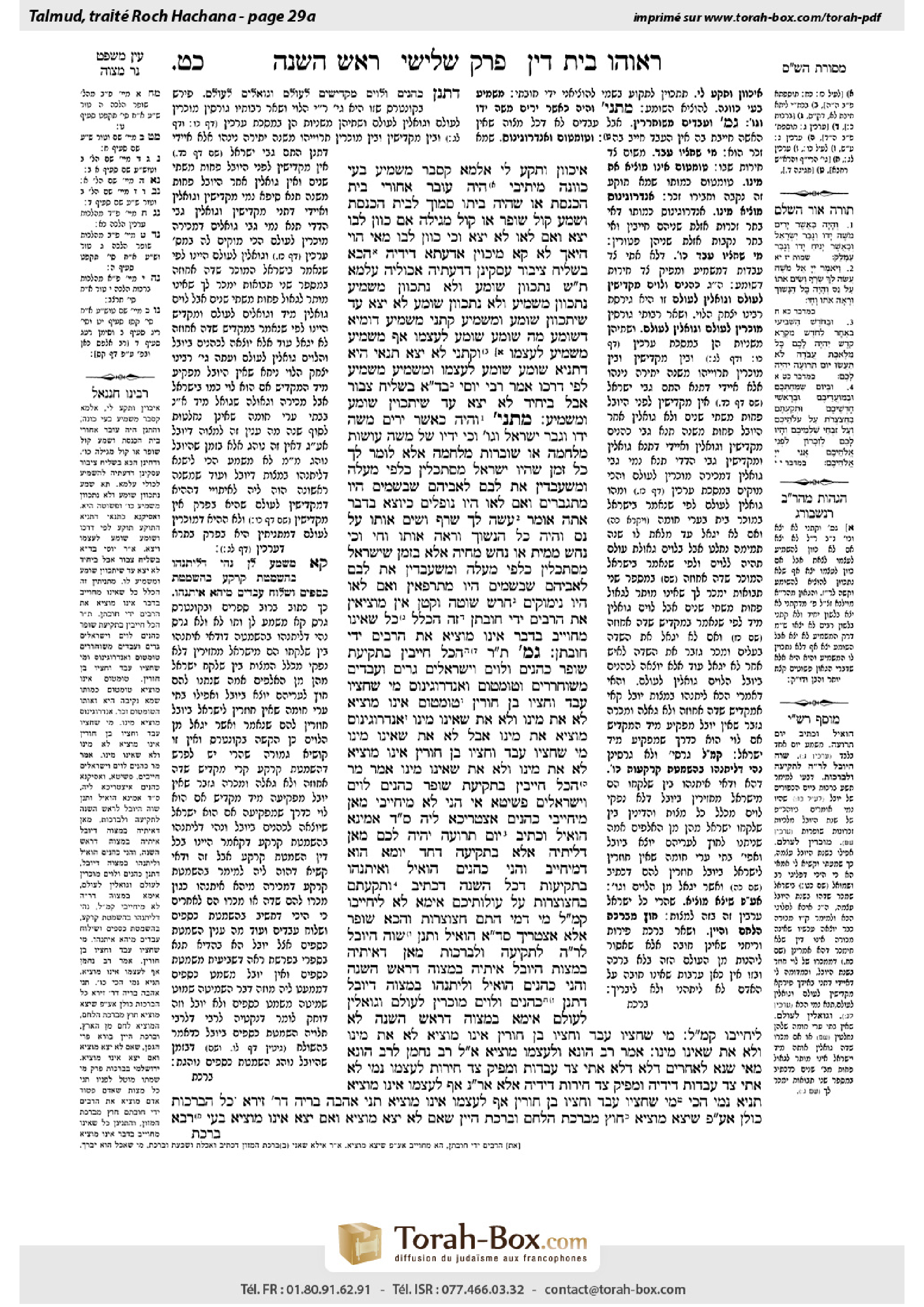
This page of Rosh Hashanah includes the Aramaic text, an English translation and an AI-generated French translation, alongside the scan above.
ראש השנה כ״ט א · Aramaic and Hebrew text
אִיכַּוַּון וּתְקַע לִי. אַלְמָא קָסָבַר: מַשְׁמִיעַ בָּעֵי כַּוָּונָה.
מֵיתִיבִי: הָיָה עוֹבֵר אֲחוֹרֵי בֵּית הַכְּנֶסֶת, אוֹ שֶׁהָיָה בֵּיתוֹ סָמוּךְ לְבֵית הַכְּנֶסֶת, וְשָׁמַע קוֹל שׁוֹפָר אוֹ קוֹל מְגִילָּה, אִם כִּוֵּון לִבּוֹ — יָצָא, וְאִם לָאו — לֹא יָצָא. וְכִי כִּוֵּון לִבּוֹ מַאי הָוֵי? הֵיאַךְ לָא קָא מִיכַּוֵּין אַדַּעְתָּא דִּידֵיהּ!
הָכָא בִּשְׁלִיחַ צִיבּוּר עָסְקִינַן, דְּדַעְתֵּיהּ אַכּוּלֵּיהּ עָלְמָא.
תָּא שְׁמַע: נִתְכַּוֵּון שׁוֹמֵעַ וְלֹא נִתְכַּוֵּון מַשְׁמִיעַ, נִתְכַּוֵּון מַשְׁמִיעַ וְלֹא נִתְכַּוֵּון שׁוֹמֵעַ — לֹא יָצָא, עַד שֶׁיִּתְכַּוֵּון שׁוֹמֵעַ וּמַשְׁמִיעַ. קָתָנֵי מַשְׁמִיעַ דּומְיָא דְשׁוֹמֵעַ. מָה שׁוֹמֵעַ — שׁוֹמֵעַ לְעַצְמוֹ, אַף מַשְׁמִיעַ — מַשְׁמִיעַ לְעַצְמוֹ, וְקָתָנֵי לֹא יָצָא.
תַּנָּאֵי הִיא, דְּתַנְיָא: שׁוֹמֵעַ — שׁוֹמֵעַ לְעַצְמוֹ, וּמַשְׁמִיעַ — מַשְׁמִיעַ לְפִי דַּרְכּוֹ. אָמַר רַבִּי יוֹסֵי: בַּמֶּה דְּבָרִים אֲמוּרִים — בִּשְׁלִיחַ צִבּוּר, אֲבָל בְּיָחִיד — לָא יָצָא, עַד שֶׁיִּתְכַּוֵּין שׁוֹמֵעַ וּמַשְׁמִיעַ.
מַתְנִי׳ ״וְהָיָה כַּאֲשֶׁר יָרִים מֹשֶׁה יָדוֹ וְגָבַר יִשְׂרָאֵל וְגוֹ׳״, וְכִי יָדָיו שֶׁל מֹשֶׁה עוֹשׂוֹת מִלְחָמָה אוֹ שׁוֹבְרוֹת מִלְחָמָה? אֶלָּא לוֹמַר לָךְ: כׇּל זְמַן שֶׁהָיוּ יִשְׂרָאֵל מִסְתַּכְּלִין כְּלַפֵּי מַעְלָה וּמְשַׁעְבְּדִין אֶת לִבָּם לַאֲבִיהֶם שֶׁבַּשָּׁמַיִם — הָיוּ מִתְגַּבְּרִים, וְאִם לָאו — הָיוּ נוֹפְלִים.
כַּיּוֹצֵא בַּדָּבָר אַתָּה אוֹמֵר: ״עֲשֵׂה לְךָ שָׂרָף וְשִׂים אוֹתוֹ עַל נֵס וְהָיָה כׇּל הַנָּשׁוּךְ וְרָאָה אוֹתוֹ וָחָי״, וְכִי נָחָשׁ מֵמִית, אוֹ נָחָשׁ מְחַיֶּה? אֶלָּא: בִּזְמַן שֶׁיִּשְׂרָאֵל מִסְתַּכְּלִין כְּלַפֵּי מַעְלָה וּמְשַׁעְבְּדִין אֶת לִבָּם לַאֲבִיהֶם שֶׁבַּשָּׁמַיִם — הָיוּ מִתְרַפְּאִין, וְאִם לָאו הָיוּ נִימּוֹקִים.
חֵרֵשׁ שׁוֹטֶה וְקָטָן אֵין מוֹצִיאִין אֶת הָרַבִּים יְדֵי חוֹבָתָן. זֶה הַכְּלָל: כׇּל שֶׁאֵינוֹ מְחוּיָּיב בַּדָּבָר — אֵינוֹ מוֹצִיא אֶת הָרַבִּים יְדֵי חוֹבָתָן.
גְּמָ׳ תָּנוּ רַבָּנַן: הַכֹּל חַיָּיבִין בִּתְקִיעַת שׁוֹפָר. כֹּהֲנִים וּלְוִיִּם וְיִשְׂרְאֵלִים. גֵּרִים וַעֲבָדִים מְשׁוּחְרָרִים. וְטוּמְטוּם וְאַנְדְּרוֹגִינוֹס. מִי שֶׁחֶצְיוֹ עֶבֶד וְחֶצְיוֹ בֶּן חוֹרִין.
טוּמְטוּם — אֵינוֹ מוֹצִיא לֹא אֶת מִינוֹ, וְלֹא אֶת שֶׁאֵינוֹ מִינוֹ. אַנְדְּרוֹגִינוֹס — מוֹצִיא אֶת מִינוֹ, אֲבָל לֹא אֶת שֶׁאֵינוֹ מִינוֹ. מִי שֶׁחֶצְיוֹ עֶבֶד וְחֶצְיוֹ בֶּן חוֹרִין — אֵינוֹ מוֹצִיא לֹא אֶת מִינוֹ, וְלֹא אֶת שֶׁאֵינוֹ מִינוֹ.
אָמַר מָר: הַכֹּל חַיָּיבִין בִּתְקִיעַת שׁוֹפָר, כֹּהֲנִים לְוִיִּם וְיִשְׂרְאֵלִים. פְּשִׁיטָא! אִי הָנֵי לָא מִיחַיְּיבִי — מַאן מִיחַיְּיבִי?!
כֹּהֲנִים אִצְטְרִיכָא לֵיהּ, סָלְקָא דַּעְתָּךְ אָמֵינָא: הוֹאִיל וּכְתִיב ״יוֹם תְּרוּעָה יִהְיֶה לָכֶם״, מַאן דְּלֵיתֵיהּ אֶלָּא בִּתְקִיעָה דְּחַד יוֹמָא — הוּא דְּמִיחַיַּיב, וְהָנֵי כֹּהֲנִים, הוֹאִיל וְאִיתַנְהוּ בִּתְקִיעוֹת דְּכׇל הַשָּׁנָה, דִּכְתִיב: ״וּתְקַעְתֶּם בַּחֲצוֹצְרוֹת עַל עוֹלוֹתֵיכֶם״, אֵימָא לָא לִיחַיְּיבוּ — קָא מַשְׁמַע לַן.
מִי דָּמֵי? הָתָם חֲצוֹצְרוֹת וְהָכָא שׁוֹפָר! אֶלָּא אִצְטְרִיךְ: סָלְקָא דַּעְתָּךְ אָמֵינָא, הוֹאִיל וּתְנַן: שָׁוֶה הַיּוֹבֵל לְרֹאשׁ הַשָּׁנָה לַתְּקִיעָה וְלַבְּרָכוֹת, מַאן דְּאִיתֵיהּ בְּמִצְוַת הַיּוֹבֵל — אִיתֵיהּ בְּמִצְוָה דְּרֹאשׁ הַשָּׁנָה, וְהָנֵי כֹּהֲנִים, הוֹאִיל וְלֵיתַנְהוּ בְּמִצְוָה דְּיוֹבֵל, דִּתְנַן: כֹּהֲנִים וּלְוִיִּם מוֹכְרִין לְעוֹלָם וְגוֹאֲלִין לְעוֹלָם, אֵימָא: בְּמִצְוָה דְּרֹאשׁ הַשָּׁנָה לֹא לִיחַיְּיבוּ — קָא מַשְׁמַע לַן.
מִי שֶׁחֶצְיוֹ עֶבֶד וְחֶצְיוֹ בֶּן חוֹרִין — אֵינוֹ מוֹצִיא לֹא אֶת מִינוֹ וְלֹא אֶת שֶׁאֵינוֹ מִינוֹ. אָמַר רַב הוּנָא: וּלְעַצְמוֹ מוֹצִיא.
אֲמַר לֵיהּ רַב נַחְמָן לְרַב הוּנָא: מַאי שְׁנָא לַאֲחֵרִים דְּלָא — דְּלָא אָתֵי צַד עַבְדוּת וּמַפֵּיק צַד חֵירוּת, לְעַצְמוֹ נָמֵי — לָא אָתֵי צַד עַבְדוּת דִּידֵיהּ וּמַפֵּיק צַד חֵירוּת דִּידֵיהּ.
אֶלָּא אָמַר רַב נַחְמָן: אַף לְעַצְמוֹ אֵינוֹ מוֹצִיא. תַּנְיָא נָמֵי הָכִי: מִי שֶׁחֶצְיוֹ עֶבֶד וְחֶצְיוֹ בֶּן חוֹרִין — אַף לְעַצְמוֹ אֵינוֹ מוֹצִיא.
תָּנֵי אַהֲבָה בְּרֵיהּ דְּרַבִּי זֵירָא: כׇּל הַבְּרָכוֹת כּוּלָּן, אַף עַל פִּי שֶׁיָּצָא — מוֹצִיא. חוּץ מִבִּרְכַּת הַלֶּחֶם וּבִרְכַּת הַיַּיִן, שֶׁאִם לֹא יָצָא — מוֹצִיא, וְאִם יָצָא — אֵינוֹ מוֹצִיא.
בָּעֵי רָבָא:
Rosh Hashanah 29a · English translation
Have intent to sound the shofar on my behalf and sound it for me. The Gemara infers: Apparently, Rabbi Zeira maintains that he who sounds the shofar for others is required to have intent to discharge the hearer’s obligation.
The Gemara raises an objection from the mishna: If one was passing behind a synagogue, or his house was adjacent to the synagogue, and he heard the sound of the shofar or the sound of the Scroll of Esther being read, if he focused his heart to fulfill his obligation, he has fulfilled his obligation, but if not, he has not fulfilled his obligation. It may be asked: And, according to Rabbi Zeira, even if the hearer focused his heart, what of it? The other one, i.e., the one sounding the shofar, did not focus his intent to sound the shofar with him in mind? If indeed the intent of the one sounding the shofar is required, how does the passerby fulfill his obligation?
The Gemara answers: Here we are dealing with the representative of the community, i.e., one who sounds the shofar for the entire congregation and has everyone in mind. He does not sound it for a specific individual, but rather on behalf of the entire community, and therefore anyone who hears him sound the shofar fulfills his obligation.
The Gemara raises another objection: Come and hear that which was taught in a baraita: If the hearer of the shofar had intent, but the sounder of the shofar did not have intent, or if the sounder of the shofar had intent, but the hearer did not have intent, he has not fulfilled his obligation, until both the hearer and the sounder have intent. The baraita teaches the halakha governing the sounder of the shofar in similar fashion to the halakha governing the hearer. From this it may be inferred that just as the hearer hears for himself, having intent to fulfill his own obligation, so too, the sounder sounds for himself, having intent to fulfill his own obligation, and not that of others. And the baraita teaches that if the sounder did not have this intent, the hearer has not fulfilled his obligation. But this indicates that if the sounder had intent to sound the shofar for himself, he need not have intent to sound it for others, therefore contradicting Rabbi Zeira’s opinion.
The Gemara answers: This is the subject of a dispute between tanna’im, as it is taught in a baraita: The hearer hears for himself, and the sounder sounds the shofar in his usual way, i.e., he need not intend to sound it for the sake of the hearer. Rabbi Yosei said: In what case is this statement said? It was said in the case of a representative of the community. But in the case of an ordinary individual, the hearer does not fulfill his obligation until both the hearer and the sounder have intent to discharge the hearer’s obligation, as argued by Rabbi Zeira.
MISHNA: Incidental to the discussion of the required intent when sounding the shofar, the mishna cites the verse: “And it came to pass, when Moses held up his hand, that Israel prevailed; and when he let down his hand, Amalek prevailed” (Exodus 17:11). It may be asked: Did the hands of Moses make war when he raised them or break war when he lowered them? Rather, the verse comes to tell you that as long as the Jewish people turned their eyes upward and subjected their hearts to their Father in Heaven, they prevailed, but if not, they fell.
Similarly, you can say: The verse states: “Make for yourself a fiery serpent, and set it upon a pole; and it shall come to pass, that everyone that is bitten, when he sees it, he shall live” (Numbers 21:8). Once again it may be asked: Did the serpent kill, or did the serpent preserve life? Rather, when the Jewish people turned their eyes upward and subjected their hearts to their Father in Heaven, they were healed, but if not, they rotted from their snakebites.
Returning to its halakhic discussion, the mishna continues: A deaf-mute, an imbecile, or a minor who sounds the shofar cannot discharge the obligation on behalf of the community. This is the principle with regard to similar matters: Whoever is not obligated to do a certain matter cannot discharge the obligation on behalf of the community.
GEMARA: The Sages taught the following baraita: All are obligated to sound the shofar: Priests, Levites, and ordinary Israelites; converts; freed slaves; a tumtum, i.e., one whose sexual organs from birth are concealed or are so undeveloped that it is impossible to determine whether the individual is male or female; a hermaphrodite [androginos], i.e., one with both male and female reproductive organs; and a half-slave, half-freeman.
A tumtum who sounds the shofar cannot discharge the obligation of one of his kind, i.e., a fellow tumtum, since men are bound by the obligation, whereas women are not, and it is possible that the sounder is female and the hearer is male, nor can he discharge the obligation of one who is not of his kind, an ordinary man or woman. A hermaphrodite can discharge the obligation of one of his kind, a fellow hermaphrodite, since if the sounder is treated as a female, the hearer is also considered a female, but he cannot discharge the obligation of one who is not of his kind. One who is half-slave and half-freeman cannot discharge the obligation of one of his kind, as the slave component of the sounder cannot discharge the obligation of the free component of the hearer, and he certainly cannot discharge the obligation of one who is not of his kind, i.e., a completely free individual.
The Master said above in the baraita: All are obligated to sound the shofar: Priests, Levites, and ordinary Israelites. The Gemara asks in astonishment: Isn’t that obvious? If these people are not obligated to perform the mitzva, who then is obligated to perform it?
The Gemara answers: It was necessary to say that priests are obligated to fulfill the mitzva, for it may enter your mind to say as follows: Since it is written: “It is a day of sounding the shofar to you” (Numbers 29:1), you might have said that with regard to one who is obligated to sound only one day, he is obligated to sound the shofar on Rosh HaShana. But with regard to these priests, since they are obligated to sound all year long, because they sound trumpets when they offer the sacrifices in the Temple, as it is written: “And you shall sound the trumpets over your burnt-offerings, and over the sacrifices of your peace-offerings” (Numbers 10:10), you might say that they are not obligated to sound the shofar on Rosh HaShana. Therefore, the baraita comes to teach us that this is not true, and that even priests are obligated to fulfill the mitzva.
The Gemara asks: Are these things comparable? There, the priests sound trumpets, and here, we are dealing with the sounding of a shofar. Rather, it was necessary to say that priests are obligated to fulfill the mitzva for a different reason, for it may enter your mind to say as follows: Since we learned in a mishna: Yom Kippur of the Jubilee Year is the same as Rosh HaShana, with regard to both the shofar blasts and the additional blessings that are recited in the Amida prayer, I might have said: One who is fully included in the mitzva of the Jubilee is also included in the mitzva of Rosh HaShana. But these priests, since they are not fully included in the mitzva of the Jubilee, as we learned in a mishna: Priests and Levites may sell their fields forever and they may also redeem their lands forever, and they are not bound by the halakhot of the Jubilee Year, I might say that they should also not be obligated to fulfill the mitzva of Rosh HaShana. Therefore, the baraita comes to teach us that this is not so, and that even priests are obligated to fulfill the mitzva.
§ It was taught in the same baraita: A half-slave, half-freeman cannot discharge the obligation on behalf of one of his kind, and he certainly cannot discharge the obligation on behalf of one who is not of his kind. Rav Huna said: Even though he cannot discharge the obligation on behalf of others, he can discharge the obligation on behalf of himself.
Rav Naḥman said to Rav Huna: What is the difference whereby he may discharge the obligation on behalf of himself but not on behalf of others? Because his slave component cannot come and discharge the obligation on behalf of the free component of the other. If so, with regard to himself as well, his slave component should not be able to come and discharge the obligation on behalf of his free component.
Rather, Rav Naḥman said: Even on behalf of himself he cannot discharge the obligation. The Gemara comments: This is also taught in a baraita: A half-slave, half-freeman cannot discharge the obligation even for himself.
Continuing the discussion of performing an obligation on behalf of others, Ahava, son of Rabbi Zeira, taught the following baraita: With regard to all the blessings, even if one already recited a blessing for himself and has consequently fulfilled his own obligation, he can still recite a blessing for others and thereby discharge their obligation, as all Jews are responsible for one another. This is true with regard to all blessings except for the blessing recited over bread and the blessing recited over wine, both before and after their consumption. With regard to these blessings, if he has not yet fulfilled his own obligation, he can discharge the obligation of others as well, but if he already fulfilled his own obligation, he cannot discharge the obligation of others, as these blessings are recited in appreciation of physical enjoyment, and can only be recited by one who is actually deriving pleasure at the time.
Rava raised a dilemma:
Rosh Hashanah 29a · Traduction française (IA)
Ayez l’intention de sonner du chofar pour moi et sonnez-le pour moi. La Guemara en déduit qu’apparemment, Rabbi Zeira estime que celui qui sonne du chofar pour autrui doit avoir l’intention de faire acquitter l’auditeur de son obligation.
La Guemara soulève une objection à partir de la Michna : si quelqu’un passait derrière une synagogue, ou si sa maison était contiguë à la synagogue, et qu’il entendait le son du chofar ou la lecture du Rouleau d’Esther, s’il avait l’intention de s’acquitter de son obligation, il s’en est acquitté ; sinon, il ne s’en est pas acquitté. On peut demander : selon Rabbi Zeira, même si l’auditeur avait cette intention, qu’importe ? L’autre, c’est-à-dire celui qui sonne du chofar, n’avait pas l’intention de sonner en pensant à lui. Si l’intention de celui qui sonne du chofar est effectivement nécessaire, comment le passant peut-il s’acquitter de son obligation ?
La Guemara répond : il s’agit ici du représentant de la communauté, c’est-à-dire de celui qui sonne du chofar pour toute l’assemblée et pense à tous ses membres. Il ne sonne pas pour une personne en particulier, mais pour toute la communauté ; par conséquent, quiconque l’entend sonner du chofar s’acquitte de son obligation.
La Guemara soulève une autre objection : viens et entends ce qui a été enseigné dans une baraïta : si l’auditeur du chofar avait l’intention de s’acquitter de son obligation, mais que celui qui sonne du chofar ne l’avait pas, ou si celui qui sonne du chofar avait cette intention, mais que l’auditeur ne l’avait pas, l’auditeur ne s’est pas acquitté de son obligation tant que l’auditeur et celui qui sonne n’ont pas tous deux eu l’intention nécessaire. La baraïta enseigne la halakha concernant celui qui sonne du chofar de la même manière que celle concernant l’auditeur. On peut en déduire que, de même que l’auditeur entend pour lui-même, avec l’intention de s’acquitter de sa propre obligation, celui qui sonne joue lui aussi pour lui-même, avec l’intention de s’acquitter de sa propre obligation, et non de celle d’autrui. Or la baraïta enseigne que si celui qui sonne n’avait pas cette intention, l’auditeur ne s’est pas acquitté de son obligation. Mais cela indique que si celui qui sonne avait l’intention de sonner du chofar pour lui-même, il n’a pas besoin d’avoir l’intention de le sonner pour autrui, ce qui contredit donc l’opinion de Rabbi Zeira.
La Guemara répond : c’est l’objet d’une controverse entre des tannaïm, comme il est enseigné dans une baraïta : l’auditeur entend pour lui-même, et celui qui sonne joue du chofar comme à son habitude, c’est-à-dire qu’il n’a pas besoin d’avoir l’intention de le sonner pour l’auditeur. Rabbi Yossei dit : dans quel cas cette affirmation a-t-elle été formulée ? Dans le cas d’un représentant de la communauté. Mais dans le cas d’un particulier, l’auditeur ne s’acquitte de son obligation que si l’auditeur et celui qui sonne ont tous deux l’intention de faire acquitter l’auditeur de son obligation, comme le soutient Rabbi Zeira.
MICHNA : À propos de l’intention requise lorsqu’on sonne du chofar, la Michna cite le verset : « Or, lorsque Moïse levait la main, Israël l’emportait ; et lorsqu’il la laissait retomber, Amalek l’emportait » (Exode 17, 11). On peut demander : les mains de Moïse faisaient-elles la guerre lorsqu’il les levait, ou la défaisaient-elles lorsqu’il les abaissait ? Le verset vient plutôt nous enseigner que tant que le peuple juif tournait les yeux vers le haut et soumettait son cœur à son Père qui est aux cieux, il l’emportait ; sinon, il succombait.
De même, on peut dire : le verset énonce : « Fais-toi un serpent brûlant et place-le sur une perche ; quiconque aura été mordu et le regardera conservera la vie » (Nombres 21, 8). Là encore, on peut demander : le serpent tuait-il ou préservait-il la vie ? En réalité, lorsque le peuple juif tournait les yeux vers le haut et soumettait son cœur à son Père qui est aux cieux, il était guéri ; sinon, il dépérissait à cause des morsures de serpent.
Pour revenir à la discussion halakhique, la Michna poursuit : un sourd-muet, un déficient intellectuel ou un mineur qui sonne du chofar ne peut pas faire acquitter la communauté de son obligation. Voici le principe applicable aux cas semblables : quiconque n’est pas tenu d’accomplir une obligation donnée ne peut pas en faire acquitter la communauté.
GUEMARA : Les Sages ont enseigné la baraïta suivante : tous sont tenus de sonner du chofar : les prêtres, les Lévites et les Israélites ordinaires ; les convertis ; les esclaves affranchis ; un tumtum, c’est-à-dire une personne dont les organes sexuels sont cachés depuis la naissance ou si peu développés qu’il est impossible de déterminer si elle est un homme ou une femme ; un hermaphrodite [androginos], c’est-à-dire une personne possédant des organes reproducteurs masculins et féminins ; et une personne à moitié esclave et à moitié libre.
Un tumtum qui sonne du chofar ne peut pas faire acquitter de son obligation une personne de sa catégorie, c’est-à-dire un autre tumtum, car les hommes sont tenus par cette obligation, contrairement aux femmes, et il est possible que celui qui sonne soit une femme et l’auditeur un homme. Il ne peut pas non plus faire acquitter une personne qui n’est pas de sa catégorie, un homme ou une femme ordinaires. Un hermaphrodite peut faire acquitter de son obligation une personne de sa catégorie, un autre hermaphrodite, car si celui qui sonne est considéré comme une femme, l’auditeur est lui aussi considéré comme une femme ; mais il ne peut pas faire acquitter une personne qui n’est pas de sa catégorie. Une personne à moitié esclave et à moitié libre ne peut pas faire acquitter de son obligation une personne de sa catégorie, car la part servile de celui qui sonne ne peut pas faire acquitter la part libre de l’auditeur ; à plus forte raison, elle ne peut pas faire acquitter une personne qui n’est pas de sa catégorie, c’est-à-dire une personne entièrement libre.
Le Maître a dit plus haut dans la baraïta : tous sont tenus de sonner du chofar : les prêtres, les Lévites et les Israélites ordinaires. La Guemara demande avec étonnement : n’est-ce pas évident ? Si ces personnes ne sont pas tenues d’accomplir la mitsva, qui donc y est tenu ?
La Guemara répond : il était nécessaire de préciser que les prêtres sont tenus d’accomplir la mitsva, car tu aurais pu penser ceci : puisqu’il est écrit « C’est pour vous un jour de sonnerie du chofar » (Nombres 29, 1), tu aurais pu dire que celui qui n’est tenu de sonner qu’un seul jour est tenu de sonner du chofar à Roch Hachana. Mais au sujet des prêtres, puisqu’ils sont tenus de sonner toute l’année, car ils sonnent des trompettes lorsqu’ils offrent les sacrifices dans le Temple, comme il est écrit : « Vous sonnerez des trompettes au-dessus de vos holocaustes et de vos sacrifices de paix » (Nombres 10, 10), tu aurais pu dire qu’ils ne sont pas tenus de sonner du chofar à Roch Hachana. La baraïta vient donc nous enseigner que ce n’est pas le cas et que même les prêtres sont tenus d’accomplir la mitsva.
La Guemara demande : ces choses sont-elles comparables ? Là-bas, les prêtres sonnent des trompettes, tandis qu’ici, il s’agit de sonner du chofar. Il était plutôt nécessaire de préciser que les prêtres sont tenus d’accomplir la mitsva pour une autre raison : tu aurais pu penser ceci : puisque nous avons appris dans une Michna que le Yom Kippour de l’année jubilaire est identique à Roch Hachana concernant à la fois les sonneries du chofar et les bénédictions supplémentaires récitées dans la prière de la Amida, j’aurais pu dire que celui qui est pleinement concerné par la mitsva de l’année jubilaire est également concerné par celle de Roch Hachana. Mais ces prêtres, puisqu’ils ne sont pas pleinement concernés par la mitsva de l’année jubilaire — car nous avons appris dans une Michna que les prêtres et les Lévites peuvent vendre leurs champs à perpétuité et racheter leurs terres à perpétuité, et qu’ils ne sont pas soumis aux halakhot de l’année jubilaire —, j’aurais pu dire qu’ils ne sont pas non plus tenus d’accomplir la mitsva de Roch Hachana. La baraïta vient donc nous enseigner que ce n’est pas le cas et que même les prêtres sont tenus d’accomplir la mitsva.
§ Il a été enseigné dans la même baraïta : une personne à moitié esclave et à moitié libre ne peut pas faire acquitter de son obligation une personne de sa catégorie et, à plus forte raison, ne peut pas faire acquitter une personne qui n’est pas de sa catégorie. Rav Houna a dit : bien qu’elle ne puisse pas faire acquitter autrui de son obligation, elle peut s’acquitter elle-même.
Rav Naḥman dit à Rav Houna : quelle différence permet à cette personne de s’acquitter elle-même, mais pas de faire acquitter autrui ? Sa part servile ne peut pas faire acquitter la part libre de l’autre. Si tel est le cas, pour elle-même aussi, sa part servile ne devrait pas pouvoir faire acquitter sa part libre.
Rav Naḥman a plutôt dit : elle ne peut pas s’acquitter elle-même non plus. La Guemara fait remarquer que cela est également enseigné dans une baraïta : une personne à moitié esclave et à moitié libre ne peut pas s’acquitter de son obligation, même pour elle-même.
Poursuivant la discussion sur l’acquittement de l’obligation d’autrui, Ahava, fils de Rabbi Zeira, a enseigné la baraïta suivante : pour toutes les bénédictions, même si quelqu’un a déjà récité une bénédiction pour lui-même et s’est ainsi acquitté de sa propre obligation, il peut encore réciter une bénédiction pour autrui et ainsi faire acquitter cette personne de son obligation, car tous les Juifs sont responsables les uns des autres. Cela vaut pour toutes les bénédictions, à l’exception de la bénédiction récitée sur le pain et de celle récitée sur le vin, avant comme après leur consommation. Pour ces bénédictions, s’il ne s’est pas encore acquitté de sa propre obligation, il peut aussi faire acquitter autrui ; mais s’il s’en est déjà acquitté, il ne peut pas faire acquitter autrui, car ces bénédictions expriment la reconnaissance d’un plaisir physique et ne peuvent être récitées que par quelqu’un qui éprouve effectivement ce plaisir à ce moment-là.
Rava souleva une difficulté :
Traduction française générée par IA à partir de l’édition anglaise de Sefaria. Vérifie toujours un passage avec le texte source.
Text from Sefaria: William Davidson Edition - Vocalized Aramaic (CC BY NC); William Davidson Edition - English (CC BY NC).