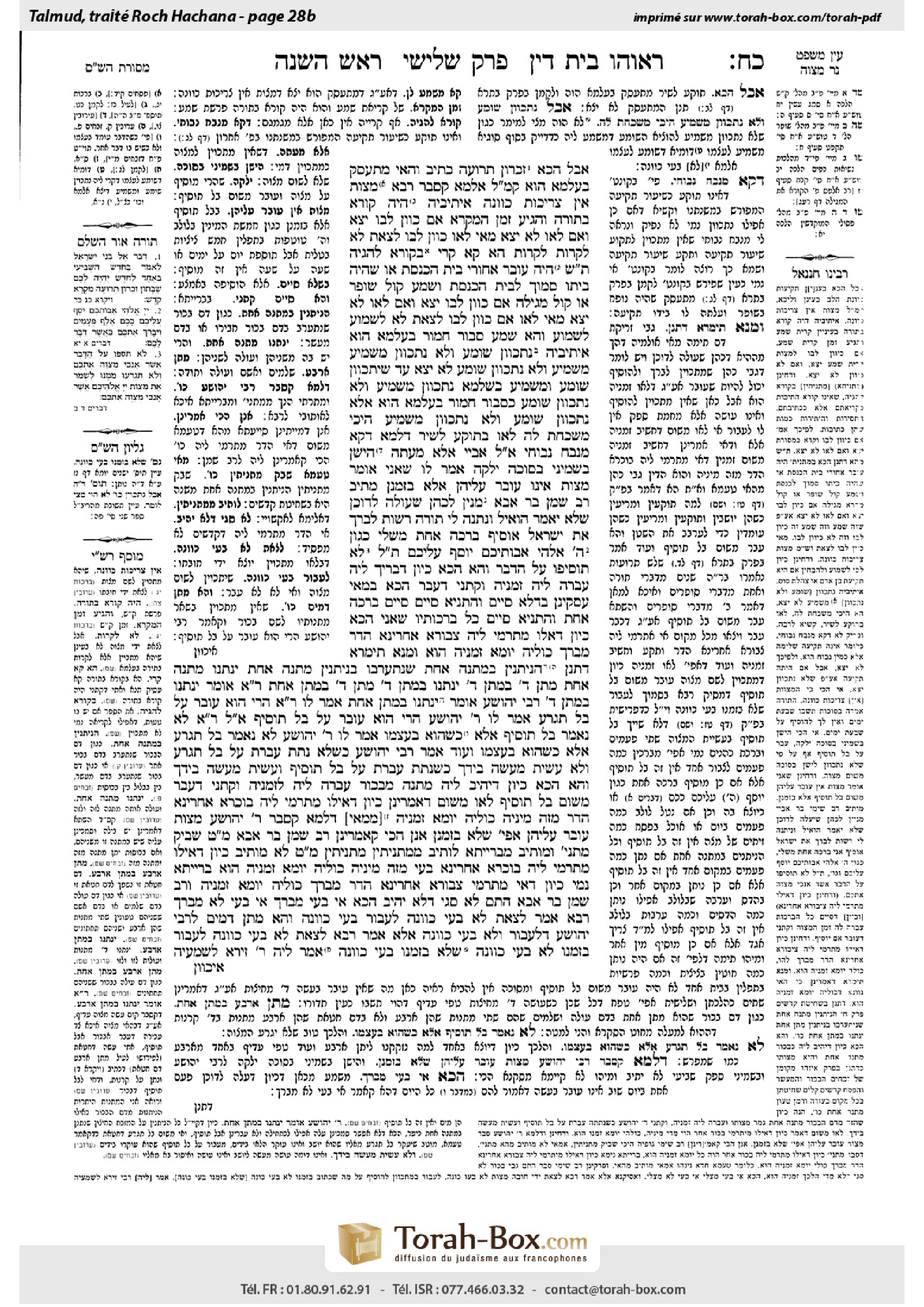
Rosh Hashanah 28b: Talmud study for Daf Yomi
Daf Yomi is the daily study of one Talmud folio. Explore 37 tractates with scans, Hebrew text, Sefaria English and AI-generated French translations where annotated.
Passage selection and English or AI-generated French translation are available where the scan has annotations. Daf Study is independent of Torah-Box and Sefaria.
Browse Rosh Hashanah · ראש השנה · All tractatesRosh Hashanah 28b text and translations
This page of Rosh Hashanah includes the Aramaic text, an English translation and an AI-generated French translation, alongside the scan above.
ראש השנה כ״ח ב · Aramaic and Hebrew text
אֲבָל הָכָא, ״זִכְרוֹן תְּרוּעָה״ כְּתִיב, וְהַאי מִתְעַסֵּק בְּעָלְמָא הוּא — קָא מַשְׁמַע לַן. אַלְמָא קָסָבַר רָבָא: מִצְוֹת אֵין צְרִיכוֹת כַּוָּונָה.
אֵיתִיבֵיהּ: הָיָה קוֹרֵא בַּתּוֹרָה וְהִגִּיעַ זְמַן הַמִּקְרָא, אִם כִּוֵּון לִבּוֹ — יָצָא, וְאִם לָאו — לֹא יָצָא. מַאי לָאו, כִּוֵּון לִבּוֹ: לָצֵאת!
לֹא: לִקְרוֹת. לִקְרוֹת?! הָא קָא קָרֵי! בְּקוֹרֵא לְהַגִּיהַּ.
תָּא שְׁמַע: הָיָה עוֹבֵר אֲחוֹרֵי בֵּית הַכְּנֶסֶת, אוֹ שֶׁהָיָה בֵּיתוֹ סָמוּךְ לְבֵית הַכְּנֶסֶת, וְשָׁמַע קוֹל שׁוֹפָר אוֹ קוֹל מְגִילָּה, אִם כִּוֵּון לִבּוֹ — יָצָא, וְאִם לָאו — לֹא יָצָא. מַאי לָאו, אִם כִּוֵּון לִבּוֹ לָצֵאת?
לֹא — לִשְׁמוֹעַ. לִשְׁמוֹעַ?! וְהָא שָׁמַע! סְבוּר, חֲמוֹר בְּעָלְמָא הוּא.
אֵיתִיבֵיהּ: נִתְכַּוֵּון שׁוֹמֵעַ וְלֹא נִתְכַּוֵּון מַשְׁמִיעַ, מַשְׁמִיעַ וְלֹא נִתְכַּוֵּון שׁוֹמֵעַ — לֹא יָצָא, עַד שֶׁיִּתְכַּוֵּון שׁוֹמֵעַ וּמַשְׁמִיעַ. בִּשְׁלָמָא נִתְכַּוֵּון מַשְׁמִיעַ וְלֹא נִתְכַּוֵּון שׁוֹמֵעַ — כְּסָבוּר חֲמוֹר בְּעָלְמָא הוּא, אֶלָּא נִתְכַּוֵּון שׁוֹמֵעַ וְלֹא נִתְכַּוֵּון מַשְׁמִיעַ — הֵיכִי מַשְׁכַּחַתְּ לַהּ? לָאו בְּתוֹקֵעַ לָשִׁיר!
דִּלְמָא דְּקָא מְנַבַּח נַבּוֹחֵי.
אֲמַר לֵיהּ אַבָּיֵי: אֶלָּא מֵעַתָּה, הַיָּשֵׁן בַּשְּׁמִינִי בַּסּוּכָּה — יִלְקֶה!
אָמַר לוֹ, שֶׁאֲנִי אוֹמֵר: מִצְוֹת אֵינוֹ עוֹבֵר עֲלֵיהֶן אֶלָּא בִּזְמַנָּן.
מֵתִיב רַב שֶׁמֶן בַּר אַבָּא: מִנַּיִן לְכֹהֵן שֶׁעוֹלֶה לַדּוּכָן, שֶׁלֹּא יֹאמַר: הוֹאִיל וְנָתְנָה לִי תּוֹרָה רְשׁוּת לְבָרֵךְ אֶת יִשְׂרָאֵל אוֹסִיף בְּרָכָה אַחַת מִשֶּׁלִּי, כְּגוֹן: ״ה׳ אֱלֹהֵי אֲבוֹתֵיכֶם יוֹסֵף עֲלֵיכֶם״ — תַּלְמוּד לוֹמַר: ״לֹא תוֹסִיפוּ עַל הַדָּבָר״. וְהָא הָכָא, כֵּיוָן דְּבָרֵיךְ לֵיהּ — עָבְרָה לֵיהּ זִמְנֵיהּ, וְקָתָנֵי דְּעָבַר!
הָכָא בְּמַאי עָסְקִינַן — בִּדְלָא סַיֵּים.
וְהָתַנְיָא סִיֵּים! סִיֵּים בְּרָכָה אַחַת.
וְהָתַנְיָא: סִיֵּים כׇּל בִּרְכוֹתָיו! שָׁאנֵי הָכָא, כֵּיוָן דְּאִלּוּ מִתְרְמֵי לֵיהּ צִבּוּרָא אַחֲרִינָא, הָדַר מְבָרֵךְ — כּוּלֵּיהּ יוֹמָא זִמְנֵיהּ הוּא.
וּמְנָא תֵּימְרָא — דִּתְנַן: הַנִּיתָּנִין בְּמַתָּנָה אַחַת, שֶׁנִּתְעָרְבוּ בַּנִּיתָּנִין מַתָּנָה אַחַת — יִנָּתְנוּ מַתָּנָה אַחַת. מַתַּן אַרְבַּע בְּמַתַּן אַרְבַּע — יִנָּתְנוּ בְּמַתַּן אַרְבַּע.
מַתַּן אַרְבַּע בְּמַתַּן אַחַת, רַבִּי אֱלִיעֶזֶר אוֹמֵר: יִנָּתְנוּ בְּמַתַּן אַרְבַּע, רַבִּי יְהוֹשֻׁעַ אוֹמֵר: יִנָּתְנוּ בְּמַתַּן אַחַת.
אָמַר לוֹ רַבִּי אֱלִיעֶזֶר: הֲרֵי הוּא עוֹבֵר עַל ״בַּל תִּגְרַע״! אָמַר לוֹ רַבִּי יְהוֹשֻׁעַ: הֲרֵי הוּא עוֹבֵר עַל ״בַּל תּוֹסִיף״!
אָמַר לוֹ רַבִּי אֱלִיעֶזֶר: לֹא נֶאֱמַר ״בַּל תּוֹסִיף״ אֶלָּא כְּשֶׁהוּא בְּעַצְמוֹ. אָמַר לוֹ רַבִּי יְהוֹשֻׁעַ: לֹא נֶאֱמַר ״בַּל תִּגְרַע״ אֶלָּא כְּשֶׁהוּא בְּעַצְמוֹ.
וְעוֹד אָמַר רַבִּי יְהוֹשֻׁעַ: כְּשֶׁלֹּא נָתַתָּ — עָבַרְתָּ עַל ״בַּל תִּגְרַע״ וְלֹא עָשִׂיתָ מַעֲשֶׂה בְּיָדֶךָ, כְּשֶׁנָּתַתָּ — עָבַרְתָּ עַל ״בַּל תּוֹסִיף״ וְעָשִׂיתָ מַעֲשֶׂה בְּיָדֶךָ.
וְהָא הָכָא, כֵּיוָן דְּיָהֵיב לֵיהּ מַתָּנָה מִבְּכוֹר — עָבְרָה לֵיהּ לְזִמְנֵיהּ, וְקָתָנֵי דְּעָבַר מִשּׁוּם ״בַּל תּוֹסִיף״. לָאו מִשּׁוּם דְּאָמְרִינַן: כֵּיוָן דְּאִילּוּ מִתְרְמֵי לֵיהּ בּוּכְרָא אַחֲרִינָא — הָדַר מַזֶּה מִינֵּיהּ, כּוּלֵּיהּ יוֹמָא זִמְנֵיהּ?!
מִמַּאי? דִּלְמָא קָסָבַר רַבִּי יְהוֹשֻׁעַ מִצְוֹת עוֹבֵר עֲלֵיהֶן אֲפִילּוּ שֶׁלֹּא בִּזְמַנָּן.
אֲנַן הָכִי קָאָמְרִינַן: רַב שֶׁמֶן בַּר אַבָּא מַאי טַעְמָא שָׁבֵיק מַתְנִיתִין וּמוֹתֵיב מִבָּרַיְיתָא, לוֹתֵיב מִמַּתְנִיתִין! מַתְנִיתִין מַאי טַעְמָא לָא מוֹתֵיב? כֵּיוָן דְּאִילּוּ מִתְרְמֵי לֵיהּ בּוּכְרָא אַחֲרִינָא בָּעֵי מַזֶּה מִינֵּיהּ — כּוּלֵּיהּ יוֹמָא זִמְנֵיהּ הוּא, בָּרַיְיתָא נָמֵי, כֵּיוָן דְּאִי מִתְרְמֵי צִבּוּרָא אַחֲרִינָא הָדַר מְבָרֵךְ — כּוּלֵּיהּ יוֹמָא זִמְנֵיהּ.
וְרַב שֶׁמֶן בַּר אַבָּא? הָתָם, לָא סַגִּי דְּלָא יָהֵיב. הָכָא, אִי בָּעֵי — מְבָרֵךְ, אִי בָּעֵי — לָא מְבָרֵךְ.
רָבָא אָמַר, לָצֵאת — לָא בָּעֵי כַּוָּונָה, לַעֲבוֹר — בָּעֵי כַּוָּונָה.
וְהָא מַתַּן דָּמִים לְרַבִּי יְהוֹשֻׁעַ, דְּלַעֲבוֹר וְלָא בָּעֵי כַּוָּונָה! אֶלָּא אָמַר רָבָא: לָצֵאת — לָא בָּעֵי כַּוָּונָה. לַעֲבוֹר, בִּזְמַנּוֹ — לָא בָּעֵי כַּוָּונָה, שֶׁלֹּא בִּזְמַנּוֹ — בָּעֵי כַּוָּונָה.
אֲמַר לֵיהּ רַבִּי זֵירָא לְשַׁמָּעֵיהּ:
Rosh Hashanah 28b · English translation
But here, with regard to a shofar, it is written: “A memorial of blasts” (Leviticus 23:24), which might have been understood as requiring conscious intent, and this one was merely acting unawares, without having any intent whatsoever of performing the mitzva. Therefore, Rava teaches us that the absence of intent does not invalidate fulfillment of the mitzva, even in the case of shofar. The Gemara concludes: Apparently, Rava maintains that the fulfillment of mitzvot does not require intent. That is to say, if one performs a mitzva, he fulfills his obligation even if he has no intention of doing so.
The Gemara raised an objection to this conclusion from what we learned in a mishna: If one was reading the passage of Shema in the Torah, and the time of reciting Shema arrived, if he focused his heart, he has fulfilled his obligation, but if not, he has not fulfilled his obligation. The Gemara reasons: What, is it not that he focused his heart to fulfill his obligation, and if he failed to do so, he has not fulfilled his duty, therefore implying that the fulfillment of mitzvot requires intent?
The Gemara rejects this argument: No, the mishna means that he intended to read the passage. The Gemara asks in astonishment: To read? But he is already reading it, for the mishna explicitly states: If one was reading in the Torah. The Gemara answers: We are discussing one who was reading from a Torah scroll in order to correct it, uttering the words indistinctly. The mishna teaches that if such an individual intends to articulate the words correctly, he has fulfilled his obligation.
The Gemara raises another objection: Come and hear that which we learned in our mishna: If one was passing behind a synagogue, or his house was adjacent to the synagogue, and he heard the sound of the shofar or the sound of the Scroll of Esther, if he focused his heart, he has fulfilled his obligation, but if not, he has not fulfilled his obligation. What, is it not that he focused his heart to fulfill his obligation, and if he failed to do so, he has not fulfilled his duty, therefore implying that the fulfillment of mitzvot requires intent?
The Gemara rejects this argument: No, the mishna means that he intended to hear the sound of the shofar. The Gemara immediately asks: To hear? But he already hears it, since the mishna explicitly states: And he heard the sound of the shofar. The Gemara answers: We are discussing one who thinks that it is merely the sound of a donkey that he is hearing, and in this case, where the listener thinks that the sound was not that of a shofar, he does not fulfill his obligation. Therefore, the mishna teaches that it is sufficient that one have intent and know that he is hearing the sound of a shofar.
The Gemara raised an objection to this answer from a baraita: If the hearer of the shofar had intent, but the sounder of the shofar did not have intent, or if the sounder of the shofar had intent, but the hearer did not have intent, he has not fulfilled his obligation, until both the hearer and the sounder have intent. Granted, with regard to the case where the sounder had intent, but the hearer did not have intent, Rava can say that this is referring to a case where the hearer thinks that it is merely the sound of a donkey and he did not have intent to hear the sound of a shofar. But with regard to the case where the hearer had intent, but the sounder did not have intent, under what circumstances can this case be found? Is it not where he sounds a shofar for music and despite the intent of the hearer he has not fulfilled his obligation? This implies that unless the sounder of the shofar has intent to fulfill the mitzva the hearer does not fulfill his obligation.
The Gemara rejects this argument: Perhaps the baraita is referring to a case where he sounded bark-like blasts with the shofar, i.e., he did not sound the shofar in the proper manner, but merely acted unawares without intent to perform the mitzva. The baraita teaches us that if he has intent to sound the blasts in the correct manner, he has fulfilled his obligation.
Abaye said to Rava: However, if that is so, that the fulfillment of a mitzva does not require intent, one who sleeps in a sukka on the Eighth Day of Assembly should receive lashes for violating the prohibition against adding to mitzvot, since he is adding to the mitzva of: “You shall dwell in sukkot for seven days” (Leviticus 23:42). Since, according to Rava, even if one did not intend to observe the mitzva of sukka but slept in the sukka for a different reason, his sleeping in the sukka constitutes the fulfillment of a mitzva to dwell there, then, if one did so at an inappropriate time, he is considered to have transgressed the prohibition against adding to the mitzvot. Yet the Sages instituted that in the Diaspora one must observe Sukkot for eight days.
Rava said to him: This is because I say that mitzvot can be transgressed only by adding to them in their prescribed times. But if one adds to a mitzva outside of the period of obligation for the mitzva, there is no violation of the prohibition against adding to mitzvot. On the Eighth Day of Assembly there is no longer a mitzva to sleep in the sukka. Therefore, sleeping in the sukka on that day does not constitute a prohibited act.
Rav Shemen bar Abba raised an objection from that which was taught in a baraita: From where is it derived that a priest who went up to the platform to recite the Priestly Blessing should not say: Since the Torah granted me permission to bless the Jewish people, I will add a blessing of my own, which is not part of the Priestly Blessing stated in the Torah, for example: “May the Lord God of your fathers make you a thousand times as many as you are” (Deuteronomy 1:11)? It is derived from the verse that states: “You shall not add to the word which I command you” (Deuteronomy 4:2). But here, since the priest already recited the Priestly Blessing, the time of the mitzva has passed, and according to Rava, after the prescribed time for performing a mitzva, one does not transgress the prohibition against adding to mitzvot, yet it nevertheless teaches that he has transgressed.
The Gemara answers: With what are we dealing here? With a case where he did not complete the fixed text of the blessing but added to it in the middle.
The Gemara raises an objection: Isn’t it taught explicitly in a parallel baraita: If he completed the Priestly Blessing. The Gemara answers: The baraita means that he completed one blessing, i.e., the first verse of the Priestly Blessing, but he still has two more blessings to recite.
The Gemara raises a further difficulty: Isn’t it taught in another baraita dealing with the same issue: If he completed all of his blessings. The Gemara explains: Here, with regard to the Priestly Blessings, it is different, since if he encounters another congregation, he may recite the blessings again, from which we learn that the entire day is the prescribed time of the mitzva. Therefore, even if he added a blessing of his own only after he finished reciting all three verses of the Priestly Blessing, he is still considered to have added to the mitzva in its prescribed time, and he therefore transgresses the prohibition against adding to mitzvot.
The Gemara comments: And from where do you say that if a mitzva may be performed again, the whole day is considered its prescribed time? As we learned in a mishna: If the blood of sacrifices that require only one sprinkling, such as the firstborn offering, became mingled with the blood of other sacrifices that require only one sprinkling, the mixture of blood is sprinkled once. Similarly, if the blood of sacrifices that require four sprinklings, such as burnt-offerings, became mingled with the blood of other sacrifices that require four sprinklings, the mixture is sprinkled four times.
However, if the blood of an offering that requires four sprinklings became mingled with the blood of an offering that requires only one sprinkling, the tanna’im disagree: Rabbi Eliezer says: The mixture of blood is sprinkled four times. And Rabbi Yehoshua says: It is sprinkled once.
Rabbi Eliezer said to Rabbi Yehoshua: But if he sprinkles the blood only once, he thereby transgresses the prohibition: Do not diminish, which renders it prohibited to take away any element in the performance of a mitzva, as he has not sprinkled the blood of an offering requiring four sprinklings, i.e., the burnt-offering in the proper manner. Rabbi Yehoshua said to Rabbi Eliezer: But according to your position, that he must sprinkle the blood four times, he thereby transgresses the prohibition: Do not add, which renders it prohibited to add elements to a mitzva, e.g. an offering requiring one sprinkling, like the firstborn animal.
Rabbi Eliezer said to Rabbi Yehoshua: The prohibition: Do not add, is stated only in a case where the blood stands by itself, but not when it is part of a mixture. Rabbi Yehoshua said to Rabbi Eliezer: Likewise, the prohibition: Do not diminish, is stated only in a case where the blood stands by itself.
Rabbi Yehoshua said further, in defense of his position: When you do not sprinkle four times, even if you transgress the prohibition: Do not diminish, you do not perform the act with your own hand, since it is merely an omission, not an action. Whereas when you sprinkle four times, you transgress the prohibition: Do not add, with regard to one of the sacrifices, and you perform the act with your own hand, i.e., you transgress the Torah’s command by means of a positive act. If one is forced to deviate from the words of the Torah, it is preferable to do so in a passive manner. The Gemara concludes the citation from the mishna.
The Gemara proceeds to derive from here that if the mitzva may be performed again the whole day is considered its prescribed time: And here, once he has already offered one sprinkling of the blood of the firstborn as required, its time has passed, since he has already completed the mitzva of sprinkling the blood of the firstborn, and it nevertheless teaches that he transgresses the prohibition: Do not add. Is it not because we say as follows: Since if he encounters another firstborn to be sacrificed, he would sprinkle of its blood again? If so, the entire day is considered the prescribed time for the mitzva of sprinkling.
The Gemara rejects this argument: From where do you conclude that this is so? Perhaps Rabbi Yehoshua maintains that mitzvot can be transgressed by adding to them even outside their prescribed times. Therefore, this source provides no proof.
The Gemara explains: This is what we were saying when we cited this mishna: What is the reason that Rav Shemen bar Abba set aside the mishna, which deals with the sprinkling of blood, and raised an objection from a baraita? He should have raised an objection from the mishna, which is more generally accepted. What is the reason that he does not raise an objection from the mishna? Since he knows that it can be argued as follows: Because if he encounters another firstborn he will be required to sprinkle its blood. Therefore the entire day is considered the prescribed time of the mitzva. If so, with regard to the baraita as well, it can be argued that because if he encounters another congregation, he may recite the Priestly Blessing again, the whole day is considered its prescribed time.
The Gemara asks: And what is the opinion of Rav Shemen bar Abba, who raised the objection from the baraita? The Gemara explains: There, it is not possible to refrain from sprinkling the blood of another firstborn that comes his way, so the entire day is certainly its prescribed time. But here, if he wishes, he may bless the other congregation, and if he wishes, he may refrain from blessing them, since he is obligated to recite the Priestly Blessing only once a day.
Rava himself said: There is no difficulty at all, since the fulfillment of a mitzva does not require intent, but the transgression of the prohibition: Do not add, or: Do not diminish, requires intent.
The Gemara raises a difficulty: But in the case of the sprinkling of blood, according to Rabbi Yehoshua, the transgression of the prohibition: Do not add, does not require intent, since he holds that if one added to the required sprinklings, he transgresses. Rather, Rava said: One must say as follows: The fulfillment of a mitzva does not require intent, and the transgression of the prohibition: Do not add, during the prescribed time of the mitzva, does not require intent, and the sprinkler of the blood therefore transgresses, as Rabbi Yehoshua maintains. However, the transgression of the prohibition: Do not add, when it is not in its prescribed time, e.g., in the case of sleeping in the sukka on the Eighth Day of Assembly, requires intent to fulfill the mitzva, and in the absence of such intent, there is no transgression.
With regard to the intent required in order to fulfill the mitzva of shofar, Rabbi Zeira said to his servant:
Rosh Hashanah 28b · Traduction française (IA)
Mais ici, à propos du chofar, il est écrit : « Un mémorial de sonneries » (Lévitique 23,24), ce qui aurait pu être compris comme exigeant une intention consciente ; or cet homme agissait simplement sans en avoir conscience, sans avoir la moindre intention d’accomplir la mitsva. Rava nous enseigne donc que l’absence d’intention n’invalide pas l’accomplissement de la mitsva, même dans le cas du chofar. La Guemara conclut : Apparemment, Rava estime que l’accomplissement des mitsvot n’exige pas d’intention. Autrement dit, si quelqu’un accomplit une mitsva, il s’acquitte de son obligation même s’il n’a pas l’intention de le faire.
La Guemara soulève une objection à cette conclusion à partir de ce que nous avons appris dans une Michna : si quelqu’un lisait dans la Torah le passage du Chéma et que l’heure de réciter le Chéma arrivait, s’il se concentrait, il s’acquittait de son obligation ; sinon, il ne s’en acquittait pas. La Guemara raisonne ainsi : n’est-ce pas qu’il se concentrait pour s’acquitter de son obligation, et que, s’il ne le faisait pas, il ne s’en acquittait pas, ce qui implique que l’accomplissement des mitsvot exige une intention ?
La Guemara rejette cet argument : non, la Michna signifie qu’il avait l’intention de lire le passage. La Guemara demande avec étonnement : De lire ? Mais il le lit déjà, puisque la Michna dit explicitement : « Si quelqu’un lisait dans la Torah ». La Guemara répond : Nous parlons de quelqu’un qui lisait dans un rouleau de la Torah afin de le corriger, en prononçant les mots indistinctement. La Michna enseigne que si cette personne a l’intention d’articuler correctement les mots, elle s’est acquittée de son obligation.
La Guemara soulève une autre objection : viens et entends ce que nous avons appris dans notre Michna : si quelqu’un passait derrière une synagogue, ou si sa maison jouxtait la synagogue, et qu’il entendait le son du chofar ou celui du rouleau d’Esther, s’il se concentrait, il s’acquittait de son obligation ; sinon, il ne s’en acquittait pas. N’est-ce pas qu’il se concentrait pour s’acquitter de son obligation, et que, s’il ne le faisait pas, il ne s’en acquittait pas, ce qui implique que l’accomplissement des mitsvot exige une intention ?
La Guemara rejette cet argument : non, la Michna signifie qu’il avait l’intention d’entendre le son du chofar. La Guemara demande aussitôt : D’entendre ? Mais il l’entend déjà, puisque la Michna dit explicitement : « Et il entendit le son du chofar ». La Guemara répond : Nous parlons de quelqu’un qui pense qu’il n’entend que le braiment d’un âne ; dans ce cas, où l’auditeur pense que le son n’est pas celui d’un chofar, il ne s’acquitte pas de son obligation. La Michna enseigne donc qu’il suffit d’avoir l’intention et de savoir que l’on entend le son d’un chofar.
La Guemara soulève une objection à cette réponse à partir d’une baraïta : si l’auditeur du chofar avait l’intention, mais que celui qui sonnait du chofar n’avait pas l’intention, ou si celui qui sonnait du chofar avait l’intention, mais que l’auditeur ne l’avait pas, il ne s’est pas acquitté de son obligation tant que l’auditeur et celui qui sonnait n’ont pas tous deux eu l’intention. Il est compréhensible que, dans le cas où celui qui sonnait avait l’intention, mais pas l’auditeur, Rava puisse dire qu’il s’agit d’un cas où l’auditeur pense qu’il n’entend que le braiment d’un âne et n’a pas eu l’intention d’entendre le son d’un chofar. Mais dans le cas où l’auditeur avait l’intention et celui qui sonnait n’en avait pas, dans quelles circonstances ce cas peut-il se présenter ? N’est-ce pas lorsqu’il sonne du chofar pour faire de la musique et que, malgré l’intention de l’auditeur, celui-ci ne s’acquitte pas de son obligation ? Cela implique que l’auditeur ne s’acquitte pas de son obligation si celui qui sonne du chofar n’a pas l’intention d’accomplir la mitsva.
La Guemara rejette cet argument : peut-être la baraïta parle-t-elle d’un cas où il a produit avec le chofar des sons semblables à des aboiements, c’est-à-dire qu’il n’a pas sonné du chofar de la manière appropriée, mais a simplement agi sans en avoir conscience et sans intention d’accomplir la mitsva. La baraïta nous enseigne que s’il a l’intention de produire les sonneries de la manière correcte, il s’est acquitté de son obligation.
Abayé dit à Rava : Pourtant, si c’est ainsi, si l’accomplissement d’une mitsva n’exige pas d’intention, celui qui dort dans une soukka le huitième jour de la fête de Chemini Atseret devrait recevoir des coups de fouet pour avoir transgressé l’interdiction d’ajouter aux mitsvot, puisqu’il ajoute à la mitsva de « demeurer dans des soukkot pendant sept jours » (Lévitique 23,42). En effet, selon Rava, même si quelqu’un n’avait pas l’intention d’accomplir la mitsva de la soukka, mais y dormait pour une autre raison, son sommeil dans la soukka constitue l’accomplissement de la mitsva d’y demeurer ; s’il le fait à un moment inapproprié, il est donc considéré comme ayant transgressé l’interdiction d’ajouter aux mitsvot. Pourtant, les Sages ont institué que, dans la Diaspora, on doit observer Soukkot pendant huit jours.
Rava lui dit : C’est parce que, selon moi, on ne peut transgresser l’interdiction d’ajouter aux mitsvot qu’en y ajoutant pendant les périodes prescrites. Mais si l’on ajoute à une mitsva en dehors de la période où l’on est tenu de l’accomplir, on ne transgresse pas cette interdiction. Le huitième jour de Chemini Atseret, il n’y a plus de mitsva de dormir dans la soukka. Par conséquent, dormir dans la soukka ce jour-là ne constitue pas un acte interdit.
Rav Shemen bar Abba soulève une objection à partir de ce qui a été enseigné dans une baraïta : d’où apprend-on qu’un prêtre qui monte sur l’estrade pour réciter la bénédiction sacerdotale ne doit pas dire : « Puisque la Torah m’a accordé la permission de bénir le peuple juif, j’ajouterai une bénédiction de mon cru », qui ne fait pas partie de la bénédiction sacerdotale énoncée dans la Torah, par exemple : « Que le Seigneur, Dieu de vos pères, vous multiplie mille fois autant que vous l’êtes » (Deutéronome 1,11) ? On l’apprend du verset qui dit : « Vous n’ajouterez rien à la parole que je vous prescris » (Deutéronome 4,2). Or ici, puisque le prêtre a déjà récité la bénédiction sacerdotale, le moment de la mitsva est passé ; selon Rava, après le moment prescrit pour accomplir une mitsva, on ne transgresse pas l’interdiction d’ajouter aux mitsvot. Pourtant, la baraïta enseigne qu’il a transgressé.
La Guemara répond : De quoi parlons-nous ici ? D’un cas où il n’a pas terminé le texte fixé de la bénédiction, mais en a ajouté quelque chose au milieu.
La Guemara soulève une objection : n’est-il pas enseigné explicitement dans une baraïta parallèle : « S’il a terminé la bénédiction sacerdotale » ? La Guemara répond : La baraïta signifie qu’il a terminé une bénédiction, c’est-à-dire le premier verset de la bénédiction sacerdotale, mais qu’il lui reste encore deux bénédictions à réciter.
La Guemara soulève une nouvelle difficulté : n’est-il pas enseigné dans une autre baraïta portant sur la même question : « S’il a terminé toutes ses bénédictions » ? La Guemara explique : ici, dans le cas des bénédictions sacerdotales, c’est différent, car s’il rencontre une autre assemblée, il peut réciter de nouveau les bénédictions ; nous apprenons de là que toute la journée constitue le moment prescrit pour accomplir la mitsva. Par conséquent, même s’il n’ajoute une bénédiction de son cru qu’après avoir fini de réciter les trois versets de la bénédiction sacerdotale, il est tout de même considéré comme ayant ajouté à la mitsva pendant le moment prescrit, et il transgresse donc l’interdiction d’ajouter aux mitsvot.
La Guemara fait remarquer : et d’où dis-tu que, si une mitsva peut être accomplie de nouveau, toute la journée est considérée comme le moment prescrit pour l’accomplir ? Comme nous l’avons appris dans une Michna : si le sang de sacrifices qui ne nécessitent qu’une aspersion, tels que le sacrifice de premier-né, se mélange au sang d’autres sacrifices qui ne nécessitent qu’une aspersion, on asperge le mélange de sang une fois. De même, si le sang de sacrifices qui nécessitent quatre aspersions, tels que les holocaustes, se mélange au sang d’autres sacrifices qui nécessitent quatre aspersions, on asperge le mélange quatre fois.
Cependant, si le sang d’un sacrifice qui nécessite quatre aspersions se mélange au sang d’un sacrifice qui n’en nécessite qu’une, les tannaim sont en désaccord : Rabbi Eliezer dit : On asperge le mélange de sang quatre fois. Et Rabbi Yehoshoua dit : On l’asperge une fois.
Rabbi Eliezer dit à Rabbi Yehoshoua : Mais s’il n’asperge le sang qu’une fois, il transgresse ainsi l’interdiction de diminuer, qui interdit de retrancher un élément quelconque de l’accomplissement d’une mitsva, car il n’a pas aspergé comme il convient le sang d’un sacrifice exigeant quatre aspersions, c’est-à-dire celui de l’holocauste. Rabbi Yehoshoua dit à Rabbi Eliezer : Mais, selon votre position, s’il asperge le sang quatre fois, il transgresse ainsi l’interdiction d’ajouter, qui interdit d’ajouter des éléments à une mitsva, par exemple dans le cas d’un sacrifice exigeant une seule aspersion, comme l’animal premier-né.
Rabbi Eliezer dit à Rabbi Yehoshoua : L’interdiction d’ajouter n’est énoncée que dans un cas où le sang est à part, mais non lorsqu’il fait partie d’un mélange. Rabbi Yehoshoua dit à Rabbi Eliezer : De même, l’interdiction de diminuer n’est énoncée que dans un cas où le sang est à part.
Rabbi Yehoshoua ajouta, pour défendre sa position : lorsque tu n’asperges pas quatre fois, même si tu transgresses l’interdiction de diminuer, tu ne commets pas l’acte de ta propre main, car il s’agit simplement d’une omission, non d’une action. En revanche, lorsque tu asperges quatre fois, tu transgresses l’interdiction d’ajouter à propos de l’un des sacrifices et tu commets l’acte de ta propre main, c’est-à-dire que tu transgresses le commandement de la Torah par une action positive. Si l’on est contraint de s’écarter des paroles de la Torah, mieux vaut le faire de manière passive. La Guemara conclut la citation de la Michna.
La Guemara poursuit et déduit de là que, si la mitsva peut être accomplie de nouveau, toute la journée est considérée comme le moment prescrit pour l’accomplir : ici, une fois qu’il a déjà fait une aspersion du sang du premier-né, comme il le devait, le moment est passé, puisqu’il a déjà achevé la mitsva d’asperger le sang du premier-né ; pourtant, la Michna enseigne qu’il transgresse l’interdiction d’ajouter. N’est-ce pas parce que nous disons ce qui suit : s’il rencontre un autre premier-né à sacrifier, il aspergera de nouveau son sang ? Si tel est le cas, toute la journée est considérée comme le moment prescrit pour la mitsva d’aspersion.
La Guemara rejette cet argument : d’où conclus-tu qu’il en est ainsi ? Peut-être Rabbi Yehoshoua estime-t-il que l’on peut transgresser l’interdiction d’ajouter aux mitsvot même en dehors des moments qui leur sont prescrits. Cette source ne prouve donc rien.
La Guemara explique : voici ce que nous voulions dire en citant cette Michna : pourquoi Rav Shemen bar Abba a-t-il écarté la Michna, qui traite de l’aspersion du sang, et soulevé une objection à partir d’une baraïta ? Il aurait dû soulever une objection à partir de la Michna, qui fait davantage autorité. Pourquoi ne soulève-t-il pas d’objection à partir de la Michna ? Parce qu’il sait que l’on peut répondre ainsi : s’il rencontre un autre premier-né, il devra asperger son sang. Par conséquent, toute la journée est considérée comme le moment prescrit pour la mitsva. Dans ce cas, on peut aussi soutenir, à propos de la baraïta, que, puisqu’il peut réciter de nouveau la bénédiction sacerdotale s’il rencontre une autre assemblée, toute la journée est considérée comme le moment prescrit pour l’accomplir.
La Guemara demande : Et quelle est l’opinion de Rav Shemen bar Abba, qui a soulevé l’objection à partir de la baraïta ? La Guemara explique : dans ce cas, il ne peut pas s’abstenir d’asperger le sang d’un autre premier-né qui se présente à lui ; toute la journée constitue donc certainement le moment prescrit. Mais ici, s’il le souhaite, il peut bénir l’autre assemblée, et s’il le souhaite, il peut s’abstenir de la bénir, puisqu’il n’est tenu de réciter la bénédiction sacerdotale qu’une fois par jour.
Rava lui-même dit : Il n’y a aucune difficulté, car l’accomplissement d’une mitsva n’exige pas d’intention, tandis que la transgression de l’interdiction d’ajouter ou de diminuer exige une intention.
La Guemara soulève une difficulté : mais dans le cas de l’aspersion du sang, selon Rabbi Yehoshoua, la transgression de l’interdiction d’ajouter n’exige pas d’intention, puisqu’il estime que si quelqu’un ajoute aux aspersions requises, il transgresse. Rava dit plutôt qu’il faut formuler les choses ainsi : l’accomplissement d’une mitsva n’exige pas d’intention, et la transgression de l’interdiction d’ajouter pendant le moment prescrit pour la mitsva n’exige pas d’intention ; celui qui asperge le sang transgresse donc, comme le soutient Rabbi Yehoshoua. En revanche, la transgression de l’interdiction d’ajouter en dehors du moment prescrit pour la mitsva, par exemple lorsqu’on dort dans la soukka le huitième jour de Chemini Atseret, exige l’intention d’accomplir la mitsva ; en l’absence d’une telle intention, il n’y a pas de transgression.
À propos de l’intention requise pour accomplir la mitsva du chofar, Rabbi Zeira dit à son serviteur :
Traduction française générée par IA à partir de l’édition anglaise de Sefaria. Vérifie toujours un passage avec le texte source.
Text from Sefaria: William Davidson Edition - Vocalized Aramaic (CC BY NC); William Davidson Edition - English (CC BY NC).