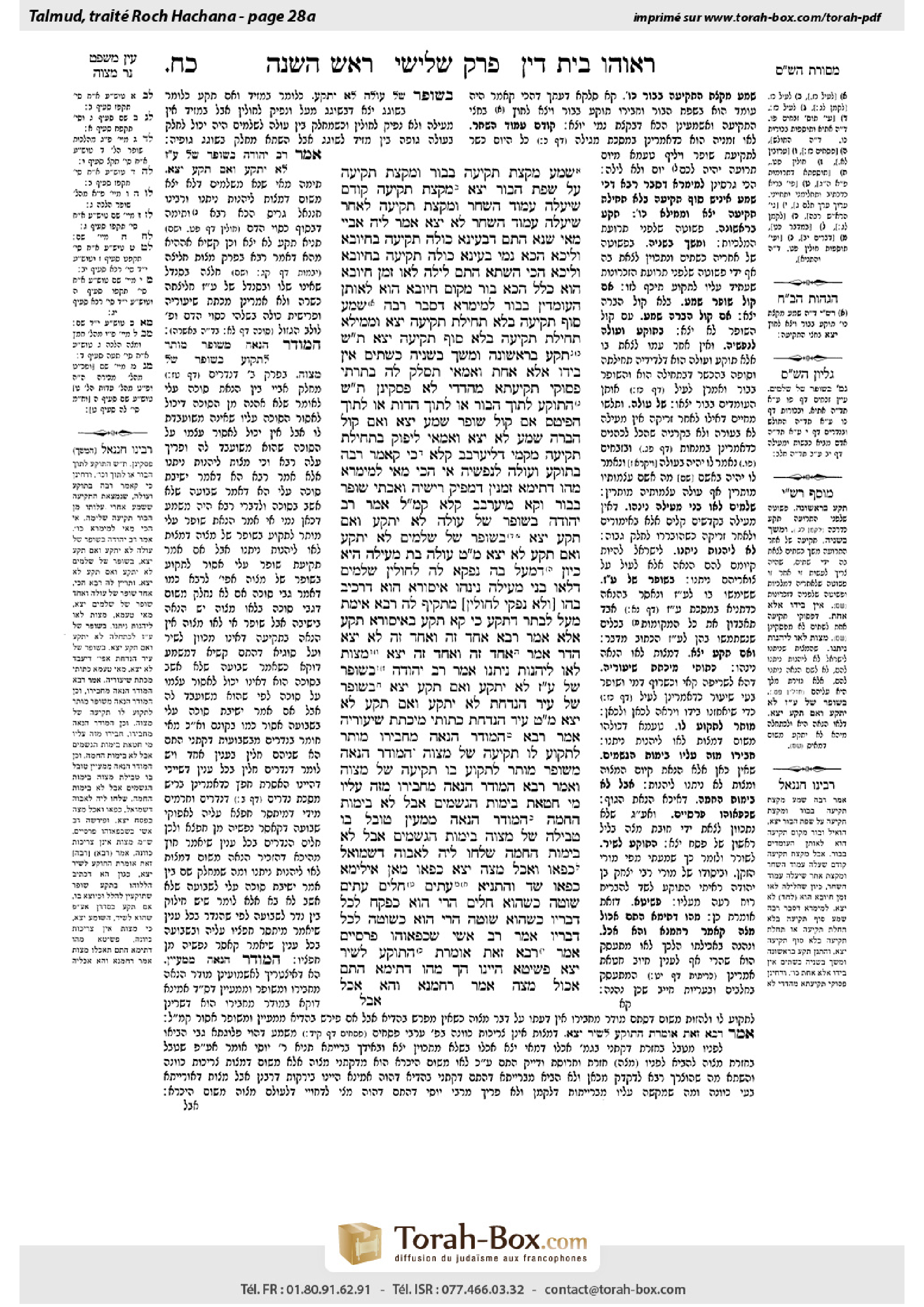
Rosh Hashanah 28a: Talmud study for Daf Yomi
Daf Yomi is the daily study of one Talmud folio. Explore 37 tractates with scans, Hebrew text, Sefaria English and AI-generated French translations where annotated.
Passage selection and English or AI-generated French translation are available where the scan has annotations. Daf Study is independent of Torah-Box and Sefaria.
Browse Rosh Hashanah · ראש השנה · All tractatesRosh Hashanah 28a text and translations
This page of Rosh Hashanah includes the Aramaic text, an English translation and an AI-generated French translation, alongside the scan above.
ראש השנה כ״ח א · Aramaic and Hebrew text
שָׁמַע מִקְצָת תְּקִיעָה בַּבּוֹר וּמִקְצָת תְּקִיעָה עַל שְׂפַת הַבּוֹר — יָצָא. מִקְצָת תְּקִיעָה קוֹדֶם שֶׁיַּעֲלֶה עַמּוּד הַשַּׁחַר וּמִקְצָת תְּקִיעָה לְאַחַר שֶׁיַּעֲלֶה עַמּוּד הַשַּׁחַר — לֹא יָצָא.
אֲמַר לֵיהּ אַבָּיֵי: מַאי שְׁנָא הָתָם — דְּבָעֵינָא כּוּלַּהּ תְּקִיעָה בְּחִיּוּבָא, וְלֵיכָּא. הָכָא נָמֵי — בָּעֵינָא כּוּלַּהּ תְּקִיעָה בְּחִיּוּבָא, וְלֵיכָּא!
הָכִי הַשְׁתָּא?! הָתָם — לַיְלָה לָאו זְמַן חִיּוּבָא הוּא כְּלָל, הָכָא — בּוֹר מְקוֹם חִיּוּבָא הוּא לְאוֹתָן הָעוֹמְדִין בַּבּוֹר.
לְמֵימְרָא דְּסָבַר רַבָּה: שָׁמַע סוֹף תְּקִיעָה בְּלֹא תְּחִילַּת תְּקִיעָה — יָצָא, וּמִמֵּילָא: תְּחִילַּת תְּקִיעָה בְּלֹא סוֹף תְּקִיעָה — יָצָא.
תָּא שְׁמַע: תָּקַע בָּרִאשׁוֹנָה, וּמָשַׁךְ בַּשְּׁנִיָּה כִּשְׁתַּיִם — אֵין בְּיָדוֹ אֶלָּא אַחַת. וְאַמַּאי? תִּסְלַק לֵהּ בְּתַרְתֵּי! פַּסּוֹקֵי תְּקִיעָתָא מֵהֲדָדֵי לָא פָּסְקִינַן.
תָּא שְׁמַע: הַתּוֹקֵעַ לְתוֹךְ הַבּוֹר אוֹ לְתוֹךְ הַדּוּת אוֹ לְתוֹךְ הַפִּיטָס, אִם קוֹל שׁוֹפָר שָׁמַע — יָצָא, וְאִם קוֹל הֲבָרָה שָׁמַע — לֹא יָצָא. וְאַמַּאי? לִיפּוֹק בִּתְחִילַּת תְּקִיעָה מִקַּמֵּי דְּלִיעַרְבַּב קָלָא!
כִּי קָאָמַר רַבָּה — בְּתוֹקֵעַ וְעוֹלֶה לְנַפְשֵׁיהּ.
אִי הָכִי, מַאי לְמֵימְרָא? מַהוּ דְּתֵימָא: זִמְנִין דְּמַפֵּיק רֵישֵׁיהּ וְאַכַּתִּי שׁוֹפָר בְּבוֹר, וְקָא מִיעַרְבַּב קָלָא — קָא מַשְׁמַע לַן.
אָמַר רַב יְהוּדָה: בְּשׁוֹפָר שֶׁל עוֹלָה — לֹא יִתְקַע, וְאִם תָּקַע — יָצָא. בְּשׁוֹפָר שֶׁל שְׁלָמִים — לֹא יִתְקַע, וְאִם תָּקַע — לֹא יָצָא.
מַאי טַעְמָא? עוֹלָה בַּת מְעִילָה הִיא, כֵּיוָן דְּמָעַל בַּהּ — נָפְקָא לַהּ לְחוּלִּין. שְׁלָמִים דְּלָאו בְּנֵי מְעִילָה נִינְהוּ — אִיסּוּרָא הוּא דְּרָכֵיב בְּהוּ, וְלָא נָפְקִי לְחוּלִּין.
מַתְקֵיף לַהּ רָבָא: אֵימַת מָעַל — לְבָתַר דְּתָקַע, כִּי קָא תָּקַע — בְּאִיסּוּרָא תָּקַע.
אֶלָּא אָמַר רָבָא: אֶחָד זֶה וְאֶחָד זֶה — לֹא יָצָא. הֲדַר אָמַר: אֶחָד זֶה וְאֶחָד זֶה — יָצָא. מִצְוֹת לָאו לֵיהָנוֹת נִיתְּנוּ.
אָמַר רַב יְהוּדָה: בְּשׁוֹפָר שֶׁל עֲבוֹדָה זָרָה — לֹא יִתְקַע, וְאִם תָּקַע — יָצָא. בְּשׁוֹפָר שֶׁל עִיר הַנִּדַּחַת — לֹא יִתְקַע, וְאִם תָּקַע — לֹא יָצָא. מַאי טַעְמָא: עִיר הַנִּדַּחַת כַּתּוֹתֵי מְיכַתַּת שִׁיעוּרֵיהּ.
אָמַר רָבָא: הַמּוּדָּר הֲנָאָה מֵחֲבֵירוֹ — מוּתָּר לִתְקוֹעַ לוֹ תְּקִיעָה שֶׁל מִצְוָה. הַמּוּדָּר הֲנָאָה מִשּׁוֹפָר — מוּתָּר לִתְקוֹעַ בּוֹ תְּקִיעָה שֶׁל מִצְוָה.
וְאָמַר רָבָא: הַמּוּדָּר הֲנָאָה מֵחֲבֵירוֹ — מַזֶּה עָלָיו מֵי חַטָּאת בִּימוֹת הַגְּשָׁמִים, אֲבָל לֹא בִּימוֹת הַחַמָּה. הַמּוּדָּר הֲנָאָה מִמַּעְיָן — טוֹבֵל בּוֹ טְבִילָה שֶׁל מִצְוָה בִּימוֹת הַגְּשָׁמִים, אֲבָל לֹא בִּימוֹת הַחַמָּה.
שְׁלַחוּ לֵיהּ לַאֲבוּהּ דִּשְׁמוּאֵל: כְּפָאוֹ וְאָכַל מַצָּה — יָצָא. כְּפָאוֹ מַאן? אִילֵימָא כְּפָאוֹ שֵׁד, וְהָתַנְיָא: עִתִּים חָלִים עִתִּים שׁוֹטֶה, כְּשֶׁהוּא חָלִים — הֲרֵי הוּא כְּפִקֵּחַ לְכׇל דְּבָרָיו, כְּשֶׁהוּא שׁוֹטֶה — הֲרֵי הוּא כְּשׁוֹטֶה לְכׇל דְּבָרָיו!
אָמַר רַב אָשֵׁי: שֶׁכְּפָאוּהוּ פָּרְסִיִּים. אָמַר רָבָא, זֹאת אוֹמֶרֶת: הַתּוֹקֵעַ לָשִׁיר — יָצָא.
פְּשִׁיטָא, הַיְינוּ הָךְ! מַהוּ דְּתֵימָא: הָתָם, אֱכוֹל מַצָּה אָמַר רַחֲמָנָא — וְהָא אֲכַל,
Rosh Hashanah 28a · English translation
If one heard part of the blast in the pit and part of the blast at the edge of the pit, he has fulfilled his obligation. But if he heard part of the blast before dawn, when it is not yet time to sound the shofar, and part of the blast after dawn, he has not fulfilled his obligation.
Abaye said to him: What is different there, in the case of one who heard part of the blast before dawn and part of it after dawn? If you say that there the entire blast needs to be heard in a time of obligation, and when he hears part of the blast before dawn and part after dawn it is not all within the same time of obligation, here too, in the case of the pit, the entire blast needs to be in a place where one can fulfill his obligation, and when he hears part of the blast in a pit and part at the edge, it is not all within a place where he can fulfill his obligation.
The Gemara rejects this argument: How can these cases be compared? There, night is not a time of obligation at all, and sounding the shofar then has no meaning whatsoever, but here, a pit is a place of obligation for those standing in the pit. That is to say, the part of the blast that was heard in the pit is not inherently invalid, but merely disqualified due to an external factor, so that it is possible to connect it with the part of the blast that was heard at the edge of the pit.
The Gemara asks: Is this to say that Rabba maintains that if one heard the end of a blast without hearing the beginning of the blast, he has fulfilled his obligation? Because in the case where one heard the beginning of the blast in a pit, he is considered to have heard only the end of the shofar blast, which he heard at the edge of the pit. And it therefore follows that if one heard the beginning of a blast without hearing the end of the blast, he has also fulfilled his obligation.
Come and hear a proof that this is not so, for we learned in the mishna: If one blew the initial tekia of the first set of tekia-terua-tekia, and then drew out the second tekia so that it spans the length of two tekiot, it counts as only one tekia, and is not considered two tekiot, i.e., the concluding tekia of the first set, and the initial tekia of the second set. But why is this so? If we consider part of a blast as a complete one, let it count as two tekiot. The Gemara explains: If one hears only the beginning or the end of a shofar blast, he has indeed fulfilled his obligation, but nevertheless, we do not divide a shofar blast into two.
The Gemara raises another difficulty: Come and hear that which was taught in a mishna: If one sounds a shofar into a pit, or into a cistern, or into a large jug, if he clearly heard the sound of the shofar, he has fulfilled his obligation; but if he heard the sound of an echo, he has not fulfilled his obligation. But why is this so? If indeed half a blast is considered a blast, let him fulfill his obligation with the beginning of the blast, before the sound of the shofar is confused with the echo, since he heard the beginning of the blast clearly.
The Gemara answers: Indeed, half a blast is not considered a blast, and Rabba’s statement must be understood differently. When Rabba spoke, he was speaking not about other people hearing the blast, but about one who was sounding the shofar for himself in a pit and emerged from the pit as he was blowing. He has fulfilled his obligation, because he was located in the same place as the sound of the shofar at all times, and so he heard the entire blast clearly.
The Gemara asks: If so, what is the purpose of Rabba’s statement? The halakha in this case should be obvious, as there is no reason that the blast should be disqualified. The Gemara answers: Lest you say that his head might sometimes emerge from the pit while the shofar itself is still in the pit, and the sound may become confused with its echo, and so he would not fulfill his obligation. Therefore, Rabba teaches us that we are not concerned about this, and the obligation is considered to have been fulfilled.
§ Rav Yehuda said: One should not blow with the shofar of an animal consecrated as a burnt-offering, but if he nevertheless transgressed and blew, he has fulfilled his obligation. One should also not blow with the shofar of an animal consecrated as a peace-offering, and if he nevertheless transgressed and blew, he has not fulfilled his obligation.
The Gemara explains: What is the reason for this distinction? A burnt-offering is subject to misuse of consecrated objects before being offered, and once one misuses it for mundane purposes, it becomes non-sacred, so that the one who blows with its shofar fulfills his obligation. In contrast, peace-offerings are not subject to misuse of consecrated objects before being offered, since in the case of sacrifices of lesser sanctity, misuse is restricted to the fats and other portions that are offered on the altar, and even this applies only after the sprinkling of the blood. Since one is not considered to be misusing peace-offerings when utilizing them for mundane purposes, the prohibition remains intact and they do not become non-sacred. Therefore, one who blows the shofar of an animal consecrated as a peace-offering does not fulfill his obligation.
Rava strongly objects to this argument: When does he commit misuse? After he has sounded it, for only then has he misused the consecrated animal. If so, when he sounds it, he is sounding with something that is still prohibited, even in the case of the animal that was consecrated as a burnt-offering, and so he should not be able to fulfill his obligation with it.
Rather, Rava said: Both this one, the shofar of a burnt-offering, and the other one, the shofar of a peace-offering, are governed by the same halakha: If he sounded them, he has not fulfilled his obligation. Later, Rava retracted his statement and then said the opposite: Both this one, the shofar of a burnt-offering, and the other one, the shofar of a peace-offering, are governed by the same halakha: If he sounded them, he has fulfilled his obligation. The reason for this is that mitzvot were not given for benefit. That is to say, the fulfillment of a mitzva is not in itself considered a benefit, and in the absence of benefit, one is not liable for misuse.
Rav Yehuda said further: One should not sound a shofar that was used for idol worship, but if he nevertheless transgressed and sounded it, he has fulfilled his obligation. One should also not sound a shofar from a city whose residents were incited to idolatry, where the majority of inhabitants committed idolatry, but if he nevertheless transgressed and sounded it, he has not fulfilled his obligation. What is the reason for this last ruling? With regard to any object found in a city whose residents were incited to idolatry, its size as required for the mitzva is seen by halakha as crushed into powder. Since a shofar from a city whose residents were incited to idolatry is destined for burning, it is considered as if it is already burnt, and it therefore lacks the requisite measurement for fulfilling the mitzva.
Rava said: If one is prohibited by vow from deriving benefit from another, i.e., if he took a vow not to receive any benefit whatsoever from a certain person, that other person is nevertheless permitted to sound a blast for him so that he fulfills the mitzva, in accordance with the principle that the fulfillment of a mitzva is not in itself considered a benefit. For the same reason, if one is prohibited by vow from deriving benefit from a particular shofar, he is nevertheless permitted to sound a blast with it so that he may fulfill the mitzva.
And Rava said further: If one is prohibited by vow from deriving benefit from another, that other person may nevertheless sprinkle the waters of purification on him, i.e., water mixed with the ashes of the red heifer, which was used to purify people and objects that had contracted ritual impurity through contact with a corpse, in the rainy season, for at that time the sprinkling is performed only in order to fulfill a mitzva. But he may not do so in the summer season, since then he also benefits from the very fact that water is being sprinkled on him. Similarly, if one is prohibited by vow from deriving benefit from a particular spring, he may nevertheless immerse in it an immersion performed in order to fulfill a mitzva in the rainy season, but not in the summer season, since then he also derives benefit from the very fact that he has immersed in cold water.
§ It is related that the following ruling was sent from Eretz Yisrael to Shmuel’s father: If one was forcibly compelled to eat matza on Passover, he has fulfilled his obligation. The Gemara clarifies the matter: Who compelled him to eat the matza? If we say that a demon forced him, i.e., that he ate it in a moment of insanity, this is difficult. Isn’t it taught in a baraita: With regard to someone who is at times sane and at times insane, at the times when he is sane, he is considered halakhically competent for all purposes and is obligated in all the mitzvot. And when he is insane, he is considered insane for all purposes, and is therefore exempt from the mitzvot. If so, someone who was compelled by a demon to eat matza is not considered obligated to perform the mitzvot at all.
Rav Ashi said: We are dealing with a case where the Persians compelled him to eat. Rava said: That is to say that one who sounds a shofar for the music, having no intent to fulfill the mitzva, fulfills his obligation, since the critical issue is hearing the blast and not the intent of the blower.
The Gemara asks: Isn’t it obvious that this is identical to that which was stated above, that one who was compelled to eat matza fulfills the mitzva even if he had no intention of doing so? The same should apply in the case of the shofar, that one who heard the blast of a shofar fulfills his obligation even if he had no intention of doing so. The Gemara answers: Lest you say that there is a difference between the two cases, there, the Merciful One says: Eat matza, and he indeed ate it, thereby fulfilling the mitzva.
Rosh Hashanah 28a · Traduction française (IA)
S’il a entendu une partie de la sonnerie dans la fosse et une partie au bord de la fosse, il s’est acquitté de son obligation. Mais s’il a entendu une partie de la sonnerie avant l’aube, alors que ce n’est pas encore le moment de sonner du chofar, et une partie après l’aube, il ne s’est pas acquitté de son obligation.
Abayé lui dit : En quoi le cas de celui qui a entendu une partie de la sonnerie avant l’aube et une partie après l’aube diffère-t-il ? Si tu dis que, dans ce cas, la sonnerie entière doit être entendue à un moment où l’on est tenu de s’acquitter de l’obligation, et que lorsqu’il en entend une partie avant l’aube et une partie après, elle n’est pas entièrement entendue pendant le même temps d’obligation, il en va de même ici, dans le cas de la fosse : la sonnerie entière doit être entendue en un lieu où l’on peut s’acquitter de son obligation, et lorsqu’il en entend une partie dans la fosse et une partie au bord, elle n’est pas entièrement entendue en un lieu où il peut s’acquitter de son obligation.
La Guemara rejette cet argument : Comment peut-on comparer ces cas ? Dans le premier cas, la nuit n’est absolument pas un moment où l’on est tenu à l’obligation, et sonner du chofar à ce moment-là n’a aucun sens. Ici, en revanche, la fosse est un lieu où ceux qui s’y tiennent sont tenus à l’obligation. Autrement dit, la partie de la sonnerie entendue dans la fosse n’est pas intrinsèquement invalide ; elle est seulement disqualifiée par un facteur extérieur, de sorte qu’on peut la joindre à la partie entendue au bord de la fosse.
La Guemara demande : Cela signifie-t-il que Rabba considère que si quelqu’un entend la fin d’une sonnerie sans en entendre le début, il s’est acquitté de son obligation ? En effet, dans le cas où quelqu’un a entendu le début de la sonnerie dans une fosse, on considère qu’il n’a entendu que la fin de la sonnerie du chofar, celle qu’il a entendue au bord de la fosse. Il s’ensuit donc que si quelqu’un entend le début d’une sonnerie sans en entendre la fin, il s’est également acquitté de son obligation.
Viens et entends une preuve qu’il n’en est pas ainsi, car nous avons appris dans la Michna : Si quelqu’un a sonné la première tekia de la première série tekia-teroua-tekia, puis a prolongé la deuxième tekia au point qu’elle dure autant que deux tekiot, elle ne compte que comme une seule tekia et n’est pas considérée comme deux tekiot, c’est-à-dire la tekia finale de la première série et la tekia initiale de la deuxième série. Mais pourquoi en est-il ainsi ? Si l’on considère qu’une partie d’une sonnerie équivaut à une sonnerie complète, qu’elle compte donc comme deux tekiot ! La Guemara explique : Si quelqu’un entend seulement le début ou la fin d’une sonnerie de chofar, il s’est effectivement acquitté de son obligation ; néanmoins, on ne divise pas une sonnerie de chofar en deux.
La Guemara soulève une autre difficulté : Viens et entends ce qui a été enseigné dans une Michna : Si quelqu’un sonne du chofar dans une fosse, une citerne ou une grande jarre, s’il a clairement entendu le son du chofar, il s’est acquitté de son obligation ; mais s’il a entendu un écho, il ne s’en est pas acquitté. Mais pourquoi en est-il ainsi ? Si une demi-sonnerie est effectivement considérée comme une sonnerie, qu’il s’acquitte de son obligation grâce au début de la sonnerie, avant que le son du chofar ne se confonde avec l’écho, puisqu’il en a clairement entendu le début.
La Guemara répond : En réalité, une demi-sonnerie n’est pas considérée comme une sonnerie, et la déclaration de Rabba doit être comprise autrement. Rabba ne parlait pas d’autres personnes qui entendent la sonnerie, mais de quelqu’un qui sonne du chofar pour lui-même dans une fosse et en sort pendant qu’il sonne. Il s’est acquitté de son obligation, car il se trouvait à tout moment au même endroit que le son du chofar et a donc entendu toute la sonnerie clairement.
La Guemara demande : Si tel est le cas, à quoi sert la déclaration de Rabba ? La halakha dans cette situation devrait être évidente, puisqu’il n’y a aucune raison que la sonnerie soit disqualifiée. La Guemara répond : De peur que tu ne dises que sa tête pourrait parfois sortir de la fosse alors que le chofar lui-même s’y trouve encore, et que le son risque de se confondre avec son écho, de sorte qu’il ne s’acquitterait pas de son obligation. Rabba nous enseigne donc qu’il n’y a pas lieu de s’en inquiéter et que l’obligation est considérée comme accomplie.
§ Rav Yehouda a dit : On ne doit pas sonner avec le chofar d’un animal consacré comme holocauste ; mais s’il a néanmoins transgressé et sonné, il s’est acquitté de son obligation. On ne doit pas non plus sonner avec le chofar d’un animal consacré comme sacrifice de paix ; s’il a néanmoins transgressé et sonné, il ne s’est pas acquitté de son obligation.
La Guemara explique : Quelle est la raison de cette distinction ? Un holocauste est susceptible d’être l’objet d’un usage profane avant d’être offert ; une fois qu’on en a fait un usage profane, il cesse d’être consacré, de sorte que celui qui sonne avec son chofar s’acquitte de son obligation. En revanche, les sacrifices de paix ne sont pas susceptibles d’être l’objet d’un usage profane avant d’être offerts, car, dans le cas des sacrifices de moindre sainteté, cet usage ne concerne que les graisses et les autres parties offertes sur l’autel, et cela seulement après l’aspersion du sang. Puisqu’utiliser les sacrifices de paix à des fins profanes ne constitue pas un usage profane au regard de la loi, l’interdiction demeure et ils ne cessent pas d’être consacrés. Par conséquent, celui qui sonne avec le chofar d’un animal consacré comme sacrifice de paix ne s’acquitte pas de son obligation.
Rava s’oppose vivement à cet argument : À quel moment commet-il un usage profane ? Après avoir sonné, car ce n’est qu’alors qu’il a fait un usage profane de l’animal consacré. Si tel est le cas, au moment où il sonne, il sonne avec un objet qui est encore interdit, même dans le cas de l’animal consacré comme holocauste ; il ne devrait donc pas pouvoir s’acquitter de son obligation avec celui-ci.
Rava dit plutôt : Ces deux cas, celui du chofar d’un holocauste et celui du chofar d’un sacrifice de paix, relèvent de la même halakha : s’il a sonné avec l’un ou l’autre, il ne s’est pas acquitté de son obligation. Par la suite, Rava revint sur sa déclaration, puis dit l’inverse : ces deux cas relèvent de la même halakha : s’il a sonné avec l’un ou l’autre, il s’est acquitté de son obligation. La raison en est que les mitsvot n’ont pas été données pour procurer un bénéfice. Autrement dit, l’accomplissement d’une mitsva n’est pas en soi considéré comme un bénéfice ; en l’absence de bénéfice, on n’est pas passible d’avoir fait un usage profane d’un objet consacré.
Rav Yehouda a dit également : On ne doit pas sonner avec un chofar qui a servi au culte idolâtre ; mais s’il a néanmoins transgressé et sonné, il s’est acquitté de son obligation. On ne doit pas non plus sonner avec un chofar provenant d’une ville dont les habitants ont été incités à l’idolâtrie, où la majorité des habitants a commis des actes idolâtres ; mais s’il a néanmoins transgressé et sonné, il ne s’est pas acquitté de son obligation. Quelle est la raison de cette dernière règle ? Pour tout objet trouvé dans une ville dont les habitants ont été incités à l’idolâtrie, la halakha considère que la mesure requise pour la mitsva est réduite en poudre. Puisqu’un chofar provenant d’une telle ville est destiné à être brûlé, on le considère comme déjà brûlé ; il ne possède donc plus la mesure requise pour accomplir la mitsva.
Rava a dit : Si quelqu’un a fait le vœu de ne tirer aucun profit d’une personne donnée, cette dernière est néanmoins autorisée à sonner pour lui afin qu’il accomplisse la mitsva, conformément au principe selon lequel l’accomplissement d’une mitsva n’est pas en soi considéré comme un bénéfice. Pour la même raison, si quelqu’un a fait le vœu de ne tirer aucun profit d’un chofar donné, il est néanmoins autorisé à sonner avec ce chofar afin d’accomplir la mitsva.
Rava a dit également : Si quelqu’un a fait le vœu de ne tirer aucun profit d’une autre personne, cette dernière peut néanmoins lui asperger les eaux de purification, c’est-à-dire de l’eau mêlée aux cendres de la vache rousse, utilisée pour purifier les personnes et les objets qui ont contracté une impureté rituelle au contact d’un cadavre, pendant la saison des pluies, car à cette période l’aspersion n’est effectuée que pour accomplir une mitsva. Mais elle ne peut pas le faire pendant l’été, puisqu’alors il tire aussi profit du simple fait que de l’eau est aspergée sur lui. De même, si quelqu’un a fait le vœu de ne tirer aucun profit d’une source donnée, il peut néanmoins s’y immerger pour accomplir une mitsva pendant la saison des pluies, mais pas pendant l’été, car il tire alors également profit du simple fait de s’être immergé dans de l’eau froide.
§ On rapporte que la décision suivante fut envoyée d’Eretz Israël au père de Chmouel : Si quelqu’un a été contraint de manger de la matsa à Pessa’h, il s’est acquitté de son obligation. La Guemara précise : Qui l’a contraint à manger de la matsa ? Si nous disons qu’un démon l’a forcé, c’est-à-dire qu’il l’a mangée dans un moment de folie, cela pose difficulté. N’est-il pas enseigné dans une baraïta : Celui qui est tantôt sain d’esprit, tantôt fou, est considéré, lorsqu’il est sain d’esprit, comme apte au regard de la halakha à tous égards et tenu d’accomplir toutes les mitsvot ; lorsqu’il est fou, il est considéré comme fou à tous égards et est donc exempt des mitsvot. Si tel est le cas, celui qu’un démon a contraint à manger de la matsa n’est pas considéré comme tenu d’accomplir les mitsvot.
Rav Achi a dit : Nous parlons d’un cas où les Perses l’ont contraint à manger. Rava a dit : Cela signifie que celui qui sonne du chofar pour en jouer, sans avoir l’intention d’accomplir la mitsva, s’acquitte de son obligation, car l’élément déterminant est le fait d’entendre la sonnerie, et non l’intention de celui qui sonne.
La Guemara demande : N’est-il pas évident que cela revient au même que ce qui a été dit plus haut, à savoir que celui qui a été contraint de manger de la matsa accomplit la mitsva même s’il n’en avait pas l’intention ? Il devrait en être de même pour le chofar : celui qui a entendu la sonnerie d’un chofar s’acquitte de son obligation même s’il n’en avait pas l’intention. La Guemara répond : De peur que tu ne dises qu’il existe une différence entre les deux cas : dans le premier, le Miséricordieux dit : « Mange de la matsa », et il en a effectivement mangé, accomplissant ainsi la mitsva.
Traduction française générée par IA à partir de l’édition anglaise de Sefaria. Vérifie toujours un passage avec le texte source.
Text from Sefaria: William Davidson Edition - Vocalized Aramaic (CC BY NC); William Davidson Edition - English (CC BY NC).