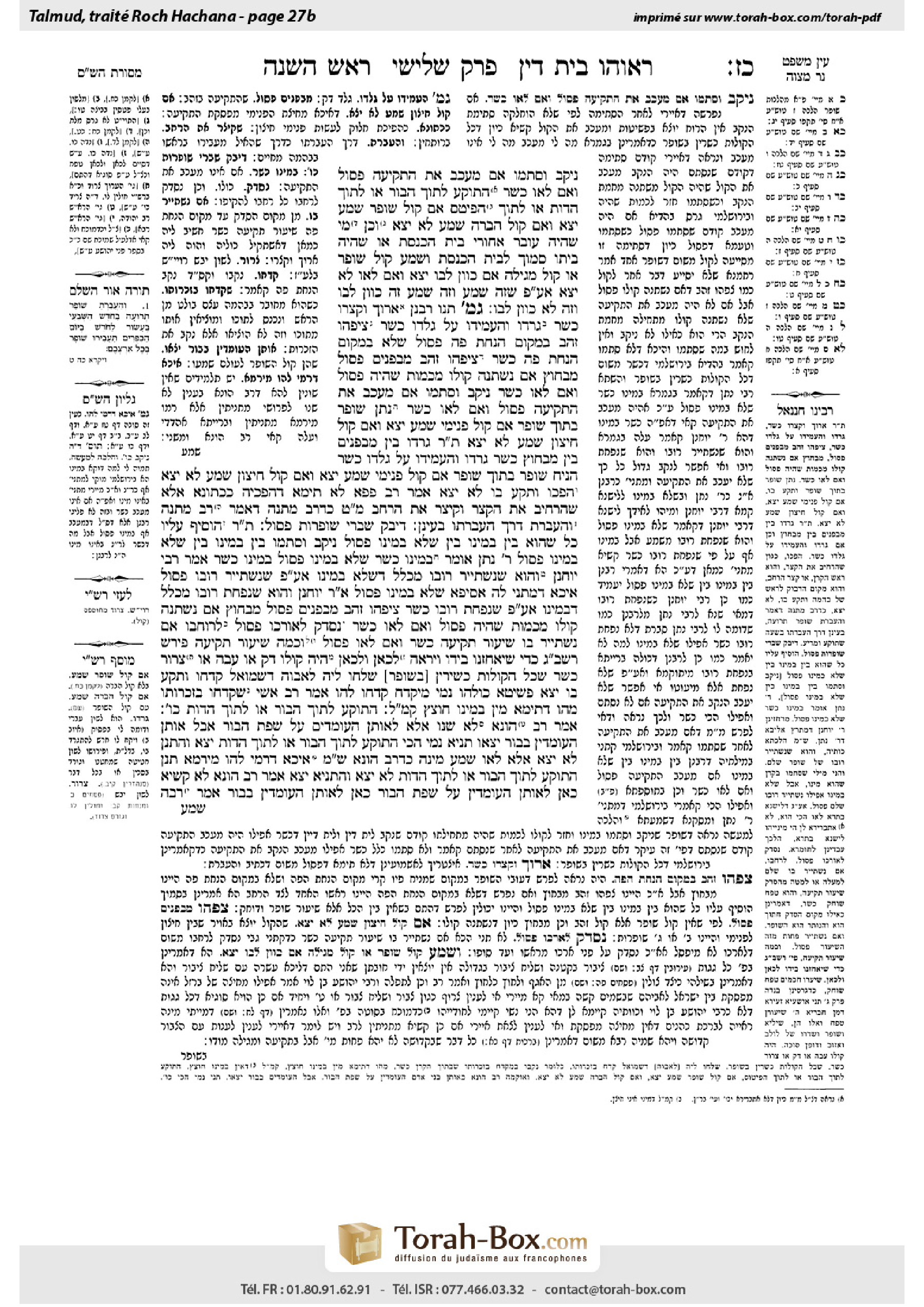
Rosh Hashanah 27b: Talmud study for Daf Yomi
Daf Yomi is the daily study of one Talmud folio. Explore 37 tractates with scans, Hebrew text, Sefaria English and AI-generated French translations where annotated.
Passage selection and English or AI-generated French translation are available where the scan has annotations. Daf Study is independent of Torah-Box and Sefaria.
Browse Rosh Hashanah · ראש השנה · All tractatesRosh Hashanah 27b text and translations
This page of Rosh Hashanah includes the Aramaic text, an English translation and an AI-generated French translation, alongside the scan above.
ראש השנה כ״ז ב · Aramaic and Hebrew text
נִיקַּב וּסְתָמוֹ, אִם מְעַכֵּב אֶת הַתְּקִיעָה — פָּסוּל, וְאִם לָאו — כָּשֵׁר. הַתּוֹקֵעַ לְתוֹךְ הַבּוֹר אוֹ לְתוֹךְ הַדּוּת אוֹ לְתוֹךְ הַפִּיטָס, אִם קוֹל שׁוֹפָר שָׁמַע — יָצָא, וְאִם קוֹל הֲבָרָה שָׁמַע — לָא יָצָא.
וְכֵן מִי שֶׁהָיָה עוֹבֵר אֲחוֹרֵי בֵּית הַכְּנֶסֶת, אוֹ שֶׁהָיָה בֵּיתוֹ סָמוּךְ לְבֵית הַכְּנֶסֶת, וְשָׁמַע קוֹל שׁוֹפָר אוֹ קוֹל מְגִילָּה, אִם כִּוֵּון לִבּוֹ — יָצָא, וְאִם לָאו — לֹא יָצָא. אַף עַל פִּי שֶׁזֶּה שָׁמַע וְזֶה שָׁמַע, זֶה כִּוֵּון לִבּוֹ, וְזֶה לֹא כִּוֵּון לִבּוֹ.
גְּמָ׳ תָּנוּ רַבָּנַן: אָרוֹךְ וְקִצְּרוֹ — כָּשֵׁר. גֵּרְדוֹ וְהֶעֱמִידוֹ עַל גִּלְדּוֹ — כָּשֵׁר. צִיפָּהוּ זָהָב בִּמְקוֹם הַנָּחַת פֶּה — פָּסוּל. שֶׁלֹּא בִּמְקוֹם הַנָּחַת פֶּה — כָּשֵׁר. צִיפָּהוּ זָהָב מִבִּפְנִים — פָּסוּל. מִבַּחוּץ, אִם נִשְׁתַּנָּה קוֹלוֹ מִכְּמוֹת שֶׁהָיָה — פָּסוּל, וְאִם לָאו — כָּשֵׁר.
נִיקַּב וּסְתָמוֹ, אִם מְעַכֵּב אֶת הַתְּקִיעָה — פָּסוּל, וְאִם לָאו — כָּשֵׁר. נָתַן שׁוֹפָר בְּתוֹךְ שׁוֹפָר, אִם קוֹל פְּנִימִי שָׁמַע — יָצָא, וְאִם קוֹל חִיצוֹן שָׁמַע — לֹא יָצָא.
תָּנוּ רַבָּנַן: גֵּרְדוֹ, בֵּין מִבִּפְנִים בֵּין מִבַּחוּץ — כָּשֵׁר. גֵּרְדוֹ וְהֶעֱמִידוֹ עַל גִּלְדּוֹ — כָּשֵׁר. הִנִּיחַ שׁוֹפָר בְּתוֹךְ שׁוֹפָר, אִם קוֹל פְּנִימִי שָׁמַע — יָצָא, וְאִם קוֹל חִיצוֹן שָׁמַע — לֹא יָצָא. הֲפָכוֹ וְתָקַע בּוֹ — לֹא יָצָא.
אָמַר רַב פָּפָּא: לָא תֵּימָא דְּהַפְכֵיהּ כְּכִתּוּנָא, אֶלָּא שֶׁהִרְחִיב אֶת הַקָּצָר וְקִיצֵּר אֶת הָרָחָב. מַאי טַעְמָא — כִּדְרַב מַתְנָה. דְּאָמַר רַב מַתְנָה: ״וְהַעֲבַרְתָּ״ — דֶּרֶךְ הַעֲבָרָתוֹ בָּעֵינַן.
דִּיבֵּק שִׁבְרֵי שׁוֹפָרוֹת — פָּסוּל. תָּנוּ רַבָּנַן: הוֹסִיף עָלָיו כׇּל שֶׁהוּא, בֵּין בְּמִינוֹ בֵּין שֶׁלֹּא בְּמִינוֹ — פָּסוּל. נִיקַּב וּסְתָמוֹ, בֵּין בְּמִינוֹ בֵּין שֶׁלֹּא בְּמִינוֹ — פָּסוּל. רַבִּי נָתָן אוֹמֵר: בְּמִינוֹ — כָּשֵׁר, שֶׁלֹּא בְּמִינוֹ — פָּסוּל.
בְּמִינוֹ כָּשֵׁר — אָמַר רַבִּי יוֹחָנָן: וְהוּא שֶׁנִּשְׁתַּיֵּיר רוּבּוֹ. מִכְּלָל דְּשֶׁלֹּא בְּמִינוֹ, אַף עַל פִּי שֶׁנִּשְׁתַּיֵּיר רוּבּוֹ — פָּסוּל.
אִיכָּא דְּמַתְנֵי לַהּ אַסֵּיפָא: שֶׁלֹּא בְּמִינוֹ — פָּסוּל, אָמַר רַבִּי יוֹחָנָן: וְהוּא שֶׁנִּפְחַת רוּבּוֹ. מִכְּלָל דִּבְמִינוֹ, אַף עַל פִּי שֶׁנִּפְחַת רוּבּוֹ — כָּשֵׁר.
צִיפָּהוּ זָהָב, מִבִּפְנִים — פָּסוּל. מִבַּחוּץ, אִם נִשְׁתַּנָּה קוֹלוֹ מִכְּמוֹת שֶׁהָיָה — פָּסוּל, וְאִם לָאו — כָּשֵׁר. נִסְדַּק לְאוֹרְכּוֹ — פָּסוּל. לְרוֹחְבּוֹ, אִם נִשְׁתַּיֵּיר בּוֹ שִׁיעוּר תְּקִיעָה — כָּשֵׁר, וְאִם לָאו — פָּסוּל.
וְכַמָּה שִׁיעוּר תְּקִיעָה? פֵּירֵשׁ רַבִּי שִׁמְעוֹן בֶּן גַּמְלִיאֵל: כְּדֵי שֶׁיֹּאחֲזֶנּוּ בְּיָדוֹ וְיֵרָאֶה לְכָאן וּלְכָאן. הָיָה קוֹלוֹ דַּק אוֹ עָבֶה אוֹ צָרוּר — כָּשֵׁר, שֶׁכׇּל הַקּוֹלוֹת כְּשֵׁירִין [בְּשׁוֹפָר].
שְׁלַחוּ לֵיהּ לַאֲבוּהּ דִּשְׁמוּאֵל: קְדָחוֹ וְתָקַע בּוֹ — יָצָא. פְּשִׁיטָא, כּוּלְּהוּ נָמֵי מִיקְדָּח קָדְחוּ לְהוּ?
אָמַר רַב אָשֵׁי: שֶׁקְּדָחוֹ בְּזַכְרוּתוֹ. מַהוּ דְּתֵימָא: מִין בְּמִינוֹ — חוֹצֵץ, קָא מַשְׁמַע לַן.
הַתּוֹקֵעַ לְתוֹךְ הַבּוֹר אוֹ לְתוֹךְ הַדּוּת כּוּ׳. אָמַר רַב הוּנָא: לֹא שָׁנוּ אֶלָּא לְאוֹתָן הָעוֹמְדִים עַל שְׂפַת הַבּוֹר, אֲבָל אוֹתָן הָעוֹמְדִין בַּבּוֹר — יָצְאוּ.
תַּנְיָא נָמֵי הָכִי: הַתּוֹקֵעַ לְתוֹךְ הַבּוֹר אוֹ לְתוֹךְ הַדּוּת — יָצָא. וְהָתְנַן: לֹא יָצָא! אֶלָּא לָאו, שְׁמַע מִינַּהּ כִּדְרַב הוּנָא, שְׁמַע מִינַּהּ.
אִיכָּא דְּרָמֵי לְהוּ מִירְמֵא. תְּנַן: הַתּוֹקֵעַ לְתוֹךְ הַבּוֹר אוֹ לְתוֹךְ הַדּוּת — לֹא יָצָא. וְהָתַנְיָא: יָצָא! אָמַר רַב הוּנָא: לָא קַשְׁיָא, כָּאן — לְאוֹתָן הָעוֹמְדִין עַל שְׂפַת הַבּוֹר, כָּאן — לְאוֹתָן הָעוֹמְדִין בַּבּוֹר.
אָמַר רַבָּה:
Rosh Hashanah 27b · English translation
If the shofar was punctured and the puncture was sealed, if it impedes the blowing, the shofar is unfit, but if not, it is fit. If one sounds a shofar into a pit, or into a cistern, or into a large jug, if he clearly heard the sound of the shofar, he has fulfilled his obligation; but if he heard the sound of an echo, he has not fulfilled his obligation.
And similarly, if one was passing behind a synagogue, or his house was adjacent to the synagogue, and he heard the sound of the shofar or the sound of the Scroll of Esther being read, if he focused his heart, i.e. his intent, to fulfill his obligation, he has fulfilled his obligation; but if not, he has not fulfilled his obligation. It is therefore possible for two people to hear the shofar blasts, but only one of them fulfills his obligation. Even though this one heard and also the other one heard, nevertheless, this one focused his heart to fulfill his obligation and has therefore indeed fulfilled it, but the other one did not focus his heart, and so he has not fulfilled his obligation.
GEMARA: The Sages taught in a baraita: If a shofar was long and it was shortened, it is still fit. If it was scraped out, so that only its outer layer remains, it is also fit. If the shofar was plated with gold at the place where one puts his mouth, it is unfit; if it was plated not at the place where he puts his mouth, it is fit. If it was plated with gold on the inside, it is unfit, as one does not hear the sound of a shofar but the sound of a golden instrument. If, however, it was plated with gold on the outside, the following distinction applies: If its sound changed from what it was before the plating, it is unfit, but if not, the gold plating is mere ornamentation and it is therefore fit.
The baraita continues: If the shofar was punctured and the puncture was sealed, if it impedes the blowing, the shofar is unfit, but if not, it is fit. If one placed one shofar inside another shofar and blew, if he heard the sound of the inner shofar, he has fulfilled his obligation, because it is considered one shofar, but if he heard the sound of the outer shofar he has not fulfilled it, as the sound issues from two shofarot at once.
The Sages taught in a different baraita: If a shofar was scraped down, whether on the inside or on the outside, it is fit. Even if it was scraped out to the point that only its outer layer remains, it is still fit. If one placed one shofar inside another shofar and blew, if he heard the sound of the inner shofar, he has fulfilled his obligation, but if he heard the sound of the outer shofar, he has not fulfilled his obligation. If he inverted the shofar and blew it, he has not fulfilled his obligation.
Rav Pappa said: Do not say that this means that he softened the shofar and turned it inside out like a tunic. Rather, the meaning is that he widened the narrow end of the shofar and narrowed its wide end. What is the reason that this is unfit? It is according to the opinion of Rav Mattana, as Rav Mattana said that the verse states: “You shall proclaim [veha’avarta] with the shofar” (Leviticus 25:9), where the word veha’avarta literally means carry, thereby teaching that we need the shofar to be sounded the same way that it was carried on the head of the animal, and if a change was made, it is unfit.
§ It was taught in the mishna: If one glued together broken fragments of shofarot to form a complete shofar, the shofar is unfit. The Sages taught in a baraita: If anything was added to a shofar, whether of the same substance, i.e., horn, or of a foreign substance, the shofar is unfit. If the shofar was punctured and sealed, whether with the same substance or with a foreign substance, it is unfit. Rabbi Natan says: If it was sealed with the same substance, it is fit; with a foreign substance, it is unfit.
The baraita stated: If it was sealed with the same substance, it is fit. Concerning this Rabbi Yoḥanan said: This applies only where most of the original shofar is intact and only a small patch was added. The Gemara concludes: By inference, if it was sealed with a foreign substance, then even if most of the original shofar is intact, it is unfit.
Some teach this ruling with regard to the last clause of the baraita, in which it was taught: If it was sealed with a foreign substance, it is unfit. Concerning this Rabbi Yoḥanan said: This is only where most of the original shofar was missing, so that the patch constitutes the majority. The Gemara concludes: By inference, if it was sealed with the same substance, then even if most of the original shofar was missing, it is still fit.
The baraita continues: If the shofar was plated with gold on the inside, it is unfit. If, however, it was plated on the outside, and if its sound changed from what it was before the plating, it is unfit, but if not, it is fit. If the shofar was cracked lengthwise, it is unfit. But if it was cracked along its width, the following distinction applies: If, of the portion above the crack there remains a measure sufficient to sound a blast, it is fit, but if not, it is unfit.
And how much is a measure sufficient to sound a blast? Rabban Shimon ben Gamliel explained: Enough that when he holds it in his hand, it can be seen protruding on one side of his hand and on the other side. If the sound of the shofar is high or deep or dry, it is fit for blowing, as the Torah does not require a particular sound, and all sounds coming from a shofar are fit.
It is related that the following ruling was sent from Eretz Yisrael to Shmuel’s father: If one drilled out the inside of a horn and blew it, he has fulfilled his obligation. The Gemara asks: It is obvious, for all shofarot are drilled, since after the horn is removed from the animal, the bone that fills the horn and connects it to the animal’s head must be removed. What, then, does this ruling teach us?
Rav Ashi said: Here we are discussing a case where he drilled the bone that fills the horn instead of removing it in the usual manner. Lest you say that even something made of the same substance interposes, and the sound that is produced is emitted from the bone and not from the shofar, the ruling therefore teaches us that since the bone and the horn are considered to be of the same substance, the shofar is fit and he has fulfilled his obligation.
§ It was taught in the mishna: If one sounds a shofar into a pit or into a cistern, he has not fulfilled his obligation. Rav Huna said: They taught this only with respect to those standing at the edge of the pit, i.e., on the outside, as they can hear only the echo coming from the pit. But those standing in the pit itself have fulfilled their obligation, since they initially hear the sound of the shofar.
This is also taught in a baraita: If one sounds a shofar into a pit or into a cistern, he has fulfilled his obligation. But didn’t we learn in the mishna that in that case he has not fulfilled his obligation? Rather, isn’t it correct to conclude from here that the contradiction must be reconciled in accordance with Rav Huna? The Gemara concludes: Indeed, learn from here that this is so.
Some had a different version of the previous passage. There are those who raise the following source as a contradiction: We learned in the mishna that if one sounds a shofar into a pit or into a cistern, he has not fulfilled his obligation. But isn’t it taught in a baraita that in that case he has fulfilled his obligation? Rav Huna said: This is not difficult; here, in the mishna, we are dealing with those standing at the edge of the pit, whereas there, in the baraita we are dealing with those standing in the pit.
Rabba said:
Rosh Hashanah 27b · Traduction française (IA)
Si le chofar a été percé et que le trou a été bouché, il est invalide si cela gêne la sonnerie, mais valide dans le cas contraire. Si quelqu’un sonne du chofar dans une fosse, une citerne ou une grande jarre, il s’est acquitté de son obligation s’il a clairement entendu le son du chofar ; mais s’il a entendu un écho, il ne s’en est pas acquitté.
De même, si quelqu’un passait derrière une synagogue, ou si sa maison était contiguë à la synagogue, et qu’il a entendu le son du chofar ou la lecture du Rouleau d’Esther, il s’est acquitté de son obligation s’il a dirigé son intention vers l’accomplissement de son obligation ; sinon, il ne s’en est pas acquitté. Il est donc possible que deux personnes entendent les sonneries du chofar, mais qu’une seule s’acquitte de son obligation. Même si les deux ont entendu, l’une a dirigé son intention vers l’accomplissement de son obligation et s’en est donc effectivement acquittée, tandis que l’autre n’a pas dirigé son intention ainsi et ne s’en est donc pas acquittée.
GUEMARA : Les Sages ont enseigné dans une baraïta : Si un chofar était long et qu’on l’a raccourci, il reste valide. Si on l’a évidé de manière qu’il ne reste que sa couche extérieure, il est également valide. Si le chofar a été plaqué d’or à l’endroit où l’on pose la bouche, il est invalide ; s’il a été plaqué ailleurs, il est valide. S’il a été plaqué d’or à l’intérieur, il est invalide, car on n’entend pas le son d’un chofar, mais celui d’un instrument d’or. En revanche, s’il a été plaqué d’or à l’extérieur, la distinction suivante s’applique : si son son a changé par rapport à ce qu’il était avant le placage, il est invalide ; sinon, le placage d’or n’est qu’un ornement et le chofar est donc valide.
La baraïta poursuit : Si le chofar a été percé et que le trou a été bouché, il est invalide si cela gêne la sonnerie, mais valide dans le cas contraire. Si quelqu’un a placé un chofar à l’intérieur d’un autre chofar et a sonné, il s’est acquitté de son obligation s’il a entendu le son du chofar intérieur, car celui-ci est considéré comme un seul chofar ; mais s’il a entendu le son du chofar extérieur, il ne s’en est pas acquitté, car le son provient simultanément de deux chofarot.
Les Sages ont enseigné dans une autre baraïta : Si un chofar a été gratté, que ce soit à l’intérieur ou à l’extérieur, il est valide. Même s’il a été évidé au point qu’il ne reste que sa couche extérieure, il reste valide. Si quelqu’un a placé un chofar à l’intérieur d’un autre chofar et a sonné, il s’est acquitté de son obligation s’il a entendu le son du chofar intérieur ; mais s’il a entendu le son du chofar extérieur, il ne s’en est pas acquitté. S’il a retourné le chofar et a sonné, il ne s’est pas acquitté de son obligation.
Rav Pappa a dit : Ne dis pas que cela signifie qu’il a assoupli le chofar et l’a retourné comme une tunique. Il faut plutôt comprendre qu’il a élargi l’extrémité étroite du chofar et rétréci son extrémité large. Pourquoi cela le rend-il invalide ? Selon l’avis de Rav Mattana, car Rav Mattana a dit que le verset énonce : « Tu proclameras [veha’avarta] avec le chofar » (Lévitique 25, 9). Le mot veha’avarta signifie littéralement « faire passer », ce qui enseigne que le chofar doit être sonné dans le même sens que celui dans lequel l’animal le portait sur sa tête ; si sa forme a été modifiée, il est invalide.
§ Il a été enseigné dans la Michna : Si quelqu’un a collé ensemble des fragments brisés de chofarot pour former un chofar entier, celui-ci est invalide. Les Sages ont enseigné dans une baraïta : Si l’on a ajouté quoi que ce soit à un chofar, que ce soit une matière de même nature, c’est-à-dire de la corne, ou une matière étrangère, le chofar est invalide. Si le chofar a été percé et rebouché, que ce soit avec une matière de même nature ou avec une matière étrangère, il est invalide. Rabbi Natan dit : S’il a été rebouché avec une matière de même nature, il est valide ; avec une matière étrangère, il est invalide.
La baraïta a énoncé : S’il a été rebouché avec une matière de même nature, il est valide. À ce sujet, Rabbi Yoḥanan a dit : Cela ne s’applique que si la majeure partie du chofar d’origine est intacte et qu’on n’a ajouté qu’une petite pièce. La Guemara conclut : On peut en déduire que s’il a été rebouché avec une matière étrangère, il est invalide même si la majeure partie du chofar d’origine est intacte.
Certains enseignent cette décision à propos de la dernière partie de la baraïta, où il est enseigné : S’il a été rebouché avec une matière étrangère, il est invalide. À ce sujet, Rabbi Yoḥanan a dit : Cela ne s’applique que si la majeure partie du chofar d’origine manquait, de sorte que la pièce ajoutée constitue la majorité. La Guemara conclut : On peut en déduire que s’il a été rebouché avec une matière de même nature, il reste valide même si la majeure partie du chofar d’origine manquait.
La baraïta poursuit : Si le chofar a été plaqué d’or à l’intérieur, il est invalide. En revanche, s’il a été plaqué à l’extérieur, il est invalide si son son a changé par rapport à ce qu’il était avant le placage, mais valide dans le cas contraire. Si le chofar s’est fendu dans le sens de la longueur, il est invalide. Mais s’il s’est fendu dans le sens de la largeur, la distinction suivante s’applique : si la partie située au-dessus de la fente conserve une longueur suffisante pour produire une sonnerie, le chofar est valide ; sinon, il est invalide.
Et quelle est la longueur suffisante pour produire une sonnerie ? Rabban Shimon ben Gamliel a expliqué : Il faut que, lorsqu’on le tient dans la main, le chofar dépasse visiblement de part et d’autre de la main. Si le son du chofar est aigu, grave ou sec, il convient pour la sonnerie, car la Torah n’exige aucun son particulier et tous les sons produits par un chofar conviennent.
On rapporte que la décision suivante a été envoyée d’Eretz Israël au père de Shmuel : Si quelqu’un a percé l’intérieur d’une corne et a sonné dedans, il s’est acquitté de son obligation. La Guemara demande : Cela va de soi, car tous les chofarot sont percés : après que la corne a été détachée de l’animal, il faut retirer l’os qui la remplit et la relie à la tête de l’animal. Qu’est-ce donc que cette décision vient nous enseigner ?
Rav Ashi a dit : Ici, nous parlons d’un cas où il a percé l’os qui remplit la corne au lieu de le retirer de la manière habituelle. De crainte que tu ne dises que même une matière de même nature fait obstacle, et que le son produit provienne de l’os plutôt que du chofar, cette décision nous enseigne que, puisque l’os et la corne sont considérés comme étant de même nature, le chofar est valide et l’homme s’est acquitté de son obligation.
§ Il a été enseigné dans la Michna : Si quelqu’un sonne du chofar dans une fosse ou une citerne, il ne s’est pas acquitté de son obligation. Rav Huna a dit : Ils n’ont enseigné cela qu’au sujet de ceux qui se tiennent au bord de la fosse, c’est-à-dire à l’extérieur, car ils ne peuvent entendre que l’écho provenant de la fosse. Mais ceux qui se tiennent dans la fosse même se sont acquittés de leur obligation, puisqu’ils entendent d’abord le son du chofar.
Cela est également enseigné dans une baraïta : Si quelqu’un sonne du chofar dans une fosse ou une citerne, il s’est acquitté de son obligation. Mais n’avons-nous pas appris dans la Michna que, dans ce cas, il ne s’est pas acquitté de son obligation ? Ne faut-il pas plutôt conclure de là que la contradiction doit être résolue conformément à l’avis de Rav Huna ? La Guemara conclut : En effet, déduis-en que c’est bien le cas.
Certains avaient une autre version du passage précédent. Certains soulèvent la source suivante comme une contradiction : Nous avons appris dans la Michna que si quelqu’un sonne du chofar dans une fosse ou une citerne, il ne s’est pas acquitté de son obligation. Mais n’est-il pas enseigné dans une baraïta que, dans ce cas, il s’est acquitté de son obligation ? Rav Huna a dit : Il n’y a pas de difficulté : ici, dans la Michna, il s’agit de ceux qui se tiennent au bord de la fosse, tandis que là, dans la baraïta, il s’agit de ceux qui se tiennent dans la fosse.
Rabba a dit :
Traduction française générée par IA à partir de l’édition anglaise de Sefaria. Vérifie toujours un passage avec le texte source.
Text from Sefaria: William Davidson Edition - Vocalized Aramaic (CC BY NC); William Davidson Edition - English (CC BY NC).