Rosh Hashanah 27a: Talmud study for Daf Yomi
Daf Yomi is the daily study of one Talmud folio. Explore 37 tractates with scans, Hebrew text, Sefaria English and AI-generated French translations where annotated.
Passage selection and English or AI-generated French translation are available where the scan has annotations. Daf Study is independent of Torah-Box and Sefaria.
Browse Rosh Hashanah · ראש השנה · All tractatesRosh Hashanah 27a text and translations
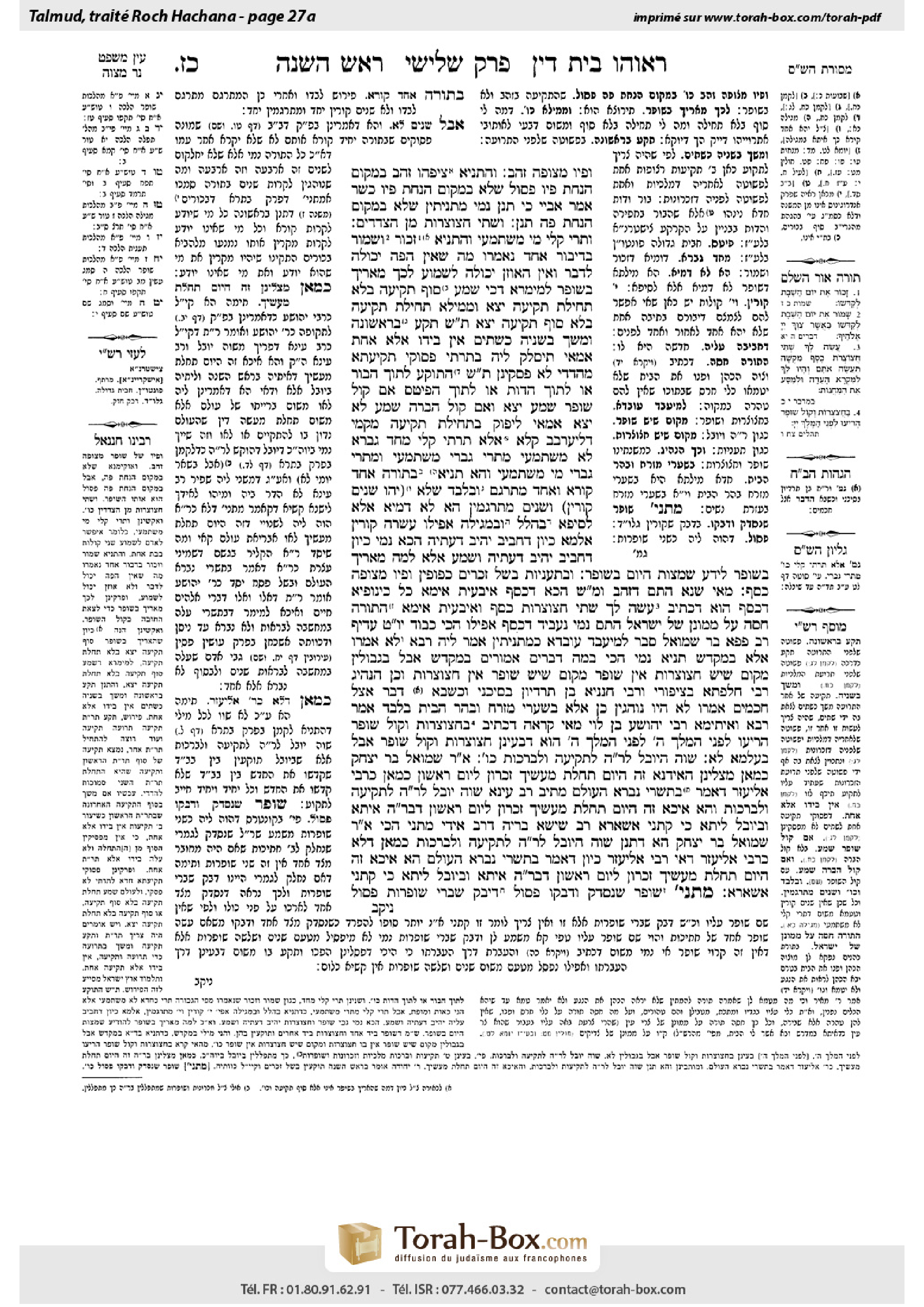
This page of Rosh Hashanah includes the Aramaic text, an English translation and an AI-generated French translation, alongside the scan above.
ראש השנה כ״ז א · Aramaic and Hebrew text
וּפִיו מְצוּפֶּה זָהָב. וְהָתַנְיָא: צִיפָּהוּ זָהָב בִּמְקוֹם הַנָּחַת פִּיו — פָּסוּל, שֶׁלֹּא בִּמְקוֹם הַנָּחַת פִּיו — כָּשֵׁר! אֲמַר אַבָּיֵי: כִּי תְּנַן נָמֵי מַתְנִיתִין — שֶׁלֹּא בִּמְקוֹם הַנָּחַת פֶּה תְּנַן.
וּשְׁתֵּי חֲצוֹצְרוֹת מִן הַצְּדָדִים. וּתְרֵי קָלֵי מִי מִשְׁתַּמְעִי? וְהָתַנְיָא: ״זָכוֹר״ וְ״שָׁמוֹר״, בְּדִיבּוּר אֶחָד נֶאֶמְרוּ, מַה שֶּׁאֵין הַפֶּה יְכוֹלָה לְדַבֵּר וְאֵין הָאוֹזֶן יְכוֹלָה לִשְׁמוֹעַ! לְכָךְ מַאֲרִיךְ בְּשׁוֹפָר.
לְמֵימְרָא דְּכִי שָׁמַע סוֹף תְּקִיעָה בְּלֹא תְּחִילַּת תְּקִיעָה יָצָא, וּמִמֵּילָא: תְּחִילַּת תְּקִיעָה בְּלֹא סוֹף תְּקִיעָה יָצָא?
תָּא שְׁמַע: תָּקַע בָּרִאשׁוֹנָה וּמָשַׁךְ בַּשְּׁנִיָּה כִּשְׁתַּיִם — אֵין בְּיָדוֹ אֶלָּא אַחַת. אַמַּאי? תִּיסְלַק לֵיהּ בְּתַרְתֵּי! פַּסּוֹקֵי תְּקִיעָתָא מֵהֲדָדֵי לָא פָּסְקִינַן.
תָּא שְׁמַע: הַתּוֹקֵעַ לְתוֹךְ הַבּוֹר אוֹ לְתוֹךְ הַדּוּת אוֹ לְתוֹךְ הַפִּיטָס, אִם קוֹל שׁוֹפָר שָׁמַע — יָצָא, וְאִם קוֹל הֲבָרָה שְׁמַע — לֹא יָצָא. אַמַּאי? לִיפּוֹק בִּתְחִילַּת תְּקִיעָה, מִקַּמֵּי דְּלִיעַרְבַּב קָלָא!
אֶלָּא: תַּרְתֵּי קָלֵי מֵחַד גַּבְרָא — לָא מִשְׁתַּמְעִי, מִתְּרֵי גַבְרֵי — מִשְׁתַּמְעִי.
וּמִתְּרֵי גַבְרֵי מִי מִשְׁתַּמְעִי? וְהָא תַּנְיָא: בַּתּוֹרָה — אֶחָד קוֹרֵא וְאֶחָד מְתַרְגֵּם, וּבִלְבַד שֶׁלֹּא יְהוּ שְׁנַיִם קוֹרִין וּשְׁנַיִם מְתַרְגְּמִין!
הָא לָא דָּמְיָא אֶלָּא לְסֵיפָא: בְּהַלֵּל וּבִמְגִילָּה — אֲפִילּוּ עֲשָׂרָה קוֹרִין. אַלְמָא, כֵּיוָן דְּחַבִּיב — יָהֵיב דַּעְתֵּיהּ, הָכָא נָמֵי: כֵּיוָן דְּחַבִּיב — יָהֵיב דַּעְתֵּיהּ וְשָׁמַע.
אֶלָּא לָמָּה מַאֲרִיךְ בְּשׁוֹפָר? לֵידַע שֶׁמִּצְוַת הַיּוֹם בְּשׁוֹפָר.
וּבְתַעֲנִיּוֹת בְּשֶׁל זְכָרִים כְּפוּפִין וּפִיו מְצוּפֶּה כֶּסֶף. מַאי שְׁנָא הָתָם דְּזָהָב, וּמַאי שְׁנָא הָכָא דְּכֶסֶף? אִיבָּעֵית אֵימָא כָּל כִּינּוּפְיָא דְּכֶסֶף הוּא, דִּכְתִיב: ״עֲשֵׂה לְךָ שְׁתֵּי חֲצוֹצְרוֹת כֶּסֶף״? וְאִיבָּעֵית אֵימָא: הַתּוֹרָה חָסָה עַל מָמוֹנָן שֶׁל יִשְׂרָאֵל.
הָתָם נָמֵי נַעֲבֵיד דְּכֶסֶף! אֲפִילּוּ הָכִי, כְּבוֹד יוֹם טוֹב עֲדִיף.
רַב פָּפָּא בַּר שְׁמוּאֵל סָבַר לְמִיעְבַּד עוֹבָדָא כְּמַתְנִיתִין. אָמַר לֵיהּ רָבָא: לָא אָמְרוּ אֶלָּא בְּמִקְדָּשׁ. תַּנְיָא נָמֵי הָכִי: בַּמֶּה דְּבָרִים אֲמוּרִים — בַּמִּקְדָּשׁ, אֲבָל בִּגְבוּלִין, מָקוֹם שֶׁיֵּשׁ חֲצוֹצְרוֹת — אֵין שׁוֹפָר, מָקוֹם שֶׁיֵּשׁ שׁוֹפָר — אֵין חֲצוֹצְרוֹת.
וְכֵן הִנְהִיג רַבִּי חֲלַפְתָּא בְּצִיפּוֹרִי וְרַבִּי חֲנַנְיָא בֶּן תְּרַדְיוֹן בְּסִיכְנִי, וּכְשֶׁבָּא דָּבָר אֵצֶל חֲכָמִים אָמְרוּ: לֹא הָיוּ נוֹהֲגִין כֵּן אֶלָּא בְּשַׁעֲרֵי מִזְרָח וּבְהַר הַבַּיִת בִּלְבַד.
אָמַר רָבָא, וְאִיתֵּימָא רַבִּי יְהוֹשֻׁעַ בֶּן לֵוִי: מַאי קְרָאָה — דִּכְתִיב: ״בַּחֲצוֹצְרוֹת וְקוֹל שׁוֹפָר הָרִיעוּ לִפְנֵי הַמֶּלֶךְ ה׳״, לִפְנֵי הַמֶּלֶךְ ה׳ הוּא דְּבָעֵינַן חֲצוֹצְרוֹת וְקוֹל שׁוֹפָר, אֲבָל בְּעָלְמָא — לָא.
שָׁוֶה הַיּוֹבֵל לְרֹאשׁ הַשָּׁנָה לַתְּקִיעָה וְלַבְּרָכוֹת וְכוּ׳. אָמַר רַב שְׁמוּאֵל בַּר יִצְחָק: כְּמַאן מְצַלֵּינַן הָאִידָּנָא ״זֶה הַיּוֹם תְּחִלַּת מַעֲשֶׂיךָ זִכָּרוֹן לְיוֹם רִאשׁוֹן״, כְּמַאן — כְּרַבִּי אֱלִיעֶזֶר, דְּאָמַר: בְּתִשְׁרִי נִבְרָא הָעוֹלָם.
מֵתִיב רַב עֵינָא: שָׁוֶה יוֹבֵל לְרֹאשׁ הַשָּׁנָה לַתְּקִיעָה וְלַבְּרָכוֹת, וְהָא אִיכָּא ״זֶה הַיּוֹם תְּחִלַּת מַעֲשֶׂיךָ זִכָּרוֹן לְיוֹם רִאשׁוֹן״, דִּבְרֹאשׁ הַשָּׁנָה אִיתָא, וּבְיוֹבֵל לֵיתָא! כִּי קָתָנֵי — אַשְּׁאָרָא.
רַב שִׁישָׁא בְּרֵיהּ דְּרַב אִידִי מַתְנֵי הָכִי, אָמַר רַב שְׁמוּאֵל בַּר יִצְחָק: הָא דִּתְנַן שָׁוֶה הַיּוֹבֵל לְרֹאשׁ הַשָּׁנָה לַתְּקִיעָה וְלַבְּרָכוֹת, כְּמַאן — דְּלָא כְּרַבִּי אֱלִיעֶזֶר, דְּאִי רַבִּי אֱלִיעֶזֶר, כֵּיוָן דְּאָמַר בְּתִשְׁרִי נִבְרָא הָעוֹלָם, הָא אִיכָּא ״זֶה הַיּוֹם תְּחִלַּת מַעֲשֶׂיךָ זִכָּרוֹן לְיוֹם רִאשׁוֹן״, דִּבְרֹאשׁ הַשָּׁנָה אִיתָא, וּבַיּוֹבֵל לֵיתָא! כִּי קָתָנֵי אַשְּׁאָרָא.
מַתְנִי׳ שׁוֹפָר שֶׁנִּסְדַּק וְדִבְּקוֹ — פָּסוּל. דִּיבֵּק שִׁבְרֵי שׁוֹפָרוֹת — פָּסוּל.
Rosh Hashanah 27a · English translation
§ It was taught in the mishna: And the mouth of the shofar that was used on Rosh HaShana was plated with gold. The Gemara raises a difficulty: But isn’t it taught in a baraita: If a shofar was plated with gold at the place where one puts his mouth, it is unfit for blowing; if it was plated, but not at the place where he puts his mouth, it is fit for blowing? Abaye said: When we learned in the mishna as well, we learned that it referred not to the place where one puts his mouth, but a little above it.
§ It was taught in the mishna: And there were two trumpets, one on each of the two sides of the person sounding the shofar. The Gemara asks: But is it really possible to properly discern two different sounds, that of the shofar and that of the trumpets, at the same time? Isn’t it taught in a baraita: The two versions of the fifth of the Ten Commandments, “Remember the Shabbat day” (Exodus 20:8) and “Keep the Shabbat day” (Deuteronomy 5:12), were spoken by God simultaneously in a single utterance, something that the human mouth cannot speak and the human ear cannot hear? This indicates that it is impossible to take in two sounds at once, and so, due to the sound of the trumpets, it should be impossible to hear the blast of the shofar. The Gemara answers: For this reason they would sound a long blast with the shofar, to make it possible to hear the sound of the shofar on its own.
The Gemara rejects this answer: Is this to say that if one hears the end of a blast without hearing the beginning of the blast he has fulfilled his obligation? In this case one hears only the end of the shofar blast, since the shofar was initially sounded together with the trumpets. If so, it would follow that if one hears the beginning of the blast without hearing the end of the blast, he has also fulfilled his obligation.
This, however, is difficult. Come and hear that which was taught in a mishna: If one blew the initial tekia, a long, continuous shofar blast, of the first tekia-terua-tekia set, and then drew out the final tekia of that set so that it spans the length of two tekiot, it counts as only one tekia and is not considered two tekiot, i.e., the final tekia of the first set, and the initial tekia of the second set. But why is this so? Let it count for him as two tekiot, since as stated above, half a blast is considered a blast. The Gemara explains: If one hears only the beginning or the end of a shofar blast, he has indeed fulfilled his obligation, but nevertheless we do not divide a shofar blast into two.
The Gemara raises another difficulty: Come and hear that which was taught in a mishna: With regard to one who sounds a shofar into a pit, or into a cistern, or into a large jug [pitas], if he clearly heard the sound of the shofar, he has fulfilled his obligation, but if he also heard the sound of an echo, he has not fulfilled his obligation. But why is this so? If half a blast is indeed considered a complete blast, let him fulfill his obligation with the beginning of the blast, before the sound is confused with the echo, since the beginning of the blast was heard clearly.
Rather, we must retreat from the explanation offered above and say as follows: Two sounds coming from one source or person cannot be discerned, and this was the miracle at Sinai in which the people heard both “Remember the Shabbat” (Exodus 20:8) and “Keep the Shabbat” (Deuteronomy 5:12) in a single divine utterance. But two sounds from two different sources or people can be properly discerned.
The Gemara raises another difficulty: But is it really true that two sounds coming from two different people can be properly discerned? Isn’t it taught in a baraita: With regard to the public reading of the Torah, one person may read and one may translate, provided that there are not two people reading and two people translating. Consequently it is clear that two sounds cannot be properly heard, even when they come from two different people.
The Gemara answers: This is not difficult, since our case is only similar to the case mentioned in the latter clause of that baraita, which reads: With regard to the reading of hallel and the Scroll of Esther, even ten people may read simultaneously. Apparently, since these readings are dear to their listeners, they direct their attention to them, listen attentively, and distinguish between the different readers. Here too, since the sounding of the shofar is dear to the listener, he directs his attention to the matter and discerns between the two sounds.
The Gemara asks: But if it is indeed possible to discern the sound of the shofar even when it is sounded simultaneously with the trumpets, why does he sound a long blast with the shofar? The Gemara answers: This is so people should know that the mitzva of the day is specifically with the shofar.
§ It was taught in the mishna: The shofarot that were used on public fast days were made from the curved horns of rams, and their mouths were plated with silver. The Gemara asks: What is different there that the shofar of Rosh HaShana is plated with gold, and what is different here that the shofarot of fast days are plated with silver? The Gemara answers: If you wish, you can say: Any shofar made for the purpose of gathering people together is made of silver, as it is written: “Make for yourself two trumpets of silver; of a whole piece shall you make them, and you shall use them for calling the assembly and for the journeying of the camps” (Numbers 10:2). And if you wish, you can say: The Torah spared the money of the Jewish people and therefore allows these shofarot to be made of silver, which is less costly than gold.
The Gemara asks: If so, there too, the shofar of Rosh HaShana should be made with silver plating. The Gemara answers: Even so, the duty of honoring the Festival is given priority, so that it is proper to beautify the shofar of Rosh HaShana. On a fast day, however, since it is not a Festival, there is no need to use gold, and silver is sufficient.
It is related that Rav Pappa bar Shmuel thought to act in accordance with the mishna regarding all the details of the shofar and the trumpets. But Rava said to him: They said this only with regard to the Temple. This is also taught in a baraita: In what case is this statement said? Only in the Temple, but in the provinces, anywhere outside the Temple, the halakha is as follows: Wherever there are trumpets, e.g., on fast days, there is no shofar, and wherever there is a shofar, e.g., on Rosh HaShana, there are no trumpets.
And similarly, Rabbi Ḥalafta established the custom in Tzippori as it is described in the mishna, and so did Rabbi Ḥananya ben Teradyon in Sikhni, and when the matter came before the Rabbis they said: They acted in this manner only at the east gates of the Temple and on the Temple Mount.
Rava said, and some say it was Rabbi Yehoshua ben Levi that said: What is the verse from which this is derived? As it is written: “With trumpets and the sound of a shofar make joyful noise before the Lord, the King” (Psalms 98:6), from which it may be inferred: Only before the Lord, the King, i.e., in His Temple, do we need both trumpets and the sound of a shofar, but in general, outside the Temple, we do not need both.
§ It was taught in the mishna: Yom Kippur of the Jubilee Year is the same as Rosh HaShana with regard to both the shofar blasts that are sounded and the additional blessings that are recited in the Amida prayer. Rav Shmuel bar Yitzḥak said: In accordance with whose opinion do we pray today on Rosh HaShana, saying: This day is the beginning of Your works, a commemoration of the first day? In accordance with whom? In accordance with the opinion of Rabbi Eliezer, who said: The world was created in the month of Tishrei. We therefore mention on Rosh HaShana that it is the first day.
Rav Eina raised an objection: It was taught in the mishna: Yom Kippur of the Jubilee Year is the same as Rosh HaShana with regard to both the shofar blasts that are sounded and the additional blessings that are recited in the Amida prayer. But there are the words: This day is the beginning of Your works, a commemoration of the first day, which can be recited on Rosh HaShana but cannot be recited on Yom Kippur of the Jubilee Year, which is neither: The beginning of Your works, nor: A commemoration of the first day. If so, how can one recite the same blessing on both occasions? The Gemara answers: When the mishna was taught, saying that the blessings of the Jubilee and Rosh HaShana are the same, it was taught with regard to the other parts of the blessings, but the line beginning: This day, is indeed omitted on Yom Kippur of the Jubilee Year.
Rav Sheisha, son of Rav Idi, taught the previous passage as follows: Rav Shmuel bar Yitzḥak said: That which we learn in the mishna, Yom Kippur of the Jubilee Year is the same as Rosh HaShana with regard to both the shofar blasts that are sounded and the additional blessings that are recited in the Amida prayer; in accordance with whom was it taught? Apparently it was not taught in accordance with the opinion of Rabbi Eliezer, as if it reflects the view of Rabbi Eliezer, there is a difficulty. Since he said that the world was created in Tishrei, then there are also the words: This day is the beginning of Your works, a commemoration of the first day, which can be recited on Rosh HaShana, but cannot be recited on Yom Kippur of the Jubilee Year. If so, how can one recite the same blessing on both occasions? The Gemara rejects this argument: When the mishna was taught, it was taught with regard to the other parts of the blessings, but this line is indeed omitted on Yom Kippur of the Jubilee Year.
MISHNA: A shofar that was cracked and then glued together, even though it appears to be whole, is unfit. Similarly, if one glued together broken fragments of shofarot to form a complete shofar, the shofar is unfit.
Rosh Hashanah 27a · Traduction française (IA)
§ Il a été enseigné dans la Michna : L’embouchure du chofar utilisé à Roch Hachana était plaquée d’or. La Guemara soulève une difficulté : N’est-il pas enseigné dans une baraïta qu’un chofar plaqué d’or à l’endroit où l’on pose la bouche est impropre à la sonnerie, tandis qu’un chofar plaqué ailleurs qu’à cet endroit est apte à la sonnerie ? Abayé dit : Lorsque nous avons également étudié la Michna, nous avons appris qu’elle ne faisait pas référence à l’endroit où l’on pose la bouche, mais à un point légèrement au-dessus.
§ Il a été enseigné dans la Michna : Il y avait deux trompettes, une de chaque côté de la personne qui sonnait du chofar. La Guemara demande : Peut-on vraiment distinguer correctement deux sons différents, celui du chofar et celui des trompettes, émis en même temps ? N’est-il pas enseigné dans une baraïta que les deux versions du cinquième des Dix Commandements, « Souviens-toi du jour du Chabbat » (Exode 20,8) et « Garde le jour du Chabbat » (Deutéronome 5,12), ont été prononcées simultanément par Dieu en une seule parole, chose que la bouche humaine ne peut prononcer et que l’oreille humaine ne peut entendre ? Cela indique qu’il est impossible de percevoir deux sons à la fois ; à cause du son des trompettes, on devrait donc ne pas pouvoir entendre la sonnerie du chofar. La Guemara répond : C’est pour cette raison qu’on sonnait longuement du chofar, afin de permettre d’entendre le son du chofar seul.
La Guemara rejette cette réponse : Cela signifie-t-il que celui qui entend la fin d’une sonnerie sans en avoir entendu le début s’est acquitté de son obligation ? Dans ce cas, on n’entend que la fin de la sonnerie du chofar, puisque celui-ci a d’abord été sonné en même temps que les trompettes. Il s’ensuivrait alors que celui qui entend le début de la sonnerie sans en entendre la fin s’est également acquitté de son obligation.
Cela pose toutefois une difficulté. Écoute ce qui a été enseigné dans une Michna : si l’on a sonné la première tekia de la première séquence tekia-teroua-tekia, puis prolongé la tekia finale de cette séquence de telle sorte qu’elle ait la durée de deux tekiot, elle ne compte que pour une seule tekia et n’est pas considérée comme deux tekiot, c’est-à-dire la tekia finale de la première séquence et la tekia initiale de la deuxième. Mais pourquoi en est-il ainsi ? Qu’elle compte pour lui comme deux tekiot, puisque, comme il a été dit plus haut, une demi-sonnerie est considérée comme une sonnerie. La Guemara explique : Si l’on n’entend que le début ou la fin d’une sonnerie du chofar, on s’est effectivement acquitté de son obligation ; néanmoins, on ne divise pas une sonnerie du chofar en deux.
La Guemara soulève une autre difficulté : Écoute ce qui a été enseigné dans une Michna : celui qui sonne du chofar dans une fosse, dans une citerne ou dans une grande jarre [pitas], s’il entend clairement le son du chofar, s’est acquitté de son obligation ; mais s’il entend aussi un écho, il ne s’en est pas acquitté. Mais pourquoi en est-il ainsi ? Si une demi-sonnerie est effectivement considérée comme une sonnerie complète, qu’il s’acquitte de son obligation grâce au début de la sonnerie, avant que le son ne se mêle à l’écho, puisque le début de la sonnerie a été entendu clairement.
Il faut plutôt revenir sur l’explication proposée plus haut et dire ceci : deux sons provenant d’une même source ou d’une même personne ne peuvent pas être distingués ; tel fut le miracle du Sinaï, où le peuple entendit à la fois « Souviens-toi du jour du Chabbat » (Exode 20,8) et « Garde le jour du Chabbat » (Deutéronome 5,12) en une seule parole divine. En revanche, deux sons provenant de deux sources ou de deux personnes différentes peuvent être distingués correctement.
La Guemara soulève une autre difficulté : Est-il vraiment vrai que deux sons provenant de deux personnes différentes peuvent être distingués correctement ? N’est-il pas enseigné dans une baraïta que, lors de la lecture publique de la Torah, une personne peut lire et une autre traduire, à condition qu’il n’y ait pas deux personnes qui lisent et deux personnes qui traduisent ? Il est donc clair que deux sons ne peuvent pas être entendus correctement, même s’ils proviennent de deux personnes différentes.
La Guemara répond : Il n’y a pas de difficulté, car notre cas ressemble uniquement à celui mentionné dans la dernière partie de cette baraïta, où il est dit que, pour la lecture du Hallel et du rouleau d’Esther, même dix personnes peuvent lire simultanément. Il semble que ces lectures étant chères à leurs auditeurs, ceux-ci leur prêtent attention, écoutent attentivement et distinguent les différents lecteurs. Ici aussi, puisque la sonnerie du chofar est chère à l’auditeur, il y prête attention et distingue les deux sons.
La Guemara demande : Mais s’il est effectivement possible de distinguer le son du chofar même lorsqu’il est sonné en même temps que les trompettes, pourquoi sonne-t-on longuement du chofar ? La Guemara répond : C’est afin que les gens sachent que la mitsva du jour s’accomplit spécifiquement avec le chofar.
§ Il a été enseigné dans la Michna : Les chofarot utilisés lors des jours de jeûne étaient faits de cornes recourbées de béliers, et leur embouchure était plaquée d’argent. La Guemara demande : En quoi le chofar de Roch Hachana diffère-t-il, puisqu’il est plaqué d’or, et en quoi les chofarot des jours de jeûne diffèrent-ils, puisqu’ils sont plaqués d’argent ? La Guemara répond : Si tu le souhaites, tu peux dire que tout chofar fabriqué pour rassembler les gens est en argent, comme il est écrit : « Fais-toi deux trompettes d’argent ; tu les feras d’une seule pièce, et tu les utiliseras pour convoquer l’assemblée et pour mettre les camps en marche » (Nombres 10,2). Et si tu le souhaites, tu peux dire que la Torah a épargné l’argent du peuple juif et permet donc que ces chofarot soient faits d’argent, qui coûte moins cher que l’or.
La Guemara demande : Si c’est ainsi, le chofar de Roch Hachana devrait lui aussi être plaqué d’argent. La Guemara répond : Malgré tout, l’obligation d’honorer la fête l’emporte, et il convient donc d’embellir le chofar de Roch Hachana. En revanche, un jour de jeûne n’étant pas une fête, il n’est pas nécessaire d’utiliser de l’or ; l’argent suffit.
Il est rapporté que Rav Pappa bar Shmuel envisageait d’agir conformément à la Michna pour tous les détails concernant le chofar et les trompettes. Mais Rava lui dit : Cela n’a été dit que pour le Temple. C’est également enseigné dans une baraïta : Dans quel cas cette déclaration a-t-elle été faite ? Uniquement dans le Temple ; dans les provinces, c’est-à-dire partout en dehors du Temple, la halakha est la suivante : là où il y a des trompettes, par exemple les jours de jeûne, il n’y a pas de chofar ; et là où il y a un chofar, par exemple à Roch Hachana, il n’y a pas de trompettes.
De même, Rabbi Ḥalafta institua la coutume à Tzippori comme elle est décrite dans la Michna, et Rabbi Ḥananya ben Teradyon fit de même à Sikhni. Lorsque la question fut portée devant les Sages, ils dirent : Ils n’agirent ainsi qu’aux portes orientales du Temple et sur le mont du Temple.
Rava dit, et certains disent que c’est Rabbi Yehoshua ben Levi qui le dit : Quel est le verset dont on déduit cela ? Il est écrit : « Avec des trompettes et le son du chofar, poussez des cris de joie devant le Seigneur, le Roi » (Psaumes 98,6). On peut en déduire que c’est uniquement devant le Seigneur, le Roi, c’est-à-dire dans Son Temple, que nous avons besoin à la fois des trompettes et du son du chofar ; en général, en dehors du Temple, nous n’avons pas besoin des deux.
§ Il a été enseigné dans la Michna : Yom Kippour de l’année du Jubilé est comme Roch Hachana, tant pour les sonneries du chofar que l’on fait retentir que pour les bénédictions supplémentaires récitées dans la Amida. Rav Chmouel bar Yitzḥak dit : De l’avis de qui prions-nous aujourd’hui à Roch Hachana en disant : « Ce jour est le commencement de Tes œuvres, mémoire du premier jour » ? De l’avis de qui ? De celui de Rabbi Eliezer, qui a dit que le monde a été créé au mois de Tichri. Nous mentionnons donc à Roch Hachana qu’il s’agit du premier jour.
Rav Eina objecta : Il a été enseigné dans la Michna que Yom Kippour de l’année du Jubilé est comme Roch Hachana, tant pour les sonneries du chofar que l’on fait retentir que pour les bénédictions supplémentaires récitées dans la Amida. Mais les mots « Ce jour est le commencement de Tes œuvres, mémoire du premier jour » peuvent être récités à Roch Hachana, mais pas à Yom Kippour de l’année du Jubilé, qui n’est ni le commencement de Tes œuvres ni la mémoire du premier jour. Si tel est le cas, comment peut-on réciter la même bénédiction à ces deux occasions ? La Guemara répond : Lorsque la Michna a été enseignée, l’affirmation selon laquelle les bénédictions du Jubilé et de Roch Hachana sont les mêmes concernait les autres parties des bénédictions ; la phrase commençant par « Ce jour » est effectivement omise à Yom Kippour de l’année du Jubilé.
Rav Sheisha, fils de Rav Idi, enseigna le passage précédent de la manière suivante : Rav Chmouel bar Yitzḥak dit : L’enseignement de la Michna selon lequel Yom Kippour de l’année du Jubilé est comme Roch Hachana, tant pour les sonneries du chofar que l’on fait retentir que pour les bénédictions supplémentaires récitées dans la Amida, a été donné de l’avis de qui ? Apparemment, il n’a pas été donné conformément à l’opinion de Rabbi Eliezer, car si cet enseignement reflétait son avis, une difficulté se poserait. Puisqu’il a dit que le monde a été créé en Tichri, les mots « Ce jour est le commencement de Tes œuvres, mémoire du premier jour » peuvent être récités à Roch Hachana, mais pas à Yom Kippour de l’année du Jubilé. Si tel est le cas, comment peut-on réciter la même bénédiction à ces deux occasions ? La Guemara rejette cet argument : Lorsque la Michna a été enseignée, cela concernait les autres parties des bénédictions, mais cette phrase est effectivement omise à Yom Kippour de l’année du Jubilé.
MICHNA : Un chofar qui s’est fendu puis a été recollé, bien qu’il paraisse intact, est impropre. De même, si l’on a recollé des fragments brisés de chofarot pour former un chofar complet, celui-ci est impropre.
Traduction française générée par IA à partir de l’édition anglaise de Sefaria. Vérifie toujours un passage avec le texte source.
Text from Sefaria: William Davidson Edition - Vocalized Aramaic (CC BY NC); William Davidson Edition - English (CC BY NC).