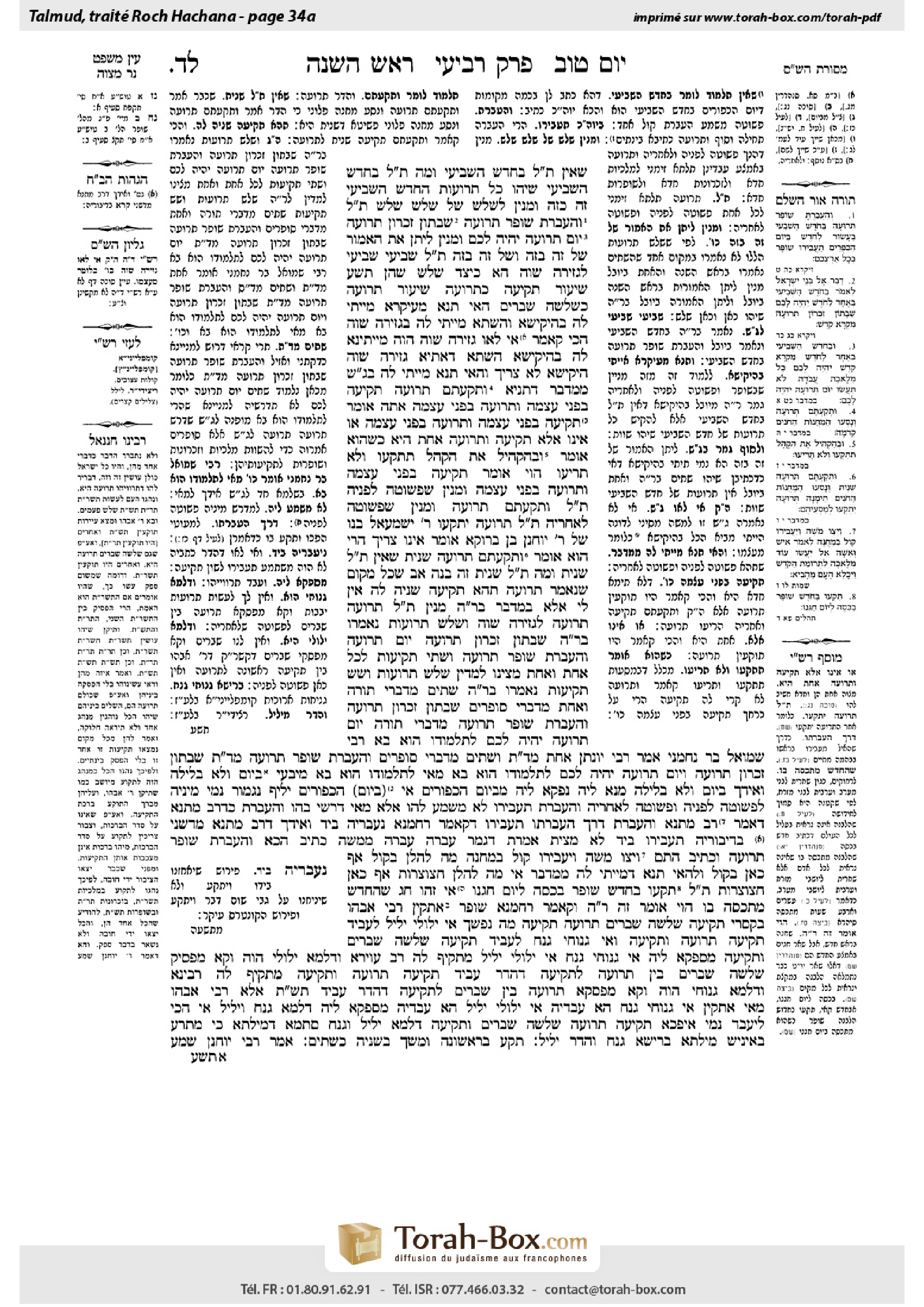
Rosh Hashanah 34a: Talmud study for Daf Yomi
Daf Yomi is the daily study of one Talmud folio. Explore 37 tractates with scans, Hebrew text, Sefaria English and AI-generated French translations where annotated.
Passage selection and English or AI-generated French translation are available where the scan has annotations. Daf Study is independent of Torah-Box and Sefaria.
Browse Rosh Hashanah · ראש השנה · All tractatesRosh Hashanah 34a text and translations
This page of Rosh Hashanah includes the Aramaic text, an English translation and an AI-generated French translation, alongside the scan above.
ראש השנה ל״ד א · Aramaic and Hebrew text
שֶׁאֵין תַּלְמוּד לוֹמַר ״בַּחֹדֶשׁ הַשְּׁבִיעִי״, וּמָה תַּלְמוּד לוֹמַר ״בַּחֹדֶשׁ הַשְּׁבִיעִי״ — שֶׁיְּהוּ כׇּל תְּרוּעוֹת הַחֹדֶשׁ הַשְּׁבִיעִי זֶה כָּזֶה.
וּמִנַּיִן לְשָׁלֹשׁ שֶׁל שָׁלֹשׁ שָׁלֹשׁ — תַּלְמוּד לוֹמַר: ״וְהַעֲבַרְתָּ שׁוֹפַר תְּרוּעָה״, ״שַׁבָּתוֹן זִכְרוֹן תְּרוּעָה״, ״יוֹם תְּרוּעָה יִהְיֶה לָכֶם״.
וּמִנַּיִן לִיתֵּן אֶת הָאָמוּר שֶׁל זֶה בָּזֶה וְשֶׁל זֶה בָּזֶה — תַּלְמוּד לוֹמַר: ״שְׁבִיעִי״ ״שְׁבִיעִי״ לִגְזֵירָה שָׁוָה.
הָא כֵּיצַד? שָׁלֹשׁ שֶׁהֵן תֵּשַׁע. שִׁיעוּר תְּקִיעָה כִּתְרוּעָה, שִׁיעוּר תְּרוּעָה כִּשְׁלֹשָׁה שְׁבָרִים.
הַאי תַּנָּא, מֵעִיקָּרָא מַיְיתֵי לַהּ בְּהֶיקֵּישָׁא, וְהַשְׁתָּא מַיְיתֵי לַהּ בִּגְזֵירָה שָׁוָה? הָכִי קָאָמַר: אִי לָאו גְּזֵירָה שָׁוָה, הֲוָה מַיְיתִינָא לַהּ בְּהֶיקֵּישָׁא. הַשְׁתָּא דְּאָתְיָא בִּגְזֵירָה שָׁוָה — הֶיקֵּישָׁא לָא צְרִיךְ.
וְהַאי תַּנָּא מַיְיתֵי לַהּ בִּגְזֵירָה שָׁוָה מִמִּדְבָּר, דְּתַנְיָא: ״וּתְקַעְתֶּם תְּרוּעָה״ — תְּקִיעָה בִּפְנֵי עַצְמָהּ וּתְרוּעָה בִּפְנֵי עַצְמָהּ. אַתָּה אוֹמֵר תְּקִיעָה בִּפְנֵי עַצְמָהּ וּתְרוּעָה בִּפְנֵי עַצְמָהּ, אוֹ אֵינוֹ אֶלָּא תְּקִיעָה וּתְרוּעָה אַחַת הִיא — כְּשֶׁהוּא אוֹמֵר: ״וּבְהַקְהִיל אֶת הַקָּהָל תִּתְקְעוּ וְלֹא תָרִיעוּ״, הֱוֵי אוֹמֵר: תְּקִיעָה בִּפְנֵי עַצְמָהּ וּתְרוּעָה בִּפְנֵי עַצְמָהּ.
וּמִנַּיִן שֶׁפְּשׁוּטָה לְפָנֶיהָ — תַּלְמוּד לוֹמַר: ״וּתְקַעְתֶּם תְּרוּעָה״. וּמִנַּיִן שֶׁפְּשׁוּטָה לְאַחֲרֶיהָ — תַּלְמוּד לוֹמַר: ״תְּרוּעָה יִתְקְעוּ״.
רַבִּי יִשְׁמָעֵאל בְּנוֹ שֶׁל רַבִּי יוֹחָנָן בֶּן בְּרוֹקָא אוֹמֵר: אֵינוֹ צָרִיךְ, הֲרֵי הוּא אוֹמֵר: ״וּתְקַעְתֶּם תְּרוּעָה שֵׁנִית״, שֶׁאֵין תַּלְמוּד לוֹמַר ״שֵׁנִית״, וּמָה תַּלְמוּד לוֹמַר ״שֵׁנִית״ — זֶה בָּנָה אָב, שֶׁכׇּל מָקוֹם שֶׁנֶּאֱמַר ״תְּרוּעָה״ — תְּהֵא תְּקִיעָה שְׁנִיָּה לָהּ. אֵין לִי אֶלָּא בַּמִּדְבָּר, בְּרֹאשׁ הַשָּׁנָה מִנַּיִן? תַּלְמוּד לוֹמַר: ״תְּרוּעָה״ ״תְּרוּעָה״ לִגְזֵירָה שָׁוָה.
וְשָׁלֹשׁ תְּרוּעוֹת נֶאֶמְרוּ בְּרֹאשׁ הַשָּׁנָה: ״שַׁבָּתוֹן זִכְרוֹן תְּרוּעָה״, ״יוֹם תְּרוּעָה״, ״וְהַעֲבַרְתָּ שׁוֹפַר תְּרוּעָה״, וּשְׁתֵּי תְּקִיעוֹת לְכׇל אַחַת וְאַחַת.
מָצִינוּ לְמֵדִין: שָׁלֹשׁ תְּרוּעוֹת וְשֵׁשׁ תְּקִיעוֹת נֶאֶמְרוּ בְּרֹאשׁ הַשָּׁנָה, שְׁתַּיִם מִדִּבְרֵי תוֹרָה, וְאַחַת מִדִּבְרֵי סוֹפְרִים. ״שַׁבָּתוֹן זִכְרוֹן תְּרוּעָה״, ״וְהַעֲבַרְתָּ שׁוֹפַר תְּרוּעָה״ — מִדִּבְרֵי תוֹרָה. ״יוֹם תְּרוּעָה יִהְיֶה לָכֶם״ — לְתַלְמוּדוֹ הוּא בָּא.
רַבִּי שְׁמוּאֵל בַּר נַחְמָנִי אָמַר רַבִּי יוֹנָתָן: אַחַת מִדִּבְרֵי תוֹרָה, וּשְׁתַּיִם מִדִּבְרֵי סוֹפְרִים. ״וְהַעֲבַרְתָּ שׁוֹפַר תְּרוּעָה״ — מִדִּבְרֵי תוֹרָה. ״שַׁבָּתוֹן זִכְרוֹן תְּרוּעָה״, וְ״יוֹם תְּרוּעָה יִהְיֶה לָכֶם״ — לְתַלְמוּדוֹ הוּא בָּא.
מַאי לְתַלְמוּדוֹ הוּא בָּא? מִיבְּעֵי: בַּיּוֹם וְלֹא בַּלַּיְלָה.
וְאִידַּךְ, בַּיּוֹם וְלֹא בַּלַּיְלָה מְנָא לֵיהּ? נָפְקָא לֵיהּ מִ״בְּיוֹם הַכִּפּוּרִים״.
אִי ״בְּיוֹם הַכִּפּוּרִים״ יָלֵיף, נִגְמוֹר נָמֵי מִינֵּיהּ לִפְשׁוּטָה לְפָנֶיהָ וּפְשׁוּטָה לְאַחֲרֶיהָ! ״וְהַעֲבַרְתָּ״ ״תַּעֲבִירוּ״ לָא מַשְׁמַע לְהוּ.
אֶלָּא מַאי דָּרְשִׁי בְּהוּ? ״וְהַעֲבַרְתָּ״ כִּדְרַב מַתְנָא. דְּאָמַר רַב מַתְנָא: ״וְהַעֲבַרְתָּ״ — דֶּרֶךְ הַעֲבָרָתוֹ, ״תַּעֲבִירוּ״ — דְּקָאָמַר רַחֲמָנָא נְעַבְּרֵיהּ בְּיָד.
וְאִידַּךְ? דְּרַב מַתְנָא — מִדְּשַׁנִּי בְּדִיבּוּרֵיהּ.
״תַּעֲבִירוּ״ בְּיָד — לָא מָצֵית אָמְרַתְּ, דְּגָמַר ״עֲבָרָה״ ״עֲבָרָה״ מִמֹּשֶׁה. כְּתִיב הָכָא: ״וְהַעֲבַרְתָּ שׁוֹפַר תְּרוּעָה״, וּכְתִיב הָתָם: ״וַיְצַו מֹשֶׁה וַיַּעֲבִירוּ קוֹל בַּמַּחֲנֶה״, מָה לְהַלָּן בְּקוֹל — אַף כָּאן בְּקוֹל.
וּלְהַאי תַּנָּא דְּמַיְיתֵי לַהּ מִמִּדְבָּר, אִי מָה לְהַלָּן חֲצוֹצְרוֹת, אַף כָּאן חֲצוֹצְרוֹת?
תַּלְמוּד לוֹמַר: ״תִּקְעוּ בַחֹדֶשׁ שׁוֹפָר בַּכֵּסֶה לְיוֹם חַגֵּנוּ״, אֵי זֶהוּ חַג שֶׁהַחֹדֶשׁ מִתְכַּסֶּה בּוֹ? הֱוֵי אוֹמֵר זֶה רֹאשׁ הַשָּׁנָה, וְקָאָמַר רַחֲמָנָא: ״שׁוֹפָר״.
אַתְקֵין רַבִּי אֲבָהוּ בְּקֵסָרִי: תְּקִיעָה, שְׁלֹשָׁה שְׁבָרִים, תְּרוּעָה, תְּקִיעָה. מָה נַפְשָׁךְ? אִי יַלּוֹלֵי יַלֵּיל — לֶעְבֵּיד תְּקִיעָה תְּרוּעָה וּתְקִיעָה, וְאִי גַּנּוֹחֵי גַּנַּח — לֶעְבֵּיד תְּקִיעָה שְׁלֹשָׁה שְׁבָרִים וּתְקִיעָה!
מְסַפְּקָא לֵיהּ אִי גַּנּוֹחֵי גַּנַּח אִי יַלּוֹלֵי יַלֵּיל. מַתְקֵיף לַהּ רַב עַוִּירָא: וְדִלְמָא יַלּוֹלֵי הֲוָה, וְקָא מַפְסֵיק שְׁלֹשָׁה שְׁבָרִים בֵּין תְּרוּעָה לִתְקִיעָה! דַּהֲדַר עָבֵיד תְּקִיעָה תְּרוּעָה וּתְקִיעָה. מַתְקֵיף לַהּ רָבִינָא: וְדִלְמָא גַּנּוֹחֵי הֲוָה, וְקָא מַפְסְקָא תְּרוּעָה בֵּין שְׁבָרִים לִתְקִיעָה! דַּהֲדַר עָבֵיד תְּקִיעָה שְׁבָרִים תְּקִיעָה.
אֶלָּא רַבִּי אֲבָהוּ מַאי אַתְקֵין? אִי גַּנּוֹחֵי גַּנַּח — הָא עַבְדֵיהּ, אִי יַלּוֹלֵי יַלֵּיל — הָא עַבְדֵיהּ! מְסַפְּקָא לֵיהּ דִּלְמָא גַּנַּח וְיַלֵּיל.
אִי הָכִי, לֶיעְבַּד נָמֵי אִיפְּכָא: תְּקִיעָה, תְּרוּעָה, שְׁלֹשָׁה שְׁבָרִים, וּתְקִיעָה — דִּלְמָא יַלֵּיל וְגַנַּח! סְתָמָא דְמִילְּתָא, כִּי מִתְּרַע בְּאִינִישׁ מִילְּתָא — בְּרֵישָׁא גָּנַח וַהֲדַר יָלֵיל.
תָּקַע בָּרִאשׁוֹנָה וּמָשַׁךְ בַּשְּׁנִיָּה כִּשְׁתַּיִם. אָמַר רַבִּי יוֹחָנָן: שָׁמַע
Rosh Hashanah 34a · English translation
Since there is no need for the verse to state: “Of the seventh month,” as it already states: “On the Day of Atonement,” what is the meaning when the verse states: “Of the seventh month”? This serves to teach that all soundings of the shofar of the seventh month must be similar to one another.
And from where is it derived that there must be three sets of three blasts each? The verse states: “Then you shall make proclamation with the blast of the shofar [shofar terua]”(Leviticus 25:9); and another verse states: “A solemn rest, a memorial of blasts [terua]” (Leviticus 23:24); and a third verse states: “It is a day of sounding [terua] the shofar to you” (Numbers 29:1). Terua is mentioned three times in these verses, and a terua is always preceded and followed by a tekia.
Since one of these verses deals with Yom Kippur of the Jubilee Year, while two of them deal with Rosh HaShana, the Gemara asks: From where is it derived to apply what is said about that verse to this one, and what is said about this verse to that one? With regard to Rosh HaShana, the verse states: “Of the seventh month” (Leviticus 25:9), and with regard to Yom Kippur the verse likewise states: “In the seventh month” (Leviticus 23:24). It is derived by verbal analogy that any shofar blasts sounded on one of these days must also be sounded on the other. Consequently, on each day one must sound three sets of tekia-terua-tekia.
How so? How does one actually perform the sounding of the shofar? One sounds three sets of three blasts each, which altogether are nine separate blasts. The length of a tekia is equal to the length of a terua, and the length of a terua is equal to the length of three shevarim.
The Gemara analyzes the baraita. This tanna initially derives his halakha from juxtaposition, based on the phrase: “Of the seventh month,” which teaches that every sounding of the shofar in the seventh month must be alike. And now he derives this halakha that one sounds three tekia-terua-tekia sets by verbal analogy from the recurrence of the term “seventh.” How can the tanna change his method of derivation in the very same baraita? The Gemara explains that this is what the tanna is saying: If there were no verbal analogy, I would have derived this halakha by juxtaposition. Now that it is derived through a verbal analogy, the juxtaposition is not necessary.
The Gemara comments: And the following tanna derives this halakha by verbal analogy from the sounding of the shofar in the wilderness, as it is taught in a baraita that the verse: “And you shall sound [utekatem] a terua” (Numbers 10:5), indicates that a tekia is its own sound and a terua is its own sound. Do you say that a tekia is its own sound and a terua is its own sound? Or perhaps is it only that a tekia and a terua are one and the same, i.e., the two terms are synonymous? When it says: “But when the assembly is to be gathered together, you shall sound a tekia [titke’u], but you shall not sound a terua [tari’u]” (Numbers 10:7), you must say that a tekia is its own sound and a terua is its own sound.
And from where is it derived that a terua is preceded by a straight blast, i.e., a tekia? The verse states: “And you shall sound [utekatem] a terua” (Numbers 10:5), which indicates that one must first sound a tekia and then a terua. And from where is it derived that a terua is followed by a straight blast? The verse states: “A terua you shall sound [titke’u]” (Numbers 10:6), i.e., first a terua and then a tekia.
Rabbi Yishmael, son of Rabbi Yoḥanan ben Beroka, says: This derivation is not necessary, as the verse states: “And you shall sound [utekatem] a terua a second time” (Numbers 10:6). As there is no need for the verse to state: “A second time,” since it is clear from the context that this is the second terua, what is the meaning when the verse states: “A second time?” This is a paradigm of the principle that in all places where it is stated terua, a tekia should be second to it. I have derived this halakha only in the wilderness. From where do I derive that the same applies to Rosh HaShana? The verse states “terua” with regard to the wilderness, and the verse states “terua” with regard to Rosh HaShana. This comes to teach by verbal analogy that the halakha of one applies to the other.
And three teruot are stated with regard to Rosh HaShana: “A solemn rest, a memorial of blasts [terua]” (Leviticus 23:24); “It is a day of sounding the shofar [terua] to you” (Numbers 29:1); “Then you shall make proclamation with the blast of the shofar [terua]” (Leviticus 25:9). And there are two tekiot for each and every one of the teruot, one before and one after.
Consequently, we are found to have learned that three teruot and six tekiot are stated with regard to Rosh HaShana. Two of the teruot are required by the statement of the Torah and one by the statement of the Sages, i.e., based on the verses but not derived directly from them. How so? “A solemn rest, a memorial of blasts [terua]” and “Then you shall make proclamation with the blast of the shofar [terua]”; these apply by Torah law. However, the verse “It is a day of sounding the shofar [terua] to you” comes for its own statement, i.e., for the verbal analogy, which teaches that the halakhot of the wilderness apply to Rosh HaShana as well. Consequently, the third terua is merely alluded to in that verse and its obligation applies by rabbinic law.
Rabbi Shmuel bar Naḥmani said that Rabbi Yonatan said: One terua applies by Torah law, and two apply by rabbinic law: “Then you shall make proclamation with the blast of the shofar [terua]” applies by Torah law. However, the verses: “A solemn rest, a memorial of blasts [terua]” and “It is a day of sounding the shofar [terua] to you”; these two phrases come for their own statement.
The Gemara asks: What does Rabbi Shmuel bar Naḥmani mean when he says that the verse: “It is a day of sounding the shofar [terua] to you,” comes for its own statement? What other halakha is derived from this verse? The Gemara explains: It is required to teach that the shofar must be sounded during the day and not at night, as indicated by the phrase: “A day of sounding the shofar.”
The Gemara asks: And the other tanna, who does not derive this halakha from this verse, from where does he learn that the shofar must be sounded during the day and not at night? The Gemara answers: He derives it from that which is stated with regard to the Jubilee Year: “On the Day of Atonement” (Leviticus 25:9), which indicates that the shofar must be sounded during the day, not at night.
The Gemara asks: If that tanna derives this halakha from the phrase: “On the Day of Atonement,” let us also derive from it that one must sound a straight blast of a tekia before each terua and a straight one after it. Since he derives one halakha from the verses that deal with Yom Kippur of the Jubilee Year, why not derive this halakha from there as well? In that case, he would not need to derive it from the verses that deal with the wilderness. The Gemara answers: The phrases “Then you shall make proclamation [veha’avarta]” (Leviticus 25:9) and “You shall make proclamation [ta’aviru]” from the same verse do not indicate a tekia according to him, as they come to teach a different matter.
The Gemara asks: Rather, what does he learn from those phrases? The Gemara answers: He expounds: “Veha’avarta,” in accordance with the opinion of Rav Mattana, as Rav Mattana said: “Veha’avarta,” which literally means: And you shall carry, indicates that the shofar must be shaped in the same way that the animal carries it on its head while alive, i.e., the natural narrow end must be maintained. One should not widen that side and narrow the naturally wide end. And the word “ta’aviru” teaches that the Merciful One states it so that one should not mistakenly explain as follows: Let us merely carry the shofar by hand throughout the land rather than sounding it.
The Gemara asks: And from where does the other tanna derive these halakhot, as he used this verse to learn that the terua must be preceded by a tekia. The Gemara answers: He derives the halakha of Rav Mattana from the fact that the verse changed its normal language. It employs the term “ta’aviru” instead of titke’u, the more common expression for sounding the shofar.
As for the concern that one might think the verse means: You shall merely carry the shofar by hand and not sound it, you cannot in any event say that, as that tanna derives by verbal analogy between the root avara used here and the same root avara that is found with regard to Moses. It is written here: “Then you shall make proclamation [veha’avarta] with the blast of the shofar,” and it is written elsewhere: “And Moses commanded, and they caused to be proclaimed [vaya’aviru] throughout the camp” (Exodus 36:6). Just as there, with regard to Moses, they proclaimed with a sound, so too here, the proclamation must be with a sound.
The Gemara asks: And according to the opinion of this tanna, who derives the halakha that each terua of Rosh HaShana must be preceded by a tekia from the sounding of the shofar in the wilderness at the time of the gathering of the assembly, one can argue as follows: If so, just as there, in the wilderness, there was sounding of trumpets, so too, here, on Rosh HaShana, there must be sounding of trumpets.
Therefore, the verse states: “Sound the shofar at the New Moon, at the full moon [keseh] for our feast day” (Psalms 81:4). Which is the Festival on which the month, i.e., the moon, is covered [mitkaseh]? You must say that this is Rosh HaShana, the only Festival that coincides with the new moon, which cannot be seen. And the Merciful One states: “Sound the shofar at the New Moon,” which indicates that on Rosh HaShana one sounds a shofar and nothing else.
§ Rabbi Abbahu instituted in Caesarea the following order of sounding of the shofar: First a tekia, a simple uninterrupted sound; next three shevarim, broken sounds; followed by a terua, a series of short blasts; and, finally, another tekia. The Gemara asks: Whichever way you look at it, this is difficult. If, according to the opinion of Rabbi Abbahu, the sound the Torah calls a terua is a whimpering, i.e., short, consecutive sounds, one should perform a tekia-terua-tekia set. And if he holds that a terua is moaning, i.e., longer, broken sounds, he should sound a set as follows: Tekia, followed by three shevarim, and then another tekia. Why include both a terua and a shevarim?
The Gemara answers: Rabbi Abbahu was uncertain whether a terua means moaning or whimpering, and he therefore instituted that both types of sound should be included, to ensure that one fulfills his obligation. Rav Avira strongly objects to this: But perhaps a terua is whimpering, and the addition of three shevarim interrupts between the terua and the initial tekia, which disqualifies the entire set. The Gemara answers: That is why one then performs a tekia-terua-tekia set, to account for this possibility. Ravina strongly objects to this: But perhaps a terua is moaning, and the terua interrupts between the shevarim and the final tekia, once again disqualifying the entire set. The Gemara likewise answers: That is why one then performs a tekia-shevarim-tekia set, to cover this possibility as well.
The Gemara asks: But if in any case one must perform the two sets of blasts, for what purpose did Rabbi Abbahu institute that one should perform a tekia-shevarim-terua-tekia set? If a terua is moaning, one already did it; if it is whimpering, one already did this, too. The Gemara answers: Rabbi Abbahu was uncertain, and he thought that perhaps a terua consists of moaning followed by whimpering. Consequently, all three sets are necessary.
The Gemara asks: If so, let one perform the opposite set as well: Tekia, terua, three shevarim, tekia, as perhaps a terua consists of whimpering and then moaning. The Gemara answers: The normal way of things is that when a person experiences a bad event, he first moans and then whimpers, but not the reverse.
§ The mishna taught: If one sounded the first tekia and then extended the second tekia of that series to the length of two tekiot, so that it should count as both the second tekia of the first set and the first tekia of the second set, it is considered as only one tekia, and one must begin the second set with a new tekia. Rabbi Yoḥanan said: If one heard
Rosh Hashanah 34a · Traduction française (IA)
Puisqu’il n’est pas nécessaire que le verset précise « du septième mois », étant donné qu’il indique déjà « le Jour des expiations », que signifie alors la précision « du septième mois » ? Elle enseigne que toutes les sonneries du shofar du septième mois doivent être semblables les unes aux autres.
Et d’où déduit-on qu’il faut trois séries de trois sonneries chacune ? Le verset dit : « Alors tu feras retentir le shofar avec une sonnerie [shofar terua] » (Lévitique 25, 9) ; un autre verset dit : « Un repos solennel, un souvenir de sonneries [terua] » (Lévitique 23, 24) ; et un troisième verset dit : « C’est pour vous un jour où l’on sonne [terua] du shofar » (Nombres 29, 1). Le terme terua est mentionné trois fois dans ces versets, et une terua est toujours précédée et suivie d’une tekia.
Puisque l’un de ces versets concerne Yom Kippour de l’année du Jubilé, tandis que les deux autres concernent Roch Hachana, la Guemara demande : D’où déduit-on qu’il faut appliquer à ce verset ce qui est dit à propos de celui-là, et à celui-là ce qui est dit à propos de ce verset ? À propos de Roch Hachana, le verset dit : « du septième mois » (Lévitique 25, 9), et à propos de Yom Kippour, le verset dit également : « au septième mois » (Lévitique 23, 24). On déduit par analogie verbale que les sonneries du shofar effectuées à l’une de ces dates doivent également être effectuées à l’autre. Par conséquent, chaque jour, il faut sonner trois séries de tekia-terua-tekia.
Comment cela ? Comment sonne-t-on concrètement du shofar ? On sonne trois séries de trois sonneries chacune, soit neuf sonneries en tout. La durée d’une tekia équivaut à celle d’une terua, et la durée d’une terua équivaut à celle de trois shevarim.
La Guemara analyse la baraïta. Au départ, ce tanna déduit sa halakha de la juxtaposition, à partir de l’expression « du septième mois », qui enseigne que toutes les sonneries du shofar effectuées au septième mois doivent être semblables. Or, à présent, il déduit cette halakha — selon laquelle on sonne trois séries de tekia-terua-tekia — par analogie verbale fondée sur la répétition du terme « septième ». Comment le tanna peut-il changer de méthode de déduction au sein même de cette baraïta ? La Guemara explique que voici ce que dit le tanna : s’il n’y avait pas d’analogie verbale, j’aurais déduit cette halakha par juxtaposition. Maintenant qu’elle est déduite par analogie verbale, la juxtaposition n’est pas nécessaire.
La Guemara remarque : Le tanna suivant déduit cette halakha par analogie verbale à partir des sonneries du shofar dans le désert, comme il est enseigné dans une baraïta que le verset « Et vous sonnerez [utekatem] une terua » (Nombres 10, 5) indique que la tekia est un son à part et la terua un son à part. Dis-tu donc que la tekia est un son à part et la terua un son à part ? Ou peut-être la tekia et la terua ne sont-elles qu’une seule et même chose, c’est-à-dire que les deux termes sont synonymes ? Lorsqu’il est dit : « Mais lorsque la communauté doit se rassembler, vous sonnerez une tekia [titke’u], mais vous ne sonnerez pas une terua [tari’u] » (Nombres 10, 7), il faut conclure que la tekia est un son à part et la terua un son à part.
Et d’où déduit-on qu’une terua est précédée d’un son continu, c’est-à-dire d’une tekia ? Le verset dit : « Et vous sonnerez [utekatem] une terua » (Nombres 10, 5), ce qui indique qu’il faut d’abord sonner une tekia, puis une terua. Et d’où déduit-on qu’une terua est suivie d’un son continu ? Le verset dit : « Vous sonnerez une terua [titke’u] » (Nombres 10, 6), c’est-à-dire d’abord une terua, puis une tekia.
Rabbi Yishmael, fils de Rabbi Yoḥanan ben Beroka, dit : Cette déduction n’est pas nécessaire, car le verset dit : « Et vous sonnerez [utekatem] une terua une seconde fois » (Nombres 10, 6). Puisqu’il n’est pas nécessaire que le verset précise « une seconde fois », car le contexte indique clairement qu’il s’agit de la deuxième terua, que signifie cette précision ? Elle établit le principe selon lequel, partout où il est question de terua, une tekia doit la suivre. Je n’ai déduit cette halakha que pour le désert. D’où déduis-je qu’elle s’applique aussi à Roch Hachana ? Le verset emploie le terme « terua » à propos du désert, et le verset emploie le terme « terua » à propos de Roch Hachana. Cela enseigne par analogie verbale que la halakha de l’un s’applique à l’autre.
Et trois occurrences de terua sont énoncées à propos de Roch Hachana : « Un repos solennel, un souvenir de sonneries [terua] » (Lévitique 23, 24) ; « C’est pour vous un jour où l’on sonne du shofar [terua] » (Nombres 29, 1) ; « Alors tu feras retentir le shofar avec une sonnerie [terua] » (Lévitique 25, 9). Chacune des teruot est encadrée par deux tekiot, l’une avant et l’autre après.
Nous avons donc appris que trois teruot et six tekiot sont énoncées à propos de Roch Hachana. Deux teruot sont requises par la Torah et une par les Sages, c’est-à-dire qu’elle se fonde sur les versets sans en être directement déduite. Comment cela ? « Un repos solennel, un souvenir de sonneries [terua] » et « Alors tu feras retentir le shofar avec une sonnerie [terua] » s’appliquent selon la Torah. En revanche, le verset « C’est pour vous un jour où l’on sonne du shofar [terua] » sert à son propre propos, c’est-à-dire à l’analogie verbale qui enseigne que les halakhot du désert s’appliquent aussi à Roch Hachana. Par conséquent, la troisième terua n’est qu’évoquée dans ce verset, et son obligation relève de la loi rabbinique.
Rabbi Shmuel bar Naḥmani a dit au nom de Rabbi Yonatan : une terua relève de la Torah et deux relèvent de la loi rabbinique. « Alors tu feras retentir le shofar avec une sonnerie [terua] » relève de la Torah. En revanche, les versets « Un repos solennel, un souvenir de sonneries [terua] » et « C’est pour vous un jour où l’on sonne du shofar [terua] » servent chacun à leur propre propos.
La Guemara demande : Que veut dire Rabbi Shmuel bar Naḥmani lorsqu’il affirme que le verset « C’est pour vous un jour où l’on sonne du shofar [terua] » sert à son propre propos ? Quelle autre halakha déduit-on de ce verset ? La Guemara explique : il enseigne que le shofar doit être sonné le jour et non la nuit, comme l’indique l’expression « un jour où l’on sonne du shofar ».
La Guemara demande : Et l’autre tanna, qui ne déduit pas cette halakha de ce verset, d’où apprend-il que le shofar doit être sonné le jour et non la nuit ? La Guemara répond : il le déduit de ce qui est dit à propos de l’année du Jubilé : « le Jour des expiations » (Lévitique 25, 9), ce qui indique que le shofar doit être sonné le jour, et non la nuit.
La Guemara demande : Si ce tanna déduit cette halakha de l’expression « le Jour des expiations », déduisons-en également qu’il faut sonner un son continu, une tekia, avant chaque terua, puis un autre après. Puisqu’il déduit une halakha des versets concernant Yom Kippour de l’année du Jubilé, pourquoi ne pas en déduire aussi celle-ci ? Il n’aurait alors pas besoin de la déduire des versets concernant le désert. La Guemara répond : selon lui, les expressions « tu feras retentir [veha’avarta] » (Lévitique 25, 9) et « tu feras retentir [ta’aviru] », dans le même verset, n’indiquent pas une tekia, car elles enseignent autre chose.
La Guemara demande : Alors, que déduit-il de ces expressions ? La Guemara répond : il interprète « Veha’avarta » conformément à l’opinion de Rav Mattana. En effet, Rav Mattana a dit : « Veha’avarta », qui signifie littéralement « tu feras passer », indique que le shofar doit garder la forme qu’il a lorsque l’animal le porte sur sa tête de son vivant, c’est-à-dire que son extrémité naturellement étroite doit être préservée. Il ne faut pas élargir ce côté ni rétrécir l’extrémité naturellement large. Et le terme « ta’aviru » enseigne que le Miséricordieux l’a formulé ainsi afin qu’on ne l’interprète pas à tort de la manière suivante : portons simplement le shofar à la main à travers le pays, au lieu d’en sonner.
La Guemara demande : Et d’où l’autre tanna déduit-il ces halakhot, puisqu’il a utilisé ce verset pour apprendre que la terua doit être précédée d’une tekia ? La Guemara répond : il déduit la halakha de Rav Mattana du fait que le verset s’écarte de la formulation habituelle. Il emploie le terme « ta’aviru » au lieu de « titke’u », l’expression plus courante pour désigner le fait de sonner du shofar.
Quant à la crainte que l’on puisse penser que le verset signifie qu’il faut simplement porter le shofar à la main, sans en sonner, cela ne saurait de toute façon être dit, car ce tanna déduit la halakha par analogie verbale entre la racine avara employée ici et la même racine avara employée à propos de Moïse. Il est écrit ici : « Alors tu feras retentir [veha’avarta] le shofar avec une sonnerie », et il est écrit ailleurs : « Moïse ordonna, et l’on fit proclamer [vaya’aviru] dans tout le camp » (Exode 36, 6). De même que là, à propos de Moïse, ils proclamèrent en faisant entendre un son, de même ici, la proclamation doit se faire par un son.
La Guemara demande : Et selon l’opinion de ce tanna, qui déduit que chaque terua de Roch Hachana doit être précédée d’une tekia à partir des sonneries du shofar dans le désert, au moment du rassemblement de la communauté, on pourrait soutenir ceci : si tel est le cas, de même que là, dans le désert, on sonnait des trompettes, de même ici, à Roch Hachana, il faudrait sonner des trompettes.
Le verset dit donc : « Sonnez du shofar à la nouvelle lune, à la pleine lune [keseh] pour le jour de notre fête » (Psaumes 81, 4). Quelle est la fête qui tombe au moment où le mois, c’est-à-dire la lune, est caché [mitkaseh] ? Il faut dire qu’il s’agit de Roch Hachana, la seule fête qui coïncide avec la nouvelle lune, laquelle est invisible. Et le Miséricordieux dit : « Sonnez du shofar à la nouvelle lune », ce qui indique qu’à Roch Hachana on sonne du shofar, et rien d’autre.
§ Rabbi Abbahu institua à Césarée l’ordre suivant pour sonner du shofar : d’abord une tekia, un son simple et continu ; ensuite trois shevarim, des sons brisés ; puis une terua, une série de sons brefs ; et enfin une autre tekia. La Guemara demande : Quel que soit l’angle sous lequel on examine la chose, cela pose problème. Si, selon l’opinion de Rabbi Abbahu, le son que la Torah appelle terua est un sanglot, c’est-à-dire une succession de sons brefs, il faudrait exécuter une série tekia-terua-tekia. Et s’il considère qu’une terua est un gémissement, c’est-à-dire des sons brisés plus longs, il faudrait sonner une série ainsi : une tekia, suivie de trois shevarim, puis d’une autre tekia. Pourquoi inclure à la fois une terua et des shevarim ?
La Guemara répond : Rabbi Abbahu ne savait pas si terua signifie gémissement ou sanglot ; il institua donc d’inclure les deux types de sons afin de s’assurer que l’on s’acquitte de son obligation. Rav Avira objecte avec force : Mais peut-être qu’une terua est un sanglot, et que l’ajout de trois shevarim interrompt la série entre la terua et la tekia initiale, invalidant ainsi toute la série. La Guemara répond : C’est pourquoi on exécute ensuite une série tekia-terua-tekia, pour tenir compte de cette possibilité. Ravina objecte avec force : Mais peut-être qu’une terua est un gémissement, et que la terua interrompt la série entre les shevarim et la tekia finale, invalidant à nouveau toute la série. La Guemara répond de même : C’est pourquoi on exécute ensuite une série tekia-shevarim-tekia, afin de tenir compte également de cette possibilité.
La Guemara demande : Mais si, dans tous les cas, il faut exécuter les deux séries de sonneries, dans quel but Rabbi Abbahu institua-t-il aussi une série tekia-shevarim-terua-tekia ? Si une terua est un gémissement, on l’a déjà exécutée ; si c’est un sanglot, on l’a déjà fait également. La Guemara répond : Rabbi Abbahu n’était pas sûr et pensait qu’une terua consistait peut-être en un gémissement suivi d’un sanglot. Par conséquent, les trois séries sont nécessaires.
La Guemara demande : Si tel est le cas, qu’on exécute aussi la série inverse : tekia, terua, trois shevarim, tekia, car une terua consiste peut-être en un sanglot suivi d’un gémissement. La Guemara répond : Lorsqu’une personne subit un événement pénible, il est naturel qu’elle gémisse d’abord, puis sanglote, et non l’inverse.
§ La Michna a enseigné : Si quelqu’un a sonné la première tekia, puis prolongé la deuxième tekia de cette série jusqu’à ce qu’elle ait la durée de deux tekiot, de sorte qu’elle compte à la fois comme la deuxième tekia de la première série et comme la première tekia de la deuxième série, elle ne compte que pour une seule tekia, et il faut commencer la deuxième série par une nouvelle tekia. Rabbi Yoḥanan a dit : Si quelqu’un a entendu
Traduction française générée par IA à partir de l’édition anglaise de Sefaria. Vérifie toujours un passage avec le texte source.
Text from Sefaria: William Davidson Edition - Vocalized Aramaic (CC BY NC); William Davidson Edition - English (CC BY NC).