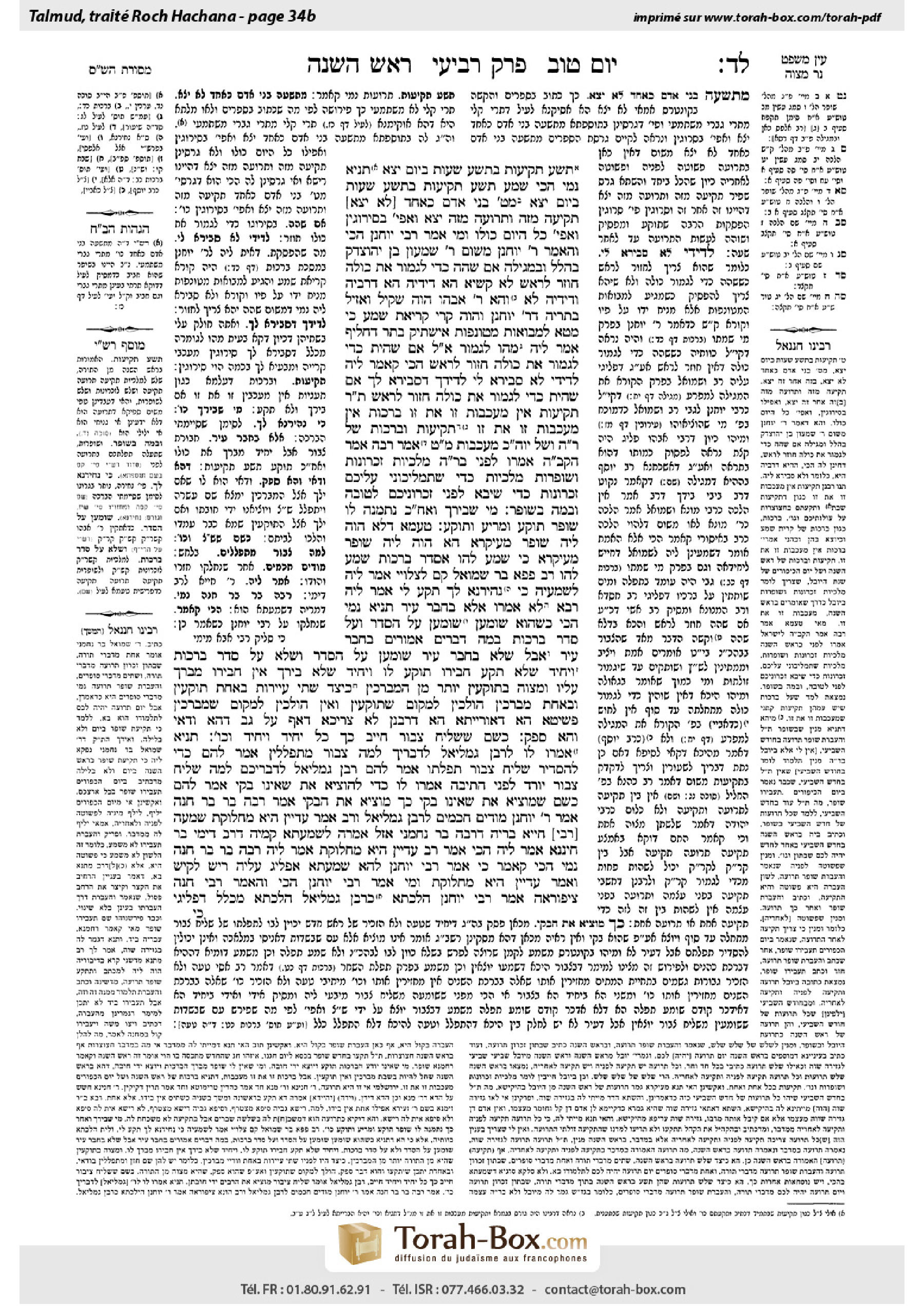
Rosh Hashanah 34b: Talmud study for Daf Yomi
Daf Yomi is the daily study of one Talmud folio. Explore 37 tractates with scans, Hebrew text, Sefaria English and AI-generated French translations where annotated.
Passage selection and English or AI-generated French translation are available where the scan has annotations. Daf Study is independent of Torah-Box and Sefaria.
Browse Rosh Hashanah · ראש השנה · All tractatesRosh Hashanah 34b text and translations
This page of Rosh Hashanah includes the Aramaic text, an English translation and an AI-generated French translation, alongside the scan above.
ראש השנה ל״ד ב · Aramaic and Hebrew text
תֵּשַׁע תְּקִיעוֹת בְּתֵשַׁע שָׁעוֹת בַּיּוֹם — יָצָא.
תַּנְיָא נָמֵי הָכִי: שָׁמַע תֵּשַׁע תְּקִיעוֹת בְּתֵשַׁע שָׁעוֹת בַּיּוֹם — יָצָא. מִתִּשְׁעָה בְּנֵי אָדָם כְּאֶחָד — לֹא יָצָא. תְּקִיעָה מִזֶּה וּתְרוּעָה מִזֶּה — יָצָא. וַאֲפִילּוּ בְּסֵירוּגִין, וַאֲפִילּוּ כׇּל הַיּוֹם כּוּלּוֹ.
וּמִי אָמַר רַבִּי יוֹחָנָן הָכִי? וְהָאָמַר רַבִּי יוֹחָנָן מִשּׁוּם רַבִּי שִׁמְעוֹן בֶּן יְהוֹצָדָק: בְּהַלֵּל וּבִמְגִילָּה, אִם שָׁהָה כְּדֵי לִגְמוֹר אֶת כּוּלָּהּ — חוֹזֵר לָרֹאשׁ! לָא קַשְׁיָא: הָא דִידֵיהּ, הָא דְרַבֵּיהּ.
וְדִידֵיהּ לָא? וְהָא רַבִּי אֲבָהוּ הֲוָה שָׁקֵיל וְאָזֵיל בָּתְרֵיהּ דְּרַבִּי יוֹחָנָן וַהֲוָה קָרֵי קְרִיאַת שְׁמַע, כִּי מְטָא לִמְבוֹאוֹת מְטוּנָּפוֹת, אִישְׁתִּיק, בָּתַר דַּחֲלֵיף אֲמַר לֵיהּ: מַהוּ לִגְמוֹר? אָמַר לוֹ: אִם שָׁהִיתָ כְּדֵי לִגְמוֹר אֶת כּוּלָּהּ — חֲזוֹר לָרֹאשׁ.
הָכִי קָאָמַר לֵיהּ: לְדִידִי — לָא סְבִירָא לִי, לְדִידָךְ, דִּסְבִירָא לָךְ: אִם שָׁהִיתָ כְּדֵי לִגְמוֹר אֶת כּוּלָּהּ — חֲזוֹר לָרֹאשׁ.
תָּנוּ רַבָּנַן: תְּקִיעוֹת — אֵין מְעַכְּבוֹת זוֹ אֶת זוֹ. בְּרָכוֹת — אֵין מְעַכְּבוֹת זוֹ אֶת זוֹ. תְּקִיעוֹת וּבְרָכוֹת שֶׁל רֹאשׁ הַשָּׁנָה וְשֶׁל יוֹם הַכִּפּוּרִים — מְעַכְּבוֹת.
מַאי טַעְמָא? אָמַר רַבָּה: אָמַר הַקָּדוֹשׁ בָּרוּךְ הוּא, אִמְרוּ לְפָנַי בְּרֹאשׁ הַשָּׁנָה מַלְכִיּוֹת זִכְרוֹנוֹת וְשׁוֹפָרוֹת, מַלְכִיּוֹת — כְּדֵי שֶׁתַּמְלִיכוּנִי עֲלֵיכֶם, זִכְרוֹנוֹת — כְּדֵי שֶׁיָּבֹא לְפָנַי זִכְרוֹנֵיכֶם לְטוֹבָה, וּבַמֶּה — בְּשׁוֹפָר.
מִי שֶׁבֵּירַךְ וְאַחַר כָּךְ נִתְמַנָּה לוֹ שׁוֹפָר — תּוֹקֵעַ וּמֵרִיעַ וְתוֹקֵעַ. טַעְמָא דְּלָא הֲוָה לֵיהּ שׁוֹפָר מֵעִיקָּרָא, הָא הֲוָה לֵיהּ שׁוֹפָר מֵעִיקָּרָא, כִּי שָׁמַע לְהוּ — אַסֵּדֶר בְּרָכוֹת שָׁמַע לְהוּ.
רַב פָּפָּא בַּר שְׁמוּאֵל קָם לְצַלּוֹיֵי, אֲמַר לֵיהּ לְשַׁמָּעֵיהּ: כִּי נָהַירְנָא לָךְ תְּקַע לִי. אֲמַר לֵיהּ רָבָא: לֹא אָמְרוּ אֶלָּא בְּחֶבֶר עִיר.
תַּנְיָא נָמֵי הָכִי: כְּשֶׁהוּא שׁוֹמְעָן — שׁוֹמְעָן עַל הַסֵּדֶר, וְעַל סֵדֶר בְּרָכוֹת. בַּמֶּה דְּבָרִים אֲמוּרִים — בְּחֶבֶר עִיר, אֲבָל שֶׁלֹּא בְּחֶבֶר עִיר — שׁוֹמְעָן עַל הַסֵּדֶר וְשֶׁלֹּא עַל סֵדֶר בְּרָכוֹת. וְיָחִיד שֶׁלֹּא תָּקַע — חֲבֵירוֹ תּוֹקֵעַ לוֹ, וְיָחִיד שֶׁלֹּא בֵּירַךְ — אֵין חֲבֵירוֹ מְבָרֵךְ עָלָיו.
וּמִצְוָה בְּתוֹקְעִין יוֹתֵר מִן הַמְבָרְכִין. כֵּיצַד? שְׁתֵּי עֲיָירוֹת, בְּאַחַת תּוֹקְעִין, וּבְאַחַת מְבָרְכִין — הוֹלְכִין לִמְקוֹם שֶׁתּוֹקְעִין, וְאֵין הוֹלְכִין לִמְקוֹם שֶׁמְּבָרְכִין.
פְּשִׁיטָא — הָא דְּאוֹרָיְיתָא, הָא דְּרַבָּנַן! לָא צְרִיכָא, דְּאַף עַל גַּב דְּהָא וַדַּאי וְהָא סָפֵק.
כְּשֵׁם שֶׁשְּׁלִיחַ צִבּוּר חַיָּיב, כָּךְ כׇּל יָחִיד וְיָחִיד וְכוּ׳. תַּנְיָא, אָמְרוּ לוֹ לְרַבָּן גַּמְלִיאֵל: לִדְבָרֶיךָ, לָמָּה צִבּוּר מִתְפַּלְּלִין! אָמַר לָהֶם: כְּדֵי לְהַסְדִּיר שְׁלִיחַ צִבּוּר תְּפִלָּתוֹ,
אָמַר לָהֶם רַבָּן גַּמְלִיאֵל: לְדִבְרֵיכֶם, לָמָּה שְׁלִיחַ צִבּוּר יוֹרֵד לִפְנֵי הַתֵּיבָה? אָמְרוּ לוֹ: כְּדֵי לְהוֹצִיא אֶת שֶׁאֵינוֹ בָּקִי. אָמַר לָהֶם: כְּשֵׁם שֶׁמּוֹצִיא אֶת שֶׁאֵינוֹ בָּקִי, כָּךְ מוֹצִיא אֶת הַבָּקִי.
אָמַר רַבָּה בַּר בַּר חָנָה אָמַר רַבִּי יוֹחָנָן: מוֹדִים חֲכָמִים לְרַבָּן גַּמְלִיאֵל. וְרַב אֲמַר: עֲדַיִין הִיא מַחְלוֹקֶת. שַׁמְעַהּ רַבִּי חִיָּיא בְּרֵיהּ דְּרַבָּה בַּר נַחְמָנִי, אֲזַל, אַמְרַהּ לִשְׁמַעְתָּא קַמֵּיהּ דְּרַב דִּימִי בַּר חִינָּנָא. אֲמַר לֵיהּ, הָכִי אָמַר רַב: עֲדַיִין הִיא מַחְלוֹקֶת. אֲמַר לֵיהּ: רַבָּה בַּר בַּר חָנָה נָמֵי הָכִי קָאָמַר. כִּי אֲמַר רַבִּי יוֹחָנָן לְהָא שְׁמַעְתָּא, אִפְּלִיג עֲלֵיהּ רֵישׁ לָקִישׁ וַאֲמַר: עֲדַיִין הִיא מַחְלוֹקֶת.
וּמִי אָמַר רַבִּי יוֹחָנָן הָכִי? וְהָאָמַר רַבִּי חָנָה צִיפּוֹרָאָה אָמַר רַבִּי יוֹחָנָן: הִלְכְתָא כְּרַבָּן גַּמְלִיאֵל, הִלְכְתָא מִכְּלָל דִּפְלִיגִי!
Rosh Hashanah 34b · English translation
the requisite nine shofar blasts at nine different times of the day, he has fulfilled his obligation, as the blasts need not be heard in immediate succession.
This is also taught in a baraita: If one heard nine shofar blasts at nine different times of the day, he has fulfilled his obligation. If one heard the blasts from nine different people simultaneously, he has not fulfilled his obligation. If one heard a tekia from this one and afterward he heard a terua from this other one, he has fulfilled his obligation, as one does not have to hear all the blasts from the same individual. And this is true even if one heard the blasts from the different individuals at intervals, and even if it took the course of the entire day.
The Gemara asks: And did Rabbi Yoḥanan actually say this? Didn’t Rabbi Yoḥanan say in the name of Rabbi Shimon ben Yehotzadak: During the reading of hallel or the Megilla of Esther, if one paused long enough to complete all of it, he must return to the beginning, as it must be read in one session? Why is the halakha different in the case of the shofar? The Gemara answers: This is not difficult, as this ruling with regard to the shofar is his own opinion, and that case of hallel and the Megilla is his teacher’s opinion. It is Rabbi Shimon ben Yehotzadak who holds that one may not pause in the middle of sounding the shofar.
The Gemara asks: And is this not also his own opinion as well? Wasn’t Rabbi Abbahu once walking after Rabbi Yoḥanan, and Rabbi Abbahu was reciting Shema as he walked? When he reached alleyways that were filthy with human excrement, where it is prohibited to utter words of Torah, he fell silent and stopped reciting Shema. After he passed through, Rabbi Abbahu said to Rabbi Yoḥanan: What is the halakha with regard to completing Shema from where I left off? Rabbi Yoḥanan said to him: If you remained in the alleyway for an interval sufficient to complete the entire Shema, return to the beginning and start again. This shows that Rabbi Yoḥanan himself holds that if one takes an extended break, he must start again from the beginning.
The Gemara answers: This is no proof, as it is possible that this is what Rabbi Yoḥanan said: I myself do not hold that one must start again after a long pause; however, according to you, as you hold that a delay is a problem, the halakha is that if you paused for an interval sufficient to complete the entire Shema, you must return to the beginning.
§ The Sages taught in a baraita: The various trumpet blasts on a fast day do not invalidate one another, i.e., if one was omitted, this does not invalidate the other blasts. Similarly, the additional blessings that are inserted into the Amida prayer on a fast day do not invalidate one another. However, the shofar blasts and additional blessings of Rosh HaShana and of Yom Kippur do invalidate one another.
The Gemara asks: What is the reason that all the blasts and blessings are indispensable on Rosh HaShana? Rabba said that the Holy One, Blessed be He, said: Recite before Me on Rosh HaShana Kingship, Remembrances, and Shofarot. Kingship, so that you will crown Me as King over you; Remembrances, so that your remembrance will rise before Me for good. And with what? With the shofar. Since these blessings constitute a single unit, one who did not recite them all has not fulfilled his obligation.
§ The mishna taught: In the case of one who recited the blessings of the additional prayer and only afterward a shofar became available to him, he sounds a tekia, sounds a terua and sounds a tekia; this is a set that he repeats three times. The Gemara explains: The reason that he may do this is that he did not have a shofar at the outset. This indicates that if he had a shofar at the outset, when he hears the blasts he must hear them by the order of the blessings, i.e., one set must be sounded after each special blessing.
The Gemara relates: Rav Pappa bar Shmuel once rose to pray on Rosh HaShana. He said to his attendant: When I signal to you that I have finished each of the blessings, sound the shofar for me. Rava said to him: They said that the shofar must be sounded after each blessing only where there is a quorum of ten [ḥever ir], not when it is sounded for an individual.
This is also taught in a baraita: When one hears the shofar blasts, he must hear them in order, i.e., a tekia-terua-tekia set, and upon the order of the blessings. In what case is this statement said? Where there is a quorum of ten [ḥever ir]. However, where there is not a ḥever ir, one must hear them in order, but he need not hear them upon the order of the blessings. And in the case of an individual who has not sounded the shofar, another may sound it for him. But with regard to an individual who has not recited the blessings, another may not recite the blessings for him.
And if one has to choose between hearing the shofar and reciting the blessings, the mitzva to be among those who sound the shofar is more important than the mitzva to be among those who recite the blessings. How so? If there are two towns, in one there are those who know how to sound the shofar, and in the other there are individuals who know how to recite the blessings, one should go to the place where they sound the shofar, and one does not go to the place where they know how to recite the blessings.
The Gemara asks: This halakha is obvious. Sounding the shofar is a mitzva by Torah law, whereas the additional prayer applies by rabbinic law. A mitzva that applies by Torah law is clearly more important. The Gemara answers: No; this seemingly superfluous ruling is necessary to teach that although in this town it is certain that the additional prayer will be recited and in this other town it is uncertain whether or not the shofar will be sounded, one should still go to the place where they know how to sound the shofar rather than the location where they know how to recite the blessings.
§ The mishna states: Just as the prayer leader is obligated in the prayers of Rosh HaShana, so too, every individual is obligated in these prayers. Rabban Gamliel says: The prayer leader fulfills the obligation on behalf of the many. It is taught in a baraita that the Rabbis said to Rabban Gamliel: According to your statement, why does the congregation recite the silent Amida prayer beforehand? He said to them: In order that the prayer leader should have time to prepare and arrange his prayer.
Rabban Gamliel said to the Rabbis: According to your statement, that the prayer leader does not fulfill the obligation on behalf of the many, why does the prayer leader descend before the ark and recite the Amida prayer? They said to him: He does so to fulfill the obligation of one who is not an expert in prayer. Rabban Gamliel said to them: Just as he can fulfill the obligation of one who is not an expert in prayer, so too, he can fulfill the obligation of the expert.
With regard to this baraita, Rabba bar bar Ḥana said that Rabbi Yoḥanan said: Ultimately, the Rabbis concede to the opinion of Rabban Gamliel. But Rav said: It is still a dispute that remains unresolved. The Gemara relates that Rabbi Ḥiyya, son of Rabba bar Naḥmani, heard this and went and stated this halakha before Rav Dimi bar Ḥinnana. He said to him that this is what Rav said: It is still a dispute. Rav Dimi bar Ḥinnana said to him: This is what Rabba bar bar Ḥana also said: When Rabbi Yoḥanan said this halakha, that the Rabbis concede to the opinion of Rabban Gamliel, Reish Lakish disagreed with him and said: It is still a dispute.
The Gemara asks: And did Rabbi Yoḥanan actually say this? Didn’t Rabbi Ḥana from the city of Tzippori say that Rabbi Yoḥanan said: The halakha is in accordance with the opinion of Rabban Gamliel? From the fact that he said: The halakha, one can conclude by inference that the Rabbis still disagree. The very fact that he issued a ruling in favor of Rabban Gamliel shows that Rabbi Yoḥanan maintains that the Sages do not accept this opinion.
Rosh Hashanah 34b · Traduction française (IA)
S’il a entendu les neuf sonneries de chofar requises à neuf moments différents de la journée, il s’est acquitté de son obligation, car il n’est pas nécessaire d’entendre les sonneries à la suite immédiate les unes des autres.
Cela est également enseigné dans une baraïta : si quelqu’un a entendu neuf sonneries de chofar à neuf moments différents de la journée, il s’est acquitté de son obligation. S’il a entendu les sonneries de neuf personnes différentes qui sonnaient simultanément, il ne s’est pas acquitté de son obligation. S’il a entendu une tékia de l’un, puis une téroua d’un autre, il s’est acquitté de son obligation, car il n’est pas nécessaire d’entendre toutes les sonneries d’une même personne. Cela reste vrai même s’il a entendu les sonneries de personnes différentes à intervalles, et même si cela a duré toute la journée.
La Guemara demande : Rabbi Yoḥanan a-t-il vraiment dit cela ? N’a-t-il pas dit au nom de Rabbi Shimon ben Yehotzadak : pendant la récitation du Hallel ou la lecture de la Méguila d’Esther, si quelqu’un s’interrompt pendant un temps suffisant pour tout achever, il doit reprendre depuis le début, car la lecture doit se faire d’une seule traite ? Pourquoi la halakha est-elle différente dans le cas du chofar ? La Guemara répond : il n’y a pas de contradiction, car la décision concernant le chofar est son propre avis, tandis que celle concernant le Hallel et la Méguila est l’avis de son maître. C’est Rabbi Shimon ben Yehotzadak qui estime qu’on ne peut pas s’interrompre au milieu des sonneries du chofar.
La Guemara demande : Mais cet avis n’est-il pas aussi le sien ? Rabbi Abbahu ne marchait-il pas un jour derrière Rabbi Yoḥanan en récitant le Chéma ? Lorsqu’il arriva à des ruelles souillées d’excréments humains, où il est interdit de prononcer des paroles de Torah, il se tut et interrompit sa récitation du Chéma. Après les avoir traversées, Rabbi Abbahu demanda à Rabbi Yoḥanan : quelle est la halakha concernant la reprise du Chéma à l’endroit où je me suis arrêté ? Rabbi Yoḥanan lui répondit : si tu es resté dans la ruelle pendant un temps suffisant pour réciter tout le Chéma, reprends depuis le début. Cela montre que Rabbi Yoḥanan lui-même estime qu’après une longue interruption, il faut recommencer depuis le début.
La Guemara répond : cela ne prouve rien, car il est possible que Rabbi Yoḥanan ait dit ceci : personnellement, je ne pense pas qu’il faille recommencer après une longue interruption ; toutefois, selon toi, puisque tu estimes qu’un retard pose problème, la halakha est que si tu t’es interrompu pendant un temps suffisant pour réciter tout le Chéma, tu dois reprendre depuis le début.
§ Les Sages ont enseigné dans une baraïta : les différentes sonneries de trompette lors d’un jour de jeûne ne s’invalident pas mutuellement, c’est-à-dire que l’omission de l’une n’invalide pas les autres. De même, les bénédictions supplémentaires insérées dans la prière de la Amida lors d’un jour de jeûne ne s’invalident pas mutuellement. En revanche, les sonneries du chofar et les bénédictions supplémentaires de Roch Hachana et de Yom Kippour s’invalident mutuellement.
La Guemara demande : Pourquoi toutes les sonneries et toutes les bénédictions sont-elles indispensables à Roch Hachana ? Rabba dit que le Saint, béni soit-Il, a dit : « Récitez devant Moi, à Roch Hachana, les bénédictions de la Royauté, des Souvenirs et des Chofarot. » Celle de la Royauté, afin que vous Me proclamiez Roi sur vous ; celle des Souvenirs, afin que votre souvenir s’élève devant Moi pour le bien. Et au moyen de quoi ? Au moyen du chofar. Puisque ces bénédictions forment une seule unité, celui qui ne les a pas toutes récitées ne s’est pas acquitté de son obligation.
§ La Michna enseigne : dans le cas de celui qui a récité les bénédictions de la prière supplémentaire, puis a seulement ensuite eu accès à un chofar, il sonne une tékia, une téroua et une tékia ; il répète cette série trois fois. La Guemara explique : il peut agir ainsi parce qu’il n’avait pas de chofar au départ. Cela indique que s’il avait eu un chofar dès le départ, les sonneries devraient être entendues selon l’ordre des bénédictions, c’est-à-dire qu’une série devrait être sonnée après chacune des bénédictions particulières.
La Guemara rapporte : Rav Pappa bar Shmuel se leva un jour pour prier à Roch Hachana. Il dit à son assistant : « Lorsque je te ferai signe que j’ai terminé chacune des bénédictions, sonne le chofar pour moi. » Rava lui dit : « Ils ont dit que le chofar doit être sonné après chaque bénédiction uniquement en présence d’un quorum de dix [ḥever ir], et non lorsqu’on sonne pour un individu. »
Cela est également enseigné dans une baraïta : lorsqu’on entend les sonneries du chofar, il faut les entendre dans l’ordre — une série tékia-téroua-tékia — et selon l’ordre des bénédictions. Dans quel cas cela s’applique-t-il ? Lorsqu’il y a un quorum de dix [ḥever ir]. En revanche, en l’absence de ḥever ir, il faut les entendre dans l’ordre, mais pas nécessairement selon l’ordre des bénédictions. Quant à l’individu qui n’a pas sonné du chofar, un autre peut sonner pour lui. Mais s’agissant de l’individu qui n’a pas récité les bénédictions, un autre ne peut pas les réciter pour lui.
Et s’il faut choisir entre entendre le chofar et réciter les bénédictions, la mitsva d’être parmi ceux pour qui l’on sonne du chofar est plus importante que celle d’être parmi ceux qui récitent les bénédictions. Comment cela ? S’il y a deux villes, dans l’une desquelles se trouvent des personnes qui savent sonner du chofar, et dans l’autre des personnes qui savent réciter les bénédictions, on doit se rendre là où l’on sonne du chofar, et non là où l’on sait réciter les bénédictions.
La Guemara demande : cette halakha n’est-elle pas évidente ? Sonner du chofar est une mitsva prescrite par la Torah, tandis que la prière supplémentaire relève d’une ordonnance rabbinique. Il est clair qu’une mitsva prescrite par la Torah est plus importante. La Guemara répond : non ; cette décision, qui semble superflue, est nécessaire pour enseigner que, même si l’on est certain que la prière supplémentaire sera récitée dans cette ville, alors que dans l’autre ville on ne sait pas si le chofar sera sonné, il faut néanmoins se rendre là où l’on sait sonner du chofar plutôt qu’à l’endroit où l’on sait réciter les bénédictions.
§ La Michna affirme : de même que l’officiant est tenu de réciter les prières de Roch Hachana, chaque individu est tenu de réciter ces prières. Rabban Gamliel dit : l’officiant acquitte la multitude de son obligation. Il est enseigné dans une baraïta que les Sages dirent à Rabban Gamliel : « Selon toi, pourquoi l’assemblée récite-t-elle d’abord la Amida à voix basse ? » Il leur répondit : « Afin que l’officiant ait le temps de préparer et d’ordonner sa prière. »
Rabban Gamliel dit aux Sages : « Selon vous, qui affirmez que l’officiant n’acquitte pas la multitude de son obligation, pourquoi l’officiant s’avance-t-il devant l’arche et récite-t-il la Amida ? » Ils lui répondirent : « Il le fait pour acquitter celui qui n’est pas expert en prière. » Rabban Gamliel leur dit : « De même qu’il peut acquitter celui qui n’est pas expert en prière, il peut aussi acquitter celui qui est expert. »
À propos de cette baraïta, Rabba bar bar Ḥana dit au nom de Rabbi Yoḥanan : en définitive, les Sages reconnaissent le bien-fondé de l’avis de Rabban Gamliel. Mais Rav dit : le désaccord reste sans être tranché. Rabbi Ḥiyya, fils de Rabba bar Naḥmani, entendit cela, alla rapporter cette halakha à Rav Dimi bar Ḥinnana et lui dit : « Voici ce que Rav a dit : le désaccord reste sans être tranché. » Rav Dimi bar Ḥinnana lui répondit : « Voici ce que Rabba bar bar Ḥana a également dit : lorsque Rabbi Yoḥanan énonça cette halakha, selon laquelle les Sages reconnaissent le bien-fondé de l’avis de Rabban Gamliel, Reish Lakish le contredit et dit : le désaccord reste sans être tranché. »
La Guemara demande : Rabbi Yoḥanan a-t-il vraiment dit cela ? Rabbi Ḥana, de la ville de Tzippori, n’a-t-il pas dit que Rabbi Yoḥanan avait déclaré : « La halakha est conforme à l’avis de Rabban Gamliel » ? Du fait qu’il a dit « la halakha », on peut déduire que les Sages sont toujours en désaccord. Le fait même qu’il ait rendu une décision en faveur de Rabban Gamliel montre que, selon Rabbi Yoḥanan, les Sages n’acceptent pas cet avis.
Traduction française générée par IA à partir de l’édition anglaise de Sefaria. Vérifie toujours un passage avec le texte source.
Text from Sefaria: William Davidson Edition - Vocalized Aramaic (CC BY NC); William Davidson Edition - English (CC BY NC).