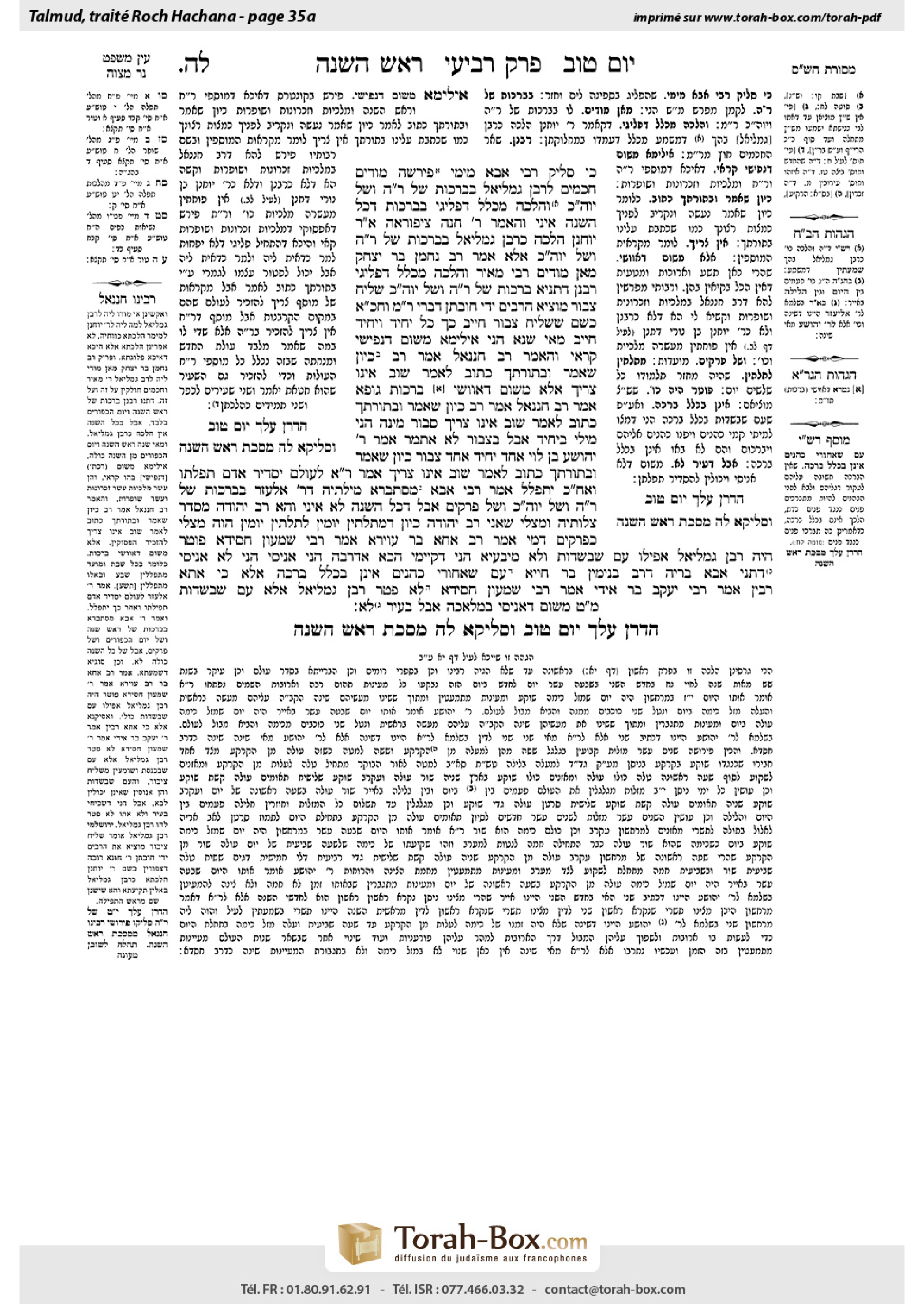
Rosh Hashanah 35a: Talmud study for Daf Yomi
Daf Yomi is the daily study of one Talmud folio. Explore 37 tractates with scans, Hebrew text, Sefaria English and AI-generated French translations where annotated.
Passage selection and English or AI-generated French translation are available where the scan has annotations. Daf Study is independent of Torah-Box and Sefaria.
Browse Rosh Hashanah · ראש השנה · All tractatesRosh Hashanah 35a text and translations
This page of Rosh Hashanah includes the Aramaic text, an English translation and an AI-generated French translation, alongside the scan above.
ראש השנה ל״ה א · Aramaic and Hebrew text
כִּי סְלֵיק רַבִּי אַבָּא מִיַּמֵּי, פֵּירְשַׁהּ: מוֹדִים חֲכָמִים לְרַבָּן גַּמְלִיאֵל בִּבְרָכוֹת שֶׁל רֹאשׁ הַשָּׁנָה וְשֶׁל יוֹם הַכִּפּוּרִים, וַהֲלָכָה מִכְּלָל דִּפְלִיגִי בִּבְרָכוֹת דְּכׇל הַשָּׁנָה.
אִינִי?! וְהָאָמַר רַבִּי חָנָה צִיפּוֹרָאָה אָמַר רַבִּי יוֹחָנָן: הֲלָכָה כְּרַבָּן גַּמְלִיאֵל בִּבְרָכוֹת שֶׁל רֹאשׁ הַשָּׁנָה וְשֶׁל יוֹם הַכִּפּוּרִים!
אֶלָּא אָמַר רַב נַחְמָן בַּר יִצְחָק: מַאן מוֹדִים — רַבִּי מֵאִיר, וַהֲלָכָה מִכְּלָל דִּפְלִיגִי — רַבָּנַן.
דְּתַנְיָא: בְּרָכוֹת שֶׁל רֹאשׁ הַשָּׁנָה וְשֶׁל יוֹם הַכִּפּוּרִים — שְׁלִיחַ צִבּוּר מוֹצִיא הָרַבִּים יְדֵי חוֹבָתָן, דִּבְרֵי רַבִּי מֵאִיר. וַחֲכָמִים אוֹמְרִים: כְּשֵׁם שֶׁשְּׁלִיחַ צִבּוּר חַיָּיב — כָּךְ כָּל יָחִיד וְיָחִיד חַיָּיב.
מַאי שְׁנָא הָנֵי? אִילֵּימָא מִשּׁוּם דִּנְפִישִׁי קְרָאֵי — וְהָאָמַר רַב חֲנַנְאֵל אָמַר רַב: כֵּיוָן שֶׁאָמַר ״וּבְתוֹרָתְךָ כָּתוּב לֵאמֹר״ שׁוּב אֵינוֹ צָרִיךְ! אֶלָּא מִשּׁוּם דְּאָוְושִׁי בְּרָכוֹת.
גּוּפָא, אָמַר רַב חֲנַנְאֵל אָמַר רַב: כֵּיוָן שֶׁאָמַר ״וּבְתוֹרָתְךָ כָּתוּב לֵאמֹר״ — שׁוּב אֵינוֹ צָרִיךְ. סְבוּר מִינַּהּ: הָנֵי מִילֵּי בְּיָחִיד, אֲבָל בְּצִבּוּר לָא. אִתְּמַר, אָמַר רַבִּי יְהוֹשֻׁעַ בֶּן לֵוִי: אֶחָד יָחִיד אֶחָד צִבּוּר, כֵּיוָן שֶׁאָמַר ״וּבְתוֹרָתְךָ כָּתוּב לֵאמֹר״ — שׁוּב אֵינוֹ צָרִיךְ.
אָמַר רַבִּי אֶלְעָזָר: לְעוֹלָם יַסְדִּיר אָדָם תְּפִלָּתוֹ, וְאַחַר כָּךְ יִתְפַּלֵּל. אָמַר רַבִּי אַבָּא: מִסְתַּבְּרָא מִילְּתֵיהּ דְּרַבִּי אֶלְעָזָר בִּבְרָכוֹת שֶׁל רֹאשׁ הַשָּׁנָה וְשֶׁל יוֹם הַכִּפּוּרִים וְשֶׁל פְּרָקִים, אֲבָל דְּכׇל הַשָּׁנָה — לָא.
אִינִי?! וְהָא רַב יְהוּדָה מְסַדַּר צְלוֹתֵיהּ וּמְצַלֵּי! שָׁאנֵי רַב יְהוּדָה, כֵּיוָן דְּמִתְּלָתִין יוֹמִין לִתְלָתִין יוֹמִין הֲוָה מְצַלֵּי, כִּפְרָקִים דָּמֵי.
אָמַר רַב אַחָא בַּר עַוִּירָא אָמַר רַבִּי שִׁמְעוֹן חֲסִידָא: פּוֹטֵר הָיָה רַבָּן גַּמְלִיאֵל אֲפִילּוּ עַם שֶׁבַּשָּׂדוֹת. וְלָא מִיבַּעְיָא הָנֵי דְּקָיְימִי הָכָא?!
אַדְּרַבָּה: הָנֵי אֲנִיסִי, הָנֵי לָא אֲנִיסִי,
דְּתָנֵי אַבָּא בְּרֵיהּ דְּרַב בִּנְיָמִין בַּר חִיָּיא: עַם שֶׁאֲחוֹרֵי כֹּהֲנִים — אֵינָן בִּכְלַל בְּרָכָה.
אֶלָּא, כִּי אֲתָא רָבִין: אָמַר רַבִּי יַעֲקֹב בַּר אִידֵּי אָמַר רַבִּי שִׁמְעוֹן חֲסִידָא: לֹא פָּטַר רַבָּן גַּמְלִיאֵל אֶלָּא עַם שֶׁבַּשָּׂדוֹת, מַאי טַעְמָא — מִשּׁוּם דַּאֲנִיסִי בִּמְלָאכָה, אֲבָל בָּעִיר — לֹא.
הַדְרָן עֲלָךְ יוֹם טוֹב וּסְלִיקָא לַהּ מַסֶּכֶת רֹאשׁ הַשָּׁנָה
Rosh Hashanah 35a · English translation
The Gemara answers: When Rabbi Abba returned from his travels at sea, he explained the matter as follows: The Sages concede to the opinion of Rabban Gamliel with regard to the blessings of Rosh HaShana and of Yom Kippur, that in these cases the prayer leader fulfills the obligation on behalf of the many. And Rabbi Yoḥanan’s statement that the halakha is in accordance with Rabban Gamliel, which, by inference, indicates that the tanna’im still disagree, is referring to the blessings of the entire year.
The Gemara raises a difficulty. Is that so? Didn’t Rabbi Ḥana from the city of Tzippori say that Rabbi Yoḥanan said: The halakha is in accordance with the opinion of Rabban Gamliel with regard to the blessings of Rosh HaShana and of Yom Kippur? Apparently, he holds that the tanna’im remain in dispute even with regard to these blessings.
Rather, Rabbi Yoḥanan’s statements must be attributed to different Sages, as Rav Naḥman bar Yitzḥak said: Who concedes to the opinion of Rabban Gamliel? Rabbi Meir. And with regard to Rabbi Yoḥanan’s ruling that the halakha is in accordance with Rabban Gamliel, which, by inference, indicates that the tanna’im still disagree, this is referring to the Rabbis, who disagree with Rabbi Meir.
The Gemara explains: As it is taught in a baraita: With regard to the blessings of Rosh HaShana and of Yom Kippur, the prayer leader fulfills the obligation on behalf of the many. This is the statement of Rabbi Meir. And the Rabbis say: Just as the prayer leader is obligated in these prayers, so too, every individual is obligated to recite them on his own. Clearly, Rabbi Meir agrees with Rabban Gamliel with regard to the blessings of Rosh HaShana and Yom Kippur, while the Rabbis dispute this ruling.
The Gemara asks: What is different about these blessings of Rosh HaShana and Yom Kippur, that Rabbi Meir concedes to the opinion of Rabban Gamliel only with regard to them, but not about the blessings recited the rest of the year? If we say that it is due to the many verses that are included in these blessings, this is difficult. Didn’t Rav Ḥananel say that Rav said: Once one has recited the line of the prayer: And in Your Torah it is written, saying, it is no longer necessary to recite the verses themselves. Rather, it is because there are many blessings, and as the blessings are long, not everyone is capable of learning them by heart.
The Gemara discusses the matter itself. Rav Ḥananel said that Rav said: Once one has recited the line of the prayer: And in Your Torah it is written, saying, it is no longer necessary to recite the verses themselves. The Gemara clarifies the scope of this ruling: Some understood from this that it applies only to an individual; however, with regard to a congregation, no, this is not the case. Nevertheless, it is stated that Rabbi Yehoshua ben Levi said: Both with regard to an individual and a congregation, once one has recited: And in Your Torah it is written, saying, it is no longer necessary to recite the verses.
§ Rabbi Elazar said: A person should always arrange his prayer in his mind and only then pray. Rabbi Abba said: Rabbi Elazar’s statement is reasonable with regard to the blessings of Rosh HaShana and Yom Kippur and in the case of prayers that are recited only intermittently. However, with regard to blessings recited all year, no, this practice is not necessary.
The Gemara asks: Is that so? Didn’t Rav Yehuda first arrange his prayer in his mind and only then pray, even on an ordinary day? The Gemara answers: Rav Yehuda was different, since he would pray only once every thirty days. During the rest of the month he would not engage in prayer, as he was busy with Torah study. Therefore, for him even regular weekdays prayers were like prayers recited intermittently.
Rav Aḥa bar Avira said that Rabbi Shimon Ḥasida said: Rabban Gamliel would allow the prayer leader to exempt even the people who were in the fields and away from the synagogue. The Gemara challenges: This statement implies that the prayer leader exempts even the people in the fields, and needless to say, he exempts those who are here in the city but did not attend the prayer service in the synagogue.
The Gemara questions this conclusion: On the contrary, the opposite is more reasonable: Those in the fields did not come to the synagogue due to circumstances beyond their control, and therefore they should be allowed to fulfill their obligation through the prayer leader. By contrast, those in the city were not prevented from coming to the synagogue due to circumstances beyond their control. Consequently, they should not fulfill their obligation through the prayer leader.
As Abba, son of Rav Binyamin bar Ḥiyya, taught in a baraita: Those people standing in the synagogue behind the priests during the Priestly Blessing, who are not positioned in front of them, face-to-face, are not included in the blessing. They are expected to make the minimal effort to stand in front of the priests. However, those in the fields are included in the Priestly Blessing.
Rather, Rabban Gamliel’s statement should be understood differently: When Ravin came from Eretz Yisrael to Babylonia, he reported that Rabbi Ya’akov bar Idi said that Rabbi Shimon bar Ḥasida said: Rabban Gamliel allowed the prayer leader to exempt only the people in the fields. What is the reason for this? Because the people in the fields are unable to come to the synagogue due to work circumstances beyond their control, and do not have time to prepare their prayers. However, Rabban Gamliel did not exempt those in the city who do not come to the synagogue, as they are able to prepare their prayers and pray by themselves.
Rosh Hashanah 35a · Traduction française (IA)
La Guemara répond : Lorsque Rabbi Abba revint de ses voyages en mer, il expliqua la question ainsi : Les Sages concèdent l’avis de Rabban Gamliel concernant les bénédictions de Roch Hachana et de Yom Kippour : dans ces cas, l’officiant acquitte la collectivité de son obligation. Quant à la déclaration de Rabbi Yoḥanan selon laquelle la halakha est conforme à l’avis de Rabban Gamliel — ce qui laisse entendre que les tannaïm sont encore en désaccord —, elle concerne les bénédictions récitées tout au long de l’année.
La Guemara soulève une difficulté : En est-il ainsi ? Rabbi Ḥana, de la ville de Tsippori, n’a-t-il pas dit que Rabbi Yoḥanan avait déclaré : La halakha est conforme à l’avis de Rabban Gamliel concernant les bénédictions de Roch Hachana et de Yom Kippour ? Il semble donc qu’il considère que les tannaïm restent en désaccord même au sujet de ces bénédictions.
Il faut plutôt attribuer les déclarations de Rabbi Yoḥanan à différents Sages, comme l’a dit Rav Naḥman bar Yitzḥak : Qui concède l’avis de Rabban Gamliel ? Rabbi Meïr. Quant à la décision de Rabbi Yoḥanan selon laquelle la halakha est conforme à l’avis de Rabban Gamliel — ce qui laisse entendre que les tannaïm sont encore en désaccord —, elle concerne les Rabbins, qui sont en désaccord avec Rabbi Meïr.
La Guemara explique : Comme il est enseigné dans une baraïta : Concernant les bénédictions de Roch Hachana et de Yom Kippour, l’officiant acquitte la collectivité de son obligation. Telle est l’opinion de Rabbi Meïr. Les Rabbins disent : De même que l’officiant est tenu de réciter ces prières, chaque individu est lui aussi tenu de les réciter lui-même. Il est donc clair que Rabbi Meïr est d’accord avec Rabban Gamliel au sujet des bénédictions de Roch Hachana et de Yom Kippour, tandis que les Rabbins contestent cette décision.
La Guemara demande : En quoi ces bénédictions de Roch Hachana et de Yom Kippour diffèrent-elles pour que Rabbi Meïr concède l’avis de Rabban Gamliel à leur seul sujet, mais pas pour les bénédictions récitées le reste de l’année ? Si l’on dit que c’est en raison des nombreux versets inclus dans ces bénédictions, cela pose difficulté. Rav Ḥananel n’a-t-il pas dit au nom de Rav : Dès lors qu’on a récité la formule de la prière « Et dans Ta Torah il est écrit, en ces termes », il n’est plus nécessaire de réciter les versets eux-mêmes ? C’est plutôt parce qu’il y a de nombreuses bénédictions et que celles-ci sont longues : tout le monde n’est pas capable de les apprendre par cœur.
La Guemara examine la question elle-même. Rav Ḥananel a dit au nom de Rav : Dès lors qu’on a récité la formule de la prière « Et dans Ta Torah il est écrit, en ces termes », il n’est plus nécessaire de réciter les versets eux-mêmes. La Guemara précise la portée de cette décision : Certains ont compris qu’elle ne s’applique qu’à un individu, mais pas à une assemblée. Pourtant, Rabbi Yehoshua ben Levi a déclaré : Tant pour un individu que pour une assemblée, dès lors qu’on a récité « Et dans Ta Torah il est écrit, en ces termes », il n’est plus nécessaire de réciter les versets.
§ Rabbi Elazar a dit : Une personne doit toujours préparer sa prière dans son esprit, et seulement ensuite prier. Rabbi Abba a dit : La déclaration de Rabbi Elazar est pertinente pour les bénédictions de Roch Hachana et de Yom Kippour, ainsi que pour les prières récitées seulement de temps à autre. En revanche, cette pratique n’est pas nécessaire pour les bénédictions récitées toute l’année.
La Guemara demande : En est-il ainsi ? Rav Yehuda ne préparait-il pas d’abord sa prière dans son esprit, puis ne priait-il pas, même un jour ordinaire ? La Guemara répond : Le cas de Rav Yehuda était différent, car il ne priait qu’une fois tous les trente jours. Le reste du mois, il ne priait pas, étant occupé à étudier la Torah. Ainsi, même les prières des jours ordinaires étaient pour lui comme des prières récitées de temps à autre.
Rav Aḥa bar Avira a dit au nom de Rabbi Shimon Ḥasida : Rabban Gamliel permettait à l’officiant d’acquitter même les personnes qui se trouvaient dans les champs, loin de la synagogue. La Guemara objecte : Cette déclaration implique que l’officiant acquitte même les personnes dans les champs ; à plus forte raison acquitte-t-il celles qui sont ici, en ville, mais qui ne se sont pas rendues à l’office dans la synagogue.
La Guemara remet cette conclusion en question : Au contraire, c’est l’inverse qui paraît plus raisonnable. Les personnes dans les champs ne sont pas venues à la synagogue en raison de circonstances indépendantes de leur volonté ; elles devraient donc pouvoir s’acquitter de leur obligation par l’intermédiaire de l’officiant. En revanche, les personnes en ville n’ont pas été empêchées de se rendre à la synagogue par des circonstances indépendantes de leur volonté. Par conséquent, elles ne devraient pas pouvoir s’acquitter de leur obligation par l’intermédiaire de l’officiant.
Car Abba, fils de Rav Binyamin bar Ḥiyya, a enseigné dans une baraïta : Les personnes qui se tiennent dans la synagogue derrière les prêtres pendant la bénédiction sacerdotale, et qui ne sont pas devant eux, face à face, ne sont pas incluses dans la bénédiction. On attend d’elles qu’elles fassent le minimum d’effort nécessaire pour se placer devant les prêtres. En revanche, les personnes dans les champs sont incluses dans la bénédiction sacerdotale.
Il faut plutôt comprendre autrement la déclaration de Rabban Gamliel : Lorsque Ravin arriva d’Eretz Israël en Babylonie, il rapporta que Rabbi Ya’akov bar Idi avait dit au nom de Rabbi Shimon bar Ḥasida : Rabban Gamliel permettait à l’officiant d’acquitter uniquement les personnes dans les champs. Pourquoi ? Parce que les personnes dans les champs ne peuvent pas se rendre à la synagogue en raison de circonstances professionnelles indépendantes de leur volonté et n’ont pas le temps de préparer leurs prières. Rabban Gamliel n’acquittait toutefois pas les personnes en ville qui ne se rendent pas à la synagogue, puisqu’elles sont en mesure de préparer leurs prières et de prier seules.
Traduction française générée par IA à partir de l’édition anglaise de Sefaria. Vérifie toujours un passage avec le texte source.
Text from Sefaria: William Davidson Edition - Vocalized Aramaic (CC BY NC); William Davidson Edition - English (CC BY NC).