Taanit 2a: Talmud study for Daf Yomi
Daf Yomi is the daily study of one Talmud folio. Explore 37 tractates with scans, Hebrew text, Sefaria English and AI-generated French translations where annotated.
Passage selection and English or AI-generated French translation are available where the scan has annotations. Daf Study is independent of Torah-Box and Sefaria.
Browse Taanit · תענית · All tractatesTaanit 2a text and translations
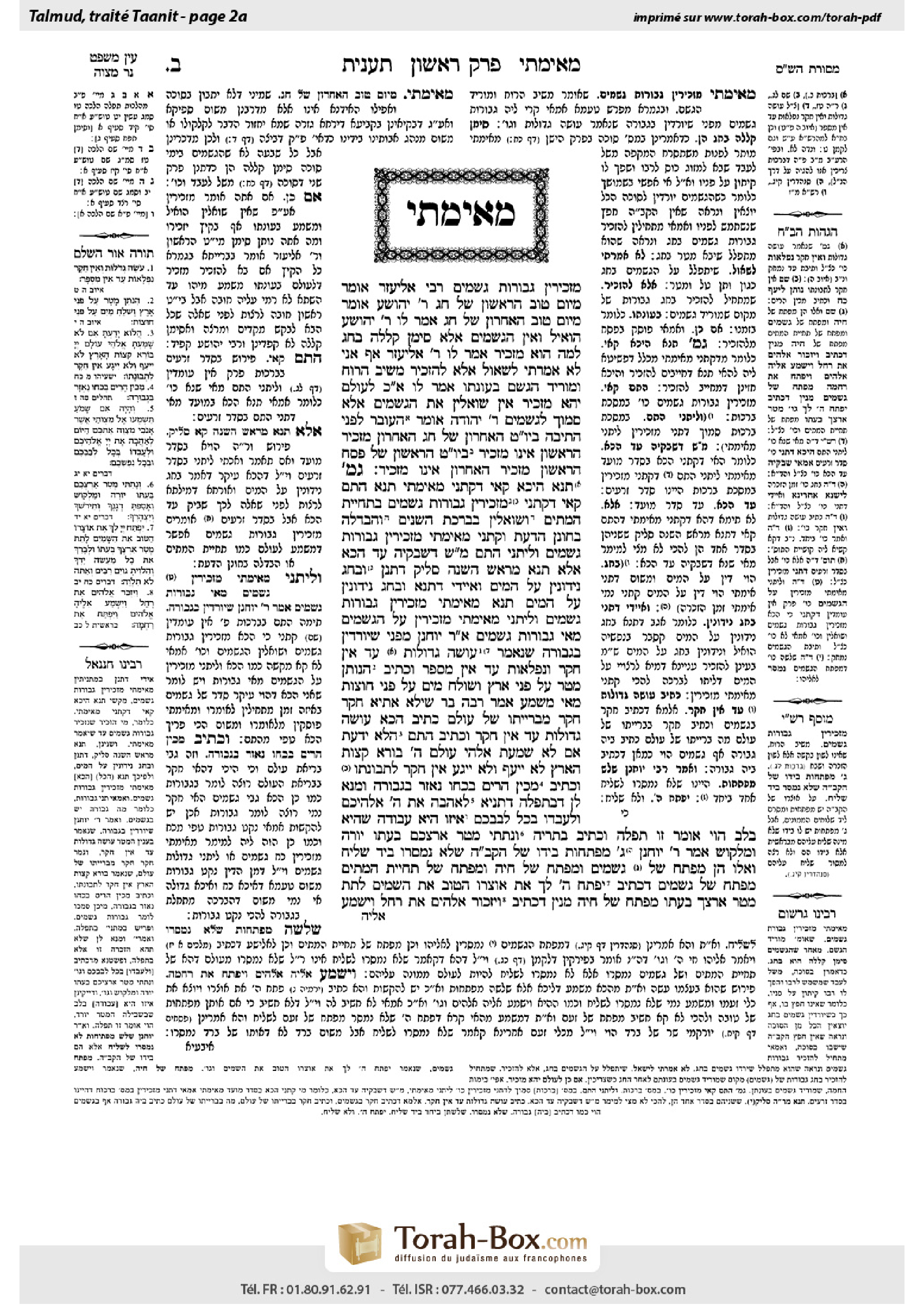
This page of Taanit includes the Aramaic text, an English translation and an AI-generated French translation, alongside the scan above.
תענית ב׳ א · Aramaic and Hebrew text
מֵאֵימָתַי מַזְכִּירִין גְּבוּרוֹת גְּשָׁמִים? רַבִּי אֱלִיעֶזֶר אוֹמֵר: מִיּוֹם טוֹב הָרִאשׁוֹן שֶׁל חַג. רַבִּי יְהוֹשֻׁעַ אוֹמֵר: מִיּוֹם טוֹב הָאַחֲרוֹן שֶׁל חַג.
אָמַר לוֹ רַבִּי יְהוֹשֻׁעַ: הוֹאִיל וְאֵין הַגְּשָׁמִים אֶלָּא סִימַן קְלָלָה בֶּחָג, לָמָה הוּא מַזְכִּיר? אָמַר לוֹ רַבִּי אֱלִיעֶזֶר: אַף אֲנִי לֹא אָמַרְתִּי לִשְׁאוֹל אֶלָּא לְהַזְכִּיר ״מַשִּׁיב הָרוּחַ וּמוֹרִיד הַגֶּשֶׁם״ בְּעוֹנָתוֹ. אָמַר לוֹ: אִם כֵּן, לְעוֹלָם יְהֵא מַזְכִּיר!
אֵין שׁוֹאֲלִים אֶת הַגְּשָׁמִים אֶלָּא סָמוּךְ לַגְּשָׁמִים. רַבִּי יְהוּדָה אוֹמֵר: הָעוֹבֵר לִפְנֵי הַתֵּיבָה בְּיוֹם טוֹב הָאַחֲרוֹן שֶׁל חַג — הָאַחֲרוֹן מַזְכִּיר, הָרִאשׁוֹן אֵינוֹ מַזְכִּיר. בְּיוֹם טוֹב רִאשׁוֹן שֶׁל פֶּסַח — הָרִאשׁוֹן מַזְכִּיר, הָאַחֲרוֹן אֵינוֹ מַזְכִּיר.
גְּמָ׳ תַּנָּא הֵיכָא קָאֵי דְּקָתָנֵי ״מֵאֵימָתַי״? תַּנָּא הָתָם קָאֵי —
דְּקָתָנֵי: מַזְכִּירִים גְּבוּרוֹת גְּשָׁמִים בִּתְחִיַּית הַמֵּתִים, וְשׁוֹאֲלִין בְּבִרְכַּת הַשָּׁנִים, וְהַבְדָּלָה בְּחוֹנֵן הַדָּעַת. וְקָתָנֵי: מֵאֵימָתַי מַזְכִּירִים גְּבוּרוֹת גְּשָׁמִים.
וְלִיתְנֵי הָתָם! מַאי שְׁנָא דְּשַׁבְקֵיהּ עַד הָכָא?!
אֶלָּא, תַּנָּא מֵרֹאשׁ הַשָּׁנָה סָלֵיק, דִּתְנַן: וּבֶחָג נִידּוֹנִין עַל הַמַּיִם. וְאַיְּידֵי דִּתְנָא וּבֶחָג נִידּוֹנִים עַל הַמַּיִם, תָּנָא מֵאֵימָתַי מַזְכִּירִין גְּבוּרוֹת גְּשָׁמִים.
וְלִיתְנֵי ״מֵאֵימָתַי מַזְכִּירִים עַל הַגְּשָׁמִים״. מַאי ״גְּבוּרוֹת גְּשָׁמִים״? אָמַר רַבִּי יוֹחָנָן: מִפְּנֵי שֶׁיּוֹרְדִין בִּגְבוּרָה, שֶׁנֶּאֱמַר: ״עֹשֶׂה גְדֹלוֹת עַד אֵין חֵקֶר וְנִפְלָאוֹת עַד אֵין מִסְפָּר״, וּכְתִיב: ״הַנֹּתֵן מָטָר עַל פְּנֵי הָאָרֶץ וְשֹׁלֵחַ מַיִם עַל פְּנֵי חוּצוֹת״.
מַאי מַשְׁמַע? אָמַר רַבָּה בַּר שֵׁילָא: אָתְיָא ״חֵקֶר״ ״חֵקֶר״ מִבְּרִיָּיתוֹ שֶׁל עוֹלָם.
כְּתִיב הָכָא: ״עֹשֶׂה גְדֹלוֹת עַד אֵין חֵקֶר״, וּכְתִיב הָתָם: ״הֲלוֹא יָדַעְתָּ אִם לֹא שָׁמַעְתָּ אֱלֹהֵי עוֹלָם ה׳ בּוֹרֵא קְצוֹת הָאָרֶץ לֹא יִיעַף וְלֹא יִיגָע אֵין חֵקֶר לִתְבוּנָתוֹ״, וּכְתִיב: ״מֵכִין הָרִים בְּכֹחוֹ נֶאְזָר בִּגְבוּרָה״.
וּמְנָא לַן דְּבִתְפִלָּה — דְּתַנְיָא: ״לְאַהֲבָה אֶת ה׳ אֱלֹהֵיכֶם וּלְעׇבְדוֹ בְּכׇל לְבַבְכֶם״, אֵיזוֹ הִיא עֲבוֹדָה שֶׁהִיא בַּלֵּב — הֱוֵי אוֹמֵר: זוֹ תְּפִלָּה. וּכְתִיב בָּתְרֵיהּ: ״וְנָתַתִּי מְטַר אַרְצְכֶם בְּעִתּוֹ יוֹרֶה וּמַלְקוֹשׁ״.
אָמַר רַבִּי יוֹחָנָן: שְׁלֹשָׁה מַפְתְּחוֹת בְּיָדוֹ שֶׁל הַקָּדוֹשׁ בָּרוּךְ הוּא שֶׁלֹּא נִמְסְרוּ בְּיַד שָׁלִיחַ, וְאֵלּוּ הֵן: מַפְתֵּחַ שֶׁל גְּשָׁמִים, מַפְתֵּחַ שֶׁל חַיָּה, וּמַפְתֵּחַ שֶׁל תְּחִיַּית הַמֵּתִים.
מַפְתֵּחַ שֶׁל גְּשָׁמִים — דִּכְתִיב: ״יִפְתַּח ה׳ לְךָ אֶת אוֹצָרוֹ הַטּוֹב אֶת הַשָּׁמַיִם לָתֵת מְטַר אַרְצְךָ בְּעִתּוֹ״. מַפְתֵּחַ שֶׁל חַיָּה מִנַּיִן — דִּכְתִיב: ״וַיִּזְכֹּר אֱלֹהִים אֶת רָחֵל וַיִּשְׁמַע
Taanit 2a · English translation
MISHNA: From when, i.e., from which date, does one begin to mention the might of the rains by inserting the phrase: He makes the wind blow and rain fall, in the second blessing of the Amida prayer? Rabbi Eliezer says: The phrase is inserted from the first Festival day of the festival of Sukkot. Rabbi Yehoshua says: From the last Festival day of the festival of Sukkot.
Rabbi Yehoshua said to Rabbi Eliezer: Since rain is nothing other than a sign of a curse during the festival of Sukkot, as rainfall forces Jews to leave their sukkot, why should one mention the might of rain during this period? Rabbi Eliezer said to him: I too did not say that it is proper to request rain at this time, but it is proper only to mention the phrase: He makes the wind blow and rain fall, in its due time. Rabbi Yehoshua said to him: If so, i.e., if reciting the phrase does not constitute a request for rain, one should always mention rain, even in the summer.
The mishna states a general principle: One requests rain only immediately preceding the rainy season. Rabbi Yehuda says: With regard to the one who passes before the ark as prayer leader on the concluding Festival day of the festival of Sukkot, the Eighth Day of Assembly: The last prayer leader, who leads the additional prayer, mentions rain, whereas the first prayer leader, for the morning prayer, does not mention rain. The opposite is the case at the conclusion of the period for mentioning rain on the first Festival day of Passover: Here, the first prayer leader, who leads the morning prayer, mentions rain, while the last prayer leader, who leads the additional prayer, does not mention rain.
GEMARA: The Gemara asks: Where does the tanna of the mishna stand, that he teaches: From when? The mishna’s opening question indicates that it has already been established that there is an obligation to mention rain at this time of the year. Where is this obligation stated? The Gemara answers: The tanna is standing there, i.e., he bases himself on a mishna in Berakhot.
As it teaches (Berakhot 33a): One mentions the might of the rains and recites: He makes the wind blow and the rain fall in the second blessing of the Amida prayer, the blessing of the resurrection of the dead. And the request for rain: And grant dew and rain as a blessing, is recited in the ninth blessing of the Amida prayer, the blessing of the years. And the prayer of distinction [havdala] between the sacred and the profane, recited in the evening prayer following Shabbat and Festivals, is recited in the fourth blessing of the Amida prayer: Who graciously grants knowledge. And it is based on that mishna, which establishes the obligation to request for rain, that this mishna teaches: From when does one begin to mention the might of the rains.
The Gemara asks: But if so, let the tanna teach this halakha there, in tractate Berakhot, at the beginning of the order of Zera’im. What is different about this case that he left it until here, toward the end of the order of Moed? In other words, if this issue is indeed a continuation of the mishna in Berakhot, why did the tanna neglect it until tractate Ta’anit?
The Gemara answers: Rather, the tanna interrupted a discussion from tractate Rosh HaShana. As we learned in a mishna there: And on the festival of Sukkot all creatures are judged for water. Since the tanna taught: And on the festival of Sukkot all creatures are judged for water, from which it can be inferred that one should request rain near the time of this judgment, he taught here: From when does one mention the might of the rains.
§ The Gemara asks a question with regard to the language of the mishna: And let the tanna simply teach: From when does one mention the rains. What is the meaning of the phrase: The might of the rains? Rabbi Yoḥanan said: Because the rains fall with might. The might of the rain displays God’s power in the world, as it is stated: “Who does great things beyond comprehension, marvels without number” (Job 5:9). And it is also written: “Who gives rain upon the earth, and sends water upon the fields” (Job 5:10).
The Gemara asks: From where may it be inferred that these verses indicate that rainfall is considered a mighty act of God? Rabba bar Sheila said: This is derived by means of a verbal analogy between the term “comprehension” here and the term “comprehension” from a passage that deals with the creation of the world.
Rabba bar Sheila elaborates on this verbal analogy. It is written here: “Who does great things that are beyond comprehension,” and it is written there, with regard to the creation of the world: “Have you not known? Have you not heard that the everlasting God, the Lord, the Creator of the ends of the earth, does not grow faint or weary? His discernment is beyond comprehension” (Isaiah 40:28). This shows that both creation and rainfall are beyond comprehension. And concerning the creation of the world, it is written elsewhere: “Who sets firm the mountains with Your strength; Who is girded with might” (Psalms 65:7). From this verse it can be inferred that rainfall, like the creation of the world, reflects God’s might.
The Gemara asks: And from where do we derive that rain must be mentioned specifically in the Amida prayer? The Gemara answers: As it was taught in a baraita with regard to the verse: “To love the Lord your God and to serve Him with all your heart” (Deuteronomy 11:13). Which is the service of God that is performed in the heart? You must say that this is referring to prayer. And, afterward, it is written: “And I shall give the rain of your land in its due time, the first rain and the last rain” (Deuteronomy 11:14). This juxtaposition teaches that it is appropriate to request rain while engaged in the service of the heart, i.e., prayer.
§ The Gemara cites related statements concerning the idea that rainfall provides evidence of God’s might. Rabbi Yoḥanan said: There are three keys maintained in the hand of the Holy One, Blessed be He, which were not transmitted to an intermediary, i.e., God tends to these matters Himself. And they are: The key of rain, the key of birthing, and the key of the resurrection of the dead.
Rabbi Yoḥanan cites verses in support of his claim. The key of rain, as it is stated: “The Lord will open for you His good treasure, the heavens, to give the rain of your land in its due time” (Deuteronomy 28:12), indicates that rainfall is controlled by God Himself. From where is it derived that the key of birthing is maintained by God? As it is written: “And God remembered Rachel and listened
Taanit 2a · Traduction française (IA)
MICHNA : À partir de quand, c’est-à-dire à quelle date, commence-t-on à mentionner la puissance des pluies en insérant la formule « Il fait souffler le vent et tomber la pluie » dans la deuxième bénédiction de la Amida ? Rabbi Eliezer dit : On insère cette formule dès le premier jour de fête de Soukkot. Rabbi Yehoshua dit : À partir du dernier jour de fête de Soukkot.
Rabbi Yehoshua dit à Rabbi Eliezer : Puisque la pluie n’est rien d’autre qu’un signe de malédiction pendant la fête de Soukkot, car elle contraint les Juifs à quitter leurs soukkot, pourquoi mentionner la puissance des pluies pendant cette période ? Rabbi Eliezer lui dit : Moi non plus, je n’ai pas dit qu’il convient de demander la pluie à ce moment-là ; il convient seulement de mentionner la formule « Il fait souffler le vent et tomber la pluie » en son temps. Rabbi Yehoshua lui dit : Dans ce cas, c’est-à-dire si réciter cette formule ne constitue pas une demande de pluie, il faudrait toujours mentionner la pluie, même en été.
La Michna énonce un principe général : On ne demande la pluie qu’à l’approche de la saison des pluies. Rabbi Yehuda dit : Pour celui qui passe devant l’arche en tant qu’officiant le dernier jour de fête de Soukkot, le Huitième Jour d’Assemblée, le dernier officiant, qui conduit la prière supplémentaire, mentionne la pluie, tandis que le premier officiant, qui conduit la prière du matin, ne la mentionne pas. C’est l’inverse à la fin de la période où l’on mentionne la pluie, le premier jour de fête de Pessa’h : le premier officiant, qui conduit la prière du matin, mentionne la pluie, tandis que le dernier officiant, qui conduit la prière supplémentaire, ne la mentionne pas.
GUEMARA : La Guemara demande : De quel point de départ le tanna part-il lorsqu’il enseigne : « À partir de quand » ? La question initiale de la Michna indique qu’il est déjà établi qu’il y a une obligation de mentionner la pluie à cette période de l’année. Où cette obligation est-elle énoncée ? La Guemara répond : Le tanna se situe là-bas, c’est-à-dire qu’il s’appuie sur une Michna de Berakhot.
Car il est enseigné (Berakhot 33a) : On mentionne la puissance des pluies et on récite « Il fait souffler le vent et tomber la pluie » dans la deuxième bénédiction de la Amida, la bénédiction de la résurrection des morts. La demande de pluie — « Accorde la rosée et la pluie en bénédiction » — est récitée dans la neuvième bénédiction de la Amida, la bénédiction des années. Et la prière de distinction [havdala] entre le sacré et le profane, récitée dans la prière du soir qui suit Chabbat et les fêtes, est récitée dans la quatrième bénédiction de la Amida : « Celui qui accorde généreusement la connaissance ». C’est sur la base de cette Michna, qui établit l’obligation de demander la pluie, que la présente Michna enseigne : « À partir de quand commence-t-on à mentionner la puissance des pluies ? »
La Guemara demande : Mais dans ce cas, que le tanna enseigne cette halakha là-bas, dans le traité Berakhot, au début de l’ordre de Zeraïm. Qu’a donc de particulier ce sujet pour que le tanna l’ait laissé pour ici, vers la fin de l’ordre de Moed ? Autrement dit, si cette question est bien la suite de la Michna de Berakhot, pourquoi le tanna a-t-il attendu le traité Ta’anit pour l’enseigner ?
La Guemara répond : En réalité, le tanna a interrompu un développement du traité Roch Hachana. Comme nous l’avons appris dans une Michna de ce traité : « Et, lors de la fête de Soukkot, toutes les créatures sont jugées quant à l’eau. » Puisque le tanna a enseigné : « Et, lors de la fête de Soukkot, toutes les créatures sont jugées quant à l’eau », ce dont on peut déduire qu’il faut demander la pluie à l’approche du moment de ce jugement, il enseigne ici : « À partir de quand mentionne-t-on la puissance des pluies ? »
§ La Guemara pose une question sur la formulation de la Michna : Que le tanna enseigne simplement : « À partir de quand mentionne-t-on les pluies ? » Que signifie l’expression « la puissance des pluies » ? Rabbi Yoḥanan dit : Parce que les pluies tombent avec puissance. La puissance de la pluie manifeste la puissance de Dieu dans le monde, comme il est dit : « Celui qui accomplit de grandes choses insondables, des merveilles innombrables » (Job 5:9). Et il est également écrit : « Celui qui fait tomber la pluie sur la terre et envoie l’eau sur les champs » (Job 5:10).
La Guemara demande : D’où déduit-on que ces versets indiquent que les précipitations sont considérées comme une manifestation de la puissance de Dieu ? Rabba bar Sheila dit : On le déduit par une analogie verbale entre le terme « insondables » employé ici et le terme « insondable » dans un passage qui traite de la création du monde.
Rabba bar Sheila développe cette analogie verbale. Il est écrit ici : « Celui qui accomplit de grandes choses insondables », et il est écrit là-bas, à propos de la création du monde : « Ne le sais-tu pas ? Ne l’as-tu pas entendu ? L’Éternel est le Dieu éternel, le Créateur des extrémités de la terre ; Il ne faiblit ni ne se fatigue, son discernement est insondable » (Isaïe 40:28). Cela montre que la création comme les précipitations sont insondables. Et, au sujet de la création du monde, il est écrit ailleurs : « Celui qui affermit les montagnes par Ta force, qui est ceint de puissance » (Psaumes 65:7). On peut déduire de ce verset que les précipitations, comme la création du monde, témoignent de la puissance de Dieu.
La Guemara demande : Et d’où déduit-on qu’il faut mentionner la pluie spécifiquement dans la Amida ? La Guemara répond : Car il a été enseigné dans une baraïta à propos du verset : « Aimez l’Éternel, votre Dieu, et servez-Le de tout votre cœur » (Deutéronome 11:13). Quel est le service de Dieu qui s’accomplit dans le cœur ? Il faut dire qu’il s’agit de la prière. Et, ensuite, il est écrit : « Je donnerai la pluie de votre pays en son temps, la première pluie et la dernière pluie » (Deutéronome 11:14). Ce rapprochement enseigne qu’il convient de demander la pluie lorsqu’on accomplit le service du cœur, c’est-à-dire la prière.
§ La Guemara cite des déclarations connexes à propos de l’idée que les précipitations témoignent de la puissance de Dieu. Rabbi Yoḥanan dit : Il y a trois clefs que le Saint, béni soit-Il, garde en Sa main et qu’Il n’a pas confiées à un intermédiaire, c’est-à-dire que Dieu s’occupe Lui-même de ces domaines. Ce sont la clef de la pluie, la clef de l’enfantement et la clef de la résurrection des morts.
Rabbi Yoḥanan cite des versets à l’appui de son affirmation. La clef de la pluie, comme il est dit : « L’Éternel ouvrira pour toi Son bon trésor, les cieux, afin de donner la pluie à ton pays en son temps » (Deutéronome 28:12), indique que les précipitations sont contrôlées par Dieu Lui-même. D’où déduit-on que la clef de l’enfantement est gardée par Dieu ? Car il est écrit : « Et Dieu se souvint de Rachel et l’écouta
Traduction française générée par IA à partir de l’édition anglaise de Sefaria. Vérifie toujours un passage avec le texte source.
Text from Sefaria: William Davidson Edition - Vocalized Aramaic (CC BY NC); William Davidson Edition - English (CC BY NC).