Taanit 2b: Talmud study for Daf Yomi
Daf Yomi is the daily study of one Talmud folio. Explore 37 tractates with scans, Hebrew text, Sefaria English and AI-generated French translations where annotated.
Passage selection and English or AI-generated French translation are available where the scan has annotations. Daf Study is independent of Torah-Box and Sefaria.
Browse Taanit · תענית · All tractatesTaanit 2b text and translations
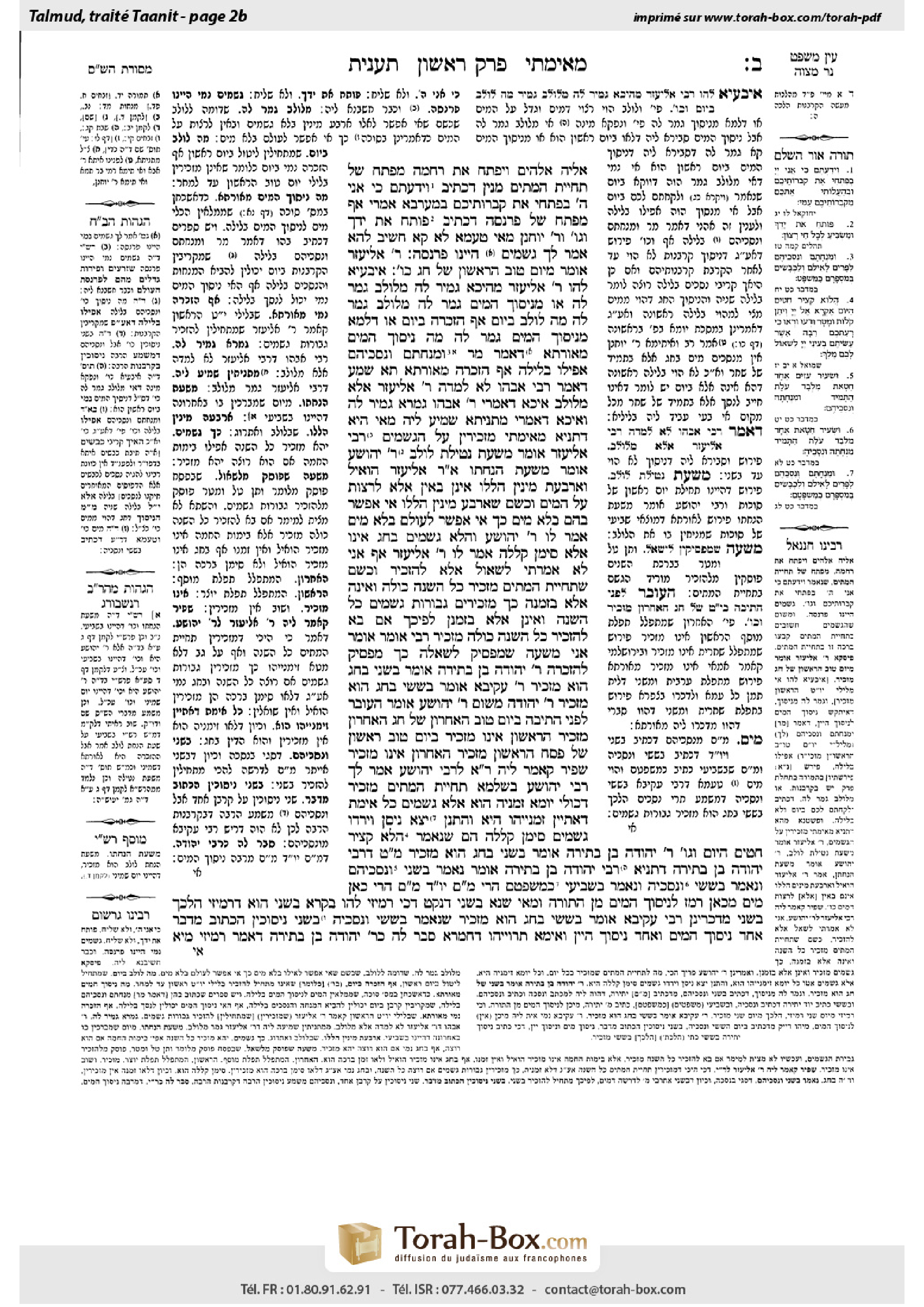
This page of Taanit includes the Aramaic text, an English translation and an AI-generated French translation, alongside the scan above.
תענית ב׳ ב · Aramaic and Hebrew text
אֵלֶיהָ אֱלֹהִים וַיִּפְתַּח אֶת רַחְמָהּ״. מַפְתֵּחַ שֶׁל תְּחִיַּית הַמֵּתִים מִנַּיִן — דִּכְתִיב: ״וִידַעְתֶּם כִּי אֲנִי ה׳ בְּפִתְחִי אֶת קִבְרוֹתֵיכֶם״.
בְּמַעְרְבָא אָמְרִי: אַף מַפְתֵּחַ שֶׁל פַּרְנָסָה, דִּכְתִיב: ״פּוֹתֵחַ אֶת יָדֶךָ וְגוֹ׳״. וְרַבִּי יוֹחָנָן, מַאי טַעְמָא לָא קָא חָשֵׁיב לְהָא? אָמַר לָךְ: גְּשָׁמִים הַיְינוּ פַּרְנָסָה.
רַבִּי אֱלִיעֶזֶר אוֹמֵר: מִיּוֹם טוֹב הָרִאשׁוֹן שֶׁל חַג כּוּ׳. אִיבַּעְיָא לְהוּ: רַבִּי אֱלִיעֶזֶר מֵהֵיכָא גָּמַיר לַהּ? מִלּוּלָב גָּמַר לַהּ, אוֹ מִנִּיסּוּךְ הַמַּיִם גָּמַר לַהּ.
מִלּוּלָב גָּמַר לַהּ: מָה לוּלָב בַּיּוֹם — אַף הַזְכָּרָה בַּיּוֹם. אוֹ דִלְמָא מִנִּיסּוּךְ הַמַּיִם גָּמַר לַהּ: מָה נִיסּוּךְ הַמַּיִם מֵאוּרְתָּא, דְּאָמַר מָר: ״וּמִנְחָתָם וְנִסְכֵּיהֶם״, אֲפִילּוּ בַּלַּיְלָה — אַף הַזְכָּרָה מֵאוּרְתָּא.
תָּא שְׁמַע, דְּאָמַר רַבִּי אֲבָהוּ: לֹא לְמָדָהּ רַבִּי אֱלִיעֶזֶר אֶלָּא מִלּוּלָב. אִיכָּא דְּאָמְרִי: רַבִּי אֲבָהוּ גְּמָרָא גְּמִיר לַהּ, וְאִיכָּא דְּאָמְרִי: מַתְנִיתָא שְׁמִיעַ לֵיהּ.
מַאי הִיא — דְּתַנְיָא: מֵאֵימָתַי מַזְכִּירִין עַל הַגְּשָׁמִים? רַבִּי אֱלִיעֶזֶר אוֹמֵר: מִשְּׁעַת נְטִילַת לוּלָב. רַבִּי יְהוֹשֻׁעַ אוֹמֵר: מִשְּׁעַת הַנָּחָתוֹ.
אָמַר רַבִּי אֱלִיעֶזֶר: הוֹאִיל וְאַרְבַּעַת מִינִין הַלָּלוּ אֵינָן בָּאִין אֶלָּא לְרַצּוֹת עַל הַמַּיִם, וּכְשֵׁם שֶׁאַרְבַּע מִינִין הַלָּלוּ אִי אֶפְשָׁר בָּהֶם בְּלֹא מַיִם — כָּךְ אִי אֶפְשָׁר לָעוֹלָם בְּלֹא מַיִם.
אָמַר לוֹ רַבִּי יְהוֹשֻׁעַ: וַהֲלֹא גְּשָׁמִים בֶּחָג אֵינוֹ אֶלָּא סִימָן קְלָלָה! אָמַר לוֹ רַבִּי אֱלִיעֶזֶר: אַף אֲנִי לֹא אָמַרְתִּי לִשְׁאוֹל, אֶלָּא לְהַזְכִּיר. וּכְשֵׁם שֶׁתְּחִיַּית הַמֵּתִים מַזְכִּיר כׇּל הַשָּׁנָה כּוּלָּהּ וְאֵינָהּ אֶלָּא בִּזְמַנָּהּ, כָּךְ מַזְכִּירִין גְּבוּרוֹת גְּשָׁמִים כׇּל הַשָּׁנָה וְאֵינָן אֶלָּא בִּזְמַנָּן. לְפִיכָךְ, אִם בָּא לְהַזְכִּיר כׇּל הַשָּׁנָה כּוּלָּהּ — מַזְכִּיר. רַבִּי אוֹמֵר, אוֹמֵר אֲנִי: מִשָּׁעָה שֶׁמַּפְסִיק לִשְׁאֵלָה — כָּךְ מַפְסִיק לְהַזְכָּרָה.
רַבִּי יְהוּדָה בֶּן בְּתִירָה אוֹמֵר: בַּשֵּׁנִי בֶּחָג הוּא מַזְכִּיר, רַבִּי עֲקִיבָא אוֹמֵר: בַּשִּׁשִּׁי בֶּחָג הוּא מַזְכִּיר. רַבִּי יְהוּדָה מִשּׁוּם רַבִּי יְהוֹשֻׁעַ אוֹמֵר: הָעוֹבֵר לִפְנֵי הַתֵּיבָה בְּיוֹם טוֹב הָאַחֲרוֹן שֶׁל חַג — הָאַחֲרוֹן מַזְכִּיר, הָרִאשׁוֹן אֵינוֹ מַזְכִּיר. בְּיוֹם טוֹב רִאשׁוֹן שֶׁל פֶּסַח — הָרִאשׁוֹן מַזְכִּיר, הָאַחֲרוֹן אֵינוֹ מַזְכִּיר.
שַׁפִּיר קָאָמַר לֵיהּ רַבִּי אֱלִיעֶזֶר לְרַבִּי יְהוֹשֻׁעַ! אָמַר לְךָ רַבִּי יְהוֹשֻׁעַ: בִּשְׁלָמָא תְּחִיַּית הַמֵּתִים מַזְכִּיר, דְּכוּלֵּי יוֹמָא זִמְנֵיהּ הוּא.
אֶלָּא גְּשָׁמִים, כֹּל אֵימַת דְּאָתַיִין זִמְנַיְיהוּ הִיא?! וְהָתְנַן: יָצָא נִיסָן וְיָרְדוּ גְּשָׁמִים — סִימַן קְלָלָה הֵם, שֶׁנֶּאֱמַר: ״הֲלוֹא קְצִיר חִטִּים הַיּוֹם וְגוֹ׳״.
רַבִּי יְהוּדָה בֶּן בְּתִירָה אוֹמֵר: בַּשֵּׁנִי בֶּחָג הוּא מַזְכִּיר. מַאי טַעְמָא דְּרַבִּי יְהוּדָה בֶּן בְּתִירָה? דְּתַנְיָא, רַבִּי יְהוּדָה בֶּן בְּתִירָה אוֹמֵר:
נֶאֱמַר בַּשֵּׁנִי ״וְנִסְכֵּיהֶם״, וְנֶאֱמַר בַּשִּׁשִּׁי ״וּנְסָכֶיהָ״, וְנֶאֱמַר בַּשְּׁבִיעִי ״כְּמִשְׁפָּטָם״,
הֲרֵי מֵ״ם יוֹ״ד מֵ״ם, הֲרֵי כָּאן מַיִם — מִכָּאן רֶמֶז לְנִיסּוּךְ הַמַּיִם מִן הַתּוֹרָה.
וּמַאי שְׁנָא בְּשֵׁנִי דְּנָקֵט, דְּכִי רְמִיזִי לְהוּ בִּקְרָא — בְּשֵׁנִי הוּא דִּרְמִיזִי, הִלְכָּךְ בְּשֵׁנִי מַדְכְּרִינַן.
רַבִּי עֲקִיבָא אוֹמֵר: בַּשִּׁשִּׁי בֶּחָג הוּא מַזְכִּיר, שֶׁנֶּאֱמַר בַּשִּׁשִּׁי: ״וּנְסָכֶיהָ״, בִּשְׁנֵי נִיסּוּכִין הַכָּתוּב מְדַבֵּר — אֶחָד נִיסּוּךְ הַמַּיִם, וְאֶחָד נִיסּוּךְ הַיַּיִן.
אֵימָא תַּרְוַיְיהוּ דְּחַמְרָא! סָבַר לַהּ כְּרַבִּי יְהוּדָה בֶּן בְּתִירָה, דְּאָמַר: רְמִיזִי מַיָּא.
Taanit 2b · English translation
to her, and He opened her womb” (Genesis 30:22). From where is it derived that the key of the resurrection of the dead is maintained by God Himself? As it is written: “And you shall know that I am the Lord when I have opened your graves” (Ezekiel 37:13).
In the West, Eretz Yisrael, they say: The key of livelihood is also in God’s hand, as it is written: “You open Your hand and satisfy every living thing with favor” (Psalms 145:16). The Gemara asks: And what is the reason that Rabbi Yoḥanan did not consider this key of livelihood in his list? The Gemara answers that Rabbi Yoḥanan could have said to you: Rain is the same as livelihood in this regard, as rain is indispensable to all livelihoods.
§ The mishna taught that Rabbi Eliezer says: One mentions rain from the first Festival day of the festival of Sukkot etc. A dilemma was raised before the Sages: From where did Rabbi Eliezer derive this halakha? He must have learned it from one of the two mitzvot of Sukkot that are linked to rain. Did he derive it from the mitzva to wave the lulav, or did he derive it from the obligation of the water libation?
The Gemara clarifies the significance of this dilemma: Did he derive this halakha from the lulav, in which case one would say: Just as the mitzva to take the lulav applies during the day and not at night, so too, the mention of rain begins during the day of the first Festival day of Sukkot. Or perhaps he derives this halakha from the water libation, in which case one would say: Just as the water libation can be prepared from the first night of Sukkot, as the Master said, with regard to the verse: “And their meal-offerings and their libations” (Numbers 29:18), and certain meal-offerings and libations may be brought even at night, so too, the mention of rain begins from the evening.
The Gemara seeks to resolve this dilemma: Come and hear a resolution, as Rabbi Abbahu said that Rabbi Eliezer derived this halakha from nothing other than the case of lulav. Some say that Rabbi Abbahu learned this claim by way of a tradition, which was the source of Rabbi Eliezer’s opinion; and some say that he learned it from a baraita.
The Gemara asks: What is the baraita from which Rabbi Abbahu may have derived his statement? The Gemara answers: As it is taught in a baraita: From when does one begin to mention the rains in his prayers? Rabbi Eliezer says: From the time that one takes the lulav, i.e., the first day of Sukkot. Rabbi Yehoshua says: From the time that one puts the lulav down, i.e., at the conclusion of Sukkot.
§ The baraita cites a discussion of these opinions. Rabbi Eliezer said: It is since these four species, the lulav and the other species taken with it, come only to offer appeasement for water, as they symbolize the rainfall of the coming year. And this symbolism is as follows: Just as these four species cannot exist without water, as they need water to grow, so too, the world cannot exist without water. Therefore, it is proper to mention rain in one’s prayers when taking the four species.
Rabbi Yehoshua said to him in response: But rain during the festival of Sukkot is nothing other than a sign of a curse. Rabbi Eliezer said to Rabbi Yehoshua: I too did not say that it is proper to ask for rain at this time, but only to mention it. And just as with regard to the resurrection of the dead, one mentions it the entire year and yet it will come only at its proper time, when God wills the resurrection, so too, one mentions the might of the rains all the year, and they fall only in their season. Therefore, if one seeks to mention rain throughout the year, he may mention it. Rabbi Yehuda HaNasi says: I say that when one ceases to request rain, one also ceases to mention it.
Rabbi Yehuda ben Beteira says: On the second day of the festival of Sukkot one mentions rain, rather than on the first day. Rabbi Akiva says: On the sixth day one mentions rain. Rabbi Yehuda says in the name of Rabbi Yehoshua: With regard to the one who passes before the ark as prayer leader on the concluding Festival day of the festival of Sukkot, the Eighth Day of Assembly, the last prayer leader of the additional prayer mentions rain, whereas the first prayer leader for the morning prayer does not mention rain. Conversely, on the first Festival day of Passover, the first prayer leader mentions rain, while the last prayer leader does not mention rain.
The Gemara asks: Rabbi Eliezer is speaking well to Rabbi Yehoshua. How does Rabbi Yehoshua respond to Rabbi Eliezer’s powerful argument that one can mention God’s praises at any time of the year? The Gemara answers: Rabbi Yehoshua could have said to you: Granted, with regard to the resurrection of the dead, one mentions this daily, as although it is not fulfilled every day, any day is fit to be its proper time.
However, in the case of rain, are all times when it falls its proper time? But didn’t we learn in a mishna (12b): If the month of Nisan has ended and rains subsequently fall, they are a sign of a curse, as it is stated: “Is not the wheat harvest today? I will call to the Lord that He may send thunder and rain, and you will know and see that your wickedness is great, which you have done in the sight of the Lord, in asking you a king” (I Samuel 12:17).
§ The baraita states that Rabbi Yehuda ben Beteira says: On the second day of the festival of Sukkot, one begins to mention rain. The Gemara asks: What is the reason for this ruling of Rabbi Yehuda ben Beteira? The Gemara answers: As it is taught, in a baraita that deals with the source for the water libation on Sukkot, that Rabbi Yehuda ben Beteira says: The Torah alludes to the water libation in its description of the libations of the additional offerings of Sukkot. The Torah uses a slightly different term for the libations of certain days. On most days, it states that the sin-offering must be brought with “its libation [veniskah]” (e.g., Numbers 29:16), in the singular form.
By contrast, it is stated on the second day that one must offer “their libations [veniskeihem]” (Numbers 29:19). The plural form indicates the presence of multiple offerings. And furthermore, it is stated concerning the sin-offering libations on the sixth day: “And its libations [unsakheha]” (Numbers 29:31), which is again a plural form that is referring to many libations. And finally, it is stated, with regard to the libations of the additional offering on the seventh day, that they must apportion the respective animals, i.e., oxen, rams, and sheep: “According to their laws [kemishpatam]” (Numbers 29:33), using another plural form which differs from the phrase used on the other Festival days: “According to the law [kamishpat]” (e.g., Numbers 29:19), in the singular.
These variations yield the three superfluous letters mem, yod, and mem, from veniskeiheM, unsakhEha, and kemishpataM, which together spell the Hebrew word for water [MaYiM]. The letter yod is represented in unsakhEha with the letter E and in MaYiM with the letter Y. From here one learns an allusion to the mitzva of the water libation in the Torah.
The Gemara asks: And what is different about the second day that Rabbi Yehuda ben Beteira took it as the day on which one begins to mention rain? The Gemara answers: The reason is that when the verse first alludes to the water libation, it is on the second day of Sukkot that it alludes to it (Numbers 29:19). Therefore, on the second day one begins to mention rain.
The baraita stated that Rabbi Akiva says: On the sixth day one begins to mention rain. The Gemara explains that this ruling is based on the allusion to the water libation in the offering of this day. As it is stated on the sixth day: “And its libations [unsakheha]” (Numbers 29:31). The allusion is written in the plural, which indicates that the verse is speaking of two libations: One is the water libation and the other one is the standard wine libation.
The Gemara raises an objection: Even if it is accepted that the verse is referring to two libations, one can say that both libations are of wine. The Gemara answers: Rabbi Akiva holds in accordance with the opinion of Rabbi Yehuda ben Beteira, who said that the superfluous letters of these verses allude to water [mayim]. This proves that the additional libation of the sixth day must be a water libation.
Taanit 2b · Traduction française (IA)
« …vers elle, et Il lui ouvrit la matrice » (Genèse 30,22). D’où déduit-on que la clé de la résurrection des morts est détenue par Dieu Lui-même ? Comme il est écrit : « Et vous saurez que Je suis l’Éternel lorsque J’ouvrirai vos tombes » (Ézéchiel 37,13).
En Occident, en Eretz Israël, on dit : la clé de la subsistance est également entre les mains de Dieu, comme il est écrit : « Tu ouvres Ta main et rassasies tout être vivant avec bienveillance » (Psaumes 145,16). La Guemara demande : Pour quelle raison Rabbi Yoḥanan n’a-t-il pas inclus cette clé de la subsistance dans sa liste ? La Guemara répond que Rabbi Yoḥanan aurait pu te dire : sous cet aspect, la pluie équivaut à la subsistance, car elle est indispensable à toutes les formes de subsistance.
§ La Michna enseignait que Rabbi Eliezer dit : on mentionne la pluie dès le premier jour de fête de Soukkot, etc. Les Sages soulevèrent une difficulté : d’où Rabbi Eliezer a-t-il déduit cette halakha ? Il a dû la déduire de l’une des deux mitsvot de Soukkot liées à la pluie. L’a-t-il déduite de la mitsva d’agiter le loulav, ou de l’obligation de la libation d’eau ?
La Guemara précise la portée de cette difficulté : a-t-il déduit cette halakha du loulav, auquel cas on dirait : de même que la mitsva de prendre le loulav s’applique pendant le jour et non pendant la nuit, de même la mention de la pluie commence durant la journée du premier jour de fête de Soukkot ? Ou bien l’a-t-il déduite de la libation d’eau, auquel cas on dirait : de même que la libation d’eau peut être préparée dès la première nuit de Soukkot, comme l’a enseigné le Maître à propos du verset : « Et leurs offrandes de farine et leurs libations » (Nombres 29,18), certaines offrandes de farine et libations pouvant être apportées même la nuit, de même la mention de la pluie commence dès le soir.
La Guemara cherche à résoudre cette difficulté : Viens et entends une réponse, car Rabbi Abbahu a dit que Rabbi Eliezer a déduit cette halakha uniquement du cas du loulav. Certains disent que Rabbi Abbahu a appris cette affirmation par tradition, qui était la source de l’opinion de Rabbi Eliezer ; d’autres disent qu’il l’a apprise d’une baraïta.
La Guemara demande : Quelle est la baraïta dont Rabbi Abbahu a pu déduire son affirmation ? La Guemara répond : Comme il est enseigné dans une baraïta : À partir de quand commence-t-on à mentionner les pluies dans ses prières ? Rabbi Eliezer dit : à partir du moment où l’on prend le loulav, c’est-à-dire le premier jour de Soukkot. Rabbi Yehoshua dit : à partir du moment où l’on dépose le loulav, c’est-à-dire à la fin de Soukkot.
§ La baraïta rapporte une discussion à propos de ces opinions. Rabbi Eliezer dit : ces quatre espèces, le loulav et les autres espèces que l’on prend avec lui, ne servent qu’à implorer la clémence en faveur de l’eau, car elles symbolisent les précipitations de l’année à venir. Cette symbolique est la suivante : de même que ces quatre espèces ne peuvent exister sans eau, puisqu’elles en ont besoin pour pousser, de même le monde ne peut exister sans eau. Il convient donc de mentionner la pluie dans ses prières lorsqu’on prend les quatre espèces.
Rabbi Yehoshua lui répondit : Mais la pluie pendant la fête de Soukkot n’est rien d’autre qu’un signe de malédiction. Rabbi Eliezer dit à Rabbi Yehoshua : Moi non plus, je n’ai pas dit qu’il convient de demander la pluie à ce moment-là, mais seulement de la mentionner. De même que l’on mentionne la résurrection des morts toute l’année, alors qu’elle n’aura lieu qu’en son temps, quand Dieu voudra ressusciter les morts, de même on mentionne toute l’année la puissance des pluies, qui ne tombent qu’en leur saison. Par conséquent, si quelqu’un souhaite mentionner la pluie tout au long de l’année, il peut le faire. Rabbi Yehuda HaNasi dit : Selon moi, lorsqu’on cesse de demander la pluie, on cesse également de la mentionner.
Rabbi Yehuda ben Beteira dit : le deuxième jour de la fête de Soukkot, on mentionne la pluie, et non le premier jour. Rabbi Akiva dit : le sixième jour, on mentionne la pluie. Rabbi Yehuda dit au nom de Rabbi Yehoshua : concernant celui qui passe devant l’arche en tant que maître de prière le dernier jour de fête de Soukkot, le Huitième Jour d’Assemblée, le dernier maître de prière de la prière supplémentaire mentionne la pluie, tandis que le premier maître de prière de la prière du matin ne la mentionne pas. À l’inverse, le premier jour de fête de Pessaḥ, le premier maître de prière mentionne la pluie, tandis que le dernier ne la mentionne pas.
La Guemara demande : Rabbi Eliezer parle à juste titre à Rabbi Yehoshua. Comment Rabbi Yehoshua réplique-t-il à l’argument décisif de Rabbi Eliezer, selon lequel on peut mentionner les louanges de Dieu à tout moment de l’année ? La Guemara répond : Rabbi Yehoshua aurait pu te dire : certes, on mentionne chaque jour la résurrection des morts, car, même si elle ne se réalise pas chaque jour, n’importe quel jour peut être le moment où elle se produira.
Mais, dans le cas de la pluie, tous les moments où elle tombe sont-ils son temps opportun ? N’avons-nous pas appris dans une Michna (12b) : si le mois de Nissan s’est achevé et que des pluies tombent ensuite, elles sont un signe de malédiction, comme il est dit : « La moisson du blé n’a-t-elle pas lieu aujourd’hui ? Je vais invoquer l’Éternel afin qu’Il envoie tonnerre et pluie, et vous saurez et verrez que le mal que vous avez commis aux yeux de l’Éternel en demandant un roi est grand » (I Samuel 12,17).
§ La baraïta rapporte que Rabbi Yehuda ben Beteira dit : le deuxième jour de la fête de Soukkot, on commence à mentionner la pluie. La Guemara demande : quelle est la raison de cette décision de Rabbi Yehuda ben Beteira ? La Guemara répond : comme il est enseigné dans une baraïta traitant de la source de la libation d’eau à Soukkot, Rabbi Yehuda ben Beteira dit : la Torah fait allusion à la libation d’eau dans sa description des libations des offrandes supplémentaires de Soukkot. La Torah emploie un terme légèrement différent pour les libations de certains jours. La plupart des jours, elle dit que le sacrifice expiatoire doit être apporté avec « sa libation [veniskah] » (par exemple, Nombres 29,16), au singulier.
En revanche, il est dit au sujet du deuxième jour qu’il faut offrir « leurs libations [veniskeihem] » (Nombres 29,19). Le pluriel indique la présence de plusieurs offrandes. En outre, il est dit à propos des libations du sacrifice expiatoire du sixième jour : « Et ses libations [unsakheha] » (Nombres 29,31), ce qui est de nouveau une forme plurielle faisant référence à de nombreuses libations. Enfin, il est dit, à propos des libations de l’offrande supplémentaire du septième jour, qu’il faut répartir les animaux concernés, c’est-à-dire les taureaux, les béliers et les agneaux : « Selon leurs règles [kemishpatam] » (Nombres 29,33), autre forme plurielle, différente de l’expression utilisée les autres jours de fête : « Selon la règle [kamishpat] » (par exemple, Nombres 29,19), au singulier.
Ces variations produisent les trois lettres superflues mem, yod et mem, tirées de veniskeiheM, unsakhEha et kemishpataM, qui forment ensemble le mot hébreu pour l’eau [MaYiM]. La lettre yod est représentée dans unsakhEha par la lettre E et dans MaYiM par la lettre Y. On apprend de là une allusion dans la Torah à la mitsva de la libation d’eau.
La Guemara demande : qu’a donc de particulier le deuxième jour pour que Rabbi Yehuda ben Beteira en ait fait le jour où l’on commence à mentionner la pluie ? La Guemara répond : la raison est que le verset fait pour la première fois allusion à la libation d’eau le deuxième jour de Soukkot (Nombres 29,19). C’est donc le deuxième jour que l’on commence à mentionner la pluie.
La baraïta rapportait que Rabbi Akiva dit : le sixième jour, on commence à mentionner la pluie. La Guemara explique que cette décision repose sur l’allusion à la libation d’eau dans l’offrande de ce jour. Car il est dit, au sujet du sixième jour : « Et ses libations [unsakheha] » (Nombres 29,31). L’allusion est écrite au pluriel, ce qui indique que le verset parle de deux libations : l’une est la libation d’eau et l’autre, la libation ordinaire de vin.
La Guemara soulève une objection : même si l’on admet que le verset fait référence à deux libations, on peut dire qu’elles sont toutes deux de vin. La Guemara répond : Rabbi Akiva suit l’opinion de Rabbi Yehuda ben Beteira, qui a dit que les lettres superflues de ces versets font allusion à l’eau [mayim]. Cela prouve que la libation supplémentaire du sixième jour doit être une libation d’eau.
Traduction française générée par IA à partir de l’édition anglaise de Sefaria. Vérifie toujours un passage avec le texte source.
Text from Sefaria: William Davidson Edition - Vocalized Aramaic (CC BY NC); William Davidson Edition - English (CC BY NC).