Taanit 3a: Talmud study for Daf Yomi
Daf Yomi is the daily study of one Talmud folio. Explore 37 tractates with scans, Hebrew text, Sefaria English and AI-generated French translations where annotated.
Passage selection and English or AI-generated French translation are available where the scan has annotations. Daf Study is independent of Torah-Box and Sefaria.
Browse Taanit · תענית · All tractatesTaanit 3a text and translations
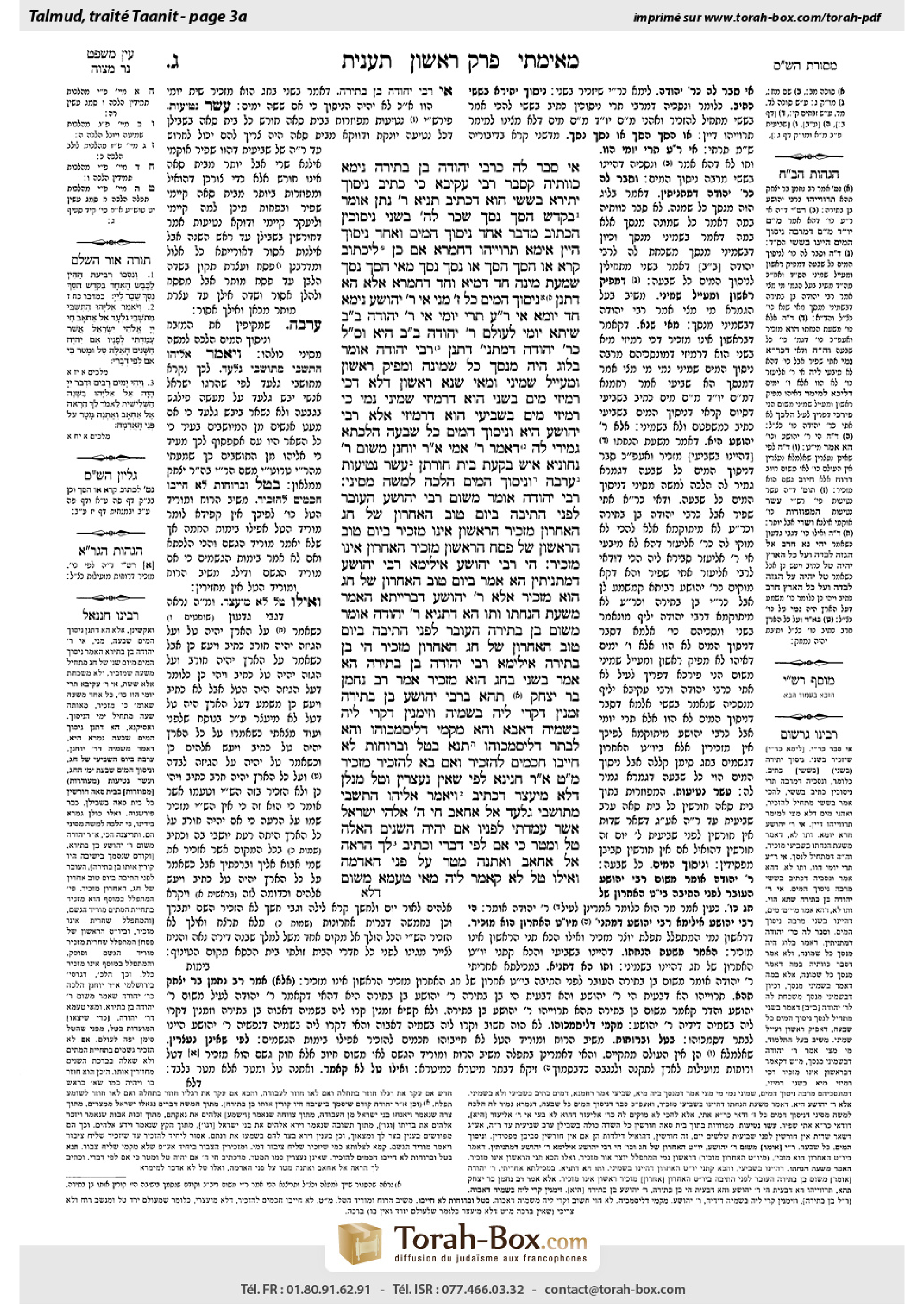
This page of Taanit includes the Aramaic text, an English translation and an AI-generated French translation, alongside the scan above.
תענית ג׳ א · Aramaic and Hebrew text
אִי סָבַר לַהּ כְּרַבִּי יְהוּדָה בֶּן בְּתִירָה — נֵימָא כְּווֹתֵיהּ! קָסָבַר רַבִּי עֲקִיבָא: כִּי כְּתִיב נִיסּוּךְ יַתִּירָא — בְּשִׁשִּׁי הוּא דִּכְתִיב.
תַּנְיָא, רַבִּי נָתָן אוֹמֵר: ״בַּקֹּדֶשׁ הַסֵּךְ נֶסֶךְ שֵׁכָר לַה׳״, בִּשְׁנֵי נִיסּוּכִין הַכָּתוּב מְדַבֵּר, אֶחָד נִיסּוּךְ הַמַּיִם וְאֶחָד נִיסּוּךְ הַיַּיִן. אֵימָא תַּרְוַיְיהוּ דְּחַמְרָא! אִם כֵּן, לִכְתּוֹב קְרָא אוֹ ״הַסֵּךְ הֶסֶךְ״, אוֹ ״נַסֵּךְ נֶסֶךְ״, מַאי ״הַסֵּךְ נֶסֶךְ״ — שָׁמְעַתְּ מִינַּהּ: חַד דְּמַיָּא וְחַד דְּחַמְרָא.
אֶלָּא, הָא דִּתְנַן: נִיסּוּךְ הַמַּיִם כׇּל שִׁבְעָה, מַנִּי? אִי רַבִּי יְהוֹשֻׁעַ — נֵימָא חַד יוֹמָא, אִי רַבִּי עֲקִיבָא — תְּרֵי יוֹמֵי, אִי רַבִּי יְהוּדָה בֶּן בְּתִירָה — שִׁיתָּא יוֹמֵי!
לְעוֹלָם רַבִּי יְהוּדָה בֶּן בְּתִירָה הִיא, וּסְבִירָא לֵיהּ כְּרַבִּי יְהוּדָה דְּמַתְנִיתִין. דִּתְנַן, רַבִּי יְהוּדָה אוֹמֵר: בַּלּוֹג הָיָה מְנַסֵּךְ כׇּל שְׁמוֹנָה. וּמַפֵּיק רִאשׁוֹן וּמְעַיֵּיל שְׁמִינִי.
וּמַאי שְׁנָא רִאשׁוֹן דְּלָא, דְּכִי רְמִיזִי מַיִם — בְּשֵׁנִי הוּא דִּרְמִיזִי; שְׁמִינִי נָמֵי, כִּי רְמִיזִי מַיִם — בִּשְׁבִיעִי הוּא דִּרְמִיזִי!
אֶלָּא: רַבִּי יְהוֹשֻׁעַ הִיא, וְנִיסּוּךְ הַמַּיִם כׇּל שִׁבְעָה — הִלְכְתָא גְּמִירִי לַהּ,
דְּאָמַר רַבִּי אַמֵּי אָמַר רַבִּי יוֹחָנָן מִשּׁוּם רַבִּי נְחוּנְיָא אִישׁ בִּקְעַת בֵּית חוֹרְתָן: עֶשֶׂר נְטִיעוֹת, עֲרָבָה, וְנִיסּוּךְ הַמַּיִם — הֲלָכָה לְמֹשֶׁה מִסִּינַי.
רַבִּי יְהוּדָה אוֹמֵר מִשּׁוּם רַבִּי יְהוֹשֻׁעַ: הָעוֹבֵר לִפְנֵי הַתֵּיבָה בְּיוֹם טוֹב הָאַחֲרוֹן שֶׁל חַג — הָאַחֲרוֹן מַזְכִּיר, הָרִאשׁוֹן אֵינוֹ מַזְכִּיר. בְּיוֹם טוֹב הָרִאשׁוֹן שֶׁל פֶּסַח — הָרִאשׁוֹן מַזְכִּיר, הָאַחֲרוֹן אֵינוֹ מַזְכִּיר.
הֵי רַבִּי יְהוֹשֻׁעַ? אִילֵּימָא רַבִּי יְהוֹשֻׁעַ דְּמַתְנִיתִין, הָא אָמַר: בְּיוֹם טוֹב הָאַחֲרוֹן שֶׁל חַג הוּא מַזְכִּיר.
אֶלָּא: רַבִּי יְהוֹשֻׁעַ דְּבָרַיְיתָא, הָאָמַר: מִשְּׁעַת הַנָּחָתוֹ.
וְתוּ, הָא דְּתַנְיָא, רַבִּי יְהוּדָה אוֹמֵר מִשּׁוּם בֶּן בְּתִירָה: הָעוֹבֵר לִפְנֵי הַתֵּיבָה בְּיוֹם טוֹב הָאַחֲרוֹן שֶׁל חַג — הָאַחֲרוֹן מַזְכִּיר, הֵי בֶּן בְּתִירָה? אִילֵימָא רַבִּי יְהוּדָה בֶּן בְּתִירָה — הָא אָמַר: בַּשֵּׁנִי בֶּחָג הוּא מַזְכִּיר!
אָמַר רַב נַחְמָן בַּר יִצְחָק: תְּהֵא בְּרַבִּי יְהוֹשֻׁעַ בֶּן בְּתִירָה, זִמְנִין דְּקָרֵי לֵיהּ בִּשְׁמֵיהּ, וְזִימְנִין דְּקָרֵי לֵיהּ בִּשְׁמֵיהּ דְּאַבָּא. וְהָא מִקַּמֵּי דְּלִיסְמְכוּהוּ, וְהָא לְבָתַר דְּלִיסְמְכוּהוּ.
תְּנָא: בַּטַּל וּבָרוּחוֹת, לֹא חִיְּיבוּ חֲכָמִים לְהַזְכִּיר. וְאִם בָּא לְהַזְכִּיר — מַזְכִּיר. מַאי טַעְמָא? אָמַר רַבִּי חֲנִינָא: לְפִי שֶׁאֵין נֶעֱצָרִין.
וְטַל מְנָלַן דְּלָא מִיעֲצַר — דִּכְתִיב: ״וַיֹּאמֶר אֵלִיָּהוּ הַתִּשְׁבִּי מִתֹּשָׁבֵי גִלְעָד אֶל אַחְאָב חַי ה׳ אֱלֹהֵי יִשְׂרָאֵל אֲשֶׁר עָמַדְתִּי לְפָנָיו אִם יִהְיֶה הַשָּׁנִים הָאֵלֶּה טַל וּמָטָר כִּי אִם לְפִי דְבָרִי״, וּכְתִיב: ״לֵךְ הֵרָאֵה אֶל אַחְאָב וְאֶתְּנָה מָטָר עַל פְּנֵי הָאֲדָמָה״, וְאִילּוּ טַל לָא קָאָמַר לֵיהּ, מַאי טַעְמָא — מִשּׁוּם
Taanit 3a · English translation
The Gemara objects: If Rabbi Akiva holds in accordance with the opinion of Rabbi Yehuda ben Beteira with regard to this derivation, let him say that it is in accordance with his ruling that one begins mentioning rain from the second day of Sukkot, not the sixth day. The Gemara answers: Rabbi Akiva holds that when that extra reference to libation is written in the verse, it is with regard to the sixth day that it is written. In other words, it is the plural phrase: “Its libations [unsakheha]” (Numbers 29:31), which appears on the sixth day, that directly indicates that one must perform more than one libation, while the other two superfluous letters merely serve to teach that this second libation must be of water, not wine. Therefore, the additional libation is performed on the sixth day.
§ It is taught in a baraita that Rabbi Natan says: “In the Sanctuary you shall pour out a libation [hassekh nesekh] of strong drink to the Lord” (Numbers 28:7). The Torah states the term for libation twice, which indicates that the verse is speaking of two libations: One is the water libation and the other one is the wine libation. The Gemara asks: Why not say that both libations are of wine? The Gemara answers: If so, let the verse write either hassekh hessekh or nassekh nesekh, with the same prefix each time. What is the meaning of the varied formulation: “Hassekh nesekh”? Learn from this that one libation is of water and the other one is of wine.
The Gemara asks: However, what about that which we learned in a mishna (Sukka 42b): The water libation is performed all seven days of Sukkot. Who is the author of this mishna? If you say it is Rabbi Yehoshua, let us say that this ritual is performed only one day, the Eighth Day of Assembly. If it is Rabbi Akiva, the mishna should state two days, the sixth and the seventh Festival days. If it is Rabbi Yehuda ben Beteira, the mishna should say that the water libation is performed on six days, from the second day of Sukkot onward.
The Gemara answers: Actually, the ruling of the mishna is that of Rabbi Yehuda ben Beteira, and he holds in accordance with the opinion of Rabbi Yehuda, as stated in a mishna. As we learned in a mishna (Sukka 48b) that Rabbi Yehuda says: He would pour with a utensil that held a log of water all eight days of Sukkot, which includes the Eighth Day of Assembly. And Rabbi Yehuda ben Beteira removes the first day from this obligation and includes the eighth, which results in seven days of water libations.
The Gemara asks: And what is different about the first day, that the water libation is not performed on that day, according to the opinion of Rabbi Yehuda ben Beteira? Is the reason that when the Torah alludes to water, it is on the second day that it alludes to this libation? If so, one should not bring the libation on the eighth day either, because when the Torah alludes to water for the last time, it is on the seventh day that it alludes to it.
Rather, the Gemara retracts from the previous explanation in favor of the claim that this mishna is in accordance with the opinion of Rabbi Yehoshua. And Rabbi Yehoshua maintains that this ruling that the water libation is performed all seven days of Sukkot is a halakha transmitted to Moses from Sinai, learned through tradition. In other words, this obligation is not based upon a textual source.
As Rabbi Ami said that Rabbi Yoḥanan said in the name of Rabbi Neḥunya of the valley of Beit Ḥortan: The halakha of ten saplings, that if there are ten saplings that require water planted in an area of a beit se’a, 2,500 square cubits, it is permitted to plow the entire field in the summer preceding the Sabbatical Year despite the fact that it is prohibited to plow other fields starting from the preceding Shavuot; the practice of walking around the altar with a willow and adorning the altar with it on Sukkot and taking it on the last day of Sukkot; and the obligation of the water libation; each of these three is a halakha transmitted to Moses from Sinai.
It is stated in the same baraita cited previously that Rabbi Yehuda says in the name of Rabbi Yehoshua: With regard to the one who passes before the ark as prayer leader on the concluding Festival day of the festival of Sukkot, the Eighth Day of Assembly, the last prayer leader of the additional prayer mentions rain, whereas the first prayer leader for the morning prayer does not mention rain. Conversely, on the first Festival day of Passover, the first prayer leader mentions rain, while the last prayer leader does not mention rain.
The Gemara asks: To which statement of Rabbi Yehoshua is Rabbi Yehuda referring? If we say that he is referring to the statement of Rabbi Yehoshua cited in the mishna, this cannot be the case, as Rabbi Yehoshua in our mishna said that one begins to mention rain on the last Festival day of the festival of Sukkot, the Eighth Day of Assembly. This indicates that one starts to mention rain from the beginning of the day, i.e., the evening prayer service.
Rather, you will say that Rabbi Yehuda is referring to the opinion of Rabbi Yehoshua, cited in the baraita. However, this too is untenable, as didn’t Rabbi Yehoshua say there that one begins to mention rain from the time one puts down the lulav, i.e., from the end of the seventh day of Sukkot? This statement also indicates that one begins to mention rain from the evening service of the Eighth Day of Assembly.
The Gemara asks another question: And, furthermore, that which is taught in a baraita that Rabbi Yehuda says in the name of ben Beteira: With regard to the one who passes before the ark on the concluding Festival day of the festival of Sukkot, the Eighth Day of Assembly, the last prayer leader mentions rain. To which of the halakhot of ben Beteira is Rabbi Yehuda referring here? If we say he is referring to the ruling of Rabbi Yehuda ben Beteira, this cannot be the case, as he said that one begins to mention rain on the second day of Sukkot.
Rav Naḥman Bar Yitzḥak said: Let the ben Beteira mentioned by Rabbi Yehuda in the baraita be understood as a reference to Rabbi Yehoshua ben Beteira, and this will resolve all the above difficulties. At times, Rabbi Yehuda calls him by his name, Rabbi Yehoshua, despite the fact that the name Rabbi Yehoshua generally refers to Rabbi Yehoshua ben Ḥananya. At other times, Rabbi Yehuda calls him by his father’s name, e.g., in the second baraita, when the ruling is attributed to ben Beteira. And the Gemara explains the reason for the different names: This baraita, where he is called by his father’s name, was written before he was ordained, and this baraita, where he is called simply Rabbi Yehoshua, was from after he was ordained.
§ It is taught in another baraita: With regard to dew and with regard to wind, the Sages did not obligate one to mention them by reciting: He makes the wind blow and the dew fall, in the second blessing of the Amida, but if one seeks to mention them, he may mention them. The Gemara asks: What is the reason that this recitation is optional? Rabbi Ḥanina said: Because winds and dew are consistent and not withheld, since the world could not exist without them, their mention is optional.
The Gemara explains: And dew, from where do we derive that it is not withheld? As it is written: “And Elijah the Tishbite, who was of the settlers of Gilead, said to Ahab: As the Lord, the God of Israel, lives, before whom I stand, there shall be no dew or rain in these years but according to my word” (I Kings 17:1), and it is written: “Go, show yourself before Ahab, and I will send rain upon the land” (I Kings 18:1). God stated that He will resume rainfall, whereas He did not say to Elijah that He will restore dew. What is the reason? Because dew
Taanit 3a · Traduction française (IA)
La Guemara objecte : Si Rabbi Akiva est du même avis que Rabbi Yehuda ben Beteira au sujet de cette déduction, qu’il dise que l’on commence à mentionner la pluie dès le deuxième jour de Soukkot, et non le sixième. La Guemara répond : Rabbi Akiva considère que, dans le verset, la référence supplémentaire à la libation est écrite à propos du sixième jour. Autrement dit, c’est la formulation au pluriel « ses libations [unsakheha] » (Nombres 29,31), qui apparaît pour le sixième jour, qui indique directement qu’il faut procéder à plus d’une libation ; les deux autres lettres superflues enseignent seulement que cette seconde libation doit être d’eau, et non de vin. La libation supplémentaire est donc effectuée le sixième jour.
§ Une baraïta enseigne que Rabbi Natan dit : « Dans le Sanctuaire, tu verseras une libation [hassekh nesekh] de boisson forte pour le Seigneur » (Nombres 28,7). La Torah emploie deux fois le terme désignant une libation, ce qui indique que le verset parle de deux libations : l’une est la libation d’eau et l’autre la libation de vin. La Guemara demande : Pourquoi ne pas dire que les deux libations sont de vin ? La Guemara répond : Dans ce cas, que le verset écrive soit hassekh hessekh, soit nassekh nesekh, en employant chaque fois le même préfixe. Que signifie cette formulation différente : « Hassekh nesekh » ? Il faut en déduire que l’une des libations est d’eau et l’autre de vin.
La Guemara demande : Cependant, qu’en est-il de ce que nous avons appris dans une Michna (Soukka 42b) : la libation d’eau est effectuée pendant les sept jours de Soukkot ? Quel est l’auteur de cette Michna ? Si vous dites qu’il s’agit de Rabbi Yehoshua, disons que ce rite n’a lieu qu’un seul jour, le huitième jour de l’Assemblée solennelle. S’il s’agit de Rabbi Akiva, la Michna devrait indiquer deux jours, les sixième et septième jours de la fête. S’il s’agit de Rabbi Yehuda ben Beteira, la Michna devrait dire que la libation d’eau est effectuée pendant six jours, à partir du deuxième jour de Soukkot.
La Guemara répond : En réalité, la décision de la Michna est celle de Rabbi Yehuda ben Beteira, qui est du même avis que Rabbi Yehuda, comme l’enseigne une Michna. En effet, nous avons appris dans une Michna (Soukka 48b) que Rabbi Yehuda dit : Il versait avec un récipient contenant un log d’eau pendant les huit jours de Soukkot, y compris le huitième jour de l’Assemblée solennelle. Rabbi Yehuda ben Beteira exclut le premier jour de cette obligation et y inclut le huitième, ce qui donne sept jours de libations d’eau.
La Guemara demande : En quoi le premier jour diffère-t-il, puisque, selon l’avis de Rabbi Yehuda ben Beteira, la libation d’eau n’y est pas effectuée ? Est-ce parce que, lorsque la Torah fait allusion à l’eau, c’est au deuxième jour qu’elle fait allusion à cette libation ? Dans ce cas, il ne faudrait pas non plus apporter la libation le huitième jour, car lorsque la Torah fait allusion à l’eau pour la dernière fois, c’est au septième jour qu’elle y fait allusion.
La Guemara revient plutôt sur l’explication précédente et retient que cette Michna est conforme à l’avis de Rabbi Yehoshua. Rabbi Yehoshua considère que cette règle, selon laquelle la libation d’eau est effectuée pendant les sept jours de Soukkot, est une halakha transmise à Moïse au Sinaï, apprise par tradition. Autrement dit, cette obligation ne repose pas sur une source scripturaire.
Car Rabbi Ami a dit que Rabbi Yoḥanan a dit au nom de Rabbi Neḥunya de la vallée de Beit Ḥortan : la halakha des dix jeunes arbres — selon laquelle, si dix jeunes arbres ayant besoin d’eau sont plantés dans une superficie d’un beit séa, soit 2 500 coudées carrées, il est permis de labourer tout le champ pendant l’été qui précède l’année sabbatique, bien qu’il soit interdit de labourer les autres champs à partir de Chavouot de l’année précédente —, la pratique consistant à faire le tour de l’autel avec un saule, à en décorer l’autel pendant Soukkot et à le prendre le dernier jour de Soukkot, ainsi que l’obligation de la libation d’eau : chacune de ces trois règles est une halakha transmise à Moïse au Sinaï.
La même baraïta citée précédemment enseigne que Rabbi Yehuda dit au nom de Rabbi Yehoshua : au sujet de l’officiant qui passe devant l’arche le jour de clôture de la fête de Soukkot, le huitième jour de l’Assemblée solennelle, le dernier officiant de la prière supplémentaire mentionne la pluie, tandis que le premier officiant de la prière du matin ne la mentionne pas. À l’inverse, le premier jour de la fête de Pessaḥ, le premier officiant mentionne la pluie, tandis que le dernier ne la mentionne pas.
La Guemara demande : À quelle déclaration de Rabbi Yehoshua Rabbi Yehuda fait-il référence ? Si l’on dit qu’il fait référence à la déclaration de Rabbi Yehoshua citée dans la Michna, cela ne peut être le cas, car Rabbi Yehoshua a dit dans notre Michna que l’on commence à mentionner la pluie le jour de clôture de la fête de Soukkot, le huitième jour de l’Assemblée solennelle. Cela indique que l’on commence à mentionner la pluie dès le début du jour, c’est-à-dire à l’office du soir.
Il faut plutôt dire que Rabbi Yehuda fait référence à l’avis de Rabbi Yehoshua cité dans la baraïta. Mais cela ne tient pas non plus, car Rabbi Yehoshua n’a-t-il pas dit là-bas que l’on commence à mentionner la pluie à partir du moment où l’on dépose le loulav, c’est-à-dire à la fin du septième jour de Soukkot ? Cette déclaration indique elle aussi que l’on commence à mentionner la pluie à l’office du soir du huitième jour de l’Assemblée solennelle.
La Guemara pose une autre question : De plus, une baraïta enseigne que Rabbi Yehuda dit au nom de ben Beteira : au sujet de l’officiant qui passe devant l’arche le jour de clôture de la fête de Soukkot, le huitième jour de l’Assemblée solennelle, le dernier officiant mentionne la pluie. À laquelle des halakhot de ben Beteira Rabbi Yehuda fait-il ici référence ? Si l’on dit qu’il fait référence à la décision de Rabbi Yehuda ben Beteira, cela ne peut être le cas, car celui-ci a dit que l’on commence à mentionner la pluie dès le deuxième jour de Soukkot.
Rav Naḥman bar Yitzḥak dit : Comprenons que le ben Beteira mentionné par Rabbi Yehuda dans la baraïta désigne Rabbi Yehoshua ben Beteira ; cela résoudra toutes les difficultés soulevées précédemment. Parfois, Rabbi Yehuda l’appelle par son nom, Rabbi Yehoshua, bien que le nom Rabbi Yehoshua désigne généralement Rabbi Yehoshua ben Ḥananya. D’autres fois, Rabbi Yehuda l’appelle par le nom de son père, par exemple dans la seconde baraïta, où la décision est attribuée à ben Beteira. La Guemara explique la raison de ces appellations différentes : cette baraïta, où il est appelé par le nom de son père, a été rédigée avant son ordination ; l’autre baraïta, où il est simplement appelé Rabbi Yehoshua, date d’après son ordination.
§ Une autre baraïta enseigne : Concernant la rosée et le vent, les Sages n’ont pas imposé de les mentionner en récitant « Il fait souffler le vent et tomber la rosée » dans la deuxième bénédiction de l’Amida ; toutefois, si l’on souhaite les mentionner, on peut le faire. La Guemara demande : Pourquoi cette récitation est-elle facultative ? Rabbi Ḥanina dit : Parce que les vents et la rosée sont constants et ne font pas défaut, puisque le monde ne pourrait subsister sans eux, leur mention est facultative.
La Guemara explique : Et la rosée, d’où savons-nous qu’elle ne fait pas défaut ? Comme il est écrit : « Élie le Tishbite, qui était parmi les habitants de Galaad, dit à Ahab : Par le Seigneur, Dieu d’Israël, devant qui je me tiens, il n’y aura, durant ces années, ni rosée ni pluie, sauf sur ma parole » (I Rois 17,1), et il est écrit : « Va, présente-toi devant Ahab, et je ferai tomber la pluie sur le pays » (I Rois 18,1). Dieu déclara qu’Il ferait revenir la pluie, tandis qu’Il ne dit pas à Élie qu’Il ferait revenir la rosée. Pour quelle raison ? Parce que la rosée
Traduction française générée par IA à partir de l’édition anglaise de Sefaria. Vérifie toujours un passage avec le texte source.
Text from Sefaria: William Davidson Edition - Vocalized Aramaic (CC BY NC); William Davidson Edition - English (CC BY NC).