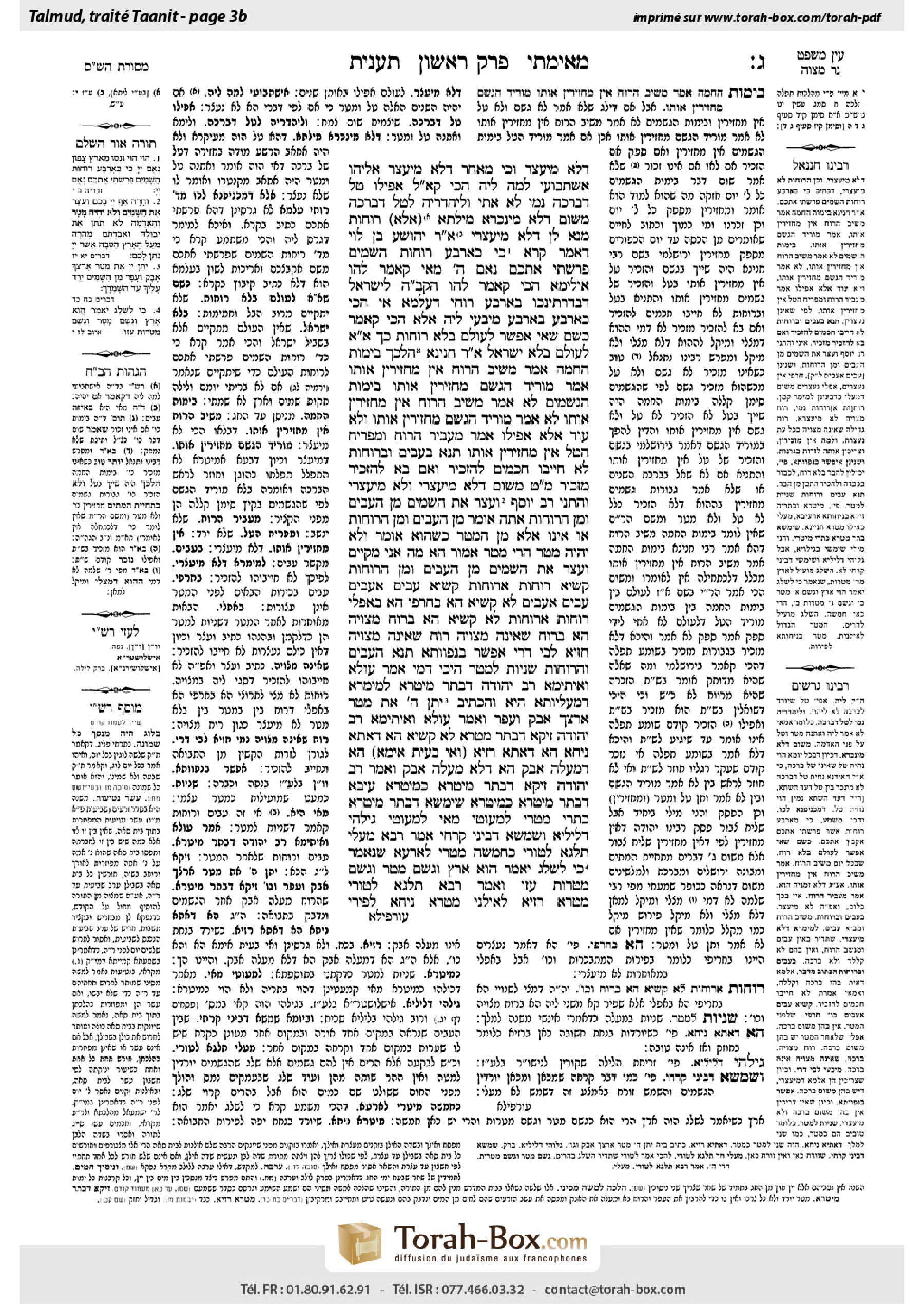
Taanit 3b: Talmud study for Daf Yomi
Daf Yomi is the daily study of one Talmud folio. Explore 37 tractates with scans, Hebrew text, Sefaria English and AI-generated French translations where annotated.
Passage selection and English or AI-generated French translation are available where the scan has annotations. Daf Study is independent of Torah-Box and Sefaria.
Browse Taanit · תענית · All tractatesTaanit 3b text and translations
This page of Taanit includes the Aramaic text, an English translation and an AI-generated French translation, alongside the scan above.
תענית ג׳ ב · Aramaic and Hebrew text
דְּלָא מִיעֲצַר. וְכִי מֵאַחַר דְּלָא מִיעֲצַר, אֵלִיָּהוּ אִשְׁתְּבוֹעֵי לְמָה לֵיהּ? הָכִי קָאָמַר לֵיהּ: אֲפִילּוּ טַל בְּרָכָה נָמֵי לָא אָתֵי. וְלַיהְדְּרֵיהּ לְטַל דִּבְרָכָה? מִשּׁוּם דְּלָא מִינַּכְרָא מִילְּתָא.
אֶלָּא רוּחוֹת מְנָא לַן דְּלָא מִיעַצְרִי? אָמַר רַבִּי יְהוֹשֻׁעַ בֶּן לֵוִי, דְּאָמַר קְרָא: ״כִּי כְּאַרְבַּע רוּחוֹת הַשָּׁמַיִם פֵּרַשְׂתִּי אֶתְכֶם נְאֻם ה׳״. מַאי קָאָמַר לְהוּ? אִילֵּימָא הָכִי קָאָמַר לְהוּ הַקָּדוֹשׁ בָּרוּךְ הוּא לְיִשְׂרָאֵל: דְּבַדַּרְתִּינְכוּ בְּאַרְבַּע רוּחֵי דְעָלְמָא, אִי הָכִי — ״כְּאַרְבַּע״? ״בְּאַרְבַּע״ מִיבְּעֵי לֵיהּ! אֶלָּא הָכִי קָאָמַר: כְּשֵׁם שֶׁאִי אֶפְשָׁר לָעוֹלָם בְּלֹא רוּחוֹת — כָּךְ אִי אֶפְשָׁר לָעוֹלָם בְּלֹא יִשְׂרָאֵל.
אָמַר רַבִּי חֲנִינָא: הִלְכָּךְ, בִּימוֹת הַחַמָּה: אָמַר ״מַשִּׁיב הָרוּחַ״ — אֵין מַחֲזִירִין אוֹתוֹ. אָמַר ״מוֹרִיד הַגֶּשֶׁם״ — מַחֲזִירִין אוֹתוֹ.
בִּימוֹת הַגְּשָׁמִים: לֹא אָמַר ״מַשִּׁיב הָרוּחַ״ — אֵין מַחֲזִירִין אוֹתוֹ. לֹא אָמַר ״מוֹרִיד הַגֶּשֶׁם״ — מַחֲזִירִין אוֹתוֹ. וְלֹא עוֹד, אֶלָּא אֲפִילּוּ אָמַר ״מַעֲבִיר הָרוּחַ וּמַפְרִיחַ הַטַּל״ — אֵין מַחֲזִירִין אוֹתוֹ.
תָּנָא: בֶּעָבִים וּבָרוּחוֹת לֹא חִיְּיבוּ חֲכָמִים לְהַזְכִּיר, וְאִם בָּא לְהַזְכִּיר — מַזְכִּיר, מַאי טַעְמָא — מִשּׁוּם דְּלָא מִיעַצְרִי.
וְלָא מִיעַצְרִי? וְהָתָנֵי רַב יוֹסֵף: ״וְעָצַר אֶת הַשָּׁמַיִם״ — מִן הֶעָבִים וּמִן הָרוּחוֹת. אַתָּה אוֹמֵר מִן הֶעָבִים וּמִן הָרוּחוֹת, אוֹ אֵינוֹ אֶלָּא מִן הַמָּטָר? כְּשֶׁהוּא אוֹמֵר ״וְלֹא יִהְיֶה מָטָר״ — הֲרֵי מָטָר אָמוּר, הָא מָה אֲנִי מְקַיֵּים ״וְעָצַר אֶת הַשָּׁמַיִם״ — מִן הֶעָבִים וּמִן הָרוּחוֹת.
קַשְׁיָא רוּחוֹת אַרוּחוֹת, קַשְׁיָא עָבִים אַעָבִים! עָבִים אַעָבִים לָא קַשְׁיָא: הָא — בְּחָרְפֵי, הָא — בְּאַפְלֵי.
רוּחוֹת אַרוּחוֹת לָא קַשְׁיָא: הָא — בְּרוּחַ מְצוּיָה, הָא — בְּרוּחַ שֶׁאֵינָהּ מְצוּיָה. רוּחַ שֶׁאֵינָהּ מְצוּיָה חַזְיָא לְבֵי דָרֵי! אֶפְשָׁר בְּנָפְווֹתָא.
תָּנָא: הֶעָבִים וְהָרוּחוֹת שְׁנִיּוֹת לַמָּטָר. הֵיכִי דָּמֵי? אָמַר עוּלָּא, וְאִיתֵּימָא רַב יְהוּדָה: דְּבָתַר מִיטְרָא. לְמֵימְרָא דִּמְעַלְּיוּתָא הִיא? וְהָכְתִיב: ״יִתֵּן ה׳ אֶת מְטַר אַרְצְךָ אָבָק וְעָפָר״, וְאָמַר עוּלָּא וְאִיתֵּימָא רַב יְהוּדָה: זִיקָא דְּבָתַר מִטְרָא!
לָא קַשְׁיָא: הָא דַּאֲתָא נִיחָא, הָא דַּאֲתָא רַזְיָא. וְאִי בָּעֵית אֵימָא: הָא דְּמַעֲלֶה אָבָק, הָא דְּלָא מַעֲלֶה אָבָק.
וְאָמַר רַב יְהוּדָה: זִיקָא דְּבָתַר מִיטְרָא — כְּמִיטְרָא. עֵיבָא דְּבָתַר מִיטְרָא — כְּמִיטְרָא. שִׁימְשָׁא דְּבָתַר מִיטְרָא — כִּתְרֵי מִטְרֵי. לְמַעוֹטֵי מַאי? לְמַעוֹטֵי גִּילְהֵי דְלֵילְיָא, וְשִׁמְשָׁא דְּבֵינֵי קַרְחֵי.
אָמַר רָבָא: מְעַלֵּי תַּלְגָא לְטוּרֵי כְּחַמְשָׁה מִטְרֵי לְאַרְעָא, שֶׁנֶּאֱמַר: ״כִּי לַשֶּׁלֶג יֹאמַר הֱוֵא אָרֶץ וְגֶשֶׁם מָטָר וְגֶשֶׁם מִטְרוֹת עֻזּוֹ״.
וְאָמַר רָבָא: תַּלְגָא — לְטוּרֵי, מִטְרָא רַזְיָא — לְאִילָנֵי, מִטְרָא נִיחָא — לְפֵירֵי,
Taanit 3b · English translation
is not withheld, and therefore it continued even during this time of drought. The Gemara asks: And since dew is not withheld, why did Elijah swear that there would be no dew as well as no rain? The Gemara explains that this is what Elijah said to Ahab: Not only will there be no rainfall, but even the dew of blessing, which helps crops grow, will not come. This prediction was indeed fulfilled. The Gemara asks: But if so, let God restore the dew of blessing when He ended the drought of rain, in the aforementioned verse. The Gemara answers: This was not necessary, because the matter is not recognizable, i.e., people cannot distinguish between dew of blessing and the regular dew which is always present.
The Gemara asks: However, with regard to winds, from where do we derive that it is not withheld but perpetually blows? Rabbi Yehoshua ben Levi said that the verse states: “For I have spread you abroad as the four winds of the heaven, says the Lord” (Zechariah 2:10). He clarifies: What is God saying to them? If we say that this is what the Holy One, Blessed be He, is saying to the Jewish people: I have scattered you to the four winds of the world; if so, why did He say “as the four winds”? He should have said: To the four winds. Rather, this is what God is saying: Just as the world cannot exist without winds, so too, the world cannot exist without the Jewish people. This interpretation of the verse is based on the claim that the winds never cease.
Rabbi Ḥanina said: Therefore, since wind and dew are always present, if during the summer one recited: He makes the wind blow, we do not require him to return and repeat the blessing since the wind blows during the summer as well. However, if one recited during the summer: He makes the rain fall, we require him to return and repeat the blessing, because rain in the summer is a curse.
Conversely, in the rainy season, if one did not recite: He makes the wind blow, we do not require him to return to the beginning, because the wind blows regardless. If one did not recite: He makes the rain fall, we require him to return and repeat the blessing. And not only that, but even if one mistakenly recited: He removes the wind and lifts the dew, i.e., that there should be no wind or dew, we do not require him to return and repeat the blessing, because wind and dew are always present.
It was taught in a similar baraita: With regard to clouds and with regard to wind, the Sages did not obligate one to mention them, but if one wishes to mention them, he may mention them. The Gemara asks: What is the reason? The Gemara answers, as above: Because clouds and winds are constant and are not withheld.
The Gemara asks: And are they not withheld? But didn’t Rav Yosef teach in a baraita that the verse: “And He will close up the heavens” (Deuteronomy 11:17), means that God will stop up the heavens from the clouds and from the winds? Do you say that “close up the heavens” means from the clouds and from the winds, or perhaps it is only referring to the absence of rainfall? When the same verse says: “So that there will be no rain,” rain is already mentioned explicitly. How then do I uphold the meaning of the verse: “And He will close up the heavens”? This must mean from the clouds and from the winds.
The Gemara summarizes its question: This is difficult due to the contradiction between the statement about wind in the first baraita and the statement about wind in the second baraita, and is similarly difficult due to the contradiction between the statement about clouds in the first baraita and the statement about clouds in the second baraita. The Gemara answers: The contradiction between one statement about clouds and the other statement about clouds is not difficult, as this first baraita is referring to early clouds that precede the rain, which come whether or not rain actually falls, whereas this second baraita is referring to late clouds, which materialize after rainfall. These late clouds are sometimes withheld by God as a punishment.
Likewise, the contradiction between the first statement about wind and the second statement about wind is not difficult, as this first baraita is referring to a typical wind, which is never withheld, while this second baraita is referring to an atypical wind, which may be withheld. The Gemara asks: An atypical wind is fit for winnowing grain on the threshing floor. Since this wind is also a necessity, one should pray for it as well. The Gemara answers: Since it is possible to winnow grain with sieves when there is no wind, there is no great need for these winds.
§ It was taught in a baraita: Clouds and winds are so significant that, in terms of their benefit, they are secondary only to rain. The Gemara asks: What are the circumstances in which this claim is correct? Ulla, and some say Rav Yehuda, said: The baraita is referring to the clouds and winds that come after rainfall. The Gemara asks: Is this to say that clouds and winds that come after rain are beneficial? But isn’t it written in the chapter of the curses: “The Lord will make the rain of your land powder and dust” (Deuteronomy 28:24), and Ulla, and some say Rav Yehuda, said: This curse is referring to winds that come after rain, as they raise up powder and dust?
The Gemara answers: This is not difficult, since this first statement of Ulla is referring to beneficial wind that comes gently, whereas this second statement of Ulla is referring to harmful wind that comes forcefully [razya], raises up powder and dust, and reduces the effectiveness of the rain. And if you wish, say instead: This, Ulla’s second statement, is referring to wind that raises dust; whereas this, Ulla’s first statement, is referring to wind that does not raise dust.
And on a related topic, Rav Yehuda said: Wind that blows after rain is as beneficial to the earth as rain itself. Clouds that appear after rain are as beneficial as rain, while sunlight that follows after rain is as beneficial as two rainfalls. The Gemara asks: If wind, clouds, and sun are all beneficial after rainfall, what does Rav Yehuda’s statement serve to exclude? The Gemara answers: He comes to exclude the glow of the evening and the sun that shines between the clouds, appearing only in patches. These phenomena are harmful after rain.
On a related note, Rava said: Snow is as beneficial to the mountains as five rainfalls to the earth of the plains, as it is stated: “For He says to the snow: Fall on the earth, likewise to the shower of rain, and to the showers of His mighty rain” (Job 37:6). This verse compares snow to rain by means of five allusions to types of rainfall: The word “rain,” which appears twice; the word “shower”; and the plural “showers,” which indicates two rainfalls. This teaches that snow is as beneficial as five rainfalls.
And on the same topic, Rava said: Snow brings benefits to the mountains; strong rain provides benefits to trees; light rain brings benefit to fruit;
Taanit 3b · Traduction française (IA)
n’est pas retenue, et elle a donc continué même pendant cette période de sécheresse. La Guemara demande : Puisque la rosée n’est pas retenue, pourquoi Élie a-t-il juré qu’il n’y aurait pas non plus de rosée, en plus de la pluie ? La Guemara explique que voici ce qu’Élie dit à Achab : non seulement il n’y aura pas de pluie, mais même la rosée de bénédiction, qui favorise la croissance des cultures, ne viendra pas. Cette prédiction se réalisa effectivement. La Guemara demande : Mais, dans ce cas, que Dieu rétablisse la rosée de bénédiction lorsqu’Il mit fin à la sécheresse causée par l’absence de pluie, dans le verset cité précédemment ? La Guemara répond : Ce n’était pas nécessaire, car la différence n’est pas perceptible, c’est-à-dire que les gens ne peuvent pas distinguer la rosée de bénédiction de la rosée ordinaire, toujours présente.
La Guemara demande : Cependant, concernant les vents, d’où savons-nous qu’ils ne sont pas retenus et qu’ils soufflent constamment ? Rabbi Yehoshua ben Levi dit que le verset déclare : « Car Je vous ai dispersés comme les quatre vents du ciel, dit l’Éternel » (Zacharie 2, 10). Il précise : Que leur dit Dieu ? Si nous disons que le Saint, béni soit-Il, dit au peuple juif : « Je vous ai dispersés aux quatre vents du monde », pourquoi a-t-Il alors dit « comme les quatre vents » ? Il aurait dû dire : « aux quatre vents ». Il faut plutôt comprendre que Dieu dit ceci : de même que le monde ne peut exister sans les vents, le monde ne peut pas non plus exister sans le peuple juif. Cette interprétation du verset repose sur l’affirmation que les vents ne cessent jamais.
Rabbi Ḥanina dit : Par conséquent, puisque le vent et la rosée sont toujours présents, si quelqu’un récite en été : « Il fait souffler le vent », nous ne lui demandons pas de reprendre la bénédiction, car le vent souffle également en été. En revanche, si quelqu’un récite en été : « Il fait tomber la pluie », nous lui demandons de reprendre la bénédiction, car la pluie en été est une malédiction.
Inversement, pendant la saison des pluies, si quelqu’un ne récite pas : « Il fait souffler le vent », nous ne lui demandons pas de reprendre la prière depuis le début, car le vent souffle de toute façon. S’il ne récite pas : « Il fait tomber la pluie », nous lui demandons de reprendre la bénédiction. Et non seulement cela, mais même s’il récite par erreur : « Il fait cesser le vent et tomber la rosée », c’est-à-dire qu’il n’y ait ni vent ni rosée, nous ne lui demandons pas de reprendre la bénédiction, car le vent et la rosée sont toujours présents.
Une baraïta similaire a été enseignée : concernant les nuages et le vent, les Sages n’ont pas imposé de les mentionner, mais celui qui souhaite les mentionner peut le faire. La Guemara demande : Pour quelle raison ? La Guemara répond, comme précédemment : parce que les nuages et les vents sont constants et ne sont pas retenus.
La Guemara demande : Mais ne sont-ils pas retenus ? Rav Yosef n’a-t-il pas enseigné dans une baraïta que le verset « Il fermera les cieux » (Deutéronome 11, 17) signifie que Dieu fermera les cieux aux nuages et aux vents ? Comprends-tu « Il fermera les cieux » comme signifiant qu’Il les fermera aux nuages et aux vents, ou cela désigne-t-il seulement l’absence de pluie ? Puisque le même verset dit : « afin qu’il n’y ait pas de pluie », la pluie est déjà explicitement mentionnée. Comment faut-il donc comprendre les mots du verset « Il fermera les cieux » ? Cela doit signifier : aux nuages et aux vents.
La Guemara résume sa question : Il y a une difficulté due à la contradiction entre ce qui est dit au sujet du vent dans la première baraïta et ce qui est dit à son sujet dans la seconde baraïta ; de même, il y a une difficulté due à la contradiction entre ce qui est dit au sujet des nuages dans la première baraïta et ce qui est dit à leur sujet dans la seconde baraïta. La Guemara répond : La contradiction entre les deux affirmations concernant les nuages ne pose pas de difficulté, car la première baraïta parle des nuages précoces, qui précèdent la pluie et surviennent que la pluie tombe ou non, tandis que la seconde baraïta parle des nuages tardifs, qui apparaissent après la pluie. Ces nuages tardifs sont parfois retenus par Dieu en guise de punition.
De même, la contradiction entre les deux affirmations concernant le vent ne pose pas de difficulté, car la première baraïta parle d’un vent ordinaire, qui n’est jamais retenu, tandis que la seconde baraïta parle d’un vent inhabituel, qui peut être retenu. La Guemara demande : Un vent inhabituel convient au vannage du grain sur l’aire de battage. Puisque ce vent est lui aussi nécessaire, ne devrait-on pas prier pour l’obtenir également ? La Guemara répond : Puisqu’il est possible de vanner le grain à l’aide de tamis lorsqu’il n’y a pas de vent, ces vents ne sont pas indispensables.
§ Il a été enseigné dans une baraïta : les nuages et les vents sont si importants que, pour les bienfaits qu’ils procurent, ils ne viennent qu’après la pluie. La Guemara demande : Dans quelles circonstances cette affirmation est-elle juste ? Oulla — et certains disent Rav Yehouda — dit : la baraïta parle des nuages et des vents qui viennent après la pluie. La Guemara demande : Cela signifie-t-il que les nuages et les vents qui viennent après la pluie sont bénéfiques ? Pourtant, il est écrit dans le chapitre des malédictions : « L’Éternel fera de la pluie de ton pays de la poudre et de la poussière » (Deutéronome 28, 24), et Oulla — et certains disent Rav Yehouda — a dit que cette malédiction désigne les vents qui viennent après la pluie, car ils soulèvent la poudre et la poussière.
La Guemara répond : Cela ne pose pas de difficulté, car la première affirmation d’Oulla concerne un vent bénéfique qui souffle doucement, tandis que sa seconde affirmation concerne un vent nuisible qui souffle avec force [razya], soulève la poudre et la poussière et réduit l’efficacité de la pluie. Et si tu le souhaites, dis plutôt : la seconde affirmation d’Oulla concerne un vent qui soulève la poussière, tandis que sa première affirmation concerne un vent qui ne soulève pas la poussière.
Dans le même ordre d’idées, Rav Yehouda dit : le vent qui souffle après la pluie est aussi bénéfique pour la terre que la pluie elle-même. Les nuages qui apparaissent après la pluie sont aussi bénéfiques que la pluie, tandis que le soleil qui paraît après la pluie est aussi bénéfique que deux averses. La Guemara demande : Si le vent, les nuages et le soleil sont tous bénéfiques après la pluie, qu’est-ce que l’affirmation de Rav Yehouda vient exclure ? La Guemara répond : Elle vient exclure la lueur du soir et le soleil qui brille par endroits entre les nuages. Ces phénomènes sont nuisibles après la pluie.
Dans le même ordre d’idées, Rava dit : la neige est aussi bénéfique aux montagnes que cinq averses le sont aux terres des plaines, comme il est dit : « Car Il dit à la neige : Tombe sur la terre, et de même à l’averse de pluie et aux averses de Sa puissante pluie » (Job 37, 6). Ce verset compare la neige à la pluie au moyen de cinq allusions à des types de précipitations : le mot « pluie », qui apparaît deux fois ; le mot « averse » ; et le pluriel « averses », qui indique deux pluies. Cela enseigne que la neige est aussi bénéfique que cinq averses.
Et sur le même sujet, Rava dit : la neige procure des bienfaits aux montagnes ; les fortes pluies profitent aux arbres ; les pluies légères profitent aux fruits ;
Traduction française générée par IA à partir de l’édition anglaise de Sefaria. Vérifie toujours un passage avec le texte source.
Text from Sefaria: William Davidson Edition - Vocalized Aramaic (CC BY NC); William Davidson Edition - English (CC BY NC).